341 Abstract—A massive and considerable amount of effluent is generated in a textile industry and allied industries. Dyes used in the dyeing section of a textile industry is a constant, intense and persistent source of concern to the environmental engineer and to the common mass in general. This dye effluent/waste cannot be degraded with the help of primary and secondary treatments. Primary treatment involves coagulation and flocculation while secondary treatment encompasses activated sludge process. So the importance , urgency and aim of a tertiary treatment process such as ozone-oxidation or ozonation. The present research engulfs the understanding of the dependence of order of reaction on pH of the solution and oxidation-reduction potential. The research on ozonation of dye is done in a bubble column reactor-fixed bed and without media . It gives an understanding and an innovative concept that dye degradation by ozonation is highly dependent on acidity or alkalinity of solution. Investigations in the variation of redox potentials in the course of ozonation reaction is also analysed. The vision, mission and objective of the area of tertiary treatment or degradation by ozonation will be greatly enunciated if the research endeavour progresses with the help of a tool such as bubble column reactor.
Index Terms—textile, ozonation, dye, bubble column, tertiary treatment.
I. INTRODUCTION
The textile industry in general consumes massive quantities of water and discharges effluents/wastes containing a wide range of recalcitrant and non-degradable contaminants. In environmental terminology , these contaminants mean suspended solids, COD,BOD as well as high pH and strong colour. This persistent problem of the removal of colour and non-degradable products in the treatment of textile dyeing and dye manufacturing wastewaters needs to be focussed and addressed. A renewed interest and ardent initiative in the treatment of textile wastewaters has occurred due to the presence of more stringent and effective industrial effluent regulations. Throughout the world environmental restrictions and regulations from various government agencies has brought an awareness amongst the industry as well as the common people. In this avenue of restrictions, textile industry is of no exception. Such is the effectivity of the regulations. This textile effluent comprises of high chemical oxygen demand(COD),low biochemical oxygen demand(BOD) and high colour concentrations(Srinivasan,2009). Since
Queen’s University, Belfast,United Kingdom.Address:Consultant,43,Judges
Bagan,P.O.-Haridevpur,Kolkata-700082,India.([email protected],[email protected], Tel.No.-0091-33-24026947)
conventional treatments have lot of disadvantages,pros and cons, the ultimate need for advanced oxidation processes such as ozonation or ozonization(Chen et al2002). Apart from ozonation, immense research work was done in the field of other avenues of advanced oxidation processes such as combination of O3/H2O2,O3/UV,H2O2/UV, application of
Fenton’s reagent etc(Beltran ,1997). Our endeavour in this avenue of research is due to the environmental benign,clean and absolutely safe process of ozonation. The ozone in dye solution is ultimately converted to O2 and no sludge is
produced like other degradation processes which produces other recalcitrant substances. Ozone oxidation is a common treatment for dye degradation because it has been shown to decrease colour, COD and increase the biodegradability(BOD5:COD) of the wastewater. The vision
of this process lies ahead with far-reaching conclusions due to its effectiveness in degrading textile wastewaters.
II. SCIENTIFIC RESEARCH PURSUIT IN THIS AREA
There has been immense and visionary research work in the area of ozonation of textile dyes. Each research itself is a newer vision of this advanced oxidation process. The effectiveness of ozonation or ozone-oxidation process is the hallmark and zenith of these endeavours.
Sarasa(1998) delineated and elaborated the treatment of a wastewater resulting from dyes manufacturing with ozone and chemical coagulation. The degradation of the compounds present in a previously chlorinated wastewater resulting from the production of azoic dyes has been studied in this project. Towards this end, the first step developed was the characterization of the spillage water by GC/MS. Secondly , a combined ozone + Ca(OH)2 treatment was
carried out, determining its efficiency on this wastewater. Chu(2000) dealt with the advanced oxidation process of ozonation of dye and its kinetics. A quantitative estimation of direct ozonation and indirect free radical oxidation of dyes with assorted chromophores was studied through the examination of reaction kinetics in the ozonation procedure. The reaction kinetics of dye ozonation under different conditions was determined by adjusting the ozone doses, dye concentration and reaction pH. This is a visionary research endeavour.
Talarposhti(2001)delineated on the topic of colour removal from a simulated dye wastewater using a two phase anaerobic packed bed reactor. According to them, the treatment alternatives applicable for the removal of colour vary, depending upon the type of dye wastewater. A synthetic, simulated mixed dye waste(Basic Yellow 28,Basic Yellow 21, Basic Red 18, Basic Violet Red 16,
Studies on Ozone-oxidation of Dye in a Bubble
Column Reactor at Different pH and Different
Oxidation-reduction Potential.
342 Basic Red 46, Basic Blue 16, Basic Blue 41) representing a known waste from a fibre production factory was investigated.
Wu(2001) studied the ozonation of aqueous azo dye in a semi-batch reactor. Results showed that the rate of ozone transfer increased with increase in initial dye concentration, the applied ozone dose and temperature. A model was developed to predict the enhancement factor of ozone mass transfer.
In 2002,Chen devised a dynamic model of ozone contacting process with oxygen mass transfer in bubble columns.
Sevimli(2002) studied the ozone treatment of textile effluents and dyes projecting the effect of applied ozone dose, pH and dye concentration.
Lin(2003) demonstrated the ozone oxidation in a rotating packed bed.
Chen(2003) described the dynamic behaviour of ozonation with pollutants in a counter current bubble column with oxygen mass transfer.
Konsowa(2003) investigated the decolorization of wastewater containing direct dye by ozonation in a batch bubble column reactor. Their study comprises decolorization of wastewater containing direct dye (Isma Fast Red83) by ozonation and projected their research in an attempt to abate pollution control caused by textile dyeing houses and dye-producing plants.
III.TOOLS BEHIND OZONATION REACTION
Ozonation takes place with the help of third or nascent oxygen in the ozone molecule. According to Chu (2000), at lower pH the ozonation takes place with the help of molecular ozone and at higher pH the process takes place with the help of hydroxyl radicals. At higher pH of the dye solution, the hydroxyl radicals are formed with the hydroxide ions acting as a catalyst(Prasad,2009,Chu,2000). Besides, investigating the kinetics of ozonation reaction shows that the order of reaction is pseudo zero order before ozone saturation is reached and tends towards first order when ozone saturation is reached. This research conclusion is controversial because in the present research the order of reaction varies with pH of the dye solution and also with oxidation-reduction potential in saturated and unsaturated condition. It can also be seen that there is direct reaction with ozone as well as indirect reactions with hydroxyl radicals in the ozonation reactions(Ravikumar,2005).
A. Importance of ozonation reaction kinetics
In the beginning it can be stressed and emphasized that oxidation potential of ozone is 2.07 Volts and that of hydroxyl radicals is 2.8 Volts. This ORP(oxidation-reduction potential) helps to degrade most compounds including dyes. The oxidation potential of ozone is 1.5 times that of chlorine. This information helps in understanding the vision, goal and utility of ozonation process. Reaction kinetics of ozonation can be envisaged and properly evaluated when saturated concentration of ozone is reached. In such a situation, the resistance to mass transfer of ozone from gas phase to liquid phase is less since ozone concentration is uniform in the liquid. In this research
endeavour, the rate constants and order of reaction were determined at various initial concentrations and pH’s. Since the oxidising ability of ozone comes either from molecular ozone or hydroxyl free radicals, the rate of dye disappearance can be formulated as follows(Chu et al,2000):
]
][
[
]
][
[
]
[
'3
k
O
OH
O
D
k
dt
D
d
OH O+
=
−
(1)Where
[
D
]
is the concentration of dye in the solution,[
O
3]
and[
OH
']
are the concentrations of ozone and hydroxyl radicals,k
O andk
OH are the respective kinetic rate constants. In a particular study where there is saturated ozone concentration or in excess, the hydroxyl free radicals and ozone concentration in the solution are presumably close to constants(i.e. at steady state).Therefore equation (1) can be rearranged to the pseudo first –order equation in equation(2) wherek
is the overall pseudo first-order rate constant.(Chu et al,2000)]
[
]
])[
[
]
[
(
]
[
'3
k
OH
D
k
D
O
k
dt
D
d
OHO
+
=
−
−
=
(2)
IV.PRESENT RESEARCH PURSUIT AND SCIENTIFIC THOUGHT
Our investigation lies in finding whether the order of reaction is first order in saturated ozone concentration. So the rate equation of examination is
n
D
k
dt
D
d
]
[
]
[
=
−
(3)k
=rate constant,n
=order of reactionOur assumption in addressing this equation is that ozone concentration is saturated.
V. MATERIALS AND METHODS
Our prime aim and objective is to unfold the hidden secrets of the dye ozonation kinetics and increase our visionary knowledge in that avenue of learning. The power of vision and objectivity of scientific endeavour is versatile and massive. So the path of learning is immense.
In our research, all experiments were carried out in a 500ml Perspex cylindrical flask and in future a scaled up bubble column reactor of 30 litres will be envisaged. The ozone output in the present path of research in an ozonator(ENALY-OZU-3000) is 200-300mg/hr. Our scheme of research was as follows:
1) Dye ozonation was studied at different initial concentrations in a bubble column reactor without media.
2) Dye ozonation was studied in a fixed bed bubble column reactor(Ruzicka,2001).
3) Dye ozonation was studied in a single media bubble column reactor at pH’s of near 4,7 and 10.The pH taken are acidic, neutral and alkaline.
343 The dye taken was Direct Red 23 dye, a diazo dye which is soluble in water. Later in our ongoing research, dye ozonation kinetics of five different dyes will be attempted and pursued.
In the beginning of our research , dye ozonation kinetics of initial dye concentrations of 100mg/l,110mg/l,120mg/l and 134.5mg/l was pursued. Then a particular initial concentration of 100mg/l was taken and the kinetics at pH 4,7 and 10 are minutely investigated. Samples were collected from the cylindrical flask at times of 5,10,15,20,25,30,35,40,45 and 50 minutes, then the samples were tested for their absorbances with the help of UV spectrophotometer(UNICAM made)(Konsowa,2003).
Before measurement of concentration ,a calibration chart was drawn between absorbance and concentration which is shown in Figure 5(Lin,2003).
The relation between absorbance and concentration is Y=k1x+k2,where k1=0.0332 ,k2=-0.3654
The rate of dye degradation with time is evaluated with the help of Newton’s Forward Interpolation Formula. Then we follow the following rate equation:
n
D
k
dt
D
d
]
[
]
[
=
−
(4)Taking logarithm on both sides of the equation we get
)
log(
)
log(
)
]
[
log(
k
n
D
dt
D
d
=
+
−
(5)
The rate constant
(
k
)
and order of reaction(
n
)
are analysed by EXCEL LINEST function(least squares regression analysis function).VI.RESULTS AND DISCUSSION
Experimental analysis in our endeavour:
a) More or less 82% degradation can be obtained for 60mg/l,70mg/l,80mg/l and 100mg/l for dye degradation in presence of gravels.
b) Within 31 minutes the degradation conversion reaches 80% for these initial concentrations
c) The following are the final degradation(with gravels):
• 60 mg/l---98% conversion----30 minutes
• 70mg/l----90% conversion----20minutes
• 80mg/l---75% conversion---30minutes
• 100mg/l---89% conversion----30minutes
Some other trends(without gravels):
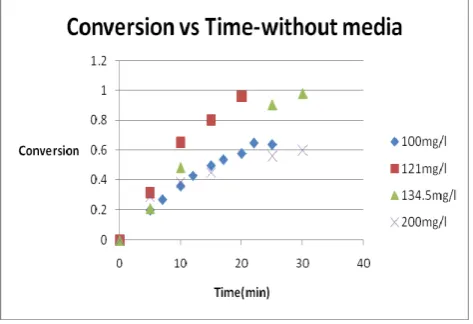
9 134.5mg/l,79% conversion,35minutes 9 120 mg/l,61% conversion,25minutes 9 200mg/l,73%conversion,30minutes 9 100mg/l,72%conversion,45minutes
d) Conversion of dye degradation in presence of media or gravels is higher than simple dye solution degradation(Figure1,Figure2)
e) Variation of order of reaction noticed due to its dependence on pH and on ORP-oxidation reduction
potential(Table 1)(Turhan ,2009)
f) Rate constant also varies with pH giving a clear indication that it is pH dependent(Table 1),(Table2).
g) It has also been validated that in acidic condition direct reaction with ozone takes place while in basic conditions indirect reactions with hydroxyl radicals take place(Konsowa,2003).
h) All analysis and investigations of dye ozonation kinetics should be followed when ozone concentration reaches a saturation value since at that condition the mass transfer of ozone from gas phase to liquid phase is less.
i) It is notable that previous literature shows that at unsaturated ozone concentration, the reaction follows zero order but at saturated condition it follows pseudo first order(Beltran,1997). But the present research does not validate that avenue of scientific pursuit. The order of reaction is highly pH dependent.
VII. VISION AND FUTURE SCIENTIFIC THOUGHTS
Ozone-oxidation of dye especially textile effluent dye is an avenue of innovation with challenge and a visionary scope of thought. This area of research is not new yet unexplored. Scientific thought in the field of pH and ORP dependency of order of reaction is a innovative idea, path breaking and of immense potential. The investigation of scaling up of laboratory scale reactor to industrial scale reactor will be our goal and mission for future. Science is advancing by leaps and bounds and newer technology is the aim of scientists. Previous knowledge and research pursuit is not always true. Our vision follows that fact and a newer avenue is opening up in the field of ozone-oxidation studies and environmental technology.
ACKNOWLEDGEMENT
I acknowledge School of Planning, Architecture and Civil Engineering, Queen’s University, Belfast, United Kingdom , Dr. Bhaskar Sengupta, Dr.Des Robinson and Dr.John Mckinley to give me a chance to do the experiments in their laboratories and I am indebted to their help.
REFERENCES
[1] Beltran.F.J., Gonzalez.M., Gonzalez.J.F., Industrial wastewater advanced oxidation. Part 1.UV radiation in the presence and absence of hydrogen peroxide, Water Research,Vol.31,No.10(1997)
[2] Chen Y.H., Chang.C.Y., Chiu.C.Y., Huang.W.H., Yu.Y.H.,Chiang.P.C., Ku.Y., Chen.J.N., Dynamic model of ozone contacting process with oxygen mass transfer in bubble, Journal of Environmental Engineering,ASCE,Vol.128,No.11,November 1(2002). [3] Chen.Y.H.,Chang.C.Y.,Chiu.C.Y.,Yu.Y.U.,Chiang.P.C.,Ku.Y.,Chen.J
.N., Dynamic behaviour of ozonation with pollutant in a counter current bubble column with oxygen mass transfer, Water Research,Vol.37.(2003)
[4] Chu Wei, Ma.Chi .Wai., Quantitative prediction of direct and indirect dye ozonation kinetics, Water Research,Vol.34,No.12.pp.3153-3160(2000)
[5] Konsowa,A.H., Decolorization of wastewater containing direct dye by ozonation in a batch bubble column reactor,158,233-240(2003) [6] Lackey,L.W., Mines.R.O., McCreanor.P.T., Ozonation of acid yellow
17 dye in a semi-batch bubble column, Journal of Hazardous Materials B138,357-362(2006)
[7] Lin.C.C., Liu.W.T.,Ozone oxidation in a rotating packed bed, Journal of Chemical Technology and Biotechnology,Vol.78(2003).
344
[9] Ravikumar.K., Pakshirajan.K., Swaminathan.T., Balu.K., Optimization of batch parameters using response surface methodology for dye removal by a novel adsorbent, Chemical Engineering Journal,105,131-138(2005)
[10] Ruzicka. M.C., Drahos.J., Fialova.M., Thomas.N.H. ,Effect of bubble column dimensions on flow regime transition, Chemical Engineering Science,56(2001)
[11] Sarasa.J.,Roche.M.P.,Ormad.M.P.,Gimeno.E.,Puig.A.,Ovelleiro.J.L., Treatment of a wastewater resulting from dyes manufacturing with ozone and chemical coagulation. Water Research,Vol.32,No.9(1998). [12] Sevimli.M.F., Hasan.Z.S., Ozone treatment of textile effluents and
dyes: effect of applied ozone dose and dye concentration, Journal of Chemical Technology & Biotechnology,Vol.77,Issue 7(2002) [13] Srinivasan S.V., Rema.T., Chitra.K., Sri Balakameswari.K.,
Suthantharajan.R., Uma Maheswari.B., Ravindranath .E., Rajamani.S., Decolourisation of leather dye by ozonation, Desalination, Vol 235,88-92(2009)
[14] Talarposhti. A.,Donnelly.T.,Anderson.G.K.,Colour removal from a simulated dye wastewater using a two-phase anaerobic packed bed reactor, Water Research,Vol.35,No.2(2001).
[15] Turhan.K.,Turgut.Z., Decolorization of direct dye in textile wastewater by ozonization in a semi-batch bubble column reactor,242,256-263(2009)
[16] Wu.J.,Wang.T.,Ozonation of aqueous dye in a semi-batch reactor, Water Research, Vol.35,No.4(2001).
APPENDIX
TABLE1:DATA SHOWING PH,ORP,ORDER OF REACTION AND INITIAL
CONCENTRATION.
pH ORP-Oxidation Reduction
Potential(mV)
Order of reaction
Initial Concentration (mg/l)
10.79 128-144 2.8 81.9 9.75 180-185 2.3 77.1 10.76 179-189 2.6 76.6 9.18 167-210 1.8 87.3 10.89 149-177 3.6 89.1 10.98 169-188 1.8 73.7 10.61 164-176 2.9 77.3 2.89 400-419 1.7 75.2 2.99 420-450 1.9 99.6 2.97 420-455 0.2 90.3 2.66 463-487 0.9 70.7 2.63 428-456 0.6 91.6 8.88 168-190 2.0 89.7 7.35 130-189 2.5 75.4 7.85 228-240 2.1 88.9 7.54 250-290 2.3 84.9 7.61 240-292 2.9 85.7
TABLE-2:DATA SHOWING THE CONVERSION OR DEGRADATION OF DYES WITH VARIATION OF PH AND OXIDATION-REDUCTION POTENTIAL pH ORP(Oxidation
–Reduction Potential)-mV
Order Initial Concentration (mg/l)
Conversion (%)
9.9 155-165 2.2 85 77 2.5 420-480 0.86 88 89 7.8 120-320 2.78 91 97
Figure 1:Conversion vs Time without media at different initial concentrations
Figure 2:Conversion vs Time with media at different initial concentrations.
345
Figure 4: Concentration vs Time at a particular initial concentration with monitoring of ORP.
Figure 5:Absorbance vs Concentration(Calibration Curve)
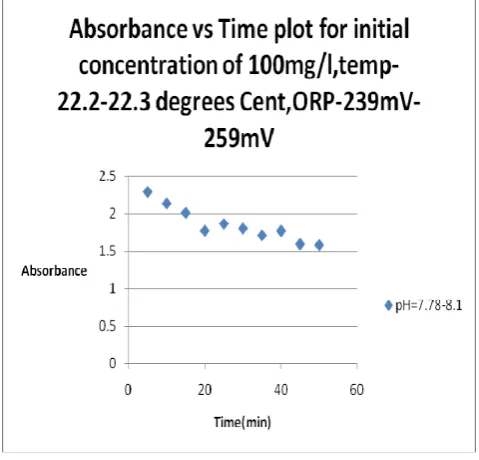
Figure6:Variation of absorbance vs time at different temperature and Oxidation-Reduction Potential
Figure 7:Variation of absorbance vs time at different temperatures and oxidation-reduction potential
346
Figure9:Concentration vs Time plot for different temperature, pH and oxidation-reduction potential.
Figure10:Concentration vs Time plot for different temperature, pH and oxidation-reduction potential.