E-ISSN 2308-9830 (Online) / ISSN 2410-0595 (Print)
Improve the Routing Algorithm in Wireless Sensor Networks
Using a Reinforcement Learning Strategy
Shadi Zeinali1 and Mohsen Davoudi-Monfared2
1 Department of Computer Sciences, Islamic Azad University, Tafresh Branch, Tafresh, Iran
2, 3 Department of Mathematics and Computer Sciences, Islamic Azad University, Tafresh Branch, Tafresh,
Iran
1
[email protected], [email protected], [email protected]
ABSTRACT
Recent developments in the field of electronic and wireless communications have the ability to design and manufacture sensors with low power consumption, small size, reasonable prices and various data uses. These small sensors, which have the ability to perform actions such as receiving various environmental information based on the sensor type, processing and sending it, monitoring and monitoring, etc., have led to the emergence of ideas for the creation and expansion of networks known as wireless sensor networks. A sensor network consists of a large number of sensor nodes that are widely distributed in an environment that collects information from the environment. The location of sensor nodes is necessarily predefined and not known. Such a feature allows us to release them in hazardous or inaccessible places. Another unique feature of sensor networks is the ability to collaborate and coordinate sensor nodes. Each node of the sensor has a processor on its board, and if it uses related algorithms, instead of sending all the raw data to the center, it first performs its initial and simple processing on them and then sends the semi-processed data.
Keywords:Wireless Sensor Networks, Clustering, Clustering, Energy Balance, Lifetime.
1 INTRODUCTION
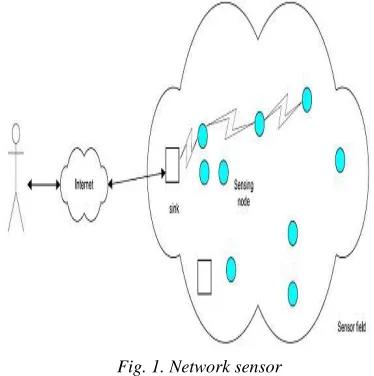
Network sensor [1] is a network consisting of a large number of small nodes operating autonomously to gather environmental information. At each sensor node there is a complete interaction with the physical environment. Sensors capture environmental information and transfer data to the data collection center called sink. Communication between nodes is wireless. Each module works independently without human intervention, and is typically physically very small and has limitations in processing power, memory capacity, energy, etc. Among other things, energy is the most critical factor in the survival of sensor networks. Once the energy ends, it stops working out of the network's cycle of activity. In many cases, shutting down a node will disrupt the entire network. For this reason, energy constraints are the source of many research topics. This network follows the protocols of the traditional network, but because of the restrictions and differences in application, you must always seek to modify, invent, and implement these protocols [20].
Fig. 1. Network sensor
2 MOTIVATION AND DEFINITION OF THE PROBLEM
have overshadowed their widespread use [20]. Therefore, increasing longevity is one of the most important issues and one of the most important challenges ahead. Facing such a problem is possible at two levels:
1- Hardware including sensor network components, energy storage device, radio equipment (which is the radio transmitter of one of the most energy consumers in wireless sensor networks) so that even receiving data, energy consumption of this piece of other parts of the node Is. At the same time, the correct selection of node nodes also plays an important role in extending the life of wireless sensor networks.
2- Software, communication protocols, middleware and energy saving techniques are important because of the limited power of nodes, the provision of protocols and solutions to prevent energy waste. For example, if the nodes are properly synchronized, timing the activity of the sensors and disabling them when not in use is one of the ways to increase the life span of these networks.
3 APPLICATION OF WIRELESS SENSOR NETWORKS
3- The range of wireless sensor networks is wide-ranging and includes applications such as agriculture, medicine, and industrial applications to military applications. For example, one of the most common uses of this technology is monitoring a remote environment. For example, the leakage of a chemical plant in the factory's vast environments can be monitored by hundreds of sensors that automatically form a wireless network and will be promptly notified to the center when a chemical leak occurs. [9]
4- Unlike traditional wired systems, these systems, on the one hand, reduce the cost of network configuration and installation. On the other hand, instead of installing thousands of wire meters, only small pieces that are about the size of a coin in the desired locations Contract. The network simply extends with the addition of several nodes and does not require complex configuration design.
4 WIRELESS SENSOR NODE STRUCTURE
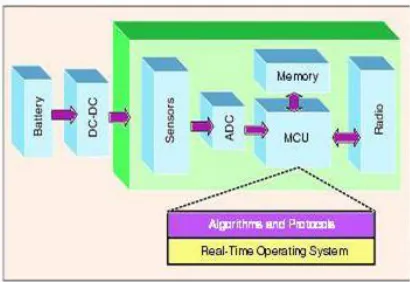
5- A sensor node usually contains 4 subsystems[16]:
Subsystem Calculation: Includes microprocessor (sub control unit, MCU) with responsibility for controlling sensors and operating communication protocols. Usually, the MCU operates in different ways for energy management purposes. But these energy-efficient practices are associated with energy consumption, so the energy consumption levels of different methods should be checked for each node's battery life. This section takes data from the sensors, depending on the application of limited processing on them, and sends it through the sender.
6- Communication subsystem: The sender unit establishes the node's communication with the network. This subsystem contains a low range of radio waves used for communications with adjacent nodes and the outside world. This radio subsystem can operate under Idle and Sleep modes. When the transmission or receiving subsystem does not have its full shutdown, it is very important to replace it in idle mode, because it consumes a lot of energy in idle state.
7- Sensory sub-system: This subsystem includes a sensor and analog-to-digital converter [1] that transmits information from a sensor and digitizes it to the processor. Low energy consumption can reduce energy consumption and save energy, resulting in increased efficiency.
Fig. 2. System structure of a wireless node sensor
If the operating system, software layer and network protocols are designed for energy conservation, the life span of the sensor networks can rise significantly. Energy management in the radio subsystem is very important because radio communications use a lot of energy when performing system tasks. On the other hand, sensor nodes act as a router, and most of the packets that the sensor receives is shared with the transmissions. Smart radio hardware helps identify the paths of packets that need to be sent, and this process reduces the overhead of computing because packets in the middle nodes do not require much of a process.
5 CHALLENGES IN WIRELESS SENSOR NETWORKS
Some of the most important challenges ahead in wireless sensor networks are as follows: • Energy management: limit the energy required sensors is always a concern for designers is because according to the charging them again there is full battery, each of which is equivalent to the loss of them, and perhaps the loss of one or more nodes The whole network fails.
Scalability: Wireless sensor networks must be distributed and capable of self-regulation [1] and self-modification [2]. Therefore, scalability is an important condition for the survival of these types of networks.
Security: One of the most important considerations in these networks is security. The distributed structure of these types of networks and their geographical dispersion
have made the hacker and viruses more vulnerable to these types of networks. Therefore, taking into account limited facilities such as processing and memory, a method should be adopted to impose the least overhead on the system.
Communications: Wireless sensor networks usually work in hard, harsh and hazardous areas with high
temperature changes. For example, consider networks that are designed and installed in order to monitor a semi-active firefighter. The communication system of this network must be in such a way as to transfer information in the shortest possible time. Perhaps the smallest delay in communication makes it completely impossible to do it.
Reliability [3]: In many applications, it is used to implement sensors from helicopters or similar devices, which may result in the loss of several nodes or in operation as a result of this, and the beats entering the sensors. They get disturbed. Or their use is in difficult environments, such as under the ocean or on the surface, chemical and microfluidic environments, war zones, and so on. Sensor nodes must be constructed in such a way as to be compatible with the environment in which they are used. For example, sensors used at the bottom of the ocean should withstand extreme pressure and be waterproof. Therefore their design must be such that they have the necessary resistance to such conditions. Network design should also be designed in such a way that failure of one or more nodes does not result in the entire network operation.
Inhomogeneity [4]: Sensor networks should be able to work with different wireless sensor devices that are different in functionality and performance, since in a network, depending on the application, two or more sensor types may be used that are normal It will be needed to work together with these devices, communication protocols and special algorithms.
Cost of production: Today, economic costs play a major role in the implementation and expansion of networks. Although the sensor nodes are low-cost for small and simple reasons, but due to the fact that thousands of nodes may be used in a sensor network, a slight drop in prices on one of these sensors will reduce the overall cost of the network.
6 METHODS AND EFFECTIVE FACTORS IN REDUCING ENERGY
CONSUMPTION
7 VARIOUS WAYS TO REDUCE ENERGY CONSUMPTION
So far, there has been a lot of research on energy conservation methods in sensor networks, and there are many classifications for these methods. In general, these methods can be classified into three categories [15], which are followed by each explanation.
Based on workflow [2]: These methods work on the basis of assuming that there is more than the expected number of sensor nodes in the environment, and if some of them are in low-power mode, they will have an effect on Do not create network. In these methods, we try to do this in such a way that the selected subset has the lowest possible.
Based on data-literacy [3]: This method includes data reduction methods and data extraction methods. Data reduction methods have been attempting to reduce data generated by doing so in a variety of ways, including deleting additional data, compressing data, and combining multiple data and interpreting them. In data extraction methods, it is emphasized that the amount of data generation is reduced, that is, the number of times the environment is reduced, or that the environment can only be taken when acceptable changes occur around the sensor's environment.
Based on sink mobility: this method works based on the fact that nodes in the sensor networks are responsible for relaying information to the sink, which causes the nodes adjacent to the sink node to perform a great deal of relay, and their energy fast Evacuate This incident causes the entire network to be interrupted by the sink, which effectively disables the network. In order to avoid this fact, sink mobility is used in these environments.
8 NODE CAPABILITIES
In a sensor network, there are various tasks that can be assigned to sensor nodes. Each application-specific node can take on application-specific tasks such as relaying, sensing and aggregation. The heterogeneity of the sensors itself is controversial, with many articles on this subject. For example, some applications require a combination of sensors to monitor temperature, pressure, ambient light and humidity. These specific sensors can include conventional sensors that are independent or interdependent.
9 HETEROGENEOUS NODES
In many studies, it is assumed that all nodes are homogeneous. Depending on the application type, the nodes can have different roles and capabilities and are heterogeneous. For example, some applications may have scenarios for measuring temperature, pressure, humidity, etc., or need to capture environment images or track objects, and so the sensors are developed with various functions, and the roles and abilities Each one is different. Even reading and reporting data in these sensors has different rates. Each of the sensors can use one of the reporting models and a data rate to send and report data according to its duty and service quality limitations.
10 ERROR HANDLING
Some sensors are damaged due to energy, physical or environmental damage. Sensor node failure should not affect the performance of the entire network. If a number of nodes fail, the routing protocols and MACs should provide a new form of links and paths for data gathering. The necessary thing is to set the transmission power and signaling rates on existing links and reduce energy consumption or re-rotate the packets over an area of the grid that has more energy. Therefore, to increase tolerance to error, several levels of redundancy in the network are required. The probability that a node is healthy at intervals (0, t) [40] is equal to:
11 SERVICE QUALITY
In many applications, delivery should take place at a specific time. Therefore, delays in delivery are one of the important considerations. In others, energy conservation, which is directly related to the lifetime of the network, is very much taken into consideration. When the energy is over, the network may intelligently lower the quality so that it reduces the processing speed or the period of awakening of the nodes, thereby increasing its lifespan. Of course, this should not reduce the quality of service from the designated channel.
12 HARDWARE LIMITATIONS
power and long lifetime. For example, an AAA battery will operate at a maximum of 100 to 120 hours in active mode. Even if we assume that the size of our sensors is large and the battery used is also rechargeable, because these sensors are often dispersed in distant and hazardous areas, recharging these batteries is very difficult and even impossible [9].
13 COMMUNICATION PROTOCOLS IN WIRELESS SENSOR NETWORKS
Before discussing communication protocols, we review the effective factors in choosing them: Energy applications: To maximize network life, routing and transmitting data packets can be distributed. A path regardless of the amount of stored energy should not always be used to send packets because it forces the nodes to run out of this path and a cavity is present in the network connections.
Deployment: In sensor networks, nodes are generally located in places that are not cognitive and not preset. The problem of sensor coverage and sleep and wake scheduling, etc., requires the network to calculate the location of the node. One method of calculation is that at least some nodes have a GPS or global location system. However, there are important conflicting factors in using GPS. Firstly, GPS only works in open space, and it's not possible to use GPS if it is underground or deep into the ocean. Secondly, expensive GPS devices are not expensive to use on a large scale. So the location in these networks has always been controversial. Because many of the wireless sensor network protocols are based on location information. For example, many routing protocols such as [31] act based on the availability of information from the location of the network nodes. Therefore, in order to achieve all the capabilities of wireless sensor networks, it is important to know the location of the nodes in the network, which increases the importance of locating techniques day by day. On the other hand, location in wireless sensor networks is a particularly difficult task due to the specific characteristics of these networks. In large wireless sensor networks, nodes are usually devices with a high constraint, low memory, low computing power, and especially limited energy. In recent years, many techniques have been proposed for locating in wireless sensor networks, these techniques can be classified into two broad categories:
1- Anchorage based techniques 2- Anchorage without need
Anchor node is a sensor node that has its own GPS position or manual settings in the global coordinate system before the start of the locating process. In the anchor node-based techniques, it is assumed that there is an initial number of harbor node in the sensor network. The purpose of these techniques is to use the capabilities of these nodes to eventually estimate all the nodes of the network to determine their place in the global coordinate system. But in the techniques without anchorage, there is no need for an anchor node, and the process of locating the sensor node estimates its relative location in the network graph. Although harbor-based techniques can calculate the definite location of nodes in the global coordinate system, for the harbor nodes, they need additional equipment, positioning and manual settings that are found in many sensor networks due to limitations in the nodes as well as inappropriate The network environment can not be used. Needless solutions to the harbor are less costly than anchor-based solutions. Anchor-based algorithms can be found in [11]. In this algorithm, first the anchor nodes distribute their spatial data in the network, and this will determine the average distance between the two nodes or the average length of a step. Non-anchorage nodes know the shortest route based on the number of steps to each of the harbors, and by getting this average length of the distance to the anchorages, they calculate their distance using this estimate. At [1], network nodes are first clustered. Each harbor is a cluster head and cluster members begin to locate using the cluster header information. This process is initially initiated by nodes in the joint area of the two clusters. However, with the clustering of the nodes, the angiogy-based algorithm is increased, but the precision and efficiency of the algorithm is still dependent on the number of anchor nodes. The use of an anchorage in any situation restricts its use in wireless sensor networks.
and spring algorithm-based methods. Of course, in general, the methods used in this type of algorithm are time-consuming and associated with high energy consumption.
14 ROUTING
The problem of routing in wireless sensor networks is one of the most important issues that ensures the optimal operation of a sensor network. Due to the limitations of the energy level of each node in a sensor network, routing should take place in such a way that the overall lifetime of the network is maximized. Therefore, the proposed routing method in these networks should use the available energy as best as possible, that is, it should be aware of the node resources, and if the node had not enough resources to send the packet to the destination [14].
Types of methods are as follows:
15 FLOOD METHOD
In this way, a node sends copies of the data to each of its neighbors to disperse a portion of the data over the network. Whenever a node receives new data, it copies it and sends it to its neighbors (except the node receiving the data from it). The algorithm converges or ends when all nodes receive a copy of the data. When it takes a handful of nodes to receive and then send some data, it's called a round. The flood algorithm in time (OD) is convergent, since d is the diameter of the network, because it takes for a piece of data d to move from one end of the network to the other end. The three weaknesses of this method are [14]:
1) Explosion: In a flood method, a node always sends data to its neighbors, regardless of whether its neighbors have received data before. This action
causes the explosion problem.
2) Overlapping: Sensors usually cover the same geographic areas and their data overlap.
3) Failure to know resources: In a flood method, nodes do not change their activities based on the amount of energy they are in. If they are aware of their sources in sensor networks, they can communicate and calculate their energy resources Match.
The rumor method [42]
This method is an alternative to the flood method that uses the crash process to save energy. Instead of sending the data alike, a rumor node sends information to one of its neighbors at random. If a rumor node receives data from its neighbors, it can
retrieve the data if the same neighbor is randomly selected.
Protocols [42] SPIN [1]
Also, nodes use quasi-data negotiation in this way to remove extra data from the network. SPIN nodes can also make decisions for their communications based on information about the application and on the basis of information about their existing resources. This will allow the sensors to efficiently disassemble the data, despite their limited resources. Two key ways to handle the SPIN protocols are to solve the problems posed by the all-embracing classical approach, using negotiation and resource matching. To overcome the collision and overlapping of the SPIN nodes, they negotiate with each other before sending information. The nodes also evaluate their resources before sending data. Each node has its own resource manager [3] to monitor energy consumption. The pseudo-data generated in SPIN as the data representer must have a volume smaller than the data they represent. Also, if two pieces of data are separated, their quasi-data must also have this property. The nodes in SPIN use three types of messages to communicate with each other:
1)
ADV:Used to send new data. When a SPIN node has data to share, this can be advertised by sending the corresponding pseudo-relevant data.2) REQ: Used to request information. A SPIN node can use this message when it wants to receive the actual data.
3) DATA: Includes data messages. DATA messages contain real data collected by sensors.
messages, nodes can request their data again if they are not received within a given time frame. Also, in the case of mobile networks, if a node is seen that its neighbors have changed, they can instantly promote all their data. The main advantage of SPIN is its simplicity, as well as its locality and dependence on a particular arrangement, which makes it easy to implement on any network.
SPIN-2: This method adds a clever simple idea to save resources to the SPIN-1, so that when there are enough resources available, SPIN-2 nodes, such as nodes in SPIN-1, use the three-step protocol. When a node observes that its energy resources are lower than a certain limit, it adapts itself to reducing its participation in the protocol to the new conditions, and in general, a node participates only in the protocol, which is confident that all the other steps of the protocol Without lowering its energy resources from the specified range, otherwise the node will not generate any REQ message with the ADV message. This method causes the node to not engage in DATA messages at low energy levels [18].
16 CONCLUSION
In this study, we first described the concept of wireless sensor networks in general, and stated that the range of wireless sensor applications is very wide and includes agricultural, medical and industrial applications to military applications. In the following, we describe the structure of its nodes, which consists of four subsystems under the subsystem headings, the subsystem of communication, the subsystem of the sensing, and the subsystem of the energy source. We then outlined the overall structure of wireless sensor networks and said that the most important general features of a sensor network are:
1) Unlike traditional wireless networks, all nodes in wireless sensor networks do not need to communicate directly with the closest power control tower or base station, but the sensors can be divided into clusters (cells) that each cluster selects a cluster header. The cluster is responsible for gathering information. Data gathering is done to reduce the data sent from the nodes to the base station and thereby improve the energy efficiency of the network. 2) Peer-to-peer network protocols provide peers
with a mesh-like communications network for transmitting information between thousands of small devices using a multi-jump method. The mesh-compliant architecture has the ability to
adapt to new nodes to cover a larger geographic area. Additionally, the system can automatically compensate for loss of a node or even a few nodes.
3) Each sensor on the network has a sensor range that is full of spots in its range. One of the goals of sensor networks is that each location in a given space must be at least in the sensitivity of a node so that the network can cover all the area in question. A sensor with sensitivity radius r can be modeled with a disk with radius r. This disk covers the points that fall within this radius. Obviously, to cover the entire area, these disks should cover all parts of the area.
We also explained that the challenges ahead in
wireless sensor networks include:
Energy management: The limited energy requirements of the sensors have always been a concern for the designers because, due to the fact that they can not be recharged, the battery life of each of them is equivalent to their loss, and possibly with the loss of one or more nodes The
whole network fails.
Scalability: Wireless sensor networks must be distributed and capable of regulation and self-modification. Therefore, scalability is an important condition for the survival of these types of networks.
Security:One of the most important considerations in these networks is security. The distributed structure of these types of networks and their geographical dispersion have made the hacker and viruses more vulnerable to these types of networks. Therefore, taking into account limited facilities such as processing and memory, a method should be adopted to impose the least overhead on the system.
Communications: Wireless sensor networks usually work in hard, harsh and hazardous areas with high temperature changes. For example, consider networks that are designed and installed in order to monitor a semi-active firefighter. The communication system of this network must be in such a way as to transfer information in the shortest possible time. Perhaps the smallest delay in communication makes it completely impossible to do it.
devices, which may result in multiple nodes being lost or interrupted by their impact on the sensor inputs. . Or their use is in difficult environments, such as under the ocean or on the surface, chemical and microfluidic environments, war zones, and so on. Sensor nodes must be constructed in such a way as to be compatible with the environment in which they are used. For example, sensors used at the bottom of the ocean should withstand extreme pressure and be waterproof. Therefore their design must be such that they have the necessary resistance to such conditions. Network design should also be designed in such a way that failure of one or more nodes does not result in the entire network operation.
Inhomogeneity: Sensor networks should be able to work with different different sensor devices in terms of functionality and performance, as it may be used within two or more types of sensors, depending on the application, which is normal for this collaboration. Devices together, communication protocols and special algorithms will be needed.
Cost of production: Today, economic costs play a major role in the implementation and expansion of networks. Although the sensor nodes are low-cost for small and simple reasons, but due to the fact that thousands of nodes may be used in a sensor network, a slight drop in prices on one of these sensors will reduce the overall cost of the network. Because we want sensor networks with a life span of at least a few months to one year, so we have to optimize the amount of energy in the network. One of the most important ways is to optimize the energy consumption in the sensory and communication nodes of the nodes. We also explained a variety of methods for reducing energy consumption, which were based on the workflow period, based on data transfer, based on the sink mobility.
Issues affecting the performance of wireless sensor networks include network dynamics, node development, energy considerations, delivery models, data aggregation / composition, nodal / link heterogeneity, error tolerance, connectivity, and coverage. In the thesis, we examined communication protocols in sensor networks and expressed the types of routing. In the next section, we examined the work and research we have done, and we said that in order to save energy in wireless sensor networks, in terms of network topology, there are three broad categories of flat-panel networks, hierarchical networks or dominant sets, and networks The cluster hierarchy is divided, with explanations for each one described.
6 REFERENCES
[1] A. A Abdel Azim Youssef, "A Scalable Anchorfree Localization Algorithm For Wireless Sensor Networks", PHD Thesis, University of Maryland, 2006.
[2] A. Boukerche, X. Cheng, and J. Linus. Energy-Aware Data-Centric Routing in Microsensor Networks. In Proceedings of the 6th ACM International Workshop on Modeling, Analysis and Simulation of Wireless and Mobile Systems (Mswim), San Diego, CA, September 2003.
[3] A. Cerpa, and D. Estrin, "Ascent: adaptive self-configuring sensor networks topologies," In IEEE Transaction on Mobile Computing, vol. 3, no. 3, pp. 272-285, September 2004.
[4] Ghosh, and S.K. Das, "Coverage and Connectivity issues in wireless sensor networks: A survey," In Pervasive and Mobile Computing, vol. 4, pp. 303-334, June 2008. [5] B. Chen, K. Jamieson, H. Balakrishnan, and R.
Morris. Span: An Energy-Efficient
Coordination Algorithm for Topology Maintenance in Ad Hoc Wireless Networks. Wireless Networks, 8(5): 481–494,2002. [6] B. Krishnamachari, D. Estrin, and S. Wicker.
The Impact of Data Aggregation in Wireless Sensor Networks. In Proceedings of the Workshops of 22nd International Conference on Distributed
ComputingSystems, 575–578, Vienna, Austria, July 2002. IEEE Computer Society.
[7] C.F. Huang and Y.C. Tseng, "The coverage problem in wireless sensor networks," In International Workshop on Wireless Sensor Networks and Applications, pp. 115-121, 2003. [8] C.F. Huang, Y.C. Tseng, and H.L. Wu, "Distributed protocols for ensuring both coverage and connectivity of a wireless sensor network," In ACM Transaction on Sensor Networks, vol. 3, no. 5, March 2007
[9] Chee-Yee Chong; Kumar, S.P., "Sensor networks: Evolution, opportunities, and challenges,"Proc IEEE, August 2003
[10]C. Intanagonwiwat, R. Govindan, D. Estrin, J. Heidemann, F. Silva, “Directed diffusion for wireless sensor networking,” ACM/IEEE Transactions on Networking, vol. 11, no. 1, pp. 2-16, 2002.
[11]C. Savarese, J. Rabaey, and K. Langendoen." Robust positioning algorithms for distributed ad-hoc wireless sensor networks". Usenix Technical Annual Conference, June 2002. [12]C. Schrugers, V. Tsiatsis, S. Ganeriwal, and M.
Networks:Exploiting Latency and Density. In Proceedings of the 3rd ACM International Symposium on Mobile Ad Hoc Networking and Computing (MobiHoc), Lausanne, Switzerland, 2002.
[13]D. Blough, M. Leoncini, G. Resta, and P. Santi. The K-Neigh Protocol for Symmetric Topology Controlin Ad Hoc Networks. In Proceedings of the 4th ACM International Symposium on Mobile Ad HocNetworking and Computing (MobiHoc), Annapolis, MD, 2003. [14]E. M. Royer and C.-K. Toh. A Review of
Current Routing Protocols for Ad-Hoc Mobile
Wireless Networks. IEEE Prersonal
Communications, 6(2): 46–55, 1999
[15]G. Anastasi, M. Conti, M.D. Francesco, and A. Passarella, "Energy conservation in wireless sensor networks: A survey," In Ad Hoc Networks, vol. 7, no. 3, pp. 537-568, May 2009.
[16]Hill, J.," System Architecture for Wireless Sensor Networks", Masters Report, University of California Berkeley, 2000
[17]Holger Karl, Andreas Willig, "Protocols And
Architectures For Wireless Sensor
Networks",John Wiley & Sons Ltd,2005 [18]A. Cerpa, and D. Estrin, "Ascent: adaptive
self-configuring sensor networks topologies," In IEEE Transaction on Mobile Computing, vol. 3, no. 3, pp. 272-285, September 2004.
[19]H. Zhang, and J.C. Hou, "Maintaining sensing coverage and connectivity in larg sensor networks," In Ad Hoc and Sensor Wireless Networks, vol. 1, no. 1-2, pp. 89-124, March 2005.
[20]I.F. Akyildiz, W. Su, Y. Sankarasubramaniam, E. Cayirci, " Wireless Sensor Networks " John Wiley & Sons Ltd,Ian F. Akyildiz Series in Communications and Networking, 2010. [21]M. Cardei, M.T. Thai, Y. Li, and W. Wu,
"Energy-efficient target coverage in wireless sensor networks," In IEEE Infocom, pp. 1976-1984, 2005.
[22]L. Hu. Topology Control for Multihop Packet Radio Networks. IEEE Transactions on Communications,41: 1474–1481, 1993. [23]L. Li, J.Y. Halpern, P. Bahl, Y.M. Wang, and
R. Wattenhofer, “A Cone-Based Distributed Topology Control Algorithm for Wireless
Multi-Hop Networks” IEEE/ACM
Transactions on Networking, Volume 13, Issue 1, pp. 147-159, Feb. 2005.
[24]Manish Kochhal - Loren Schwiebert And Sandeep Gupta, Integrating Sensing Perspectives for BetterSelf Organization of Ad Hoc Wireless Sensor Networks, Journal Of
Information Science And Engineering 20, 449-475,2004.
[25]M. Cardei, and D.Z. Du, "Improving wireless sensor networks lifetime through power aware organization," In Wireless Networks, vol. 11, no. 3, pp. 333-340, May 2005.
[26]M. Cardei, M.T. Thai, Y. Li, and W. Wu, "Energy-Efficient Target Coverage In Wireless Sensor Networks," In IEEE Infocom, pp. 1976-1984, 2005.
[27]M. Cardei, D.M. Callum, and X. Cheng, "Wireless sensor network whit energy efficient organization," In Journal of Interconnection Network, vol. 3, pp. 213-229, 2002.
[28]M. Hajiaghayi, N. Immorlica, and V. S. Mirrokni. Power Optimization in Fault-Tolerant Topology Control Algorithms for Wireless Multi-hop Networks. Proceedings of the 9th Annual International Conference on Mobile Computing and Networking, pages 300–312. ACM Press, 2003.
[29]M. Ilyas, and I. Mahgoub, "Handbook of sensor networks : compact wireless and wired sensing systems," In CRC Press Publishers, ISBN: 0-8493-1968-4, 2005.
[30]M. N. Halgamuge, S. M. Guru, and A. Jennings. Energy Efficient Cluster Formation in Wireless Sensor Networks. In International Conference on Telecommunications (ICT), Papeete, Tahiti, 2003.
[31]N. B. Priyantha, A. Chakraborty, and H. Balakrishnan, "The Cricket location-support system," in Proceedings of MOBICOM 2000. [32]P. Santi, Topology control in wireless ad hoc
and sensor networks, ACM Computer Survey 37, 2 (Jun. 2005), 164-194. M. U. Mahfuz and K. M. Ahmed. A review of micro-nano-scale wireless sensor networks for environmental protection: prospects and challenges. Science and Technology of Advanced Materials, 6(3– 4):302–306, April–May 2005.
[33]S. Capkun, M. Hamdi, and J.-P. Hubaux, "GPS-free positioning in mobile ad-hoc networks", 34th Annual Hawaii International Conference on System Sciences, 2001.
[34]S. Meguerdichian, F. Koushanfar, M. Potkonjak, and M. B. Srivastava, "Coverage problems in wireless ad hoc sensor networks," In 20th Annual Joint Conference of the IEEE Computer and Communication Societies, pp. 1380-1387, 2001.
[36]Usha Nandini Raghavan and Soundar Kumara and Xu, Decentralised topology control algorithms for connectivity of distributed wireless sensor networks, Department of Industrial EngineeringThe Pennsylvania State University.
[37]V. Kawadia and P. R. Kumar. Power Control and Clustering in Ad Hoc Networks. In Proceedings of IEEE Infocom, San Francisco, Ca, March 2003.
[38]V. Rodoplu, and T. H. Meng, “Minimum energy mobile wireless networks,”IEEE Journal on Selected Areas in Communications, Volume 17, Issue 8, pp. 1333-1334 Aug. 1999. [39]W. R. Heinzelman, J. Kulik, and H.
Balakrishnan. Adaptive Protocols for Information Dissemination in Wireless Sensor Networks. Proceedings of the 5th Annual International Conference on Mobile Computing and Networking, pages 174–185. ACM, Seattle, WA, August 1999.
[40]X. Y. Li, P.-J. Wan, Y. Wang, and C. W. Yi. Fault Tolerant Deployment and Topology Control in Wireless Networks. In Proceedings of the 4th ACM International Symposium on Mobile Ad Hoc Networking and Computing (MobiHoc), Annapolis, MD, 2003.
[41]Y. Xu, J. Heidemann, and D. Estrin. Geography-Informed Energy Conservation for Ad Hoc Routing. In Proceedings of the 7th Annual International Conference on Mobile Computing and Networking (Mobi-Com), pages 70–84, Rome, Italy, July 2001. ACM. [42]Z. J. Haas, J. Y. Halpern, and L. Li.