Modifying an Agent-Based Method of Disturbance Handling with
Alternative Techniques of Learning
Mahmoud Mohamed1, Iman Badr2, Mustafa Sami3 and Adel Drwaish4
1
Department of Computer science, Higher Institute of computer science and information system, NCA academy, Cairo, Egypt
2, 4
Department of Computer science, Faculty of Science, Helwan University, Cairo, Egypt 3
Department of Computer science, faculty of computer and information, Helwan University, Cairo, Egypt
1
[email protected], [email protected], [email protected], [email protected]
ABSTRACT
In this paper we proposed modifying an agent based method for disturbance handling of FMS towards learning technologies, we present alternative learning techniques to improve disturbance handling. We are using here two techniques; the first is learning by training instance, and other is learning by future estimation. In first technique, we proposed method that work at the beginning on traditional method for handling disturbance, the resulting solution are used as training instances for creating the knowledge base, and then we derive learning action groups from it. At occurrence disturbance, we check learning actions to apply one from it; if not, we handle disturbance and record its as newer learning action. In second technique; it depends on sensing identified indications and merge it with learning action, whereas if this indications occur again, the system will apply the estimation scenario.
Keywords: Disturbance Handling, Decision Tree, Estimation Mechanism, Learning Action, Rescheduling.
1. INTRODUCTION
The occurrence of disturbance in manufacturing system caused in many damages to these systems; such as decrease of productivity, and delay in implementation times and delivery times, this led to increased cost of the factories to cover the disturbance. Therefore, it was necessary to handle the disturbances by good ways to avoid those losses and achieving quick response to deal with the disturbances, methods of handling must be conformable to nature of manufacturing systems from dynamic and flexibility.
There are several models available to deal with the unrest, the most successful methods that based on agent technology, because the agent technology is characterized by cooperation and negotiation among the
parts of the system, to achieve quick and appropriate solutions to disturbances with regard to time, the impact and the reaction.
In previous study an agent-based method for automating disturbance handling for flexible manufacturing systems, we use the method that depends on the agent technology for handling the disturbances, this method has a good and effective potential in handling disturbance [1]. Method relied in measuring the efficiency into two factors is makespan and machine utilization.
One of the most important areas of development and raising the efficiency of the manufacturing system is trend in the development of systems to become learning systems. Where they can interact more sophisticated and learned during the production process and disturbances that happen during it. So here, we offer a model for the development of the aforementioned processing systems in the direction of the learning. We'll see here providing illustration of how to convert the previous method into learner system by using learning techniques. We develop the method in the direction of how to estimate the disturbances and handle it with best action and in less time than the current methods. Moreover, embed it in a knowledge base that will allow it in the future to deal quickly in response to various types of disturbance that may occur.
2. BACKGROUND OF LEARNING
The ability to learn must be part of any system that would claim to possess general intelligence. Intelligent agents must be able to change through the course of their interactions with the world as well as through the experience of their internal states and processes.
There are many definition of learning, according to [2] learning is a type of artificial intelligent that provides computers with ability to learn without being explicitly programmed, learning explore the study and construction of algorithms that can learn from making predictions on data. Herbert Simon introduce a public definition for learning as" any change in a system that allow it to perform better the second time in repetition of the same task or on another task drawn from the same population"[3].
Learning process consists of main components enable us to build learning system; we refer here to some of them as follows [4]:
1.The data and goals of the learning task: one of the primary ways in which we characterize learning problems is according to the goal of learner and the given data.
2.The representation of learned knowledge: Machine-learning programs have made use of all the representation language to express the knowledge base, such as programs that learn to classify objects may represent these concepts as expressions in predicate calculus, a triangle table or problem solving rules.
3.Training instances: the learner must be known how convert a given set of training instances to a generalization, heuristic rules, or plan that satisfies its goals.
4.Heuristic search: learning programs must commit to a direction and the order of search, as well as to the use of available training data and heuristics to search efficiently.
The idea of using learning in manufacturing system is that percepts should be used not only for forecasting, but also for improving the agent's ability to act in the future, learning takes place as a result of the interaction between the agents and the world and from observation by the agent of its own decision making processes. According to [5] learning in a multi agent environment can help agents to improve their performance. Agents, in meeting with others, can be learned about the partner's knowledge and strategic behaviors. Agents that operate in dynamic environments could react to unexpected events by generalizing what they have learned during a training stage. In cooperative problem solving systems, cooperative behavior can be made more efficient when agent adapt to information about the environment and
about their partners. Agents that are learned from each other can sometimes avoid repeatedly coordinating their actions from scratch for similar problems. They will sometimes be able to avoid communication at run-time by using learned coordination concepts, which is especially useful whenever they do not have enough time to negotiate.
There are some cases in manufacturing system may represent good ways for learning to improve its performance such as:
1.Some of the system configuration changes such as: new manufacturing resources (machines, AGV) are embedded to the manufacturing system; some machines in service breakdown or removed from the system. Any change in hardware or software for any situation from the last one, each agent must learn about the changes of the working system and update its knowledge about its environment and other agents.
2.At occurrence of unexpected events such as arrivals of new jobs depending on its priority or due date, this events represent learning opportunities.
3.When problem or disturbance is terminated with success (suitable handling), this represents a good case for learning.
3. METHODOLOGY FOR
MODIFICATION
3.1 Architecture components of an Agent-Based
Method
after that each operation agent sends a confirmation to its related job agents[1][6].
3.2 Modifying an Agent Based Method towards
Learning Techniques
The method starts by detecting the disturbance of the incident, determining the place and the type of
disturbance. In other words, at this step, the agent in concern detects a disturbance in its corresponding entity such as resource or job.
In the next step, all the relevant details that are related to the detected disturbance such as time, place of the disturbance, parts or jobs affected by this disturbance and the conditions and constraints associated with disturbance, are recorded.
Fig. 1. architecture of agent environment
There some knowledge should be learned by any agent based manufacturing system, the most important includes the success and failures of the past, the usefulness of different pieces of knowledge with respect to different tasks, the relationship between the multi agent system and its environment, and the capability and accountability of other agent in the system.
After that, in the old method the agent who is responsible for solving the disturbance will search in database to know if the disturbance at hand occurred before with the same constraints and conditions, this agent will apply old solution.
This technique represents big complexity, because this required symmetry between disturbance type, conditions
and constraints related to its and with the incoming disturbance, the process of comparing required long time, and complicated procedures programming to reach the suitable solution.
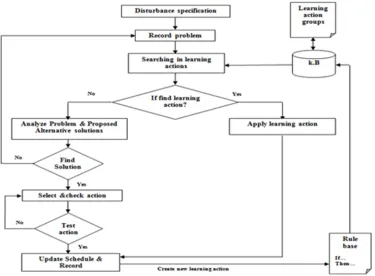
In our modifying method, the supervisor agent starts by searching in knowledge base about the learning action compatible with the detected disturbance in conditions and constraints.
3.3 Learning system
Fig. 2. an Agent-BASED method using learning technology
The Learning action distinguished in representation as the rule base formats that based on ID3 algorithm, this algorithm have the ability to the management of complexity, heuristic for selecting suitable solution, and potential for handling noisy data.
All this properties facilitate to do the comparing process for choosing suitable learning action. Also it didn’t search for repeated solution only, but it searches for solution with similar circumstances. From all of the above, this led to increase the opportunities to find suitable solution quickly.
Here, the Learning action based on learn from history, where it create its knowledge base from training instance occurred before, such that at occurrence disturbance, the system is analyzed disturbance and found solution for it, then we represent the disturbance and its solution in rule base format and store their in knowledge base for creating learning action.
In the next step of the method, if there is a learning action, we will go to apply learning action step for executing the solution, and making suitable update for the original schedule.
In case of supervisor agent didn't find learning action, we will go to analyzed and proposed alternative solution to apply the steps of old method, which designed especially to reach a solution, but after achieve solution, we represented it in rule base format and recorded it in knowledge base for joining its into learning action
groups. Fig2 illustrates steps of method for disturbance handling.
By applying modification in the old method achieve to us; facility for reaching to the solution, decreasing the time of handling process, improving efficiency of handling process and achieve quick response for adaption to disturbances.
Decision tree is the most popular symbolic machine learning algorithms. It expresses the learned hypothesis or target function using a unique representation format known as a decision tree. Decision tree can be compiled into simple IF-Then rules for improving human comprehensibility. They have been successful applied to a variety of learning tasks [3].
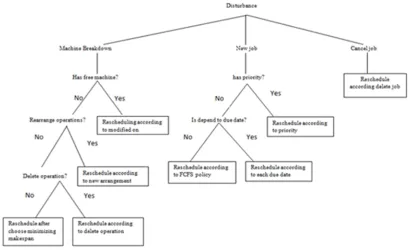
The ID3 algorithm is the core algorithms on which many variants have been developed. The algorithm constructs decision tree in a top-down fashion by recursively partitioning the instance at each node. Fig 3 illustrates the decision tree for disturbance handling method, which derived from it rule-bases that used for creating the learning actions.
4. APPLICATION SCENARIO TO
SUPPORT HANDLING PROCESS
The mechanism existed in each autonomous agent to support handling the disturbances are mainly dependent on the type of disturbance. We mentioned earlier the
disturbance handling method determine the type of disturbance and recorded all details of it, and then we start to see if there are any learning action, we can apply learning mechanism according to type of disturbance as in the following cases.
Fig. 3. decision tree for disturbance handling process
4.1 Application Scenario to Support Machine
Breakdown Recovery
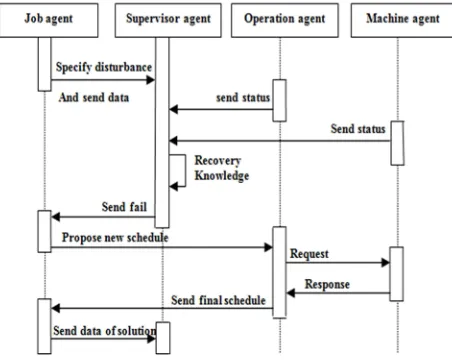
In this section, the focus is the mechanisms that support the machine breakdown. Machine agent 1 specifies the disturbance, records all details about it and sends this data into supervisor agent. Additional to, the operation agent sends data related to this disturbance (like data about operations of failure machine) to the supervisor agent. supervisor agent categorized data in form of rule base information, it begin searching in their knowledge base by comparing between the decision tree existed in each learning action , which especially work on machine breakdown and the categorized data that grouped by supervisor agent to extract decision if it is available. In case of we obtain decision as illustrated in sequence diagram of Fig4. The supervisor agent makes rescheduling based on this learning action, where it will send modification to machine agent 2 and operation agent, which are responsible for executing the operations. In addition, supervisor agent sends final schedule to job agent.
In the other case that illustrates in sequence diagram of Fig 5, supervisor agent sends failing of finding solution to machine agent 1, which announces other machine agent by this disturbance. The other machine agent request and start negotiate with operation agent to cover this disturbance, if the machine agent 2 received response from operation agent, it will send this result to machine agent 1 to transfer operations into the operation agent and selected machine agent and job agent. Finally, job agent sends data of the solution to supervisor agent in order to record this instance in its knowledge base as new learning action.
4.2 Application Scenario to Support Arrival New
Job Recovery
agent. In addition, supervisor agent captures the status of machine agent and operation agent.
Fig. 4. sequence diagram of mechanism for machine breakdown in case have a learning action
Fig. 5. sequence diagram of mechanism for machine breakdown in case create a new learning action
Supervisor agent categorized data in form of rule base information, it begins searching in its knowledge base by comparing between the decision tree existed in each learning action, which especially work on rush order and the categorized data that grouped by supervisor agent to extract decision if it is available.
In case of we obtain decision as illustrated in sequence diagram of Fig 6. The supervisor agent starts to make rescheduling based on this decision by sending data of solution to operation agent, after that operation agent sends solution to machine agent to execute it.
In the other case that illustrates in sequence diagram of Fig7, supervisor agent sends failing of finding solution
to job agent, where job agent send proposed new schedule to operation agent, which start to request and negotiate with machine agent until reach to final schedule and then it sends this final schedule to job agent.
5. AN ESTIMATION DISTURBANCE
MECHANISM
Traditionally, the disturbance management mechanisms are completely reactive; if and only if disturbance is occurring, system apply the appropriate handling mechanism, but for improving disturbance handling this
required the existence of an estimation mechanism, which estimates the occurrence of disturbances.
The estimation of disturbance is based on the discovery of indications, which reveal the presence of a disturbance; the indications is unexpected values such as high temperature in a component, a quality problem, or starting wear in tools.
Fig. 6. sequence diagram mechanism for arrival new job in case has a learning action
The system can be identified the indication through the sensor part that embedded in each agent existing in the system, this sensors is responsible for sensing events that occurred for agents(collect data to agent), the system record the indications in especial part of knowledge base to using it for estimation procedure. Therefore, part of estimation system for handling disturbance is enabling each agent of detect indications and send information to knowledge base that based on rule based; whereas after that system enable of using learning action based on estimation system to detect disturbance early (before occurrence).
The mechanism will execute through stages. Firstly, system is recording and following indications until reach to start of disturbance and the system apply suitable handling technique according to disturbance type. Secondly, it creates a sequence of rule bases about the last scenario and stores it in knowledge base for creating learning action and update learning action groups. Finally, as soon as an indication occurred, system apply disturbance-handling scenario that derives from developed learning action. In the future, we will develop analysis techniques to detect disturbance early before reach to starting disturbance.
The estimation mechanism improve handling process, where it decreasing handling time by detect disturbance
Fig. 7. sequence diagram mechanism for arrival new job in case create a new learning action
early, and speedup the handling process, this enable us in the future to convert disturbance handling process into normal operations; whereas it apply handling scenario earlier.
6. CONCLUSION AND FUTURE WORK
One of the most important ways to improve disturbance handling for FMS is using learning technologies, which increase power off and efficiency of flexible manufacturing system. In this paper presented modifying for our previous method that based on agent for handling disturbance in FMS towards using learning techniques. We develop previous learning part by converting it from search in database into create newer technique based on knowledge base and learning actions.
is available a learning action, we will apply it using capability of supervisor agent to execute the rescheduling. If we did not find a learning action, we will handle disturbance, represents with rule bases, creates the newer learning action, and adds it to knowledge base. This led to decrease time of handling due to achieving quick response against disturbances and decrease time for searching about solution in the database by facilitate the comparing processes.
The second stage is using future estimation technique through sensing especial indications about disturbance, it embedded this indications with handling process of disturbance, after that it represent it using rule bases and create learning action groups for the future estimation. This stage present a good improvement in handling process, it is achieving speedup response more than traditional methods; such it begin start of handling process as soon as it had sensed indications and not only disturbance occur. One of the most benefit of this approach, it present developing in estimate of disturbance before occurrence, this lead to decrease or prevent damages that occur in the system.
Future works represented in developing analysis techniques that used for estimation and prediction and in testing method with large benchmark of real data.
REFERENCES
[1] Mahmoud. M, Iman. B, Mostufa. S, Adel. D” An
Agent-Based Method for Automating Disturbance Handling for Flexible Manufacturing Systems” The 10th IEEE International Conference on Computer Engineering and Systems (ICCES) 2015
[2] Deng L., Yu D. "Deep Learning: Methods and
Applications" (PDF). Foundations and Trends in Signal Processing 7: 3–4(2014)
[3] Simon. H.A"why should machine learn?" in Michalski
et al, 1983.
[4] George.F. L “artificial intelligence structures and
strategies for complex problem solving”, ADDISON WESLE, fourth edition, 2001
[5] Goldman. C. V, Rosenschin. J.S "mutually supervised
learning in multi-agent systems" in Weiss G and SenS (eds), adaption and learning in multi agent system, lecture notes in artificial intelligence, 1042, pp.85-96, Springer-Verlag, 1996.
[6] Iman. B. “An Agent-Based Scheduling Framework for