Enhancement of Channel Potential and Spectral Efficiency using Hyper-MIMO In
5G
Moby P.M
1, Athira Krishna K.R
2, Axamol Charly C
3and Sreeshma P.S
41PG Scholar, Royal College of Engineering & Technology, Thrissur, Kerala, India. Email: [email protected] 2
PG Scholar, Royal College of Engineering & Technology, Thrissur, Kerala, India. Email: [email protected]
3
PG Scholar, Royal College of Engineering & Technology, Thrissur, Kerala, India. Email: [email protected]
4PG Scholar, Royal College of Engineering & Technology, Thrissur, Kerala, India. Email: [email protected]
Article Received: 22 September 2017 Article Accepted: 25 December2017 Article Published: 12 January 2018
1. INTRODUCTION
One of the prominent wireless technologies is Mobile networking, which can yield voice and/or data network
connectivity through wireless. Most famous application of mobile networking is cellular phone [5]. In mobile as
well as fixed, demand for radio transmission throughput will always increase. One can definitely predict that, in
coming decades, millions of users in a large city will want to transmit and receive holographic video more or less
continuously, about 100 Mbps per consumer in each direction. Hyper- MIMO often called Massive MIMO is a
promising technology for meeting this demand.
Hyper-MIMO provides greater channel potential improvements over 4 G technologies. Thus the channel potential
can be achieved without the need for more bandwidth or additional base stations, if the channel potential is
improved. With the help of various advanced technologies like Hyper-MIMO, MM-wave communication, etc
consumers definitely will replace 4G by 5G. There has been prominent growth in the data rates and the spectral
efficiency of the radio transmission. Mobile communication starting from cellular generation like 2G, 3G and now
4G with varying the data rates from 12kbps in 2g to100Mbps in 4g [8].This shows that the increase in data rates
comes with the increase in the potential of the systems. So here going to discuss and simulate the potential of
systems like MIMO systems and hyper MIMO systems.
2. 5G ARCHITECTURE
The next generation of wireless connectivity is 5G. Fifth generation will yield great speeds and a good potential. It
will provide data rate between 10Gbps and 100Gbps.In real time applications latency is very important, in 4G its
range between 40ms and 60ms. Even though this is a very low latency but not able to provide day to day
applications like in a video-game player, we want our system to respond in single sweep of time when a button is
A B S T R A C T
Hyper-MIMO systems are regarded as one of the most upcoming research areas today, given to the next generation of mobile networking. This is due to the fact that Hyper-MIMO channel can offer a noteworthy capacity gain over a traditional multiple-input multiple output (MIMO) channel. In Hyper-MIMO we are increasing number of transmitting antennas at base station to improve performance. In this paper we discuss about Hyper-MIMO, enhanced channel potential over traditional MIMO system. Hyper-MIMO contributes an immense channel potential and spectral efficiency for the users with high data rate. This paper discusses and simulates the potential and the Spectral efficiency improvement of Hyper-MIMO using MR Precoding and Zero-forcing Precoding of hyper MIMO systems.
pressed. While moving to 5G, they have assured a ultra-low latency range between 1ms to 10ms. Then in future we
can actually watch any live telecast without any delay. For improving the potential, Management of the available
bandwidth is very prominent factor to be taken in account; one idea is that as not all systems need the same
bandwidth, we may improve the capacity by providing bandwidth according to their needs.
As research have shown that a mobile user stays inside for about 85 percent of time and outside for about 15 percent
of time. In this scenario for a user inside will receive a call that signal will undergo many losses and hence
efficiency will be less, data bit rate will be reduced and energy efficiency also reduced. The reason behind is that
there is only single base station at the middle of the cell site that manage all these. While moving to 5G architecture
both outside and inside have different models. Thus the penetration losses can be reduced to some extent. This will
be implemented using Hyper- MIMO technology by employing more number of antennas.
Fig. 1: General 5G cellular network architecture [5]
Usually in MIMO system we utilize three or five antennas, by using Hyper-MIMO, we are increasing number of
transmitter and receiver antennas approximately between ten to hundred. By doing this capacity gain has been
increased [5]. In Hyper- MIMO network for establishing a well-grounded network two things have to be setup.
First, a base station will be establish in a cell site with array of antennas on it and these base station are connected
using optical fibre cables. When a user is outside he/she is connected to the base station directly or connected via
multiple hops from the antennas by creating virtual Hyper-MIMO network. Next step an antenna array will be
establish in every building, these antennas array will be in line of sight with the base station. The communication
inside is done using by various technologies like Wi-Fi, visible light communication, MM-wave communication
etc [5].
3.
HYPER-MIMO
Hyper-MIMO is a multi-user MIMO (MU-MIMO) technology where K user systems are serviced on the same
spatial-division multiplexing. A breakthrough in wireless communication to perform wireless spatial multiplexing
is an array of independently-controlled antennas.
The data streams are carried on focused beams of data under LOS propagation conditions, where as in a cluttered
propagation environment, the data streams can arrive from many directions simultaneously. If the signal is desired,
then the streams tend to strengthen each other constructively, and where they are unwanted then interfere
destructively. In order to carry out multiplexing the antenna array needs to know the frequency response of the
propagating channels between each of its elements and each of the users. In pre-coding section channel state
information (CSI) is utilized and the data streams are mapped into the signals that drive each of the antennas. [7].
By using Hyper-MIMO technology one advantage is that we can increase the potential and reliability, and also we
can reduce the error rate. By transmitting multiple versions of our message through different channels the
probability all the signals will be affected same will be less. At the receiver section these multiple copies are
received and processed to retrieve our original message.
With the help of diversity techniques communication link can be stabilize, improve its capacity, performance, and
reduces data error rate. Due to these benefits by MIMO technology is deployed as a part of communication
standards such as 802.11 (WiFi), 802.16 (WiMAX), and LTE [5].
Fig. 2: Hyper- MIMO: a multi-user MIMO technology [7]
4. ENERGY EFFICENCY & CHANNEL CAPACITY
ASPECTS IN HYPER-MIMO
In Hyper-MIMO systems can achieve large energy efficiency when compared to conventional MU-MIMO
systems. This gain can be in two major ways, both based on increasing the size of the system that is (M, K). First,
for a given system throughput, transmission power of the user equipments in Hyper-MIMO systems can be reduced
significantly, by raising M well beyond the maximum limit of eight antennas per base station in current LTE
The capacity improvement is due to the use of spatial multiplexing. In Hyper- MIMO beam division multiple
access (BDMA) techniques can be used. It will allot beam for each user which are orthogonal to each other. The
subscriber will use same beam if the users are in same location by using multiple access techniques like
FDMA/TDMA, thus improving the capacity. The energy efficiency is also improving due to focussing of beam in
particular target location [9].
5. SPECTRAL EFFICIENCY OF HYER-MIMO
To keep up with the rapid traffic growth, a key goal of the 5G technologies is to improve the area throughput by
orders of magnitude; 100X and even 1000X higher throughput are regularly mentioned as 5G design goals. [10]
The area throughput of a wireless network is measured in bit/s/km2 and can be modeled as follows:
Area throughput= Bandwidth Cell density Spectral efficiency This simple formula reveals that there are three main
components that can be improved to yield higher area throughput: (1) more bandwidth can be allocated for 5G
services; (2) the network can be densified by adding more cells with independently operating access points; and (3)
the efficiency of the data transmissions (per cell and for a given amount of bandwidth) can be improved [10].
In order to increase spectral efficiency Precoding in Hyper-MIMO systems is essentially, Precoding can be done in
transmitting side. ZF and MR precoding can be increased the spectral efficiency, In general, ZF precoder performs
well under high SNR conditions. The ZF precoder outperforms MR. It also suppresses inter-cell interference at the
cost of reducing the array gain. It is noted that spectral efficiency increases as the number of BS antennas grows.[9]
6. DICUSSION & SIMULATION RESULTS
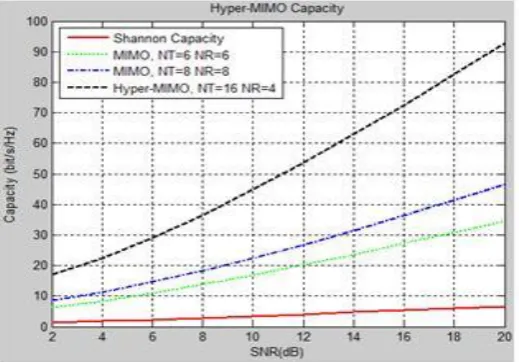
The potential/capacity for Hyper-MIMO system are shown in the following figure3The capacity of the system
capacity is implemented in Matlab for the simulation.
We can see that as increase in number of antennas in transmits side, potential/capacity is increasing. Here the black
line is showing the capacity of Hyper-MIMO systems and green and blue lines show the system capacity for 6x6
and 8x8 MIMO systems respectively. Thus, at high SNR, the capacity increases linearly with the number of
antennas at both transmitter and receiver side. Hyper-MIMO system is approximately three times the capacity of
the MIMO systems. Thus, at high SNR, the capacity/potential increases rapidly with the number of antennas at
transmitter side.
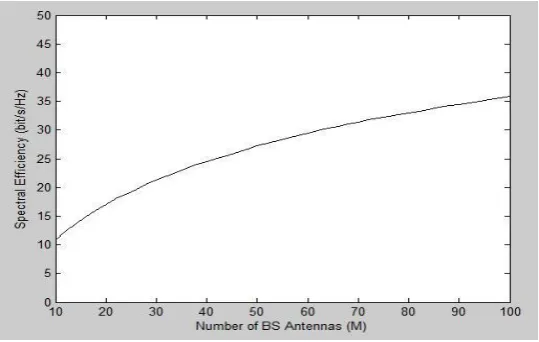
The Spectral efficiency vs Maximal Ratio Precoding of the Hyper-MIMO during downlink transmission is shown
inFig3.2.Here concrete for downlink transmission with K = 10 users, an SNR of 5 dB, and uncorrelated Rayleigh
fading channels.
Fig. 4: Downlink Simulation with MR Precoding
The Spectral efficiency vs Zero Forcing Precoding of the Hyper-MIMO during downlink transmission is shown in
figure 3.3.
7. CONCLUSION
The simulation result shows that the number of transmit antennas increases, the channel capacity/potential increase
quite rapidly, as well as spectral efficiency as shown in figure, which is required to implement in 5G. The Hyper-
MIMO system shows the maximum capacity and spectral efficiency which has been proved by simulations. If the
values of transmit antennas can be reached in thousands, the channel capacity and spectral efficiency will be large
and high data rate is possible without any doubt, it can be very useful to full- fill the hope of 5G and even more.
REFERENCES
[1] Md.Shoriful Islam, Md.Kamruzzaman, Tazkia Jessy, “Performance Analysis of Massive MIMO for 5G
Wireless Communication Systems IEEE Acess.2016.
[2] Elias Yaacoub, Mohammed Husseini, Hassan Ghaziri “An Overview of Research Topics and Challenges for
5G Massive MIMO Antennas, IEEE @Con 2016.
[3] G. J. Foschini and M. J. Gans, “On limits of wireless communications in a fading environment when using
multiple antennas, Wireless Pers. Commun., vol. 6, pp. 311335, Mar. 1998.
[4] Jon.W.Wallace, Michael A. Jensen A. Lee Swindlehurst and, Brian D. Jeff, “Experimental Characterization of
the MIMO Wireless Channel: Data Acquisition and Analysis IEEE Transaction in wireless communication 2003.
[5] Sk. Saddam Hussain, Shaik Mohammed Yaseen and Koushik Bar-man “An Overview Of Massive MIMO
System IN 5GI-JCTA, 9(11) 2016, pp 4957-4968.
[6] Yamini Devlal1, Mrs. Meenakshi Awasthi “Capacity Analysis of MIMO Technology, in IJEC, ISSN:
2319-7242 Volume 4 Issue 1 January 2015, Page No. 9819-9824.
[7] Thomas L Marzetta Massive MIMO An Introduction 15387305/14 Volume 20 Bell Labs Technical
Journal.
[8] David Tse, Pramod Viswanath. “Fundamentals of Wireless Communication”.
[9] Massive MIMO Wireless Networks: An Overview Noha Hassan Electronics 2017.
![Fig. 1: General 5G cellular network architecture [5]](https://thumb-us.123doks.com/thumbv2/123dok_us/1374526.1647630/2.595.171.428.297.473/fig-general-g-cellular-network-architecture.webp)
![Fig. 2: Hyper- MIMO: a multi-user MIMO technology [7]](https://thumb-us.123doks.com/thumbv2/123dok_us/1374526.1647630/3.595.186.421.422.544/fig-hyper-mimo-a-multi-user-mimo-technology.webp)