Open Source Software: A Case Study of Spoken Tutorials
Inderpreet Kaur
Dept. of comp Sci. Mata Sahib Kaur Girls College Talwandi Sabo, Punjab, India
Abstract
This paper describe the open source technology and also describe IT literacy promotion drive in India, using Spoken Tutorials, offered
through organized self-learning workshops. Further define the steps
that taken to make the Spoken Tutorials suitable for self-learning are described. As the Spoken Tutorial activity is restricted to open-source software, practice-based learning is possible, thereby being as effective as active learning. In addition this study describes the advantages and disadvantages of open source software in different
field of education and business. Digital India also promotes open
source software in its applications. Government of India also take initiative to adopt open source collaborate it with existing application and provide interface to access these applications. There are number of reasons of popularity of spoken tutorials. The user having no knowledge about accessibility of open source code and no guidance provide by the developers. Only the spoken
part of these tutorials is dubbed into Indian languages, benefiting
a large number of students who are weak in English, which is nevertheless widely spoken in India. India spends a large amount of money on personal computers and proprietary software like
Microsoft office, Windows etc, whereas these software are free like Linux etc, and therefore it helps in countries economy. Data
collected from different sources to describe the accessibility of spoken tutorials. In India around 22 lakh students and teachers from all states of India, have taken this Software training. Students
from rural places have also benefited from this training.
Keywords
Open Source Software, Spoken Tutorial
I. Introduction
Open Source Software (OSS) came into existence with the development of ICT. The term “open source” refers to software that includes the original source code, used to create it so that users can modify it to make it work according to their needs. It also includes the right of redistribution; therefore, there may be
products that are based on other open source products. While the
software may be free, a developer or distributor may charge for services including special programming, installation, training and technical support, etc. In general, the source code of OSS is widely accessible, freely available and reusable. The most popular source license, the General Public License (GPL), allows almost full use and re-use of source code.
II. History of Open Source Software
Open source software has been around since the very beginning of electronic computing. In the early days of information technology
it was quite natural and financially sound for developers to share
source code among very few and very expensive computing
machines. As the machines became smaller, more diversified,
and cheaper, the number of developers grew, and the source code,
in general, became more complex. Development of free software was especially flourishing in the academic environments. Barkley Software Distribution (BSD) is license developed for distribution of BSD version of Unix operating system developed by University
of California Berkeley from 1977 to 1995 in collaboration with AT&T labs, as described by Raymond (2001). At the beginning of the development, code was shared between AT&T and Berkeley. Due to a divestment in 1984 it became a proprietary AT&T product. Since the beginning of 1980s, the idea of close sourced/proprietary
software became mainstream, taking the place that free software sharing has held for a long time. The open source supporters went to found their own organizations such as free software foundation
(FSF) founded by Richard Stallman, as described by Weber (2004).
The FSF did not have desired impact on bringing back open source software development to the mainstream. However, this situation was about to change with the successful release of Linux kernel. The system initially developed by the Linux Torvalds as a part of academic project, with the support of the developer’s community came to produce very complex, sophisticated software that was free for everyone to use. Eric Raymond was very much inspired by this set of events, that in his now famous book”The Cathedral
and the Bazaar” he talks about the importance of Linux, as it was the very first time the open source developer community
showed that not only complex and sophisticated software can be built in such way, but also that business models can be built around such way of software development and distribution. In
1998, Raymond was one of the main contributors to the Open
Source Initiative (OSI), an organization that is envisioned as open source educational and advocacy organization. Many companies have followed the suit, and decided to open source a piece of their proprietary software as a part of business strategy to deal
with the competition. Thus, among the initial suitors we can find
Netscape Corporation, by open sourcing Netscape internet browser tried to compete against closed source and free distribution of
Microsoft’s Internet Explorer (Raymond (2001)). In the past 10
years, many companies have entered the open source business arena, using some of the business models proposed by Raymond
(2001). Unfamiliar with the environment, companies had very
quickly to readjust their way of doing business in order to ripe some
perceived benefits of open source trends. Besides open sourcing
software, companies tend to participate and contribute to open source projects, as well as adopt some of software development methodologies such distributed and voluntary based development community as open source utilizes
III. Open-source v/s Closed Source
Open source software is based on the idea that the user can not only view but also can change the source code of the existing application. Open source licenses affect the way people can use, study, modify, and distribute software. In general, open source licenses grant computer users permission to use open source software for any purpose they wish. Closed source only the original authors of proprietary software can legally copy, inspect, and alter that software. And in order to use proprietary software, computer users must agree (usually by signing a license displayed
the first time they run this software) that they will not do anything
with the software that the software’s authors have not expressly
permitted. Microsoft Office and Adobe Photoshop are examples
IV. Advantages of Open Source Software
A. Lower Cost
It has lower costs, and in most cases this is only a fraction of the cost. According to studies, open source software collectively helps business owners save around $60 billion a year.
B. Free to use
Open source is a fairly new concept that has gained huge popularity
in the field of IT in recent years, because open-source software is free to use, distribute and modify. It is developed by a non-profit
community.
C. Secure
Open-source software is more secured as the code is accessible
to everyone. Anyone can fix bugs as they are found, and users do
not have to wait for the next release. The fact that is continuously analyzed by a large community produces secure and stable code.
D. Highly Reliable
There are two main reasons why open source software is reliable.
First of all, they are developed chiefly by skillful and talented
experts who do their best to create high-quality programs. Second, they are worked on by tens or hundreds of people, which means there are numerous eyes that can monitor for the presence of
bugs and many pairs of hands that can fix these defects within the shortest amount of time. Both of these factors lead to products that
have excellent quality and helpful features and perform well.
E. Freedom
Unlike closed proprietary software, OSS can be altered and
extended by any developer familiar with the source code. This grants organizations freedom from “vendor lock-in” and assures long-term viability
F. No Dependency
Open source is not depend on the company or author that helps to create it. Even if the company fails, the code continues to exist and be developed by its users.
V. Disadvantages of Open Source
A. Training Needed
The main disadvantage of open-source software is not being straightforward to use. Open-source operating systems like Linux cannot be learned in a day. They require effort and possibly training from your side before you are able to master them. You may need to hire a trained person to make things easier, but this will incur additional costs.
B. Compatibility
There is a shortage of applications that run both on open source and proprietary software; therefore, switching to an open-source platform involves a compatibility analysis of all the other software used that run on proprietary platforms. Many of the latest hardware are incompatible to the open-source platform; so, you have to rely on third-party drivers.
VI. Uses of Open Sources in Education
There are many benefits of open source software to teachers, students and places of education. With open source software,
your school, college can take control of its computer resources and manage its IT future.
A. Lower Total Cost of Ownership
Most open source operating systems are low-cost or free for educational use. They come with a variety of useful administration tools and user applications.. However, these operating systems
are very much like Microsoft Windows or Microsoft NT from an
administration point of view and these differences often make it necessary to either employ a system administrator or contract
the system administration out to a qualified professional. Hiring
external system administration may appear to stretch the IT budget. Keep in mind, though, that if you use an open source operating system, you would not have to pay large license fees for each
computer’s operating system. What is more there are many open
source software packages that also come at lost cost but provide equivalent functionality to the propriety alternatives. For example,
the word processing tasks: OpenOffice, A free multi-platform office productivity suit. It includes the key desktop applications
such as a word processor, spreadsheet, presentation manager and
drawing program similar to Microsoft Word.
B. Greater Learning of Concepts Rather than Products
Exposing students to Linux will have a long-term impact on its growth in other areas. The primary reason many companies have spent millions of dollars on Microsoft software is that people know
it. In 5 years today’s 9th grade students will be in the workforce.
If they’re already comfortable with open source software, it will make it that much easier for open source software to move
farther into other sectors. Unfortunately, at the moment we’re in a
situation where propriety software has become the default standard everywhere. People are unwilling to learn how to use alternative products because it’s not what they will need to know in business.
Businesses are unwilling to change to alternative products because they will have to face retraining costs. What this means to schools
is that there’s a greater emphasis on teaching how to use certain products to students rather than teaching them the basic concepts behind the use of those products.
Instead of teaching students the basics of good layout for essays, teachers often end up teaching students how to layout their essays using a particular product. Instead of teaching student’s basic computer presentation skills teachers often end up teaching students how to use a particular product for presentation. These lessons are useful but they did not achieve their original purpose.
C. Lower Costs for Student’s Home Systems
Running the latest Microsoft Office suite at school disadvantages
the students whose machines at home are too old to run these products as well as those who cannot afford to upgrade. Files
saved in the latest version of MS Word cannot be read by previous versions. Files saved in previous versions of MS Word lose much
of their careful formatting when being opened in the latest version.
Since Microsoft upgrades its Office suite regularly, and none of
these are particularly backwards compatible with the previous
versions, a family may find themselves paying to upgrade their
software several times and probably their hardware once or twice during the education of one student. Fortunately many of the open source software products run on lower end machines with very
little difficulty. What is more, since files are saved in open formats it is possible to move files between different versions of many
products can also read and save files in the Microsoft Word format.
Choosing to run open source software, where possible, on your school computers allows parents to save money by not requiring
them to upgrade their computer and software just so that files can
be used both at home and at school.
D. Works well on Older Hardware
We have already mentioned that many open source packages can
run quite on older machines. Schools rarely have the money to buy the latest hardware but frequently software upgrades require hardware upgrades in order to perform reasonably. Many businesses regularly replace older machines with new in order to keep up with their software’s hardware requirements. These machines are usually in good working order but in the Microsoft world they are essentially useless. The Linux Terminal Server Project (LTSP) helps side-step this problem. LTSP allows labs to be deployed with most of the machines as diskless workstations which boot
from a network server. By using LTSP a school or college can
quickly increase the number of available workstations for students without a large expenditure on hardware or software licensing.
With LTSP in place, a few faster machines can be configured as
servers perhaps one per lab. If there is adequate hardware available,
it is possible to set up networked home directories. Users would effortlessly have an office suite, email and browser.
Administrative costs for software updates are reduced, due to centralized control and virus updating, there is less risk from viruses and worms, software licensing and hardware costs are reduced.
E. Customization
Open source means you have access to the source code of the software. You have permission to change the software and correct the things that are bothering you, or add new features, or take features away. And if you don’t have the skills to change these
things, you have permission to get other people to fix them for you.
You have permission to make copies of your changed software and install them wherever you need them. In fact, so long as you comply some fairly simple requirements, you even have permission to spread your new copies of the software far and wide. Open source software is much more customizable than propriety software because ultimately, if you don’t like it, you can change it. In some cases, changing the software may not be practical, but in many cases, whole systems can be put together
in ways that match the specific requirements of your school just
by gluing together existing open source packages.
VII. Why it is Important for India?
A. Economic
India spends a large amount of money on personal computers
and proprietary software like Microsoft office, Windows XP etc,
whereas this software are free like Linux etc, and therefore it help in countries economy.
B. Localization Support
Localization play a major role in adoption, as government can use technology to communicate to citizens in their own language.
For example, Red hat Enterprise Linux Desktop is available in 11 Indian languages.
C. The Power E-Governance
The E-Governance utilizes its time and wealth on software
development. It can be made more efficient if it adopts the
open source model that promotes the sharing of software code. Government departments across different states have the same requirements and instead of each government department developing separate programs for the same task, they could share the same code base and make minor changes to suit the needs of the each state.
D. Better Security
E-governance software uses Citizens personal data, it need more protection and security and the same is provided by the Open
Source Software as the source can be evaluated and fixed by open
source community and the system vulnerabilities often discovered by the community itself not by hackers.
E. Independence from Western Countries:
Open Source Software can make our Country independent from
Western Countries. We do not need to depend on their software
companies as by open source we can download, modify and use it the way we want without paying any penny for all these purposes.
VIII. How Digital India Helps?
A flagship program of Government of India, Digital India is policies related to Open Source. In 2015, Department of Electronics &
Information Technology of Ministry of Communication & Information Technology released three major policies related to open source. These policies are quite comprehensive and are potential game changers.
A. Policy on Adoption of Open Source Software for Government of India
The most important policy among these is Policy on Adoption of Open Source Software for Government of India.
“Policy on Adoption of Open Source Software for Government of India (GoI)” is released to encourage the formal adoption and use of Open Source Software in government organizations. To ensure
strategic control in e-Gov applications and systems and define
framework for adoption of OSS along with reducing the total cost of ownership are core objectives of the policy. The Framework for Adoption of Open Source Software In e-Governance Systems is already prepared. The policy statement clearly says, “Government of India shall endeavor to adopt Open Source Software in all e-Governance systems implemented by various Government organizations, as a preferred option in comparison to Closed Source Software”, and that “The source code shall be available for the
community/adopter/end-user to study and modify the software and to redistribute copies of either the original or modified software.”
It also says, “Source code shall be free from any royalty.”
B. Policy on Collaborative Application Development by opening the Source Code of Government Application
This is another important policy related to open source philosophy.
By this policy, the Government of India wants to promote re-use of existing developed applications. By opening the source code,
the Govt. of India wants successful, scalable, high-quality e-Gov applications to be developed in a collaborative manner. It also wants new applications to be developed to encourage creativity — both inside and outside the Government by encouraging
collaborative development between Govt. departments/agencies
source open approach including the use and release of application source code to public can reduce costs and development time and improve the overall quality and security through increased transparency and mass peer review. A Collaborative Application
Development Platform is being prepared to achieve the objective
of the same
C. Policy on Open Application Programming Interfaces (APIs) for Government of India
Under the overarching vision of Digital India, Government of India
aims to make all government services digitally accessible to citizens through multiple channels, such as web, mobile, and common service delivery outlets. To meet this objective, there is a need for an interoperable ecosystem of data, applications and processes which will make the right information available to the right user at the right time. For promoting Open Standards for software interoperability across various Government departments and
agencies, GoI has already notified the “Policy on Open Standards
for e-Governance” and “Technical Standards on Interoperability Framework for e-Governance”. The worldwide initiatives on “Open Government” also focus on open APIs to easily access the information collected by Government organizations. This policy intends to encourage the formal use of Open APIs in Government organizations. This policy sets out the government’s approach on the use of “Open APIs” to promote software interoperability for all e-Governance applications & systems and provide access to data and services for promoting participation of all stakeholders
including citizens. Significant work in the field of Open Source has happened in India earlier as well, but this is the first time
concrete and comprehensive policies are in place to guide the agencies of the Government of India. The implementation of the policies has been started and we are hopeful that open source, like in other parts of the world, will be hugely helpful and successful in bridging the digital divide in India.
IX. Initiative to Promote FOSS
The Government of India has taken another initiative and seek help
from country’s premier institutes to participate in DIGITAL INDIA
project and promote use of FOSS for achieving the objectives explained earlier. The IITs have started spoken tutorials concept to reach students and institutions for promoting FOSS. It has been
successful in achieving the desired objectives. We are trying to
put before the data proving the success of the “Spoken Tutorials” project.
It is well known that seeing and hearing someone explain a process greatly improves understanding. Audio-video demonstrations can illustrate features with maximum clarity. The Spoken Tutorial
project (launch on the 26th of January, 2010) is the initiative of the
‘Talk to a Teacher’ activity of the National Mission on Education through Information and Communication Technology (ICT),
launched by the Ministry of Human Resources and Development,
Government of India. Learning is more effective when animation and narration are presented simultaneously. The objective is to pass on the knowledge of technology and free and open source software (FOSS) through the website to the millions in our country
who lack opportunities and/or access to learn any software.
The spoken Tutorial Project aims to make spoken tutorials on FOSS available in several Indian languages for the learner to be
able to learn in the language he/she is comfortable in.
There are number of reasons of popularity of spoken tutorials. Lack of knowledge about accessibility
1.
Lack of proper guidance 2.
Lack of infrastructure facilities available 3.
Difficulty in understanding English 4.
The goal is to enable the use of spoken tutorials to teach in any Indian language and to be taught to learners of all levels of
expertise - Beginner, Intermediate or Advanced.
The target group is the community at large, including school children, college students, working professionals, retired professionals, housewives, teachers, trainers, research scholars, software users and developers. They also conduct software training
workshops using spoken tutorials and give certificates to those
who pass an online test.
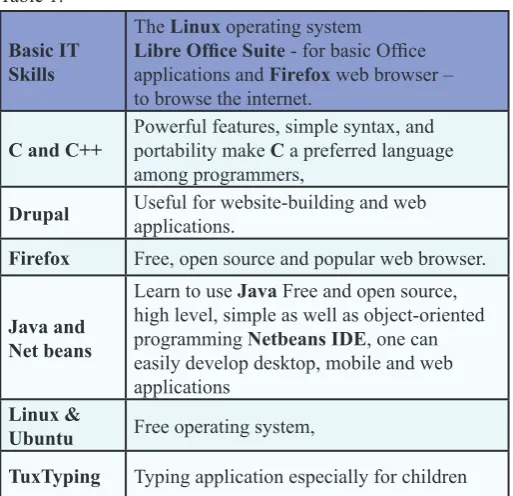
The Spoken Tutorial Project is about teaching and learning a particular FOSS (Free and Open Source Software)
Table 1:
Basic IT Skills
The Linux operating system
Libre Office Suite - for basic Office
applications and Firefox web browser – to browse the internet.
C and C++ Powerful features, simple syntax, and portability make C a preferred language among programmers,
Drupal Useful for website-building and web applications. Firefox Free, open source and popular web browser.
Java and Net beans
Learn to use Java Free and open source, high level, simple as well as object-oriented programming Netbeans IDE, one can easily develop desktop, mobile and web applications
Linux &
Ubuntu Free operating system,
TuxTyping Typing application especially for children (Source: SpokenTutorial.com)
The trainings started in July 2011. These have spread across several Institutions - Degree colleges, Polytechnics, ITIs and even Schools, NGOs, Govt. Offices and some Corporations. Present
survey concludes around 22 lakh students and teachers from all states of India, have taken this Software training. Students from
rural places have also benefited from this training. Any College / University which wishes to contribute towards IT literacy and awareness can become a RESOURCE (Robust Extensions for Spoken Tutorial project on Open Source Software Usage
for Recruitment, Community and Education) Center. A
RESOURCE Center can conduct remote SELF workshops in its
college, for other colleges and can also train other colleges and schools in conducting Spoken Tutorial SELF training.
Table 2:
Total number of Workshop/Training 43002
Participants Count 2268846
Total no. of Institutions 3009
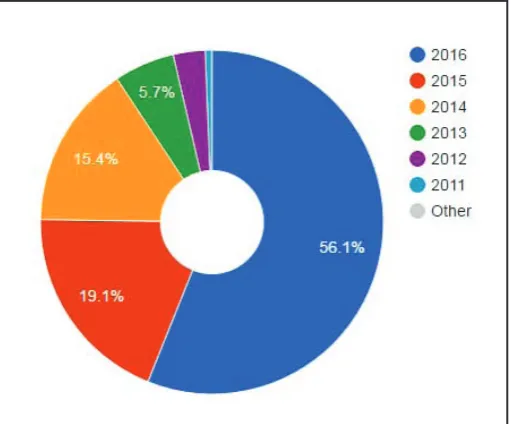
Fig. 1:
X. Conclusion
The present study describes the use of open source software in deferent departments of government. The advantages and disadvantages of open sources are determined from deferent
research studies. The education system also gets benefits from
open source software. In addition, it describes how spoken tutorial promotes open source software through free training program. Further, identify the goal to enable the use of spoken tutorials to teach in any Indian language and to be taught to learners of all
levels of expertise - Beginner, Intermediate or Advanced.
References
[1] Pedagogical and Organisational Issues in the Campaign
for IT Literacy Through Spoken Tutorials by Kannan M. Moudgalya
[2] Evaluation of student perceptions and interests using Spoken
Tutorials in online courses by Kiran L. N. Eranki, bKannan M. Moudgalya
[3] A Brochure on Aakash applications. [Online] Available: http://aakashlabs.org/builds/Aakash_brochure_ inside_20_11_2013.pdf and [Online] Available: http:// aakashlabs.org/builds/Aakash_brochure_outside_ 20_11_2013.pdf
[4] Ministry of Human Resource Development. National mission on education through ICT. [Online] Available: http:// www. sakshat.ac.in
[5] Introduction to Linux by Machtelt Garrels Beginning PHP and MYSQL By W. Jason Wilmore
[6] Spoken tutorials portal. [Online] Available:
http://spoken-tutorial.org
[7] Open office Basic: An Introduction By James Steinberg [8] Wikipedia, the free encyclopedia
[9] Google.co.in