Analyzing IoT Reference Architecture Models
Atefeh Torkaman1 and M.A.Seyyedi2
1
ITRC, Tehran, Iran
2 South Islamic Azad University, Tehran, Iran
1[email protected], 2[email protected]
ABSTRACT
These days, every one talk about new technology; Internet of things (IoT) which includes multiple different categories such as; Wireless sensor networks, Low power embedded systems, Internet-connected wearables,etc. High degree of heteroge-neity in devices, functionalities and network protocols are exist in this area. So, a comprehensive reference architecture model is necessitate to homogenize these diversity and define a set of building blocks for IoT environment. In this paper, an ITU_T standard IoT reference architecture is discussed. Four reference architecture projects; the IoT_A, WSO2, Korean and Chinese perspectives are explores. Finally, the characteristics and capabilities of these projects are investigates.
Keywords: Internet of Things, Wireless Technology, Security Issues.
1. INTRODUCTION
Internet of things is a scenario in which all the things are connected to the internet through the information sensing devices for the purpose of intell-igent identification and management [1].
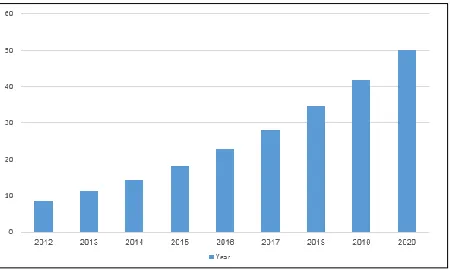
The growth of the number and variety of devices that are collecting data is incredibly rapid. A study by Cisco estimates that the number of Internet-connected devices overtook the human population in 2010, and that there will be 50 billion Internet-connected devices by 2020 [2].
Fig. 1. Related Work
Although, IoT provides new opportunities but also brings new challenges on the interaction between things, levels of functionalities, security, etc. This motivates, first, the creation of a Reference Model for the IoT domain in order to promote a common understanding. Second, a Reference Architecture should be consider to explain essential building blocks to deal with conflicting requirements regarding functionality, performance, deployment and security.
Reference model is a division of functionality into elements together with the data flow among those ele-ments [14].
A reference architecture handles those requirements and forms a superset of functionalities, information struc-tures, mechanisms and protocols [3].
This paper, first, explains IoT reference model recom-mended by ITU_T. Then, 4 IOT architecture reference projects; IoT_A, Korean RA, Chinese RA and WSO2 are studied. At the end of the paper, different properties of these models are analyzed and compared.
This paper is organized into 6 sections. The following section investigates some studies related to the Internet of things, IoT reference models and reference. In section III, IoT reference model and architecture are discussed. Section IV explains essential requirements in IoT architecture. Analyzing the IoT architectures are shown in section V. and finally, section VI, presents the conclusion of the study.
2. RELATED WORK
The authors of paper [3] talked about IoT reference architecture and its important requirements. In this research the evolution of the IoT reference architecture was discussed.
In [7] IoT challenges on technologies, applications, and standardization were depicted, also an open and general IoT architecture consisting of three platforms to meet the architecture challenge was proposed. Finally, this paper has discussed the opportunity and prospect of the Internet of Things.
The authors of [8] have introduced two reference architectures for IoT, namely the IoT_A Architectural Reference Model and the reference architecture proposed by WSO2. Analyzing the characteristics of these two projects were described at the end of the paper. References [9, 12] mainly have focused on the concept of Internet of Things, architecture and security issues with suggested countermeasure and suggested further areas of research needed.
Reference Architecture has comprehensively discussed in [10]. The authors of this paper have examined Reference Architectures and the driving forces behind development of them.
A Study report on IoT Reference Architectures and frameworks has provided by the authors of reference [11]. In this report, the reference models proposed by ISO, ITU_T were investigated and some reference architecture model such as; Korean RAM, IEEE P2413 etc. were studied.
Reference [13] has generally introduced the Internet of things, its features, challenges and vulnerabilities. This study has searched to assess the emergency challenges due to different attacks in IoT infrastructure, and physical security of the sensors.
3. IOT REFERENCE MODEL &
REFERENCE ARCHITECTURE
A Reference Model is an abstract framework for understanding significant relationships among the entities of some environment [14].
The IoT Reference Model provides the highest abstraction level for the definition of the IoT Architectural Reference Model.
Up to now, few standard committees have been researched in IoT reference model. Among them, the International Telecommunication Union (ITU) is one of the best organizations that proposed a comprehensive reference model in IoT environment.
In this regard, an overview of the Internet of things (IoT) has provided by ITU-T Y.2060. It clarified the concept and scope of the IoT, identified the fundamental characteristics and high-level requirements of the IoT and described the IoT reference model [5].
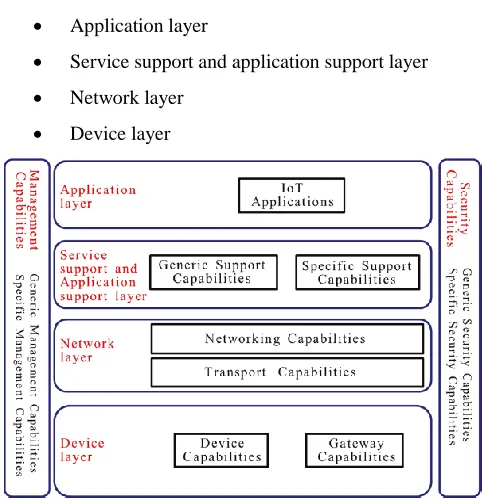
The reference model tries to establish a common grounding for IoT architectures and IoT systems. Fig 2 shows the ITU recommended reference model for IoT. It is composed of four layers as well as
management and security capabilities which are associated with the four layers.
The four layers are as follows [5]:
Application layer
Service support and application support layer
Network layer
Device layer
Fig. 2. ITU-T recommended IoT Reference Model
Application layer: which contains IoT applications. Service and application support layer: consists of common capabilities which can be used by different IoT applications and various detailed capability groupings, in order to provide different support functions to different IoT applications.
Network layer: provides relevant control functions of network connectivity and IoT services and applications transportation.
Device layer: includes direct/indirect device interaction with the gateway and communication network.
Management capabilities: how to manage the devices, traffic and etc.
Security capabilities: includes authorization, authentica-tion, application data confidentiality and integrity protection, privacy protection, security audit, anti-virus and etc.
A Reference Architecture maps onto software elements that implements the functionality defined in the Reference Model [14].
Architecture handles requirements and forms a superset of functionalities, information structures, mechanisms and protocols [3].
Beneficial Uses of the IoT Reference Architecture [6]:
It provides a language for everyone involved.
It provides an abstract but also rich view of the domain.
Can assist IoT project leaders in planning the work at hand and the teams needed.
3.1 IoT Reference Architecture Projects
Few proposals have been introduced so far in IoT Reference Architecture model. In this paper, four known models were investigated;
IoT_A Architectural Reference Model (IoT_A)
proposed by European Commission (FP7 )
IoT Reference Architecture developed by the WSO2
company
Korean IoT Reference Model
Chinese IoT Reference Model
3.2 IoT-A
Architectural
Reference Model [6]
European Commission within the Seventh Framework Program (FP7) has supported the proposed project; IoT_A1 by Martin Bauer and et.al.
The recommended reference architecture provided high-level architectural views and perspectives for constructing IoT systems [6].
Fig. 3. IoT_A's Views and perspectives
Views: different angles for viewing an architecture that can be used when designing and implementing it.
1 Internet of Things Architecture (IoT-A): http://www.iot-a.eu/
Perspectives: set of tasks, tactics, directives, and architectural decisions for ensuring that a given concrete system accomplishes one or more quality attributes.
Architectural views concludes:
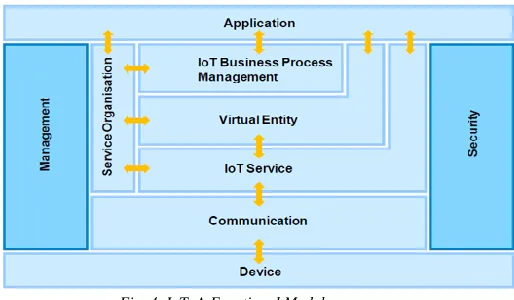
Functional view: Figure 4 depicts the Functional View. It consists nine functionality groups, each one with one or more functional components.
Information view: it describes the components that handle information, the static and dynamic information flows through the system.
Deployment and operation view: this view investigates how the IoT component communicate with each other.
Each perspective encompasses:
a desired quality level
relevant IoT requirements
applicability to (types of) IoT systems
activities to achieve the desired qualities
architectural tactics to be used by architects
Fig. 4. IoT_A Functional Model
3.3 Korean Architectural Reference Model [5]
The Korean Study group has specified IoT reference architecture from a communication viewpoint and a functional viewpoint.
Fig.5. Functional view of IoT RA[5]
Figure 6 shows detailed architecture of IoT Platform. Specifically it specifies details of Core Functions in Functional view of IoT RA in Figure 5.
Core Functions consists of Connectivity & Underlying Network Management, Resource & Service Management, Semantics & Knowledge, and Security & Privacy [5].
Fig. 6. IoT Platform detailed architecture [5]
3.4
Chinese Architectural Reference Model
China Communications Standards Association (CCSA) has proposed a reference architecture model for the IoT, which consists of sensing layer, network and business layers, and application layer [7].
Fig.7. IoT reference architecture proposed by CCSA [6]
Figure 7 shows its open and general architecture, which is layered, open, and flexible.
The architecture includes three functional platforms as follows [7]:
Sensing layer : connects sensors, controllers, RFID readers, and location sensing device to IoT network layer
Network and service layer: includes backbone networks and resource administration platforms.
Application layer: includes various applications in IoT system.
3.5
WSO2 Architectural Reference Model
WSO2 an American company has proposed an Architectural Reference Model based on its expertise in the development of IoT solutions.
Figure 8 depicts WSO2 recommended architecture. It consists of five layers [8]:
Device Layer: each device should have a unique identifier and direct or indirect communication with the Internet.
Communications Layer: supports device connectivity with multiple potential protocols
Aggregation/Bus Layer: supports, aggregates, and combines communications from several devices, as well as bridges and transforms data among different protocols.
Event Processing and Analytics Layer: processes and reacts upon events coming from the Aggregation/Bus Layer, as well as can perform data storage.
External Communications Layer: through which users can interact with devices and access data available at the system.
Device Management Layer: communicates with devices through different protocols and allows remotely managing them.
Identity and Access Management Layer: responsible for access control and security directives.
4. IOT REFERENCE ARCHITECTURE
REQUIREMENTS
IoT Requirements have been recommended by various consortia, and manufacturers. Some of them have direct or indirect influence on the design and architecture of an IoT systems. They may be apply to all systems or a particular domain or application area.
According to ITU-T Y.2066 [11] the IoT common requirements are divided into functional and non-functional requirements.
Non-functional: requirements refer to the requirements related to the implementation and operation of the IoT itself.
Functional requirements: refers to the requirements related to the IoT actors, i.e., entities which are external to the IoT and that interacts with the IoT.
IoT functional requirements are categorized as follows [11]:
Application support requirements
Service requirements
Communication requirements
Device managements
Data management
Security
Confidentiality and privacy
Non-functional requirements includes:
Interoperability
Scalability
Reliability
Availability
Application support requirements: These requirements are only related to the "service provider" actor.
Service requirements
:
These requirements are related to the service provider, IoT user and thing actors.Interoperability: any communication and movement should be supported by IoT.
Scalability:The IoT RA should support a large range of applications varying in size, complexity, and workload.
Reliability: such as reliability in communication, service and data management etc.
Availability: is required in service provisioning, data management, communication, sensing and actuating things of IoT.
Security: The IoT RA should support secure components, communications, access control to the system and the management services and data security [5].
Confidentiality and Privacy:The IoT RA should support the confidentiality and privacy requirements of an IoT implementation [5].
Device requirements: refer to the functional requirements from the piece of equipment connected with things [11].
Service requirements: These requirements are related to the service provider, IoT user and thing actors [11].
Communication requirements: refer to the functional requirements related to message exchange among the IoT user, service provider, data manager and thing actors [11].
Data management requirements: refer to the functional requirements from storing, aggregating, transferring and etc. [11].
5. ANALYZING IOT REFERENCE
ARCHITECTURES PROJECTS
In order to achieve better platform and systems in the field of Internet of Things, Reference Architecture must fulfilled most of the discussed requirements.
In this section, four mentioned reference architectures projects according to the listed requirements, are compared.
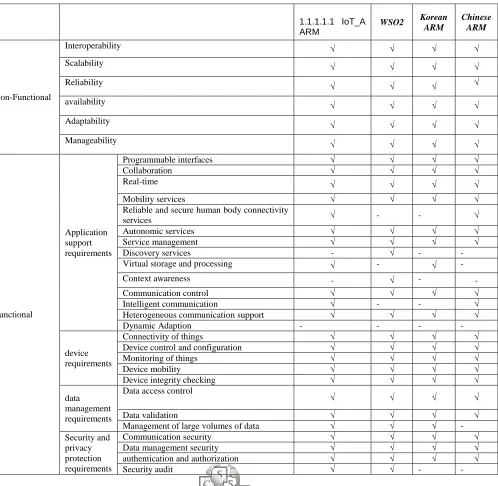
As shown in Table 1, all of the non-functional requirements encompassed by the four IoT reference architecture projects.
Some of the functional requirements are not addressed by these projects. Among them, dynamic adaption should be consider in IoT reference architecture, due to the high dynamicity of IoT environments.
These days, large volume of data is another important issue in data mining and IoT systems which Chinese projects did not talk about this capability.
The reference architecture of IoT systems should support Context-Awareness. Only WSO2 includes this The IoT_A, unlike the other projects, supports the implementations involving safe human body capability accordingly claims that it is flexible, customized and has
autonomic services based on the related context of IoT components. connectivity. In this regard, quantified reliability, security and privacy protection is required. Discovery services is another issue which should be defined in IoT architecture, WSO2 can discover devices according to different criteria, such as geographic location information, type of device, etc.
Table 1: Analyzing reference architectures projects
1.1.1.1.1 IoT_A ARM
WSO2 Korean
ARM
Chinese ARM
Non-Functional
Interoperability √ √ √ √
Scalability √ √ √ √
Reliability √ √ √ √
availability √ √ √ √
Adaptability √ √ √ √
Manageability √ √ √ √
Functional
Application support requirements
Programmable interfaces √ √ √ √
Collaboration √ √ √ √
Real-time √ √ √ √
Mobility services √ √ √ √
Reliable and secure human body connectivity
services √ - - √
Autonomic services √ √ √ √
Service management √ √ √ √
Discovery services - √ - -
Virtual storage and processing √ - √ -
Context awareness - √ - -
Communication control √ √ √ √
Intelligent communication √ - - √
Heterogeneous communication support √ √ √ √
Dynamic Adaption - - - -
device requirements
Connectivity of things √ √ √ √
Device control and configuration √ √ √ √
Monitoring of things √ √ √ √
Device mobility √ √ √ √
Device integrity checking √ √ √ √
data management requirements
Data access control
√ √ √ √
Data validation √ √ √ √
Management of large volumes of data √ √ √ -
Security and privacy protection requirements
Communication security √ √ √ √
Data management security √ √ √ √
authentication and authorization √ √ √ √
6. CONCLUSION
IoT brings a newer information society and cognitive science. Wide variety of devices and protocols in the IoT environments make the development of the IoT systems more challenging.
In this paper, ITU_T Reference Model was defined. Four recent projects of IoT Reference Architectures, namely the IoT_A and the Reference Architectures proposed by the WSO2, Korean and Chinese Reference Architectures were surveyed.
Some important requirements of these projects were compared and analyzed.
It was observed that some of the projects need to fulfill the essential requirements such as reliability, management of big data, security and etc.
According to different challenges in IoT environments and existence of some weaknesses in IoT architectures, the authors of this paper believe that, more research and attention on IoT reference architectures is evitable.
REFERENCES
[1] Shao Xiwen “Study on Security Issue of Internet of Things based on RFID” 2012 4th International Conference on Computational and Information Sciences.
[2] Paul Fremantle, a Reference Architecture for the Internet of Things, WSO2, October 20, 2015.
[3] Michael Weyrich and Christof Ebert, “Reference Architectures for the Internet of Things”, published by the IEEE computer society, 2016
[4] http://docs.oasis-open.org/soa-rm/soa-ra/v1.0/soa-ra-pr-01.pdf
[5] Study Report on IoT Reference
Architectures/Frameworks, ISO, 2014
[6] Martin Bauer , Mathieu Boussard, Nicola Bui, Francois Carrez, Pierpaolo Giacomin , Stephan Haller, Edward Ho, Christine Jardak, Jourik De Loof, Carsten Magerkurth, Stefan Meissner, Andreas Nettsträter, Alexis Olivereau , Alexandru Serbanati, Matthias Thoma, Joachim W. Walewski., "Internet of Things – Architecture ( reference model for IoT) ", European Commission within the Seventh Framework Programme (2007-2013).
[7] Shanzhi Chen, HuiXu,DakeLiu, Bo Hu, and Hucheng Wang, " A Vision of IoT: Applications, Challenges and Opportunities With China Perspective ", Ieee Internet Of Things Journal, Vol. 1, No. 4, August 2014. [8] Everton Cavalcante, Marcelo Pitanga Alves, Thais
Batista, Flavia C. Delicato, Paulo F. Pires, "An Analysis of Reference Architectures for the Internet of Things", CobRA '15, Pages 13-16, 2015.
[9] Mayuri A. Bhabad, Sudhir T. Bagade, “ Internet of Things: Architecture, Security Issues and Countermeasures” , International Journal of Computer Applications (0975 – 8887) Volume 125 –No 14, September 2015
[10]Robert Cloutier, Gerrit Muller, Dinesh Verma, Roshanak Nilchiani , Eirik Hole , Mary Bone, “The Concept of Reference Architectures” , Systems Engineering Vol. 13, No. 1, 2010.
[11]Common requirements of the Internet of things, Series Y.2066: Global Information Infrastructure, Internet Protocol Aspects And Next-Generation Networks Next Generation Networks – Frameworks and functional architecture models 2014.
[12]Ebraheim Alsaadi, Abdallah Tubaishat, " Internet of Things: Features, Challenges, and Vulnerabilities ", International Journal of Advanced Computer Science and Information Technology (IJACSIT) Vol. 4, No. 1, 2015, Page: 1-13, ISSN: 2296-1739.
![Fig.5. Functional view of IoT RA[5]](https://thumb-us.123doks.com/thumbv2/123dok_us/1327866.1640972/4.612.76.310.73.225/fig-functional-view-of-iot-ra.webp)