Abstract—Present study has the aimed to assess the percentage of removal of chemical oxygen demand (COD) of non-biodegradable leachate from the landfill in the city of Loja (Ecuador) to be subjected to a Fenton process. Different concentrations of H2O2 and FeSO4 were combined in acidic pH
values, obtaining removals close to 80% with a concentration of 500 ppm of H2O2 and 1000 ppm of FeSO4 at pH 4, thus
establishing an optimum working radius H2O2/FeSO4 equal to
0.5. Through Box-Behnken statistical analyses were determinates the significant factors, which correspond to the concentration of H2O2 and FeSO4 employed. With this
information the process was optimized, reaching a theoretical removal of 81% at concentrations of 312 ppm of H2O2 and 1087
ppm of FeSO4 at pH 4. It was observed in this process removal
of 79% of turbidity, 33% of Nitrates and 89% of Phosphates.
Index Terms—Fenton, landfill leachate, COD removal.
I. INTRODUCTION
Population growth attached to urban and industrial development, carry associated an increase in waste generation, and consequently, the removal of it, which usually are deposited in landfills [1].
Leachates are liquids commonly generated and associated with landfill [2]. The own humidity of the waste and the rainwater that percolates through them react with the products of decomposition of organic matter that is deposited in these locations, generating a highly polluting product [3]-[5].
A leachate is generally characterized by a strong odor and a dark color as well as retaining a large number of contaminants [6] which are divided into 4 groups : dissolved organic matter represented by parameters such as Chemical Oxygen Demand (COD), macro inorganic components, heavy metals and xenobiotic organic compounds from industrial and household chemicals present in low concentrations (typically less than 1 mg/l of individual compounds) [7].
The leachate composition is variable and depends on many factors such as age, environmental conditions, type of waste and operating systems within the landfill [2], [8], [9].
Young or middle-aged leachate (less than 10 years old), are acidogenic type, they have a high organic load of low molecular weight and biodegradability (Biological Oxygen
Manuscript received October 29, 2014; revised March 18, 2015. María Santin-Gusman, Mónica Cisneros-Abad, and Silvio Aguilar-Ramírez are with the Environmental Engineering Department. Technical University of Loja, Ecuador (e-mail: [email protected], [email protected], [email protected]).
Javier Moreno-Andrés is with the Environmental Technologies Department, Faculty of Sea and Environmental Sciences, University of Cádiz, Spain (e-mail: [email protected]).
Demand - BOD5/COD) between 0.6 and 1 [10]. While old leachate (over 10 years old) is methanogenic type, have a high concentration of organic matter where the refractory type is predominantly and therefore are not biodegradable with an index BOD5/COD <0.3 because this inhibits biomass action [3], [11], [12].
Among the different types of physicochemical systems, advanced oxidation processes (AOPs) have been reported as one of the most efficient methods to degrade a wide variety of organic compounds of refractory type that are presented in the leachate due to the generation of hydroxyl radicals (·OH) [8], [13].
Within these processes Fenton 's reagent (Fe++, H2O2) has been widely used because it is efficient, easy to deal, it reacts well with organic compounds and does not produce toxic compounds during oxidation [1].
The Fenton process in water produces radicals in the absence of organic compounds. According to the following reactions [13]:
2 3
2 2
Fe H O FeOH OH (1)
3 2
2 2 2
FeH O Fe HO H (2)
Oxidation of ferrous ions to ferric ions begins and catalyzes the decomposition of hydrogen peroxide molecules giving as a result the rapid generation of hydroxyl radicals (Eq. (1)), This reactions depends on the pH [14]. So that in the absence of any other oxidizable substance, the net reaction of H2O2, gives as result the formation of H2O and O2 catalyzed by iron [10].
TABLEI:CHARACTERIZATION OF LEACHATE
Parameters Units Value*
Lower 95 % confidence interval
Upper 95 % confidence interval Dissolved
Oxygen mg/l. 3.50 2.94 4.05
pH pH units 8.42 8.30 8.55
Turbidity NTU 39.38 30.91 47.84
Total Suspended Solids
mg/l. 224.75 159.81 289.69
Sulfates mg/l. 72.09 61.76 82.41
Total Nitrogen mg/l. 1274.05 1126.49 1421.61
COD mg/l. 2296.00 1917.47 2674.53
BOD5 mg/l. 708.32 538.47 878.18
Alkalinity mg/l. 6034.38 4768.63 7300.12
Fecal coliform UFC/100
ml. 45062.50 33220.70 56904.30 *Average for 16 samples taken from Loja´s landfill
There have been several studies on the basis of the
Optimization for Fenton Process in Removal of COD for
Landfill Leachate Treatment
application of system for the treatment of landfill leachate, which have reported promising results reaching removals between 60%-75% COD [10], [12], [15]-[18].
Taking into account the importance of natural resources and the level in that the leachate affects the environment was proposed to do the present research work with the main goal to optimize the Fenton process for the treatment of these fluids.
II. MATERIAL AND METHODS A. Sampling and Characterization
The leachate collected for the present study was taken from Loja's Landfill, located in southern of Ecuador. Was made a total of 16 sampling on the basis of standard INEN 2169:98, the samples were transported to the laboratory and kept on refrigeration at 4 °C for the subsequent analysis. Results obtained from the characterization are shown in Table I. All of these analyses were developed under standardized methodology APHA [19].
B. Experimental Procedure
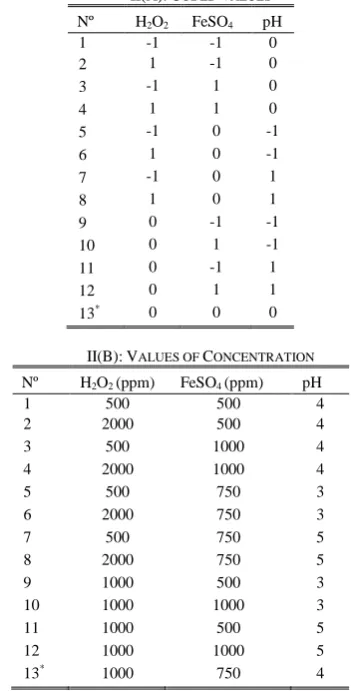
To evaluate and optimize the Fenton process was chosen a random experimental design to laboratory scale. Were considered some variables like pH, concentration of hydrogen peroxide (H2O2) and concentration of ferrous sulfate (FeSO4). Table II(a) shows the encrypted experimental combinations where: -1 corresponds to the lowest concentration of reagent, 0 to the average concentration and +1 to the highest concentration evaluated. Table II(b) shows the concentrations used for each of the experiments.
All experiments were carried out into a glass reactor with 2l. of capacity using jar-test equipment (Phipps & Bird) with flat stirring vanes. It was used as batch reactor. A liter of leachate was placed into the glass reactor and then the pH was conditioned according to the provisions of the experimental design using 95-97% H2SO4 (Sigma - Aldrich). The Fenton reaction was carried out by the addition of 30% H2O2 (Fisher Scientific) and then FeSO4 7H2O (Baker Analyzed); after this, the glass reactor was carried to the jar-test equipment where the sample was subjected to a rapid mixing of 250 rpm for 80 seconds and slowly mixed for 20 minutes at 30rpm.
Once the stirring is finished, the sample was transferred to a graduated cylinder (test-tube) with 1000 ml. of capacity for precipitating the sludge formed; during a period of 2 hours. The final sampling was made taking an aliquot of supernatant liquid.
To perform COD analysis was used a thermal reactor HACH DRB 200 and a HACH DR 2800 spectrophotometer. The expression used to determine the COD removal (%) achieved was the follows:
100
initial final
initial
COD - COD
COD
(3)
Parameters such as: Nitrates and Phosphates were determined in the spectrophotometer. The pH was measured with a pH-meter HANNA 8520 while the turbidity was measured using a HACH 2100N turbidimeter.
All analyzes were carried out according to standard
methods [19].
C. Statistical Analysis
The experimental design proposed corresponds to a statistical model of response surface type Box Behnken [20], [21].
This model produces a quadratic response surface equal to:
2 3 , 3 2 2 , 2 2 1 , 1 3 2 1 0
)
(
)
(
)
(
%
VarC
b
VarB
b
VarA
b
VarC
b
VarB
b
VarA
b
b
COD
removal
(4)To determinate the significance of the factors at a confidence level of 95%, three replicates to the central value were carried (Table II). Values of the coefficients are contrasted with the value of the expanded uncertainty Uexp.
If: , the factor corresponding to the coefficient
does not affect significantly the process. TABLEII:EXPERIMENTAL DESIGN
II(A):CODED VALUES
Nº H2O2 FeSO4 pH
1 -1 -1 0
2 1 -1 0
3 -1 1 0
4 1 1 0
5 -1 0 -1
6 1 0 -1
7 -1 0 1
8 1 0 1
9 0 -1 -1
10 0 1 -1
11 0 -1 1
12 0 1 1
13* 0 0 0
II(B):VALUES OF CONCENTRATION
Nº H2O2 (ppm) FeSO4 (ppm) pH
1 500 500 4
2 2000 500 4
3 500 1000 4
4 2000 1000 4
5 500 750 3
6 2000 750 3
7 500 750 5
8 2000 750 5
9 1000 500 3
10 1000 1000 3
11 1000 500 5
12 1000 1000 5
13* 1000 750 4
*Number 13 experiment represents the central point
D. Optimum Point Determination
The first and second derivatives of the polynomial regarding to the significant variables are calculated. With these values the determinant of the Hessian matrix is constructed to determine whether the stationary point is a maximum, minimum or indefinite.
III. RESULTS AND DISCUSSION
Fenton process for treatment of landfill leachate. TABLEIII:RESULTS OF CODREMOVAL
Nº H2O2 (ppm)
FeSO4 (ppm) pH
COD Removal (%)
1 500 500 4 24,3
2 2000 500 4 12,5
3 500 1000 4 79,5
4 2000 1000 4 59,1
5 500 750 3 58,3
6 2000 750 3 30,2
7 500 750 5 75,2
8 2000 750 5 37,8
9 1000 500 3 60,5
10 1000 1000 3 61,8
11 1000 500 5 37,0
12 1000 1000 5 80,1
13 1000 750 4 66,9
After evaluate each of the experimental runs, were obtained in specific cases removal of COD close to 80% (+/- 0.40) varying concentrations of H2O2, FeSO4 at different pH values (Table III).
Was obtained a removal of 80% using 1000 ppm of H2O2 and 1000 ppm of FeSO4 into the sample at pH 5 (Table III, Fig. 1); likewise was reached 79.5% of removal when the dosage of H2O2 was reduced to 500 ppm reacting with 1000 ppm of FeSO4 working the sample to pH 4 (Table III, Fig. 1). Some studies as [22] reports that the oxidation by Fenton reaction can remove approximately 20 to 80% of COD present in the leachate. [17] reports a 68% COD removal only with Fenton oxidation and reaches values of 86% when it is combined with a coagulation process, are reported similar cases in which was obtained a total removal between 63% and 71% combining Fenton process with other systems [2], [11].
[23] obtains a removal of 61% at 45 minutes of the reaction, obtaining the maximum efficiency of 62.9% after 60 min; therefore, there is a tendency to increase the removal rate over time.
In our case, the reaction time was two hours and superior results were obtained. The optimum pH was set at 4 because, in this, the removals were high with a lower dosage of reagents (Table III, Fig. 1).
Fig. 1. Percentage of COD removal efficiency versus ratio [H2O2]/[Fe2+] achieved at pH=3, pH=4, and pH = 5.
Ref. [4], [24] in his studies established that the optimum pH for the Fenton reaction is in the range of 2-4 and that the system can work at values near 5, but not on this because the efficiency of treatment would decrease significantly.
As for the concentration of reactants [10], [25] establish an optimal ratio of H2O2/Fe (II) between 1.5-3. In this particular case, the ratio with greater efficiency was obtained with values of 1 and 0.5, achieving removals of 80% and 79.45% respectively (Fig. 1).
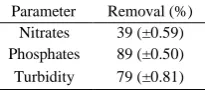
In addition to this it was determined that with Fenton process is obtained significant removals in other parameters such as those showed in Table IV.
TABLEIV:RESULTS OF OTHERS PARAMETERS REMOVAL
Parameter Removal (%) Nitrates 39 (±0.59) Phosphates 89 (±0.50) Turbidity 79 (±0.81)
A. Process Optimization
Statistical analysis established that significant process
values correspond to the doses of H2O2 and FeSO4 used in the oxidation.
With this information the stationary point of the process which result to be a theoretical maximum where COD removal was set at 81.4 %, using a dose of H2O2 of 312ppm, 1086ppm of FeSO4 working of the sample to pH 4 (Fig. 2).
Fig. 2. Response surface models for COD removal efficiency at pH 4.
that found in the experimentation carried out. The concentrations of reactants and pH are very close to those used in experiment 3.
IV. CONCLUSIONS
Fenton was effectively used to reduce concentrations of COD of landfill leachate. The maximum amount of COD that could be removed by the Fenton’s treatment was 79.5 % of the initial value with a concentration of 500 ppm of H2O2 and 1000 ppm of FeSO4 at pH 4, thus establishing an optimum working radius H2O2/FeSO4 equal to 0.5.
Through Box-Behnken statistical analyses were determinates the significant factors, which correspond to the concentration of H2O2 and FeSO4. The process was optimized, reaching a theoretical removal of 81% at concentrations of 312 ppm of H2O2 and 1087 ppm of FeSO4 at pH 4.
A trend, experimental and theoretical it is noted that decreasing the ratio [H2O2]/[Fe2 +] increases the efficiency of removal of COD at pH 4. Whereas at pH 5 and pH 3 with decreasing the ratio decreases the efficiency. Therefore a dependence of peroxide greater than the iron is noticed; so an excess in hydrogen peroxide affects negatively to the process. Usually the Fenton process achieves greater efficiency at pH acids. In this matrix shows that as the pH decreases, the efficiency decreases.
ACKNOWLEDGMENT
The authors are grateful to the local government of Loja (Ecuador) - GAD for their full collaboration.
REFERENCES
[1] Y. Chen, C. Liu, J. Nie, S. Wu, and D. Wang, “Removal of COD and decolorizing from landfill leachate by Fenton’s reagent advanced oxidation,” Clean Technol. Environ. Policy, vol. 16, no. 1, pp. 189–193, Apr. 2013.
[2] W. G. Moravia, M. C. S. Amaral, and L. C. Lange, “Evaluation of landfill leachate treatment by advanced oxidative process by Fenton’s reagent combined with membrane separation system,” Waste Manag., vol. 33, no. 1, pp. 89–101, Jan. 2013.
[3] M. G. Lak, M. R. Sabour, A. Amiri, and O. Rabbani, “Application of quadratic regression model for Fenton treatment of municipal landfill leachate.,” Waste Manag., vol. 32, no. 10, pp. 1895–902, Oct. 2012. [4] S. K. Singh and W. Z. Tang, “Statistical analysis of optimum Fenton
oxidation conditions for landfill leachate treatment,” Waste Manag., vol. 33, no. 1, pp. 81–88, Jan. 2013.
[5] D. Venu, R. Gandhimathi, P. V. Nidheesh, and S. T. Ramesh, “Treatment of stabilized landfill leachate using peroxicoagulation process,” Sep. Purif. Technol., vol. 129, pp. 64–70, May 2014. [6] A. M. Schiopu and M. Gavrilescu, “Options for the treatment and
management of municipal landfill leachate: Common and specific issues,” CLEAN — Soil, Air, Water, vol. 38, no. 12, pp. 1101–1110, Dec. 2010.
[7] P. Kjeldsen, M. A. Barlaz, A. P. Rooker, A. Baun, A. Ledin, and T. H. Christensen, “Present and long-term composition of MSW landfill leachate: A review,” Crit. Rev. Environ. Sci. Technol., vol. 32, no. 4, pp. 297–336, Oct. 2002.
[8] A. Anfruns, J. Gabarró, R. Gonzalez-Olmos, S. Puig, M. D. Balaguer, and J. Colprim, “Coupling anammox and advanced oxidation-based technologies for mature landfill leachate treatment,” J. Hazard. Mater., vol. 258–259, pp. 27–34, Aug. 2013.
[9] C. Ricordel and H. Djelal, “Treatment of landfill leachate with high proportion of refractory materials by electrocoagulation: System performances and sludge settling characteristics,” J. Environ. Chem. Eng., vol. 2, no. 3, pp. 1551–1557, Sep. 2014.
[10] D. Hermosilla, M. Cortijo, and C. P. Huang, “Optimizing the treatment of landfill leachate by conventional Fenton and photo-fenton
processes.,” Sci. Total Environ., vol. 407, no. 11, pp. 3473–3481, May 2009.
[11] A. R. Abood, J. Bao, J. Du, D. Zheng, and Y. Luo, “Non-biodegradable landfill leachate treatment by combined process of agitation, coagulation, SBR and filtration,” Waste Manag., vol. 34, no. 2, pp. 439–447, Feb. 2014.
[12] M. A. Zazouli, Z. Yousefi, A. Eslami, and M. B. Ardebilian, “Municipal solid waste landfill leachate treatment by fenton, photo-fenton and fenton-like processes: Effect of some variables,” J. Environ. Heal. Sci. Eng., vol. 9, no. 1, 2012.
[13] Y. Deng and J. D. Englehardt, “Treatment of landfill leachate by the Fenton process.,” Water Res., vol. 40, no. 20, pp. 3683–3694, Dec. 2006.
[14] D. Rubio, E. Nebot, J. F. Casanueva, and C. Pulgarin, “Comparative effect of simulated solar light, UV, UV/H2O2 and photo-Fenton treatment (UV-Vis/H2O2/Fe2+,3+) in the Escherichia coli inactivation in artificial seawater.,” Water Res., vol. 47, no. 16, pp. 6367–6379, Oct. 2013.
[15] M. Ahmadian, S. Reshadat, N. Yousefi, S. H. Mirhossieni, M. R. Zare, S. R. Ghasemi, N. Rajabi Gilan, R. Khamutian, and A. Fatehizadeh, “Municipal leachate treatment by Fenton process: effect of some variable and kinetics,” J. Environ. Public Health, vol. 2013, p. 169682, Jan. 2013.
[16] S. Renou, J. G. Givaudan, S. Poulain, F. Dirassouyan, and P. Moulin, “Landfill leachate treatment: Review and opportunity,” J. Hazard. Mater., vol. 150, no. 3, pp. 468–493, Feb. 2008.
[17] A. Talebi, N. Ismail, T. T. Teng, and A. F. M. Alkarkhi, “Optimization of COD, apparent color, and turbidity reductions of landfill leachate by Fenton reagent,” Desalin. Water Treat., vol. 52, no. 7–9, pp. 1524–1530, Feb. 2014.
[18] J. Zhu, “Optimization of Fenton process for treatment of landfill leachate using response surface methodology,” Asian J. Chem., vol. 26, no. 19, pp. 6630–6634, 2014.
[19] A. P. H. Association, Stand. Methods Exam, 1998.
[20] R. Myers, D. Montgomery, and C. Anderson-Cook, “Response surface methodology: Process and product optimization using designed experiments,” Wiley Series in Probability and Statistics, 2009. [21] T. Wani, A. Ahmad, and S. Zargar, “Use of response surface
methodology for development of new microwell-based spectrophotometric method for determination of atrovastatin calcium in tablets,” Chem. Cent., 2012.
[22] H. Li, S. Zhou, Y. Sun, and J. Lv, “Application of response surface methodology to the advanced treatment of biologically stabilized landfill leachate using Fenton’s reagent,” Waste Manag., vol. 30, no. 11, pp. 2122–2129, Nov. 2010.
[23] B. Pieczykolan, I. Płonka, K. Barbusiński, and M. Amalio-Kosel, “Comparison of Landfill leachate treatment efficiency using the advanced oxidation processes,” Arch. Environ. Prot., vol. 39, no. 2, pp. 107–115, Jun. 2013.
[24] O. S. Amuda, I. A. Amoo, and O. O. Ajayi, “Performance optimization of coagulant/flocculant in the treatment of wastewater from a beverage industry,” J. Hazard. Mater., vol. 129, no. 1–3, pp. 69–72, Feb. 2006. [25] H. Zhang, X. Wu, and X. Li, “Oxidation and coagulation removal of
COD from landfill leachate by Fered–Fenton process,” Chem. Eng. J., vol. 210, pp. 188–194, Nov. 2012.
Javier Moreno-Andrés was born in Granada, Spain in 1986. He graduated on environmental sciences from the University of Granada, Spain in 2011 and completed an MSc degree in water management from University of Cádiz, Spain. Now he is a Ph.D. student in the Environmental Technologies Department, University of Cádiz.
His Ph.D. research interest is in the area of water treatment, specifically water disinfection based in advanced oxidation processes.
His research focuses on find new sustainable and effective solutions in water treatment. He has published one international journal paper and one international conference paper.
Mónica Jacqueline Cisneros Abad was born in Loja, Ecuador in 1966. She is a professor and the head of the Chemical Department, which is in environmental engineering area.
She graduated in civil engineer from Technical Particular University of Loja, Ecuador and obtained the MSc. Geological engineer title in the University of Granada, Spain.
Her research interests are based on environmental engineering laboratories, focusing on water aspects.
Silvio David Aguilar Ramirez was born in Zaruma, Ecuador in 1977. He is a professor at Environmental Engineering Section in Technical Particular University of Loja, Ecuador as well as a research assistant at the Chemical Department.
He obtained his degree in chemical engineering from Technical Particular University of Loja, Ecuador and obtained an MSc degree in water management from University of Cádiz, Spain.