Effect of Modification on the Physicochemical and
Thermal Properties of Organophilic Clay Modified
with Octadecylamine
Salawudeen T. Olalekan*
1, Isam Y. Qudsieh
1,2, Nassereldeen A. Kabbashi
1, Ma’an Alkhatib
1,Suleyman A. Muyibi
1,
Faridah Yusof
1, Qasim H. Shah
31Nanoscience & Nanotechnology Research Group, Department of Biotechnology Engineering, Faculty of Engineering,
International Islamic University Malaysia, P. O. Box 10, 50728 Kuala Lumpur, Malaysia. 2
Department of Chemical Engineering, Faculty of Engineering, Jazan University, P.O. Box 706, Jazan 45142, Saudi Arabia. 3
Department of Mechanical Engineering, Faculty of Engineering, International Islamic University Malaysia, P. O. Box 10, 50728 Kuala Lumpur, Malaysia.
*1
Abstract
--
Organophilic clay was modified by ion exchangereactions using Octadecylamine. The reaction process was carried out at a temperature of 70oC for 90 minutes reaction time in a batch reactor equipped with a mechanical stirrer rotating at a speed of 300 rpm. Physicochemical and thermal properties of the clay before and after modification were determined and compared using Field Emission S canning Electron Microscope/ Energy Dispersive X-ray spectroscopy (FES EM/EDX), Fourier transform infrared spectroscopy (FT-IR) and Thermogravimetric Analyzer (TGA). FES EM images show clearly the micro structural differences between the modified and unmodified clay while EDX shows a compositional changes between modified and unmodified clay with the presence of 7.27% carbon in the modified clay. The analysis of FT-IR spectra shows the attachment of some functional groups which are mostly alkyl and hallo-alkyl groups. This is an indication of proper modification. TGA plots of both pure unmodified and organically modified clay attained stability at a temperature between 500oC and 900oC after reduction in weight due to evaporation of moisture and decomposition of the adhered Alkylammonium salts between 30oC and 500oC. This confirmed that thermal stability of the organically modified clay compared favorably with pure natural clay under TGA.
Index Term-- Alkyl group, Hallo-alkyl group, Organophilic clay, Octadecylamine,
I. INTRODUCTION
Clay refers to a naturally occurring materials composed primarily of fine-grained minerals, which is generally plastic at appropriate water contents and will harden when dried or fired [1]. They have varying chemical composition depending on both the physical and chemical changes in the environment where clay deposits are found. Clay has been found very efficient in enhancing the mechanical properties of polymers. Modified clays are used as adsorbent in vegetable oil refinery [2] and in the removal of organic compounds in waste water
[3]. The most common clay used in polymer enhancement is montmorillonite, a member of smectite clay family [4]. This is because of its remarkable property enhancements in polymer composite at moderate filler loadings and the possibility of forming polymer nanocomposite without the use of any solvent [5]. Various researchers have reported improvement in mechanical [6], flammability ([7], and barrier [8] properties of thermoplastic by addition of organically modified layered silicates to polymer matrices. The remarkable potential of clay as filler element in polymer nanocomposite is traceable to its high aspect ratio, packing fraction and high surface area [9]. This combination gives high degree of dispersion in clay/polymer nanocomposite and hence leads to enhanced or better properties.
However, the effect of modification on clay properties which indirectly may affect the natural potential of clay is not given any attention. The goal of the present study therefore, is to investigate the effect of modification on the physical properties (colour, density, and specific gravity), chemical properties (elemental composition and surface properties ) and thermal properties of the clay after modification. This is because if the processing temperature is too high compared to thermal stability of the filler element, this may lead to decomposition and hence affect the properties of polymer/clay composite.
II. EXPERIM ENTA L METHODS
Materials
The bentonite clay, Octadecylamine (90%) was manufactured by Acros Organics, New Jersey, USA, while Concentrated HCl manufactured by Fisher Scientific, UK was obtained from Biochemical Laboratory, International Islamic University Malaysia. All the materials above were used as received without any further purification. The experimental setup consisted of a two liters capacity conical flask, medium size water bath (110OC max) Schutzart Din 40050-IP-20, mixer, SS-20w, with maximum s peed of 1000 RPM and Vacuum drier model JEIOTECH OV-11/12.
Clay Modification
Octadecylamine has been used by many authors [11, 12 and 13] for clay modification and the results proved excellent compared to other modifiers with similar properties . Hence Octadecylamine was used in this study.
1000ml of distilled water was measured into 2 liters capacity beaker, heated and maintained at a temperature of 80oC in a thermostatic water bath. 20 grams of clay sample was measured into the hot water and allowed to disperse under mixer rotating at 300 rpm for 90 minutes. A solution containing 10g Octadecylamine with 4.2ml of concentrated hydrochloric acid (HCl) in 500ml hot distilled water maintained at 70OC was subsequently added into the mixture and allowed to mix for another 90 minutes with the speed adjusted to 400 rpm. After this, the solid was filtered and washed severally with 2 liters hot distilled water using vacuum filtration apparatus. The clay residue was dried in a vacuum oven maintained at 70oC for 48hrs. Such is the organomodified clay used in this study labeled as OCT.
Preparation of Unmodified Clay
In order to condition the unmodified clay, 20g of bentonite was dispersed in 1000ml of hot distilled water at 70oC. The suspension was thoroughly mixed for 90 minutes. The solid was filtered and dried in a vacuum oven maintained at 70oC for 48hrs. Such is the untreated clay used in this study. It was labeled as UTD.
Physicochemical Properties Determination
The specific gravity, of both the unmodified and organically modified clay samples was determined and compared using Electronic Densimeter MD-3008 manufactured by ALFA MIRRAGE. In order to determine the surface characteristics of the clay samples, both the Field emission scanning microscopy (FESEM) and Fourier Transform Infrared Spectroscopy (FT-IR) were used. The clay samples were mounted each on FESEM (JEOL JSM-5600) to view their microstructural images before and after modification. The Energy Dispersive X-ray (EDX) analysis was simultaneously carried out to know the elemental composition of those samples. FT-IR measurement was carried out on each of the clay samples using FT-IR Bruker Tensor 27. All spectra were recorded and analyzed to know the type and nature of the functional group attachment. The results of FT-IR were used to complement that of FESEM/EDX.
Thermal Stability Analysis
The clay thermal stability was analyzed in an inert atmosphere under Nitrogen condition at a heating rate of 5OC min-1 on a Thermogravimetric Analyzer (TG-DTA EN 55011). The clay sample was loaded in a platinum pan (¾ full). This was followed by introduction of N2 gas into the TGA compartment for 5 minutes to purge the likely oxygen in the environment of the system. After the purging, the sample was heated in the N2 atmosphere from room temperature to the maximum of 1000OC. The mass-loss with increasing temperature was plotted.
III. RESULTS AND DISCUSSION
Specific Gravity (S.G) Analysis
The specific gravity analysis of the clay samples shows a slight reduction after modification as shown in table I. This is because during modification metallic compound like MgO, was completely removed (See Table II) and the organic ions were attached which make the clay to be more organophilic and less hydrophilic and hence causing the reduction in the density of the clay sample. This therefore led to the reduction in the specific gravity.
TABLE I
PHYSICAL PROP ERTY OF CLAY SAMP LES
FESEM/EDX Results
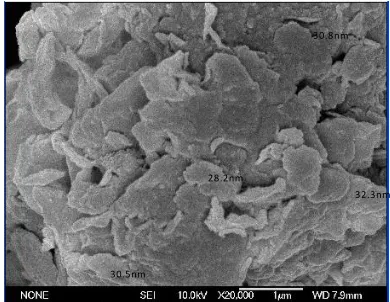
Fig. 1a and 1b shows the FESEM images of unmodified and Octadecylamine modified clay samples respectively. Fig. 1b, when compared with Fig. 1a shows a clear distinction on visual analysis the microstructural differences in both UTD and OCT. The diameter of UTD as measured by FESEM varied between 28.2 to 32.3nm while that of OCT varied between 31.0 to 35.6nm. These variations thus led to decrease in the density of OCT treated clay as the particulate volume
Properties
UTD OCT
Specific
will automatically increase and therefore decrease the specific gravity. This also is an evidence of chemical reaction or modification.
Fig. 1a. FESEM Image of Untreated Clay
EDX Results
In order to differentiate between the unmodified and organically modified clay by identifying the elemental composition of each sample, the Energy Dispersive X-ray (EDX) analysis was carried out. EDX results is as shown in Table II. It can be seen from the table that the Mg+ has been completely removed after modification from OCT. This was due to the reaction between the cation Mg+ from UTD and the ions from the clay modifiers. In addition carbon attachment is obvious in octadecylamine treated clay with a percent composition of 7.27. This justified the effective surface treatment of theclay sample. Jyh, (2002) [14] observed similar results in his work.
TABLE II
RESULTS OF EDX STANDARD QUANTITATIVE ANALYSIS
Mineral Composition (% )
Clay
Type O Mg Al C Si Fe Au
UTD 3.32 1.05 6.47 0.00 31.86 4.08 53.21
OCT 5.28 0.00 8.28 7.27 31.78 4.62 42.77
3.4 FT-IR Results
To further confirm the nature of modification and functional group attachment, FT-IR analysis was conducted and the peaks analyzed (see Fig. 2).
Fig. 1b. FESEM Image of OCT T reated Clay
Fig. 2. FT -IR Spectra of Pure Bentonite and Organophilic Clay
The FT-IR spectra in the fig. 2 above show the absorbance of the clay samples at various wave numbers. At 3600 cm-1 band, the peaks for both clay samples are the same. But within 2000 to 3000 cm-1 band region, the peaks are well pronounced on Octadecylamine treated clay while such peaks are
not found in untreated clay spectra. Similar effect was observed at peaks labeled 1468, 1505, 721, 516 and 451 cm-1 as shown in Fig 4. These functional groups attachment with carbon content implies that Octadecylamine treated clay sample will be more organophilic and less hydrophilic an d in 28.2nm
30.5nm
30.8nm
32.3nm
35.6nm
31.0nm 32.9nm
OCT
turns found better application in polymer composite preparation compared to the un-modified clay.
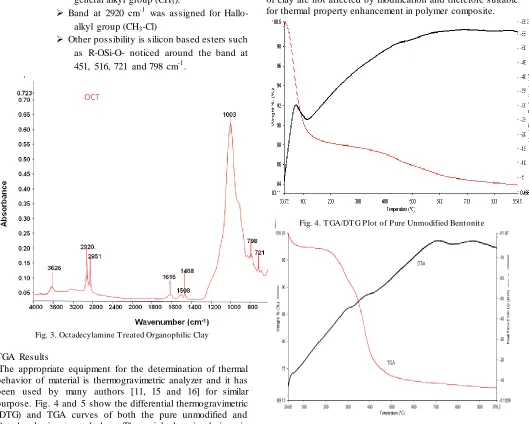
The analysis of the functional group attachment o n each peak in OCT spectra using FT-IR library showed the following results (See Fig. 3).
Band at 1467 and 2851 cm-1 represents the general alkyl group (CH3).
Band at 2920 cm-1 was assigned for Hallo-alkyl group (CH3-Cl)
Other possibility is silicon based esters such as R-OSi-O- noticed around the band at 451, 516, 721 and 798 cm-1.
Fig. 3. Octadecylamine T reated Organophilic Clay
TGA Results
The appropriate equipment for the determination of thermal behavior of material is thermogravimetric analyzer and it has been used by many authors [11, 15 and 16] for similar purpose. Fig. 4 and 5 show the differential thermogravimetric (DTG) and TGA curves of both the pure unmodified and Octadecylamine treated clays. The weight loss is obvious in both samples between 30oC and 150oC due to the evaporation of water of hydration in the inorganic cations and those adsorbed in the alumnosilicate surfaces. Above 150oC, the weight loss in pure unmodified clay reduces until it becomes stable at temperature above 600oC. The loss in weight here is traceable to dehydration of some trapped water molecules in the interstices of the clay layers and that due to hydroxylation of the mineral, which is accompanied by a change in the crystal structure [17]. Whereas, in organically modified clay (Fig. 5), there is constant weight loss due to the breakdown of organic compounds resulting from clay modification in
addition to water evaporation. This is justified by the results of FT-IR, fig. 3 above showing different functional groups attached to the surface of the clay. The same result was observed by Jyh (2002) [14], when a modifying agent of stearyltrimethyl ammonium chloride compound was used. At temperature above 600oC the weight of the modified clay become stable and its behavior become similar to pure unmodified bentonite. This implies that the thermal properties of clay are not affected by modification and therefore suitable for thermal property enhancement in polymer composite.
Fig. 4. T GA/DT G Plot of Pure Unmodified Bentonite
Fig. 5. T GA/DT G Plot of Organically Modified Bentonite
CONCLUSION
alkylammonium ions and hence makes the clay more organophilic or less hydrophilic. This is evident in the FT-IR peaks analysis that shows the presence of functional groups like alkyl group (-CH3), halo alkyl group (-CH3-Cl-) and some silicon based esters (R-OSi-O) in the modified clay. The thermal stability of the clay modified with alkylammonium salts such as Octadecylamine is not affected once the residual free ammonium salts is avoided. This was confirmed in the TGA plots of both pure unmodified and organically modified clay that attained stability at a temperature between 500oC and 900oC after loss in weight due to evaporation of moisture and decomposition of the adhered alkylammonium salts between 30oC and 500oC.
ACKNOWLEDGEMENT
The authors gratefully acknowledged the support of Malaysian Ministry of Higher Education for funding this project under the Fundamental Research Grant Scheme project no. FRGS 0206 – 56
REFERENCES
[1] Stephen, G. and Martin, R.T., (1995) Definition of Clay and Clay Minerals: Joint Report of the Aipea Nomenclature and CMS Nomenclature Committees, Clay and Clay Minerals, 43, (2), 255-256.
[2] Salawudeen, T .O., Dada, E.O. and Alagbe,. S.O. (2007). “Performance Evaluation of Acid T reatment Clays for Palm Oil Bleaching” Journal of Engineering and Applied Sciences 2 (11), 1677-1680.
[3] Caualcante, A.M., T orres, L.G. and Coelho, G.L.V., (2005) Adsorption of Ethyl Acetate Onto Modified Clays and its Regenaration with Supercritical CO2, Braz. Journal of Chemical Engineering, 22 (1), 2682-1865.
[4] Karian, H. (2003) Handbook of Polypropylene and Polypropylene Composites, Mercel Dekker Inc, New York.
[5] Manias, E., T ouny, A., Wu, L., Strawhecker, K, Lu, B and Chung, T .C. (2001) Polypropylene/Montmorillonite Nanocomposite, Review of the Synthetic Routes and Material Properties, Chemical Material, 3516–3523.
[6] Fornes, T .D. Yoon, P.J. Keskkula, H. and Paul, D.R. (2001) Nylon 6 Nanocomposite: T he Effect of Matrix Molecular Weight. Polymer, 42, 09929-09940.
[7] Beyer, G., (2006) Flame Retardancy of T PU and PVC Nanocomposites. Gummi, Fersern, Kunststoffe, 59, (8). 1-8. [8] Messersmith, P., and Giannelis, E., (1995) Synthesis and Barrier
Properties of Poly (1-Caprolactone)-layered Silicate Nanocomposites. Journal of Polymer Chemistry, 33, 1995. [9] Salawudeen, T . O., Isam, Y. Q., Ma’an F. A., and Suleyman, A.
M., (2008) Potential Application of Carbon Nanotubes as Filler Elements in the Production of Polymer- Nanocomposite: A Review, 15th Regional Symposium on Chemical Engineering in Conjunction with the 22nd Symposium of Malaysian Chemical Engineers (RSCE-SOMChe) Conference, Kuala Lumpur, Malaysia, vol ii,, 139-143.
[10] Maduchhanda, S., Kausik, D., Sankar, G and Amarnath, B, (2008) Polypropylene-clay Composite Prepared from Indian Bentonite, Bull. Mater. Sci., 31, (1), 23-28
[11] Maged, A., O., Michael, P. and Ulrich W. S. (200 3) Surface T reatment of Clay Minerals-T hermal Stability, Basal-plane Spacing and Surface Coverage, Journal of Materials Chemistry, 13, 2359-2366.
[12] GarciaiLopez, D., Picazo, O., Merino, J.C. and Pastor, J.M. (2002) Polypropylene-clay Nanocomposites: Effect of Compatibilizing Agebts on Clay Dispersion. European Polymer Journal 39, 945 -950.
[13] Salawudeen, T .O., Suleyman, A.M.,., Ma’an, F.A., Isam, Y. Q., Qassim, H. S and Faridah, Y., (2009) Effect of Modification on the T hermal Stability of Clay Modified with Different
Alkylammonium Salts. Kuliyah of Engineering Research Innovation and Exhibition, IIUM, Malaysia, 32.
[14] Jyh, M. H., George, J., Zong, M. G., Wei, X, Wei, P.P., (2002) The Characterization of Organic Modified Clay and Clay Filled PMMA Nanocomposite. Journal of Applied Polymer Science, 83, 1702-1710.
[15] Hailing, Z., Chao, G., Yanping, W., Paul, C.P., Hao, K., Xiaowen, C. and Deyue, Y.,(2005). In situ Polymerization Approach to Multiwalled Carbon Nanotubes-reinforced Nylon 1010 Composites: Mechanical Properties and Crystallization Behavior. Polymer 47, 113-122.