22
Cardiac Care Unit Nurses’ Perception of Educational
Competencies (Modified Delphi Method)
Hamideh Dehghani
1, Khadijeh Nasiriani
2*1 Research Center for Nursing & Midwifery Care, Shahid Sadoughi University of Medical Sciences, Yazd, Iran.
2 School of Nursing, Research Center for Nursing & Midwifery Care, Shahid Sadoughi University of Medical Sciences and Health Services, Yazd, Iran.
ABSTRACT
Educational competency is an important professional qualification for nurses. Applying knowledge to nursing care for special patients is an integral part of professional nursing in special units in hospitals. This study was conducted to assess cardiac care nursing educational competencies using modified Delphi method. Participants were 60 CCU nurses from hospitals in Shahid Sadoughi University of Medical Sciences in Yazd selected through purposive and snowball sampling. Data was collected using semi-structured interviews during the first round and questionnaires during the second and third rounds. Data was analyzed using conventional content analysis method in the first round and quantitative descriptive analysis in the second and third rounds. For panelists the most important educational competencies to empower Cardiac Care Unit (CCU) nurses were 37 qualifications including personal characteristics (tolerance, carefulness, smartness, work ethic, lifelong learning, self-confidence, responsibility), professional characteristics (being experienced and trained, being skilled, speed and accuracy), the ability to adapt to extreme conditions, quick and accurate forecast and management of heart problems, being interested in educating the patients, students and colleagues, having the ability to interpret ECG, control dysrhythmia, cardiac blocks and myocardial infarction. The findings of this study determine educational competencies required for CCU nurses. Accordingly matrons and nursing supervisors can evaluate their check lists, provide competency assessment worksheets, examine nurses on arrival, periodically while in service, and enhance their competencies.
Key Words: Professional competency, cardiac care, nurse, Delphi research
eIJPPR 2017; 7(5): 22-28
HOW TO CITE THIS ARTICLE: Hamideh Dehghani, Khadijeh Nasiriani. (2017). “Cardiac Care Unit Nurses’ Perception of Educational Competencies (Modified Delphi Method)” , International Journal of Pharmaceutical and Phytopharmacological Research, 7(3), pp.1-8
INTRODUCTION
CCU is one of the most critical units of hospitals in which special care is needed because of the complexity and critical condition of patients[1, 2]. Nurses are more available than other health care team, spend more time with pat
ients and reduce patients’ concerns by answering their questions and providing proper care to them.[3] Care behaviors in CCU include all critical care related to
survival of the patient. CCU nurses are faced with enormous problems. With regard to the critical condition of patients these nurses can be the most effective factor on patients’ health.[4]Since all the problems relating to patients is more important and critical in CCU nursing care in this environment should be adequately professional and well-timed[5]. Williams et al. stated that: “Meeting individual needs of patients is the basis of nursing care. The ultimate goal of nursing staff is to help patients do activities
Corresponding author:Khadijeh Nasiriani
Address: School of Nursing, Research Center for Nursing & Midwifery Care, Shahid Sadoughi University of Medical Sciences and Health
Services, Yazd, Iran.
e-mail[email protected]
Relevant conflicts of interest/financial disclosures: The authors declare that the research was conducted in the absence of any
commercial or financial relationships that could be construed as a potential conflict of interest.
23 they cannot do alone” [6]. It is believed that care
occurs when nurses know patients’ wants and views and put themselves in their shoes. Therefore with a better understanding of patients’ perception of the priority of care behaviors nurses can provide the necessary support and comprehensive care according to individual needs of patients.[7] Human resources constitute the foundation of health systems. If the plans and projects related to training of human resources are not compatible with health and social conditions of a country it will not be able to raise people’s health to a level where they can economically and socially have productive lives. Meanwhile nursing has a significant role in providing these health services. In terms of importance it is enough to say that almost a third of operating budget of health centers is devoted to nursing unit [8].Nursing care is the preoccupation of every hospital. And the ultimate goal of nursing managers is to improve nurses’ training and knowledge to deliver higher quality care [9]. Professional competence of nurses is influenced by their educational competency [10]. The concept of professional competence specifically in intensive care nursing is somewhat different from nursing in general. This difference is due to the nature of ICU and its special conditions. ICU is one of the most critical units of hospitals in which special care is needed because of the complexity and critical condition of patients [11, 12]. Clinical and professional competence are divided into three and four main areas respectively. In the area of clinical competency, concepts such as special nurse’s familiarity with the basics of nursing care, familiarity with clinical guidelines, and nursing interventions have been proposed. Within the area of professional competence concepts such as nursing
care ethics, decision-making, patient care
improvement and collaboration with other intensive care team members have been mentioned [13]. One aspect of nurses’ competency is related to their educational competence. Applying knowledge to the care of special patients is an integral part of professional nursing in special units in hospitals. However special care training courses for nurses vary from country to country. The number of studies examining the knowledge of intensive care nurses and examining the impact of trainings on improving special nursing care quality is limited in Europe [14].Also members of the European Specialist Nurses Association believe that there is a need for a single educational curriculum for in-service training of all members of the care team including nurses, doctors, physical therapists and other people involved [15]. Lakanmaaa et al (2012) used Delphi technique to examine the qualifications required for specialist nursing care. The results of this study showed that the competencies required in the ICU can be divided into five main areas: knowledge, skills, values and attitudes, nursing experience and personal areas of nursing. Four areas can be found in the existing competencies and the personal domain is involved in new nursing. The results showed that nursing
competence needs in the ICU is multidimensional [16]. Nursing competence is the ability to simultaneously use knowledge, skills, attitudes and values in patient care. Nursing competence has recently attracted more attention because of its importance. Given the increasing significance of nursing competence it is important to precisely understand its dimensions, including educational, clinical, and moral aspects. The concept of professional competence specifically in intensive care nursing is somewhat different from its concept in nursing in general. This difference is due to the nature and specific conditions of CCU. Despite the importance of nursing care and caring behaviors there is much difference in educational competencies and caring behavior priorities in this regard which can affect nursing care. Considering the importance of the concept of educational competency especially in CCUthis study aims to examine the CCU nurses’ perception of educational competencies.
MATERIALS AND METHODS
24 questionnaire which was sent to 63 panelists. They
were asked to whether they were in agreement or disagreement about educational competency of CCU nurses.SPSS 18 and descriptive statistics were used in the third round. It should be noted that during the third round given the expansion of the CCU in the hospital, some other nurses were willing to participate in the study to whom the questionnaire was sent.The items that gained 80% agreement or consensus were kept and the rest were discarded.The remained items were approved as the final results and published. It should be noted that for moral considerations research goals were explained to all participants and their informed written consent were acquired.
RESULTS
In the first round 6 matrons and 59 nurses participated in the study. They were from 26 to 50 years old. The mean and standard deviation of their age was 37.05 ± 5.66. They had 3 to 28 years of work experience. The mean and standard deviation of work experience was 13.42 ± 6.48. With regard to sex 51 (86.44%) were female and 8 (13.55%) were male. In terms of education 4 (6.77%) had a master’s degree in nursing and 55 (93.22%) had bachelor’s.
Also based on analysis of the codes, to have a competent nurse for education in the CCU, three main themes or categories were obtained: personal competency of specialist nurse (such as tolerance, carefulness, smartness, work ethic, lifelong self-learning, self-confidence, and responsibility), professional competency of specialist nurse (such as being experienced and trained, being skilled, having speed and accuracy), and organizational competency (to value the status of trained nurses, allocating material benefits to education, allocating intellectual benefits to education, efficient educational supervision, and efficient management supervision). The subcategories were merged with the items derived from searching literature and 94 items were obtained.
The results of second round of Delphi
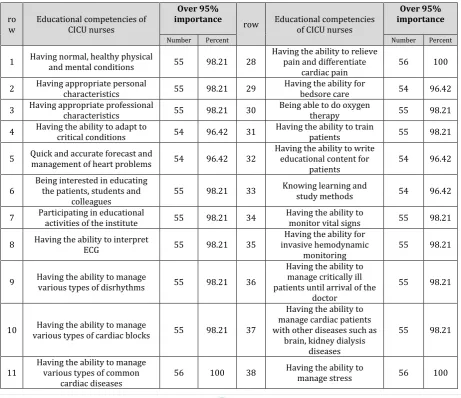
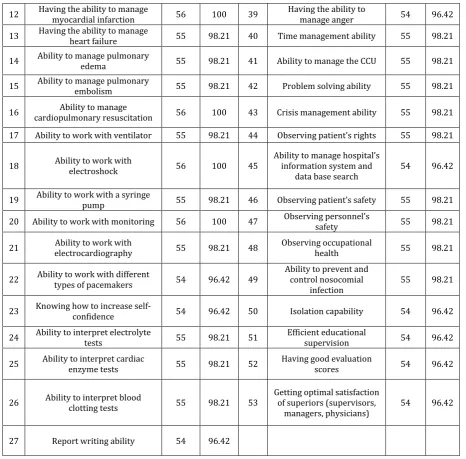
In the second round 7 matrons and 49 nurses participated in the study. They were from 25 to 50 years old. The mean and standard deviation of their age was 36.03 ± 6.27. They had 3 to 28 years of work experience. The mean and standard deviation of work experience was 13.28 ± 7.11. With regard to sex 47 (83.92%) were female and 9 (16.07%) were male. In terms of education 5 (8.92%) had a master’s degree in nursing and 51 (91.07%) had bachelor’s. In this round the panelists’ comments about 94 items were collected. 51 items gained the relative frequency of “very important” and “important”. These items were accepted for the next round and the rest were excluded (Table 1).
In the third round, 53 approved items were sent to participants to determine the percentage of their agreement. 37 items obtained over 80% agreement and the rest were discarded (Table 2). Finally the
resulting items were introduced as the necessary qualifications for CCU nurses.
DISCUSSION
Selecting qualified and competent nurses for CCU and improving their knowledge and performance has a critical impact on ensuring the quality of nursing care and improves care delivery to patients. Due to the nature of CCU nurses working in this unit need a whole range of educational competencies. Writing on the importance of cardiovascular nursing, Fridlund et al. state that cardiovascular nursing is developing rapidly and there is much evidence about the effects of these nurses’ performance on reducing the suffering of patients. However there is not enough awareness about of the extent and content of cardiovascular nursing education in Sweden [17]. Timmins also wrote that cardiovascular nurses need ongoing education to perform their role. Accordingly professional organizations should strive to plan appropriate educational courses for their members [18]. Roschkov et al believe that roles and responsibilities of cardiovascular nurses are extensive and varied. They have various clinical, educational, administrative, and research responsibilities which need a better understanding in the future.[19] Based on their findings, CCU nurses should know about all the diseases directly related to their unit and other diseases which are diagnosed in their patients. In designing a curriculum for cardiovascular nursing, Astin et al (2015) found that eight themes necessary: (1)principles of cardiovascular pathophysiology; (2) optimizing cardiovascular health; (3) assessment and planning; (4) Principles and practices of individual- and family-centered care; (5) education and communication; (6) emotional and spiritual wellbeing; (7) physical well-being and comfort; and (8) checking the quality of care[20]. According to the results and the results of other researchers cardiovascular nursing involves different areas of health and treatment including primary, secondary and tertiary care. Therefore a cardiovascular nurse should have knowledge and skill in the areas of health promotion, cardiac prevention and rehabilitation, acute, chronic and episodic care and palliative care [21]. Based on the results of a study Holm et al cardiovascular nurses should be able to collect information on medical and family history, physical examination and diagnostic test results including genotypes [22]. Ballew et al. state that cardiac nurses must learn how to manage gastrointestinal bleeding as in patients with heart failure who have a device [23]. Cardiovascular nurses in Europe need to improve their knowledge and performance in oral anticoagulant therapy to provide optimal service to cardiac patients and to minimize side effects [24].
25 responsible for evaluating and managing patients’
symptoms often by using technology. Moreover they should be able to develop therapeutic relationships with their patients and in the first step they should provide vital physical and mental care in both the critical and relief stages of the disease.[25] Cardiac nurses need to have more knowledge and special practical training to provide information about sexual concerns and give sexual advice to cardiac patients.[26] To train patients about cardiovascular diseases healthcare workers need to learn advanced communication skills, identify educational needs, competencies and motivation in adult education and counseling patients about lifestyle.[27,28]
CONCLUSION
As cardiac care nurses play an important role in ensuring nursing care quality in cardiovascular wards and can improve the care delivered to the patients it is necessary to select the nurses carefully so that they have appropriate professional and personal qualities. In line with this they should receive training on general, basic nursing, and specialist cardiac content through integrated educational approach. At the same time, managerial and organizational requirements should be established to maintain and improve their competencies and capabilities.
REFRENCES
[1] Haji Nejad M, Rafii F, Jafarjalal E, Haghani H
Relationshipbetween nurses care behavior and patient satisfaction in patient opinion. Iran Nurses Journal. 2007; 20(49):73-83. [In Persian]
[2] Chester LR. Many critical care nurses are
unaware of evidence based practice. Am J Crit Care. 2007; 16(2):106-07.
[3] Borhani F. Nurses and nurses managers’
opinion about patient education barriers. Qazvin Uni Med ScJ. 2002;5(4):84-90. [In Persian]
[4] Suhonen R, Efstathiou G, Tsangari H, Jarosova
D, Leino-Kilpi H, Patiraki E, et al. Patients’ and nurses’ perceptions of individualized care: An international comparative study. J Clin Nurs. 2012;21(7):1155-67.
[5] Gjengedal E, Storli SL, Holme AN, Eskerud RS.
An act of caring–patient diaries in Norwegian intensive care units. Nurs Crit Care.2010;15(4):176-84.
[6] Rafie F, Oskouie F,Nikravesh M. Caring
behaviors of burn nurses and the related factors. Burns.2007;33(3): 299-05.
[7] Negarandeh R, Mohammadi S, Zabolypour S,
Ghojegh TA. Relationship between quality of senior nursing students’caring behaviors and patients’satisfaction. Hayat. 2012;18(3). [In Persian]
[8] Force MV. The relationship between effective
nurse managers and nursing retention. J Nurs Adm.2005;35(7-8):336-41.
[9] McClure ML. Magnet hospitals: Insights and
issues. Nurs Adm Q. 2005;29(3):198-201.
[10] Zaghari Tafreshi M, Rasouli M, Sajadi
M.Simulation in nursing education: A review article. Iranian Journal of Medical Education.2013;12(11):888-94. [In Persian]
[11] Haji Nejad M, Rafii F, Jafarjalal E, Haghani
H.Relationship between nurses care behavior and patient satisfaction in patient opinion. Iran Nurses Journal. 2007;20(49):73-83. [In Persian]
[12] Chester LR. Many critical care nurses are
unaware of evidence based practice. Am J Crit Care. 2007;16(2):106-07.
[13] Riitta-Liisa L, Suominen T, Perttila J,
Leino-Kilpi H. Competence in intensive and critical care nursing: A literature review. Intensive and Critical Care Nursing. 2008;24:78-89.
[14] Fulbrook P,Albarran JW, Baktoft B,
Sidebottom B.A survey of European intensive care nurses’ knowledge levels. International Journal of Nursing Studies. 2012;49:191-200.
[15] Labeau S. Post-registration ICU nurses
education: Plea for a European curriculum. International Journal of Nursing Studies. 2012;49:127-8.
[16] Lakanmaaa RL, Suominenb T, Perttilä J,
Puukkae PY. Leino-Kilpi H. Competence requirements in intensive and critical care nursing — Still in need of definition? A Delphi study.Intensive and Critical Care Nursing.2012;28:329-336.
[17] Fridlund B, Mårtensson J.Cardiovascular
nursing in RN and higher education in Swedish universities: A national survey. European Journal of Cardiovascular Nursing. 2004;3(3):255-259.
[18]Timmins F. Cardiac nurses’ views of
continuing professional education. European Journal of Cardiovascular Nursing. 2008;7(1):59-66.
[19] Roschkov S, Rebeyka D, Comeau A, Mah J,
Scherr K, Smigorowsky M, et al.Cardiovascular nurse practitioner practice: Results of a Canada-wide survey. Canadian Journal of Cardiovascular Nursing[Journal canadien en soins infirmiers cardio-vasculaires]. 2006;17(3):27-31.
[20]Astin F, Carroll DL, Ruppar T, Uchmanowicz I,
26 Cardiovascular Nursing. 2015;14(2
suppl):S1-S17.
[21] Riley JP, Bullock I, West S, Shuldham C.
Practical application of educational rhetoric: A pathway to expert cardiac nurse practice? European Journal of Cardiovascular Nursing.2003;2(4):283-290.
[22] Holm K, Chyun D, Lanuza DM.Self-rated
competency and education/programming needs for care of the older adult with cardiovascular disease: A survey of the members of the Council of Cardiovascular Nursing. Journal of Cardiovascular Nursing.2006;21(5):363-366.
[23] Ballew CC, Surratt JF,Collins TL, Shah N.
Gastrointestinal bleeding in patients with ventricular assist devices: What every cardiac nurse should know. Progress in Transplantation.2013;23(3):229-234.
[24] Oterhals K, Deaton C, De Geest S, Jaarsma T,
Lenzen M, Moons P, et al.European cardiac nurses’ current practice and knowledge on anticoagulation therapy. European Journal of Cardiovascular Nursing.2013;13(3):261-9. doi: 10.1177/1474515113491658.
[25] Jones I, Johnson M. What is the role of the
coronary care nurse? A review of the literature. European Journal of Cardiovascular Nursing. 2008;7(3):163-170.
[26] Jaarsma T, et al. Sexual counselling of
cardiac patients: nurses’ perception of practice, responsibility and confidence. European Journal of Cardiovascular Nursing. 2010;9(1):24-29.
[27] Bakalis N. Clinical decision-making in
cardiac nursing: a review of the literature. Nursing Standard. 2006;21(12):39-46.
[28] Svavarsdóttir MH, Sigurðardóttir
ÁK,Steinsbekk A. Knowledge and skills needed for patient education for individuals with coronary heart disease: The perspective of health professionals. European Journal of Cardiovascular Nursing.2016;15(1):55-63.
Table 1. Frequency distribution of educational competencies of CCU nurses with an importance of above 95% for panelists
ro
w Educational competencies of CICU nurses
Over 95% importance
row Educational competencies of CICU nurses
Over 95% importance
Number Percent Number Percent
1 Having normal, healthy physical and mental conditions 55 98.21 28 Having the ability to relieve pain and differentiate
cardiac pain 56 100
2 Having appropriate personal characteristics 55 98.21 29 Having the ability for bedsore care 54 96.42
3 Having appropriate professional characteristics 55 98.21 30 Being able to do oxygen therapy 55 98.21
4 Having the ability to adapt to critical conditions 54 96.42 31 Having the ability to train patients 55 98.21
5 Quick and accurate forecast and management of heart problems 54 96.42 32 Having the ability to write educational content for
patients 54 96.42
6 Being interested in educating the patients, students and
colleagues 55 98.21 33
Knowing learning and
study methods 54 96.42
7 Participating in educational activities of the institute 55 98.21 34 Having the ability to monitor vital signs 55 98.21
8 Having the ability to interpret ECG 55 98.21 35 invasive hemodynamic Having the ability for
monitoring 55 98.21
9 Having the ability to manage various types of disrhythms 55 98.21 36
Having the ability to manage critically ill patients until arrival of the
doctor
55 98.21
10 various types of cardiac blocksHaving the ability to manage 55 98.21 37
Having the ability to manage cardiac patients with other diseases such as
brain, kidney dialysis diseases
55 98.21
11 Having the ability to manage various types of common
cardiac diseases 56 100 38
Having the ability to
27
12 Having the ability to manage myocardial infarction 56 100 39 Having the ability to manage anger 54 96.42
13 Having the ability to manage heart failure 55 98.21 40 Time management ability 55 98.21
14 Ability to manage pulmonary edema 55 98.21 41 Ability to manage the CCU 55 98.21
15 Ability to manage pulmonary embolism 55 98.21 42 Problem solving ability 55 98.21
16 cardiopulmonary resuscitation Ability to manage 56 100 43 Crisis management ability 55 98.21
17 Ability to work with ventilator 55 98.21 44 Observing patient’s rights 55 98.21
18 Ability to work with electroshock 56 100 45 Ability to manage hospital’s information system and
data base search 54 96.42
19 Ability to work with a syringe pump 55 98.21 46 Observing patient’s safety 55 98.21
20 Ability to work with monitoring 56 100 47 Observing personnel’s safety 55 98.21
21 Ability to work with electrocardiography 55 98.21 48 Observing occupational health 55 98.21
22 Ability to work with different types of pacemakers 54 96.42 49 Ability to prevent and control nosocomial
infection 55 98.21
23 Knowing how to increase self-confidence 54 96.42 50 Isolation capability 54 96.42
24 Ability to interpret electrolyte tests 55 98.21 51 Efficient educational supervision 54 96.42
25 Ability to interpret cardiac enzyme tests 55 98.21 52 Having good evaluation scores 54 96.42
26 Ability to interpret blood clotting tests 55 98.21 53 Getting optimal satisfaction of superiors (supervisors,
managers, physicians) 54 96.42
27 Report writing ability 54 96.42
Table 2. Frequency distribution of educational competencies of CCU nurses with an importance of above 80% for panelists
ro
w Educational competencies of CICU nurses
Over 80%
agreement row Educational competencies of CICU
nurses
Over 80% agreement
Number Percent Number Percent
1 Having appropriate personal characteristics 58 92.06 20 Ability to interpret cardiac enzyme tests 54 85.71
2 Having appropriate professional characteristics 59 93.65 21 Ability to interpret blood clotting tests 51 80.95
3 Having the ability to adapt to critical conditions 58 92.06 22 Report writing ability 54 85.71
4 Quick and accurate forecast and management of heart problems 60 95.23 23 Having the ability to relieve pain and differentiate cardiac pain 61 96.82
28 6 Having the ability to interpret ECG 63 100 25 Having the ability for invasive hemodynamic monitoring 55 87.3
7 Having the ability to manage various types of disrhythms 63 100 26 critically ill patients until arrival of Having the ability to manage
the doctor 52 82.53
8 various types of cardiac blocksHaving the ability to manage 61 96.82 27
Having the ability to manage cardiac patients with other diseases such as brain, kidney
dialysis diseases
55 87.3
9 various types of common cardiac Having the ability to manage
diseases 58 92.06 28 Having the ability to manage stress 55 87.3
10 Having the ability to manage myocardial infarction 59 93.65 29 Time management ability 51 80.95
11 Having the ability to manage heart failure 58 92.06 30 Problem solving ability 56 88.88
12 Ability to manage pulmonary edema 60 95.23 31 Crisis management ability 53 84.12
13 Ability to manage pulmonary embolism 62 98.41 32 Observing patient’s safety 54 85.71
14 Ability to manage cardiopulmonary resuscitation 60 95.23 33 Observing personnel’s safety 58 92.06
15 Ability to work with ventilator 58 92.06 34 Observing occupational health 54 85.71
16 Ability to work with electroshock 57 90.47 35 Ability to prevent and control nosocomial infection 53 84.12
17 Ability to work with different types of pacemakers 60 95.23 36 Efficient educational supervision 54 85.71
18 Knowing how to increase self-confidence 51 80.95 37 superiors (supervisors, managers, Getting optimal satisfaction of
physicians) 54 85.71