Fulfillment of National Road Functions in Ambon City
in Realizing Good Safety Road Functions
Robinson Birahy
Abstract--
One of the objectives of implementing compliance with road function tests is to provide safety for road users. Law of the Republic of Indonesia No. 38 of 2004 and Government Regulation of the Republic of Indonesia No. 34 of 2006, stating that the operation of public roads must meet the requirements of functional worthiness. In addition, in the Law of the Republic of Indonesia No. 22 of 2009 states that the Road Operator in this case the Government must maintain the Security, Safety, Order and Smoothness of Road Traffic and Transportation. this study aims to analyze and evaluate the fulfillment of recommendations for road function tests from the assessment of technical requirements on the national road section in Ambon city. This research was conducted with an evaluation mechanism, Observation and Interview to fulfill the Recommendation for Road Function Fit Test based on PU Permen No. 11 / PRT / M / 2010, where this study aims to evaluate the preparation of the ULFJ Team's Recommendation program and Observation of its fulfillment. Based on the results of the research on the fulfillment of the recommendations of the road test feasibility team technically that the fulfillment of the ULFJ Team recommendations must be carried out in 2014-2017, the fulfillment carried out by the road operators has not gone well so that the Laksdya leo wattimena (Passo - Durian Patah), Y. Syaranamual (Durian Patah - Laha) and Ir. M. Putuhena (Durian Broken - Laha) is still categorized as Fit for Conditional Functions (LS) so that the status of the three road segments cannot be improved from a conditional function (LS) to a function-worthy (L), in realizing safety
Index Term--Fulfillment of road function feasibility tests, safety roads, road operators
Preliminary
Road as part of the national transportation system, has a very strong link with a region and the socio-cultural life of its people. The road network system in Indonesia serves around 92% of passenger transportation and 90% of freight transportation. So that, if there is a decrease in the level of service and road capacity, it will greatly affect the smooth movement of the economy and cause high social costs to road users.
Ambon City is the Capital of Maluku Province which has experienced rapid population growth, so that the activities or movements of people and goods are also higher. Rapid population growth also drives the growth of ownership of two-wheeled and four-two-wheeled vehicles that are very high and fast, so the growth of National roads in Ambon city must be able to keep up with vehicle growth without ignoring the principle of safe roads for road users.
Every 1% of economic growth will result in traffic growth of 1.5%. (Nuzul Achyar, 2002 and Rizal Tamin 2006 - 2007).
Law of the Republic of Indonesia No. 38 of 2004 concerning Roads in Article 30 and Government Regulation of the Republic of Indonesia No. 34 of 2006 concerning Roads article 102 Suggesting that the operation of public roads must meet the requirements of functional worthiness.
In addition, in the Law of the Republic of Indonesia No. 22 of 2009 concerning traffic and road transport, in Article 23 paragraph 1 implies that the Road Operator in this case the Government is obliged to maintain the
Security, Safety, Order and Smoothness of Road Traffic and Transportation.
As a road development coach, the Ministry of Public Works through the Directorate General of Highways, has an important role in preparing safe roads in Indonesia. To translate the implementation of the Law and Government Regulations above, the Minister of Public Works issued Permen PU No. 11/ PRT/M/2010 concerning procedures and requirements for road function feasibility, in carrying out one of the Strategic Plans as an effort to develop a road audit system, which is the Test of Safety of Functioning Roads that are safe.
The objective of the function of the road is to realize orderliness of road organizers which includes regulation, guidance, development and supervision up to the creation of roads that meet the provisions of Security, Safety, Order and Smooth Traffic and Road Transportation which are economical and environmentally friendly.
This effort is carried out to reduce the risk of road accidents, where road function feasibility tests are road inspections and audits to determine the condition of a road whether it has met the road geometric, road pavement structure, the structure of the technical feasibility requirements which include the building complementary, utilization of road parts, technical management and traffic engineering as well as technical equipment for roads. The entire National Road Section in Ambon City has been carried out by the Road Function Fit Test and has a roadworthiness feasibility certificate issued by the Minister of Public Works, in the form of a Conditional Worthy Function (LS) to be operated as a public road. To improve the condition of the Fit for Conditional Functions (LS), the Director General of Highways undertakes efforts to Fulfill Road Function Fulfillment so that all road conditions that are Fit for Conditional Functions (LS) become safety-fit and safe to operate, while providing comfort and fluency for road users in traffic.
Writing Purpose
The purpose of this paper is to identify and determine the extent of the handling that has been carried out by the Road
Operator in an effort to fulfill the feasibility of the function of a safe Road in the city of Ambon.
Literature Review
International Journal of Civil & Environmental Engineering IJCEE-IJENS Vol: 19 No: 02 9 road users and administrative requirements that provide legal
certainty for operators and road users so that roads can be operated for the public.
Safety is one of the basic principles of carrying out land transportation. This principle is often not in line with what happens in the field. This is indicated by the increasing number and fatalities of road accident victims. Based on reports issued by the Indonesian National Police, in 2012 the number of casualties reached 29,544 people and in 2013 the number of casualties amounted to 25,270, which means that in every 1 hour there were around 3 people who died from traffic accidents. Road Safety is the physical fulfillment of road elements against road technical requirements and
environmental conditions that avoid or not cause traffic accidents.
Road safety issues are not only faced on a national scale, but also become a global problem. In the 2013 Global Status Road Safety, the World Health Organization (WHO) stated that around 1.24 million people in the world died every year on the road and 20-50 million people suffer fatal injuries from road accidents. In the report also stated that traffic accidents on the road are the main cause of the eighth death globally and is the leading cause of death for young people aged 15-29 who are of productive age. If no action is taken immediately, it is predicted that in 2030 traffic accidents will be the fifth largest cause of death in the world.
The best category of road functions according to PU candy No. 11/PRT/M/2010 concerning the procedures and requirements for the feasibility of road functions including:
1. The category of Function Worth (L), is:
The condition of a road, both new and road that has been operated, which meets all technical requirements and all administrative requirements so that it is feasible to be operated to the public.
The function is valid until the road conditions are deemed necessary to be re-evaluated, but not more than 10 years.
Re-evaluation can be carried out on the initiative to carry out the road or the proposal of the Police or the traffic organizer and road transport
2. The category of eligible conditional function (LS) is:
The condition of a road, which fulfills some technical requirements that are feasible to function the road but are still able to provide safety for road users and / or have at least document the status of the road.
The Conditional Functionality of the new road states that the road is feasible to be operated to the public after technical improvements have been made in time according to the recommendations.
Appropriate Conditional Functions on roads that have been operated state that the road is feasible to be operated to the public together with technical improvements in time according to recommendations.
3. The Category not Function Worth (TL) is :
Non-Feasible categories of roads are prohibited from being operated to general public.
Disability functions of a road are valid until the road is repaired and reevaluated.
4. Fit Category The derived function (LT) is:
Fulfillment of technical requirements that are worth the function of the road must consider the needs and capabilities of the area and the physical condition of the road environment.
Difficulty in achieving for a reason that is difficult to avoid, both all or part of the road, can reduce the technical requirements of the road to levels that still meet safety requirements.
For the reduced technical requirements, it is necessary to add road equipment to regulate traffic so that road users get safety protection.
Must be based on the ULFJ Team's proposal and must get permission from the road organizer.
Stages Of Implementing Road Function Feasibility
Implementation of roadworthiness functions adhere to the principles of accountability, transparency, communication and consultation. In general, the implementation of roadworthiness functions is carried out in five stages of activities, namely:
1. Preparation stage
The purpose of this stage is to prepare everything related to the implementation of the Road Function Fit Test from the beginning to the end which includes the establishment and determination of the team, stipulation of command sections that will be assessed on the functioning of the road, establishment and determination of the Evaluation Team at the Technical
2. Stage of testing and preparation of minutes
At this stage, the test time, segment segmentation, field observations and measurements, field data filling, and compilation of the minutes are determined.
3. Certification stage
This stage is the issuance of the Road Function Worthy Certificate including the Official Report of Tests and Evaluation of Road Functions by the Road Operator. At the National Road Operator, certificates will be issued if the evaluation process by the Evaluation Team and the Central
Evaluation Team has been completed. Proof of the completion of the evaluation process is by affixing the initials by the Secretary.
4. Publication stage
The stages when the Road Function Worthy Certificate that has been issued must be published by the Minister of Public Works to the general public. This is in accordance with the provisions of Law No. 22 of 2009 concerning Road Traffic and Transportation.
5. Monitoring stage (evaluation and achievement of function feasibility)
It is the evaluation and fulfillment stage of the Road Function Fit Test results where the Road Operator follows up on the Tests of Road Function Feasibility in the form of Road Function Feasibility Maps, programming and budgeting for meeting recommendations, monitoring and evaluating the implementation, evaluation for ULFJ implementationagain, ULFJ implementation returns, and so on as a cycle of unbroken cycles.
International Journal of Civil & Environmental Engineering IJCEE-IJENS Vol: 19 No: 02 11 The stage of supervision of road function feasibility consists of
evaluating the feasibility of road functions and the achievement of road function feasibility.
Evaluation of road function feasibility is a series of activities that will see that the proper flow of road functions is carried out correctly by each organizer correctly in accordance with their duties, functions and authorities.
Whereas the Achievement of the Feasibility of the Road Function is a series of activities starting from the planning of fulfilling the recommendations contained in the Minutes of the Road Function Worthiness Certificate and the implementation of fulfillment.
Fulfillment of recommendations is carried out as an effort to attain feasibility status, from Non-Proper and Conditional Worth status to Function Worth, and maintain the Road Function Worthy status. The achievement of the fulfillment of road functions is one form of performance of the Road Operator in realizing safety roads that must be implemented by the Road Operator, together with the agency responsible for the field of Road Traffic and Transportation Facilities and Infrastructure and the Police of the Republic of Indonesia.
Meeting recommendations can be carried out in the following two conditions:
1. Fulfillment of recommendations can be directly carried out before the issuance of a certificate.
2. Fulfillment of recommendations is carried out after submission of a certificate to the Technical Implementation Unit and other parties as mandated in the Official Report on Test and Evaluation of Road Functions.
Fulfillment of recommendations on Road Operators generally through the following stages:
1. The Technical Implementing Unit receives the Road Function Worthy Certificate and the Test Function Evaluation and Road Function Worth Evaluation then makes and recapitulates it into the Road Function Feasibility Map in the area.
2. The Technical Implementation Unit prepares a plan / proposal for activities to fulfill recommendations and submit them to work units responsible for the program and budget to be subsequently programmed and budgeted. The plan for fulfilling roadworthiness function recommendations can be made in the form of a Map of Fulfillment of Road Function Fulfillment Plans. The following is an example of a Map of the Fulfillment Function of the Road Function Plan
3. Recommendations that have been programmed and determined are then carried out by each work unit concerned and reported their achievements to the Road Operator.
Fulfillment of Aspects and involvement of other Agencies / stakeholders
The division of tasks of the ULFJ Team in the Road Function Feasibility Test stage
Road Operator (DG of Highways, BPJT, Public Works Agency / Provincial / District / City Highways, or Regional Road Operator agencies) conduct technical and administrative requirements assessment:
A.1. Technical Geometric Roads, A.2. Technical Road Pavement Structure, A.3. Technical Road Complementary Structure, A.4. Technical Use of Road Parts,
A.6a. Technical Road Equipment is directly related to Road Users,
A.6b. Road Equipment Techniques that are not directly related to Road Users,
B.2. Road status determination document, B.3. Road class assignment documents, B.4. Land ownership determination document B.5 Document leger determination, and
B.6. AMDAL document (Environmental Document)
LLAJ Organizing Elements (Ministry of Transportation, Department of Transportation or Regional LLAJ Organizing Agency) carry out testing / assessment of focused technical and administrative requirements:
A.5. Technical Implementation of Traffic Management and Engineering,
A.6.a. Technical Road Equipment that is Directly Linked to Road Users, and
B.1. Documents for setting instructions, orders and prohibitions in regulating traffic for all road equipment.
The National Police element conducts testing / assessment of focused technical and administrative requirements:
Assessing form A.6.b for components of road user security
equipment facilities, providing information such as accident-prone locations and prone to congestion.
Knowledge of locations prone to accidents and prone to congestion is the basis for conducting checks and providing recommendations in more detail.
Research Methods
Research Methods Fulfillment of road function feasibility tests in realizing the safety function of roads, carried out with an evaluation mechanism, Observation and Interview fulfillment of the results of the Road Function Worthy Test Recommendation based on PU Permen No. 11 / PRT / M / 2010, where this study aims to evaluate the compilation of program recommendations for ULFJ Team and Observation of implementation of its fulfillment.
The fulfillment mechanism for road function tests in this study was carried out by the procedure for fulfilling the recommendations of road technical function feasibility tests where secondary data was obtained from literature reviews and primary data were obtained from field observations and interviews.
International Journal of Civil & Environmental Engineering IJCEE-IJENS Vol: 19 No: 02 13
Table I
Full Name and ULFJ Team Recommendation ULFJ
Discussion
Fulfillment of the Certificate of Conditional Functionality (LS) on the national road in Ambon city in accordance with the Official Report of Road Function Feasibility Test and Evaluation of Road Function Feasibility Certificates must be fulfilled by the Road Operator as a whole and by other related parties in 2014-2017, but this has not been fully fulfilled by road operators and road organizer elements. Observation and Interview Analysis Fulfillment of the recommended road test function recommendations is not
Carried out on all aspects of the fulfillment of the road function feasibility test, only focused on a number of components, from the assessment of technical requirements at the road function feasibility test carried out by the ULFJ team in 2012 and the results of the Proper Test and Evaluation of Road Functions are Conditionally Worth LS).
Results of analysis Observations and interviews Fulfillment of technical feasibility tests of road functions in realizing the road the safety for the 3 national road segments can be seen in table 2 and table 3.
NO SECTION NAME SECTION LENGHT
(Km)
ULFJ TEAM RECOMENDATION
in 2012
1. Laksdya leo wattimena street (Passo - Durian Patah) 5,782 Feasible Conditional Function(LS) 2. Y. Syaranamual street (Durian Patah - Laha) 3,66 Feasible Conditional Function(LS) 3. Ir. M. Putuhena street (Durian Patah - Laha) 13,992 Feasible Conditional Function(LS)
Total 23,434
Map of Location of Research Activities on National Roads in Ambon City
Table II
Road Operator Handling Program
Table III
ULFJ Recommendations and fields observations results NO SECTION NAME
ROAD MANAGEMENT HANDLING PROGRAM
2014 2015 2016 2017
1.
Laksdya leo wattimena street (Passo – Durian Patah)
1. Bridge Routine Maintenance
Passo - Durian Patah
1.Road Routine Maintenance Passo-Durian Patah 2.Bridge Routine
Maintenance Passo - Durian Patah
1.Road Routine Laksdya Leo wattimena (Passo-Durian Patah)
2.Bridge Routine Maintenance Laksdya Leo wattimena (Passo-Durian Patah)
1.Road Routine Laksdya Leo wattimena (Passo-Durian Patah) 2.Bridge Routine
Laksdya Leo wattimena (Passo-Durian Patah)
2. Y. Syaranamual street (Durian Patah - Laha)
1.Routine Maintenance Durian Patah – Laha
2.Bridge Routine Maintenance Durian Patah - Laha
1.Road Routine Maintenance Durian Patah– Laha
2.Bridge Routine Maintenance Durian Patah - Laha
1.Road Routine Maintenance
Y.Syaranamual (Durian Patah-Laha)
2. Preservation of Road Routine Maintenance Y.Syaranamual (Durian Patah - Laha) 3.Bridge Routine
Y.Syaranamual (Durian Patah-Laha)
1.Road Routine Y.Syaranamual (Durian Patah-Laha)
2.Bridge Routine Y.Syaranamual (Durian Patah-Laha)
3. Ir.M. Putuhena street (Durian Patah - Laha)
1.Routine Maintenance Durian Patah – Laha 2.Road periodic
maintenance Durian Patah – Laha 3.Bridge Routine
Maintenance Durian Patah - Laha
1.Road Routine Durian Patah– Laha
2.Bridge Routine Durian Patah - Laha
1.Road Routine
Ir.M.Putuhena (Durian Patah - Laha)
2.Bridge Routine Ir.M.Putuhena (Durian Patah-Laha)
1.Road Routine Ir.M.Putuhena (Durian Patah - Laha)
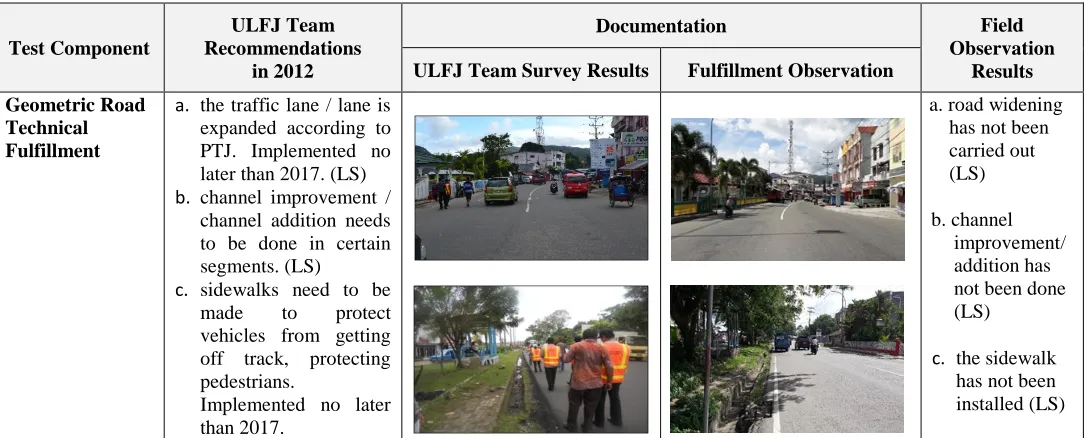
2.Bridge Routine Ir.M.Putuhena (Durian Patah-Laha) Test Component ULFJ Team Recommendations in 2012
Documentation Field
Observation Results ULFJ Team Survey Results Fulfillment Observation
Geometric Road Technical Fulfillment
a. the traffic lane / lane is expanded according to PTJ. Implemented no later than 2017. (LS)
b. channel improvement / channel addition needs to be done in certain segments. (LS)
c. sidewalks need to be made to protect vehicles from getting off track, protecting pedestrians.
Implemented no later than 2017.
a. road widening has not been carried out (LS)
b. channel improvement/ addition has not been done (LS)
International Journal of Civil & Environmental Engineering IJCEE-IJENS Vol: 19 No: 02 15
Test Component
ULFJ Team Recommendations
in 2012
Documentation Field
Observation Results ULFJ Team Survey Results Fulfillment Observation
Technical Compliance of Road
Complementary Structures
a. The Wai Nini Bridge needs to be widened due to narrowing, because the width of the road is not the same as the traffic lane before entering the bridge. (LS) b. In order to provide
parking space outside the road body on several segments so as not to disturb the smooth flow of traffic. Implemented no later than 2014. (LS)
a. Wai Nini Bridge has not been expanded (LS)
b. There is no parking space outside the road on several segments (LS)
Technical Compliance with the Use of Road Parts
a. PTJ requires the Rumaja width for the road being 13 m, while the maximum width of the housing on the Paso-Durian Patah segment I segment is 9-10 m clean up activities on the road so that only the traffic is carried out at the latest in 2017. (LS)
b. PTJ requires Rumija at least 15 m, but in this segment Rumija is less than 15 m, so that the space limit is adjusted to the width with the smallest limit
according to PTJ. (LS)
c. PTJ requires the width of the Ruwasja to be at least 15 m but the field varies. In order for the minimum limit of Ruwasja to be realized, working with the Regional Government will be implemented no later than 2017. (LS)
a. Not yet cleaned up on activities on the side of the road so that only for traffic (LS)
b. the exact limit of the limit has not been made and adjust the width with the smallest limit according to the PTJ. (LS)
Based on the results of the Road Function Fulfillment Test fulfillment technically in tables 2, 3 and 4, it can be stated that the fulfillment of Road Function Feasibility is based on the recommendations of the Road Function Worthy Test Team in 2012, that the implementation of ULFJ Team Recommendations must be carried out in 2014-2017, but fulfillment carried out by road operators and road organizer elements has not gone well so that the 3 road segments in Ambon city are still categorized as Fit for Conditional Functions (LS). The categories of the three roads are as follows: 1. The Laksdya leo wattimena (Passo - Durian Patah) road is
still categorized as Perfect Conditional Function (LS) 2. Y. Syaranamual Road (Durian Patah - Laha) is still
categorized as Perfect Conditional Function (LS)
3. Ir. M. Putuhena (Broken Durian - Laha) is still categorized as Perfect Conditional Function (LS)
Due to the limitations of the APBN Budget, road operators have not carried out the Fulfillment Test and Evaluation of Fully Performing Road Functions based on the recommendations of the ULFJ Team. Where the priority of the national road handling program is still focused on the national road functional and national road stability according to the target of the 2015-2019 DGH Renstra.
To overcome the above problems in 2018 the Director General of Highways as a road operator through the Environmental and Road Safety Sub-Directorate has implemented a fulfillment program by prioritizing the fulfillment of two trans roads so that the roads that have been fulfilled can be upgraded from proper conditional functions ( Technical
Fulfillment of Organizing Management and Traffic Engineering
a. Marka (LS) the axis line on the axle, the dividing line is cut off and the separator is full and the edges of this segment have not been installed
b. Sign (LS) No Traffic Signs, Signs must be installed in less places.
Implemented no later than 2014.
c. Sidewalk (LS) Sidewalks along this road segment do not exist on either side of the road carried out no later than 2017.
d. Crossing Place (LS) Zebra crossing that has not yet been in several segments so that it is immediately equipped. Implemented no later than 2014
e. Road & Traffic Transportation Support Facilities (LS)
Bus stops in some segments, which are not functioned as they should. In order for the bus stop to function according to its function, it is carried out no later than 2014
a. Markings have been installed and must be treated (L)
b. Signs have been installed but not all of them (LS)
c. The sidewalk has been installed on the right and left side yet (LS)
d. Zebra crossing has not been made in several segments (LS)
International Journal of Civil & Environmental Engineering IJCEE-IJENS Vol: 19 No: 02 17 entire national road segment has not been accommodated to
fulfill the road function in 2018.
Conclusions and Recommendations
Conclusion
The feasibility of road functions aims to realize the orderliness of road organizers which includes regulation, guidance, development and supervision up to the creation of roads that meet the provisions of Security, Safety, Order and Smooth Traffic and Road Transportation which are economical and environmentally friendly.
Fulfillment of ULFJ Team recommendations is carried out as an effort to achieve feasibility status, from Non-Proper and Conditional Worth status to Function Worthiness, and to maintain the Safe Status of a Safe Road Function. From the results of observations and interviews conducted in this study, it can be concluded that the fulfillment of road function feasibility on the 3 national road segments in Ambon City is still categorized as Fit for Conditional Functions (LS).
Thus the handling of compliance with road function feasibility tests above, has not yet answered the ULFJ Team recommendations on the three road sections so that it requires considerable time to fulfill the roadworthiness test according to the Recommendation of Tests and Evaluation of Road Function Feasibility from the ULFJ Team on the national road section in the city of Ambon, so that the status of the three roads cannot be upgraded from the condition of conditional function (LS) to a feasible road (L), in indicating the feasibility of a safe road function.
Suggestion
1. It is necessary to re-examine the handling program for the fulfillment of road function tests carried out by road operators, which only prioritizes the fulfillment of trans road sections, and only accommodates two sections per hall of national roads because it requires a very long time to fulfill ULFJ Team Recommendations so that the road is worthy of safety functions.
2. Road organizers Need to coordinate continuously with relevant agencies in the field of Road Traffic and Transportation Facilities and Infrastructure (DLLAJ) and the National Police of the Republic of Indonesia to accelerate the implementation of road function feasibility tests.
REFERENCES
[1] Undang-Undang Republik Indonesia Nomor 38 Tahun 2004 tentang Jalan
[2] Peraturan Pemerintah No. 43 Tahun 1993 Tentang Prasarana dan Lalu Lintas Jalan
[3] Peraturan Pemerintah No. 34 Tahun 2006 Tentang Jalan
[4] Peraturan Menteri Pekerjaan Umum No. 11/ PRT/M/2010 tentang Tata Cara dan Persyaratan Kelaikan Fungsi Jalan.
[5] Peraturan Menteri Pekerjaan Umum No. 19/ PRT/M/2011 tentang Persyaratan Teknis Jalan dan Kriteria Perencanaan teknis Jalan. [6] Peraturan Menteri Perhubungan NomorPM 96 Tahun2015 tentang
Pedoman Pelaksanaan Kegiatan Manajemen dan Rekayasa Lalu Lintas
[7] Instruksi Dirjen Bina Marga Nomor 02/Db/In/2012 tentang Panduan Teknis Rekayasa Keselamatan Jalan
[8] Petunjuk Pelaksanaan Kelaikan Fungsi Jalan No. 09/P/BM/2014 Direktorat Jendral Bina Marga, Kementrian Pekerjaan Umum 2014 [9] Al Ardi Fadzila Syahilendra, Uji Laik Fungsi Jalan Ditinjau Dari
Aspek Teknis Pada Jalan Imam Bonjol-Jalan Teuku Umar Kabupaten Jember, Skripsi, Fakultas Teknik, Universitas Jember, kota Jember.
[10] Alfrianto Rifki, Analisis Kelaikan Fungsi Jalan Secara Teknis Dengan Metode Kuantitatif (Studi Kasus : Ruas Jalan Nasional Batas Kota Sanggau-Sekadau, Kalimantan Barat, Skripsi, Fakultas Teknik, Universitas Gadjah Mada, kota Yogyakarta.