e-ISSN: 2278-7461, p-ISSN: 2319-6491
Volume 5, Issue 5 [May. 2016] PP: 74-81
A Study And characterization Of magnet or heological Fluid For
Damper In Automobile Suspension
Dr.B.SWAMINATHAN1 D.ANURADHA2 M.SRINU RAJ3
Professor, Department of Mechanical, Faculty of HITS ,Hyderabad ,India.
ABSTRACT: The paper is focused on preparation and characterization of magnetorheoloigcal fluid for damper application. The application of MR fluid in different applications has become an emerging field for the researchers. The semiactive control using MR damper in an automobile suspension is advantageous in terms of performance as compared to passive control and cost as compared to active control. Hence the work includes preparation of MR fluid using different carrier fluids and additives and study effect of particle size, type and amount of additives and viscosity on stability of fluid. The carrier fluids used are paraffin oil, silicon oil, synthetic oil and additives are Aerosil200 and AP3 Greece. Carbonyl iron powder of size 1 µm and 5 µm have been used and observed the performance of fluid. The viscosity of MR fluid is influenced by the size of particle, small size particles can disperse properly in fluid. Greater the viscosity better be the Magnetorheological effect. Using stabilization agents like Aerosil200 and AP3 Greece used in this work improves stability. Increasing the amount of additives increases the stability. Selection of the type of stabilizer is equally important to achieve better stability. Aerosil200 (Fumed silica) avoids agglomeration and provides better stability than AP3 Greece.
Key words: MR Fluid, AP3 Greece, Sedimentation, Flux Density, MR Damper.
I.
INTRODUCTION
The Magnetorheological fluid is discovered by Jacob Rabinow in 1940’s. It comes in a category of smart fluids which is controllable. It is composed of a carrier fluids, micron sized ferromagnetic particles and additives to impart the stability of fluid. The rheological properties of these fluids are changes on application of external magnetic field. Rheology deals with the study of deformation and flow of matter under the action of the impact of a stress. The rheological properties of controllable fluids depend on carrier fluid, density of particles, particle size, temperature and external magnetic field etc. It has wide applications in all sectors viz. civil, mechanical, automobile, biomedical etc. Nowadays the MR fluids exhibit many attractive properties like high yield stress, low viscosity, wide dynamic range etc. Because of this magneto rheological fluids are recently used in suspension of high class vehicle. Fig1 (a) shows MR fluid without magnetic field and fig1 (b) shows MR fluid after application of magnetic field. The ferromagnetic particles are randomly spread into the carrier fluid while the magnetic field is not provided and as soon as the magnetic field is provided the particles are arranged in rows. The change in position of particle after application of magnetic field creates a resistance to the flow of fluid from orifice while using in dampers which in turn increases the resistive force. The strength of magnetic field is responsible to increase or decrease the rate of flow of MR fluid i.e. the viscosity of fluid changes with change in the strength of magnetic field.
(a) (b)
Now days the researchers are working on improving the performance along with the reduction in cost of MR fluid. Different carrier fluids viz. silicon oil, synthetic oil, castor oil, vegetable oil etc. were used to prepare MR fluid for different applications. Similarly, different additives depending upon the properties of carrier fluid have been used to improve the stability of MR fluid. Research has been conducted by many authors by using different sizes of ferromagnetic particles and checked the performance in terms of yield strength of fluid. But still this field is open for the researchers as there are lots of fluids yet which one can try as a carrier fluid like water, kerosene, paraffin oil, vegetable oils, mineral oil etc. for reducing cost of MR fluid. To improve the stability of MR fluid different additives can use and find out optimum percentage of it particular combination to achieve better stability. Hence the Preparation and Characterization of Magnetorheological Fluid For Damper In Automobile Suspensionwork is focused on preparation of MR fluid using different carrier fluids as paraffin oil, silicon oil and synthetic oil. Carbonyl iron particles in two different sizes 1 µm and 5 µm are used. Arosil, AP3 Greece and Arabic gum are used as additives. Various combinations have been tried and found out compositions which will provide better performance in terms of dynamic response and yield strength. The reduction in the cost of MR fluid is also an important field for the researcher to bring the MR fluid in applications like an automobile suspension in commercial vehicles, automotive clutch, brakes etc. Few of the researches in this field are briefly explained below.
Turczyn et.al has composed MR suspension using Silicon, Synthetic and Mineral oil as carrier fluid and Arosil, Arabic gum and Arsil as additives. The effect of additives on stability of MR fluid has been investigated. The stability of MR fluid improves with addition of additives. It does not diminish magnetic property of fluid but even increases dynamic viscosity in presence of an external magnetic field [1]. Fang C. et al has composed MR suspension using Silicon oil as carrier fluid and Guar gum powder as additives. Guar Gum improves sedimentation stability and thixotropy of fluid by forming a coating layer over a CI powder [2]. Wu W. P. et al.
has mentioned that guar gum improves stability as well as yield stress but the major limitation of guar gum is excessive absorption of moisture which leads to microbial degradation of MR fluid [3]. Chiranjit Sarkar et. al.
CI based MR fluid prepared by mixing oleic acid as carrier fluid and tetranethyle ammonium has better chain strength and less sedimentation. It performs good in brake application [4]. S. ElizabethPremalatha composed MR fluid using Silicon oil as base fluid, iron powder and grease as additives. The sedimentation is improved by adding higher percentage of additives [5]. Kumbhar B. K. et al. composed MR fluid using Carbonic iron and electrolyte iron powder with oleic acid as carrier fluid and grease as an additive and recommended a composition suitable for MR Brake application [6].
II.
PROPERTIES OF TYPICAL MR FLUID
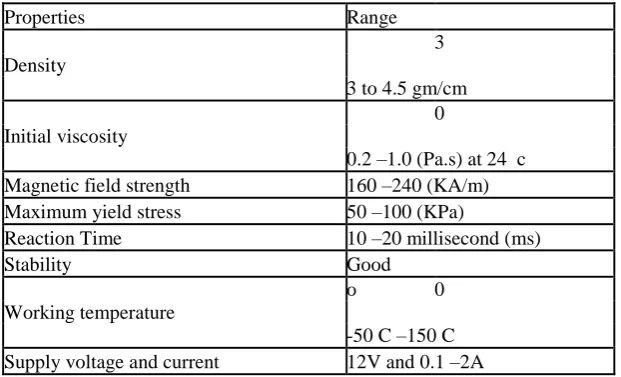
The properties of typical MR fluid are given in the table below.
Table 1 Properties of typical MR fluid
Properties Range
Density
3
3 to 4.5 gm/cm
Initial viscosity
0
0.2 –1.0 (Pa.s) at 24 c Magnetic field strength 160 –240 (KA/m) Maximum yield stress 50 –100 (KPa)
Reaction Time 10 –20 millisecond (ms) Stability Good
Working temperature
o 0
-50 C –150 C Supply voltage and current 12V and 0.1 –2A
III.
PREPARATION OF MR FLUID
The materials used for preparation of MR fluid are Carrier fluids: Low viscosity
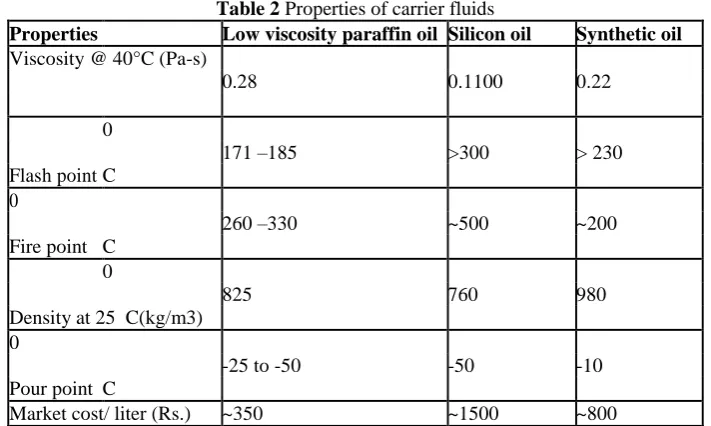
Carbonyl iron powder. The carbonyl iron powder of size 1 µm and 5 µm are used. The various combinations of carrier fluids and additives have been practiced and also practiced the combinations by varying the percentage and type of additive to obtain composition of MR fluid with better stability. Table 2 shows properties of carrier fluids used for the composition.
Table 2 Properties of carrier fluids
Properties Low viscosity paraffin oil Silicon oil Synthetic oil Viscosity @ 40°C (Pa-s)
0.28 0.1100 0.22
0
171 –185 >300 > 230 Flash point C
0
260 –330 ~500 ~200 Fire point C
0
825 760 980
Density at 25 C(kg/m3) 0
-25 to -50 -50 -10 Pour point C
Market cost/ liter (Rs.) ~350 ~1500 ~800
Table 4 shows the percentage of various constituents used for preparation of MR fluid. The compositions of MR fluid with different carrier fluids have been tried by altering amount and type of additive keeping the percentage of carbonyl iron powder same (35%).
Table 4 Composition of MR fluid
Carrier
Fe Particles Fe Additives
Sr. No. (1µm) Particles(5µm) [wt % of
fluid Type
[wt %] [wt %] CI]
Low
MR1. Viscosity 35 35 AP3 Greece 6% Paraffin oil
MR2.(A)
Silicon Oil
35 35 Arosil 200 1% (OKS 1050)
(B)
Silicon Oil
35 35 Arosil 200 2% (OKS 1050)
Low
MR3. Viscosity 35 35 Arosil 200 2% Paraffin oil
MR4.
Synthetic oil
35 35 Arosil 200 2% (OKS 352)
IV.
PREPARATION OF MR FLUID
effect on viscosity.Preparation and Characterization of Magnetorheological Fluid For Damper In Automobile Suspension
Figure 2 Electronic weighing machine and mechanical stirrer
V.
CHARACTERIZATION OF MR FLUID
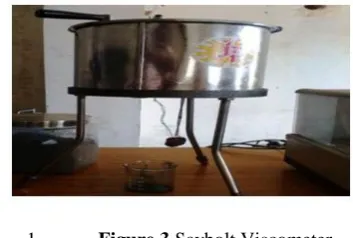
The rheological properties viz. viscosity of MR fluid has been tested using Saybolt viscometer as shown in fig 3. To measure the viscosity prepared MR fluid is filled into the Saybolt apparatus and measured the time required to fill 60 ml oil in beaker through an orifice provided to it apparatus. Initially the kinematic is obtained from instrument and then converted into dynamic viscosity.
1. Figure 3 Saybolt Viscometer
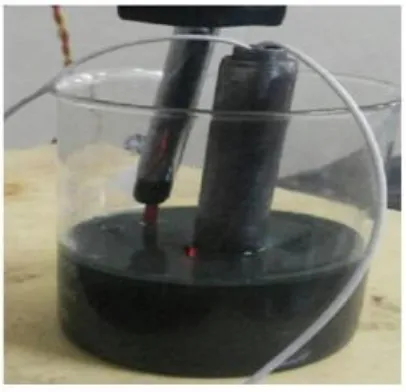
Figure 4 Set up flux density measurement using Gauss meter
Finally, to calculate sedimentation ratio, every sample is kept into cylindrical glass test tube shown in fig 5 and observed after every 5 hrs the change in boundary of clear and turbid part of fluid. The observation is continued till 50 Hrs and calculated the sedimentation ratio by using a simple relation given below.
, x, 100%, , , ,
, x y, ,
, , Where, x= length of clear part, y= length of turbid part, The samples are kept in test as shown in fig below,
Figure 5 Cylindrical glass tube with MR fluid
VI.
RESULT AND DISCUSSION
As shown in table different compositions have been tried and tested. Amongst all the samples listed in the table 5A and 5B have found their properties within the prescribed range mentioned in the table. MR 2 and MR 3 have very good magnetic field strength. But cost of carrier fluid used for MR 2 and MR 3 (Silicon oil) is highest of all per liter whereas cost of paraffin oil is comparatively very less. Properties of MR1 are comparable with MR2 and MR3. Similarly, carbonyl iron powder in two different sizes have been used and observed the effect on particle size on viscosity, sedimentation and response time of the fluid.
Table 5 A Properties of prepared MR fluid (1µm particle)
Properties MR 1 MR 2 (A) MR 3 MR 4
Properties MR 1 MR 2 (A) MR 3 MR 4
Density 3.56 gm/cm3 3.83 gm/cm3 4.21 gm/cm3 4.48 gm/cm3 Initial viscosity 0.95 Pa-s 0.72 Pa-s 0.75 Pa-s 0.93Pa-s Reaction Time 16ms 10ms 11ms 13ms Supply voltage 12V and 0.2- 12V and0.2– 12V and 0.2- 12V and 0.2- and current 1.8A 1.8A 1.8A 1.8A
The effect of particle size is significant on the carrier fluid with low viscosities than the fluid with higher viscosities. The numbers of factors influences rheology are particle size, particle size distribution and mass of iron powder i.e. solid in carrier fluid. The particles distribution with size 1µm is better than fluid with size 5 µm. Hence for same fluid and same mass of iron powder viscosity of fluid with particle size 1 µm is more than 5 µm properly in the initial stage but sedimentation rate is higher than the fluid with particle size 1 µm. The viscosity of MR2 and MR3 is less than other because the initial viscosity of silicon oil is less as compared to other and amount of carbonyl iron powder used in all composition is same i.e. 35%. The Magnetorheological effect is depend upon the viscosity of fluid greater the viscosity bigger the effect. Increasing the amount of iron powder can increase the effect.
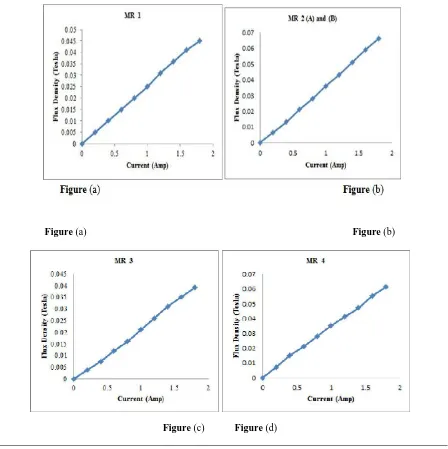
Fig 5 (a) (b) (c) (d) shows plots between current and flux density for fluid with particle size 1 µm. The increase in current in the step size of 0.2 Amp the flux density increases.
Figure (a) Figure (b)
Figure 6 Plot for Current Vs Flux Density (Fluid with particle size 1 µm)
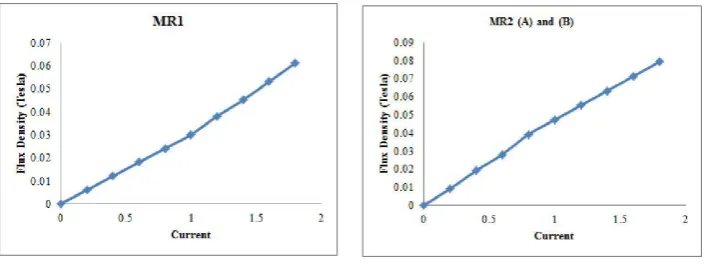
Similarly plots of Current Vs Flux Density are drawn for fluid with particle size 5 µm. The flux density is more than the former.
(a) (b)
Preparation and Characterization of Magnetorheological Fluid For Damper In Automobile Suspension
(c) (d)
Figure 7 Plot for Current Vs Flux Density (Fluid with particle size 5 µm)
Sedimentation Ratio is calculated for fluid with particle size 1 µm and particle size 5 µm. The sedimentation rate in all compositions i.e. MR1, MR2 (A) and MR(B), MR3, MR4 of fluid with particle size 5 µm is more than fluid with particle size 1 µm. It means sedimentation increases with increase in the particle size because it is depend upon density of particle. Similarly, increasing the amount of additive in MR fluid improves the stability as shown in fig 8, in MR2 (A) amount of additive is 1% of weight of iron powder and in MR2 (B) it is 2%. It is observed that by increasing the amount of additive (Aerosil200) by 1 % in MR2 (B), the reduction in sedimentation coefficient of fluid are 22 % and 16 % in the fluid with particle size 1 µm and 5 µm respectively. Aerosil200 (fumed silica) is a very good binder and hence using same carrier fluid in MR1 and MR3, MR3 has better stability than MR1.
(a) Fluid with particle size (1 µm) (b) Fluid with particle size (1 µm)
VII.
CONCLUSION
From the results discussed above it is clear that as the stability of fluid is depend upon particle size, viscosity, amount of carbonyl iron powder and additives. Particle size affects the viscosity of fluid. Viscosity of fluid with particle size 1 µm was found more than particle size 5 µm. The amount of additives used in composition influences the stability of fluid. The stability of MR2 (B) is improved by increasing Aerosil200 amount by 1%. Type of additive use in composition affects the stability. The stability of MR3 is far better than MR1 as Aerosil200 is good binder than AP3 Greece. Sedimentation of fluid is also depending upon type of carrier fluid used in the composition. If the initial viscosity of carrier fluid is less then faster sedimentation is possible. Hence to avoid this problem the amount of carbonyl iron powder is to be increased in the composition.
REFERENCES
[1] R. Turczyn, M. Kciuk, Preparation and study of model Magnetorheological fluids, Journal of achievements in materials and manufacturing engineering, 2008, 27(2).
[2] Fang, C; Zhao, B.Y; Chen, L.S; Wu, Q & Hu, N.L.K. The effect of the green additive guar gum on the properties of magnetorheological fluid. Smart Mater.Struc., 2005, 14(1), N1–N5.
[3] Wu, W.P; Zhao, B.Y; Wu, Q & Hu, L.S.C.K. The strengthening effect of guar gum on the yield stress of magnetorheological fluid. Smart Mater. Struc., 2006, 15(4), N94–N98.
[4] Chiranjit Sarkar, Harish Hirani, Synthesis and Characterization of Antifriction Magnetorheological Fluids for Brake, Defence Science Journal, Vol. 63, No. 4, July 2013, pp. 408-412.
[5] S. Elizabeth Premalatha1,2, R. Chokkalingam1, M. Mahendran, Magneto Mechanical Properties of Iron Based MR Fluids, American Journal of Polymer Science 2012, 2(4): 50-55.
[6] Kumbhar B. K., Satyajit R. Patil, Suresh M. Sawant, Synthesis and characterization of fo rheological fluids for MR brake application, Engineering science and Technology an International Journal, Elsevier, 18(2005),432-438.
[7] Honghui Zhang, Changrong Liao, Weimin Chein, Shanglian Huang, A magnetic design method of MR fluid dampers and FEM analysis of magnetic saturation, Science online paper.
[8] Mukund A. Patil, Swapnil Sapkale, Sagar Soni, Vijay Sarvaiya, Vishal Parekh, Theoretical And Experimental Studies On Magnetorheological Fluid Damper With Dc Input. International Journal of Mechanical Engineering andTechnology, 3(2), 2012, pp. 610–619.
[9] Nitin H. Ambhore, Shyamsundar D. Hivarale and Dr. D. R. Pangavhane, A Comparative Study of Parametric Models of Magnetorheological Fluid Suspension Dampers. International Journal of Mechanical Engineering andTechnology, 4(1), 2013, pp. 222–232.
[10] Piyush Gulati, Rajesh Kanda, JaiInder Preet Singh, Manjinder Bajwa, Simulation and Optimization of Material Flow Forging Defects In Automobile Component and Remedial Measures Using Deform Software. International Journal ofMechanical Engineering and Technology, 3(1), 2012, pp. 204–216. [11] Weng W. Chooi Design, modelling and testing of magnetorheological (MR) dampers using analytical