Abstract—Making our homes greener requires optimization of environmental impacts through efficient use of energy, water and building materials and proper disposal of waste. The study is an attempt to build greener homes by introducing codes leading to a rating system to minimize the environmental damage during its life span and to revolutionize the design of new buildings for healthy and more sustainable lifestyles. The code has been proposed based on six criteria covering energy, water, materials, waste, ecology, health and wellbeing. Each criterion is assessed and weighted based on its relative importance and a total score is obtained after assessing all the criteria. It also recommended that all buildings should be certified or coded by a licensed and accredited code assessor to ensure that the rating is independent and trustworthy.
I. INTRODUCTION
The concept of sustainability in building and construction has evolved over many years. In fact, the United Nations Centre for Human Settlements [1] acknowledges that housing is now universally recognized as a human right and that effort to implement this right must be strengthened and accelerated. Furthermore, the success and progress of human society depends on physical infrastructure, and a nation’s economic strength is reflected in its infrastructure assets [2]. With almost 60 percent of world population expected to be living in urban areas by the year 2030 [3], massive construction activity is taking place globally. Sustainable construction is a way for the building industry to move towards achieving sustainable development, taking into account the environmental, socio-economic and cultural issues. Specifically, it involves issues such as design and management of buildings, materials and building performance, energy and resource consumption - within the larger orbit of urban development and management [4]. Building greener homes requires optimization of environmental impacts such as water use, energy flow and waste output in addition to CO2 emissions from the building. Bangladesh is recognized worldwide as one of the countries potentially most vulnerable to the impacts of global warming and climate change [5]-[10]. This is due to its unique geographic location, dominance of floodplains, and low elevation from the sea, high population density, high levels of poverty, and overwhelming dependence on nature, its
Manuscript received June 16, 2011, revised August 23, 2011.
Authors are with the Department of Civil and Environmental Engineering at Islamic University of Technology (IUT), Board Bazar, Gazipur-1704, Bangladesh. (e-mail: [email protected]; [email protected]; [email protected]).
resources and services. Global warming has caused fundamental changes to our climate. According to the IPCC, a 45 cm sea-level rise could cause a potential land loss of 10.9 percent and a one meter sea-level rise a loss of 20.7 percent [8]. The UNDP predicts that 11 percent of the population will be directly threatened by a one meter sea-level rise [11]. The fast growing mega city like Dhaka is more exposed due to its unplanned urbanization, rapid population growth and massive boom in construction sectors, improper management and planning. The wetland has been filled up for constructing houses, agricultural land around Dhaka city is decreasing very rapidly. Therefore, the study is an attempt to address the issues of greener homes by introducing a rating system indicating a scale of 1-5 based on six criteria covering energy, water, materials, waste, ecology, health and wellbeing. Homes are coded to encourage their owners to live a more sustainable lifestyle and build homes in a more efficient way using materials from sustainable and locally available sources. This creates less waste with lower running costs.
II. CONCEPTS OF GREENER HOME
Greener buildings or homes practices offer an opportunity to create environmentally-sound and resource-efficient buildings or homes by using an integrated approach to design. Greener homes are the process of producing a constructed facility that encompasses ultimate energy efficiency, forward-thinking resources management, and general sustainable construction [12]. Achieving greener building, however, requires an integrated team; combining a wide range of different specialists through in depth collaboration so that the complexity of trade-offs between architectural features, value and cost, building services and other factors can be reached [13]. The characteristics of greener homes include:
• resource conservation, including energy efficiency, renewable energy, and water conservation features; • consideration of environmental impacts and waste
minimization;
• creation of a healthy and comfortable environment; • reduce operation and maintenance costs and use of
environment friendly construction materials; • Contribute to overall quality of life.
In US, LEED™ (Leadership in Energy & Environmental Design) provides Greener Building Rating System. It provides a complete framework for assessing building performance and meeting sustainability goals [3]. Compared to a standard building, a LEED-certified building uses 32% less electricity and reduces annual average CO2 emissions by 350 metric tons [14]. UK introduced the Code for Sustainable
Building Greener Homes Based on Coding and Rating
System
S. Shams, K. Mahmud, and M. Al-Amin
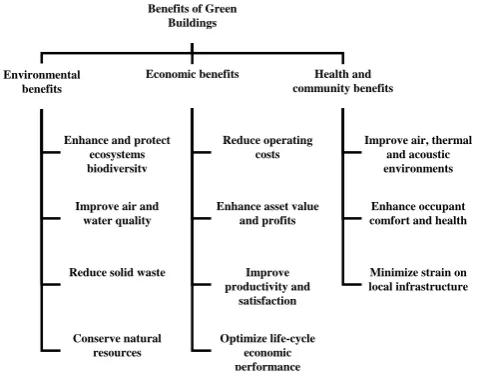
Homes in April 2007 (Department for Communities and Local Government, 2007) after consultation with environmental groups and the home building and construction industries. The code is a voluntary standard designed to improve the overall sustainability of new homes based on nine criteria such as energy and CO2 emissions, pollution, water, health and well-being, materials, management, surface water run-off, ecology and waste. The code is set in a single framework within which the home building industry can design and construct homes to higher environmental standards and offers a tool for developers to differentiate themselves within the market. Where it is used the code also gives new homebuyers better information about the environmental impact of their new home and its potential running costs. The USGBC identifies that the greener homes have following advantages [15]:
III. IMPORTANCE OF RATING AND CODING SYSTEM The developing city like Dhaka is having an annual growth of 12% in construction sector which contributes 3.7% of GDP [16] and employs 1.6 million people. Today, real estate and construction industry is the biggest of all the locally run industries and contributing 14.50 billion BDT (US$ 231 million) [16] annually. As per the Town Improvement Act 1953 (TI Act 1953) Rajdhani Unnayan Kartipakkhya (RAJUK: Capital Development Authority) is the legitimate authority to prepare land use plan and take care of plan implementation, control the development and manage the growth of Dhaka city. But it has failed to implement and control the planned development growth resulting Dhaka into an overcrowded and polluted mega city. Inappropriate planning permission process and corruption in the whole system are hindering the planned development of Dhaka city. The existing one or two storied buildings are demolished to construct multistoried building by the real estate developers which create a significant stress on water, energy and waste management. If present trend of unsustainable unplanned growth of construction goes on it will not be far away when the city might turn into a deserted city due to lack of basic utilities such as water supply, gas and electricity. Therefore, a rating and coding system is required for existing and new homes to influence the design and construction approach leading to a sustainable and healthy environment.
IV. CODING AND RATING SYSTEM
The code for Greener Homes (CGH) is an environmental assessment rating method for new homes which assesses environmental performance in a two stage process (Design and Post-construction phase) using objective criteria and verification. The results of the code assessment are recorded on a certificate assigned to the dwelling. The code has been proposed based on six criteria covering energy, water, materials, waste, ecology, health and wellbeing. Each criterion is given a weight based on their relative importance over one another as shown in the Table I below. The weighting factors used in the Code have been derived from extensive studies involving a wide range of stakeholders (Design Engineers, Architects, City Planners, Policy makers, Environmental Specialist, Doctors, Dwellers) who were asked to rank (in order of importance) a range of environmental impacts. Altogether, 78 stakeholders were asked to give their feedback obtained through a questionnaire and recompiled to assess the relative importance of each criterion over one another.
TABLE I:SHOWING THE RELATIVE IMPORTANCE OF EACH CRITERION IN THE CODING ASSESSMENT.
Criteria Weight Reason
Energy 0.3 It is the most important criteria and the city like Dhaka is facing severe energy crisis and three times more important than the use of materials Water 0.2 Twice as important as the use of materials Materials 0.1 Less important as compared to other criteria Waste 0.2 Twice as important as the use of materials Ecology 0.1 Ecology is directly or indirectly related with water
uses and waste disposal and given half importance as compared to water or waste. Health and
Wellbeing
0.1 Health and Wellbeing is as important as ecology
A. Energy
Energy is one of the most important criteria which need to be assessed based on use of renewable energy such as solar energy, energy from biomass. Proper management and wise use of energy can cut down emissions. Therefore, optimum and use of renewable energy is a major criterion for greener homes and it has been highly weighted with 30 credits. The Table II shows the importance of each factor.
B. Water
Adequate water supply with necessary drainage facility for disposal of waste water is an important criterion and therefore it has been given 20 credits. Ecology, health and wellbeing are directly or indirectly influenced by the availability of water and its proper management. Available records and some groundwater related researches show that the groundwater abstraction in the city has increased by several hundred percent in last few decades. In 1980 about 112 million cubic meters groundwater was withdrawn from about 80 tube wells to meet the ongoing demands of the city. But the need for groundwater increased so high that in 1990 about 136 tube wells were used to withdraw about 183 million cubic meters of groundwater. According to Dhaka Water and Sewerage Authorities (DWASA), it has a capacity to supply 1.27 billion litres per day against a demand of 1.6 Benefits of Green
Buildings
Environmental benefits
Economic benefits Health and community benefits
Enhance and protect ecosystems biodiversity
Improve air and water quality
Reduce solid waste
Conserve natural resources
Reduce operating costs
Enhance asset value and profits
Improve productivity and
satisfaction
Optimize life-cycle economic performance
Improve air, thermal and acoustic environments
Enhance occupant comfort and health
billion litres for residents in the capital city Dhaka. The efforts to increase water supplies faced difficulties as many of the 750 deep tubewells it used in the capital were unusable due to falling ground water levels. According to a statistics of Bangladesh Water Development Board (BWDB), groundwater level in Mirpur dropped 53.75 metres between 1991 and 2008, while the decline was 18.59 metres in Mohammadpur, 37.4 metres in Sabujbagh, 8.22 metres in Sutrapur, and 14.14 metres in Dhaka Cantonment during the same period.
TABLE II:FACTORS AFFECTING ENERGY USES AND THEIR RELATIVE IMPORTANCE
Sub-criteria
for energy Weight Credits Reason
Solar
Energy 0.5 15
In a country like Bangladesh there is a tremendous potential for use of solar energy and emphasis has been given for using solar energy in every houses, particularly in high rising buildings.
Biogas 0.5 15
Biodegradable waste from the houses or large dwelling places can be collected and used to produce biogas through aerobic or anaerobic biodigestor and use it for cooking, generating electricity.
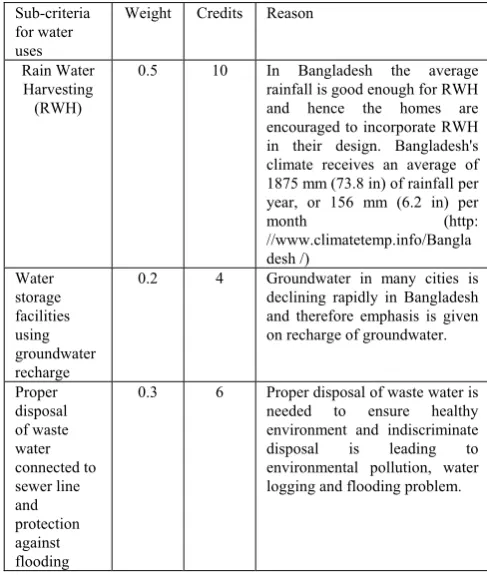
Provisions for Rain Water Harvesting (RWH), giving priority on uses of surface water over ground water, necessary water storage facilities with emphasis on ground water recharge and disposal of waste water through connected sewer lines can be an important factor and they have been weighted accordingly as shown in the Table III below. The dwellers are encouraged to use water saving technologies through aerated and self-closing faucets.
TABLEIII:FACTORS AFFECTING WATER USES AND STORAGE AND THEIR RELATIVE IMPORTANCE
Sub-criteria for water uses
Weight Credits Reason
Rain Water Harvesting (RWH)
0.5 10 In Bangladesh the average rainfall is good enough for RWH and hence the homes are encouraged to incorporate RWH in their design. Bangladesh's climate receives an average of 1875 mm (73.8 in) of rainfall per year, or 156 mm (6.2 in) per
month (http: //www.climatetemp.info/Bangla
desh /) Water
storage facilities using groundwater recharge
0.2 4 Groundwater in many cities is declining rapidly in Bangladesh and therefore emphasis is given on recharge of groundwater.
Proper disposal of waste water connected to sewer line and protection against flooding
0.3 6 Proper disposal of waste water is needed to ensure healthy environment and indiscriminate disposal is leading to environmental pollution, water logging and flooding problem.
C. Waste
The disposal of waste and its efficient management can
reduce environmental impact, cut down water, air and soil pollution and given a total of 20 credits. Waste can be viewed as a resources and the concept of greener homes based on management of waste is another important criteria in code assessment. It can directly or indirectly improve surrounding ecological set up and ensure safe health and promote wellbeing. Table V shows the factors affecting waste disposal.
D. Materials
Use of materials is one of the criteria used in code assessment and given 10 credits. Use of locally available materials are encouraged and emphasis has been given on use of materials which can be recycled as shown in Table IV with relative importance. The materials for construction have a significant impact on the embodied energy and embodied CO2 of a building. Therefore, selection of materials can significantly reduce embodied energy and CO2 which play an important role in reducing the impact of climate change resulting from emission.
TABLE IV:FACTORS AFFECTING MATERIALS USE AND THEIR RELATIVE IMPORTANCE
Sub-criteria for materials
use Weight Credits Reason Use of
locally available Materials over 80 %
0.7 7
Use of locally available materials will ensure sustainability and generate local jobs and save money.
Use of materials that can be
recycled 0.3 3
Using recycles materials can decrease ecological footprint.
TABLE V: FACTORS AFFECTING WASTE DISPOSAL AND THEIR RELATIVE IMPORTANCE
Sub-criteria
for waste disposal Weight Credits Reason
Community based waste
management and disposal using composting
0.6 12
Waste should be managed locally with emphasis on provision for composting. Emphasis should be given on energy recovery if possible through bio-gas plant.
Segregation and collection of materials for
recycling 0.4 8
Door to door collection ensures better waste management and segregation at the point of source rather than at the transfer station increase collection efficiency of various materials which are not biodegradable.
E. Ecology
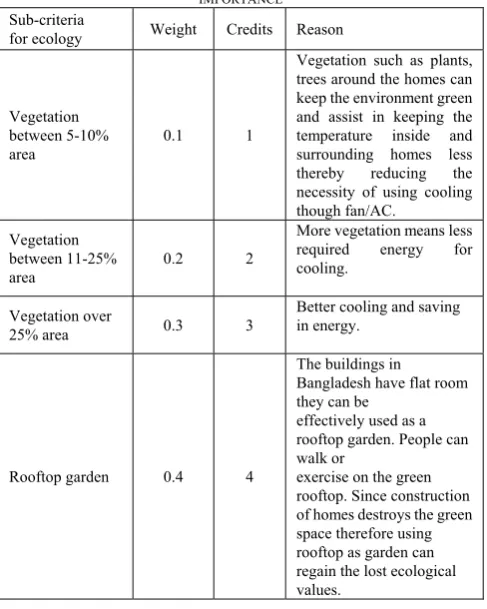
temperature near canopy and thus reduce (4–5°C) the incoming heat flux [17]-[19]. Table VI shows the factors affecting ecological value.
TABLE VI:FACTORS AFFECTING ECOLOGICAL VALUE AND THEIR RELATIVE IMPORTANCE
Sub-criteria
for ecology Weight Credits Reason
Vegetation between 5-10%
area 0.1 1
Vegetation such as plants, trees around the homes can keep the environment green and assist in keeping the temperature inside and surrounding homes less thereby reducing the necessity of using cooling though fan/AC.
Vegetation between 11-25%
area 0.2 2
More vegetation means less required energy for cooling.
Vegetation over
25% area 0.3 3
Better cooling and saving in energy.
Rooftop garden 0.4 4
The buildings in Bangladesh have flat room they can be
effectively used as a rooftop garden. People can walk or
exercise on the green rooftop. Since construction of homes destroys the green space therefore using rooftop as garden can regain the lost ecological values.
F. Health and Wellbeing
Health and wellbeing is directly or indirectly dependent on water, waste disposal and ecology. The greener homes should ensure sound health for its dwellers with adequate ventilation and provision for natural sunlight as shown in Table VII below. The construction of greener homes should emphasis on efficient use of ventilation and day lighting. Adequate day lighting can improve mental health and productivity [20].
TABLE VII:FACTORS AFFECTING HEALTH AND WELLBEING AND THEIR RELATIVE IMPORTANCE
Sub-criteria for health and wellbeing
Weight Credits Reason
Adequate ventilation (80% of indoor area covered with ventilation)
0.4 4
Necessary ventilation is required for maintaining indoors of house free from any odours and keeping air fresh.
Adequate natural sunlight (over 80% indoor area has access to natural sunlight)
0.6 6
The houses constructed should ensure enough natural
sunlight and keeping the indoor free from dampness and thereby reducing the growth of germs and bacteria harmful for health.
Based on the above criteria it has been recommended that homes will be rated based on Table VIII.
V. IMPLICATION FOR DEVELOPING CITIES
Developing cities are at present faced with the need to increase their energy production to accelerate development and raise the living standards of their populations, while at the same time reducing energy production costs and energy-related pollution. Increasing the efficiency of energy use to reduce its polluting effects and to promote the use of renewable energies must be a priority in any action taken to protect the urban environment [1]. Habitat highlights the following figures that illustrate the magnitude of the urbanization trend [1]:
• Currently, 40% of the population of developing countries already lives in cities,
• By 2020, 52% of the population of developing countries will be in cities and towns;
• Currently, three-quarters of global population growth occurs and is expected to continue to occur in the urban areas of developing countries, causing hypergrowth in the cities.
TABLE VIII: SHOWING RATINGS OF HOMES BASED ON THE OBTAINED CREDITS OR SCORES.
Credits Rating
Less than 20 1
Between 20-40 2
Between 41-60 3
Between 61-80 4
Over 80 5
The greatest challenge will be in Africa and Asia as Latin America and the Caribbean already have 75% city dwellers, while in contrast, only one-third of the population of Africa and Asia live in urban areas [1]. Cities in the developing world thus provide great opportunities for introducing rating and coding system leading towards sustainable greener homes. It is therefore imperative that developing countries develop and operationalize a system of greener homes indicators, with the aim of making them part and parcel of the design and construction process.
VI. CONCLUSION
local materials as possible into its construction - to support local economies, to avoid the high energy and financial costs of long-distance transportation, and to fit in with local aesthetics. It also recommended that there should be an authority in the developing countries to certify the buildings in terms of sustainability. All buildings should be certified or coded by a licensed and accredited code assessor to ensure that the rating is independent and trustworthy. The code will minimize the environmental damage from the construction process and will offer an opportunity to revolutionise the design of new homes so that the housing market encourages people to live more sustainable lifestyles. The fast growing cities like Dhaka needs immediate attention so that buildings are designed for maximum efficiency with optimum use of resources and lesser impact on environment. Energy efficient buildings, while limiting the growth of CO2 emissions, can also improve indoor and outdoor air quality, improve social welfare and enhance energy security. It is also recommended that the real estate developers working with construction industries needs to be assessed and ranked annually based on the concept of greener buildings or energy savings in comparison to the conventional approach of construction method. Following steps are recommended for the greener homes.
• Establish and strengthen indigenous building materials industry based on inputs of locally available natural resources;
• Formulate programmes to enhance the utilization of local resources including energy, water and waste disposal to be managed by the local community.
• Promote the increased use of energy-efficient designs and technologies and sustainable utilization of natural resources.
• Provide financial incentives to promote recycling of energy-intensive materials in the construction industry. • The use of construction materials and products that create
pollution during their life cycle should be discouraged such as imposing pollution tax.
REFERENCES
[1] Habitat (United Nations Centre for Human Settlements),“Cities in a Globalizing World: Global Report on Human Settlements”, London: Earthscan,2001
[2] Hudson, R.W., Haas, R. and Uddin, W. “Infrastructure management: design, construction, maintenance rehabilitation, renovation”, McGraw-Hill, New York, 1997.
[3] Syal, M., Hastak, M., Mullens, M. and Sweany, A. “United States-India collaborative research directions in urban housing and supporting infrastructure”, Journal of Architecture Engineering, Vol. 12, No. 44, pp.163-173, 2006.
[4] Ding, G.K.C. “Sustainable construction- The role of environmental assessment tools”, Journal of Environmental Management, Vol. 86, No. 3, pp.451-464, 2008.
[5] ADB Climate changes in Asia: Bangladesh Country Report. Regional study on global environmental issues. Asian Development Bank. Regional Study on Global Environmental Issues series, Manila, The Philippines, 1994.
[6] Ali, A. “Vulnerability of Bangladesh to climate change and sea level rise through tropical cyclones and storm surges”, Journal of Water Air Soil Pollution, Vol. 92, pp.171-179, 1996.
[7] Ali, A. “Climate change impacts and adaptation assessment in Bangladesh” ,Climate Research, Vol. 12, pp.109-116,1999.
[8] IPCC Science of Climate Change – Third Assessment Report (AR3) of the Intergovernmental Panel on Climate Change. Cambridge University Press, Cambridge,2001.
[9] Piguet, E., Climate change and forced migration. Research Paper No. 153.UNHCR Evaluation and Policy Analysis Unit, Geneva, 2008. [10] Climate Risk Index (2010): Who is most vulnerable? Weather-related
loss events since 1990 and how Copenhagen needs to respond. Sven Harmeling, Germanwatch. Available: http://www.germanwatch.org / klima/cri2010.pdf.
[11] UNDP Human Development Report 2007/2008. Fighting Climate Change: Human Solidarity in a Divided World. UNDP, New York, 2007.
[12] Rajgor, G. “Sustainable building: firing on target – US building designers aim for green”, Refocus, Vol. 5, No. 2, pp.62-73, 2004. [13] Sorrell, S. “Making the link: climate policy and the reform of the UK
construction industry”, Energy Policy, Vol. 31, No. 9, pp.865-878, 2003.
[14] USGBC (2007). Building design leaders collaborating on carbon-neutral buildings by2030. Available:www.usgbc.org/News /PressReleaseDetails.aspx?ID_3124.
[15]USGBC (2004). Leadership in Energy and Environmental Design, Available: http://www.usgbc.org/leed/leed_main.asp. [16] BBS National Accounts Statistics, July 2006, Bangladesh Bureau of
Statistics. CACCI (Confederation of Asia-Pacific Chamber of Commerce and Industry) (2006) “SMEs in Bangladesh”, CACCI Journal, Vol. 4, pp.1-19, 2006.
[17] Onmura, S., Matsumoto, M. and Hokoi, S. “Study on evaporative cooling effect of roof lawn gardens”, Energy and Buildings, Vol. 33, pp.653–666,2001
[18] Hien, W. N. “Study of thermal performance of extensive roof top greenery system in the tropical climate”, Building and Environment, Vol. 42, No. 1, pp. 25–54, 2007.
[19] Rumana R. and Mohd. Hamdan Bin Ahmed “ Thermal performance of rooftop greenery system at the tropical climate of Malaysia, a case study of a 10 storied building R.C.C flat rooftop”, Journal of
Architecture and Built Environment, Vol. 37, No. 1, pp.41-50, 2009.
[20] Younger, M., Morrow-Almeida, H. R., Vindigni, S. M. and Dannenberg, A. L. “The Built Environment, Climate Change, and Health Opportunities for Co-Benefits”, American Journal of Preventive Medicine, Vol. 35, No. 5, pp.517-526, 2008.
Shahriar Shams was born on 9 May 1973 in Dhaka,
Bangladesh. He is currently teaching as an Assistant Professor in the Department of Civil and Environmental Engineering at Islamic University of Technology (IUT), Gazipur, Bangladesh. He obtained his PhD from The University of Manchester (UK) in 2008. He obtained his M.Sc. in Environmental Engineering and Sustainable Infrastructure from Royal Institute of Technology (KTH) Sweden. He has published a number of International Journal and conference papers related to water and environmental issues.
Kashif Mahmud is an Assistant Professor in Civil
and Environmental Engineering Department of Islamic University of Technology (IUT), Gazipur, Bangladesh. He received both his M.Sc. and B.Sc. in Civil Engineering from Bangladesh University of Engineering and Technology (BUET), Dhaka, Bangladesh. His main research interests are Solid waste management, Landfill leachate management and characterization, Application of biological & chemical processes in waste water treatment, Leachate recirculation modeling, Sustainable developments, etc.He has published several research papers in international refereed journals and conference proceedings.
Md. Al – Amin is currently working as a lecturer in