R E S E A R C H
Open Access
Consolidating drug data on a global scale
using Linked Data
Milos Jovanovik
*and Dimitar Trajanov
Abstract
Background: Drug product data is available on the Web in a distributed fashion. The reasons lie within the regulatory domains, which exist on a national level. As a consequence, the drug data available on the Web are independently curated by national institutions from each country, leaving the data in varying languages, with a varying structure, granularity level and format, on different locations on the Web. Therefore, one of the main
challenges in the realm of drug data is the consolidation and integration of large amounts of heterogeneous data into a comprehensive dataspace, for the purpose of developing data-driven applications. In recent years, the adoption of the Linked Data principles has enabled data publishers to provide structured data on the Web and contextually interlink them with other public datasets, effectively de-siloing them. Defining methodological guidelines and specialized tools for generating Linked Data in the drug domain, applicable on a global scale, is a crucial step to achieving the necessary levels of data consolidation and alignment needed for the development of a global dataset of drug product data. This dataset would then enable a myriad of new usage scenarios, which can, for instance, provide insight into the global availability of different drug categories in different parts of the world.
Results: We developed a methodology and a set of tools which support the process of generating Linked Data in the drug domain. Using them, we generated the LinkedDrugs dataset by seamlessly transforming, consolidating and publishing high-quality, 5-star Linked Drug Data from twenty-three countries, containing over 248,000 drug products, over 99,000,000 RDF triples and over 278,000 links to generic drugs from the LOD Cloud. Using the linked nature of the dataset, we demonstrate its ability to support advanced usage scenarios in the drug domain.
Conclusions: The process of generating the LinkedDrugs dataset demonstrates the applicability of the
methodological guidelines and the supporting tools in transforming drug product data from various, independent and distributed sources, into a comprehensive Linked Drug Data dataset. The presented user-centric and analytical usage scenarios over the dataset show the advantages of having a de-siloed, consolidated and comprehensive dataspace of drug data available via the existing infrastructure of the Web.
Keywords: Methodology, Drugs, Drug products, Healthcare, Linked data, Open data, Data consolidation, Tools
Background
Accessing comprehensive drug and healthcare data on the Web can be a challenging task. The main reason lies in the fact that the data is available in different for-mats, at distributed Web locations. Additionally, most of the drug and healthcare datasets are published for specific purposes only, so consequentially, they contain
*Correspondence: [email protected]
Faculty of Computer Science and Engineering, ’Ss. Cyril and Methodius’ University in Skopje, Rugjer Boshkovikj 16, P.O. Box 393, 1000 Skopje, Macedonia
limited data. For instance, national drug repositories con-tain information about drug products which are approved and sold in the country [1–7]; websites aimed for the general public [8–13] contain descriptive drug use infor-mation, such as target, dosage, packaging and warnings; websites aimed for professionals [14–16] contain more specific drug data, such as active ingredients, chemical formulas, drug-drug interactions, food-drug interactions, toxicity, etc. Websites such as DrugBank [14, 17] con-tain more comprehensive drug data. However, the drug entries in their dataset are generic drugs, i.e. active ingre-dients of drugs, and not actual drug products which can
be bought by patients. Various mobile and web appli-cations [18–22] contain information about drug prod-ucts, but the data they use is country-specific and is not available to the interested parties in an open for-mat. Global drug product repositories exist as well [23– 25], but they either do not provide means of getting the data in an open format, or are locked behind a pay-wall. Additionally, some of them provide data for drugs reg-istered in countries from specific world regions only, or solely provide the name of the drug product in a specific country.
The Linked Data approach
According to [26–29], the emergence of the Linked Data principles has introduced new ways to integrate and con-solidate data from various and distributed sources. The Linked Data principles provide means and standards for representing, storing and retrieving data over the exist-ing infrastructure of the Web. This enables publishexist-ing and contextual linking of data on the Web and with it, cre-ating a Web of data, as opposed to the current Web of documents.
With this, the Web becomes a distributed network for standards-based data access, usable by software agents and machines. The interlinked nature of the distributed datasets provides new use-cases for the end-users, which are generally unavailable over isolated datasets. The Linked Data approach solves the issue of having ‘data silos’ in traditional relational database systems, silos which cannot link to other databases without a specific code written for the task, or specific mapping created in a data warehousing solution.
Additionally, the schema-flexibility of RDF provides means of independent data management and evolution, which is very well suited for the nature of the Web, but also for non-Web use in environments where data de-siloing and consolidation is needed [30, 31].
So far, as a result of the adoption of Linked Data prin-ciples by data publishers, the Linked Open Data (LOD) Cloud [32] has been populated with 1104 interlinked datasets [33]. These datasets, published on the Web fol-lowing the Linked Data principles, belong to 8 different domains: government, publications, life sciences, user-generated content, cross-domain, media, geographic and social web.
Motivation
Drug and healthcare data is already available on the Web, both as Linked Data in the LOD Cloud and as regular data on websites and in mobile applications, intended for human consumption. However, the drug data available currently as Linked Data is comprised of drug entities which are generic drugs, i.e. active ingredients of drugs, not actual drug products registered in a specific country,
under a specific name, with a specific dosage form, strength and price, for which an end-user might be inter-ested. Such end-users are the patients, the pharmacists, the doctors, but also medical institutions, pharmaceuti-cal companies, etc, which need access to drug products from specific countries for a multitude of user-centric and analytical scenarios [34]: accessing general information about drugs which can be bought in a country, accessing information about the availability of different drugs and drug categories in different countries, accessing pricing information, etc.
The national drug data are generally available on the Web, but on regular webpages and not as Linked Data. In order to transform the data from the national drug registries into high-quality, 5-star Linked Data [35], we propose a set of methodological guidelines which aim to assist drug data publishers and other interested parties into generating a global Linked Drug Data dataset, con-sisting of official data about drugs registered for use in different countries. One such global Linked Drug Dataset would be accessible by using W3C standards via the exist-ing Web infrastructure and would enable a myriad of new drug-analysis scenarios, including the above-mentioned ones. It would enable further data exploitations via devel-opment of innovative applications and services which use the data gathered from national drug registries of different countries in the world.
Such methodological guidelines should include steps aimed towards modeling and aligning the data, trans-forming the data into 5-star Linked Data, publishing the created datasets on the Web and defining use-cases or developing applications on top of the dataset. They should be aimed towards assisting drug data owners and pub-lishers, such as the national governing bodies, medical institutions, pharmaceutical companies, pharmacies, etc., in publishing their data in the same aligned, Linked Data format. Their data, once transformed into Linked Drug Data and interlinked with the drug data already pub-lished using the same methodology, could be used for data-based analytics (by the medical institutions, pharma-ceutical companies and governing bodies) or for reaching potential customers (by pharmacies).
In this paper, we propose a set of such methodolog-ical guidelines for consolidating drug data on a global scale, using Linked Data. In order to support our method-ological guidelines, we have developed a set of open and publicly available tools, which can be reused in the pro-cess of applying the steps from the methodology over drug data from any country.
drug data from the official national drug registries of twenty-three different countries, executes data cleaning, aligns and transforms the data into 5-star Linked Data and publishes them on the Web in a common, aligned and consolidated Linked Data dataset. We then demonstrate a set of user-centric and analytical usage scenarios over the generated dataset, which are otherwise unavailable or very time-consuming in a scenario where a user works with the data available on the Web in HTML webpages.
Related work
Linked Data projects in the healthcare domain
Numerous projects and efforts have already worked on transforming drug and healthcare data into Linked Data. According to [33], there are currently 83 life science datasets in the LOD Cloud. These datasets contain health-care data from various subdomains, such as drugs, dis-eases, genes, interactions, clinical trials, enzymes, etc. The most notable are the Linking Open Drug Data (LODD) project, Bio2RDF and the Semantic Web Health Care and Life Sciences Interest Group at W3C.
The LODD project [36] focuses on interlinking data about drugs already existing on the Web, as described in [37, 38]. The data ranges from impact of the drugs on gene expression to results of clinical trials. The aim of the project is to enable answering of interesting scientific and business questions by interlinking previously sepa-rated data about drugs and healthcare. As part of their work, they have collected datasets with over 8,000,000 RDF triples, interlinked with more than 370,000 RDF links. However, it seems that the project has not been updated for some time now, and Bio2RDF has taken over the hosting and continual publication of the datasets.
Bio2RDF [39] is an open-source project which cre-ates RDF datasets from various life science resources and databases, and interconnects them following the Linked Data principles into one comprehensive network [40–42]. The latest release of Bio2RDF contains around 11 billion triples which are part of 35 datasets [43]. These datasets hold various healthcare data: clinical trials (ClinicalTrials), drugs (DrugBank, LinkedSPL, NDC), dis-eases (Orphanet), bioactive compounds (ChEMBL), genes (GenAge, GenDR, GOA, HGNC, HomoloGene, MGD, NCBI Gene, OMIM, PharmGKB, SGD, WormBase), pro-teins (InterPro, iProClass, iRefIndex), gene-protein inter-actions (CTD), biomedical ontologies (BioPortal), side effects (SIDER), terminology (Resource Registry, MeSH, NCBI taxonomy), mathematical models of biological pro-cesses (BioModels), publications (PubMed), etc.
One of the datasets, which is a part of the LODD cloud and Bio2RDF, is the DrugBank dataset, described in [17]. It provides RDF data about drugs, such as chemical, pharmacological and pharmaceutical information, taken from an the existing DrugBank database [14, 17] of drug
information. The DrugBank RDF dataset [44] contains over 766,000 RDF triples for 4,770 drugs. These drugs are generic drugs, i.e. active ingredients in drug products.
The World Wide Web Consortium (W3C) has estab-lished the Semantic Web for Health Care and Life Sciences Interest Group (HCLS IG) [45] to help organizations from the health domain in their adoption of the Semantic Web technologies. It is comprised of experts from around 30 W3C member organizations: research centers, universi-ties, companies, health institutions, etc. Its mission is to develop and support the use of the technologies of the Semantic Web in the fields of healthcare, life sci-ences, clinical research and translational medicine [46]. It is comprised of various subgroups, which are focused on making the biomedical data available in RDF, developing and maintaining biomedical ontologies, etc.
In recent years, our research team gained experience in the drug and healthcare domain by applying the Linked Data principles and the Semantic Web technologies in the several different scenarios. We have transformed and pub-lished the drug product data from the Health Insurance Fund of Macedonia as 5-star Linked Data, by connecting it to the LODD and LOD Cloud datasets via the Drug-Bank dataset [47]. We have since extended this dataset with 5-star Linked Data about the Macedonian medical institutions and drug availability lists from pharmacies [48]. We have also used Linked Data for an analysis of the connections between drugs and their interactions with food, and recipes from different national cuisines, result-ing in findresult-ings that uncovered the result-ingredients and cuisines most responsible for negative food-drug interactions in different parts of the world [49]. These projects helped us gain insight in the domain and identify the challenges of applying Linked Data in the domain.
Linked Data methodologies
There are a few methodologies defined in the Linked Data domain, which deal with the process of generating, pub-lishing and using Linked Data. They are mainly focused on government data, but some are domain independent. The W3C Government Linked Data Working Group has created official guidelines for publishing and accessing open (government) data using the Linked Data principles [50], and with it they suggest three existing methodologies which can be used with the Linked (Government) Data lifecycle. These three methodologies are: (a) the method-ology of Hyland et al., (b) the methodmethod-ology of Hausenblas et al. and (c) the methodology of Villazón-Terrazas et al.
steps which are part of the generally accepted Linked Data lifecycle, but is missing guidelines on how to use the gen-erated Linked Data. The authors believe that the usage of the generated dataset should be left to the users and other interested parties, and according to them, is not a task for the Linked Data publisher.
Hausenblas et al. [52] state that the existing data man-agement approaches - which assume control over the data, the schema and the data generation - cannot be used in the environment of the Web, due to its open and decentral-ized nature. Their methodology consist of the following steps: (1) Data awareness, (2) Modeling, (3) Publishing, (4) Discovery, (5) Integration, and (6) Use-cases. It also cov-ers most of the general Linked Data lifecycle steps, but does not provide detailed guidelines for the process of publishing the generated Linked Data dataset on the Web. Similarly to Hyland et al., based on their experience in linked government data production, Villazón-Terrazas et al. [53] define a set of methodological guidelines for generating, publishing and exploiting Linked Govern-ment Data. Their lifecycle consists of the following steps: (1) Specify, (2) Model, (3) Generate, (4) Publish, and (5) Exploit. This is the only existing methodology in the Linked Data domain which covers all of the lifecycle steps, but unfortunately is focused on government data.
In addition to these three methodologies selected by the W3C Government Linked Data Working Group, the LOD2 Project has developed an updated Linked Data lifecycle for extracting, creating, enriching, linking and maintaining Linked Data [54]. The Linked Data lifecycle supported by the LOD2 integrated environment consists of (1) Extraction, (2) Storage, (3) Authoring, (4) Interlink-ing, (5) Classification, (6) Quality, (7) Evolution/Repair, and (8) Search/Browsing/Exploration. Even though this is the only methodology which provides software tools for the denoted steps, and the number of steps here is larger than in the other methodologies, it still misses some key elements of the Linked Data lifecycle, such as the data modeling, the definition of the URI format for the enti-ties and the ways of publishing the generated dataset. The provided tools are also general, and cannot be applied in a specific domain without further work and domain knowledge.
Results
We developed a methodology and a set of supporting tools for the drug domain, which allowed us to streamline the incremental process of generating high-quality Linked Data of drug products from twenty-three countries. This newly created dataset of drug product data, the Linked-Drugs dataset [55], currently consists of over 248,000 drug products, interlinked with over 91,000,000 relations denoting similarity between them, and with over 278,000 links to their corresponding active ingredients available
as Linked Data in the LOD Cloud. The LinkedDrugs dataset enables a novel way of using drug product data, by unlocking new user-centric and analytical usage scenar-ios, previously unavailable over isolated and siloed drug data repositories. These scenarios utilize the consolidated and aligned nature of the dataset and its contextual links to entities from the LOD Cloud. This is achieved by auto-matically generating the additional relations in our dataset which link the drugs between themselves, and link the drugs with drug entities and active ingredients published as part of other LOD Cloud datasets. Using W3C stan-dards over the existing infrastructure of the Web, we are then able to retrive data from these distributed datasets, and present them to the end-users in a comprehensive manner.
Here, we will provide a brief overview of the developed methodological guidelines and their tools aimed at assist-ing the data publishers durassist-ing the specific steps in the methodology, while a more in-depth description is pro-vided in the ‘Methods’ section. We will then present the LinkedDrugs dataset, along with the process of develop-ing the automated system which constructs the dataset. Then, we will present an overview of newly enabled usage scenarios over the consolidated drug product data.
The methodological guidelines
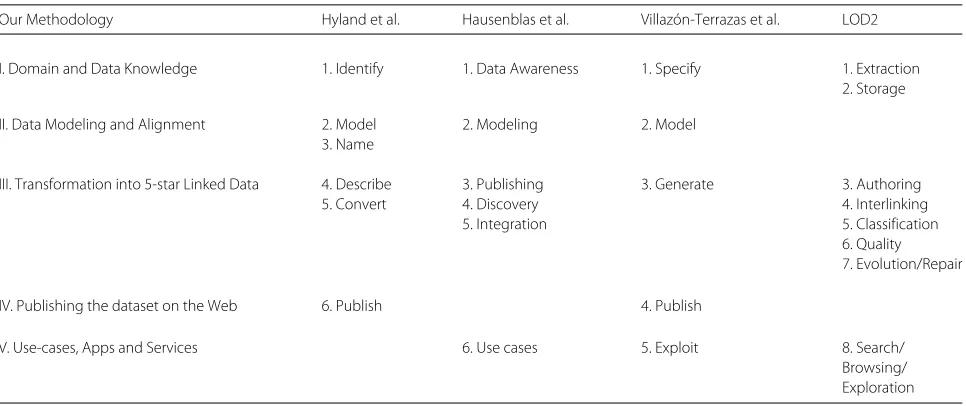
Our methodological guidelines for consolidating drug data using the Linked Data approach improve upon the existing Linked Data methodologies and contain steps, activities and tools which are specific to the drug data domain. We used our experience in the domain of Linked Healthcare Data to develop guidelines which aim to guide data publishers through the process of generating high quality, 5-star Linked Data in order to interlink, align and consolidate drug data from different national drug reg-istries or other sources of drug data. The alignment and relationship between the existing methodologies and our guidelines is outlined in Table 5.
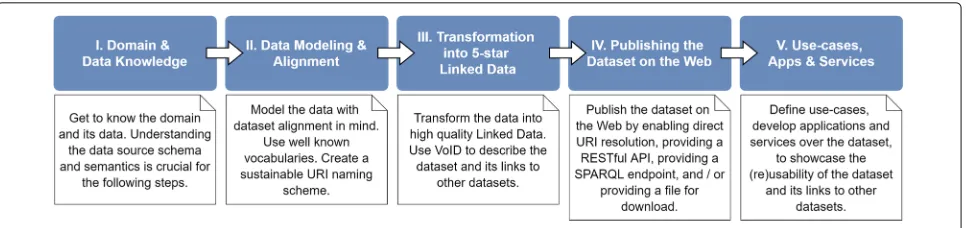
Fig. 1The methodology for consolidating drug data using the Linked Data approach
reuse of such components reduces development time and increases productivity [56, 57].
Methodology supporting tools
As part of the methodological guidelines, we developed a set of tools as reusable components which simplify the execution of the specific steps of the methodology. Their intent is to support the Linked Drug Data generation pro-cess for both people from the drug domain which do not have deeper knowledge of Linked Data, and Linked Data publishers which do not have deeper knowledge of the drug domain. The set consists of (a) the RDF schema, (b) the CSV template, (c) the OpenRefine transforma-tion script, (d) the SPARQL-based tool for extending and interlinking the dataset and (e) the web-based tool for automated transformation, interlinking and publish-ing of the generated Linked Drug Data dataset. These reusable components are open and publicly available on GitHub [58].
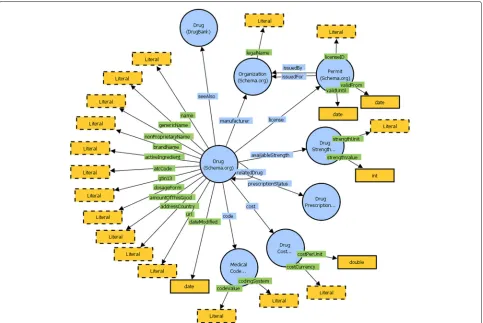
The RDF schema is a common data schema for all national drug data repositories, used for modeling of drug products on a global scale (Fig. 2). Its goal is to provide alignment of drug data from different sources, with dif-ferent format and difdif-ferent levels of data granularity, in order to enable simpler data exploitation. It is comprised of classes and properties from the Schema.org vocabulary [59], which is a novel approach in the drug data domain.
The CSV template represents the necessary formal tem-plate for the data which is being prepared for transfor-mation, i.e. the data which will be annotated with our RDF schema. It contains 39 columns which represent the different data fields needed from the source data for the transformation process. They inlude the URI of the drug, its brand name, generic name(s), manufacturer, ATC code(s), active ingredient(s), strength, cost, license infor-mation, etc. They are modelled to fit the RDF schema, which encompasses all data necessary for high-quality modeling of the domain.
The OpenRefine transformation script is a reusable tool which helps automate the transformation process, while ensuring compliance of the generated data with the defined RDF schema and therefore provides aligned,
high-quality 5-star Linked Data for the drug domain. Its intent is to lower the bounds of transforming data into RDF and Linked Data for data publishers which are not deeply involved and experienced in the Semantic Web and Linked Data practices. Through several sub tasks, this reusable script for the OpenRefine-based suite of tools (e.g. LODRefine, BatchRefine), interlinks the drug products between themselves based on the therapeutic, pharmacological and chemical properties of the drugs, links the drug products to generic drugs, i.e. active ingre-dients from the LOD Cloud datasets and transforms the data into RDF format.
The SPARQL-based tool for extending and interlink-ing the dataset is comprised of two reusable SPARQL queries. The first query extends the dataset by assigning ATC codes to all drugs from the dataset which miss this information. It does so by using the interlinked nature of the dataset, i.e. the links the drug products have to generic drugs and active ingredients from the LOD Cloud. The second query detects all pairs of drugs from the dataset which have the same ATC code, and then interlinks them with properties from the RDF schema which denote the therapeutic, pharmacological and chemical similarity of the drugs.
The web-based tool for automated transformation, interlinking and publishing of the generated Linked Drug Data dataset is intended for data publishers which gen-erate Linked Drug Data with the previous tools. The data publishers can upload the generated Linked Data dataset(s) on the LinkedDrugs project website [60], and after a human-based quality assessment, the dataset will be automatically published. For this we use a publicly available Virtuoso instance [61], from which the new dataset is available on the Web as Linked Data, via its SPARQL endpoint [62].
LinkedDrugs: global linked drug products dataset
Fig. 2The RDF vocabulary designed for the drug data domain, comprised of Schema.org classes and properties. For dataset interoperability, it also uses the classes from the ATC Classification Ontology and properties from the DrugBank Ontology and RDFS
Netherlands, New Zealand, Nigeria, Norway, Romania, Russia, Serbia, Slovakia, Slovenia, South African Republic, Spain, Uganda, Ukraine and USA. The countries were chosen to represent the global diversity and to show that a holistic solution for generating Linked Drug Data on a global scale is possible. Currently, the generated Linked-Drugs dataset contains over 99,000,000 RDF triples, which represent data for over 248,000 drug products from the denoted countries. The dataset also contains over 91,000,000 schema:relatedDrug relations between the drugs, and over 278,000rdfs:seeAlsorelations to generic drugs from DrugBank and DBpedia.
This automated system and its workflow represent a concrete example of applying the methodological guide-lines and supporting tools presented in this paper, and thus serve as their validation scenario.
Generating the LinkedDrugs dataset
The national drug registries of many countries around the world are available online. We analyzed the national drug registry websites of 31 countries in order to define a common set of properties, i.e. a schema skeleton, for the
target dataset. These steps of domain analysis and RDF schema definition correspond to the activities denoted in Step I and Step II of the methodological guidelines, which are already done and we directly use them for our specific application.
In order to design, test and validate our automated sys-tem for gathering 2-star drug data from the national drug registries and generating 5-star Linked Data from the drug domain on a global scale, we selected a subset of twenty-three countries. We aimed for a diverse subset, which will encompass different global regions.
The drug registries of these countries are available online. Their websites are listed in the project page on GitHub [58]. The drug data from most of the national registries is available in a structured format in HTML pages, intended for human consumption via searching and browsing on the website itself. The data from a smaller group of countries is available via structured files in Microsoft Excel or PDF formats, available for direct download.
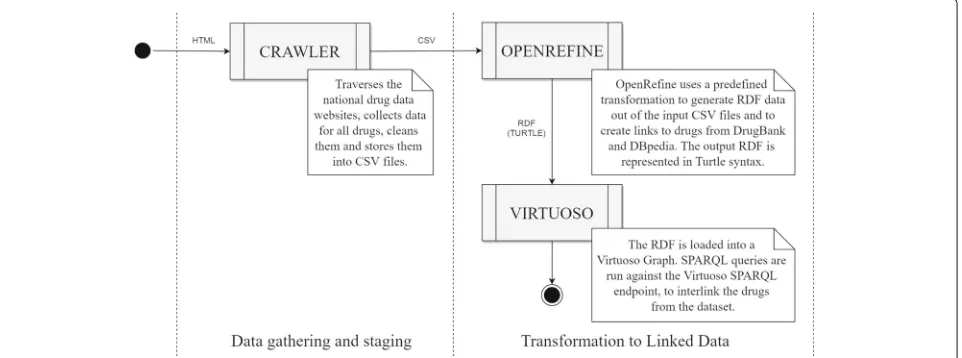
skeleton, uses the transformation script and the SPARQL query to transform the data to RDF, extend it with missing ATC codes and add links to drugs from the same dataset and drugs from DrugBank and DBpedia, thus turning the dataset into a Linked Data dataset. The workflow of these actions is depicted in Fig. 3. These steps represent the activities defined in Step III of the methodological guidelines.
Data gathering and staging. In order to create a sus-tainable system for Linked Drug Data, we had to design a way to collect the necessary data from the national drug registries, on a scheduled basis. Therefore, we developed a set of specialized web crawler applications which crawl the designated drug registry websites, collect the neces-sary data, clean it and store it in a predefined CSV format (Fig. 3). We need to use a set of such crawlers as the target websites differ in structure and available data. The out-put CSV files from the crawlers use the predefined CSV structure described above.
Like most of the data available on the Web, the drug data available on the national drug registry websites is not evenly structured, nor completely clean. We therefore needed to extend our crawlers with functionalities which perform data cleaning tasks and work to detect data from all variations of the source webpages.
As per the suggestions in Step III of the guidelines, we used their existing webpage URLs of the drugs as their unique URIs, e.g. https://lekovi.zdravstvo.gov.mk/ drugsregister/detailview/53457. As many of the drug enti-ties contain information about more than one generic name, manufacturer, active ingredient and strength, the crawlers are tasked with splitting them into the corre-sponding columns in the CSV files. Additionally, infor-mation such about the cost of the drug and its strength are split into separate fields, to match the CSV template. The crawlers also take care about the specific formats
needed for some of the columns, such as the dates, the country codes, the currency codes, and the prescription status.
The drug data from the several of the countries were an exception, as they are available for download as Microsoft Excel or PDF files. For these datasets, the crawlers have to restructure the columns from the source data and generate a CSV file with the correct column names according to the CSV template. For these drugs, we generate custom URIs as identifiers, which have the format http://linkeddata.finki.ukim.mk/lod/data/loddw/ drugs/countryCode#drugID. Here,drugIDis an ID gen-erated by the crawler, countryCode is a three-letter country code (according to [63]) of the country where the drug was registered and the other parts of the URI identify the project and the datatype on our Linked Data website:
/lod/data/loddw is the project and /drugs is the categorization of the data.
The result of this stage in the workflow, in our case with the three selected countries, is a set of twenty-three separate CSV files which follow the CSV template. The only difference is that some of the CSV files can have no values in some columns, due to the data being unavail-able online. When we get all twenty-three CSV files, the first part of the workflow is done and we can continue with the second part.
Transformation to Linked Data. The CSV files can be combined into one CSV file, or remain separate. The only difference will be in the performance of the next step which can be done as a single longer process, or as twenty-three separate and shorter processes. To keep the processing time per transformation shorter, we use twenty-three separate CSV files, each representing the drug dataset of a different country.
We send the twenty-three CSV files to a BatchRe-fine instance [64], which represents a wrapper over an
OpenRefine instance with the RDF extension, that can be used as a REST-based service. The HTTP POST calls to the BatchRefine REST-based service are done with the reusable BASH script developed as part of the methodol-ogy supporting tools and contain (a) the CSV file which needs to be transformed and (b) the OpenRefine trans-formation script defined as a supporting tool for the guidelines. The result of the call is a transformed RDF out-put, which contains part of the generated Linked Drug Data dataset.
The output of our BatchRefine transformations are twenty-three RDF files in Turtle format. These RDF files are a Linked Data dataset: they contain 5-star data about the drugs from the twenty-three countries, along with links to generic drugs from the LOD Cloud - more specif-ically, links to generic drugs from both DBpedia and DrugBank. As we will see later in the text, we can use these links to fetch data about the drugs from our dataset which we don’t have on our end and which do not exist on the source national drug registry websites, but can be found in other datasets on the Web and can potentially prove to be of interest for the end-users.
After the transformation with BatchRefine is done, we load the RDF files into a Virtuoso instance [61] using a BASH script. All RDF files are loaded into the same RDF graph. The latest run of the workflow (Fig. 3) resulted in 248,746 distinct drugs in this step, represented with a total of 7,245,294 RDF triples and with 278,542 outgoing links to drugs from the LOD Cloud.
After the RDF data has been stored into an RDF graph in Virtuoso, we use the SPARQL queries for extend-ing the dataset with missextend-ing ATC codes and interlink-ing related drugs. We execute the SPARQL queries over our dataset stored in Virtuoso, using a BASH script. In the latest run of the workflow (Fig. 3), 38,758 new ATC codes were added for drug products which did not have an ATC code in the source registry. Then, 91,782,500schema:relatedDrug triples were added between similar drug products, i.e. 45,891,250 pairs of drugs from our dataset were identified to have the same function, but exist under different brand names, are from different countries, or are produced by different manufac-turers, or maybe have a different packaging size, strength, cost, etc. As we will see further in the text, we can utilize these interlinkings for providing the users with alternative drugs they may aquire for treating their condition, either in the same of in a different country.
The workflow shown in Fig. 3 is activated on a sched-uled period, currently set at one month. In order to handle the data changes during updates, we backup the RDF graph holding our dataset and replace it with the newly created RDF graph. With this we employ versioning and maintain the default graph identifier to always denote the latest version of the LinkedDrugs dataset.
According to the recommendations in Step IV of our guidelines, the dataset needs to be published on the Web, where it will be publicly available. There-fore, we published our LinkedDrugs dataset accord-ing to the best practices for publishaccord-ing Linked Data [50], via a permanent, dereferenceable URI, which sup-ports HTTP content negotiation: http://linkeddata.finki. ukim.mk/lod/data/drugs# [65]. The dataset is hosted at a live Virtuoso instance [61], in a named RDF graph <http://linkeddata.finki.ukim.mk/lod/data/drugs#> which holds the latest version of the dataset, publicly available via a SPARQL endpoint [62] which serves as a REST-based service. Additionally, data dumps of the dataset are available on Datahub [55].
Usage scenarios
With the automated system and its workflow we start with twenty-three different, distributed and browsable datasets, available on the Web and intended for human consumption via HTML webpages, and using the method-ological guidelines and tools we manage to create a con-solidated dataset of interlinked and schema-aligned drug products from different countries, additionally linked to generic drugs and active ingredients from the LOD Cloud. In order to demonstrate the advantages of having the drug data in a 5-star data quality format, and therefore imple-ment the recommendations from Step V of the method-ological guidelines, we will show a few use-case scenarios via SPARQL queries. The most basic scenario would be to select all data about a single drug of interest, which is very simple and straight-forward, and therefore omitted here. Since the Virtuoso SPARQL endpoint at [62] can be used as a REST-based service, these SPARQL queries could be used from any type of application to always access and exploit the latest data available.
Interlinked drug data. The interlinking cre-ated between the drugs from the dataset, with the
schema:relatedDrug triples, can be utilized in a use-case which allows the end-users to discover drugs from the same country or another country which have the same therapeutic, pharmacological and chemical properties as the drug of his/her interest. This is a useful feature when the drug of interest is not available or when the user is traveling abroad. Getting information about drugs with the same properties and their respective prices can be useful for determining the drug from a specific category which is affordable in the specific case. This can be used by pharmacists, doctors and even patients for gathering information and determining the appropriate treatment.
Query 1
1 prefix schema: <http://schema.org/>
2 prefix drugbank: <http://www4.wiwiss.fu-berlin.de/drugbank/resource/drugbank/> 3
4 SELECT ?drug ?name ?gtin ?strengthValue ?strengthUnit ?costPerUnit 5 ?costCurrency ?manufacturerName ?prescriptionStatus ?country 6 FROM <http://linkeddata.finki.ukim.mk/lod/data/drugs#> 7 WHERE {
8 <http://www.legemiddelverket.no//Legemiddelsoek/Sider/Legemiddelvisning. 9 aspx?pakningId=c5a02a30-d471-4ba0-8197-38955f384dd8> 10 schema:relatedDrug ?drug .
11 OPTIONAL { ?drug schema:name ?name } 12 OPTIONAL { ?drug schema:gtin13 ?gtin }
13 OPTIONAL { ?drug schema:prescriptionStatus ?prescriptionStatus } 14 OPTIONAL { ?drug schema:addressCountry ?country }
15 OPTIONAL {
16 ?drug schema:cost ?costEntity .
17 ?costEntity schema:costPerUnit ?costPerUnit ; 18 schema:costCurrency ?costCurrency . 19 }
20 OPTIONAL {
21 ?drug schema:availableStrength ?strengthEntity . 22 ?strengthEntity schema:strengthValue ?strengthValue ;
23 schema:strengthUnit ?strengthUnit .
24 }
25 OPTIONAL {
26 ?drug schema:manufacturer ?manufacturerEntity .
27 ?manufacturerEntity schema:legalName ?manufacturerName . 28 }
29 }
30 ORDER BY ?name
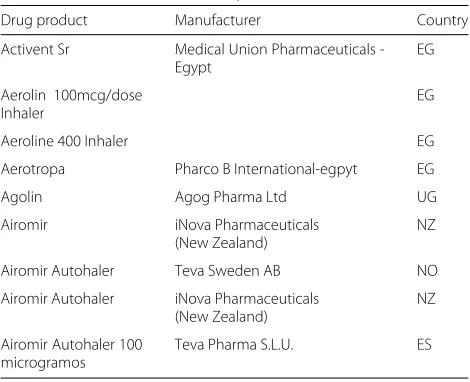
In the query, only a handful of data of interest of the related drugs are selected, but depending on the specific use-case, they can be expanded. Query 1 can also be mod-ified to include the specific drug of interest, by modifying the drug URI in line 8. In our example in Query 1, we use the Norwegan drug “Airomir” as an example, and get results for over 300 distinct and related drugs from many different countries in the dataset. The query and its full results can be viewed online on Seminant [66], at http:// seminant.com/queries/5803e77573656d19eb6c5d00. Par-tial results are shown in Table 1.
Linked LOD drug data. The main advantage of hav-ing links between data from different and distributed datasets is the ability to query them from a sin-gle point, over the existing infrastructure of the Web, using W3C standards such as HTTP, SPARQL and
RDF. As we have rdfs:seeAlso links from drugs
in our dataset to corresponding generic drugs from the DrugBank and DBpedia datasets, we can utilize them to get additional information about the drugs from our dataset whenever we are browsing them. Such additional information will come from the Drug-Bank and DBpedia datasets, and can include additional drug description, the interactions the drug has with other drugs or with certain foods, the drug mech-anism of action, the drug pharmacology, absorption, biotransformation and toxicity, the list of alternative brand names and a list of webpages for the drug on other
locations on the Web. This data is not available on the original national drug registry websites, which are the source for our dataset; it is data retrieved directly from the distributed DrugBank and DBpedia dataset, using SPARQL federation [67].
An example of a federated SPARQL query which selects information about a drug of interest from the DrugBank and DBpedia datasets is shown below (Query 2).
Table 1Partial results from Query 1
Drug product Manufacturer Country
Activent Sr Medical Union Pharmaceuticals -Egypt
EG
Aerolin 100mcg/dose Inhaler
EG
Aeroline 400 Inhaler EG
Aerotropa Pharco B International-egpyt EG
Agolin Agog Pharma Ltd UG
Airomir iNova Pharmaceuticals
(New Zealand)
NZ
Airomir Autohaler Teva Sweden AB NO
Airomir Autohaler iNova Pharmaceuticals (New Zealand)
NZ
Airomir Autohaler 100 microgramos
Query 2
1 prefix rdfs: <http://www.w3.org/2000/01/rdf-schema#> 2 prefix schema: <http://schema.org/>
3 prefix drugbank: <http://wifo5-04.informatik.uni-mannheim.de/drugbank/
4 resource/drugbank/>
5 prefix dbo: <http://dbpedia.org/ontology/> 6 prefix dbp: <http://dbpedia.org/property/> 7
8 SELECT ?loddrug ?genericName
9 (group_concat(distinct ?brandName; separator = ", ") AS ?brandNames) 10 ?comment ?description ?biotransformation ?affectedOrganism ?absorption 11 ?chemicalFormula ?toxicity
12 (group_concat(distinct ?foodInteraction; separator = " ") AS ?foodInteractions) 13 (group_concat(distinct concat(?interactingDrugLabel, ‘: ’, ?interactionStatus);
14 separator = ". ") AS ?drugInteractions)
15 (group_concat(distinct ?url; separator = ", ") AS ?urls) 16 WHERE {
17 GRAPH <http://linkeddata.finki.ukim.mk/lod/data/drugs#> { 18 <http://www.aemps.gob.es/cima/especialidad.do?metodo=
19 verPresentaciones&codigo=79539>
20 rdfs:seeAlso ?loddrug .
21 }
22 SERVICE <http://wifo5-04.informatik.uni-mannheim.de/drugbank/sparql> { 23 OPTIONAL { ?loddrug drugbank:description ?desc . }
24 OPTIONAL { ?loddrug drugbank:genericName ?gname . } 25 OPTIONAL { ?loddrug drugbank:brandName ?bname . }
26 OPTIONAL { ?loddrug drugbank:biotransformation ?biotransformation . } 27 OPTIONAL { ?loddrug drugbank:affectedOrganism ?affectedOrganism . } 28 OPTIONAL { ?loddrug drugbank:absorption ?absorption . }
29 OPTIONAL { ?loddrug drugbank:chemicalFormula ?chemicalFormula . } 30 OPTIONAL { ?loddrug drugbank:foodInteraction ?foodInteraction . } 31 OPTIONAL { ?loddrug foaf:page ?page . }
32 OPTIONAL { ?loddrug drugbank:toxicity ?toxicity . } 33 OPTIONAL {
34 ?drugInteractionEntity drugbank:interactionDrug1 ?loddrug ;
35 drugbank:interactionDrug2 ?interactingDrug ;
36 drugbank:text ?interactionStatus .
37 ?interactingDrug rdfs:label ?interactingDrugLabel . 38 }
39 }
40 SERVICE <http://dbpedia.org/sparql> { 41 OPTIONAL {
42 ?loddrug dbo:abstract ?abstract .
43 FILTER (langMatches(lang(?abstract), "en")) 44 }
45 OPTIONAL {
46 ?loddrug rdfs:label ?label .
47 FILTER (langMatches(lang(?label), "en")) 48 }
49 OPTIONAL {
50 ?loddrug rdfs:comment ?comment .
51 FILTER (langMatches(lang(?comment), "en")) 52 }
53 OPTIONAL { ?loddrug dbp:tradename ?tradename . }
54 OPTIONAL { ?loddrug dbo:wikiPageExternalLink ?externalLink . } 55 }
56 BIND(IF(bound(?abstract), ?abstract, ?desc) as ?description) 57 BIND(IF(bound(?bname), ?bname, ?tradename) as ?brandName) 58 BIND(IF(bound(?gname), ?gname, ?label) as ?genericName) 59 BIND(IF(bound(?page), ?page, ?externalLink) as ?url) 60 }
The query selects some very important data about the drug of interest and its active ingredient from Drug-Bank and DBpedia. The most significant are the chemical, biological and pharmacological properties of the drug,
Table 2Partial results from Query 2
Description (from DBpedia)
Duloxetine (Cymbalta, and generics) is a serotonin-norepinephrine reuptake inhibitor (SNRI) created by Eli Lilly. It is mostly prescribed for major depres-sive disorder, generalized anxiety disorder, fibromyalgia and neuropathic pain. Duloxetine failed to receive US approval for stress urinary incontinence amid concerns over liver toxicity and suicidal events; however, it was approved for this indication in the UK, where it is recommended as an add-on medication in stress urinary incontinence instead of surgery.
Food Interactions
Food does not affect maximum levels reached, but delays it (from 6 to 10 hours) and total product exposure appears to be reduced by only 10 percent. People taking this product who drink large amounts of alcohol are exposed to a higher risk of liver toxicity. Take without regard to meals.
Drug Interactions
Amitriptyline: Possible increase in the levels of this agent when used with duloxetine. Ciprofloxacin: Ciprofloxacin increases the effect/toxicity of duloxetine.
Desipramine: Possible increase in the levels of this agent when used with duloxetine. Flecainide: Possible increase in the levels of this agent when used with duloxetine. Fluvoxamine: Fluvoxamine increases the effect and toxicity of duloxetine. Imipramine: Possible increase in the levels of this agent when used with duloxetine. Isocarboxazid: Possible severe adverse reaction with this combination.
Nortriptyline: Possible increase in the levels of this agent when used with duloxetine. Phenelzine: Possible severe adverse reaction with this combination.
Propafenone: Possible increase in the levels of this agent when used with duloxetine. Rasagiline: Possible severe adverse reaction with this combination.
Thioridazine: Increased risk of cardiotoxicity and arrhythmias.
Tranylcypromine: Possible severe adverse reaction with this combination
them when determining treatment for acute conditions of a patient who is already on a treatment of a chronic medical condition.
An example run of Query 2, for the drug prod-uct “Duloxetina” from Spain, results in details for the generic drug “Duloxetine” from both
Drug-Bank and DBpedia: http://seminant.com/queries/
5803e9b973656d19eba65e00. Among other details, it also shows the 3 specific food - drug interactions the drug is involved in, along with the 13 drug - drug interac-tions it has. Partial results from the query are shown in Table 2.
Analytics. Aside from the use-case scenarios for end-users, our LinkedDrugs dataset can be used for analytical queries as well. These analytical queries allow interested
parties to gain insight into the drug markets of different countries, allowing them to analyze the available consol-idated data using a single entry point for querying and using a single query language. The analytics could be built-in built-in specific analytic applications, or can be executed with separate and standalone SPARQL queries.
To get a better understanding of the analytical possibil-ities over consolidated drug data from multiple countries, we will look at an example query which identifies the most common drug categories per country. This would allow the user, e.g. pharmaceutical company, to gain a better knowledge on the national drug markets and make an informed decision about placing their drug in the country of interest. A general SPARQL query for this analytical scenario is given below (Query 3):
Query 3
1 prefix schema: <http://schema.org/>
2 prefix drugbank: <http://www4.wiwiss.fu-berlin.de/drugbank/resource/drugbank/> 3
4 SELECT count (distinct ?drug) as ?count ?atc ?country 5 FROM <http://linkeddata.finki.ukim.mk/lod/data/drugs#> 6 WHERE {
7 ?drug a schema:Drug ;
8 schema:addressCountry ?country ; 9 drugbank:atcCode ?atcCode . 10 FILTER (strlen(?atcCode) > 3)
11 BIND(SUBSTR(xsd:string(?atcCode), 1, 3) AS ?atc) 12 }
Table 3Partial results from Query 3
Drugs ATC Prefix Country
5362 C09 RO
2152 C09 ES
1536 J01 RU
1488 C09 NL
1270 N05 US
976 J01 ZA
758 C09 IE
709 C09 SK
707 N02 NZ
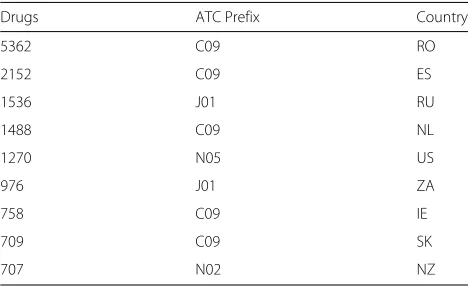
A sample run of Query 3 shows that Romania, Spain, Netherlands, Ireland and Slovakia have most drugs (5,362, 2,152, 1,488, 758 and 709, respectively) in the category of agents acting on the renin-angiotensin system (ATC C09), Russia and South African Republic have most drugs (1,536 and 976, respectively) in the category of antibac-terials for systemic use (ATC J01), while USA has 1,270 drugs in the psycholeptics category (ATC N05). These partial results are shown in Table 3. The full results from the query are available at http://seminant.com/queries/ 5803ebc473656d19ebac5e00.
Another analytical scenario would be to assess the aver-age drug price per drug category, per country. It could be used by medical authorities in a country to determine the cost situation per category in other countries and use the information for local regulations. It could also be used by a pharmaceutical company to determine the price range for a new drug, before it goes to market. An example SPARQL query which can be used for such an analysis is given below (Query 4):
A sample run of Query 4 identifies that the ATC drug categories with the highest average price in Norway are drugs for disorders of the musculo-skeletal system (ATC M09), respiratory system products (ATC R07) and ali-mentary tract and metabolism products (ATC A16). In Macedonia they are alimentary tract and metabolism products (ATC A16), pituitary and hypothalamic hor-mones and analogues (ATC H01) and antihemorrhagics (ATC B02), while in Australia and Slovenia they are respi-ratory system products (ATC R07) and in South African Republic they are immunosuppressants (ATC L04), hema-tological agents (ATC B06) and alimentary tract and metabolism products (ATC A16). These partial results are shown in Table 4, while the full results which include other countries as well, are available at http://seminant.com/ queries/5803ed6e73656d19eb537e00.
In cases when an inter-country comparison of the pric-ing is necessary, an application could use a currency converter to transform the values to the same currency of choice, and make the comparison.
Discussion
The generated LinkedDrugs dataset aims to be the first comprehensive, consolidated and aligned dataset of drug product data on a global scale. In its first version, the dataset consisted of only seven countries; currently, that number has grown to twenty-three. As we have the methodology and the tools in place, the addition of new countries is more or less straightforward. Even though Linked Data datasets with drug data already exist in the LOD Cloud, they consist solely of generic drugs, i.e. active ingredients. Contrary to this, our LinkedDrugs dataset consists of drug products which are registered in a specific
Query 4
1 prefix schema: <http://schema.org/>
2 prefix drugbank: <http://www4.wiwiss.fu-berlin.de/drugbank/resource/drugbank/> 3
4 SELECT (?totalCost / ?drugCount as ?averageCost) ?costCurrency ?atc 5 ?drugCount ?country
6 WHERE {
7 SELECT count (distinct ?drug) as ?drugCount 8 sum (xsd:float(?cost)) as ?totalCost 9 ?costCurrency ?atc ?country
10 FROM <http://linkeddata.finki.ukim.mk/lod/data/drugs#> 11 WHERE {
12 ?drug a schema:Drug ;
13 schema:addressCountry ?country ; 14 drugbank:atcCode ?atcCode ; 15 schema:cost ?costEntity .
16 ?costEntity schema:costPerUnit ?costPerUnit ; 17 schema:costCurrency ?costCurrency . 18 FILTER (strlen(?atcCode) > 3)
19 BIND(SUBSTR(xsd:string(?atcCode), 1, 3) AS ?atc) 20 FILTER (?costPerUnit != "0"^^xsd:double)
21 BIND(REPLACE(?costPerUnit, ",", ".") AS ?cost) 22 }
23 }
Table 4Partial results from Query 4
Avg. price Currency ATC Prefix Country
93480.60 NOK M09 NO
47221.40 NOK R07 NO
39557.30 NOK A16 NO
32021.40 MKD A16 MK
28837.20 MKD H01 MK
27478.20 MKD B02 MK
22500.00 AUD R07 AU
17822.00 SVN R07 SI
13360.10 EUR V10 CY
10679.50 ZAR LO4 ZA
10127.10 ZAR B06 ZA
9880.81 ZAR A16 ZA
country, have a specific name, dosage form, amount, strength, barcode, manufacturer, license, price, ATC code, etc. Since these drug products from our dataset are linked to the existing generic drugs and active ingredients from the LOD Cloud, the novel usage scenarios greatly exceed what is currently possible with Linked Drug Data on the Web.
The developed methodological guidelines and support-ing tools intend to encourage and lower the boundaries for data publishers from the domain to contribute to the LinkedDrugs dataset, further extending its potential and value. Since the adoption of the developed tools can present a potential hurdle, we believe that the transfor-mation process presented in this paper can serve as an additional guide.
Our methodological guidelines extend the existing Linked Data methodologies, briefly presented in the section “Background” . Here, we will make an explicit comparison of the similarities and differences in the approaches among the existing methodologies, and our findings and proposal to group them into five gen-eral steps. These five gengen-eral steps have allowed us to define our own methodological guidelines for the drug data domain, by defining tasks and tools specific for the domain and adding them to the corresponding general steps. These specific tasks and tools have been the result of our research in the domain, as well as our previous work with generating, publishing and using healthcare Linked Data datasets.
The existing Linked Data methodologies have a vary-ing number of steps, but still generally cover the same activities. The main difference in the methodologies is the grouping of actions within different steps and on different levels of granularity. Apart from some explicit differences, which we will further examine, they cover the palette of actions involved in the process of generating and publish-ing a Linked Data dataset, and thus can be grouped into five general steps.
From Table 5, we can see that all existing Linked Data methodologies define the knowledge of the data, its domain and the existing datasets from the LOD Cloud as the first step(s). The actions they cover in the steps relate to these tasks, and while some methodologies focus on the data domain, others recommend knowledge of existing Linked Data datasets, as well.
The second step refers to the tasks of modeling the data, locating and selecting the appropriate ontology or vocab-ulary, extending existing ontologies and vocabularies to
Table 5Aligning our methodological guidelines with existing Linked Data methodologies. Additionally, our approach focuses on lifecycle reuse by step modularity
Our Methodology Hyland et al. Hausenblas et al. Villazón-Terrazas et al. LOD2
I. Domain and Data Knowledge 1. Identify 1. Data Awareness 1. Specify 1. Extraction
2. Storage
II. Data Modeling and Alignment 2. Model 2. Modeling 2. Model
3. Name
III. Transformation into 5-star Linked Data 4. Describe 3. Publishing 3. Generate 3. Authoring
5. Convert 4. Discovery 4. Interlinking
5. Integration 5. Classification
6. Quality 7. Evolution/Repair
IV. Publishing the dataset on the Web 6. Publish 4. Publish
V. Use-cases, Apps and Services 6. Use cases 5. Exploit 8. Search/
match the original data schema, creating a custom ontol-ogy or vocabulary from scratch and mapping it to existing ontologies, and defining the URI naming scheme for the ontology classes and properties. The methodologies of Hyland et al. [51], Hausenblas et al. [52] and Villazón-Terrazas et al. [53] explicitly define these tasks, whereas the LOD2 methodology does not define them. For this step, we defined an RDF schema which can be reused when working with drug data from national drug reg-istries or other sources. The provided CSV template allows the data publisher to align the data in the cor-rect format in a CSV file, and prepare it for the next step.
The third step is focused on transforming the source data into RDF, creating links and 5-star Linked Data datasets, and creating metadata descriptions of the dataset and its links to other datasets. All four methodologies define these tasks, with the LOD2 methodology being the most specific one. The LOD2 methodology, being the lat-est one, understandably contains activities which include classification, quality control, data evolution and version-ing. The use of the VoID vocabulary is explicitly stated in this phase in the methodologies of Hyland et al. and Hausenblas et al. The methodology of Villazón-Terrazas et al. defines this task in its next step, ‘4. Publish’, but as it contains other tasks which better fit in our next step, we left it out of this one. Here, we developed an OpenRefine transformation script which can be used with any source drug data formatted with the CSV template from the previous step, in order to get high quality, 5-star Linked Drug Data. For the purpose of generating addi-tional links between similar drugs in the dataset itself, we developed a SPARQL-based tool which can be used over any Linked Drug Dataset generated with the OpenRefine transformation script.
The fourth step defines the tasks for publishing the dataset on the Web. The exact actions which should be undertaken are defined in the methodologies of Hyland et al. and Villazón-Terrazas et al. The other two method-ologies do not define such tasks and steps. In order to simplify this step for data publishers, we provide a web-based tool for automated publishing of the generated Linked Drug Data dataset. The tool also interlinks the new dataset with the consolidated LinkedDrugs dataset, which already contains drug product data from twenty-three national drug repositories.
The fifth step consists of tasks for defining use-case scenarios or development of specific applications and ser-vices which take advantage of the newly created Linked Data dataset and its links to other datasets. The methodol-ogy of Hyland et al. does not specify such an activity, argu-ing that the data publisher does not have to think about potential use and reuse of the data while working on gen-erating Linked Data from the source dataset. According to
them, the data publisher should just make sure he/she cor-rectly transforms, describes and publishes the data, and let the users and the interested community know about the dataset. However, Hausenblas et al., Villazón-Terrazas et al. and the LOD2 Project team explicitly state that the last step of the Linked Data generation process should consist of defining use-cases and/or developing applications and services.
The tools we developed as support for the steps of the methodology aim to help data publishers from the domain. They can aid both data publishers from the drug domain which do not necessarily have prolific experience with Linked Data, as well as Linked Data publishers which are not very familiar with the domain of drugs and health-care. These open-source and reusable tools are supposed to lower the bounds for interested parties to get involved in the domain and include their datasets in the global LODD and LOD Cloud.
Conclusions
The amounts of data available on the Web represent a goldmine for data-driven applications and services [68]. Unfortunately, the data is available in different for-mats and is distributed over various locations. This is a huge obstacle which blocks progress in data retrieval in many domains. The healthcare domain is no differ-ent: the national drug authorities publish their data on the Web in different formats and granularity levels, and there is no comprehensive method for retrieving and using them.
The Linked Data concept provides new ways of pub-lishing and connecting data from different distributed sources, which allows data consolidation. It also pro-vides a new spectrum of use-case scenarios which can be useful for generating new business value for busi-nesses and independent developers, by allowing them to develop innovative applications and services in the domain. The opportunities which lie within the creation of new use-case scenarios from Open Data and Linked Data are a field whose potential is becoming increasingly recognized [69].
aligned between themselves and which can then easily be consolidated into a comprehensive system or dataspace.
We implemented our guidelines and tools as part of an automated system for transformation and publish-ing of the 2-star and 3-star data from twenty-three national drug registries into consolidated and aligned 5-star Linked Drug Data. The system provides reg-ular updates which make sure the created Linked-Drugs dataset always contains new data. In order to create the dataset, we use the defined common RDF schema, the CSV template, the OpenRefine transforma-tion script, as well as the SPARQL queries for extending the dataset and interlinking the drugs from the dataset. With this, we ensure data alignment with other LOD and LODD datasets. Currently, our generated Linked-Drugs dataset contains over 99,000,000 RDF triples, which represent data for over 248,000 drug products from twenty-three countries. The dataset also contains over 91,000,000 schema:relatedDrug relations between the drugs, and over 278,000rdfs:seeAlsorelations to generic drugs and active ingredients from DrugBank and DBpedia.
We further present new usage scenarios enabled by Linked Data, aimed both for end-users and analytical pur-poses, which utilize the consolidated and aligned nature of the dataset and its contextual links to entities from the LOD Cloud. We achieve this by automatically generat-ing the additional relations in our dataset which link the drugs between themselves, and link the drugs with drug entities published as part of other LOD Cloud datasets. Using W3C standards and the Semantic Web technolo-gies, we are then able to retrive data from these distributed datasets, and present them to the end-users in a compre-hensive manner.
As future work, we plan to extend the number of national drug registries from the current twenty-three. The design of the supporting system requires that we only modify the data gathering and staging part of the work-flow, while the transformation and publishing process remains the same. We also intend to extend the reconcil-iation tasks in OpenRefine, by employing reconcilreconcil-iation for the company names. This would provide additional links in the dataset between the drugs and the manu-facturers, represented by company entities on the LOD Cloud. Given that the names of the companies and their details are sometimes on local languages, depending on the drug registry, we would also add a translation ser-vice in the workflow. We also plan to add an automated VoID metadata generation task for the dataset, which is a recommendation from Step III. Regarding applica-tions built on top of the datasets, we have already started developing user-focused and analytical applications which provide the end-users with detailed information about a drug product and its interaction with other drugs and
foods, but also provide insight into the drug product avail-ability on a global scale. All of these additional features would further add to the benefit of having consolidated and aligned drug data from various countries in one place, accessible via the existing infrastructure of the Web and via existing W3C standards.
Methods
The methodological guidelines
Based on our experience with applying the Linked Data principles in the healthcare and drug domain and on the existing Linked Data methodologies, we developed a set of methodological guidelines for consolidating drug data using the Linked Data approach. These guidelines improve upon the existing Linked Data methodologies and contain steps, activities and tools which are specific to the drug data domain. Their purpose is to guide data publishers through the process of generating high qual-ity, 5-star Linked Data in order to interlink, align and consolidate drug data from different national drug reg-istries or other sources of drug data. The alignment and relationship between the existing methodologies and our guidelines is outlined in Table 5.
Along with the guidelines, we have developed a set of tools which simplify the execution of the specific steps of the methodology. Their intention is to support the Linked Drug Data generation process for both peo-ple from the drug domain which do not have deeper knowledge of Linked Data, and Linked Data publish-ers which do not have deeper knowledge of the drug domain. These tools are open and publicly available on GitHub [58].
Our methodological guidelines consist of the following steps (Fig. 1):
I. Domain and Data Knowledge II. Data Modeling and Alignment
III. Transformation into 5-star Linked Data IV. Publishing the Linked Data dataset on the Web V. Use-cases, Applications and Services
Step I: Domain and data knowledge
The first step corresponds to the first steps from the exist-ing methodologies: it is important for the data publisher to know the domain and the data in it very well. This understanding of the data source schema and semantics is crucial for the following steps which will involve data modeling, schema alignment and data transformation.
In the drug data domain, if this is the first time the data publisher comes across Linked Data, our advice is to first get familiar with the 5-star data system from Tim Berners-Lee [35], the four principles of Linked Data [70], and the LOD Cloud [32]. After that, a study of the LODD Project [36], the Bio2RDF Project [43] and the DrugBank Linked Data dataset [44] is recommended. This will help the data publisher to get a better insight into the Linked Drug Data and Linked Healthcare Data domains, the types of data which exist in them, their schema, their similarities and differences and their existing and potential links. It will also help him/her determine the ontologies and vocabu-laries already used in the domain, which can be important for the next step.
In a general case, when working with any other domain, it is important for the data publisher to get familiar with the domain in question and with the meaning of the dataset selected for transformation. For this, a consult with a domain expert is usually necessary and there-fore advised. Another approach is to explore the existing Linked Data datasets which are similar to or from the same domain as the one of interest. For this, the Datahub portal [71] and the LOD Cloud cache instance [72] could be used.
Step II: Data modeling and alignment
In the next step, the data publisher should focus on data modeling and alignment with other existing or future datasets. The data publisher has to choose the correct schema for the dataset, in order to annotate it correctly, i.e. use the data fields which are necessary for the final use-cases, annotate the fields unambiguously and with the correct semantics and make the correct schema choices which will allow seamless alignment with other datasets. Additionally, the data publisher has to define the URI naming scheme for the data entities, and optionally for the ontology or vocabulary classes and properties.
Data schema. In the drug data domain, studying the datasets from the LODD and Bio2RDF projects can help get an insight into the ontologies and vocabularies used in the domain. Some of the ontologies and vocabular-ies which a data publisher needs to have in mind are: Schema.org [59], DBpedia Ontology [73], UMBEL [74], DICOM [75], the DrugBank Ontology used for the data at [44], as well as other biomedical ontologies [76].
In order to support the data publishers from the drug domain in this step, we designed a reusable RDF
schema for the data, shown in Fig. 2. The schema can be used by data publishers working with drug data from national drug registries or other sources. The schema is comprised of classes and properties from the Schema.org vocabulary [59]: the schema:Drug
class, along with a large set of properties which instances of the class can have, such as name,
code,activeIngredient,nonProprietaryName,
availableStrength, cost, manufacturer,
relatedDrug, description, url, etc. Addition-ally, in order to align the drug data with generic drugs from DrugBank, we use the properties brandName,
genericName, atcCodeand dosageForm from the DrugBank Ontology. In order to annotate the links which the drug product entities will have to generic drug enti-ties from the LOD Cloud dataset, the rdfs:seeAlso
relation is used.
In general, when working with data from another domain, the data schema is defined with the choice of vocabularies or ontologies to be used. The principles of ontology engineering and usage have been developed for this purpose exactly: to maximise the chances of reuse, and therefore allow better alignment between datasets [77]. This means the agent should always try to reuse an existing vocabulary or ontology, giving advantage to those which are most widely used. A few tools for ontology and vocabulary discovery exist, and the data publisher should use them in this stage. The two most notable are Linked Open Vocabularies (LOV) [78] and DERI Vocabularies [79], which also provide usage statistics which can be used to assess the impact of a given vocabulary or ontology in a specific domain. Our choice of the Schema.org vocabu-lary follows the reusability paradigm: it is the most widely and generally used vocabulary across the Web.
However, datasets tend to have specific fields, which are not covered by existing ontologies. In this cases, the exist-ing ontology or vocabulary should be extended, or a new one should be defined. However, each time a new ontol-ogy is developed, it is important to define the mappings between the new classes and properties and the classes and properties from other ontologies, in order to enable ontology matching and RDF-based reasoning, for schema alignment. In order to avoid defining specific new prop-erties, we reused some properties from the Schema.org vocabulary which are currently not explicitly intended for use with schema:Drug entities. An example of such properties is theschema:addressCountryproperty which should be used for an address, but we use it in our schema to denote the country in which the drug is registered.
annotated with the same upper-level ontology or vocab-ulary allows interlinking and inference between them, i.e. it improves the alignment which is crucial for data consolidation.
Data alignment. For the data alignment task, the data publisher needs to make sure that the generated dataset will be well aligned with existing and future datasets from the same domain. In order to aid the data publishers with this, as well as help them in preparing the drug data for the transformation step, we developed a CSV template intended for the drug domain [58]. This CSV template can be used with the drug data and is comprised of the fields necessary for applying the RDF schema from Fig. 2.
The data publisher interested in publishing Linked Drug Data should use this CSV template for the data, following the specifics defined for each of the fields. These specifics assure that the data will be of high quality and completely aligned with other drug data generated using the same methodological guidelines.
URI formats. From the URI naming scheme perspec-tive, in the domain of drug data it is important to deter-mine the types of entities which exist in the dataset. This will help in defining the entity URIs for the Linked Data dataset. According to the Linked Data principles, each entity in the dataset - along with the classes and proper-ties in the ontology - needs to have a unique indentifier in the form of an HTTP URI. In order to provide better per-formance when using the dataset in the future, our experi-ence suggests using separate URL paths for different entity
types, e.g. http://example.com/drug/, http://
example.com/interaction/,http://example. com/disease/, etc. An additional recommendation is to use slash-based URIs, instead of hash-based ones. This may result in using an additional HTTP request by the machine accessing the URI, but it provides better perfor-mance when accessing large datasets [80].
However, to simplify this step for the drug data publish-ers, we advise the use of the existing webpage URLs of the drugs from the national registry websites, which are already unique. According to the Linked Data principles, the entity URI should denote a Web location where the end-users and agents can get more information about the entity, so our approach satisfies the condition.
Step III: Transformation into 5-star Linked Data
During the third step, the source dataset should be trans-formed into a 5-star Linked Data dataset. The process of transformation can be executed in many different ways, and with various software tools, e.g. OpenRefine [81], LODRefine [82], D2R Server [83], Virtuoso [84], Silk Framework [85], etc.
To help the data publishers from the drug domain and to automate this step, we developed a reusable OpenRe-fine transformation script [58]. This transformation script
is specifically designed for the drug data domain, and the RDF schema and CSV template from Step II. It contains a set of actions which generate RDF from the inputed CSV file which contains drug data. In the process, it also locates associated generic drugs from the DrugBank and DBpe-dia datasets for each drug product in source dataset, and extends the generated RDF with links between the drugs from the dataset and the corresponding drugs from the LOD Cloud.
The transformation script can be reused with any Open-Refine instance which has the RDF extension. It can be applied on any drug data dataset formatted with the CSV template from Step II. As a result, it will generate a Linked Drug Data dataset annotated with the RDF schema from Step II (Fig. 2).
The RDF schema from Step II defines relations between the drug products from the dataset as well. These relations are denoted with theschema:relatedDrug relation (Fig. 2). In order to provide means for generating RDF triples which interconnect the drugs from the dataset, we developed a SPARQL query [58] which can be executed over the dataset generated with the OpenRefine trans-formation script. The SPARQL query detects all pairs of drugs from the dataset which have the same ATC code - and therefore have the same therapeutic, pharmaco-logical and chemical properties - and creates two triples connecting the first drug to the second one with the
schema:relatedDrugproperty, and vice-versa. In a general case, in order to make the correct choices about the tools to be used for the transformation pro-cess, it is important to distinguish the characteristics of the dataset first. The nature of the dataset will determine if (a) the transformation is a one-time task, a task which will have to be executed on a given time interval (e.g. once a month), or a continually running task; (b) old versions of the transformed dataset are necessary for versioning and as backup, if during future transformations only the changes in the data are needed for transformation, i.e. ‘delta’ updates are performed, or if older data are no longer necessary for the particular use-case; (c) manual or auto-mated data cleansing is needed before the first transfor-mation and/or subsequent transfortransfor-mations; (d) the source dataset is always available at the same location and is accessible via the same interfaces. These specifics of the dataset in question can then help the data publisher deter-mine if the transformation task can be fully or partially automated, and identify the parts of the transformation workflow which require human attention and input.