© 2017 IJSRST | Volume 3 | Issue 8 | Print ISSN: 2395-6011 | Online ISSN: 2395-602X Themed Section: Science and Technology
Age Group Determination from Face Using Texture Classification based on
Probabilistic Non-Extensive Entropy
Aruna Bhat
Research Scholar, Department of Electrical Engineering, IIT Delhi, India
ABSTRACT
Various types of changes occur in face as the age of a person progresses from childhood to senile stage. One of most prominent change that happens is the gradual change in the texture of the face. Such changes are highly conspicuous in the form of wrinkles on the face. As a person grows old, the texture of the skin changes and is initially most visible in the face. It may start with introduction of fine lines and dark spots progressing all the way to high intensity of wrinkles on the face. It is a known fact that texture is an integral part of natural images and has been widely used for solving may problems in the area of pattern recognition, image processing and computer vision. Texture classification aims at assigning labels to the unknown textures represented by some textural features. The technique presented here is suitable for classification of people into different age groups by texture characterisation of the face. A probabilistic non-extensive entropy feature based on a Gaussian information measure has been used for texture characterization. This entropy is bounded by finite limits and is non-additive in nature. It can be used to represent the information content in non-extensive systems having some degree of regularity or correlation thereby finding its application in texture classification problems since textures found in nature are random and at the same time contain some degree of correlation or regularity at some scale. The probabilistic non-extensive entropy used for age group determination based on texture classification is primarily founded upon Gaussian information gain function. The non-additive property of this entropy makes it especially significant for the texture classification required for age determination. Also the non-linearity of the information gain function plays an important role in the identification of textures having high spatial correlation and containing non-additive information content. This entropy measure increases the non-linearity of the exponential information gain introduced in by replacing the linear exponent of the exponential by a quadratic probability term. Inner Product Classifier is used for performing classification. It considers the errors between the training features and the test image features using triangular or t-norms. The triangular norms aid in highlighting the errors and find a margin between them. The inner product between the aggregated training features vector and t-norm of the error vectors must be the lowest for the test feature vectors for it to match with the training feature vectors.
Keywords : Texture Classification, Probabilistic Non Extensive Entropy, Inner Product Classifier, Frank t-norm, Gray level Co-occurrence matrix
I.
INTRODUCTION
This paper describes a method to determine the age group of a person from his/her face on the basis of texture classification.
The field of age estimation from face has seen some active research in recent years [1]. However new methods need to be developed to improvise the efficiency and performance of such a system. Hayashi et al. [2] proposed a methodology to estimate the age and
influences individual facial components. They also suggested that eyes and nose are more informative than the other facial components in automatic age estimation. Various types of changes occur in face as the age of a person progresses from childhood to senile stage. One of most prominent change that happens is the gradual change in the texture of the face. Such changes are highly conspicuous in the form of wrinkles on the face. As a person grows old, the texture of the skin changes and is initially most visible in the face. It may start with introduction of fine lines and dark spots progressing all the way to high intensity of wrinkles on the face. It is a known fact that texture is an integral part of natural images and has been widely used for solving may problems in the area of pattern recognition, image processing and computer vision. Texture classification [12] aims at assigning labels to the unknown textures represented by some textural features. The technique presented here is suitable for classification of people into different age groups by texture characterisation of the face. A probabilistic non-extensive entropy feature [15] based on a Gaussian information measure has been used for texture characterization. This entropy is bounded by finite limits and it is non-additive in nature, which is what makes it useful for the representation of information content in the non-extensive systems containing some degree of regularity or correlation and also justifies its use for texture classification problem since textures found in nature are random and at the same time contain some degree of correlation or regularity at some scale.
Age Group Estimation / Classification can be done for the following classes:
1. Child - Category 1
2. Adolescent - Category 2
3. Youth - Category 3
4. Middle Aged - Category 4
5. Old/Senile - Category 5
Petrou et al. [6] proposed that co-occurrence based can be effectively used for texture classification. It Co-occurrence matrix finds the joint probability of occurrence for two pixel intensities separated by an offset distance. The resulting co-occurrence probabilities can be used for calculating the texture features. Various other methods can be used for texture feature extraction
like Gabor filters [7], Markov random fields [8], Wavelet representations [9] etc. It is also crucial for such features to be robust. Ves et al. [10] proposed a structuring element for defining the granulometric size distribution of the texture from which descriptors like mean, variance, skew-ness and kurtosis are derived and used for texture classification. Entropy is known to be a dependable feature for texture characterization. Various measures of entropy have been proposed in the past. Shannon entropy [11] is one of the well-known entropies that have been extensively used as crucial co-occurrence features for texture classification. Renyi entropy [13] is another entropy measure which is an improvement over Shannon entropy and has also seen wide applicability in classification and recognition problems including face recognition. Pal and Pal [14] claim that an exponential entropy is more effective for the image specific applications than Shannon and Renyi logarithmic measures of entropy since the exponential entropy measure is bounded by finite upper and lower bounds unlike the logarithmic measure which is undefined when either the probability of occurrence of the event is zero or when the events are equally likely and the number of events is very large.
The organization of the rest of the paper is as follows: Section II discusses the proposed methodology in detail providing an in depth description of the probabilistic non extensive entropy measure used for feature extraction followed by the design of Inner Product Classifier to perform texture classification for age group determination. Experimental results have been discussed in Section III. Section IV elaborates the conclusion and the future scope is provided in the Section V.
II.
METHODOLOGY
Feature Extraction:
non-linearity of the exponential information gain introduced in by replacing the linear exponent of the exponential by a quadratic probability term.
Consider a random variable X = {x1,x2,….,xn} with the probabilities P={p1,p2,….pn}. Assume that the probability distribution is complete i.e. pi ∈ [0,1] and
∑ for i=1,2,…n where, n is the number of
probabilistic experiments. Let the information gain on the ith event of X with an associated probability pi be defined by the Gaussian function given by:
I(pi) = (1)
A maximum information gain of 1 is achieved when an event is least likely to occur (pi = 0). As the occurrence of an event becomes more certain with pi approaching to 1, the information gain reduces monotonically to reach a minimum value of e−1.
Figure 1: Gaussian Information gain I(pi) as the probability pi increases from 0 to 1.
The entropy of X is defined as:
H(P) = E(I(pi)) = ∑ = ∑ (2)
The normalized entropy HN is of the form: HN = (H-Hmin)
.
(Hmax-Hmin) -1
(3)
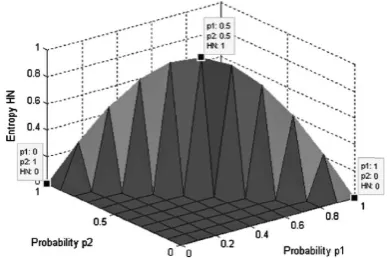
Figure 2: Normalized Entropy HN plotted as function of
the probabilities p1 and p2
The minimum values of HN are obtained when the
probability of either event becomes one while the maximum value occurs when both the events are equally likely to occur.
Some of the noteworthy properties of this entropy are:
1. The entropy is bounded by the limits zero (lower bound) and the individual entropy (upper bound).
2. The entropy is non-additive in nature.
3. The Gaussian information measure I(pi) is a continuous function for all pi ∈ [0,1].
4. I(pi) is bounded by the lower limit of e−1 and the upper limit of 1.
5. As the value of pi increases, the value of I(pi) keeps decreasing.
6. The entropy H(P) is a continuous function.
7. Maximum Entropy is given by:
Hmax = . (4)
8. Maximum Entropy is given by:
Hmin= e−1. (5)
9. Conditional Entropy of X given Y is:
H(X|Y) = ∑x∈X ∑y∈Y p(xi,yj) (6)
10. Joint Entropy of X and Y is defined as:
The joint entropy of X and Y is always less than the sum of the individual entropies. This non-additive nature of the entropy has been useful for representing non-additive information found in some random physical processes which makes it ideal for characterizing various random textures found in nature. Textures usually contain repetitive or correlated patterns due to the non-additive information content found in them. There are strong correlations between pixels of the same texture in terms of luminous levels and spatial orientations. In such situations measuring the average information content of a texture by the simple addition of individual contributions of pixels is not enough and some extension is required.
The requirement of non-additive entropy for representing textures containing correlated patterns is met by this non-extensive entropy function. The texture discriminating capability of this entropy is more due to the advantages of the non-linear exponent over the linear exponent of the exponential. This entropy is most effective for the textures with long range pixel interactions and strong correlations which come under the category of non-extensive systems. Structured texture patterns exhibit regularity and orientation in long range zone while irregular patterns are dominant in the short range zone and this entropy is known to be the best for short range interactions since it allows for texture correlations even for the shortest displacement since even the most irregular textures have some amount of correlation even at the smallest level.
The process begins with the computation of gray level co-occurrence matrix for the training set of texture images over four directions (0o, 45o, 90o,135o). The entropy is computed from the gray level co-occurrence probabilities (GLCP) and averaged over the set of angles. The offset distance is set to 31 pixels for the 128 x 128 image since it is assumed that the texel unit or a significant portion of it is contained within one-eighth segment of the image.
Classifier Design :
Inner Product Classifier (IPC) [16] is used to perform the classification. The IPC classifier utilizes the errors between the training features and the test image features based on triangular norms (t-norms). An aggregate of
the two training features and fusion of their errors using t-norms are used for the development of the classifier. The triangular norms aid in highlighting the errors so as to identify a margin between them. A minimum of two errors can be found through the fusion by t-norms. The inner product between the aggregated training features vector and t-norm of the error vectors has to be the least for the test feature vectors so as to match with the training feature vectors. As is evident, the difference between the highest and the lowest inner products yields the highest margin. The training feature vectors with the lowest inner product demoting margin, give the identity of the test feature vector. As the errors are positive, the margin is towards the positive side of the hyperplane. The t-norms norm is a function given by:
T: [0, 1] × [0, 1] → [0, 1]
It generalizes the logical conjunction of two fuzzy variables (two feature vectors) a and b in the interval [0,1].
It also satisfies the following conditions: 1. Commutativity:
T(a, b) = T(b, a) (8)
2. Monotonicity:
T(a, b) ≤ T(c, d) if a ≤ c and b ≤ d
(9)
3. Associativity:
T(a, T(b, c)) = T(T(a, b), c) (10)
4. Identity :
The number 1 acts as identity element:
T(a, 1) = a (11)
The classifier works as per the following algorithm:
1. If M is the total number of training samples for each subject, let i = 1,2,…..,M.
2. If N is the total number of features per sample, let j = 1,2,…..,N
3. Let where, and be the feature vectors of
4. Compute the error Eij between the i th
training sample of each user sample and the test sample, given by:
(12)
5. Fuse the errors of the ith and the kth training samples by Frank t-norm denoted by tF,
(13)
such that p = 2.
for
(14)
Here we consider all possible combinations of the training sample errors which lead us obtaining the least value of
6. Find the average feature value of the ith and the kth training samples.
(15)
The above fused error vectors act as support vectors and the average feature vectors act as weights together leading to the hyper plane given by their inner product. To find the correct classification for a test subject in the database calls for identifying the correct and closest proximity of the test sample with respect tp the hyperplane.
The Inner product of and must be the least
for the sample to be matched.
∑ 〈 〉 for (16)
The minimum of is the measure of identity
associated with the x . The user which yields the minimum of all among the entire x subjects identifies the correct class.
III.
EXPERIMENTAL RESULTS
To evaluate the proposed technique, the standard available databases have been used for assessment of age group, namely the Park facial age dataset provided by The Park Aging Mind Lab [17] and Adience dataset [18].
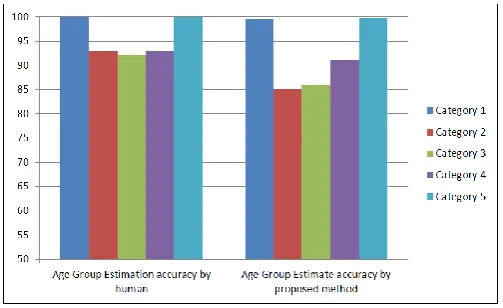
A comparative analysis of the automated age group estimation of the images present in the datasets using the
proposed method with human age group determination was done to examine the accuracy of the technique. The classification was observed to be nearly as accurate as human age group estimation for Category 1 and 5. The classes between these two extreme categories were found to be slightly tricky for correct age group determination for both human as well as the proposed method.
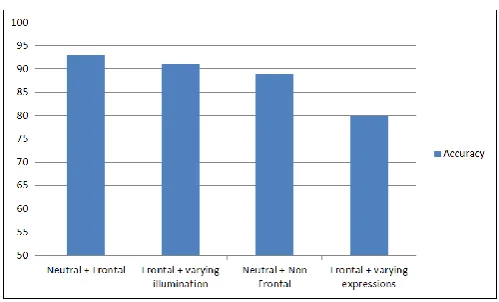
Also the success rate was found to be significantly high for frontal and neutral faces, the accuracy being nearly as good as humans. For rest of the cases, increasing the training data size was found necessary to achieve similar high performance.
The age group is estimated using the proposed technique with accuracy of 93% over the frontal face images having neutral expression
Figure 3. Comparison of Age Group Estimation Accuracy: Human vs. Proposed Method (Park dataset)
Figure 4. Comparison of Age Group Estimation Accuracy: Human vs. Proposed Method (Adience
Figure 5. Effect of variations in face on average accuracy of automatic age group estimation
The results encourage the utility of the proposed methodology in successfully determining the correct age group of a candidate. It can also be observed that the system being based on texture based information is resilient to the changes brought about by variations in lightning conditions. The training effort required for the neutral-frontal faces is significantly lower and the technique is achieves high performance in terms of success rate with much lesser computational cost and time.
IV.
CONCLUSION
Automated age group estimation based on Texture Classification has yielded performance which supports the application of the method in practical scenarios. The presented technique has been carefully evaluated over standard databases. The method explored being primarily founded upon Probabilistic Non-Extensive Entropy has aided in obtaining the features which perfectly represent the information about texture changes occurring in face of a person as age progresses. Inner Product Classifier adds to the efficiency of the system by using this information effectively in classifying the images into correct age group categories. A quick extraction of the features is followed by this unique classifier which is based on the principle of minimization of error between the features by emphasizing a margin between them. The success rate with neutral - frontal face images is comparable to human age group determination.
V.
FUTURE SCOPE
The proposed methodology can be further extended for taking into account the impact of variations in facial expressions, pose, illumination, makeup, cosmetic changes, facial distractions like hair growth, spectacles etc. on automatic age group estimation. They are known to affect the performance of face recognition systems as well. The methods to counter this issue need to detect robust features which are invariant to the changes brought about by the aforementioned factors. Such methodology when amalgamated with the proposed technique will yield a sturdy and efficient age group determination system that can be used for various applications.
VI.
REFERENCES
[1]. Hlaing Htake Khaung Tin, Myint Myint Sein, “Automatic Age Prediction of Aging Effects on Face Images”, The 10th International Conference on Computer Applications (ICCA), 02, 2012. [2]. Hayashi, J., Yasumoto, M., Ito, H., Niwa, Y.and
Koshimizu, H., “Age and Gender Estimation from Facial Image Processing. In Proceedings of the SICE Annual Conference, 13-18, 2002.
[3]. Nazre Batool, Rama Chellappa, “Modeling and Detection of Wrinkles in Aging Human Faces Using Marked Point Processes”, ECCV Workshops (2), 178-188, Oct. 7 – 13, Florence, Italy, 2012.
[4]. Lanitis, A., On the Significance of Different Facial Parts for Automatic Age Estimation. In Proceedings of the 14 the International Conference on Digital Signal Processing. 1027-1030, 2002.
[5]. Hu Han, Charles Otto, Anil K. Jain, “Age Estimation from Face Images: Human vs. Machine Performance”, The 6th IAPR International Conference on Biometrics (ICB), Madrid, Spain, June 4 - 7, 2013.
[6]. M Petrou, A Talebpour, A Kadyrov, Reverse engineering the way humans rank texture, Pattern Analysis and Applications, 10 (2) (2007) 101–114. [7]. M. Idrissa, Acheroy, Texture classification using
Gabor filters, Pattern Recognition Letters, 23 (2002) 1095–1102.
Analysis and Machine Intelligence, 5 (1) (1983) 25–39.
[9]. A. Laine, J. Fan, Texture classification by wavelet packet signatures, IEEE Transactions on Pattern Analysis and Machine Intelligence, 15 (11) (1993) 1186–1191.
[10]. E. de Ves, X. Benavent, G. Ayala, J. Domingo, Selecting the structuring element for morphological texture classification, Pattern Analysis and Applications, 9 (1) (2006) 48–57. [11]. C.E Shannon, A mathematical theory of
communication, Bell Syst. Tech, J. 27 (1948) 379–423, July.
[12]. R.M Haralick, K Shanmugan, I Dinstein, Textural features for image classification, IEEE Trans. Syst. Man Cybern. 3 (1973) 610–621.
[13]. A. Renyi, On measures of entropy and information, Fourth Berkeley Symposium, vol. 1, pp. 547– 561,1961.
[14]. Nikhil Pal, Sankar Pal, Entropy–a new definition and its applications, IEEE Transactions on System Man Cybernetrics, 21 (5) (September 1991). [15]. Seba Susan, Madasu Hanmandlu, A non-extensive
entropy feature and its application to texture classification, Neurocomputing, 120 (2013) 214– 225.
[16]. Mamta, Madasu Hanmandlu, Robust ear based authentication using Local Principal Independent Components, Expert Systems with Applications 40 (2013) 6478–6490 (Elsevier).
[17]. Minear, M. & Park, D.C., (2004). A lifespan database of adult facial stimuli. Behavior Research Methods, Instruments, & Computers. 36, 630-633., http://agingmind.utdallas.edu/facedb/view/neutral-faces