University of Pennsylvania
ScholarlyCommons
Publicly Accessible Penn Dissertations
1-1-2014
Computational Models of Information Processing
Wendy HamUniversity of Pennsylvania, [email protected]
Follow this and additional works at:http://repository.upenn.edu/edissertations
Part of theBusiness Administration, Management, and Operations Commons, and the Management Sciences and Quantitative Methods Commons
This paper is posted at ScholarlyCommons.http://repository.upenn.edu/edissertations/1304 For more information, please [email protected].
Recommended Citation
Computational Models of Information Processing
Abstract
The necessity and desire to understand the nature of information permeates virtually all aspects of scientific endeavors in both natural and social systems. This is particularly true in research that seeks to understand how various forms of organizations arise and function. This dissertation is dedicated towards understanding one important concern in the study of information in organizations: that of information integrity. There are two aspects of information integrity that are interesting to examine in management contexts: First, because the definition and quantification of information is often nebulous, the onus to preserve information integrity, from ensuring a successful information transfer to minimizing distortion, to a large extent falls on the information recipient. Second, unlike in physical systems, in which there tends to be a clear demarcation between the information processing system and the environment, the boundary between the two in
management contexts is usually more diffuse, which can give rise to complex interactions. The structure of the environment can thus have a significant influence on an information recipient's ability to process information and to preserve its integrity. I present two computational models to develop theories about these aspects: In the first, I look at how an organization's strategic effort to acquire (and therefore receive) information co-evolves with its absorptive capacity in different types of environment. Here, loss of information integrity is defined by acquisition failure. The model suggests that an exploitative information acquisition strategy could better preserve information integrity and eventually generate a more diverse knowledge stock than an explorative strategy could, thereby challenging common assumptions. The model also highlights several environmental and cognitive parameters that modulate the relationship between information acquisition strategy and its outcome. In the second model, I look at information processing in the context of event forecasting. The model is built on the idea that events have structural signatures that are given by the web of causal relationships from which those events arise. As forecasters receive information about an event, their failure to preserve the integrity of the event's structural information hurts forecast performance, but interestingly, some events have structural characteristics that buffer against this effect.
Degree Type Dissertation
Degree Name
Doctor of Philosophy (PhD)
Graduate Group Management
First Advisor Daniel A. Levinthal
Keywords
Computational modeling, Forecasting, Information processing, Knowledge acquisition, Network, Simulation
Subject Categories
Business Administration, Management, and Operations | Management Sciences and Quantitative Methods
COMPUTATIONAL MODELS OF INFORMATION PROCESSING
Wendy Ham
A DISSERTATION
in
Management
For the Graduate Group in Managerial Science and Applied Economics
Presented to the Faculties of the University of Pennsylvania
in
Partial Fulfillment of the Requirements for the
Degree of Doctor of Philosophy
2014
Supervisor of Dissertation
_______________________
Daniel A. Levinthal, Reginald H. Jones Professor of Corporate Management; Chairperson, Management Department
Graduate Group Chairperson
_______________________
Eric Bradlow, Chairperson, Wharton Marketing Department; K.P. Chao Professor; Professor of Marketing, Statistics, and Education; Vice-Dean and Director, Wharton Doctoral Programs; Co-Director, Wharton Customer Analytics Initiative
Dissertation Committee
Lori Rosenkopf, Simon and Midge Palley Professor; Professor of Management; Vice Dean and Director, Wharton Undergraduate Division
Philip E. Tetlock, Leonore Annenberg University Professor in Democracy and Citizenship; Professor of Management; Professor of Psychology
COMPUTATIONAL MODELS OF INFORMATION PROCESSING
COPYRIGHT
2014
Wendy Ham
This work is licensed under the Creative Commons Attribution- NonCommercial-ShareAlike 3.0 License
To view a copy of this license, visit
iii ACKNOWLEDGMENTS
Throughout the course of my studies at Wharton, I was the recipient of a tremendous
amount of generosity and kindness, without which this dissertation would not have been
completed, or possibly even started. I am deeply grateful to: my advisor, Dan Levinthal,
for his never-ending supply of insights, solutions, creativity, patience, and words of
encouragements; Phil Tetlock, for giving me the opportunity and all the support I needed
to work on an exciting project that became Chapter 3 of this dissertation; Lori Rosenkopf,
for helping me navigate the doctoral program from the very start, for having me in her
research group, and for an inspiring social network seminar; Martine Haas, for always
offering the most thorough feedback and the most practical advice, and for many years of
mentorship, including some adventures in the field; John Paul MacDuffie, for many years
of having me as a teaching assistant, for numerous helpful discussions, and for instilling
into me lessons on how to manage people at work; Marshall Meyer, Olivier Chatain,
Ethan Mollick, and Raffi Amit, for taking the time to discuss research ideas with me at
various stages of the program; Tom Carter, Nathan Hodas, Brian Hollar, Peter Dodds,
David Brooks, Jacopo Tagliabue, Margreth Keiler, Murad Mithani, and Roozbeh
Daneshvar from the Santa Fe Institute Complex Systems Summer School, for helping me
learn how to build models for the first time; Michael Kearns, Dave Matuszek, and Scott
Weinstein, for their inspiring and practical classes; Liza Law, the Management
Department IT Help Desk, the Mack Institute for Innovation Management, and the
iv supplementary research funding and equipment; Patia McGrath, Henry Han, Justin
Rising, Amit Gal, Shinjae Won, Hyejeong Jo, Shefali Patil, Jihae Shin, Anindya Ghosh,
Vangelis Souitaris, and Andrea Contigiani for being such great friends and colleagues,
and for making graduate school a richer experience; my special thanks to Ilan Almog for
countless hours of technical and motivational discussions; Tori Huang, Alexey
Pakhomov, Eric Knoll, Masahiro Maeda, Ashley Kim, Manuel Zamfir, Sarah Zhang,
Joon Bae, Ji Park, Murray Gudesblat, Alvin Barlian, Oliver Friedmann, Felix Arndt,
Ellen Kang, Juliana Azem Ribeiro de Almeida, Emi Terasawa, Charles Pensig, Kiran
Nambiar, Peter Chislett, Ray Shah, Bill Inman, and Greg Katz, for keeping me sane and
entertained. Lastly, beyond words can convey, I am grateful to my parents and my family
v ABSTRACT
COMPUTATIONAL MODELS OF INFORMATION PROCESSING
Wendy Ham
Daniel A. Levinthal
The necessity and desire to understand the nature of information permeates virtually all
aspects of scientific endeavors in both natural and social systems. This is particularly true
in research that seeks to understand how various forms of organizations arise and
function. This dissertation is dedicated towards understanding one important concern in
the study of information in organizations: that of information integrity. There are two
aspects of information integrity that are interesting to examine in management contexts:
First, because the definition and quantification of information is often nebulous, the onus
to preserve information integrity, from ensuring a successful information transfer to
minimizing distortion, to a large extent falls on the information recipient. Second, unlike
in physical systems, in which there tends to be a clear demarcation between the
information processing system and the environment, the boundary between the two in
management contexts is usually more diffuse, which can give rise to complex
interactions. The structure of the environment can thus have a significant influence on an
information recipient’s ability to process information and to preserve its integrity. I
present two computational models to develop theories about these aspects: In the first, I
look at how an organization’s strategic effort to acquire (and therefore receive)
vi Here, loss of information integrity is defined by acquisition failure. The model suggests
that an exploitative information acquisition strategy could better preserve information
integrity and eventually generate a more diverse knowledge stock than an explorative
strategy could, thereby challenging common assumptions. The model also highlights
several environmental and cognitive parameters that modulate the relationship between
information acquisition strategy and its outcome. In the second model, I look at
information processing in the context of event forecasting. The model is built on the idea
that events have structural signatures that are given by the web of causal relationships
from which those events arise. As forecasters receive information about an event, their
failure to preserve the integrity of the event’s structural information hurts forecast
performance, but interestingly, some events have structural characteristics that buffer
vii TABLE OF CONTENTS
ACKNOWLEDGMENTS ... iii
ABSTRACT ... v
LIST OF TABLES ... ix
LIST OF ILLUSTRATIONS ... x
CHAPTER 1 ... 1
CHAPTER 2 ... 13
1. Introduction ...13
1.1. Exploitative and explorative strategies in knowledge acquisition ...14
1.2. Framework: Absorptive capacity, knowledge acquisition strategy, and outcome ...17
2. The mechanism of knowledge acquisition ...21
2.1. Distance sensitivity ...22
2.2. Learning curve: Magnitude and age ...23
3. Model specifications ...27
3.1. Knowledge universe ...27
3.2. Knowledge acquisition environment ...30
3.3. Agent ...32
4. Simulations ...34
4.1. Baseline ...35
4.2. Distance sensitivity ...36
4.3. Magnitude sensitivity ...37
4.4. Age sensitivity ...39
5. Limitations and extensions ...40
5.1. Static vs. dynamic knowledge universe ...41
5.2. Density vs. diversity of the knowledge acquisition environment ...42
5.3. Static vs. dynamic knowledge acquisition strategy ...44
5.4. Conclusion ...45
CHAPTER 3 ... 46
viii
2. Event predictability ...50
2.1. Forecasting environment: The causal structure of an event ...50
2.2. Forecasting mechanisms ...60
2.3. Forecaster performance in different causal structures ...63
3. Model specifications ...74
3.1. Event structure network and event occurrence ...74
3.2. Cognitive representation network ...77
4. Understanding events ...83
4.1. Network centralization (Cx) ...83
4.2. Probability of event occurrence (pe) ...86
4.3. Latency (T) ...90
4.4. Predictability: Sensitivity to random perturbations ...92
5. Four classes of structurally distinct events ...100
5.1. Network centralization ...101
5.2. Path length ...102
5.3. Jaccard similarity ...102
5.4. Predictability: Sensitivity to random perturbations ...103
6. Types of imperfect cognitive representation and their effects on forecast performance ...105
6.1. Imperfect understanding of structural relationships between event precursors ...106
6.2. Lack of available information (due to forecast time) ...109
6.3. Arbitrary lack of attention to available information ...112
6.4. Big-picture bias in attention ...114
6.5. Temporal bias in attention ...118
6.6. Summary of simulation results ...122
7. Takeaways for forecasters ...126
8. Limitations and Extensions ...131
8.1. Empirical validation ...131
8.2. Alternative modeling choices ...133
8.3. Additional features and analyses ...134
9. Conclusion ...136
APPENDIX 1: TABLES ... 137
APPENDIX 2: ILLUSTRATIONS ... 144
ix LIST OF TABLES
Table 1 Mapping of terminologies used in Chapter 3 145
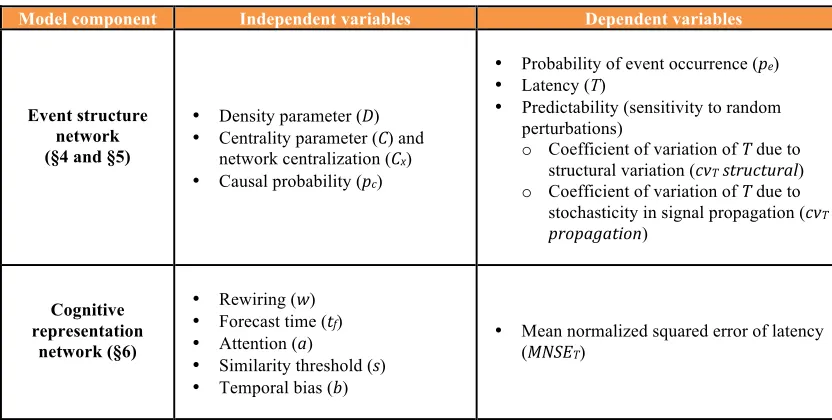
Table 2 Independent and dependent variables in the simulations 146
Table 3 Effects of event structure parameters on event occurrence probability, latency, and predictability
147
Table 4 Effect of density parameter (D) on cvT propagation as mediated by
average path length, number of alternative paths, and cvPL
148
Table 5 Effect of network centralization on cvT propagation as mediated
by average path length, number of alternative paths, and cvPL
149
Table 6 Effects of imperfect cognitive representations on forecast error in
structurally distinct events 150
Table 7 Forecasting environments and their points of sensitivity and
x LIST OF ILLUSTRATIONS
Figure 1 Mechanism of knowledge acquisition 152
Figure 2 Knowledge acquisition model overview 153
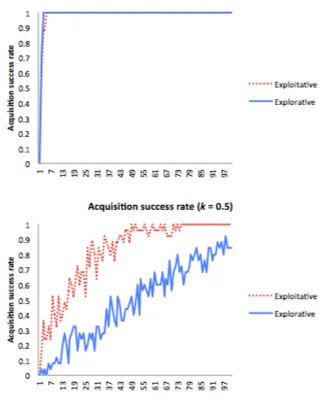
Figure 3 Distance sensitivity parameter 154
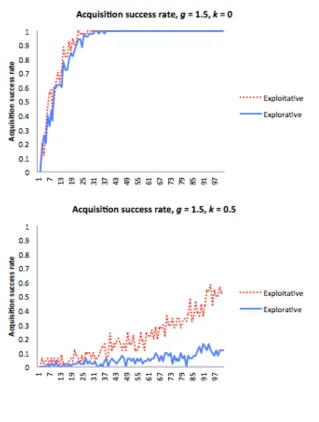
Figure 4 Magnitude sensitivity parameter 156
Figure 5 Age sensitivity parameter 158
Figure 6 A set of events represented as a Bayesian network 159
Figure 7 Event structure network and cognitive representation network 160
Figure 8 The effect of link density parameter (D) on network
centralization (Cx) at various centrality parameter (C) values and
network size (N) = 50
161
Figure 9 The effect of centrality parameter (C) on network centralization
(Cx) at various link density parameter (D) values and network
size (N) = 50
162
Figure 10 Link density parameter (D) and probability of event occurrence
(pe)
163
Figure 11 Centrality parameter (C) and maximum probability of event
occurrence (pe)
165
Figure 12 Network centralization (Cx) and probability of event occurrence
(pe) (at pc = 0.05)
166
Figure 13 Network centralization (Cx) and average path length (at pc =
0.05)
167
Figure 14 Causal probability (pc) and probability of event occurrence (pe)
plotted against t (at D = 0.2 and C = 0)
168
Figure 15 Link density (D) and latency (T) (at C = 0 and pc = 0.20) 169
xi
Figure 17 Causal probability (pc) and latency (T) (at D = 0.04, D = 0.08, D
= 0.20, and C = 0)
171
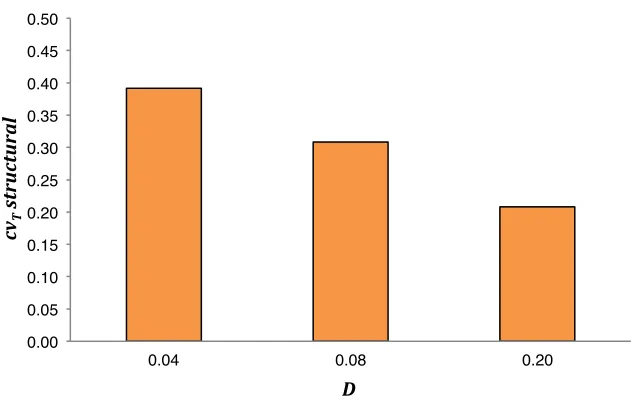
Figure 18 Link density (D) and cvTstructural (at C = 0 and pc = 0.01) 172
Figure 19 Network centralization (Cx) and cvTstructural (at various D and
pc = 0.05)
173
Figure 20 Causal probability (pc) and cvTstructural (at various D and C) 174
Figure 21 Link density (D) and cvTpropagation (at C = 0 and various pc) 175
Figure 22 Link density (D) and coefficient of variance of path length (cvPL) 176
Figure 23 Path length and cvTpropagation (at pc = 0.1) 177
Figure 24 Number of alternative paths and cvTpropagation 178
Figure 25 Effect of cvPL on cvTpropagation 179
Figure 26 Network centralization (Cx) and cvTpropagation (at various D
and pc = 0.05)
180
Figure 27 Network centralization (Cx) and coefficient of variance of path
length (cvPL) (at various D)
181
Figure 28 Effect of causal probability (pc) on cvTpropagation in event
network (at various D and C)
182
Figure 29 Effect of causal probability (pc) on cvTpropagation in simple
linear chain (at average path length = 5, cvPL = 0.1)
183
Figure 30 Four structurally distinct events 184
Figure 31 Network centralization (Cx) in four network types 185
Figure 32 Average path length in four network types 186
Figure 33 Coefficient of variance of path length (cvPL) in four network
types
187
Figure 34 Jaccard similarity in four network types 188
xii
Figure 36 cvT propagation in four network types (at pc = 0.01) 190
Figure 37 Effect of rewiring parameter (w) (at pc = 0.01, tf = 0) 191
Figure 38 Effect of forecast time (tf) (at pc = 0.01) 193
Figure 39 Effect of attention (a) (at pc = 0.01, tf = 40) 195
Figure 40 Effect of similarity threshold (s) (at pc = 0.01, tf = 10) 196
1 CHAPTER 1
ORGANIZATION, INFORMATION, AND THE PROBLEM OF INTEGRITY
The necessity and desire to understand the nature of information permeates
virtually all aspects of scientific endeavors in both natural and social systems. This is
particularly true in research that seeks to understand how various forms of organizations
arise and function. Organization implies coordination, and coordination entails the
capture, storage, transmission, manipulation, aggregation, and interpretation of
information. The studies of organization and of information are inevitably intertwined.
The inseparability of organization and information is illustrated by the ease with
which the particular interests of a scientific discipline that is concerned with
understanding organizations can be redescribed as a study of information. Life sciences,
for instance, are dedicated to deciphering puzzles about how molecular building blocks
are organized to produce sophisticated structures that are capable of regulating,
self-perpetuating, and self-evolving. Yet, strands of research in life sciences can be readily
reconceptualized as an effort to understand various facets of information: Geneticists are
concerned with the ways in which information is stored and transmitted across
generations of cells and organisms; molecular biologists study various signaling
pathways through which information is manipulated to facilitate intra- and extracellular
communications; developmental biologists look at how undifferentiated cells process
information that allows them to grow and combine into specialized tissues;
2 repertoire of defense mechanisms; neurobiologists study how information is converted
back and forth in the forms of electrical and chemical signals to generate complex
configurations that are themselves capable of governing other information processing
systems.
Much like the subdisciplines of life sciences above, some of the most important
research in management can be described as studies of information: Nelson and Winter’s
(1982) work on routines, for instance, is about identifying the form of information
encoding that allows firms to preserve their capabilities amidst evolutionary pressures.
Radner’s (1992) work on types of hierarchy is about a firm’s particular necessities to
manage its information processing activities. Coase’s (1937) and Williamson’s (1981)
work on the boundary of the firm is about understanding the cost of information search,
and in a similar vein, Nickerson and Zenger’s (2004) work on firm configurations is
about identifying optimal information organizing efforts. Staw et al.’s (1981) work on
threat-rigidity effects is about how firms translate information about adversity into
adjustments of internal structure and external actions. Hambrick et al.’s (1996) work on
top management teams is about how information processing at the executive level
influences a firm’s competitive decisions.
The examples above illustrate more than just the omnipresence of concerns about
information in various studies of organization. Rather, they also suggest that in the study
of organization, there is often an explicit or implicit consideration of information
3 organizational routines, is fundamentally about the preservation of information integrity.
On the other hand, the problems of information transmission and information processing,
such as in the study of cell signaling pathways or organizational hierarchy, are not
primarily about information integrity but nevertheless depend on the presumption of it.
The problem of information integrity is one that has received considerable
attention in engineering. Advancements in electrical communication in the last couple
centuries, which can be traced back to Samuel Morse’s development of the electrical
telegraph in the 1800s, have necessitated a closer look at the problem (Beauchamp, 2001;
Pierce, 1980). Due to physical limitations, signal transmission via electrical
communication systems is prone to noise, interference, and distortion. Information theory
emerged in the 1940’s to assign a formal treatment to this problem; Claude Shannon’s
(1948) seminal paper, which is widely considered to have marked the birth of information
theory, begins with a succinct assertion that captures the essence of concerns about
information integrity: “The fundamental problem of communication is that of
reproducing at one point either exactly or approximately a message selected at another
point.”
The basic framework of information theory entails the transmission of
information from a source to a receiver. It divides the problem of information integrity
into two main components: the problem of representing information at the source and the
problem of delivering that information to the receiver. Both components determine the
4 utilized at the receiving end. The premise of the first component is that information in its
raw form is usually compressible; there are typically redundant or unnecessary elements
in the original representation of information that can be removed to allow for a more
compact, algorithmic description (Shannon, 1948; Wade, 1994). The implicit
assumptions here are that information representation imposes some costs and that there is
only a limited amount of resources available to absorb those costs. The premise of the
second component is that the channel through which information is delivered has a
maximum capacity; there are factors intrinsic and extrinsic to the channel that makes
information delivery susceptible to noise, interference, and distortion (Shannon, 1948).
The subfield of channel coding theory concerns itself with this problem; it consists of
techniques for allowing efficient and faithful signal transmissions across imperfect
channels (e.g., Hamming, 1950).
These concepts are familiar to management researchers. With regards to the
problem of information representation, scholars have long recognized that some types of
information are more compressible than others: Tacit knowledge is often contrasted with
explicit knowledge; the former is difficult to describe and thus also difficult to transfer,
whereas the latter can be readily codified and shared (Nonaka, 1991; Polanyi, 1958).
With regards to the problem of information delivery, management scholars typically take
a holistic approach and look at the characteristics of the information that is to be
delivered, the channel through which it is to be delivered, and the intended recipient of
the information. The combination of these factors, for example, provides some
5 1996; von Hippel, 1994). It is interesting to note here that both management scholars and
information theorists explicitly recognize that the delivery of information is not
frictionless or costless. This resemblance in insights is not to be taken for granted: As von
Hippel (1994) observed, “… the central tendency in economic theorizing has been to
view information as costlessly transferrable, and much of the research on the special
character of markets for information has been based precisely on this characteristic…
However, a number of scholars with an empirical as well as theoretical interest in the
economics and diffusion of technological information have long argued, and to some
extent shown, that the costs of information transfer in technical projects can vary
significantly (Nelson, 1959, 1982; Rosenberg, 1982; Griliches, 1957; Mansfield, 1968;
Pavitt, 1987; and Teece, 1977).”
Although it is interesting to note the similarities between the frameworks based on
which management scholars and information theorists look at the problem of information
integrity, there are several important differences: As previously discussed, the bulk of
information theorists’ focus is on the source and the channel, whereas management
scholars pay sizable attention not only to those two components but also to the recipient
of information. While information in information theory is defined in terms of precisely
quantified bits, the definition and quantification of information in management research
is far more nebulous (Weick, 1979). The processing of information in management
6
owing to the ambiguous nature of the information in question (Kaplan, 2008).1
Furthermore, information transfer is frequently initiated by the recipient rather than the
source (e.g., Borgatti & Cross, 2003). The onus to preserve information integrity, from
ensuring a successful information transfer to minimizing distortion, to a large extent thus
falls on the information recipient.
Another noteworthy difference between management contexts and physical
systems (in which information theory is typically applied) is that in the latter, due to their
physical nature, it is usually possible to identify with little ambiguity the boundary
between the information processing system and the environment (i.e., everything else
outside of the system). Consequently, it is possible to analyze the interacting components
of an information processing system in relative isolation. In management contexts, the
boundary is more diffuse. A conversation between two organizational actors, for instance,
never occurs in a vacuum but is always influenced by the particular circumstances in
which that conversation takes place. Such circumstances are derived from a multitude of
possible factors outside of those that pertain directly to the individuals (e.g., Daft &
Weick, 1984; Russell, 1980), including task-level ones, such as problem structure
(Newell & Simon, 1972), group-level ones, such as group norms (Feldman, 1984), and
organizational-level ones, such as organizational culture (Schein, 1985).
1 This is why the term knowledge rather than information is usually more appropriate in management
7 The next two chapters in this dissertation are dedicated towards examining the
problem of information integrity by taking into account the two distinguishing aspects of
information studies in management research described above: the role of the information
recipient and the influence of environmental attributes. In the first of the two chapters, I
look at the organization as the information recipient, specifically how its strategic effort
to acquire (and therefore receive) information co-evolves with its absorptive capacity
(Cohen & Levinthal, 1990) in different types of environments. Here, the preservation of
information integrity is defined by acquisition success. In the last chapter, I look at the
individual actor as the information recipient, specifically how such an actor processes
information in order to offer predictions about an event. I discuss in detail the
mechanisms by which the failure to preserve the integrity of information about the
environment hurts forecast performance, and I also show that, interestingly, some types
of environmental structure can sometimes buffer against this effect.
Another common thread between the two chapters is that they are both aimed at
unpacking some mechanisms in information processing that have typically been treated
as a black box in the literature. The method employed in both chapters is computational
modeling, which allows for the development of theories about mechanisms that are
difficult to observe in the empirical setting. In this regard, I share a common goal with
some existing lines of work, such as the use of neural net models to unpack the
mechanisms of analogical reasoning (Gavetti & Warglien, 2007). I provide a brief
8 Chapter 2: The interactions between information recipient and environmental
attributes in information acquisition
Organizations presumably seek to acquire information according to a particular
strategy rather than mindlessly. In this chapter, I look at two ideal types of information
acquisition strategy: exploitative and explorative (cf. March, 1991). A purely exploitative
organization is one that seeks to acquire information that is as local or as closely related
as possible to the set of information it already has, whereas an explorative organization is
one that seeks to acquire information that is as distant or as unrelated as possible to the
set of information it already has (cf. Cyert & March, 1963; Gavetti & Levinthal, 2000;
Katila & Ahuja, 2002; March & Simon, 1958).
A common assumption in the organizational learning literature is that
organizations should employ an explorative information acquisition strategy when it
seeks to diversify its stock of information. This assumption is worth revisiting, however,
considering that empirical studies have shown that in reality, organizations often fail to
acquire distant information despite repeated attempts (e.g., Monteiro, 2009). On the other
hand, organizations that deliberately focus on acquiring local information sometimes find
themselves well-positioned to acquire distant information: Kao’s expertise in soap, for
instance, opened up new opportunities in floppy disk manufacturing due to some
technological overlaps between the two domains (Rosenkopf & Nerkar, 2001).
An organization’s unsuccessful attempt at acquiring information that it intends to
9 To understand the mechanisms behind this phenomenon, I build a computational model
with absorptive capacity as the guiding framework (Cohen & Levinthal, 1990). There are
three basic assumptions embedded in the model: First, an organization’s absorptive
capacity is shaped by the organization’s existing stock of information; second, as the
organization successfully acquires new information, the new information is incorporated
into the organization’s stock of information, thereby reshaping its absorptive capacity;
third, information acquisition strategy is treated as a stable, exogenous attribute of the
organization. (In contrast, absorptive capacity is thus treated as an endogenous variable.)
The information acquisition mechanism itself is modeled as a two-step process: In the
first step, the organization chooses information that it intends to acquire, and in the
second step, it attempts to actually acquire it. The first step is guided by the
organization’s information acquisition strategy, whereas the outcome of the second step
depends on whether the organization is endowed with the requisite absorptive capacity.
The model further takes into account the role of the environment in influencing
the outcome of an information acquisition attempt. (An organization is assumed to
operate within an information acquisition environment.) The attribute of the environment
that is explored in the model is the level of diversity of information that it contains. The
interaction between environment diversity and information acquisition strategy is easy to
see: An explorative organization, for example, would tend to have more difficulty finding
distant knowledge in an environment characterized by low diversity. It does not
necessarily mean, however, that it would be less successful in acquiring new information
10 Simulation results show that an exploitative strategy can outperform an
explorative one in a wide range of conditions. Performance in this case is measured by
the volume and the diversity of the stock of information that the organization
accumulates over time. The model furthermore shows that a number of additional factors,
such as sensitivity to information distance, requirement for repeated engagement with
information, and depreciation of information stock over time, can exacerbate the
explorative organization’s difficulty in acquiring new knowledge and therefore in
preserving information integrity. The results presented in this chapter thus offer an
interesting and perhaps counterintuitive insight that an organization’s quest for diverse
information can often be better served by an exploitative rather than explorative
information acquisition strategy.
Chapter 3: The interactions between information recipient and environmental
attributes in the use of information to make predictions
Whereas the research presented in Chapter 2 as summarized above primarily
looks at ensuring successful information transfer as the basic requirement for the
preservation of information integrity, the research presented in Chapter 3 examines
another element: that of information distortion. The research in Chapter 3 also goes
beyond information acquisition; it looks at the way in which information subsequently
gets processed and utilized. The specific task with which the information recipient is
11 The primary research question in this chapter is: What does it take to make the
most accurate predictions possible? This question can be divided into two parts: The first
is about events themselves—do events have particular attributes that make them easier or
harder to predict? (It should be noted that here, an event is considered a part of the
environment such that event attributes are considered environmental attributes.) The
second part of the question is about the forecaster’s cognitive mechanism—what is it
about a forecaster’s thinking style that translates into superior or inferior forecast
performance?
To examine the questions above, I build a computational model based on the idea
that events have structural attributes. Events have causes, and those causes typically
materialize in the form of preceding events (referred to as precursors), which in turn have
their own causes. An event’s structural attributes are defined by the way in which its
precursors are connected to each other via causal relationships. Two structural attributes
of an event that the model explores are the density and the distribution of causal
relationships.
At a given point in time, two kinds of information are available to describe an
event: the first is information about its causal structure, and the second is information
about the extent of precursor activation in its causal structure, including information
about which specific precursors have already been activated. The former is independent
of time, whereas the latter can change over time. Forecasters, as the recipients of
12 these two kinds of information. To take this consideration into account, the model
incorporates representations of several types of cognitive imperfections that may affect a
forecaster’s perception of information about an event: ignorance about the event’s causal
structure, arbitrary lack of attention, big-picture bias (treating information as more
general than it really is), and temporal bias (having an attentional bias towards newer or
older information). The time at which a forecaster is asked to make a prediction also
matters and is thus included in the model; the more time has passed, the more information
about the event tends to be available to the forecaster.
Simulation results show complex interactions between the types of cognitive
imperfection above and the attributes of an event’s causal structure. While information
distortion generally hurts forecast performance, some types of causal structure seem to
buffer against this effect. Simulation results also show that depending on an event’s
causal structure, efforts to avoid information distortion may not be worth the cost as they
13 CHAPTER 2
BITE OFF WHAT YOU CAN CHEW? KNOWLEDGE ACQUISITION
STRATEGY AND THE EVOLUTION OF ABSORPTIVE CAPACITY
1. Introduction
The choices an organization makes typically have lasting consequences. Path
dependence is a well-studied explanation for this (e.g., Arthur, 1994; Nerkar, 2003): An
organization does not have a blank slate at a given point in time but must rather continue
from the leading edge of its traveled path. Choices themselves often have persistent
characteristics; each choice is drawn not randomly but as guided by some overarching
strategy (Nath & Sudharshan, 1994; Porter, 1980). Furthermore, the outcome of each
choice often alters organizational resources on which the execution of strategy itself
depends (cf. Helfat & Peteraf, 2003; Teece, Pisano, & Shuen, 1997; Winter, 2003).
I apply this understanding to the context of organizational learning. In particular, I
look at how strategy directs choice in knowledge acquisition, and how over time it shapes
the organization’s knowledge stock and subsequently absorptive capacity (Cohen &
Levinthal, 1990), which themselves are important resources in knowledge acquisition. I
thus conceptualize organizational learning as a continuous feedback loop, in which I treat
knowledge acquisition strategy as a stable exogenous attribute but knowledge acquisition
process and outcome as endogenous and perpetually evolving. My approach emphasizes
14 absorptive capacity over time. In this regard, I follow a long line of theoretical and
empirical work that draws attention to the recursive element of absorptive capacity (e.g.,
Ahuja, 2000; Cockburn & Henderson, 1998; Lane & Lubatkin, 1998; Lyles & Salk,
1996; Pennings & Harianto, 1992; Pisano, 1994; Shane, 2000; Stuart, 1998).
Based on this approach, I build a computational model to offer some insights into
a common problem in organizational learning: When should organizations make
persistent attempts to acquire local versus distant knowledge? I review below why
organizations face this choice and why a particular knowledge acquisition strategy may
or may not lead to its intended outcome. I then present my model, within which I derive
several boundary conditions that are defined by the following parameters: distance
sensitivity, magnitude sensitivity, and age sensitivity.
1.1. Exploitative and explorative strategies in knowledge acquisition
Knowledge acquisition strategy can be characterized according to a dimension
with two extremes: exploitative and explorative (March, 1991). A purely exploitative
organization is one that chooses to acquire new knowledge that is as local as possible to
its existing knowledge stock (cf. Cyert & March, 1963; Gavetti & Levinthal, 2000;
March & Simon, 1958), whereas a purely explorative organization is one that chooses to
acquire new knowledge that is as distant as possible. In reality, organizations adopt a
knowledge acquisition strategy that resides somewhere in between these two extremes
(Katila & Ahuja, 2002). An organization’s choice in knowledge acquisition may
15 exploitative strategy can be viewed as diversity avoiding and an explorative strategy
diversity seeking.
Each of the two knowledge acquisition strategies above has its benefits and
limitations. Organizations may lean toward being exploitative for a number of reasons,
such as to minimize knowledge acquisition and integration costs (Dosi, 1988; Grant,
1996), as well as to increase the chances of synergy among existing knowledge bases
(Henderson, 1994). Consistent with these lines of reasoning, Helfat (1994) found that
firm-level R&D investments become more focused over time in a path-dependent
manner. Furthermore, Stuart and Podolny (1996) found that even in the face of major
technology shifts, firms often made only limited adjustments to the scope of their
technological search. A limitation that is frequently attributed to the exploitative strategy
is that it can lead organizations to develop ‘core rigidities’ (Leonard-Barton, 1992) or fall
into ‘competency traps’ (Levitt & March, 1988). Furthermore, since the exploitative
strategy can be viewed as diversity avoiding, it may limit an organization’s combinative
capability (Kogut & Zander, 1992) such that it generates mostly incremental rather than
breakthrough innovations (Dewar & Dutton, 1986).
The explorative knowledge acquisition strategy, on the other hand, is often lauded
as being important for organizational performance and survival due to its promise of
bringing into the organization distant knowledge that can be recombined to produce
breakthrough innovations (Fleming, 2001; Rosenkopf & Nerkar, 2001). Many illustrative
16 developed its approach to retail brokerage by borrowing ideas from the supermarket
business (Gavetti, Levinthal, & Rivkin, 2005); IDEO designed the articulating
ball-and-socket joint design for desk lamps based on principles in human hip-bone ball-and-sockets
(Hargadon & Sutton, 1997); Qualcomm developed its revolutionary mirasol® color
display technology by studying the microstructures of Morpho butterfly wings
(Graham-Rowe, 2008). Nevertheless, the explorative strategy is often a risky one to follow. The
value of distant knowledge is often difficult to ascertain not only due to its relative
unfamiliarity, but also because its expected payoff is subject to much uncertainty. For
example, when the desired outcome of an explorative knowledge acquisition strategy is a
novel and game-changing technology, many variables beyond a single organization’s
control may turn out to be critical, such as market and customer acceptance of the
technology, the adoption and diffusion of it, and competitors’ strategic actions (Fleming,
2001; Rosenberg, 1996).
The choice between exploitative and explorative knowledge acquisition strategies
is a difficult one for organizations not only due to the trade-offs discussed above, but
perhaps most importantly, because organizations have limited resources such that pouring
resources into one strategy often means depriving the other (March, 1991). Furthermore,
in deciding on knowledge acquisition strategies in general, there are other factors to
consider, such as whether knowledge stickiness would be a significant impediment
(Szulanski, 2003), whether the organization is equipped with the right structure for the
choice of strategy (Nickerson & Zenger, 2005), whether the competitive environment in
17 relatedly, whether it is even possible to accurately infer the state of the environment
(Posen & Levinthal, 2012).
1.2. Framework: Absorptive capacity, knowledge acquisition strategy, and outcome
Despite the aforementioned variety of considerations, one unifying assumption in
evaluating the choice between exploitative and explorative knowledge acquisition
strategies is that the former will indeed result in the accumulation of local knowledge,
and the latter distant knowledge. This assumption is worth revisiting, however, because
in reality the implementation of a knowledge acquisition strategy does not always lead to
its intended outcome. Organizations often deliberately seek distant knowledge only to
find themselves acquiring local knowledge yet again. As documented by Monteiro
(2009), many multinational corporations attempt to acquire distant knowledge through
their subsidiaries around the globe and yet are frequently unable to convert on the
opportunities to do so. Conversely, organizations that deliberately focus on local
knowledge sometimes find themselves successfully acquiring and even developing new
knowledge in a completely different domain. For example, Kao’s local knowledge of
surfactant (soap) technologies led it to develop a better coating for floppy disks
(Rosenkopf & Nerkar, 2001). These instances thus raise the interesting question of
whether the path to distant knowledge is sometimes paved by an exploitative knowledge
acquisition strategy, and vice versa.
Absorptive capacity is my guiding framework in investigating this question. Of
18 new knowledge towards commercial ends (Cohen & Levinthal, 1990), I focus on the
acquisition component. A fundamental principle in this framework is that an
organization’s absorptive capacity is shaped by the characteristics of its knowledge stock
(Cohen & Levinthal, 1990, Volberda, Foss, & Lyles, 2010). Learning takes place in a
cumulative fashion (Bower & Hillgard, 1981; Lindsay & Norman, 1977) such that prior
related knowledge in an organization’s knowledge stock is important for new knowledge
acquisition. The value of prior knowledge is not only due to its content per se, but also
the relevant learning skills that were accumulated as a result of prior knowledge
acquisition (Ellis, 1965; Estes, 1970).
In familiar and stable contexts, the type of prior related knowledge that is
important for successful knowledge acquisition tends to be clear, whereas in novel and
uncertain contexts, it tends to be difficult to predict ex-ante (Tushman & Anderson,
1986). In the latter, diversity in a knowledge stock can thus become a source of
competitive advantage. As Cohen & Levinthal (1990:131) explained: “In a setting in
which there is uncertainty about the knowledge domains from which potentially useful
information may emerge, a diverse background provides a more robust basis for learning
because it increases the prospect that incoming information will relate to what is already
known. In addition to strengthening assimilative powers, knowledge diversity also
facilitates the innovative process by enabling the individual to make novel associations
19 The absorptive capacity framework allows us to surmise that an exploitative
organization is likely to be successful in the early stage of its knowledge acquisition
attempts because its choice of new knowledge rarely strays far from its prior knowledge.
Such an exploitative organization is able to quickly amass a large body of closely related
knowledge. It may then be able to use it to acquire increasingly distant knowledge, one
step at a time. It is also possible, however, that such an exploitative organization ends up
becoming a prisoner of its own knowledge, never generating enough diversity in its
knowledge stock to venture beyond local knowledge. An explorative organization, on the
other hand, can be expected to have some difficulty acquiring knowledge in its earlier
attempts. This difficulty may persist such that it becomes permanently stuck as a poor
acquirer of knowledge. An alternative and more optimistic outlook is that it may
eventually accumulate a diverse enough knowledge base to improve future acquisition
success. Which of these alternative scenarios plays out likely depends on factors beyond
absorptive capacity itself.
For instance, the outcome of a knowledge acquisition strategy likely depends on
the characteristics of the environment (Argote, McEvily, & Reagans, 2003). As intuition
would suggest, an explorative strategy would not work well in a knowledge acquisition
environment that does not offer diverse knowledge; an explorative organization in such
an environment simply would not be able to satisfy its appetite for distant knowledge.
Similarly, an exploitative strategy might not work well in a knowledge acquisition
environment that is too diverse; an exploitative organization in such an environment
20 existing knowledge stock. It should also be noted, however, that when the knowledge
acquisition environment is more diverse, an exploitative organization might also be able
to find knowledge that is more local to its existing knowledge stock.
Diversity of new knowledge in a knowledge acquisition environment is
sometimes a function of density (cf. Hansen & Haas, 2001), which can be understood as
volume of knowledge per unit space and time. Density implies the availability of options:
At the most fundamental level, it allows an organization to acquire any new knowledge at
all. A barren environment of very low density can inhibit knowledge acquisition
irrespective of strategy. Conversely, assuming non-zero level of diversity, greater density
in a knowledge acquisition environment improves the chances that an organization can
find what it truly prefers. In a high-density environment, an exploitative organization is
likely to be able to find knowledge that is extremely close to its existing knowledge
stock, whereas an explorative organization is likely to be able to find knowledge that is
extremely distant to its existing knowledge stock.
By investigating the interrelationships among knowledge acquisition strategy,
knowledge stock, absorptive capacity, and knowledge acquisition environment, I
contribute to the organizational learning literature on at least two fronts: First, I offer
insights on why there is sometimes a discrepancy between knowledge acquisition
strategy, which implies an intended outcome, and actual outcome. Second, I unpack the
mechanism of knowledge acquisition to show how a particular knowledge stock
21 demonstrated the link between knowledge stock characteristics and organizational
performance (e.g., Brusoni, Prencipe, & Pavitt, 2001; Hargadon & Sutton, 1997), less is
known about how to obtain a desired knowledge stock configuration.
The rest of this paper is organized as follows: In §2 below, I discuss in greater
detail the mechanism of knowledge acquisition and explain how it translates into my
computational model. In §3, I present the model specifications. In §4, I present my
simulation experiments and results. In §5, I discuss some limitations and possible
extensions of the model.
2. The mechanism of knowledge acquisition
Figure 1 summarizes three main processes in my conceptual model: First, an
organization’s knowledge stock and knowledge acquisition strategy co-determine its
knowledge choice. Second, the organization’s knowledge stock determines whether the
chosen knowledge can be successfully acquired. Third, if the attempted acquisition is
successful, the newly acquired knowledge contributes to and reshapes the organization’s
knowledge stock. As shown in the figure, I highlight the role of absorptive capacity in the
second process.2 It represents the organization’s ability to actually acquire knowledge
that it chooses to acquire.
--- Insert Figure 1 about here ---
2 Absorptive capacity also plays a role in the first and third process, i.e., the evaluation of new knowledge
22 2.1. Distance sensitivity
In my model, absorptive capacity is primarily a function of the distance between
the organization’s new knowledge of choice and its existing knowledge stock. The
greater the distance, the more difficult the new knowledge is to acquire (Pennings &
Harianto, 1992). Several factors may modulate this relationship. For example, different
knowledge acquisition contexts may render absorptive capacity more or less sensitive to
distance; prior related knowledge may be more or less crucial for acquisition success in
some disciplines or circumstances than in others. Knowledge acquisition in basic science,
for instance, typically requires more closely related knowledge compared to knowledge
acquisition in applied science (Page, 2007: 119-127). Sensitivity to distance may also be
influenced by certain organizational characteristics distinct from sheer knowledge stock,
such as material resources, prior experience with knowledge search, network position,
combinative capability, organizational form, organizational size, and group
characteristics within the organization (Almeida, Dokko, & Rosenkopf, 2003; Fosfuri &
Tribó, 2008; Haas, 2006; Haas, 2010; Lavie & Rosenkopf, 2006; Powell, Koput, &
Smith-Doerr, 1996; Rosenkopf & Almeida, 2003; Van den Bosch, Volberda, & Boer,
1999).
I assign a parameter called distance sensitivity to take into account such factors
that can influence the sensitivity of absorptive capacity to distance. As such, given
greater distance sensitivity, an exploitative organization would be much more likely to
23 distant knowledge, it is unlikely to succeed. Conversely, given greater distance
sensitivity, an explorative organization would be much more likely to prefer more distant
knowledge. The twist, however, is that it is unlikely to succeed at acquiring it.
2.2. Learning curve: Magnitude and age
Independent of distance to new knowledge, the intrinsic characteristics of an
organization’s knowledge stock itself also matters for absorptive capacity. Research on
learning curve suggests two main factors influence the ease of knowledge acquisition and
thus absorptive capacity: the magnitude and age of existing knowledge (Darr, Argote, &
Epple, 1995; Dutton & Thomas, 1984; Hayes & Clark, 1986; Yelle, 1979).
2.2.1. Magnitude sensitivity
Knowledge magnitude is a function of repeated engagement. Not all types of
knowledge in an organization’s knowledge stock get accessed or utilized with equal
frequency or intensity; an organization tends to engage with certain types of knowledge
more intensively than with others (Levitt & March, 1988; Nelson & Winter, 1982). In
some contexts, the types of knowledge that enjoy a greater level of engagement may
become more influential in driving the organization’s knowledge acquisition outcome.
For instance, repeated engagement with knowledge via deliberate practice is perhaps
more critical for further knowledge acquisition in a large airline than in a small
technology startup; the former organization operates in a complex yet relatively stable
24 interrelationships, whereas the latter operates in a rapidly changing landscape, in which
knowledge domains and their interrelationships are constantly being redefined (Posen &
Levinthal, 2012).
To take into account the effect of engagement on absorptive capacity, I assign a
magnitude sensitivity parameter. Assuming positive distance sensitivity, an exploitative
organization whose knowledge acquisition context is characterized by greater magnitude
sensitivity would be much more likely to prefer and successfully acquire knowledge that
is more local and with which it has engaged more. Conversely, an explorative
organization in the same context would be much more likely to prefer knowledge that is
more distant and with which it has engaged less. Like the exploitative organization,
however, such an explorative organization would still be much more likely to
successfully acquire local knowledge with which it has engaged more.
2.2.2. Age sensitivity
Knowledge age is defined as the temporal distance between the present and the
time of acquisition. Organizations presumably do not have infinitely persistent and
reliable memory; knowledge tends to depreciate over time due to individual memory
deterioration, imperfections in knowledge management systems, and employee turnover
(Darr, Argote, & Epple, 1995). Furthermore, recency of knowledge in the knowledge
stock also tends to influence attention and preference (Levitt & March, 1988). Variance
in these factors suggests that an organization’s absorptive capacity may be more or less
25 To take into account the effect of knowledge age on absorptive capacity, I assign
a parameter called age sensitivity. An exploitative organization with greater age
sensitivity would thus be much more likely to prefer and acquire new knowledge that is
more local, particularly in relation to its more recently acquired existing knowledge. An
explorative organization with greater age sensitivity, on the other hand, would be much
more likely to prefer but less likely to successfully acquire new knowledge that is more
distant, particularly in relation to its more recently acquired existing knowledge.
2.3. Effects of knowledge acquisition environment diversity on absorptive capacity
Diversity of the knowledge acquisition environment is expected to influence
absorptive capacity differently with regards to distance sensitivity, magnitude sensitivity,
and age sensitivity. I explain each relationship below:
2.3.1. Environment diversity and distance sensitivity
In a more diverse knowledge acquisition environment, an exploitative
organization can choose and then attempt to acquire knowledge that is more local to its
existing knowledge stock. Conversely, an explorative organization can choose and then
attempt to acquire knowledge that is more distant to its existing knowledge stock. The
expected effect of environment diversity on the acquisition success of these opposing
strategies is thus straightforward: Greater diversity will result in greater acquisition
success for exploitative organizations, but it will hurt explorative organizations.
26 In a more diverse knowledge acquisition environment, any organization,
irrespective of strategy, is expected to have greater difficulty repeatedly engaging with a
single type of knowledge. Given some positive value of magnitude sensitivity, greater
environment diversity thus lowers the probability of acquisition success. When both
magnitude sensitivity and distance sensitivity are positive, greater environment diversity
should hurt the explorative organization even more since now it is even less likely to
repeatedly engage with a single type of knowledge.
2.3.3. Environment diversity and age sensitivity
As long as distance sensitivity is zero, greater diversity together with age
sensitivity should have no impact on acquisition success for any type of strategy. When
both distance sensitivity and age sensitivity are positive, however, greater environment
diversity should hurt the explorative organization because now it is more likely to choose
and then fail to acquire more distant knowledge. This subsequently increases the
likelihood that it has no recently acquired knowledge in its knowledge stock, which
further hurts its probability of future acquisition success. The opposite is expected for the
exploitative organization: Greater environment diversity allows it to successfully choose
and acquire more local knowledge. This subsequently increases the likelihood that it
always has recently acquired knowledge in its knowledge stock, which improves its
27 3. Model specifications
The model is composed of a nested hierarchy of three components: (1) a
knowledge universe, which stores information about the relatedness of all knowledge
domains, (2) a knowledge acquisition environment, which contains a subset of the
knowledge universe, and (3) an agent (i.e., an organization) that operates inside the
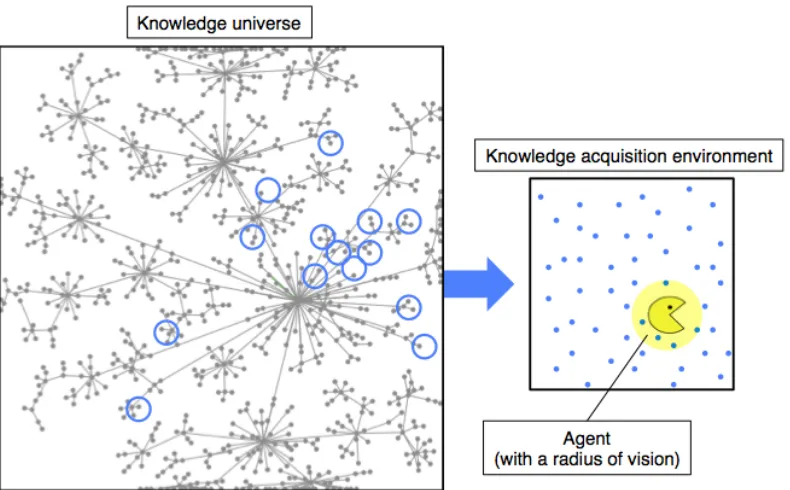
knowledge acquisition environment and possesses its own knowledge stock. Figure 2
provides an illustrative overview of these three components.
--- Insert Figure 2 about here ---
3.1. Knowledge universe
The knowledge universe is a map that represents the network of connections
among all knowledge domains. The map thus provides some information about how far
apart or closely related a given pair of knowledge domains is.
The model assumes that the knowledge universe is a true map. In other words, it
is not subject to an agent’s perception or mental model. As such, there is only one
knowledge universe. An agent has only an imperfect idea about where various
neighborhoods of knowledge domains are located and how they are organized. The extent
to which an agent understands the map is a function of the agent’s own knowledge stock.
For example, if an agent possesses some knowledge about nanotechnology, then the
28 relative to other neighboring knowledge domains, and a less clear idea about knowledge
domains that are further away.
As illustrated in Figure 2, the knowledge universe takes the form of an undirected,
scale-free network that is generated via a preferential attachment process (Barabási &
Albert, 1999). The growth process starts with an initial network of two connected nodes.
New nodes are then added to this network one at a time. Each new node selects an
existing node to which it then connects.3 The probability 𝑝! that an existing node 𝑖gets
selected by the new node is proportional to node 𝑖’s degree 𝑘!, such that:
𝑝! = !! !!
!
!!!
where 𝑛 is the number of existing nodes in the knowledge universe network at the time 𝑝!
is calculated. New nodes continue to be added to the network until the total number of
nodes equals to 𝑁. 𝑁 is thus the size of the knowledge universe.
My choice of representing the knowledge universe as a scale-free network that is
grown via preferential attachment is based on two reasons: First, a large body of
empirical research has demonstrated that two classes of knowledge-related networks—
information and collaboration networks—frequently have a scale-free topology. Some
examples of such networks are: the World Wide Web (Barabási, Albert, & Jeong, 2000),
Wikipedia entries (Cappoci, Servedio, Colaiori, Buriol, Donato, Leonardi, & Caldarelli,
3 A consequence of this process is that there is no isolate or “island” in the model. Since it is difficult to
imagine a knowledge domain in reality that is completely isolated from everything else, this feature of the model appears reasonable.
29
2006), scientific co-authorships (Newman, 2001a; Newman, 2001b), and Hollywood actor
collaborations (Barabási & Albert, 1999).
Second, preferential attachment appears to be a reasonable mechanism for
describing the growth and evolution of a knowledge network. Knowledge presumably
evolves in a “rich-get-richer” manner. Knowledge domains that have a relatively large
number of connections to other domains tend to be more visible and well-understood
such that they are more likely to become the building blocks for the development of
future knowledge domains.
Given that the knowledge universe is represented as a network, it is important to
clarify what the nodes and links represent: The nodes represent knowledge domains, and
the links represent the relevance between knowledge domains. Based on Gorayska and
Lindsay’s (1993) work, I define relevance in terms of functional relationships: Two
knowledge domains are relevant to each other if one contains a means to some end that is
embedded in the other. For example, evolutionary biology is relevant to organizational
studies because it contains some concepts that help to accomplish the goals of
organizational studies. The knowledge universe can thus be interpreted as a complete
historical record of functional relationships among knowledge domains.
The definition of a knowledge domain—and therefore what a node represents—is
more difficult to pin down: How granular does a knowledge domain need to be?
Fortunately, the choice of scale-free topology offers a convenient solution: A scale-free
30 can be assumed away. If one were to zoom in to a neighborhood in the knowledge
universe, that neighborhood would appear to have a structure that is similar to the
structure of the overall knowledge universe. The generalizability of a conclusion drawn
based on the knowledge universe is thus minimally compromised regardless of whether a
node represents an entire discipline (such as management), a sub-discipline (such as
operations), or a specific topic (such as just-in-time systems). Finally, it is important to
note that my choice of representing knowledge domains as nodes in a network assumes
that knowledge domains are generally comparable units.
3.2. Knowledge acquisition environment
The knowledge acquisition environment represents the knowledge space in which
an agent can acquire knowledge. The knowledge acquisition environment consists of
knowledge units, each of which has a location or “address” in the knowledge universe.
(These knowledge units are thus simply replicas of a subset of nodes from the knowledge
universe. In other words, each knowledge unit in the knowledge acquisition environment
has a “parent node” in the knowledge universe.) The knowledge units are spatially
scattered in the knowledge acquisition environment as unattached nodes, and their
locations in the knowledge acquisition environment are independent of their parent
nodes’ locations in the knowledge universe (Figure 2).
When discussing knowledge in the knowledge acquisition environment, I use the
term “unit” rather than “domain” for two reasons: First, the word “domain” implies a
31 acquisition environment, however, this property is not directly observable. Second,
because there can be many replicas of the same knowledge domain in the knowledge
acquisition environment, it would be imprecise to call each replica a knowledge domain.
Some real-world correlates of the knowledge acquisition environment are
industries and geographic regions in which an organization operates. The knowledge
acquisition environment can, however, have a broader and more abstract meaning. For
example, the set of publications to which an organization subscribes or the set of alliance
partners with which an organization interacts can also make up the agent’s knowledge
acquisition environment. The knowledge acquisition environment therefore has an
agent-centric interpretation. (Although this does not necessarily imply that an agent has much
control over the content of the knowledge acquisition environment.)
In the model, the knowledge acquisition environment is represented as a
two-dimensional lattice of a fixed area (Figure 2). It has a density E; which is simply the total
number of knowledge units that the knowledge acquisition environment contains since
the area is of a fixed size.4 The knowledge acquisition environment is set up according to
a simple procedure: A node in the knowledge universe is randomly chosen to be
replicated as a new knowledge unit in the knowledge acquisition environment, and this
new knowledge unit is given a random (x, y) coordinate. This process is repeated until
there are a total of E knowledge units in the knowledge acquisition environment. Each
node in the knowledge universe can be replicated more than once, such that there may be
4 I choose to use the label density rather than volume because density leads to a better intuition about the