199 |
P a g e
Differential Evolution and Genetic Algorithm Based
MPPT Controller for Photovoltaic System
Nishtha Bhagat
1, Praniti Durgapal
2, Prerna Gaur
3Instrumentation and Control Engineering, Netaji Subhas Institute of Technology, New Delhi (India)
ABSTRACT
This paper presents a comparison between two proposed approaches for optimization of power of a solar PV
panel. The algorithms are used for the tuning of PID controller parameters. The PID controller will set the duty
cycle of the boost converter to give maximum power at load. The algorithms are written in the manuscript file of
MATLAB to work in sync with the closed loop model of PV panel in SIMULINK.
Keywords: Differential Evolution algorithm, Genetic Algorithm, MPPT, PID Controller
I. INTRODUCTION
In the modern day world, we are in the need of finding new sources of energy. These sources should be capable
of replacing the conventional sources of energy. This can happen if the newer sources have lower cost of
hardware implementation, higher efficiency, ease of use, and flexibility to adapt in varying environmental
conditions. A major source of energy can be the solar PV panel. The PV panel converts the sun’s irradiation to
a power signal. Due to the non linear characteristics of the PV panel, the need for maximum power point
tracking arises.
Maximum Power point tracking has been carried out by conventional methods like Perturb and Observe and
Incremental Conductance. These are gradient based methods and work only for continuous evaluation of
photovoltaic . They produce oscillations at steady state which are undesirable. On the other hand,
algorithms like Genetic algorithm and Differential Evolution are based on biological evolution. They can be
used for optimization of non linear, stochastic and discontinuous functions[2].
The genetic algorithm initializes a population of individuals randomly. It uses methods of crossover and
mutation to generate off springs for next generations. But differential evolution uses methods of mutation and
selection to generate off springs. The fitness value of all the individuals is calculated at each step. Individuals
with lower fitness are promoted to next generations preferably. When one of the stopping criteria is met the
algorithms stop and the final fitness and the parameter values are returned[3] .
II. DIFFERENTIAL EVOLUTION ALGORITHM
The differential evolution algorithm works on minimising an objective function also called a fitness function. It
finds the values of optimum parameters to get the objective function minimised. The population size, number of
generations and lower and upper limits of parameters are selected. The children produced in subsequent
generations depends on mutation factor and crossover probability. The fitness value is evaluated after every
200 |
P a g e
Fig. 1: flowchart of DE
2.1. Maximum Power Point Tracking using DE based PID controller
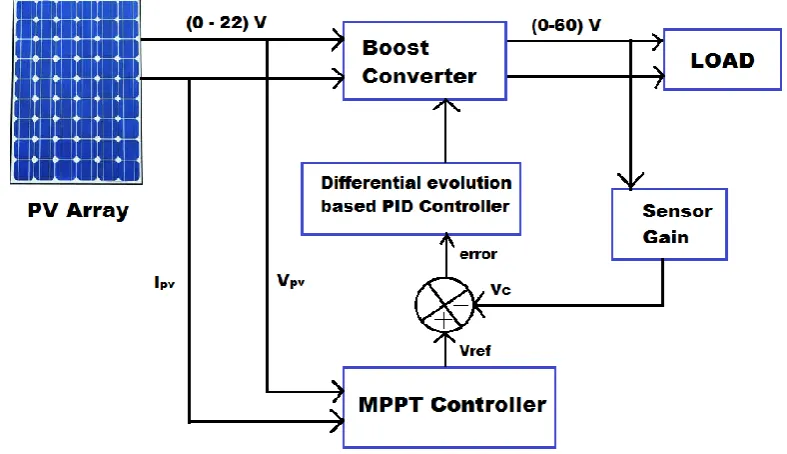
The configuration of maximum power point tracking system using differential evolution algorithm is shown in
Fig. 2. The error signal is generated from the difference of PV panel voltage maximum voltage and the output
voltage. The DE algorithm generates optimum values of controller parameters to get steady optimised power at
the DC load.
Fig 2: block diagram of closed loop MPPT system
2.2. Simulation
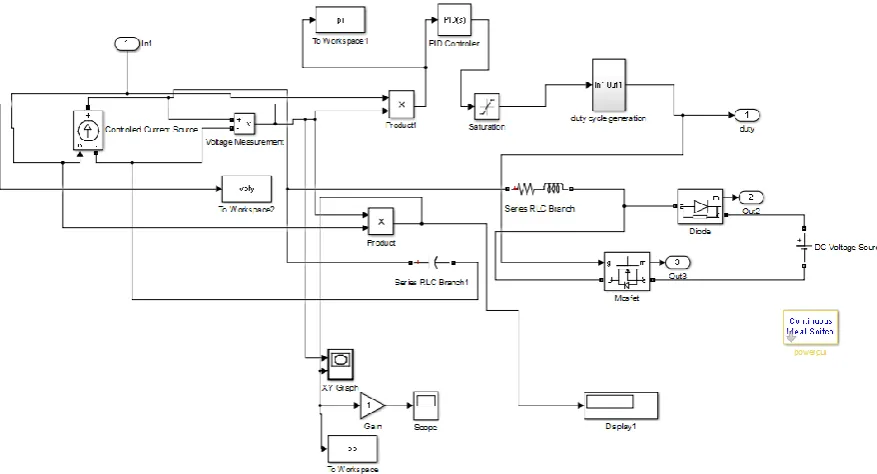
The simulation of a subsystem consisting of DE based MPPT system is shown in Fig. 3. A closed loop negative
feedback configuration is formed. The PV panel voltage is the reference input and the measured output voltage
201 |
P a g e
values of PID controller parameters. The output of the PID controller is connected the duty cycle generationblock. Hence, the required duty cycle of boost converter is set to get the maximum power at dc load[4] .
Fig 3: Subsystem of Closed loop DE based MPPT
2.3 Results
In the proposed model of differential evolution based PID controller for maximum power point tracking, the
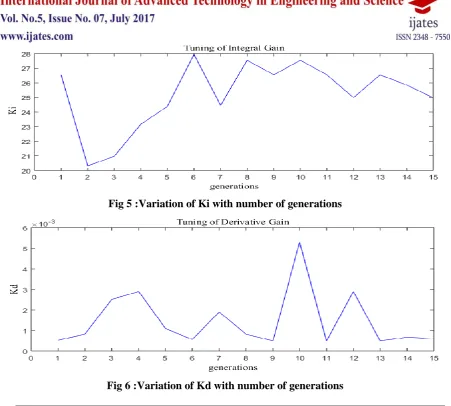
proportional gain converges to 0.0102 as seen in Fig. 4. The Integral gain converges to 25.8527 as seen in Fig.
5. The Derivative gain converges to 0.0029 as seen in Fig. 6. The output power converges to 4.68 W at an
irradiation level of as shown in Fig. 7.
202 |
P a g e
Fig 5 :Variation of Ki with number of generations
Fig 6 :Variation of Kd with number of generations
203 |
P a g e
III. GENETIC ALGORITHM
The genetic algorithm is also an evolutionary algorithm. Its aim is also to minimize the fitness function. It
produces children for subsequent generations depending on the values of crossover and mutation factors[1] . The
genetic algorithm toolbox can be used to set these values. The MATLAB manuscript file can also be used to set
these values according to the syntax.
3.1 Simulation
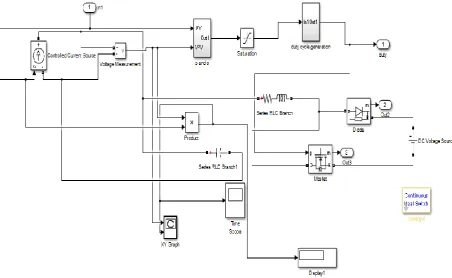
The simulation of a subsystem consisting of GA based MPPT system is shown in Fig. 8. A closed loop negative
feedback configuration is formed. The PV panel voltage is the reference input and the measured output voltage
is the output. The error signal is passed through the PID controller. The output of PID controller is connected to
the duty cycle generation block. Hence, the required duty cycle of boost converter is set to get the maximum
power at dc load. The genetic algorithm is written in manuscript file of MATLAB as a function.
Fig 8: Subsystem of GA based MPPT
3.2 Results
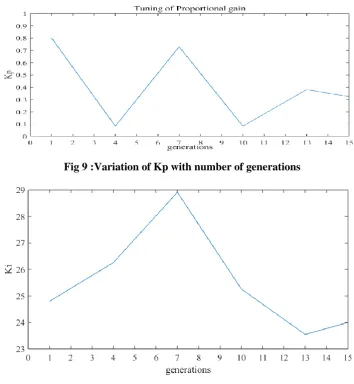
In the proposed model of genetic algorithm based PID controller for maximum power point tracking, the
proportional gain converges to 0.3010, integral gain converges to 24.2210, and derivative gain converges to
204 |
P a g e
Fig 9 :Variation of Kp with number of generations
Fig 10 :Variation of Ki with number of generations
205 |
P a g e
Fig 12: Output power versus time curve
Table 1: Comparison of Performance Parameters
Differential Evolution Genetic Algorithm
Kp = 0.0102 Kp = 0.3010
Ki = 25.8527 Ki = 24.2210
Kd = 0.0029 Kd = 0.3400
Rise time = 0.02 sec Rise Time = 0.07
Settling Time = 0.03 s Settling Time = 0.09s
IV. DISCUSSION
The values of performance parameters with DE approach and GA approach are noted. The rise time is very less
0.02 seconds with the use of DE algorithm and 0.7 with the use of GA algorithm. The time taken to reach steady
state is 0.03seconds and 0.09 seconds respectively.
V. CONCLUSION
The proposed models of the DE based and GA based MPPT systems are used to control the parameters of the
PID controller. The input is the error signal generated by the difference of PV panel power and the feedback
power from boost converter.
The disadvantage of using gradient-based methods like Perturb and observe or Incremental Conductance is that
they can get stuck in a local minimum and their performance is dependent on initial values of design variables.
It can be seen that differential evolution algorithm is more efficient than genetic algorithm with PV panel
maximum power point tracking. As we have achieved optimum values of performance parameters, these method
206 |
P a g e
IV. ACKNOWLEDGEMENT
Authors acknowledge the support, encouragement and facilities provided by Netaji Subhas Institute of
Technology, Delhi, India in carrying the presented research work.
REFERENCES
[1] S.Mallika and R.Saravanakumar, Genetic Algorithm Based MPPT Controller for Photovoltaic System,
International Electrical Engineering Journal), 4(4), 2013, 1159-1164.
[2] Sajjad Aliesfahani and Mehdi Shahbazian, Maximum Power Point Tracking for Solar Photovoltaic System
Using Genetic Programming Toolbox for Identification of Physical System, Journal of Automation and
Control, 3(1), 2015, 25-28.
[3] Sridhar Ramasamy, Jeevananthan .S and S.S.DashThamizh Selvan, An Intelligent Differential Evolution
based Maximum Power Point Tracking (MPPT)Technique for Partially Shaded Photo Voltaic (PV) Array,
Int. J. Advance. Soft Comput. Appl., 6(2), 2014.
[4] Muhammad Sheraz and Mohammed A. Abido, An Efficient MPPT controller Using Differential Evolution
and Neural Network, IEEE International Conference on Power and Energy (PECon), 2-5 2012, Kota