R E S E A R C H A R T I C L E
Open Access
Expert validation of fit-for-purpose guidelines for
designing programmes of assessment
Joost Dijkstra
1*†, Robert Galbraith
2, Brian D Hodges
3, Pauline A McAvoy
4, Peter McCrorie
5, Lesley J Southgate
5,
Cees PM Van der Vleuten
1, Val Wass
6and Lambert WT Schuwirth
1,7Abstract
Background:An assessment programme, a purposeful mix of assessment activities, is necessary to achieve a complete picture of assessee competence. High quality assessment programmes exist, however, design requirements for such programmes are still unclear. We developed guidelines for design based on an earlier developed framework which identified areas to be covered. A fitness-for-purpose approach defining quality was adopted to develop and validate guidelines.
Methods:First, in a brainstorm, ideas were generated, followed by structured interviews with 9 international assessment experts. Then, guidelines were fine-tuned through analysis of the interviews. Finally, validation was based on expert consensus via member checking.
Results:In total 72 guidelines were developed and in this paper the most salient guidelines are discussed. The guidelines are related and grouped per layer of the framework. Some guidelines were so generic that these are applicable in any design consideration. These are: the principle of proportionality, rationales should underpin each decisions, and requirement of expertise. Logically, many guidelines focus on practical aspects of assessment. Some guidelines were found to be clear and concrete, others were less straightforward and were phrased more as issues for contemplation.
Conclusions:The set of guidelines is comprehensive and not bound to a specific context or educational approach. From the fitness-for-purpose principle, guidelines are eclectic, requiring expertise judgement to use them
appropriately in different contexts. Further validation studies to test practicality are required.
Background
There is a growing shared vision that aprogrammeof as-sessment is necessary to achieve a coherent and consistent picture of (assessee) competence [1-4]. A programme is more than a combination of separate tests. Just as a test is not simply a random sample of items; a programme of as-sessment is more than a random set of instruments. An op-timal mix of instruments should match the purpose of assessment in the best possible way. However, there is less clarity about what is actually needed to achieve an inte-grated, high quality programme of assessment. Little is known about key relations, compromises, and trade-offs needed at the level of a highly integrated programme of
assessment [5]. This does not imply that existing pro-grammes of assessment are not of high quality, indeed there are numerous examples of good programmes of assessment which are based on extensive deliberation and which are designed by experts [6-8].
However, scientific evidence on quality of such pro-grammes in its entirety is currently limited, and certainly in need of theory formation and applicable research outcomes. The scant research that has been conducted into the quality of programmes of assessment, focuses on various aspects of assessment, with different aims and adopting diverse view-points on quality, and the results of the individual studies therefore are hard to compare. From a psychometric per-spective quality has been almost exclusively defined as the reliability of combinations of decisions and a “unified view of validity” [9-13]. From an educational perspective the focus has been on the alignment of objectives, instruction, and on using assessment to stimulate desirable learning * Correspondence:[email protected]
†Equal contributors 1
Department of Educational Development and Research, Maastricht University, Maastricht, The Netherlands
Full list of author information is available at the end of the article
behaviour [14-16]. In another study Baartman [17] took competency-based education as a basis for quality, and proposed adding education-based criteria, such as authenticity and meaningfulness, to the established psy-chometric criteria. Most of this research determines as-sessment quality afterwards, when asas-sessment has already taken place. Unfortunately, this does not provide assess-ment designers with much support when they intend to construct a high-quality programme. In our study we therefore investigate the possibility of enhancing quality of assessment programmes from a design perspective by pro-viding guidelines for assessment design.
In various local contexts standards, criteria, and guide-lines are used to support assessment development. How-ever, the transferability of these to other contexts is fairly low as they are highly contextual and often based on local policy decisions. On the other hand guidance is available at a broader educational level, e.g., the Standards for educational and psychological testing [18]. But these standards focus predominantly on single tests (i.e. the measuring instrument) instead of on programmes of as-sessment. And, despite the standards being open to expert judgement and acknowledging contextual differences (e.g. in regulations), they are still formulated from a specific testing framework and from the perspective ofassessment of learning[19]. This predetermines the goal of assessment and takes an ideological standpoint in the quality perspec-tive and as a result, such standards are necessarily pre-scriptive. So, our aim in this study is to develop and validate more context-independent guidelines, applicable with different purposes in mind (includingassessment for learning), and with a focus on programmes of assessment instead of single instruments. In addition we seek to de-velop and validate guidelines that support both assessment developers and decision makers. In this study we adopted thefitness-for-purpose principle [5,20], in which quality is determined as the extent to which a programme of assess-ment fulfils its purpose or its function. The advantage of this is that it makes the quality framework more widely applicable and less reliant on contemporary ideas on education and assessment. From the fitness-for-purpose perspective definingcriteria is avoided, and instead
de-sign guidelines are formulated. For example, a quality
criterion would be: “An assessment programme should have summative tests”, whereas a guideline would be: “The need for summative tests should be considered in light of the purpose.” Given the fitness-for-purpose principle the application of the guidelines are necessar-ily eclectic. In different contexts assessment designers need to decide how important or relevant a guideline is, and use their own expertise to make decisions based on specific contextual circumstances.
In this paper we propose a set of design guidelines for programmes of assessment, based on a framework
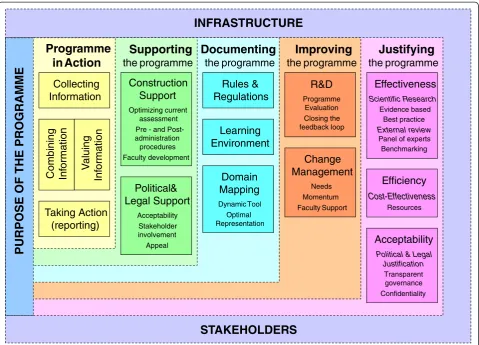
developed in our previous research [5]. This framework defines the scope of what constitutes a programme of as-sessment and should be covered by our guidelines (see Figure 1).
The framework is divided into several layers and is placed in the context of stakeholdersandinfrastructure (outer layer). The starting point is the purpose of the
programme (key element in the framework). Around
the purpose, 5 layers (dimensions) were distinguished. (1) Programme in actiondescribes the core activities of a programme, i.e. collecting information, combining and valuing the information, and taking subsequent action. (2)Supporting the programmedescribes activities that are aimed at optimizing the current programme of assess-ment, such as improving test construction and faculty de-velopment, as well as gaining stakeholder acceptability and possibilities for appeal. (3) Documenting the programme describes the activities necessary to achieve a defensible programme and to capture organizational learning. Ele-ments of this are: rules and regulations, learning environ-ment, and domain mapping. (4)Improving the programme includes dimensions aimed at the re-design of the programme of assessment, after the programme is admi-nistered. Activities are R&D and change management. (5) The final layer justifying the programme describes activities that are aimed at providing evidence that the purpose of the programme is achieved taking account of effectiveness, efficiency, and acceptability.
Because the aim of this study was to formulate guide-lines that are general enough to be applicable to a variety of contexts, and yet at the same time meaningful and concrete enough to support assessment designers, we started by generating ideas for guidelines based on the above framework for programmes of assessment using the input of international experts in the field of assess-ment in medical education. In order to validate the guidelines we sought expert consensus. In this article we do not go into further detail about the framework; but kindly refer the reader to our previous publication [5]. In describing the results we will focus on the most important and salient findings (i.e. the guidelines). For the complete set of guidelines we refer to Additional file 1: the addendum.
Method
Study design
discussions. Finally a member check phase was initiated to validate the guidelines based on expert consensus.
Participants
The participants were purposefully selected based on their experience with programmes of assessment. They all have published extensively on assessment. Given their back-grounds it was anticipated that these experts would pro-vide the most valuable information. The nine participants of the focus group of the preceding study [5] were invited by e-mail to participate in this follow-up study, explaining the goal and providing details about the method and pro-cedures. One participant declined because of retirement, another declined because of other obligations, a third declined because of a change in field of work. With the addition of CvdV and LWTS a total of eight experts took part in this study. The experts (all co-authors) came from North America (2) and Europe (6). Within their institu-tion, they fulfil different (and some multiple) roles in their assessment practice e.g. programme directors, national committee members, and other managerial roles. They
represent different (educational) domains ranging from undergraduate and graduate education, to national licens-ing and recertification.
Procedure and data analysis
The brainstorm was done by the research team (JD, CvdV, LWTS) based on their experience and data from the pre-ceding study [5]. This resulted in a first draft of the set of guidelines, which served as a starting point for the discus-sion phase. The discusdiscus-sion took place in multiple (Skype®) interviews with the participants. Individual interviews were held with each participant and led by one researcher (JD) with the support of a second member of the research team (either CvdV or LWTS). The interview addressed the first draft of guidelines and was structured around three open questions: 1. Is the formulation of the guidelines clear, con-cise, correct? 2. Do you agree with the guidelines? 3. Are any specific guidelines missing? The interviews were recorded and analysed by the research team to distil a con-sensus from the various opinions, suggestion, and recom-mendations. One researcher (JD) reformulated the
0
Collecting Information
Combining Informa
tion
V
a
luing
In
forma
tion
PURPOSE OF THE PR
OGRAMME
Supporting
the programme
Justifying
the programme
Improving
the programme
STAKEHOLDERS
Documenting
the programme
Construction Support Optimizing current
assessment Pre - and Post-administration
procedures Faculty development
Taking Action (reporting)
Programme
in Action
INFRASTRUCTURE
Political& Legal Support
Acceptability Stakeholder involvement
Appeal
Rules & Regulations
Learning Environment
R&D Programme
Evaluation Closing the feedback loop
Effectiveness Scientific Research
Evidence based Best practice
External review
Panel of experts Benchmarking
Efficiency
Cost-Effectiveness
Resources Change
Management Needs Momentum Faculty Support Domain
Mapping Dynamic Tool
Optimal Representation
Acceptability Political & Legal
Justification
Transparent governance Confidentiality
guidelines and to avoid overly adherence to initial formula-tions the interview data (expert suggesformula-tions) were taken as starting point. The goal of the new formulation was to rep-resent the opinions and ideas expressed by the experts as accurately as possible. Peer debriefing was done to check the reformulation by the research team (JD, CvdV, & LWTS) to reach initial consensus. After formulating a complete and comprehensive set of guidelines, a member-check procedure was conducted by e-mail. All participants were sent the complete set for final review and all responded. No content-related issues had to be resolved and some wording issues were resolved as a final consensus document was generated.
Results
A set of 72 guidelines was developed based on expert ex-perience, and then validated based on expert consensus. Because of the length of this list we have decided not to provide exhaustive detail about all of them, but to limit ourselves to the most salient guidelines per layer of the framework (the complete list is provided as an addendum in Additional file 1). For reasons of clarity, a few remarks on how to read this section and the addendum with the complete set of guidelines. Firstly, the guidelines are divided over the layers of the framework and grouped per element within each layer. We advise the reader to regard the guidelines in groups rather than as separate guidelines. Also in application of the guidelines it is expected that it is not practical to apply guidelines in isolation. Secondly, there is no linear order in the guidelines presented. When reading the guidelines, you may not immediately come across those guidelines or important topics you would ex-pect to be given priority. There is potentially more than one way of ordering the guidelines. For instancecostsare important throughout the design process. However, be-cause of the way this framework is constructed,costsare addressed near to the end. Thirdly, there is overlap in the guidelines. It appeared impractical and somewhat artificial to split every assessment activity into separate parts. The guidelines are highly related, and overlap and/or redun-dancy are almost inevitable. In the example ofcosts, which are primarily addressed as part ofcost-efficiency, references to costsare actually made in several guidelines. Fourthly, the level of granularity is not equal for all guidelines. De-termining the right level of detail is a difficult endeavour, variable granularity reflects the fact that some issues seem more important than others, and others may have been investigated in depth. Hence, the interrelatedness and the difficulty of determining the right level of granularity is also a reason to review the guidelines per group. The division of guidelines within elements of the layers was done based on key recommendations in the design process. However, in some situations this division might be arbitrary and of less relevance. Finally we have
sought to find an overarching term that would cover all possible elements of the programme, such as assess-ments, tests, examinations, feedback, and dossiers. We wanted the guidelines to be broadly applicable, and so we have chosen the term assessment components. Simi-larly for outcomes of assessment components we have chosen assessment information (e.g. data about the asses-sees’competence or ability).
General
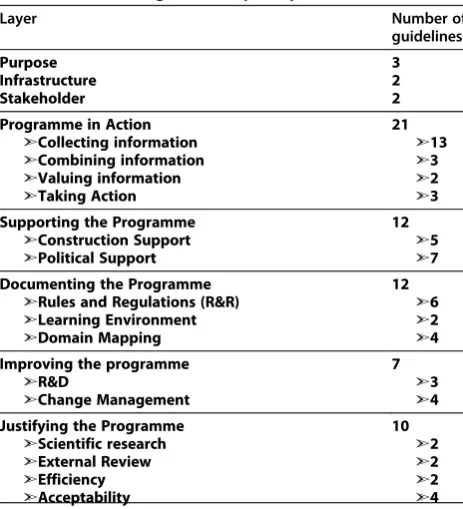
In addition to the fact that the number of guidelines exceeded our initial expectations, we found that most guidelines focused on the more practical dimensions of the framework (see Table 1). In particular, many of the guidelines deal with collecting information. This is not unexpected, since considerable research efforts are fo-cused on specific assessment components for collecting information (measuring). On the other hand some guidelines (e.g. on combining information) are less ex-plicit and straightforward and there is less consensus, resulting in less nuanced guidelines.
Three major principles emerged and led to generic guidelines that are applicable in any design consider-ation are set out below. These are (1) the principle of proportionality, (2) the need to substantiate decisions applying the fitness-for-purpose principle, and (3) get-ting the right person for the right job. These were trans-lated into the following general guidelines (I-III):
Table 1 Number of guidelines per layer
Layer Number of
guidelines
Purpose Infrastructure Stakeholder
3 2 2
Programme in Action ➣Collecting information ➣Combining information ➣Valuing information ➣Taking Action
21 ➣13 ➣3 ➣2 ➣3 Supporting the Programme
➣Construction Support ➣Political Support
12 ➣5 ➣7 Documenting the Programme
➣Rules and Regulations (R&R) ➣Learning Environment ➣Domain Mapping
12 ➣6 ➣2 ➣4 Improving the programme
➣R&D
➣Change Management
7 ➣3 ➣4 Justifying the Programme
➣Scientific research ➣External Review ➣Efficiency ➣Acceptability
I).Decisions (and their consequences) should be proportionate to the quality of the information on which they are based.
This guideline has implications for all aspects of the assessment programme, both at the level of the design of the programme, and at the level of individual decisions about assessees’ progress. The higher the stakes, the more robust the information needs to be.
In the layerProgramme in Actionfor instance, actions based on (collected) information should be proportionate to the quantity and quality of the information. The more high-stakes an action or decision, the more certainty (justification and accountability) is required, the more the information collection process has to comply with scientific criteria, and usually the more information that is required.
For example the decision that an assessee has to retake one exam, can be taken based on less information (e.g. the results of one single test) compared to a decision that the assessee has to retake an entire year of medical school, which clearly requires a series of assessments or maybe even a dossier.
II)Every decision in the design process should be underpinned preferably supported by scientific evidence or evidence of best practice. If evidence is unavailable to support the choices made when designing the programme of assessment, the decisions should be identified as high priority for research. This implies that all choices made in the design process should be defensible and can be justified. Even if there is no available scientific evidence, a plausible or reasonable rationale should be proposed. Evidence can be sought through a survey of the existing literature, new research endeavours, collaborative research, or completely external research. We stress again that the fitness-for-purpose principle should guide design decisions. The evaluation of the contribution to achieving the purpose(s) should be part of the underpinning.
III) Specific expertise should be available (or sought) to perform the activities in the programme of
assessment.
This guideline is more specifically aimed at the expertise needed for the assessment activities in the separate layers and elements within the assessment programme. A chal-lenge in setting up a programme of assessment is to “get the right person for the right job”. Expertise is often needed from different fields including specific domain knowledge, assessment expertise, and practical knowledge about the organisation. Some types of expertise, such as psychometric expertise for item analysis, and legal expert-ise for rules and regulations, are obvious. Others are less clear and more context specific. It is useful when designing an assessment programme to articulate the skill set and the body of knowledge necessary to address these issues.
Salient guidelines per dimensions in the framework
This section contains the more detailed and specific guide-lines. We describe them in relation to the layers of our previously described model (see Figure 1), starting from
the purpose towards the outer layers. In the addendum
(Additional file 1) all guidelines are described and grouped per element within each layer.
Purpose, stakeholders, and infrastructure
From the fitness for purpose perspective, by definition the purpose of an assessment programme is an important key element. The authors all agreed that defining the pur-pose of the programme of assessment is essential and must be addressed at a very early stage of the (re)design. Al-though there was some initial debate on the level of detail and the number of purposes, it was generally acknowl-edged that, at least in theory, there should be one principal purpose.
A1 One principal purpose of the assessment programme should be formulated.
This principal purpose should contain the function of the assessment programme and the domains to be assessed. Other guidelines in this element address the need for multiple long and short term purposes and the definition of framework to ensure consistency and coher-ence of the assessment programme. The challenge in designing a programme of assessment will be to combine these different purposes in such a way that they are achieved in the optimal way with a clear hierarchy defined in terms of importance. This group of guidelines is aimed at supporting this combination.
Whereas in the original model stakeholders and infra-structurehad been addressed last, they are now considered to be essential in many design decisions and are now con-sidered at an early stage as well. Also, during the discus-sions, many guidelines led to questions about the organization and infrastructure, and the people needing to be involved. It was decided that it is imperative to establish parameters in relation to infrastructure, logistics, and staff-ing as soon as possible.
A4 Opportunities as well as restrictions for the assessment programme should be identified at an early stage and taken into account in the design process.
A7 The level at which various stakeholders participate in the design process should be based on the purpose of the programme as well as the needs of the stakeholders themselves.
Programme in action
an assessment component. In line with general guideline (II), a rationale for the selection of instruments should be provided, preferably based on scientific research and/ or best practice. The rationale should justify how compo-nents contribute to achieving the purpose of the assess-ment programme.
B1 When selecting an assessment component for the programme, the extent to which it contributes to the purpose(s) of the assessment programme should be the guiding principle.
During the interviews the experts agreed without much debate on the majority of guidelines about
collect-ing information (B2-B9). These should aid in
demon-strating the underpinning of the selection choices. Different components have different strengths and weak-nesses and these have to be weighed against each other in order to decide the optimal balance to contribute to the purpose of the assessment. The interrelatedness of the guidelines should be taken into account in the de-sign, but feasibility (Infrastructure) and acceptability (Stakeholders) are also clearly important. This is not as obvious as it seems. Currently design is often focussed almost exclusively on the characteristics of individual as-sessment components and not on the way in which they contribute to the programme as a whole. Often there is a tendency to evaluate the properties of an assessment component per se and not as a building block in the whole programme.
Around the guidelines about combining information there was considerably more discussion, therefore we decided to formulate them more generically and provide more elaborate explanations. Important within this group of guidelines is an underpinning for combing in-formation (general guideline II), whereas in practice data is often combined based in similarity in format. (e.g. the results a communication station and a resuscitation sta-tion in one OSCE).
B14 Combination of the information obtained by different assessment components should be justified based on meaningful entities either defined by purpose, content, or data patterns.
Guidelines on valuing information and on taking ac-tionboth consider the consequences (e.g. side effects) of doing so. Also links with other elements are explicitly made in these groups of guidelines.
B21 Information should be provided optimally in relation to the purpose of the assessment to the relevant stakeholders.
Supporting the programme
In this layer, we found extensive agreement among the authors. Within the guidelines on construction support, next to the definition of tasks and procedures for sup-port, special attention was given to faculty development
as a supporting task as part of the availability of expertise to perform a certain task (general guideline III).
C4 Support for constructing the assessment components requires domain expertise and assessment expertise. Guidelines on political and legal support are strongly related to the proportionality principle (general guideline I) and address procedures surrounding assessment, such as possibilities for appeal. This relates to seeking accept-ance for the programme and acceptaccept-ance of change which forms a basis for and links with improving the
programme.
C6 The higher the stakes, the more robust the procedures should be.
C8 Acceptance of the programme should be widely sought.
Documenting the programme
The fact thatrules and regulations have to be documen-ted did not raise much debate. These guidelines address the aspects that are relevant when considering the rules and regulations including the need for an organisational body, upholding the rules and regulations. The fact that
the context (e.g. learning environment) in which the
programme of assessment exists must be made explicit was self apparent.
A group of guidelines which received special attention in the discussions addressed Domain Mapping. The term blueprinting is deliberately not used here, because this term is often used to denote a specific tool using a matrix format to map the domain (content) to the programme and the instruments to be used in the programme. With Domain Mapping, a more generalised approach is implied. Not only should content match with components, but the focus should be on the as-sessment programme as a whole in relation to the over-arching structure (e.g. the educational curriculum) and the purpose.
D9A domain map should be the optimal representation of the domain in the programme of assessment.
Improving the programme
The wording in this layer turned out to evoke different connotations. R&D in particular is defined differently in different assessment cultures. We therefore agreed to define research in R&D as the systematic collection of all necessary information to establish a careful evalu-ation (critical appraisal) of the programme with the in-tent of revealing areas of strengths and areas for improvement. Development should then be interpreted as re-design. Once this shared terminology was reached, consensus on the guidelines came naturally.
Apart from measures to solve problems in a programme, political change or new scientific insights can also trigger improvement. Change management refers to activities to cope with potential resistance to change. (Political) accept-ance of changes refers to changes in (parts of) the programme. Also these guidelines are related to thepolitical and legal support.
E4 Momentum for change has to be seized or has to be created by providing the necessary priority or external pressure.
Justifying the programme
The guidelines in this layer are more general, probably due to the fact that they are tightly related to the specific context in which a programme of assessment is embedded. Outcomes of good scientific research on assessment activ-ities are needed to support assessment practices with trust-worthy evidence, much like the drive for evidence-based medicine. Although this is a general principle which should guide the design of the programme as a whole, the guide-lines abouteffectivenessbecome specifically important when one has to justify choices made in the programme.
F2 New initiatives (developments) should be accompanied by evaluation, preferably scientific research.
Guidelines on cost-effectiveness appear obvious as it is generally regarded as a desirable endeavour from a fit-for-purpose perspective. In every institution or organisation, resources including those for assessment programmes -are limited. If the programme of assessment can be made more efficient, resources can be freed up for other activities. However, guidelines on this are rarely made explicit.
F6 A cost-benefit analysis should be made regularly in light of the purposes of the programme. In the long term, a proactive approach to search for more resource-efficient alternatives should be adopted. The guidelines onacceptabilityare related to the issue of due practice. As an assessment programme does not exist within a vacuum, political and legal requirements often determine how the programme of assessment is designed and justified. An issue not often addressed during the design process is the use of outcomes by others, and related unintended consequences thereof.
F10 Confidentiality and security of information should be guaranteed at an appropriate level.
Discussion and conclusion
We developed a comprehensive set of guidelines for designing programmes of assessment. Our aim was to formulate guidelines that are general enough to be applic-able to a variety of contexts. At the same time they should be sufficiently meaningful and concrete as to support as-sessment designers. Since we tried to keep away from spe-cific contexts or educational approaches, it is likely that this
set may be applicable beyond the domain of medical educa-tion. Although these guidelines are more general than exist-ing sets of guidelines, criteria or standards, we cannot dismiss that our backgrounds (i.e. medical education) might have resulted in too restrictive formulations of guidelines. This stresses the need for further replication of our study and on application of these guidelines in a range of contexts.
Although establishing guidelines is an ongoing process, it is remarkable that in a short time such a good consensus was reached among the experts. Most of the debate actually focused around a few specific guidelines, probably those that are more difficult to enunciate or less certain in their utility. For example topics like combining information re-main still highly debated, and no complete and final answers can be provided at this time.
In trying to be as comprehensive as possible we acknow-ledge the risk of being over-inclusive. We would like to stress that when designing a programme of assessment, these guidelines should be applied with caution. We recog-nise and indeed stress that contexts differ and not all guidelines may be relevant in all circumstances. Hence, designing an assessment programme implies making delib-erate choices and compromises, including the choice of which guidelines should take precedence over others. Nevertheless, we feel this set combined with the frame-work of programmes of assessment enables designers to keep an overview of the complex dynamics of a programme of assessment. An interrelated set of guide-lines aids designers in foreseeing problematic areas, which otherwise would remain implicit until real problems arise.
We must stress that the guidelines do not replace the need for assessment expertise. Hence, given our fitness-for-purpose perspective on quality, putting the challenge in applying these general guidelines to a local context. Such a translation from theory into practice is not easy and we see the possibility of providing a universally applic-able prescriptive design plan for assessment programmes to be slim. Only, if a specific purpose or set of purposes could be decided upon, one could argue that a set of guidelines could be prescriptive. However, thus far it has been the experience that one similar purpose across con-texts is extremely rarely found, let alone a similar set of purposes.
provide additional clarity and understanding. This is a longer term endeavour beyond the scope of this paper. Also, it will involve more data gathering and examples from various domains.
Although validation by the opinions of experts is suscep-tible to biases, it was suitable in our study for generating a first concrete set of guidelines. The validation at this stage is divergent in nature and therefore inclusive and, as such, the guidelines might be over-inclusive. This is only one form of validation and not all guidelines can be substantiated with scientific evidence or best practice. Therefore further valid-ation through specific research is necessary, especially in the area of implementation and translation to practice. Dif-ferent programmes of assessment will have to be analysed in order to determine whether the guidelines are useful in practice and are generally applicable in different contexts. A practical validation study is now needed. It is encouraging to have already encountered descriptions of programmes of assessment in which to some extent the guidelines are intui-tively or implicitly appreciated and taken into account. Of course this is to be expected since not all guidelines are new. However, we think that the merit of this study is the attempt to provide a comprehensive and coherent listing of such guidelines.
Additional file
Additional file 1Addendum complete set of guidelines - BMC Med Educ - final.doc.This addendum contains the set of 72 guidelines developed and validated in this study.
Competing interests
The authors declare that they have no competing interests. Author details
1Department of Educational Development and Research, Maastricht University, Maastricht, The Netherlands.2Center for Innovation, National Board of Medical Examiners, Philadelphia, USA.3Wilson Centre for Research in Education, Faculty of Medicine, University of Toronto, Toronto, ON, Canada. 4
Assessment Development, National Clinical Assessment Service (NCAS), London, UK.5Centre for Medical and Healthcare Education, St George’s, University of London, London, UK.6Keele University, School of Medicine, Staffordshire, UK.7Flinders Innovation in Clinical Education, Flinders University, Bedford Park, SA, Australia.
Authors’contributions
JD, CVDV and LWTS started with a brainstorm phase to generate the initial set (based on previous discussions) followed by a series of discussions with all authors. JD reformulated the guidelines. Peer debriefing was done to check the reformulation by JD, CvdV, & LWTS. JD checked with each author to reach consensus. All authors provided feedback on the manuscript, and read and approved the final manuscript.
Received: 10 January 2012 Accepted: 17 April 2012 Published: 17 April 2012
References
1. Lew SR, Page GG, Schuwirth LWT, Baron-Maldonado M, Lescop JMJ, Paget NS, Southgate LJ, Wade WB:Procedures for establishing defensible programmes for assessing practice performance.Medical Education2002,36:936–941. 2. Schuwirth LWT, Southgate L, Page GG, Paget NS, Lescop JMJ, Lew SR,
Wade WB, Baron-Maldonado M:When enough is enough: a conceptual
basis for fair and defensible practice performance assessment.Medical Education2002,36:925–930.
3. Van der Vleuten C, Schuwirth LWT:Assessing professional competence: from methods to programmes.Medical Education2005,39:309–317. 4. Savage JK:In-training assessment (ITA): designing the whole to be greater than the sum of the parts.Medical Education2006,40:13–16. 5. Dijkstra J, Van der Vleuten C, Schuwirth L:A new framework for designing
programmes of assessment.Adv Heal Sci Educ2010,15:379–393. 6. Dannefer EF, Henson LC:The Portfolio Approach to Competency-Based
Assessment at the Cleveland Clinic Lerner College of Medicine.Academic Medicine2007,82:493–502.
7. Davies H, Archer J, Southgate L, Norcini J:Initial evaluation of the first year of the Foundation Assessment Programme.Medical Education
2009,43:74–81.
8. Ricketts C, Bligh J:Developing a Frequent Look and Rapid
Remediation Assessment System for a New Medical School.Academic Medicine2011,86:67–71. doi:10.1097/ACM.1090b1013e3181ff1099ca1093. 9. Birenbaum M:Evaluating The Assessment: Sources Of Evidence For
Quality Assurance.Studies in Educational Evaluation2007,33:29–49. 10. Burch V, Norman G, Schmidt H, Van der Vleuten C:Are specialist
certification examinations a reliable measure of physician competence?. Adv Heal Sci Educ2008,13:521–533.
11. Harlen W:Criteria for evaluating systems for student assessment.Studies in Educational Evaluation2007,33:15–28.
12. Knight PT:The Value of a Programme-wide Approach to Assessment. Assessment & Evaluation in Higher Education2000,25:237–251.
13. Wass V, McGibbon D, Van der Vleuten C:Composite undergraduate clinical examinations: how should the components be combined to maximize reliability?.Medical Education2001,35:326–330.
14. Biggs J:Enhancing teaching through constructive alignment.High Educ
1996,32:347–364.
15. Cilliers F, Schuwirth L, Adendorff H, Herman N, van der Vleuten C:The mechanism of impact of summative assessment on medical students’ learning.Adv Heal Sci Educ2010,15:695–715.
16. Cilliers F, Schuwirth L, Herman N, Adendorff H, van der Vleuten C:A model of the pre-assessment learning effects of summative assessment in medical education.Advances in Health Sciences Education2011, online first. 17. Baartman LK:Assessing the assessment: Development and use of quality
criteria for competence assessment programmes.: Universiteit Utrecht; 2008.
18. ERA, APA, NCME:Standards for Educational and Psychological Testing. Washington: AERA; 1999.
19. Schuwirth LWT, Van der Vleuten CPM:Programmatic assessment: From assessment of learning to assessment for learning.Medical Teacher
2011,33:478–485.
20. Harvey L, Green D:Defining Quality.Assessment & Evaluation in Higher Education1993,18:9–34.
doi:10.1186/1472-6920-12-20
Cite this article as:Dijkstraet al:Expert validation of fit-for-purpose
guidelines for designing programmes of assessment.BMC Medical Education201212:20.
Submit your next manuscript to BioMed Central and take full advantage of:
• Convenient online submission
• Thorough peer review
• No space constraints or color figure charges
• Immediate publication on acceptance
• Inclusion in PubMed, CAS, Scopus and Google Scholar
• Research which is freely available for redistribution