Progress report on a programme of insecticide analysis
and toxicity-testing in relation to the marine
environment
J O H N E . P O R T M A N N
Ministry of Agriculture, Fisheries and Food,
Fisheries Laboratory, Burnham-on-Crouch, Essex, England
KURZFASSUNG: Fortschrittsbericht fiber ein Arbeitsprogramm der Insektizidanalyse und der Toxizitiitsprfifung in bezug auf die marine Umwelt. Seit 1965 l~ufi im Fischereilaborato- rium yon Burnham-on-Crouch ein Arbeitsprogramm zur Priifung der Toxizi6it verschiedener chemischer Stoffe gegeniiber Meerestieren. Die Konzentration chlorhaltiger Insektizide in Meeresfischen und Sdaalentieren wurde untersucht und die Toxizifiit yon Metallen und yon Phe- nol gegenfiber drei Crustaceenarten und einer Molluskenart ermittelt. Ferner wurde der Einflul3 der Temperatur, der Tiergr&3e und des Nahrungsangebotes auf die Toxizit~it gepr~ifi. Eine Reihe x~on Detergentien wurde ebenfalls hinsichtlich toxischer Wirkungen untersucht. Die Konzentrationen yon drei verschiedenen Insektiziden wurden in der Muskulatur und in der Leber des Kabeljaus
(Gadus rnorhua)
bestimmt.I N T R O D U C T I O N
In 1965, work was commenced at our laboratory on the effects of pollution on inshore fisheries. It at once became apparent that, although considerable information is available regarding the toxicity of various pollutants to freshwater life, there is little on the toxicity of pollutants to marine life.
The term "chemical pollutant" covers a multitude of materials but these can be loosely divided into the following categories: inorganic and organic trade wastes, detergents, oils, radioactive wastes, and pesticides. Because many trade wastes contain quantities of heavy metals, and domestic sewage contains detergents, it was decided to examine the toxicity of these groups of compounds to a number of marine animals. In recent years pesticides have been the cause of increasing alarm, and it is intended to examine the toxic effects of these materials in due course; however, at the present time this problem is being approached from a different angle, and analysis of shellfish and fish specimens for organo-chlorine pesticides is well under way. Details of the early results of our toxicity tests and of our pesticide analyses are presented in this paper.
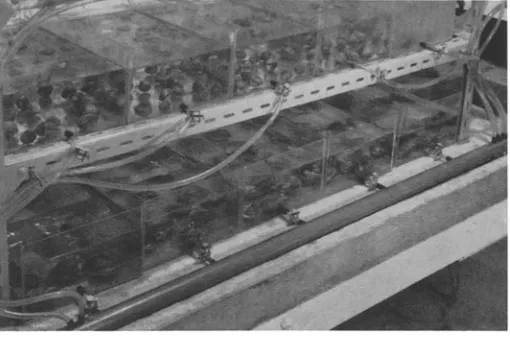
toxicity-testing arrangements, each consisting of 15 perspex tanks in three tiers. Perspex was used because it was easy to wipe clean and because, if necessary, acids and solvents such as acetone could be used without damage to the interior surfaces. Each tank held 10 litres of sea-water and was provided with an aerator and a sloping splash guard to minimize the interchange of different pollutant concentrations by the aerator spray. A variety of marine animals were used in the tests, but the chief ones were the pink shrimp
(Pandalus montagui),
brown shrimp(Crangon crangon),
shore crab(Carcinus
rnaenas),
and cockle(Cardium edule);
25 animals were normally held in each tankduring an experiment. For each experiment a control was run, with a different test species, to guard against erroneous results; for example due to failure of the air supply.
Fig. 1: Toxicity-testing apparatus
The test animals, which had been acclimatized to laboratory conditions for at least 3 days, were placed in sea-water to which toxin solutions at a range of concentrations had been added, and lei~ for 48 hours, this being the standard experimental period. All the experiments were conducted in the dark in rooms in which the air temperature was controlled, and tanks containing mobile animals were covered with a plastic mesh to prevent escapes. The tanks were examined at intervals during the course of the ex- periments and animals which had died were removed, the total number dead atter 48 hours being recorded. The results are all expressed in terms of LDs0, this being the concentration required to kill 50 % of the test animals; this value is readily obtained by graphical interpretation of the results.
RESULTS A N D D I S C U S S I O N T o x i c i t y o f m e t a l s a n d p h e n o l
temperature, with four heavy metals and phenol, using the four test species mentioned above, are shown in Figures 2a and b. It was found that with four out of the five chemicals the pink shrimp
(Pandalus montagui)
was the most susceptible species, and in the only exception the LDs0 forPandalus
was very close to that for the most susceptible species. We have had only one other such exception in all the tests made to date with 36 different chemicals or mixtures. The order of tolerance a~er pink shrimps is not so clear, although the general one of brown shrimps, shore crabs andFi 000'0 @
A :Pink shrimp B : Brown shrimp C : Shore c r a b
D : Cockle [7
100.0
_z
z 10.0
11:
u
1,0
HgCI CuSO 4 Zn SO 4 C6HBOH NiSO 4
I000~0 A : HgCl 2 ~ I(1110-07
B: CuSO 4 ~ 1
C : Zn SO,;
D: C6 HB OH
E: NiSO 4 i
ooo,
oool;
PINK BROWN SHORE CRAB COCKLE
SHRIMP SHRIMP
Fig 2 Results of experiments using 4 heavy metals and phenol on pink shrimps, brown shrimps, shore crabs and cockles: (a) the order of susceptibility of the 4 test species; (b) the
order of toxicity of the 5 solutions
cockles is illustrated in Figure 2a. Two experiments with cockles were terminated when less than 50 % mortality had occurred a~er 48 hours with concentrations up to 500 ppm; one experiment used phenol and the other nickel.
The relative toxicity of the five chemicals is shown in Figure 2b; the most toxic material was mercury, followed in order by copper, zinc, phenol and nickel. This sequence is interesting because it follows the relative solubilities of the four metals in sea-water. It is assumed that the metals act as enzymatic poisons, whereas phenol, being corrosive in nature, is assumed to act primarily upon the external surfaces.
E f f e c t s o f t e m p e r a t u r e o n t o x i c i t y
to examine this factor. These experiments were carried out using only two species, brown shrimps and cockles, but, as the results in Figures 3a and b show, the effect of temperature was very pronounced with both these animals. In fact a reduction in temperature from 220 to 50 C was sufficient to increase the tolerance of brown shrimps
- 10000
;00o
°°°°
t,oo,o I
100,0
Phenol \ ~
I " ~ _ ~ Phenol
C o p p e r
Mercury
I00 Copper I0.0
*o
~o ).o ?
Ol Ol ]
TENPERATURE *C
1~.0
1 0
@
0 1 01
T E M P E R A T U R E °C
1oo.o
1 ~q
100 Z
"o
1.c
Fig. 3: Effect of temperature on the LDs0 of mercury, copper and phenol on (a) cockles, (b) brown shrimps
to copper and mercury by a factor of 5, although with phenol there was no effect (Fig. 3b). With cockles the effect was even more pronounced, and a fall in temperature from 22 ° to 50 C increased the LDs0 by factors of approximately 80 and 130 for copper and mercury respectively; there was also an effect on the LDs0 for phenol on cockles, although the factor was only 2.4.
There are undoubtedly many other factors which may influence the susceptibility of a species to a toxin, and two of the more likely ones are the age of the animals and whether or not they have been starved prior to the experiment; both of these factors were briefly examined.
E f f e c t s o f s t a r v a t i o n o n t o x i c i t y
There was no such problem with shrimps and one batch was fed on chopped mussels whilst a second batch was starved. Both samples of cockles were collected from the same bed and both samples of shrimps came from the same catch.
Figure 4 shows the effect on the LD50 of using fed and unfed specimens of both cockles and brown shrimps for an experiment with mercury; in both instances star- vation reduced the tolerance of the animals to the toxin. The LD50 for brown shrimps
c~ ~_ 1.0
z
g
uJ - 0 . 5 u
o 0.(
S t a r v e d a n i m a l s
F e d a n i m a l s
)
B R O W N SHRIMP
/ f - ' ~ 5 15
5 5 5
i / I
5 S ~
/ / /
"<11/11 5 i / /
C O C N L E
Fig. 4: Effect on the LD50 of mercury of feeding and not feeding brown shrimps and cockles prior to an experiment
was halved, falling from 1.3 to 0.65 ppm, whereas it was reduced by approximately one-third for cockles, falling from 15.5 to 9.6 ppm. If starvation is considered as a stress then these results are readily explained, since imposition of a stress in addition to the toxin might reasonably be expected to reduce the animals' resistance. Further experiments are needed on this topic before it can be said that results would always be so pronounced, but clearly starvation is a factor which must be considered.
E f f e c t s o f a g e o f t e s t a n i m a l s o n t o x i c i t y
151
C -
w 0.5 z
3
0.0
1
/
~
l I- i/ /11/
LENGTH IN CENTIMETRES -1.5
-1.0 m m z
z
' 0 . 5 ~ P 3
- 0 . 0
Fig. 5: Effect of the size of brown shrimps used in an experiment to determine the LD50 for mercury
T o x i c i t y of detergents
When failures of specific fisheries occur around our coasts the cause is frequently attributed to the increasing quantity of detergents discharged into inshore waters. As there is no evidence on this question it was decided to examine the possibility of detergents being toxic to marine animals. It is only the surface active agents which are likely to be directly harmful to marine life and therefore only these compounds were
E r; z m z o w o (_)
- 1 0 0
50
7:
12
• E O
DOB5 DOB'. L{ JN O5 r- "
12
i
OP 11 EO7
L-T~ 1(
oP !! ooB t
"Eo °~ o55!
f
I f I I tI
~2 IC O C K L E
" - - J 0
P I N K S H R I M P B R O W N S H R I M P S H O R E C R A B
g
z c} m5
O z "o -p 3examined, although detergent formulations contain large quantities of other materials (D.S.I.R. 196t). The standard toxicity tests were conducted using the four test species but the concentrations were limited to a maximum of 100 p p m detergent. It is unlikely that anionic and non-ionic detergents in domestic sewage would be much in excess of 20 ppm and 2 ppm respectively (MINISTRY OF TECHNOLOGY 1966), and this was felt t o be a more than adequate limit. A number of different detergent compounds were tested but the main ones comprised 3 anionic detergents (Dobs JN, Dobs 055 and Lauryl Ether sulphate 3 Ethylene oxide) and 2 non-ionics (Octyl Phenol 11 Ethylene oxide and Nonyl Phenol 12 Ethylene oxide).
The results of the tests are shown in Figure 6 and indicate that at concentrations likely to be found in sewage effluents these detergents were not particularly harmful, at least to our adult test species. None of the detergents were used in concentrations above 100 ppm; for those cases where the LDs0 was above the maximum concentration the figure shows the LDs0 as being 100 ppm. The anionic detergents were generally found to be less toxic than the non-ionic detergents, and with only two exceptions the LDs0s were recorded as in excess of 100 ppm. LDs0 values below 100 ppm were recorded for eight of the tests with non-ionic detergents, and Octyl Phenol 11 Ethylene Oxide was found to be the more toxic of the two. This result is in agreement with work by MARCHETTI (1965), who found that an increase in the number of ethylene oxide molecules also increased the dose required to kill goldfish.
Although these results indicate that household detergents are unlikely to be a problem to adult animals in the marine field, the LDs0 figures above 20 ppm probably underestimate the toxicity because the use of aerators, which was unavoidable, resulted in foaming, particularly at the higher concentrations, and since the foam contains relatively much higher concentrations of detergent than the mother liquor (Moss 1958, TODD 1954) the concentration of detergent in the water must have been less than the nominal dose figure.
P e s t i c i d e a n a l y s i s
The pesticide analysis programme at Burnham-on-Crouch consists of the analysis of fish and shellfish, collected both locally and from distant waters, for ten organo- chlorine insecticides, namely a, fi and 7 BHC, heptachlor epoxide, aldrin, dieldrin, endrin, pp' DDT, DDE and TDE. For this work the preparation and clean-up method of DE FAUBrRT MAUNDER et al. (1964) is used and a final sample volume of 1 ml is achieved. Analysis of the 1 ml concentrate is by gas liquid chromatography using a Varian Aerograph dual column, dual E/C detector instrument with two recorders. The columns used are 5 tic 1/8 in. O.D. pyrex glass and are packed with 2.5 °/0 SE 301 and 0.25 0/0 Epikote 1001 on I00/120 mesh Celite W and 2 0/00ronite polybutene 128 on 80/100 mesh Gas-Chrom Q respectively.
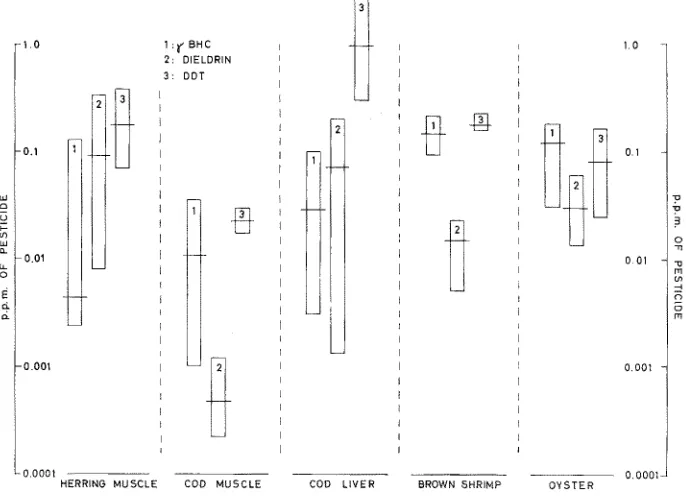
ever, it can be seen that the fish liver contains proportionately more pesticide than the muscle tissue. This would be expected as it is now well established that organo-chlorine compounds are stored in fatty tissues, and the result is in agreement with results published by other workers
(HOLDEN
1966, ROBINSON et al. 1967). Our highest pesticide residue to date has been for D D T in a whiting liver (19.2 ppm) and generally we have found that livers from whiting (Merlangius merlangus) have the highest organo-chlorine pesticide content.I
I . 0 1 :~' BHC 2', DIELDRIN I II
3: DDT I
-0.001
HERRING M U S C L E COD M U S C L E
1.0
0.1
0 0 1
0 . 0 0 I
0.0001 0.0001
CO0 L I V E R BROWN SHRIMP O Y S T E R
Fig. 7" Range and mean concentrations of 7 BHC dieldrin and DDT found in some fish and shellfish
The results for oysters shown in Figure 7 were obtained in about March of 1967 and more recent results have been lower by a factor of ten. This suggests a possibility of seasonal variation, and work is now in progress on the analysis of regular oyster samples in an attempt to test this. As work by BUTLER (1966) has shown, such a vari- ation might reasonably be expected, since the oyster's environment will be subjected to seasonal variations in concentrations of pesticides according to their usage in agriculture.
S U M M A R Y
2. Increase in t e m p e r a t u r e was f o u n d to cause a m a r k e d increase in the toxicity of some chemicals.
3. The larger~size animals were shown to be less susceptible to mercury.
4. S t a r v a t i o n of animals p r i o r to experiments was d e m o n s t r a t e d to reduce their tolerance to mercury.
5. T h e toxicity of a n u m b e r of detergents to the 4 test species is described.
6. Results of pesticide analyses are given in terms of ranges a n d m e a n concentrations f o u n d in muscle tissue from 2 species of fish, the liver of one fish, a n d for whole shrimps a n d oysters.
A c k n o w l e d g m e n t : The technical assistance of Messrs. P. M. CONNOR and M. J. WAI~DLE in carrying out many of the toxicity experiments is gratefully acknowledged.
L I T E R A T U R E C I T E D
BUTI~ER, P. A., 1966. The problem of pesticides in estuaries. Spec. Publ. Am. Fish. Soc. No 3, 110-115.
D.S.I.R., 1961. Synthetic detergents. Notes Wat. Pollut. No. 15.
FAISBERT MAUNDrR, M. J. de, E~AN, H., GODLY, E. W., HAMMOND, E. W., ROBUI~N, J. & THOMSON, J., 1964. Clean-up of animal fats and dairy products for the analysis of chlor- inated pesticide residues. Analyst, Lond. 89, 168-174.
HOLDEN, A. V., 1966. Organo-chlorine insecticide residues in salmonid fish. J. appI. Ecol. 3
(Suppl.), 45-53.
MARCHETTI, R., 1965. Critical review of the effects of synthetic detergents on aquatic life.
Stud. Rev. gen. Fish. Coun. Mediterr. No 26.
MINISTRY OF TECHNOLOGY, 1966. Synthetic detergents. II: non-ionic detergents. Notes Wat. Pollut. No 34.
Moss, H. V., 1958. Synthetic detergents. Continuing research related to water and sewage treatment. W a t . & War. Engng. 61 (745), 116-119.
ROBINSON, J., COULSON, J. C., CRABTREE, A. N., I)OTTS, G. R. & RICHARDSON, A., 1967.
Organo-chlorine residues in marine organisms. Nature, Lond. 214 (5095), 1307-1311. TODD, R., 1954. Water purification upset seriously by detergents. Wat. Sewage Wks 101 (2), 80.
Dicussion following the paper by PORTMANN 1
KINNE: I am glad that Dr. PORTMANN has studied toxicity of pollutants as a function of
different important parameters, namely, temperature, size of the test animal, and starvation. A detailed assessment of toxicity is, no doubt, only possible if different physiological states of the organism in question and different environmental conditions are taken into account. My question: Have you done or are you planning to conduct any experiments on the efficiency of food conversion? It seems to me that caloric analyses - including uptake, conversion, and excretion of food - represent a most useful and important criterion for the assessment of the economy of life processes under different stresses of pollution.
SIMVSON: We do consider such studies important, but at the moment we are pressing ahead with the general review of the toxicity of a range of substances and with examining some of the effects of other factors on these. With our limited staff I think we have to limit our research to this for the present.
MANN: Bisher wurde nur tiber die Wirkung einzelner Stoffe auf Fische etc. berichtet. Bei den Abw~issern der Industrie haben w i r e s aber nicht mit definierten Einzelsubstanzen, sondern mit Stoffgemischen zu tun. Ich halte es daher fiir unbedingt notwendig, Kombinationen yon Abwasserstoffen zu untersuchen. Aus der Abwasserchemie des SiJBwassers ist bekannt, daB manche Stoffe in Kombinationen additiv wirken; andere rufen sogar noch st~irkere Wirkungen hervor, als aus ihrer Addition zu erwarten w~ire.
SIMrSON: I agree that it is most important to examine the toxicity of mixtures of toxicants; it is planned to include them in the near future.
KmNZ: Ein Wort zu der eben yon Herrn Kollegen MANN erw~ihnten additiven biologischen Wirkung mancher Abwasserinhaltsstoffe. Dieses Ph~inomen wurde w~ihrend des Symposiums verschiedentlich angesprochen. Es ist sicher yon grundlegender Bedeutung, vor allem wenn es darum geht, die unter definierten Laboratoriumsbedingungen erarbeiteten Versuchsergebnisse auf die Situation im Meer zu iibertragen und Vorhersagen tiber das AusmaB der jeweils zu erwartenden biologischen Konsequenzen der Einleitung bestimmter Substanzgemische zu machen. Brauchbare Voraussagen dieser Art sind ja ein Hauptziel unserer gegenw~irtigen Ab- wasserforschung. - Abwasserinhaltsstoffe kSnnen sich abet nicht nur hinsichtlich ihrer biologi- schen Wirkungen beeinflussen, sondern auch ,,direkt" durch physiko-chemische Wechselwirkun- gen. Es erscheint mir daher wichtig, dab derartige Interreaktionen zwischen Abwasserkom- ponenten untersucht werden. Dies ist natiJrlich ein Aspekt der Abwasserforschung, der weniger den Biologen als den Wasserchemiker angeht. Aber auch bei prim~ir biologisch orientierten Untersuchungen darf dieser Aspekt nicht v~511ig ausgeklammert werden, well beispielsweise ein an Ort A eingebrachter (und vom Biologen hinsichttich seiner physiotogischen und/Skologischen Wirkungen untersuchter) Stoff schon an einem wenige Kilometer entfernten Ort B seine chemi- sche Identit~it ver;indert haben und zu einem Stoff mit anderen biologischen Konsequenzen ge- worden sein kSnnte.
PEAI~SON: Could I ask you if you have investigated the level of pesticide residues in Ammo- dytes species? There was a suggestion that the increased level of pesticide residues in the eggs of certain sea-bird species was related to the level of such substances in Ammodytes spec. which constitute their major food source.