RESEARCH
Results of an online questionnaire
to survey calf management practices on dairy
cattle breeding farms in Austria and to estimate
differences in disease incidences depending
on farm structure and management practices
Daniela Klein‑Jöbstl
1*, Tim Arnholdt
1, Franz Sturmlechner
2, Michael Iwersen
1and Marc Drillich
1Abstract
Background: Calf disease may result in great economic losses. To implement prevention strategies it is important to gain information on management and to point out risk factors. The objective of this internet based survey was to describe calf management practices on registered dairy breeding farms in Austria and to estimate differences in calf disease incidences depending on farm structure and management practices.
Results: A total of 1287 questionnaires were finally analysed (response rate 12.2 %). Herd characteristics and regional distribution of farms indicated that this survey gives a good overview on calf management practices on registered dairy farms in Austria. The median number of cows per farm was 20 (interquartile range 13–30). Significant differ‑ ences regarding farm characteristics and calf management between small and large farms (≤20 vs >20 cows) were present. Only 2.8 % of farmers tested first colostrum quality by use of a hydrometer. Storing frozen colostrum was more prevalent on large farms (80.8 vs 64.2 %). On 85.1 % of the farms, whole milk, including waste milk, was fed to the calves. Milk replacer and waste milk were more often used on large farms. In accordance with similar studies from other countries, calf diarrhoea was indicated as the most prevalent disease. Multivariable logistic regression analysis revealed that herd size was associated with calf diarrhoea and calf respiratory tract disease, with higher risk of disease on large farms. Furthermore, feeding waste milk to the calves was associated with increasing calf diarrhoea incidence on farm. In the final model with calf respiratory tract disease as outcome, respondents from organic farms reported less often a respiratory tract disease incidence of over 10 % compared with conventional farms [odds ratio (OR) 0.40, 95 % confidence interval (CI) 0.21–0.75] and farmers that housed calves individually or in groups after birth signifi‑ cantly reported more often to have an incidence of respiratory tract disease >10 % compared with farms where all calves were housed individually (OR 2.28, 95 % CI 1.16–4.48).
Conclusion: The results obtained in this study provide an overview on calf management on dairy breeding farms in Austria and may help to further point out areas to be improved on farm.
Keywords: Questionnaire, Dairy calf, Management, Diarrhoea
© 2015 Klein‑Jöbstl et al. This article is distributed under the terms of the Creative Commons Attribution 4.0 International License (http://creativecommons.org/licenses/by/4.0/), which permits unrestricted use, distribution, and reproduction in any medium, provided you give appropriate credit to the original author(s) and the source, provide a link to the Creative Commons license, and indicate if changes were made. The Creative Commons Public Domain Dedication waiver (http://creativecommons.org/ publicdomain/zero/1.0/) applies to the data made available in this article, unless otherwise stated.
Open Access
*Correspondence: [email protected]
1 Clinical Unit for Herd Health Management in Ruminants, University Clinic for Ruminants, Department for Farm Animals and Veterinary Public Health, University of Veterinary Medicine Vienna, Veterinaerplatz 1, 1210 Vienna, Austria
Background
Calf morbidity and mortality result in great economic losses [1, 2]. Therefore, it is of importance to find optimal intervention and prevention strategies to reduce the risk of calf diseases on farms [3]. Diarrhoea and respiratory tract disease are the most frequent diseases in calves [4, 5]. Several risk factors for calf diseases, particularly diar-rhoea, have been identified, including farm size, presence of a calving pen and hygiene in this area, the quality of colostrum and the route of colostrum feeding as well as type of calf housing [4, 6–9].
Calf management has been evaluated in several Euro-pean countries and in North America with larger cattle herds (mean >40 cows) [10–13]. In Austria, dairy farms are traditionally family-owned and small sized with an average number of 18 dairy cows, predominantly Fleck-vieh breed [14]. Therefore, it can be assumed that the calf management on these small farms, similarly to countries with comparable agricultural structures, differs from that of other countries. Also, calves of different breeds might be managed differently as reported by Stanek et al. [13] for Holstein–Friesian and Fleckvieh calves in Czech Republic.
The objective of the present study was to describe calf management practices on registered dairy breeding farms in Austria and to estimate differences in disease incidences depending on farm structure and manage-ment practices.
Methods
Study population
Approximately 10,500 cattle breeders registered in the Association of Austrian cattle breeders (ZAR) were cho-sen as study population. Registered farms cover 66 % of all dairy farms and 78 % of all dairy cows in Austria [14].
Questionnaire
An internet-based questionnaire was designed by using Google Forms [15]. The questionnaire comprised five areas of interest: (1) farm characteristics, (2) calving and care of the newborn, (3) calf housing, (4) calf feed-ing, and (5) calf disease and mortality in pre-weaned calves. In total, the questionnaire consisted of 32 ques-tions, with supplementary questions depending on the given answers. The questions were semi-closed, closed, multiple choice, and open questions. The questionnaire was tested by ten selected farmers for comprehensibility and clarity before the hyperlink was sent out via email to all registered dairy breeders. The survey was online for 4 weeks from October to November 2012. Farmers could answer the questionnaire anonymously. The question-naire (in German) is provided as Additional file 1.
Data analyses
All records were edited by individually examining for aberrant results and plausibility before statistical analy-ses. Questionnaires with less than five answers given in total in area of interest 2 to 5 (2) calving and care of the newborn, (3) calf housing, (4) calf feeding, and (5) calf disease and mortality were excluded from statistical anal-yses. Free text statements were assessed individually and grouped according to their similarity where appropriate.
Data were statistically analysed using PASW, version 20.0 (IBM Cooperation, New York, USA). Descriptive statistics were calculated for farm characteristics and management practices.
For a more detailed analysis, the farms were catego-rised by herd size, farmers’ reported incidence of diar-rhoea and respiratory tract disease (within 1 year). Herd size was categorised according to the median number of cows on farm (≤20 vs >20 cows). Differences between small and large herds were evaluated by use of Chi square tests.
To facilitate the farmers the questions regarding dis-ease incidence, they were categorised with the answers ≤10 %, 11–25 %, 26–50 %, 51–75 %, and >75 %. For further analysis, farms were categorised into farms with a maximum of 10 % and with more than 10 % of calves affected by diarrhoea or respiratory tract disease, respectively, as frequencies in categories >10 % were small. To identify associations between variables and the outcome variables calf diarrhoea and respiratory tract disease a two-step process was used. First, univariable logistic regression models were applied to determine the associations between the outcome variable and each binary or categorical variable. In the second step, vari-ables with a P value ≤0.2 were included in a final mul-tivariable logistic regression model using calf diarrhoea and calf respiratory tract disease incidence (≤10 % vs >10 %) as outcome variable. A backward stepwise elimi-nation of non-significant variables was performed to obtain a minimal model containing only significant vari-ables (P < 0.05).
Results and discussion
Response rate
A total of 1501 breeders answered the questionnaire, resulting in an overall response rate of 14.2 %. According to the previously described exclusion criteria, 214 ques-tionnaires had to be withdrawn, thus, a total of 1287 sur-veys were used in the final analysis.
The response rate was comparable to and the total number of respondents was greater than in other simi-larly designed questionnaire based surveys [5, 17, 18]. In other studies on calf management, however, the response rate was greater, achieving 58–73 % [4, 19]. The hyperlink to the questionnaire was sent via email to registered cat-tle breeder. Due to the nature of this kind of survey and its dissemination, a potential bias may exist, as it cannot be excluded that farms e.g. with severe problems tended not to participate. Furthermore, this survey does not pro-vide any information about calf management practices on not registered farms and farms with no access to the internet. Thus, it can be speculated whether this survey compromises the more professional and modern dairy farms in Austria.
Although the study was not designed as a representa-tive survey, herd characteristics (herd size, breed, milk
yield; see chapter general farm characteristics and regional distribution) indicated that this survey gives a good overview on calf management practices on regis-tered dairy breeding farms in Austria.
General farm characteristics
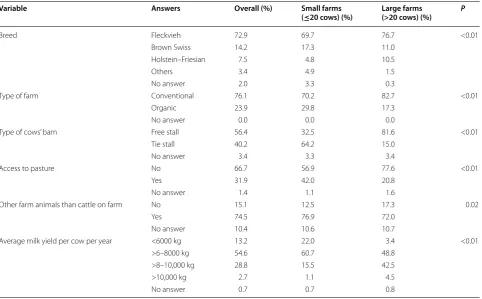
The median number of dairy cows of farms participating in the study was 20 (interquartile range 13–30). This is similar to the average number of 18 dairy cows per farm on registered farms in Austria [14]. Similar studies were conducted in countries with greater average herd size [7, 11, 13, 20–22]. Data regarding general farm characteris-tics are presented in Table 1. Distribution of main breeds on registered dairy farms in Austria is 74.5 % Fleckvieh, 13.4 % Brown Swiss, and 10.9 % Holstein Frisian [14] and was similar (P > 0.05) in our study. Significant dif-ferences between small and large dairy farms were found for all general farm characteristics evaluated (Table 1). In summary, small farms were more often organic pro-ducing farms, on small farms cows had access to pas-ture, and cows were kept tied-up more often than on large farms. Furthermore, farm animals others than cat-tle were more often kept on small than on large farms. The question regarding “other farm animals than cattle”
Table 1 Answers given by the 1287 respondents on general farm characteristics
Data are given for all farms and for small and large farms, separately. P‑value presents differences between small and large farms
Variable Answers Overall (%) Small farms
(≤20 cows) (%) Large farms (>20 cows) (%) P
Breed Fleckvieh 72.9 69.7 76.7 <0.01
Brown Swiss 14.2 17.3 11.0 Holstein–Friesian 7.5 4.8 10.5
Others 3.4 4.9 1.5
No answer 2.0 3.3 0.3
Type of farm Conventional 76.1 70.2 82.7 <0.01
Organic 23.9 29.8 17.3
No answer 0.0 0.0 0.0
Type of cows’ barn Free stall 56.4 32.5 81.6 <0.01
Tie stall 40.2 64.2 15.0
No answer 3.4 3.3 3.4
Access to pasture No 66.7 56.9 77.6 <0.01
Yes 31.9 42.0 20.8
No answer 1.4 1.1 1.6
Other farm animals than cattle on farm No 15.1 12.5 17.3 0.02
Yes 74.5 76.9 72.0
No answer 10.4 10.6 10.7
Average milk yield per cow per year <6000 kg 13.2 22.0 3.4 <0.01 >6–8000 kg 54.6 60.7 48.8
>8–10,000 kg 28.8 15.5 42.5
>10,000 kg 2.7 1.1 4.5
was included because in a previous study the presence of additional farm animals was associated with diarrhoea in calves [9]. On 54.6 % of the farms the average milk yield was between 6000 and 8000 kg per cow per year. On all registered farms, the average milk yield in 2013 was 7200 kg [14]. Milk yield (given as a categorical vari-able, see Table 1) differed significantly (P < 0.01) between small and large farms. Small farms generally had lower
milk yields. Results suggest a lower degree of specialisa-tion of small farms.
Calving and care of the newborn
Details regarding calving management and care of the newborn are presented in Table 2. Calving manage-ment and care of the newborn are important for the calves’ health and were therefore evaluated in detail in
Table 2 Answers given by the 1287 respondents on management regarding calving and care of the newborn calf
Data are given for all farms and for small and large farms, separately. P‑value presents differences between small and large farms
p.n. post natum
a Dipping or spraying with iodine, chlortetracycline or foreshot
Variable Answers Overall (%) Small farms
(≤20 cows) (%) Large farms (>20 cows) (%) P
Presence of calving pen on farm No 51.1 27.0 68.5 <0.01
Yes 47.0 70.5 30.4
No answer 1.9 2.5 1.1
Cow calf separation p.n. Immediately 41.0 46.9 35.8 <0.01 Within 1 h 47.6 44.7 49.4
Within 4 h 3.4 1.8 5.2
Later than 4 h 7.8 6.3 9.4
No answer 0.2 0.3 0.2
Time of first colostrum feeding p.n. Within 4 h 83.7 83.0 84.3 0.36
4–6 h 13.5 14.6 12.3
>6 h 1.1 1.1 1.1
No answer 1.7 1.3 2.3
Quantity of first colostrum fed within
the first 6 h p.n. <2 L2–4 L 13.371.9 15.469.9 11.273.5 0.11
>4 L 12.7 13.3 12.4
No answer 2.1 1.4 2.9
Checking colostrum quality No 78.7 80.3 77.7 0.21
Yes 20.8 19.0 22.0
No answer 0.5 0.7 0.3
If yes, method Hydrometer 13.5 2.5 23.5 <0.01
Visual inspection 86.1 97.5 75.0
No answer 0.4 0.0 1.5
Use of an oesophageal feeder for first colostrum No 63.1 67.5 58.0 <0.01
Yes 6.0 8.9 3.1
If necessary 27.1 17.3 37.6
No answer 3.8 6.3 1.3
Frozen colostrum stocks No 27.0 35.8 18.6 <0.01
Yes 72.7 64.2 80.8
No answer 0.3 0.0 0.6
Routine umbilical care No 26.9 23.8 29.9 0.02
Yes 69.5 72.3 69.6
No answer 3.6 3.9 0.5
If yes, type of umbilical care Dipping/sprayinga 28.4 28.5 28.6 0.64 Stripping out 17.5 16.5 18.8
Combination 54.1 55.0 52.6
the present study. Overall, on 47.0 % of the farms a calv-ing pen was available, which is in accordance with other studies [11, 20]. In a German survey on large farms with more than 100 dairy cows, a calving pen was obviously more common with up to 100 % of the farms having such an area [17]. Significant differences were, however, also present in availability of a calving pen between small and large farms of the present study. The use of a calv-ing pen is recommended to minimize stress for the cow and newborn and ensure best hygiene [3, 4]. Neverthe-less, in practice, calving pens are often not cleaned and disinfected regularly, or are used also for diseased ani-mals, and might represent a risk factor for spreading infections [9]. This seems to be the case also on the farms of the present study as on farms with a calving pen uni-variable logistic regression revealed that the odds that farmers reported a diarrhoea incidence of >10 % was greater on farms with a calving pen than on farms with-out [odds ratio (OR) 1.57, 95 % confidence interval (CI) 1.24–1.98]. This hypothesis, however, was not confirmed in the multivariable logistic regression model, where the reported incidence of diarrhoea was not affected by the presence of a calving pen. As the calving pen might pose a risk factor for the newborn, it is recommended to sepa-rate calves from their dam as soon as possible after birth and to house calves individually in a clean area [3]. The vast majority of the farmers (88.5 %) indicated to separate the calf from its dam within 1 h after parturition. This is similar to the findings of Kehoe et al. [20] in Pennsylva-nia, whereas in studies from Canada, England and Wales, calves were generally separated later from their dam [11, 23].
Early cow-calf separation is also proposed to ensure an early and targeted colostrum supply [24]. Data concern-ing colostrum management are summarised in Table 2. Results suggest that farmers are aware of the importance of a timely colostrum supply, as 83.7 % stated to feed first colostrum within 4 h after birth. Although colostrum quality plays an important role in regard to a sufficient immunoglobulin supply to calves, most farmers (97.2 %) did not check first colostrum quality by use of a hydrom-eter. Regarding time and quantity of first colostrum feeding no difference could be detected between small and large farms. In contrast, frozen colostrum stocks and oesophageal tube feeding of first colostrum were significantly less common on small than on large farms (P < 0.01). Although the definition of small and large herds differ between the present study and the study by Kehoe et al. [20], these authors also found that the use of a hydrometer for colostrum quality estimation and the storage of frozen colostrum stocks was more often per-formed on large farms. Results concerning colostrum management are in accordance with results of a previous
case control study performed in Austria [9]. Results of both studies (the present study and [9]) suggest that first colostrum feeding was performed early post natum by most farmers. Answers regarding this question, however, have to be interpreted with care, as farmers may have stated what they know is correct, but may not necessarily represent the true daily management practice. For ade-quate passive transfer of immunoglobulins (Ig) not only time, but also Ig quantity fed to the calf plays an impor-tant role. Although easy, fast, and cheap methods like hydrometers and Brix-refractometers to estimate colos-trum quality on farm are available [25], colostrum quality was solely checked on few farms. A reason for this can only be hypothesized. Maybe, in contrast to the knowl-edge of importance of timely first colostrum feeding, the knowledge on importance of colostrum quality is not widespread.
Routine umbilical care was performed on 69.5 % of the farms. No significant difference was detected between the different routines and the reported incidence of umbilical diseases. This finding, however, has to be inter-preted with care as 93.4 % of the respondents answering this question stated that the umbilical disease incidence was ≤10 %.
Calf housing
Data on calf housing are given in Table 3. Individual calf housing is common in many countries including Austria [11, 19, 26]. No clear tendency was found with regard to the duration of individual housing. Individually calf housing has been suggested with the aim to avoid trans-mission of pathogens between animals [27]. In epidemio-logical studies, however, rather group size than grouping itself was associated with an increased risk for calf dis-eases [4, 28]. Furthermore, it was suggested that social contact provided by group housing of calves increases performance (feed intake, weight gain) and animal wel-fare [29–31]. Nevertheless, in individually housed calves it is easier to feed calves individually according to their special needs and to control the animals’ health status. The great proportion of farms (84.5 %) housed calves indoors what is similar to studies from Canada and Sweden [11, 19]. Reasons might be exposure to extreme climate conditions in Canada, Sweden, as well as in Aus-tria during winter that prevents farmers from housing calves under outdoor conditions. Furthermore, in Alpine regions large gradients make it often difficult to position outdoor igloos.
dry, but also water and high pressure cleaner were used. An additional disinfection, however, was only performed on 19.9 % of the farms. Nevertheless, no association between hygienic measures and calf diseases were found in present study.
Calf feeding
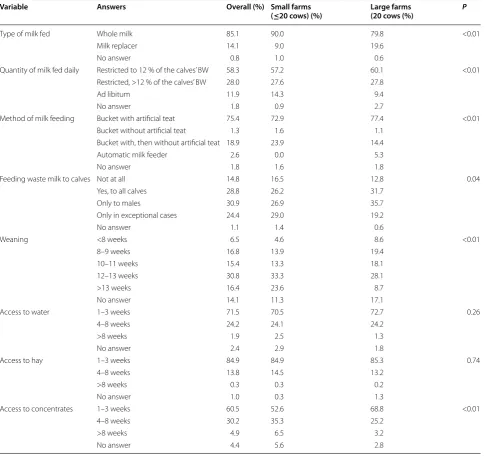
On 85.1 % of the farms, calves were fed with whole milk. On 84.1 % (n = 1082) of the farms waste milk (milk from cows with clinical mastitis, high somatic cell counts, or within the withdrawal period after treatment with drugs) was at least fed in exceptional cases to the calves (Table 4). Milk replacer and waste milk were signifi-cantly more often fed on large farms (P < 0.01). Reasons for whole milk feeding were not asked, but could be due to the fact that it is easy to handle, consists of good bal-anced nutrients and that milk produced over the quota, can be fed [11]. Feeding waste milk was a common prac-tice on the majority of the farms similar as reported by other authors [11, 13, 23, 32]. Although in a recent study Al Mawly et al. [33] pointed out that waste milk may pro-tect calves from diarrhoea, this practice increases the risk of pathogen transmission and the emerging of antimicro-bial resistance in bacteria [34–36].
On 86.3 % of the farms, milk was fed restricted and on 11.9 % of farms ad libitum. Recent studies state a benefit on growth, health, and performance later in life of feed-ing larger amounts of milk than the traditional feedfeed-ing of 10–12 % of the calves’ body weight [37]. This, however, is still not common on dairy farms, neither on farms of the present study nor in other countries that have been sur-veyed [11, 19]. Weaning took place late (73.7 % of the farm-ers, answering this question, stated not to wean calves before the 10th week of life) compared with other studies of different countries where calves were usually weaned between week 7 and 10 [11, 13, 19]. Reasons for relatively late weaning on farms were not asked and can only be hypothesised. Advantages of later weaning are higher daily weight gains and a reduced drop in energy intake after weaning [38, 39]. Reported disadvantages, such as higher feeding costs for late weaned calves [38] may be less pro-nounced in Austria because feeding milk produced over the quota is very common. It will be interesting if late weaning changes with the ending of the milk quota system this year.
Access to concentrates, hay, and water is important for rumen development in calves. On most of the farms calves had free access to hay and concentrates from the first 3 weeks of life (84.9 and 60.5 %, respectively; Table 5). Table 3 Answers given by the 1287 respondents on calf housing
Data are given for all farms and for small and large farms, separately. P‑value presents differences between small and large farms
p.n. post natum
Variable Answers Overall (%) Small farms
(≤20 cows) (%) Large farms (>20 cows) (%) P
Calves housed p.n. Individually 88.8 88.0 89.8 0.15
Individually and in groups 4.7 5.8 3.5
In groups 6.3 6.0 6.5
No answer 0.2 0.2 0.2
Calf housing p.n. Within cows’ barn 46.3 45.2 47.2 0.85 Own barn for calves
and young stock 38.2 38.4 38.1
Outdoors 14.2 14.7 13.9
In‑ and outdoors 0.8 0.9 0.6
No answer 0.5 0.8 0.2
If calves are housed
individually, duration 1–2 weeksUp to 6 weeks 33.137.0 33.633.3 31.740.9 0.15
>6 weeks 23.3 22.7 24.7
No answer 6.6 10.4 2.7
Cleaning of calf housings Regular 61.1 61.8 60.1 0.06
Infrequently 34.5 33.9 35.4
Not at all 2.3 1.6 2.9
No answer 2.1 2.7 1.6
Cleaning Only dry 23.1 26.5 20.4 <0.01
With water 10.2 12.0 8.1
With high pressure 42.2 39.6 45.1 Additional disinfection 19.9 18.1 21.5
Early concentrate feeding to calves was particularly com-mon on large Austrian farms and is in accordance with studies from other countries [11, 13]. In contrast to the aforementioned studies, in the present study hay was also offered early during the milk feeding period.
Calf disease
Morbidity and mortality data obtained in the present study have to be interpreted with care. As usually no data on calf diseases exist on farms in Austria [9], we
asked the farmers to estimate the proportion of calves suffering from different diseases. Consequently, the results might rather represent sensation of the farmer regarding disease incidence than true incidence. Fur-thermore, the predetermined classification of incidence was quite rough but considers that on average farms in Austria each case represents approximately 5 %-points. The prevalence of diseases in calves estimated by the farmers is presented in Table 5. Calf diarrhoea was the most prevalent disease. Approximately half of the Table 4 Answers given by the 1287 respondents on calf feeding
Data are given for all farms and for small and large farms, separately. P‑value presents differences between small and large farms
BW body weight
Variable Answers Overall (%) Small farms
(≤20 cows) (%) Large farms (20 cows (%) P
Type of milk fed Whole milk 85.1 90.0 79.8 <0.01
Milk replacer 14.1 9.0 19.6
No answer 0.8 1.0 0.6
Quantity of milk fed daily Restricted to 12 % of the calves’ BW 58.3 57.2 60.1 <0.01 Restricted, >12 % of the calves’ BW 28.0 27.6 27.8
Ad libitum 11.9 14.3 9.4
No answer 1.8 0.9 2.7
Method of milk feeding Bucket with artificial teat 75.4 72.9 77.4 <0.01 Bucket without artificial teat 1.3 1.6 1.1
Bucket with, then without artificial teat 18.9 23.9 14.4 Automatic milk feeder 2.6 0.0 5.3
No answer 1.8 1.6 1.8
Feeding waste milk to calves Not at all 14.8 16.5 12.8 0.04 Yes, to all calves 28.8 26.2 31.7
Only to males 30.9 26.9 35.7
Only in exceptional cases 24.4 29.0 19.2
No answer 1.1 1.4 0.6
Weaning <8 weeks 6.5 4.6 8.6 <0.01
8–9 weeks 16.8 13.9 19.4
10–11 weeks 15.4 13.3 18.1
12–13 weeks 30.8 33.3 28.1
>13 weeks 16.4 23.6 8.7
No answer 14.1 11.3 17.1
Access to water 1–3 weeks 71.5 70.5 72.7 0.26
4–8 weeks 24.2 24.1 24.2
>8 weeks 1.9 2.5 1.3
No answer 2.4 2.9 1.8
Access to hay 1–3 weeks 84.9 84.9 85.3 0.74
4–8 weeks 13.8 14.5 13.2
>8 weeks 0.3 0.3 0.2
No answer 1.0 0.3 1.3
Access to concentrates 1–3 weeks 60.5 52.6 68.8 <0.01
4–8 weeks 30.2 35.3 25.2
>8 weeks 4.9 6.5 3.2
farmers, however, estimated that the calf diarrhoea inci-dence on farm was not more than 10 %. This might be comparable to other studies where the reported median herd level incidence for calf diarrhoea was between 7.8 and 10.5 % [4, 7, 40].
Interestingly, in contrast to the question concerning diarrhoea, questions on other diseases were not answered by more than two-thirds of the respondents (Table 5). An explanation for this could be that farmers are more sensi-tive to calf diarrhoea than to other diseases, particularly as this disease can affect a large number of animals. It can only be speculated whether not answering questions was because farmers were not able to (not knowing) or not wanting to. Not answering questions concerning diseases was not correlated with answers given to any other ques-tion (any other dependent variable), but not answering questions to respiratory tract, umbilical, and joint dis-ease, as well as mortality, were correlated with each other
(correlation coefficient >0.60). It is probable that certain farmers generally did not want to answer questions on disease prevalence on their farms. Due to the fact that the questionnaires could be answered anonymously and due to the aforementioned knowledge that usually no data on calf disease exist, it is more likely that farmers did not know the incidence of (especially less prevalent) diseases.
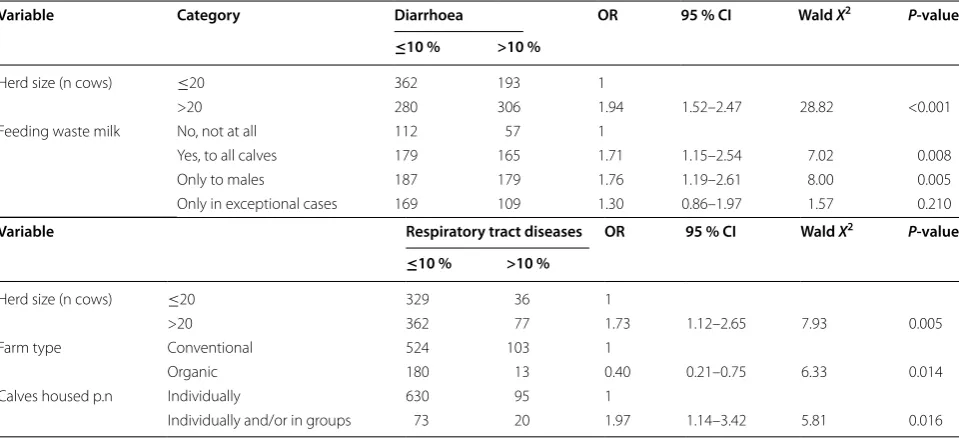
Within this study, associations between diarrhoea and respiratory tract disease, respectively, and management on farm were analysed (Table 6). Herd size differed sig-nificantly between farms with ≤10 % and >10 % diseased calves, with large farms reporting greater disease inci-dence than small ones. Associations between herd size and disease were also found in other studies and have been explained by increased stocking density and less time for individual care of calves [8, 9]. Another explana-tion could be that on farms of different sizes the recogni-tion of diseases differs. Furthermore, other management Table 5 Farmers’ reported proportion of calves suffering from health problems on 1287 Austrian dairy breeding farms
a Defined as calves born alive that died within the first 3 weeks of life
Disease/problem Reported incidence (%) No answer
≤10 >10–25 >25–50 >50–75 >75
Diarrhoea 51.0 23.4 9.8 4.0 2.6 9.2
Respiratory tract disease 54.7 6.4 1.9 0.5 0.2 36.3
Umbilical disease 57.0 3.5 0.5 0.0 0.1 38.9
Joint problems 47.1 1.3 0.1 0.1 0.0 51.4
Calf mortalitya 58.0 3.2 0.2 0.0 0.1 38.6
Table 6 Results of the multivariable logistic regression models with farmer reported incidence of calf diarrhoea and calf respiratory tract diseases, respectively, as outcome variable (≤10 % or >10 %)
Hosmer–Lemeshow for the model diarrhoea and respiratory tract disease, respectively are P = 0.99 and 0.92
OR odds ratio, CI 95 % confidence interval, p.n. post natum
Variable Category Diarrhoea OR 95 % CI Wald X2 P-value
≤10 % >10 %
Herd size (n cows) ≤20 362 193 1
>20 280 306 1.94 1.52–2.47 28.82 <0.001 Feeding waste milk No, not at all 112 57 1
Yes, to all calves 179 165 1.71 1.15–2.54 7.02 0.008 Only to males 187 179 1.76 1.19–2.61 8.00 0.005 Only in exceptional cases 169 109 1.30 0.86–1.97 1.57 0.210
Variable Respiratory tract diseases OR 95 % CI Wald X2 P-value
≤10 % >10 %
Herd size (n cows) ≤20 329 36 1
>20 362 77 1.73 1.12–2.65 7.93 0.005
Farm type Conventional 524 103 1
Organic 180 13 0.40 0.21–0.75 6.33 0.014
Calves housed p.n Individually 630 95 1
factors that differ between small and large farms may influence this outcome. Therefore, we tested for con-founding of evaluated management factors on the associ-ation between herd size and diarrhoea, but could not find such an effect in this study.
In the final model with calf diarrhoea as outcome vari-able, feeding of waste milk was also associated with the reported incidence of calf diarrhoea. Feeding this kind of milk to all or at least to male calves was associated with higher calf diarrhoea incidence. In contrast, when farm-ers reported to feed waste milk only in exceptional cases, the reported calf diarrhoea incidence was not higher. As reported in other studies and already mentioned above, feeding waste milk increases the risk of pathogen trans-mission and the emerging of antimicrobial resistance in bacteria [34–36], that might lead to an increased calf diarrhoea incidence on farm.
On conventional farms an incidence of respiratory tract diseases of >10 % was reported more often than on organic farms. Reasons for this finding can only be hypothesised. It can be speculated whether organic farm-ers spend more effort in disease prevention as they are limited in using drugs, or if self-assessment of organic and conventional farmers differs. In a study by Bidokhti et al. [41] seroprevalence to bovine coronavirus and bovine res-piratory syncytial virus was lower on organic than on con-ventional farms. The authors stated that possible reasons might be better biosecurity levels on organic farms and limited purchasing of animals to organic farms.
Another factor significantly associated with higher odds for respiratory tract disease on farms was calf hous-ing post natum. On farms where calves were also housed in groups a higher odds for respiratory tract disease inci-dence >10 % was present than on farms where all calves were housed individually post natum (Table 6). This may suggest that group housing of calves may have a negative influence on the calves` health with regard to respiratory tract diseases. This greater risk might be due to a higher pathogen load and stocking density [27]. No significant interactions were found in the final models.
Significant associations and interactions between calf diarrhoea and calf respiratory tract disease, and between these two diseases and other diseases (umbilical disease, joint problems) were found. This could be because one disease might predispose for other diseases. Another rea-son could be that pathogens, e.g. Coronavirus, affect sev-eral organs [8]. As the time order of the different diseases is unknown, it is not possible to say whether diseases are a risk factor for or a result of diarrhoea and respiratory tract disease, respectively. Furthermore, possibly com-mon herd level factors may increase the animal level pre-disposition to several diseases. Consequently this study cannot provide cause-effect information.
Several variables that were supposed to be associated with disease in calves did not remain significant in the multivariable model. These variables were e.g. herd char-acteristics (presence of other farm animals than cattle on farm), colostrum management (time of first colostrum feeding, quantity of colostrum fed, testing for colostrum quality), calf housing (in- vs outdoor housing, hygienic measures), and feeding (milk quantity fed, access to water, hay and concentrates). Some of these factors have already been described as risk factors in previous stud-ies [4, 7, 9, 22, 24, 40, 42]. One reason for these missing significant associations may be that the study was not planned as a risk factor analysis and consequently the study design did not fit. Furthermore, results may be influenced by the fact that disease incidence given by the respondents was mainly based on estimations rather than on true numbers. Finally, some of these factors e.g. colos-trum management, were very similar on most farms.
Conclusion
In conclusion, the results obtained in this study provide data on calf management on dairy breeding farms in Aus-tria. These data may help to further point out areas to be improved on farm, e.g. testing for colostrum quality and prevention strategies for diarrhoea. Furthermore, sig-nificant differences could be determined between small and large Austrian farms, suggesting a higher degree of specialisation on large farms. These findings could be important with regard to farm consultancy provided by veterinarians, other specialists and organisations offer-ing advisory services to elaborate prevention strategies to reduce the risk of calf diseases.
Abbreviations
OR: odds ratio; 95 % CI: 95 % confidence interval; p.n.: post natum.
Authors’ contributions
DKJ made substantial contributions to conception and design, analysed and interpreted data, and wrote the manuscript. TA drafted the questionnaire, edited answers, and was involved in drafting the manuscript. FS was involved in the development of the questionnaire, distributed the questionnaire, and revised the manuscript critically. MI was involved in conception and design of the study, contributed to the statistical analysis, and revised the manuscript critically for important intellectual content. MD was involved in conception and design of the study, and revised the manuscript critically for important intellectual content. All authors read and approved the final manuscript.
Author details
1 Clinical Unit for Herd Health Management in Ruminants, University Clinic for Ruminants, Department for Farm Animals and Veterinary Public Health, University of Veterinary Medicine Vienna, Veterinaerplatz 1, 1210 Vienna, Austria. 2 Association of Austrian Cattle Breeders (ZAR), Dresdner Str. 89/19, 1200 Vienna, Austria.
Additional file
Acknowledgements
The authors acknowledge the support of all farmers that answered the questionnaire and the Association of Austrian cattle breeders (ZAR) and the regional Dairy Herd Improvement Service (Landeskontrollverbände) for sup‑ porting the contribution of the questionnaire. Furthermore, we thank Cornelia Rouha‑Mülleder for critical review of the data.
Compliance with ethical guidelines
Competing interests
The authors declare that they have no competing interests.
Received: 8 April 2015 Accepted: 23 July 2015
References
1. Østerås O, Gjestvang M, Vatn S, Sølverød L (2007) Perinatal death in production animals in the Nordic countries—incidence and costs. Acta Vet Scand Suppl 49(Suppl 1):S14
2. Mohd Nor N, Steeneveld W, Mourits MC, Hogeveen H (2012) Estimating the costs of rearing young dairy cattle in the Netherlands using a simula‑ tion model that accounts for uncertainty related to diseases. Prev Vet Med. 106:214–224
3. Mee JF (2008) Newborn dairy calf management. Vet Clin North Am Food Anim Pract 24:1–17
4. Svensson C, Lundborg K, Emanuelson U, Olsson SO (2003) Morbidity in Swedish dairy calves from birth to 90 days of age and individual calf‑level risk factors for infectious diseases. Prev Vet Med. 58:179–197
5. Pothmann H, Nechanitzky K, Sturmlechner F, Drillich M (2014) Consul‑ tancy to dairy farmers relating to animal health and herd health manage‑ ment on small‑ and medium‑sized farms. J Dairy Sci 97:851–860 6. Bendali F, Sanaa M, Bichet H, Schelcher F (1999) Risk factors associated
with diarrhoea in newborn calves. Vet Res 30:509–522
7. Lundborg GK, Svensson EC, Oltenacu PA (2005) Herd‑level risk factors for infectious diseases in Swedish dairy calves aged 0–90 days. Prev Vet Med. 68:123–143
8. Woolums AR, Berghaus RD, Smith DR, White BJ, Engelken TJ, Irsik MB et al (2013) Producer survey of herd‑level risk factors for nursing beef calf respiratory disease. J Am Vet Med Assoc 243:538–547
9. Klein‑Jöbstl D, Iwersen M, Drillich M (2014) Farm characteristics and calf management practices on dairy farms with and without diarrhea: a case‑control study to investigate risk factors for calf diarrhea. J Dairy Sci 97:5110–5119
10. Heinrichs AJ, Heinrichs BS (2011) A prospective study of calf factors affecting first‑lactation and lifetime milk production and age of cows when removed from the herd. J Dairy Sci 94:336–341
11. Vasseur E, Borderas F, Cue RI, Lefebvre D, Pellerin D, Rushen J et al (2010) A survey of dairy calf management practices in Canada that affect animal welfare. J Dairy Sci 93:1307–1315
12. Boersema JS, Noordhuizen JP, Lievaart JJ (2013) Hazard perception of Dutch farmers and veterinarians related to dairy young stock rearing. J Dairy Sci 96:5027–5034
13. Stanek S, Zink V, Dolezal O, Stolc L (2014) Survey of preweaning dairy calf‑ rearing practices in Czech dairy herds. J Dairy Sci 97:3973–3981 14. ZAR (2013) Annual report of the association of Austrian cattle breeders.
http://www.zar.at/article/archive/18980
15. Google (2014) Create a survey using Google Forms. https://support. google.com/docs/answer/87809?hl=en
16. Tripepi G, Jager KJ, Dekker FW, Zoccali C (2010) Stratification for confounding–part 1: the Mantel‑Haenszel formula. Nephron Clin Pract. 116:c317–c321
17. Heuwieser W, Iwersen M, Gossellin J, Drillich M (2010) Short communica‑ tion: survey of fresh cow management practices of dairy cattle on small and large commercial farms. J Dairy Sci 93:1065–1068
18. Simensen E, Kielland C, Hardeng F, Boe KE (2014) Associations between housing and management factors and reproductive performance in 327 Norwegian sheep flocks. Acta Vet Scand 56:26
19. Pettersson K, Svensson C, Liberg P (2001) Housing, feeding and manage‑ ment of calves and replacement heifers in Swedish dairy herds. Acta Vet Scand 42:465–478
20. Kehoe SI, Jayarao BM, Heinrichs AJ (2007) A survey of bovine colostrum composition and colostrum management practices on Pennsylvania dairy farms. J Dairy Sci 90:4108–4116
21. Vaarst M, Sorensen JT (2009) Danish dairy farmers’ perceptions and attitudes related to calf‑management in situations of high versus no calf mortality. Prev Vet Med. 89:128–133
22. Torsein M, Lindberg A, Sandgren CH, Waller KP, Tornquist M, Svensson C (2011) Risk factors for calf mortality in large Swedish dairy herds. Prev Vet Med. 99:136–147
23. Brunton LA, Duncan D, Coldham NG, Snow LC, Jones JR (2012) A survey of antimicrobial usage on dairy farms and waste milk feeding practices in England and Wales. Vet Rec. 171:296
24. Trotz‑Williams LA, Leslie KE, Peregrine AS (2008) Passive immunity in Ontario dairy calves and investigation of its association with calf manage‑ ment practices. J Dairy Sci 91:3840–3849
25. Bartier AL, Windeyer MC, Doepel L (2015) Evaluation of on‑farm tools for colostrum quality measurement. J Dairy Sci 98:1878–1884
26. Marce C, Guatteo R, Bareille N, Fourichon C (2010) Dairy calf housing sys‑ tems across Europe and risk for calf infectious diseases. Animal. 4:1588–1596 27. Barrington GM, Gay JM, Evermann JF (2002) Biosecurity for neonatal
gastrointestinal diseases. Vet Clin North Am Food Anim Pract. 18:7–34 28. Maunsell F, Donovan GA (2008) Biosecurity and risk management for dairy replacements. Vet Clin North Am Food Anim Pract. 24:155–190 29. Duve LR, Jensen MB (2012) Social behavior of young dairy calves housed
with limited or full social contact with a peer. J Dairy Sci 95:5936–5945 30. Duve LR, Weary DM, Halekoh U, Jensen MB (2012) The effects of social contact and milk allowance on responses to handling, play, and social behavior in young dairy calves. J Dairy Sci 95:6571–6581
31. Bernal‑Rigoli JC, Allen JD, Marchello JA, Cuneo SP, Garcia SR, Xie G et al (2012) Effects of housing and feeding systems on performance of neona‑ tal Holstein bull calves. J Anim Sci 90:2818–2825
32. Duse A, Waller KP, Emanuelson U, Unnerstad HE, Persson Y, Bengtsson B (2013) Farming practices in Sweden related to feeding milk and colostrum from cows treated with antimicrobials to dairy calves. Acta Vet Scand 55:49 33. Al Mawly J, Grinberg A, Prattley D, Moffat J, Marshall J, French N (2015)
Risk factors for neonatal calf diarrhoea and enteropathogen shedding in New Zealand dairy farms. Vet J 203:155–160
34. Selim SA, Cullor JS (1997) Number of viable bacteria and presumptive antibiotic residues in milk fed to calves on commercial dairies. J Am Vet Med Assoc 211:1029–1035
35. Langford FM, Weary DM, Fisher L (2003) Antibiotic resistance in gut bacteria from dairy calves: a dose response to the level of antibiotics fed in milk. J Dairy Sci 86:3963–3966
36. Aust V, Knappstein K, Kunz HJ, Kaspar H, Wallmann J, Kaske M (2013) Feeding untreated and pasteurized waste milk and bulk milk to calves: effects on calf performance, health status and antibiotic resistance of faecal bacteria. J Anim Physiol Anim Nutr (Berl). 97:1091–1103 37. Khan MA, Weary DM, von Keyserlingk MA (2011) Invited review: effects
of milk ration on solid feed intake, weaning, and performance in dairy heifers. J Dairy Sci 94:1071–1081
38. Bjorklund EA, Heins BJ, Chester‑Jones H (2013) Whole‑milk feeding duration, calf growth, and profitability of group‑fed calves in an organic production system. J Dairy Sci 96:7363–7370
39. de Passille AM, Borderas TF, Rushen J (2011) Weaning age of calves fed a high milk allowance by automated feeders: effects on feed, water, and energy intake, behavioral signs of hunger, and weight gains. J Dairy Sci 94:1401–1408
40. Windeyer MC, Leslie KE, Godden SM, Hodgins DC, Lissemore KD, LeBlanc SJ (2014) Factors associated with morbidity, mortality, and growth of dairy heifer calves up to 3 months of age. Prev Vet Med. 113:231–240 41. Bidokhti MR, Traven M, Fall N, Emanuelson U, Alenius S (2009) Reduced
likelihood of bovine coronavirus and bovine respiratory syncytial virus infection on organic compared to conventional dairy farms. Vet J. 182:436–440