R E S E A R C H A R T I C L E
Open Access
Drivers to adopting B-flow
ultrasonography:contextualizing the
integrated technology acceptance model
Gulsah Hancerliogullari Koksalmis
1,2Abstract
Background:Ovarian torsion is an unprecedented gynecological crisis that regularly influences ladies of regenerative age. Its signs and indications are like those of other abdominal conditions, which make its differential determination testing. B-flow ultrasonography (B-flow USG), which is utilized for the differential determination of ovarian torsion, is the highest quality level non-intrusive indicative instrument in the early period of an ovarian torsion. The aim of this paper is to investigate and incorporate variety of factors affecting physicians’actual use of B-flow USG.
Methods:Drawing from technology acceptance model (TAM), five variables–actual use, behavioral intention to use,
attitude toward use, perceived ease of use and perceived usefulness – are integrated with social influence
and knowledge to propose a theoretical model. The data was collected from the medical doctors including radiologists, urologists, gynecologists, pediatric surgeons between June and October 2018. The sample size is
N= 512 hence, structural equation modeling (SEM) methodology has been implemented to study the relationship between explanatory factors and actual use of B-flow USG. SmartPLS 3.2.7 software was used for the data analysis and testing of the validity of the eight hypotheses.
Results:The results indicate that actual use of B-flow USG is positively affected by knowledge, social influence, perceived ease of use, perceived usefulness, attitude toward use and behavioral intention to use.
Conclusions:It is discovered that perceived usefulness mediates the relationship between perceived ease of use and attitude toward use, and attitude toward use mediates the relationship between perceived usefulness and behavioral intention to use B-flow USG. The implications of the outcomes are discussed, and suggestions for future research are made.
Keywords:Ovarian torsion, B-flow ultrasonography (B-flow USG), Technology acceptance model, Knowledge, Social influence
Background
Ovarian torsion is a surprising gynecological crisis that comprises around 2.7% of the gynecologic protestations
in regenerative age ladies [1–3]. The most well-known
reasons for ovarian torsion, which happens because of the turn of the pedicle of the ovarian tissue, are irritation and injury [3]. Ovarian torsion regularly gives
nonspe-cific manifestations, including abdominal torment,
spasms, testiness, loss of craving and hot flashes [2, 4].
In view of these nonspecific manifestations, the differen-tial finding of the infection from other abdominal condi-tions is testing. Past investigacondi-tions have announced that exploratory laparotomy, which is regularly performed dependent on preservationist demonstrative techniques, has a 56% false conclusion rate [4]. Numerous investiga-tions have detailed that an exact conclusion must be made by visual finding amid an obtrusive laparoscopy or laparotomy [2]. With the ongoing advances in the innovation, the utilization of non-intrusive analytic ap-paratuses is obligatory. What’s more, it is vital to assess the pedicle blood flow and blood divider structure for
© The Author(s). 2019Open AccessThis article is distributed under the terms of the Creative Commons Attribution 4.0 International License (http://creativecommons.org/licenses/by/4.0/), which permits unrestricted use, distribution, and reproduction in any medium, provided you give appropriate credit to the original author(s) and the source, provide a link to the Creative Commons license, and indicate if changes were made. The Creative Commons Public Domain Dedication waiver (http://creativecommons.org/publicdomain/zero/1.0/) applies to the data made available in this article, unless otherwise stated.
Correspondence:[email protected] 1
Department of Industrial Engineering, Faculty of Management, Istanbul Technical University, Istanbul, Turkey
2School of Management, Centre of Operational Research, Management
the conclusion of the infection with the end goal to counteract superfluous medical procedure. While color Doppler USG has been generally utilized for the differ-ential finding of ovarian torsion throughout the previous 2 years, the as of late presented B-flow ultrasonography imaging framework seems to conquer the challenges in the assessment of blood flow and divider thickness. B-flow is another strategy that expands the goals, outline rate and dynamic scope of B-mode to at the same time picture blood flow and tissue [5–7].
Despite the increasing usage of B-flow USG, research on actual use of B-flow USG is scarce. The aim of this empirical study is to fill this gap by exploring the accept-ance of B-flow USG, and various factors that affect
phy-sicians’ preference of B-flow USG use. None of the
empirical research takes into account both drivers and barriers to predict user intention to adopt B-flow USG. So as to have a robust theoretical basis for investigating the acceptance of B-flow USG, this study draws on tech-nology acceptance model which has been utilized in nu-merous researches to anticipate and find out user perception of system use.
The contributions of this study are fourfold. First, this study identifies which determinants are more effective in acceptance of B-flow USG use. No previous research dem-onstrates factors affecting the adoption of B-flow USG. Moreover, there has been no study where the constructs used in this model are modeled together to determine the determinants of actual use of B-flow USG. Second, there are few researches studied the determinants of actual use of medical systems; however, to the best of knowledge, the current research has the largest sample size with 528 partic-ipants and more than 97% of the responses were used in the analysis. Third, this study assesses if the incorporation of technology acceptance model supplies a robust theoret-ical basis for studying the acceptance of B-flow USG. This paper discovered two mediation effects: perceived useful-ness mediates the relationship between perceived ease of use and attitude toward use, besides attitude toward use mediates the relationship between perceived usefulness and behavioral intention to use B-flow USG. Fourth, the results of this study prove that behavioral intention to use is sig-nificantly and directly associated to actual use of B-flow USG. Knowledge, social influence, perceived ease of use, perceived usefulness and attitude toward use also influence actual use of B-flow USG significantly and indirectly through behavioral intention to use. The results of the present study are of high relevance to stakeholders includ-ing B-flow USG users, hospital managements, manufac-turers and suppliers. The target audience also involves business analysts and researchers who seek to comprehend the factors driving physicians to use B-flow USG and, hence, to make future forecasts of the imaging technology and its distribution.
The organization of the rest of the paper is as follows: In the second section theoretical background and hy-potheses are provided. The research methodology is ex-plained in the third section. Next, the results of the analysis are provided. The paper concludes with discus-sion of the findings, directions for future research and theoretical and practical implications.
Theoretical background and hypotheses development The theoretical basis of this research consists of Tech-nology Acceptance Model. So as to investigate the ac-ceptance of a novel technology, B-flow USG, the integration of this model with knowledge and social in-fluence is selected as a theoretical framework. The
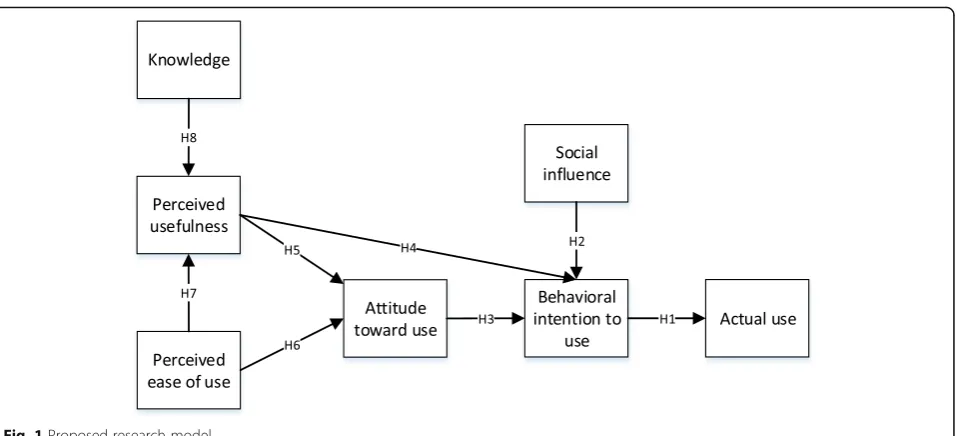
pro-posed research framework is shown in Fig.1. There are
7 constructs, specifically, actual use, attitude toward use, behavioral intention to use, knowledge, perceived ease of use, perceived usefulness, social influence with 32 items. The hypotheses are developed based on the literature.
Technology acceptance model
The technology acceptance model is currently a
com-mon predictive tool for testing the users’acceptance of
new technologies in various industries including health-care, education, e-commerce, etc. [8]. TAM, which
de-scribes users’ behavior towards information technology
adoption, is a model emerging from theory of reasoned action (TRA) [9]. TAM consists of the following factors, i.e., constructs, which can be utilized to solve any tech-nology acceptance problems: actual system use, behav-ioral intention to use, attitude towards use, perceived usefulness, perceived ease of use and external variables. According to TAM, which is an information systems theory, perceived usefulness (PU) and perceived ease of use (PEU) are the primary antecedents of intention to use information technology. Moreover, it was indicated that perceived ease of use influences perceived useful-ness and attitude towards use; perceived usefuluseful-ness af-fects both attitude towards use and behavioral intention to use; attitude towards use influence behavioral intention to use which determines actual system use.
Actual use
Actual use is a measure of the frequency and intensity of the use of information technology in an individual’s work. The level of use of the new technology shows the use of the system and the acceptance of the technology. To get more benefits from the B-flow USG, surely the system usage needs to increase. So, this helps the physicians to achieve their goals for execution of B-flow USG [10].
Behavioral intention to use
Behavioral intention means“the degree to which a
perform some specified future behavior” [11]. It is
de-fined as“a behavioral tendency of people to keep using a
certain technology” [8]. It is a determinant of the
possi-bility that an individual will be engaged in a certain be-havior [12]. The more a person is willing to use a system, the higher is his or her likelihood of using it [13]. In the current study, since the usage of B-flow USG is done of one’s own fee will, finding out the determi-nants of behavioral intention to use B-flow USG is im-portant for the actual use of it. Earlier work have described the impact of behavioral intention on actual use. As a result, it was hypothesized as follows:
H1. Behavioral intention has a positive relationship with actual use ofB-flow USG.
Social influence
Social influence refers to “a person’s perception that
most people who are import to him think he should or
should not perform the behavior in question”[14]. Social
influence, which affects the behavioral intention directly is denoted as subjective norm in TRA and Extended TAM, and it is represented as social factors in Model of PC Utilization. Social influence is crucial merely in the initial periods of personal experimentation with the technology. It is indicated that social influence affects behavioral intention positively [11,15]. Users will intend to use B-flow USG if their families, friends and peers use it or recommend using it. As a result, it was hypothe-sized as follows:
H2. Social influence has a positive relationship with behavioral intention to useB-flow USG.
Attitude toward use
Attitude refers to “individual’s positive or negative
feel-ings about performing the target behavior” [14, 16]. In
other words, it is the person’s behavior for a service or a product. Based on the TRA, behavioral intention to use is affected by the attitude toward behavior and subjective norms. In accordance with the TAM, perceived useful-ness and attitude toward use determine the behavioral intention to use. Several researches have shown the im-pact of attitude toward use on behavioral intention to
use, which is significant [15, 17–20]. As a result, it was
hypothesized as follows:
H3. Attitude toward use has a positive relationship with behavioral intention to useB-flow USG.
Perceived usefulness
Perceived usefulness is“the degree to which an
individ-ual believes that using a particular system would
en-hance his or her job performance”[8]. Put differently, it
means that B-flow USG usage will improve the product-ivity of the user and ultimately result in being more effi-cient and accurate [21]. In the original technology acceptance model, perceived usefulness is a key factor affecting behavioral intention to use [16]. Several re-searches in various areas verifies the effect of perceived usefulness on the behavioral intention to use and
atti-tude toward use [18, 22–24]. Thus, in addition to
vari-ous application areas, the effect of perceived usefulness on behavioral intention to use B-flow USG may be crit-ical. As a result, it was hypothesized as follows:
H4. Perceived usefulness has a positive relationship with behavioral intention to useB-flow USG.
In the original TAM, not only perceived usefulness but also perceived ease of use are affecting attitude toward use. Moreover, perceived usefulness and attitude toward use affect behavioral intention to use [8]. A user who thinks that B-flow USG usage improves his or her per-formance has an optimistic attitude toward use B-flow USG. Several research have demonstrated the positive and significant relationship between perceived usefulness
and attitude toward use [8,18,25,26]. Hence, it was
hy-pothesized as follows:
H5. Perceived usefulness has a positive relationship with attitude toward useB-flow USG.
Perceived ease of use
Perceived ease of use is “the degree to which a person
believes that using a particular system would be free of effort” [8]. Alias, it is a sign of the intellectual strength necessary for learning and using an information system [27]. Both perceived usefulness and perceived ease of use are affecting attitude toward use in the original TAM. A user who thinks that using the B-flow USG would be easy has an optimistic attitude toward use B-flow USG. Therefore, it was hypothesized as follows:
H6. Perceived ease of use has a positive relationship with attitude toward useB-flow USG.
If all other factors are held constant, the easier the sys-tem, the higher the user’s job performance is, the more useful it can be [28]. Users may not feel confident with a new system, since they do not have the necessary skills and comfort. Nevertheless, after gaining a certain amount of knowledge and being more familiar with it, their perception of its ease of use may change [29]. If using B-flow USG is easy, people may not need to waste time to find out how to use them. Research in various fields has confirmed the significant effect of perceived
ease of use on perceived usefulness [11, 18, 19, 25, 30].
Thus, it was hypothesized as follows:
H7. Perceived ease of use has a positive relationship with perceived usefulness ofB-flow USG.
Knowledge
Understanding of a technology is considered to be a learned behavior according to the Theory of Reasoned Action [14]. Therefore, it ought to track the growth of knowledge via experimentation. Although several TAM studies evaluate user knowledge directly, there are many research have utilized experimentation to represent knowledge [31]. the following research mainly studies
practical knowledge, through evaluating users’
estima-tions of their individual comparative expertise with
technology [32]. Earlier research has verified that the knowledge has a positive effect on perceived usefulness [33]. Therefore, it was hypothesized as follows:
H8. Knowledge has a positive relationship with perceived usefulness ofB-flow USG.
Methods Survey design
This study depends on information collected from B-flow USG users. A survey methodology was conducted to collect the data and to validate the conceptual model proposed in this research. The sample was drawn from the medical doctors including radiologists, urologists, gynecologists, pediatric surgeons.
The survey consisted of three parts. The first part in-cluded the cover letter and informed consent statement. The second part consisted of the questions related to demographics, such as age, gender, B-flow USG experi-ence, etc.. The third part consisted of the questions re-lated to the TAM and additional items assessing knowledge and social influence. The survey did not con-tain any personal information that could potentially spe-cify the identity of a particular respondent.
Data collection
For the aim of the research, the data was collected through online surveys. The objective of the study and background on the research were provided to the partic-ipants, and they are encouraged to participate. So as to evaluate the acceptance of B-flow USG, a survey of all users was preferred.
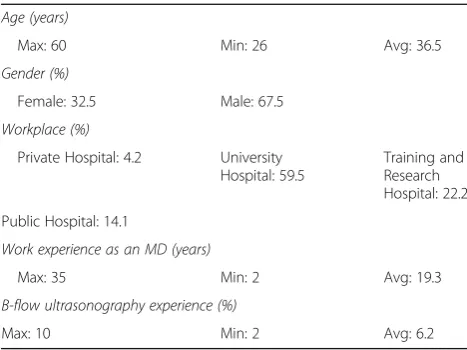
A total of 528 surveys were collected from partici-pants, and 512 of them were used in the analysis, which is adequate since, as a rule of thumb, the sample size re-quired for factor analysis should be at least four or five times of the number of items [34]. Overall, 67.5% of the respondents were male, and the average age of the par-ticipants was 36.5. Of the respondents, 59% of them is working at university hospitals and average B-flow USG experience is 6.2 years. The summary of demographic
in-formation of the participants is provided in Table1.
Measurement development
for the construct perceived ease of use (e.g., PEU01,
PEU2,…, PEU06) were taken from [8,16, 36]. The seven
items to measure the construct perceived usefulness (e.g.,
PU01, PU02, …, PU07) were taken from [8, 16, 36]. The
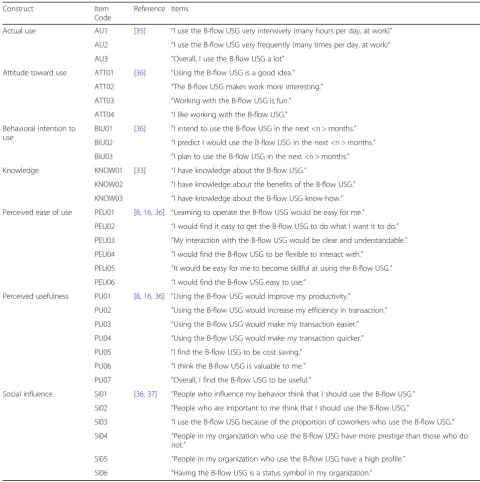
six items for the construct social influence (e.g., SI01, SI02,…, SI06) were taken from [36,37]. The details of the constructs and items are provided in Table2.
Data analysis
In this study, a multivariate analysis method, specifically, the partial least squares structural equation modeling (PLS-SEM), is used to test and validate the proposed model. This modeling approach enables researchers to explicate relatively new circumstance from measures and models even in the lack of theoretical background. The PLS-SEM, which was used in similar research in the lit-erature, provides accurate estimations even the data is not normally distributed [38]. The SmartPLS 3.2.7 soft-ware was used to perform the PLS-SEM technique and the do the analyses.
Results
Measurement model
In order to test the measurement model’s psychometric features, confirmatory factor analysis (CFA) was per-formed. The construct reliability and validity of the con-structs were evaluated reviewing the content validity, convergent validity and discriminant validity of the con-structs. The content validity was evaluated through cor-responding literature and pilot testing the scale [39]. The convergent validity was assessed by item reliability
of each measure, Cronbach’s alpha, composite reliability
(CR) of each construct and the average variance ex-tracted (AVE) [39–41].
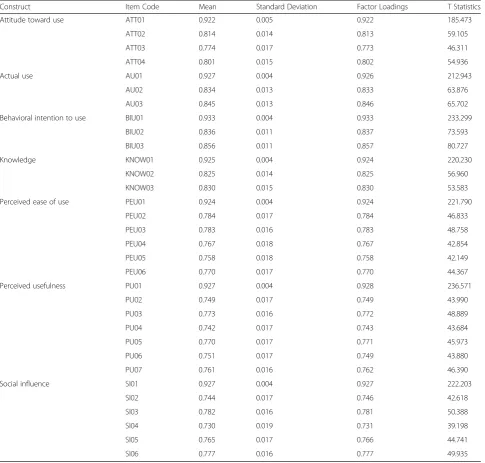
The item reliability of a measure is evaluated by its fac-tor loadings which represent the correlation between each item and the respective construct. The recommended
values for factor loadings is at least 0.6 [34, 41]. As
pro-vided in Table 3, the factor loadings of all the items are
above 0.7 which proves convergent validity at the item level; therefore, none of the items had to be removed from the proposed research model. Moreover, the results show that all of the items have significant t-statistics (p< 0.05).
At the construct level, the reliability was evaluated by measuring the Cronbach’s alpha and composite
reliabil-ity values (Table4). The Cronbach’s alpha quantifies the
level of internal consistency of constructs, and the
higher is the better. It was suggested that Cronbach’s
alpha values above 0.7 should be considered good [41]. In this study, the Cronbach’s alpha values of each con-struct exceed the threshold, which implies that each of the construct has a good internal consistency. The
com-posite reliability denotes “the shared variance among a
set of observed variables measuring an underlying
con-struct” [41]; in other words, how well the items measure
a construct. The CR values for the corresponding mea-sures varied between 0.895 and 0.917, exceeding the
rec-ommended value of 0.7 [41,42].
Average variance extracted is the last measure of
con-vergent validity; it indicates “the variance captured by
the construct in relation to the amount of variance at-tributable to measurement error”, and the recommended value for AVE is greater than 0.5 [41,43]. The results in-dicate that the AVE values of all constructs are greater
than the recommended value 0.5 (Table 4). The
statis-tical results imply good convergent validity of the meas-urement model.
Next, the discriminant validity was assessed which mea-sures the extent to which constructs differ. Discriminant
validity at the item level exists “when an item
corre-lates more highly with items in the construct it pur-ports to measure than items belonging to other
constructs” [44, 45], which is also valid for this study.
Discriminant validity of the measurement constructs
are evaluated through “comparing the square root of
the AVE for a given construct with the correlations
between that construct and all other constructs” [46].
The correlation matrix for the constructs are
pro-vided in Table 5. Discriminant validity at the
con-struct level appears satisfactory since the diagonal elements, square roots of the AVEs, are larger than the off-diagonal elements in their corresponding rows and columns.
Structural model and hypotheses testing
Structural equation modeling is performed to check the fit between the proposed research model and the data. The reason for applying this methodology is to observe several relationships simultaneously, particularly where there are direct and indirect effects among the con-structs within the model [34].
Table 1Demographic information
Age (years)
Max: 60 Min: 26 Avg: 36.5
Gender (%)
Female: 32.5 Male: 67.5
Workplace (%)
Private Hospital: 4.2 University Hospital: 59.5
Training and Research Hospital: 22.2 Public Hospital: 14.1
Work experience as an MD (years)
Max: 35 Min: 2 Avg: 19.3
B-flow ultrasonography experience (%)
PLS-SEM through SmartPLS 3.2.7 was used in order to test the hypotheses. Non-parametric assessment cri-teria based on bootstrapping is performed with 5000
it-erations of resampling [47, 48]. Table6 summarizes the
standardized parameters (β coefficients) and the
corre-sponding t-values to measure each coefficient’s signifi-cance [38].
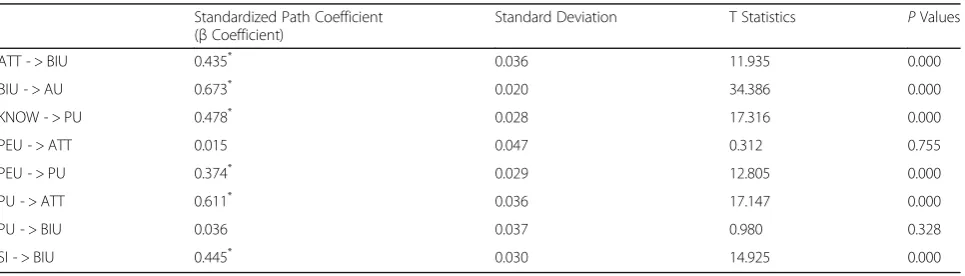
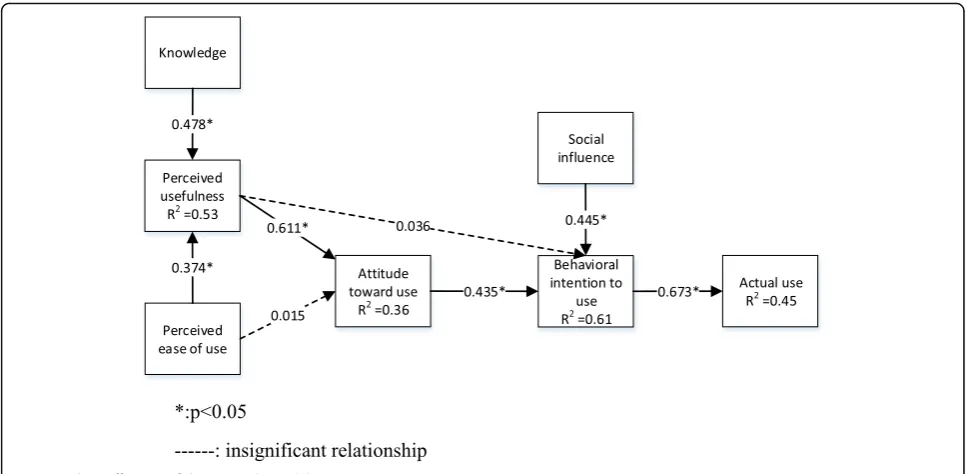
Behavioral intention to use significantly affects actual
use of B-flow USG (β= 0.673, p< 0.05; H1 supported).
Social influence and attitude toward use significantly
affect behavioral intention to use B-flow USG (β= 0.445,
p< 0.05;β= 0.435,p< 0.05; H2 and H3 supported); how-ever, the effect of perceived usefulness on behavioral intention to use B-flow USG is found to be insignificant (β= 0.036, p> 0.05; H4 not supported). Perceived useful-ness significantly influences attitude toward use B-flow
USG (β= 0.611 p< 0.05; H5 supported); on the other
hand, and perceived ease of use affects attitude toward use B-flow USG, but not significantly (β= 0.015,p> 0.05; H6 not supported). The effects of and perceived ease of use and knowledge on perceived usefulness are signifi-cant (β= 0.374, p< 0.05; β= 0.478, p< 0.05; H7 and H8 Table 2Constructs, codes, references and items
Construct Item Code
Reference Items
Actual use AU1 [35] “I use the B-flow USG very intensively (many hours per day, at work)” AU2 “I use the B-flow USG very frequently (many times per day, at work)” AU3 “Overall, I use the B-flow USG a lot”
Attitude toward use ATT01 [36] “Using the B-flow USG is a good idea.” ATT02 “The B-flow USG makes work more interesting.” ATT03 “Working with the B-flow USG is fun.” ATT04 “I like working with the B-flow USG.” Behavioral intention to
use
BIU01 [36] “I intend to use the B-flow USG in the next <n > months.” BIU02 “I predict I would use the B-flow USG in the next <n > months.” BIU03 “I plan to use the B-flow USG in the next <n > months.” Knowledge KNOW01 [33] “I have knowledge about the B-flow USG.”
KNOW02 “I have knowledge about the benefits of the B-flow USG.” KNOW03 “I have knowledge about the B-flow USG know-how.” Perceived ease of use PEU01 [8,16,36] “Learning to operate the B-flow USG would be easy for me.”
PEU02 “I would find it easy to get the B-flow USG to do what I want it to do.” PEU03 “My interaction with the B-flow USG would be clear and understandable.” PEU04 “I would find the B-flow USG to be flexible to interact with.”
PEU05 “It would be easy for me to become skillful at using the B-flow USG.” PEU06 “I would find the B-flow USG easy to use.”
Perceived usefulness PU01 [8,16,36] “Using the B-flow USG would improve my productivity.”
PU02 “Using the B-flow USG would increase my efficiency in transaction.” PU03 “Using the B-flow USG would make my transaction easier.” PU04 “Using the B-flow USG would make my transaction quicker.” PU05 “I find the B-flow USG to be cost saving.”
PU06 “I think the B-flow USG is valuable to me.” PU07 “Overall, I find the B-flow USG to be useful.”
Social influence SI01 [36,37] “People who influence my behavior think that I should use the B-flow USG.” SI02 “People who are important to me think that I should use the B-flow USG.”
SI03 “I use the B-flow USG because of the proportion of coworkers who use the B-flow USG.” SI04 “People in my organization who use the B-flow USG have more prestige than those who do
not.”
Table 3Confirmatory factor analysis
Construct Item Code Mean Standard Deviation Factor Loadings T Statistics Attitude toward use ATT01 0.922 0.005 0.922 185.473
ATT02 0.814 0.014 0.813 59.105 ATT03 0.774 0.017 0.773 46.311 ATT04 0.801 0.015 0.802 54.936 Actual use AU01 0.927 0.004 0.926 212.943
AU02 0.834 0.013 0.833 63.876 AU03 0.845 0.013 0.846 65.702 Behavioral intention to use BIU01 0.933 0.004 0.933 233.299
BIU02 0.836 0.011 0.837 73.593 BIU03 0.856 0.011 0.857 80.727 Knowledge KNOW01 0.925 0.004 0.924 220.230
KNOW02 0.825 0.014 0.825 56.960 KNOW03 0.830 0.015 0.830 53.583 Perceived ease of use PEU01 0.924 0.004 0.924 221.790
PEU02 0.784 0.017 0.784 46.833 PEU03 0.783 0.016 0.783 48.758 PEU04 0.767 0.018 0.767 42.854 PEU05 0.758 0.018 0.758 42.149 PEU06 0.770 0.017 0.770 44.367 Perceived usefulness PU01 0.927 0.004 0.928 236.571
PU02 0.749 0.017 0.749 43.990 PU03 0.773 0.016 0.772 48.889 PU04 0.742 0.017 0.743 43.684 PU05 0.770 0.017 0.771 45.973 PU06 0.751 0.017 0.749 43.880 PU07 0.761 0.016 0.762 46.390 Social influence SI01 0.927 0.004 0.927 222.203
SI02 0.744 0.017 0.746 42.618 SI03 0.782 0.016 0.781 50.388 SI04 0.730 0.019 0.731 39.198 SI05 0.765 0.017 0.766 44.741 SI06 0.777 0.016 0.777 49.935
Table 4Construct reliability and validity for the measurement model
Constrtuct Cronbach’s Alpha Composite Reliability (CR) Average Variance Extracted (AVE)
ATT 0.848 0.898 0.688
AU 0.839 0.903 0.756
BIU 0.849 0.909 0.769
KNOW 0.826 0.895 0.741
PEU 0.886 0.914 0.640
PU 0.894 0.917 0.615
supported). All the hypotheses which are supported or
not are summarized in Table7.
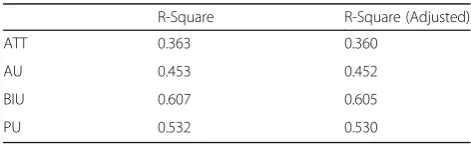
The R-square (R2) value specifies the percentage of
total variance of the dependent variable (i.e., actual use) explained by the independent variables. Among the en-dogenous constructs, behavioral intention to use has the highest amount of variance accounted by its exogenous
construct, 61% (R2= 0.607). The results further show
that proposed model explains the 36% (R2= 0.363) of
total variance of attitude toward use B-flow USG, 45%
(R2= 0.453) of total variance of actual use, 53% (R2=
0.532) of total variance of perceived usefulness, as pro-vided in Table8.
Figure2illustrates theβcoefficients and the R2values of the dependent variables. The analysis implies that be-havioral intention to use is a significant determinant of actual use of B-flow USG. It is shown that behavioral intention to use is explained by social influence and atti-tude toward use, which is consistent with the earlier lit-erature; nevertheless, the effect of perceived usefulness on behavioral intention to use B-flow USG is found to be insignificant. Perceived usefulness significantly influ-ences attitude toward use B-flow USG; on the other hand, in contrast to literature, perceived ease of use af-fects attitude toward use insignificantly. Finally, per-ceived ease of use and knowledge are found to be significant determinants of perceived usefulness.
Direct and indirect effects
Direct, indirect and total effects of each construct on the behavioral intention to use B-flow USG are provided in
Table 9. Behavioral intention to use has the highest
dir-ect and total effdir-ect on actual use of B-flow USG. Atti-tude toward use, knowledge, perceived ease of use, perceived usefulness and social influence have significant indirect effects on actual use of B-flow USG.
Further comments for this research can be crucial to foster the whole concept. In this model, perceived use-fulness and attitude toward use have intervening roles. In order to observe the relationships, new models are set up between perceived ease of use-attitude toward use and perceived usefulness-behavioral intention to use. So that, the role of perceived usefulness and attitude toward use will be seen in the implementation of extended
tech-nology acceptance model. According to the p-values
provided in Figs. 3 and 4 there are significant
relation-ships between perceived ease of use and attitude toward use, and perceived usefulness and behavioral intention to use, respectively.
Employment of PLS is to determine the effect of medi-ation, which is the strong relation between the predictor and criterion variable. In this paper, whether perceived usefulness and attitude toward use are the mediating
variables or not are identified. As illustrated in Fig. 3,
perceived ease of use has a significant direct effect on
at-titude toward use B-flow USG (β= 0.349, p< 0.05).
When perceived ease of use and perceived usefulness are regressed on attitude toward use, perceived ease of use became insignificant (β= 0.016, p> 0.05), which is case
in Fig. 3b. Hence, it can be concluded that perceived
usefulness is a mediator.
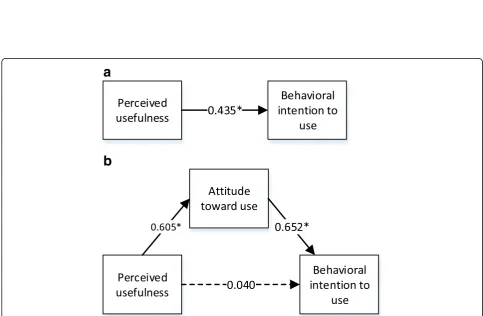
Similarly, perceived usefulness has a significant direct
effect on behavioral intention to use B-flow USG (β=
0.435, p< 0.05) (Fig. 4). When perceived usefulness and attitude toward use are regressed on behavioral intention to use B-flow USG, perceived usefulness became insig-nificant (β= 0.04, p> 0.05), which is case in Fig. 4b. Table 5Discriminant validity for the measurement model
ATT AU BIU KNOW PEU PU SI ATT 0.830
AU 0.513 0.869 BIU 0.675 0.673 0.877 KNOW 0.439 0.221 0.279 0.861 PEU 0.348 0.187 0.217 0.458 0.800 PU 0.602 0.327 0.432 0.649 0.593 0.784 SI 0.492 0.458 0.670 0.230 0.123 0.302 0.791
Table 6Path coefficients
Standardized Path Coefficient (βCoefficient)
Standard Deviation T Statistics PValues ATT - > BIU 0.435* 0.036 11.935 0.000 BIU - > AU 0.673* 0.020 34.386 0.000 KNOW - > PU 0.478* 0.028 17.316 0.000 PEU - > ATT 0.015 0.047 0.312 0.755 PEU - > PU 0.374* 0.029 12.805 0.000 PU - > ATT 0.611* 0.036 17.147 0.000 PU - > BIU 0.036 0.037 0.980 0.328 SI - > BIU 0.445* 0.030 14.925 0.000
*
Hence, it can be concluded that attitude toward use is a mediator.
Discussion
The early period of a radiological assessment of intense abdominal torment in the pediatric age gather caused by the contorted pedicle in ovarian torsion stays testing [49]. In the mid-1990s, most specialists recommended that the visual evaluation of contorted adnexial struc-tures and color change in the ovaries pictured by ex-ploratory laparotomy or a laparoscopic strategy is the best quality level for the choice to continue with the medical procedure [4]. Be that as it may, it was proposed that visual finding amid laparoscopy could be misdirect-ing [1]. Today, it is concurred that discoveries of clinical assessment, ultrasonography and attractive reverberation imaging (X-ray) help choice to continue with the med-ical procedure. The patient history and the palpation of a mass in the lower abdominal segment may propose the likelihood of torsion, however ultrasonography is im-perative for the differential determination from other clinical pathologies [1]. The assessment of the veins in the hilus locale is trying in the non-intrusive radiological examination.
The color Doppler is generally utilized for the ultra-sonographic assessment of the ovarian tissue and the veins, and as of late, B-flow USG gave tasteful outcomes
to the appraisal of blood flow rate and speed [49, 50].
The sonographic window and ancient rarities are con-straints in the assessment of veins with color Doppler USG in the intense stage, however these impediments
were overwhelmed by utilizing B-flow USG [7,51,52].
The proposed research model explains 45% of total variance of actual use of B-flow USG. A path analysis in-dicated that the majority results are consistent with the information system literature by showing that perceived usefulness, perceived ease of use, attitude toward use and behavioral intention to use are the significant deter-minants (direct or indirect) of actual use of B-flow USG. In addition to the TAM constructs, two external factors social influence and knowledge are also significant in
predicting peoples’actual use of B-flow USG.
This study contributes to recent research that found behavioral intention to use to be key determinant of ac-tual use of B-flow USG. Next, it has been shown that so-cial influence and attitude toward use are significant factors affecting the behavioral intention to use B-flow USG. Moreover, perceived usefulness has significant ef-fect on attitude toward use B-flow USG. The results of the proposed model highlights knowledge and perceived ease of use as significant factors influencing perceived usefulness of B-flow USG.
The current research also shows that perceived useful-ness is not affecting behavioral intention to use signifi-cantly; however, it affects behavioral intention to use indirectly attitude toward use. Similarly, perceived ease of use is not a significant determinant of attitude toward use B-flow USG; however, it affects attitude toward use indirectly through perceived usefulness. In addition, ceived usefulness mediates the relationship between per-ceived ease of use and attitude toward use, and attitude toward use mediates the relationship between perceived usefulness and behavioral intention to use B-flow USG.
Implications
The findings of this research provide also useful infer-ences for stakeholders including B-flow USG users, hos-pital managers, investors, manufacturers and suppliers to recognize the perception toward the acceptance and adoption of B-flow USG. The decision makers need to recognize the constructs of the model that were tested in this paper.
Table 7Summary of hypotheses
Hypothesis Path Hypothesis Supported H1 BIU - > AU “Behavioral intention to use has a positive effect on actual use of B-flow USG.” Yes H2 SI - > BIU “Social influence has a positive effect on behavioral intention to use B-flow USG.” Yes H3 ATT - > BIU “Attitude toward use has a positive effect on behavioral intention to use B-flow USG.” Yes H4 PU - > BIU “Perceived usefulness has a positive effect on behavioral intention to use B-flow USG.” No H5 PU - > ATT “Perceived usefulness has a positive effect on attitude toward use B-flow USG.” Yes H6 PEU- > ATT “Perceived ease of use has a positive effect on attitude toward use B-flow USG.” No H7 PEU - > PU “Perceived ease of use has a positive effect on perceived usefulness of B-flow USG.” Yes H8 KNOW- > PU “Knowledge has a positive effect on perceived usefulness of B-flow USG.” No
Table 8R-Square values
R-Square R-Square (Adjusted) ATT 0.363 0.360
The most noticeable aspect of this model is that social influence, knowledge, perceived ease of use, perceived usefulness, attitude towards use and behavioral intention to use are determinants of actual use B-flow USG. Among them, behavioral intention to use and social in-fluence have the strongest impact on actual use of B-flow USG.
Social influence has been found to be a significant in-direct determinant of actual use B-flow USG. The opin-ions of colleagues and peers may be very important among the users of B-flow USG. The physicians, hospital managements and medical communities can take an op-timistic position toward system adoption. If the B-flow USG users are appreciated for their system use, the po-tential users might be motivated to use the it.
Another noticeable aspect of the results is that know-ledge, perceived ease of use and perceived usefulness has indirect effects on intention to use B-flow USG, which indicates that users tend to rate B-flow USG useful if they have knowledge about and find easy to use it. In
other words, physicians are likely to use B-flow USG more if they believe that using the system will increase their performance and productivity. Therefore, for B-flow USG to be successful, developers need to focus their attention on sufficient training programs, designing not only useful but also easy to use.
Limitations and future research directions
Although the findings of the present study contribute to a better understanding of the factors that affect behav-ioral intention to use B-flow USG, there are several limi-tations to this study, which offers an opportunity for future research. Firstly, the current results cannot be generalized to the wider population due to the fact that the sample was obtained from physicians in Turkey. The findings might change if the model is retested in a differ-ent region. Any generalization of the results to other context should be made with caution although they are relatively reflecting the medical imaging technology. Sec-ondly, demographic information that were collected
Table 9Direct, indirect and total effects on actual use of B-flow USG
Dependent Variable
Independent Variables
Direct Effects
Indirect Effects
Total Effects
PValues Actual use of B-flow USG ATT – 0.293* 0.293* 0.000
BIU 0.673* – 0.673* 0.000 KNOW – 0.097* 0.097* 0.000 PEU – 0.072* 0.072* 0.000 PU – 0.203* 0.203* 0.000 SI – 0.300* 0.300* 0.000
*p< 0.05
a
b
Fig. 3aStandardized parameters of direct effects.bStandardized parameters of indirect effects (mediation effect of perceived usefulness)
a
b
through survey was not used as a factor in the proposed research model. As a future research, demographic char-acteristics including gender, age, education level or em-ployment, can be incorporated in the model. Thirdly, even though some portion of the dependent variables are explained, 61% of behavioral intention to use is ex-plained in the research model. Therefore, as a future re-search, further constructs may be taken into account that might be important in explaining behavioral intention to use B-flow USG. Lastly, this research can be integrated with qualitative study to understand and to explain the behavioral intention to use B-flow USG due to the fact that qualitative and quantitative aspects may complement each other to offer a better understanding.
Conclusions
This paper aims to investigate the acceptance of a med-ical imaging technology, B-flow USG using the
Technol-ogy Acceptance Model as the main theoretical
framework, and integrate key determinants, including knowledge and social influence. A total of 528 surveys were collected from the medical doctors including radi-ologists, urradi-ologists, gynecradi-ologists, pediatric surgeons be-tween June and October 2018, and 512 of the surveys were used in the analysis. So as to investigate the pro-posed research model, structural equation modeling using partial least squares methodology was conducted, which is widely used in several disciplines. SmartPLS software was utilized to analyze the collected data. This study enables both practical and theoretical implications for B-flow USG use. To the best of knowledge, this study is the first comprehensive study to integrate the con-structs mentioned above to examine the antecedents of B-flow USG acceptance.
Abbreviations
ATT:Attitude toward use; AU: Actual use; AVE: Average variance extracted; BIU: Behavioral intention to use; CFA: Confirmatory factor analysis;
CR: Composite reliability; KNOW: Knowledge; PEU: Perceived ease of use; PLS-SEM: Partial least squares structural equation modeling; PU: Perceived usefulness; SEM: Structural equation modeling; SI: Social influence; TAM: Technology acceptance model; TRA: Theory of reasoned action; USG: Ultrasonography
Acknowledgements
Not applicable.
Authors’contributions
GHK was responsible for study design, data collection, analyzing the data, and preparing the manuscript. The author read and approved the final manuscript.
Funding
This research did not receive any specific funding or grants from funding agencies in the public, commercial, or not-for-profit sectors.
Availability of data and materials
The datasets used and analyzed during the current study are available from the corresponding author on reasonable request.
Ethics approval and consent to participate
Ethical approval was issued by the Social Sciences and Human Research Ethics Committee of the Istanbul Technical University (Project Number:79). Informed consent was obtained from all participants prior to the survey.
Consent for publication
Not applicable.
Competing interests
The author declares that she has no competing interest.
Received: 14 January 2019 Accepted: 30 June 2019
References
1. Hibbard LT. Adnexal torsion. Am J Obstet Gynecol. 1985;152(4):456–61 PubMed PMID: 4014339.
2. Rock J, Thompson J. Surgery for benign disease of the ovary. Oper Gynecol; 2003. p. 648–9.
3. Moravec WD, Angerman NS, Reale FR, Hajj SN. Torsion of the uterine adnexa: a clinicopathologic correlation. Int J Gynaecol Obstet. 1980;18(1):7– 14 PubMed PMID: 6106607.
4. Baker TE, Copas PR. Adnexal torsion. A clinical dilemma. J Reprod Med. 1995;40(6):447–9 PubMed PMID: 7650658.
5. Başaklar AC. Bebek ve çocukların cerrahi ve ürolojik hastalıkları. Ankara: Palme Yayıncılık; 2006. p. 1765–86.
6. Chiao RY, Mo LY, Hall AL, Miller SC, Thomenius KE. B-mode blood flow (B-flow) imaging. Ultrason. 2000:1469–72 PubMed PMID: WOS:
000171881300323.
7. HançerlioğullarıKÖ, Soyer T, Tosun A, HançerlioğullarıG. Is B-flow USG superior to color Doppler USG for evaluating blood flow patterns in ovarian torsion? J Pediatr Surg. 2015;50(7):1156–61.
8. Davis FD. Perceived usefulness, perceived ease of use, and user acceptance of information technology. MIS Q. 1989:319–40.
9. Ajzen I, Fishbein M. Attitude-behavior relations: a theoretical analysis and review of empirical research. Psychol Bull. 1977;84(5):888.
10. Nwankpa JK. ERP system usage and benefit: a model of antecedents and outcomes. Comput Hum Behav. 2015;45:335–44.
11. Venkatesh V, Davis FD. A theoretical extension of the technology acceptance model: four longitudinal field studies. Manag Sci. 2000;46(2): 186–204.
12. Ajzen I, Fishbein M. Understanding attitudes and predicting social behaviour; 1980.
13. Azen I, Madden T. Prediction of goal directed behaviour: attitudes, intentions and perceived behavioural control; 1986.
14. Fishbein M, Ajzen I. Belief, attitude, intention and behavior: an introduction to theory and research1975.
15. Karaali D, Gumussoy CA, Calisir F. Factors affecting the intention to use a web-based learning system among blue-collar workers in the automotive industry. Comput Hum Behav. 2011;27(1):343–54.
16. Davis FD, Bagozzi RP, Warshaw PR. User acceptance of computer technology: a comparison of two theoretical models. Manag Sci. 1989;35(8): 982–1003.
17. Ahn T, Ryu S, Han I. The impact of web quality and playfulness on user acceptance of online retailing. Inf Manag. 2007;44(3):263–75.
18. Calisir F, Altin Gumussoy C, Bayram A. Predicting the behavioral intention to use enterprise resource planning systems: an exploratory extension of the technology acceptance model. Manag Res News. 2009;32(7):597–613. 19. Lee M-C. Factors influencing the adoption of internet banking: an
integration of TAM and TPB with perceived risk and perceived benefit. Electron Commer Res Appl. 2009;8(3):130–41.
20. Teo T, Noyes J. An assessment of the influence of perceived enjoyment and attitude on the intention to use technology among pre-service teachers: a structural equation modeling approach. Comput Educ. 2011;57(2):1645–53. 21. Mahindroo A, Singh H, Samalia HV. AWERProcedia Information Technology
& Computer Science. World. 2012;14:16.
23. Venkatesh V. Determinants of perceived ease of use: integrating control, intrinsic motivation, and emotion into the technology acceptance model. Inf Syst Res. 2000;11(4):342–65.
24. Venkatesh V, Morris MG. Why don't men ever stop to ask for directions? Gender, social influence, and their role in technology acceptance and usage behavior. MIS Q. 2000:115–39.
25. Lin W-B. Investigation on the model of consumers’perceived risk—integrated viewpoint. Expert Syst Appl. 2008;34(2):977–88.
26. Liu S-H, Liao H-L, Pratt JA. Impact of media richness and flow on e-learning technology acceptance. Comput Educ. 2009;52(3):599–607.
27. Arasanmi CN, Wang WYC, Singh H. Examining the motivators of training transfer in an enterprise systems context. Enterp Inf Syst. 2017;11(8): 1154–72.
28. Davis FD. User acceptance of information technology: system characteristics, user perceptions and behavioral impacts. Int J Man Mach Stud. 1993;38(3): 475–87.
29. Hackbarth G, Grover V, Mun YY. Computer playfulness and anxiety: positive and negative mediators of the system experience effect on perceived ease of use. Inf Manag. 2003;40(3):221–32.
30. Oh S, Ahn J, Kim B. Adoption of broadband internet in Korea: the role of experience in building attitudes. J Inf Technol. 2003;18(4):267–80. 31. Agarwal R, Prasad J. Are individual differences germane to the acceptance
of new information technologies? Decis Sci. 1999;30(2):361–91. 32. Venkatesh V, Davis FD. A model of the antecedents of perceived ease of
use: development and test. Decis Sci. 1996;27(3):451–81.
33. Kumpajaya A, Dhewanto W. The acceptance of bitcoin in Indonesia: extended TAM with IDT. J Bus Manag. 2015;4(1):28–38.
34. Hair JF, Black WC, Babin BJ, Anderson RE, Tatham RL. Multivariate data analysis (Vol. 6). Upper Saddle River, NJ: Pearson Prentice Hall; 2006. 35. Elkhani N, Soltani S, Nazir Ahmad M. The effects of transformational
leadership and ERP system self-efficacy on ERP system usage. J Enterp Inf Manag. 2014;27(6):759–85.https://doi.org/10.1108/JEIM-06-2013-0031. 36. Venkatesh V, Morris MG, Davis GB, Davis FD. User acceptance of information
technology: toward a unified view. MIS Q. 2003:425–78.
37. Moore GC, Benbasat I. Development of an instrument to measure the perceptions of adopting an information technology innovation. Inf Syst Res. 1991;2(3):192–222.
38. Hair JF, Sarstedt M, Ringle CM, Mena JA. An assessment of the use of partial least squares structural equation modeling in marketing research. J Acad Mark Sci. 2012;40(3):414–33.
39. Sheikh Z, Islam T, Rana S, Hameed Z, Saeed U. Acceptance of social commerce framework in Saudi Arabia. Telematics Inform. 2017;34(8):1693–708. 40. Anderson JC, Gerbing DW. Assumptions and comparative strengths of the
two-step approach: comment on Fornell and Yi. Sociol Methods Res. 1992; 20(3):321–33.
41. Fornell C, Larcker DF. Evaluating structural equation models with unobservable variables and measurement error. J Mark Res. 1981:39–50. 42. Peterson RA, Kim Y. On the relationship between coefficient alpha and
composite reliability. J Appl Psychol. 2013;98(1):194.
43. Fisher MT. A theory of viral growth of social networking sites: Case Western Reserve University; 2013.
44. Barclay D, Higgins C, Thompson R. The partial least squares (pls) approach to casual modeling: Personal Computer Adoption Ans Use as an Illustration1995.
45. Kwok D, Yang S. Evaluating the intention to use ICT collaborative tools in a social constructivist environment. Int J Educ Technol High Educ. 2017;14(1):32. 46. Baharum HIB. Learning business English in virtual worlds: effectiveness and acceptance in a Malaysian context: a thesis submitted in partial fulfilment of the requirements for the degree of doctor of philosophy in management information Systems at Massey University. Palmerston North: Massey University; 2013.
47. Chin WW. Commentary: issues and opinion on structural equation modeling: JSTOR; 1998.
48. Henseler J, Ringle CM, Sinkovics RR. The use of partial least squares path modeling in international marketing. New challenges to international marketing: Emerald Group Publishing Limited; 2009. p. 277–319. 49. De Rosa P, Russo E, Cerbone V. Post-tx renal monitoring with B-flow
ultrasonography. In: Kidney transplantation-new perspectives: InTech; 2011. 50. Shadinger LL, Andreotti RF, Kurian RL. Preoperative sonographic and clinical
characteristics as predictors of ovarian torsion. J Ultrasound Med. 2008;27(1): 7–13.
51. Servaes S, Zurakowski D, Laufer MR, Feins N, Chow JS. Sonographic findings of ovarian torsion in children. Pediatr Radiol. 2007;37(5):446–51.
52. Wang YH, Zheng QC, Yuan GX, Ren JH. The application of ultrasound B-flow imaging in detection of carotid atherosclerotic micro-vessel with ischemic cerebrovascular disease. Saudi Med J. 2012;33(10):1080–6.
Publisher’s Note