R E S E A R C H A R T I C L E
Open Access
Experiencing aging or demystifying myths?
–
impact of different
“
geriatrics and
gerontology
”
teaching strategies in first
year medical students
Alessandra Lamas Granero Lucchetti
1*, Giancarlo Lucchetti
1*, Isabella Noceli de Oliveira
2,
Alexander Moreira-Almeida
2and Oscarina da Silva Ezequiel
3Abstract
Background:With the aging of the population comes a greater need for geriatric and gerontology teaching. However, there is currently a dearth of investigations on the impact of different educational methodologies for teaching in this area early in medical courses. The present study aims to determine the impact of two educational strategies on the topic“Geriatrics and Gerontology”(“experiencing aging”and“myths of aging”) as compared to a control group (no intervention) on the attitudes, empathy and knowledge of first year medical students.
Methods:An intervention-based study in education was conducted at the beginning of the first year of a medical course. Students submitted to educational strategies were compared against students with no intervention. The two strategies were:“Experiencing Aging” –also known as the“aging game”(simulation of the disabilities and physiological changes of aging), and“Myths of Aging”- a knowledge discussion based on a“quiz show”, questioning common myths about aging. All students were assessed on their attitudes towards older persons (Maxwell-Sullivan, UCLA attitudes), empathy (Maxwell-Sullivan), knowledge on facts and positive view about aging (Palmore), and cognitive knowledge. Data were analysed using Student’st, Chi-squared or ANOVA tests.
Results:A total of 230 students were assessed. The“experiencing aging”intervention was associated with improvement in empathy but worsening of attitude. The“myths of aging”intervention was associated with an improved attitude overall and positive view about aging but with no change in empathy towards older persons.
Conclusion:Educational strategies can influence the attitudes and empathy of students, leading to different outcomes. These data highlight the importance of assessing the outcomes of educational strategies in medical teaching to ascertain in what manner (how), situations (when) and settings (where) these activities should be introduced.
Keywords:Medical education, Geriatrics, Medicine, Older people care
* Correspondence:[email protected];[email protected] 1Division of Geriatrics, School of Medicine, Federal University of Juiz de Fora,
Av. Eugenio do Nascimento s/n, Bairro Dom Bosco, Juiz de Fora, Brazil Full list of author information is available at the end of the article
Background
Population aging is a global reality, with estimates pro-jecting that 22% of the world population will be older adults by 2050 [1]. This rapid demographic transition poses new challenges in medicine, such as managing comorbidities, chronic diseases, understanding physio-logical changes of aging, recognizing different pharma-cokinetics and pharmacodynamics and their implications for prescribing, institutionalization, palliative care, as well as ethical and legal dilemmas [2].
This scenario means that medical students and doc-tors, irrespective of specialty, need to develop specific Geriatrics and Gerontology competencies to meet the health needs of the older population [3–5]. To this end, many international medical schools have proposed a cur-riculum which covers these areas [6, 7] along with guidelines requiring a minimum geriatrics content for medical students [2].
However, a consensus is currently lacking on how and when the subject should be introduced into medical train-ing courses. Tullo et al. [8] conducted a systematic review assessing “Geriatrics and Gerontology” teaching strategies for undergraduate medical students. Nevertheless, the re-sults were mixed and further evidence is required on the use of these strategies to modify students’ behavior. An-other noteworthy point is that, even after specific educa-tional interventions, students’ attitudes toward elderly worsened over ensuing years, pointing to the need for lon-gitudinal exposures which begin early in the curriculum [9]. The reasons for such worsening are not totally under-stood. The most probable one is the fact that there is a stereotype against older people (ageism) by physicians and health professionals and, this stereotyped view, is taught to the students during the medical course. In other words, the older person is viewed as cognitive im-paired, physical dependent and with emotional problems [10]. A recent systematic review [11] showed that stu-dents show little interest in the area of geriatrics driven by the low exposure and complexity of older patients, low financial return and low status, preferring careers which have acute somatic illness than chronic ones. Same results were found by Bagri et al. [12] who found that medical students were depressed by the decline and death of their older patients, were concerned about patients’ unrealistic expectations and opportunities for litigation, felt unsure how to handle ethical dilemmas, and found communicating with older adults to be enjoyable but time consuming and challenging.
In this context, discussions on Geriatrics and Geron-tology teaching should consider what, how and when to teach, since teaching and learning regimes (TLRs) can have diverse results. On one hand, some participants could embrace the strategy positively and use it to de-velop their professional practice. On the other hand,
some could express dissatisfaction or unease with it [13]. These challenges may help in the identification on how new strategies could influence the attitude and empathy of undergraduates toward the elderly at an early stage, given that they can influence future changes in behavior of these professionals.
Considering Constructivism as the“theoretical frame-work” that supports the pedagogical decisions of our medical school curriculum, we felt the necessity of using active strategies in the early phases of the medical course in order to discuss the questions related to aging. For that purpose, ludic strategies, which are a type of experi-ential learning where learner “engages in some activity, looks back at the activity critically, abstracts some useful insight from the analysis and puts the results to work
“were chosen [14, 15]. These strategies are based in a transformative learning theory, which is founded on both humanist and constructivist perspectives [16]. Ac-cording to Mezirow [17]: “Transformative learning is learning that transforms problematic frames of referen-ce—sets of fixed assumptions and expectations (habits of mind, meaning perspectives, mindsets)—to make them more inclusive, discriminating, open, reflective, and emo-tionally able to change”
There are many types of games used in medical educa-tion, such as virtual environments, alternative reality games, simulations and social-cooperative play. A number of studies have been suggesting beneficial effects of using educational games in learning. However, a recent system-atic review [18] was inconclusive and asked for additional and better designed studies to assess the effectiveness of these games. Particularly in the field of geriatrics, other systematic review [14] showed that the most commonly used strategies in the scientific literature was the “aging game” (simulation of the disabilities and physiological changes of aging), although results have been conflicting. Other studies have also used interactive games and com-petitions (social-cooperative play).
Although there is an increasing interest in active learn-ing through educational games and in the necessity of teaching students about geriatrics and in changing their attitudes towards older adults, there are few studies which assessed and compared how these educational strategies could impact first-year medical students. If we could change students’ views in the beginning of the course, it may be possible to reverse the ageism and waken their interest to follow a career in geriatrics.
Methods
Type of study and setting
An intervention-based quasi-experimental study in edu-cation was conducted at the Federal University of Juiz de Fora (UFJF), Juiz de Fora, Brazil, between July 2014 and July 2015.
Participants
During the first and second semesters of 2014, and the first semester of 2015, all students officially enrolled on the first period of the UFJF medical course were invited to take part in the study. In a pre-defined day, during a first-year course called “Integrative themes in Clinical Practice”, two faculty members (from the Division of Geriatrics) clarified the objectives of the activity, explained about the study and invited students to par-ticipate. All students who voluntarily participated in the educational activities proposed and that signed the con-sent form were included.
Instruments
The self-report questionnaire (Additional file 1) applied was based on previous studies on education in geriatrics [8], took 25 min to complete, were provided in Portuguese, and contained the following instruments:
– Questionnaires collecting sociodemographic data: gender, age, family income and semester of course.
– Basic knowledge in geriatrics: instrument devised by the researchers for assessing cognitive knowledge (using 10 multiple-choice questions on theoretical content taken from Brazilian public admissions exams for geriatricians). The content of these questions includes: inappropriate prescribing, frailty, delirium, dementia, falls, aging epidemiology, physiological changes with aging and comprehensive geriatric assessment.
– UCLA Geriatric Attitudes Test [19]: test used worldwide for assessing the attitudes of medical students and residents toward elderly patients. This instrument comprises 14 questions using a 5-point Likert response format (1 = totally disagree to 5 = to-tally agree). The higher the score on the scale, the greater number of positive attitudes held toward elderly people. Some example questions include:
“Most old people are pleasant to be with”,“As people grow older, they become less organized and more confused”. In the present study, we found a Cronbach’s alpha of 0.618.
– Facts about aging (Palmore-FAQ-1): a test used worldwide for assessing the knowledge of medical students and residents about elderly patients. The instrument comprises 25 multiple choice questions with four possible answers. An example of a
question includes:“Happiness among old people is: (a) rare, (b) less common than among younger people, (c) about as common as among younger people, (d) more common than younger people. The analysis can be done in two ways: tallying only the correct answers - for example, the answer for the question was letter (c) - or interpreting whether students have a more positive or negative view about old people (If the student answered letters (a) or (b) he/she has a more negative view about old people, if the student answered letter (d) a more positive view and if the student answered letter (c) a neutral view [20]. In the present study, we found a Cronbach’s alpha of 0.711.
– Modified Maxwell-Sullivan attitudes toward the elderly scale [21]: this instrument assesses attitudes toward the elderly (8 questions) and empathy (3 questions). Students mark answers on a 5-point Likert response format (1 = strongly agree to 5 = strongly disagree). Some example questions include: (a) attitude:“Treatment of elderly is hopeless”,
“Treatment of elderly is too time-consuming”; (b) Empathy:“I can truly empathize with older patients”,“I understand what it feels like to have problems with aging”. In the present study, we found a Cronbach’s alpha ranging from 0.638 (attitudes) to 0.739 (empathy).
Data collection
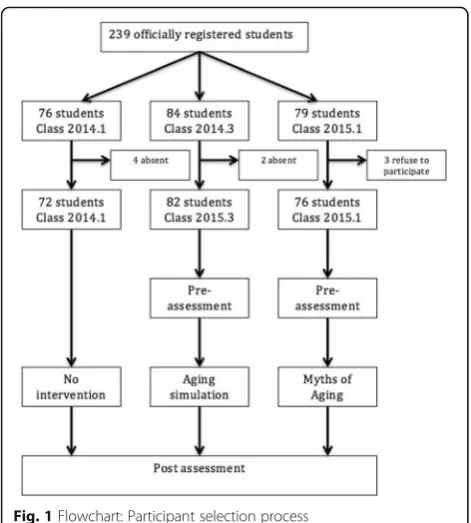
Two educational strategies were introduced (“ experien-cing aging”or“myths of aging”) among first year medical students at the beginning of the second semester of the 2014 course–2014.3 Group (“experiencing aging”) and at the beginning of the first semester of the 2015 course – 2015.1 Group (“myths of aging”). The groups were com-pared against a Control Group with no intervention (first semester of 2014–2014.1 Group) (Fig. 1: Flowchart). The interventions were performed during the first class (first week of medicine course) of a 15-h compulsory course. There was no difference in the classes as cohorts, since they are all first-year students from the same university and with similar admittance methods.
Each intervention was 02 (two) hours’ long and students were split into groups of 25–30. Prior to com-mencing the intervention, the participants filled out questionnaires (pre-test) and after the intervention com-pleted the questionnaire for a second time (post-test).
The comparison among groups employed the same methodology adopted in previous studies [14, 22].
Intervention
– Experiencing aging (“Aging Game”): students (total 25–30) visited 5 different stations for approximately 20 min each. Through dramatization (“simulation”), the students simulated what it feels like to be an elderly person with several aging-related physiological and pathological impairments. This intervention was based on previous studies [14,22] and entailed activities such as: Walking difficulties: attachment of weights to legs and walking while negotiating
obstacles placed on the floor; Visual problems: glasses simulating visual impairments (e.g. cataracts and glaucoma); Hearing problems: headphones introducing background noise and cotton plugging ears; among others.
– Myths of aging: this activity was devised by the National League of Nursing of the United States and adapted for the Brazilian milieu and medical
students. This is a game type activity whose purpose is to help students recognize and deconstruct myths associated with aging and involve them in a
discussion about myths and attitudes towards older people. Incorporating a quiz show design
(“Jeopardy!™”format), it includes topics ranging from physical health to psychosocial issues and sexuality [23]. In the present study, each classroom had a
total of 25–30 students divided into three teams [24].
Statistical Analysis
The descriptive analysis was performed using measures of absolute and relative frequency for categorical vari-ables, as well as mean and standard deviation for con-tinuous variables. The intervention and no-intervention groups were compared at baseline using the Chi-squared (for categorical variables) and ANOVA tests (for con-tinuous variables).
The groups submitted to the educational interventions were assessed pre and post intervention to measure im-pact, i.e. students served as their own controls for the scales applied (UCLA, Palmore, Knowledge, Empathy, Attitude). A repeated measures paired t-test was used for this evaluation. In this case, we applied Bonferroni's correction due to multiple comparisons.
ANOVA for independent measures and the post-hoc Tukey test were used to compare the three groups after the interventions (“experiencing aging”,“myths of aging” and“no intervention”) for attitudes, empathy and know-ledge. Since some demographic characteristics (gender and age) differed among groups, we have also conducted an ANCOVA with age and gender as covariates.
Effect sizes (r) were added to all analyses based on the following formulae: (a) t-tests: r=√[t2/(t2+ df )] and (b) ANOVA: r=√(SSm/SSt), SSm = between-group effect
and SSt = total amount of variance in the data.
According to Cohen, r= 0.10 represents a small effect size, r = 0.30 represents a medium effect size and r = 0.50 represents a large effect size [25].
Statistical analyses were performed using the statistics program SPSS version 20.0 (SPSS Inc.).
Ethics, consent and permissions
The present study was approved by the IRB of the Univer-sity Hospital of the Federal UniverUniver-sity of Juiz de Fora, Brazil. Participation was voluntary, informed consent was obtained (signed by students) after explaining the objec-tives and before the intervention, collected data were anonymized to maintain the integrity of the responders, and the data were handled and stored in accordance with the tenets of the Declaration of Helsinki (2008).
Results
Of the 239 students in the three groups initially selected, 230 were assessed (6 absent and 3 refusals). This gave final samples of 72 for the “2014.1 Group” (Control Group - CG), 82 for the“2014.3 Group” (“Experiencing Aging” Group - EA) and 76 for the “2015.1 Group” (“Myths of Aging”Group–MA).
Concerning the baseline demographics, the EA Group has more females than the MA group (63.4% versus
39.5%, p= 0.008) and was younger (18.71 ± 1.43 years versus 19.73 ± 2.72 years,p= 0.009). However, no differ-ences on family income between groups (55.1% had a family income of≥7 minimum wages in the EA group and 50.0% had a family income of≥7 minimum wages in the MA group).
We carried out the analysis of skewness and kurtosis for all instruments used and, based on the ranges of Gravetter (±2.00) [26], there was no evidence of skewness and kurtosis, ranging from−0.09 (SE: 0.16) to 1.08 (SE: 0.17) for skewness and−0.69 (SE: 0.32) to 1.50 (SE: 0.34) for kurtosis.
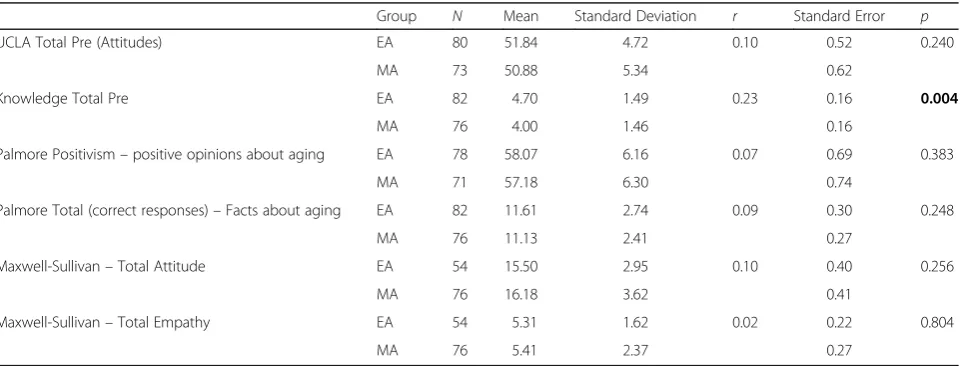
The students were assessed at baseline (prior to inter-ventions, one week into the medical course) on know-ledge about aging and attitudes toward older adults (Table 1). Subsequently, EA and MA groups were com-pared, where the CG served as post-intervention control for these intervention groups. At baseline, statistically significant differences were found only for basic cognitive knowledge in geriatrics (greater in EA Group,
p= 0.004).
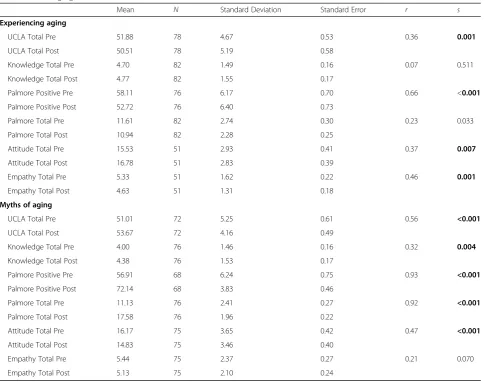
The post-intervention analysis for the EA Group (Table 2) revealed the following changes: a significant difference on the UCLA scale total (a worse general atti-tude – p= 0.001), greater negativism on the Palmore questionnaire (negative opinions about aging) post inter-vention (p< 0.001), a worse attitude toward elderly people on the Maxwell-Sullivan attitude scale (p= 0.007) and an improvement in empathy toward the elderly on the Maxwell-Sullivan empathy scale (p= 0.001). No sig-nificant differences in students’knowledge pre and post-intervention were observed.
The post-intervention analysis for the MA group (Table 2) revealed the following changes: a significant
difference on the UCLA scale total pre- and post-intervention (an improvement in general attitude –p< 0.001), significant differences between students’ know-ledge pre- and post-intervention (p= 0.003), marked im-provement in score on the Palmore questionnaire, indicating a higher rate of correct responses on facts about aging (p< 0.001) and greater positivism (positive opinions about aging) post intervention (p< 0.001), and improvement in attitude toward elderly people on the Maxwell-Sullivan attitude scale (p< 0.0001). No improvement in empathy toward the elderly was found on the Maxwell-Sullivan empathy scale (p= 0.070).
Comparison of the groups post intervention (Table 3) revealed the following differences in total score: a
signifi-cant difference on the UCLA scale total
post-intervention between the MA x EA Groups (p= 0.001) and MA x CG (p< 0.001), and a marked improvement in knowledge score (Palmore questionnaire) for the MA group compared to the others (p< 0.001). The MA group exhibited a more positive view about elderly people than the other groups (p< 0.001) and also a bet-ter attitude toward older people on the Maxwell-Sullivan attitude scale. No significant differences were detected between the groups for students’ knowledge or for empathy on the Maxwell-Sullivan empathy scale. All significant results were maintained after carrying out ANCOVA with age and gender as covariates
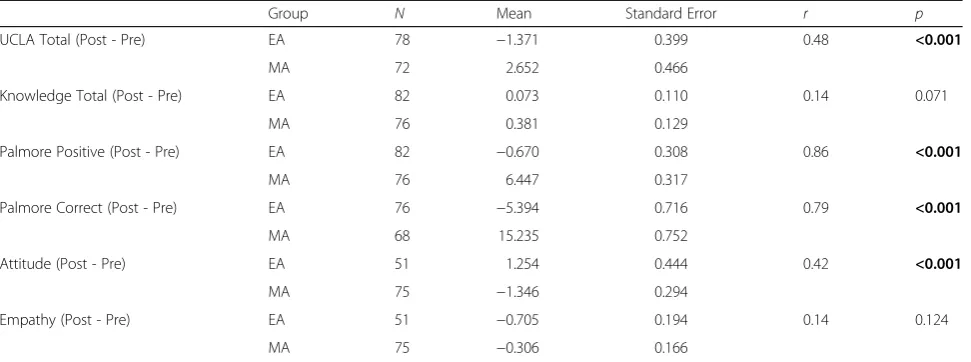
Lastly, comparison of pre-post differences between the EA and MA groups (Table 4) revealed: a significant dif-ference on the UCLA scale total, an improvement in score and positive view about elderly people on the Palmore questionnaire, and an improvement in attitude toward elderly people on the Maxwell-Sullivan attitude scale in the MA group compared to the EA Group. No
Table 1Knowledge, attitudes and empathy at baseline among groups submitted to Experiencing Aging (ES) and Myths of Aging (MA) workshops
Group N Mean Standard Deviation r Standard Error p
UCLA Total Pre (Attitudes) EA 80 51.84 4.72 0.10 0.52 0.240
MA 73 50.88 5.34 0.62
Knowledge Total Pre EA 82 4.70 1.49 0.23 0.16 0.004
MA 76 4.00 1.46 0.16
Palmore Positivism–positive opinions about aging EA 78 58.07 6.16 0.07 0.69 0.383
MA 71 57.18 6.30 0.74
Palmore Total (correct responses)–Facts about aging EA 82 11.61 2.74 0.09 0.30 0.248
MA 76 11.13 2.41 0.27
Maxwell-Sullivan–Total Attitude EA 54 15.50 2.95 0.10 0.40 0.256
MA 76 16.18 3.62 0.41
Maxwell-Sullivan–Total Empathy EA 54 5.31 1.62 0.02 0.22 0.804
MA 76 5.41 2.37 0.27
significant difference between knowledge and empathy was noted.
Discussion
The present study found that different brief educational strategies had a mixed effect (positive and negative) on the attitudes, knowledge and empathy toward elderly of
first year medical students. Comparing the two strat-egies, the “Experiencing Aging” strategy was associated with increased empathy among the students, albeit with worsening attitude. The “Myths of Aging” strategy was associated with an improvement in overall attitude and a more positive view of aging and with no changes in em-pathy toward older adults.
Table 2Difference pre- and post-intervention for EA and MA groups on Knowledge about aging, empathy, attitude and Palmore scale (facts on aging)*
Mean N Standard Deviation Standard Error r s
Experiencing aging
UCLA Total Pre 51.88 78 4.67 0.53 0.36 0.001
UCLA Total Post 50.51 78 5.19 0.58
Knowledge Total Pre 4.70 82 1.49 0.16 0.07 0.511
Knowledge Total Post 4.77 82 1.55 0.17
Palmore Positive Pre 58.11 76 6.17 0.70 0.66 <0.001
Palmore Positive Post 52.72 76 6.40 0.73
Palmore Total Pre 11.61 82 2.74 0.30 0.23 0.033
Palmore Total Post 10.94 82 2.28 0.25
Attitude Total Pre 15.53 51 2.93 0.41 0.37 0.007
Attitude Total Post 16.78 51 2.83 0.39
Empathy Total Pre 5.33 51 1.62 0.22 0.46 0.001
Empathy Total Post 4.63 51 1.31 0.18
Myths of aging
UCLA Total Pre 51.01 72 5.25 0.61 0.56 <0.001
UCLA Total Post 53.67 72 4.16 0.49
Knowledge Total Pre 4.00 76 1.46 0.16 0.32 0.004
Knowledge Total Post 4.38 76 1.53 0.17
Palmore Positive Pre 56.91 68 6.24 0.75 0.93 <0.001
Palmore Positive Post 72.14 68 3.83 0.46
Palmore Total Pre 11.13 76 2.41 0.27 0.92 <0.001
Palmore Total Post 17.58 76 1.96 0.22
Attitude Total Pre 16.17 75 3.65 0.42 0.47 <0.001
Attitude Total Post 14.83 75 3.46 0.40
Empathy Total Pre 5.44 75 2.37 0.27 0.21 0.070
Empathy Total Post 5.13 75 2.10 0.24
*
We considered ap≤0.0083 as significant (Bonferroni multiple comparison procedure)
Table 3Comparison among groups post-intervention (total score on scales and post - pre difference)
EA CG MA r
M (SD) M (SD) M (SD) p Post-hoca
UCLA Total Post 50.51 (5.19) 50.00 (5.68) 53.67 (4.18) 0.30 <0.001 EA x MA (p= 0.001); CG x MA (p< 0.001); EA x CG (p= 0.809)
Knowledge Total Post 4.77 (1.55) 4.64 (1.35) 4.38 (1.53) 0.11 0.256 EA x MA (p= 0.233); CG x MA (p= 0.544); EA x CG (p= 0.852)
Palmore Positivism 52.72 (6.40) 55.38 (5.29) 72.14 (3.83) 0.85 <0.001 EA x MA (p< 0.001); CG x MA (p< 0.001); EA x CG (p= 0.009)
Palmore Total Post 10.94 (2.28) 10.22 (2.24) 17.58 (1.96) 0.84 <0.001 EA x MA (p< 0.001); CG x MA (p< 0.001); EA x CG (p= 0.104)
Attitude Total Post 16.78 (2.83) 16.29 (4.2) 14.83 (3.46) 0.22 0.007 EA x MA (p= 0.009); CG x MA (p= 0.042); EA x CG (p= 0.734)
Empathy Total Post 4.63 (1.29) 5.32 (2.09) 5.13 (2.10) 0.14 0.140 EA x MA (p= 0.324); CG x MA (p= 0.824); EA x CG (p= 0.124)
a
These findings can be explained by the fact that in
“Experiencing Aging”, students experience the functional limitation associated with aging [27–29], and thus are able to put themselves in the shoes of the elderly, thereby increasing their empathy. However, owing to the simulation of the limitations and disabilities (visual diffi-culty, disabilities, among others), it is likely that this worsened students’attitudes toward the elderly, deeming them incapable of managing their lives due to the nu-merous limitations demonstrated in the activity. These results are similar to the findings of a previous investiga-tion [30], but conflict with other studies that found posi-tive or neutral results after using this same strategy [8, 31]. In our view, because this activity was introduced at the beginning of the course (students were not yet famil-iar with the subject and held many stereotypes regarding the elderly), it may have strengthened the myths of aging leading to the decline in attitude. Perhaps if imple-mented among students with greater knowledge in the area of geriatrics and gerontology, results may have been different, as suggested by some studies in doctors and students with more years of“experiencing aging”[32].
On the other hand, the “Myths of Aging” activity in-volves questions and answers whose main strategy is to demystify the stereotypes surrounding aging [33]. In this context, the students modify the way they imagine and see aging, which can result in a change in views on eld-erly. With regard to empathy, because the students had not experienced the limitations imposed by aging, no significant differences were evident, despite a tendency toward improvement. With regard to knowledge, an in-crease in the number of right answers to the facts on aging was noted, given that some content addressed in the “Myths of Aging” workshop can help answer the Palmore. Cognitive knowledge however, showed no changes, a situation which might be explained by the
fact that this type of knowledge was not the focus of the workshop (the content of these questions were not taught in this activity).
These results contribute further evidence to this field of teaching. Despite the numerous studies addressing educational strategies for teaching geriatrics, results remain mixed and conflicting, where some systematic reviews have shown promising results [8, 31] whereas others have not [14]. One important finding revealed by the present study was the fact that teaching, can lead to mixed results, highlighting that strategies must be assessed and evidence-based.
Although a subject not extensively discussed in health education, other interventions in the gerontology area have also reported worsening attitudes, including one study using the same intervention employed in the present study. Henry et al. [30] assessed 156 health stu-dents using the Experiencing Aging activity (aging game), MacKnight [34] assessed 83 first year medical students after a home visit and van Zuilen et al. [35] assessed 288 junior and senior medical students after 2 weeks of a geriatrics course (which includes a rota-tion). All these studies found a worsening attitude towards older adults and suggest that exposure of students to only the unhealthy side of aging (experien-cing limitations or exposure to chronic patients) can reinforce stereotypes of aging.
Based on this discussion, it is clear that strategies can have different effects on students, depending on when they are introduced, on the profile of students and the manner in which they are implemented. Thus, educators must establish the optimal strategy for meeting learning goals. In this context, some may argue that having a positive attitude towards older adults without seeing things from the perspective of the elderly (i.e. empathy), could not have a strong influence on future professional
Table 4Comparison among groups post-intervention (post - pre difference)
Group N Mean Standard Error r p
UCLA Total (Post - Pre) EA 78 −1.371 0.399 0.48 <0.001
MA 72 2.652 0.466
Knowledge Total (Post - Pre) EA 82 0.073 0.110 0.14 0.071
MA 76 0.381 0.129
Palmore Positive (Post - Pre) EA 82 −0.670 0.308 0.86 <0.001
MA 76 6.447 0.317
Palmore Correct (Post - Pre) EA 76 −5.394 0.716 0.79 <0.001
MA 68 15.235 0.752
Attitude (Post - Pre) EA 51 1.254 0.444 0.42 <0.001
MA 75 −1.346 0.294
Empathy (Post - Pre) EA 51 −0.705 0.194 0.14 0.124
MA 75 −0.306 0.166
practice and then develop the attitude. We believe this re-flection must be made and, in our opinion, perhaps a strat-egy combining the two workshops, demystifying the myths first and subsequently experiencing aging, may potentialize attitudes and empathy early in medical training.
The present study has several limitations. First, the study provided only a snapshot assessment of the stu-dents. It is unclear whether these results will persist over the long term. Second, this was an intervention-based, non-randomized study with a control group. Although constituting a limitation, this type of study is widely con-ducted in the area of medical education. Third, the in-vestigation was conducted within a single Brazilian medical school, and so caution should be exercised when generalizing the results. Forth, there was a significant difference among groups concerning age and gender. The reasons for these differences are not clear, since the admittance criteria were the same through the years and the number of spots remained stable. Based on previous data, the demographics of our medical school classes can vary among semesters [36]. Nevertheless, in order to minimize these differences, we carried out the ANCOVA test including age and gender as covariates. Fifth, since we are carrying out multiple analyses (multiple compari-sons), we decided to use the Bonferroni correction in order to reduce the type I error (a more conservative approach). This procedure could increased probability of making type II error, and consequently reduce statistical power.
Nevertheless, the study has also some strengths, such as an appropriate number of students, the use of inter-ventions that have been previously tested by other research groups and the use of a relatively large number of internationally recognized scales, which allows the comparison with other countries.
Future studies should focus on how these strategies work in different cultures around the world, since some cultures have more stereotypes towards older persons. For instance, the present study found we found a mean of 3.7 in our pre-intervention sample, which is similar to US students with 3.7 [37] and to Singaporean students with 3.6 [38]. However, in regard to the Palmore test, US stu-dents have a higher score than Chinese stustu-dents and our Brazilian students (16.1 versus 12.2 versus 11.6) [37, 39].
Other future directions of research are: (a) the investiga-tion of strategies focusing on both empathy and attitude-enhancing activities, allowing students to become empath-etic with their older patients, as well as, avoiding ageism and stereotypes towards aging, (b) in which moment these games may be delivered in order to students fully benefit from these strategies. A comparison between different moments of the course (beginning or final students) is warranted and (d) how these strategies could impact the long-term clinical practice and attitudes of these students.
Conclusions
In conclusion, educational strategies can influence the attitudes and empathy of students differently, leading to both desirable and undesirable outcomes. These results underscore the importance of assessing educational strategies in medical teaching to ascertain in what man-ner, situations and settings these activities should be run.
Additional file
Additional file 1:Study Questionnaire. (DOCX 87 kb)
Abbreviations
ANCOVA:Analysis of covariance; ANOVA: Analysis of Variance; CG: Control group; EA: Experience aging; IRB: Institutional review board; MA: Myths of aging; r: Effect size; UCLA: University of California–Los Angeles; UFJF: Federal University of Juiz de For a
Acknowledgements
Authors would like to acknowledge all students who participated in the study.
Funding No funding.
Availability of data and materials
The dataset of the present study is available upon request. Contact [email protected] for further information.
Authors’contributions
ALGL, GL, INO, AMA, OSE made substantial contributions to conception and design; ALGL, GL, INO make substantial contributions to acquisition of data; ALGL, GL, AMA, OSE analyzed and interpreted the data; ALGL, GL participated in drafting the article; ALGL, GL, INO, AMA, OSE revised the manuscript critically for important intellectual content; and all authors gave final approval of the version to be submitted.
Competing interests
The authors of this manuscript declare that they have no competing interests.
Consent to publication Not applicable.
Ethics approval and consent to participate
This study was reviewed and approved by the Institutional Review Board of the University Hospital at Juiz de Fora, Brazil. All participants signed consent forms and had their right to withdraw from the study at any time.
Author details
1Division of Geriatrics, School of Medicine, Federal University of Juiz de Fora,
Av. Eugenio do Nascimento s/n, Bairro Dom Bosco, Juiz de Fora, Brazil. 2School of Medicine, Federal University of Juiz de Fora, Juiz de Fora, Brazil. 3Department of Medical Education, School of Medicine, Federal University of
Juiz de Fora, Juiz de Fora, Brazil.
Received: 1 May 2016 Accepted: 30 January 2017
References
1. Lunenfeld B. An aging world-demographics and challenges. Gynecol Endocrinol. 2008;24(1):1–3.
2. Leipzig RM, Granville L, Simpson D, Anderson MB, Sauvigne K, Soriano RP. Keeping granny safe on July 1: a consensus on minimum geriatrics competencies for graduating medical students. Acad Med. 2009;84(5):604–10. 3. Motta LB, Aguiar AC. Novas competências profissionais em saúde e o
4. Wong LLR, Carvalho JA. O rápido processo de envelhecimento populacional do brasil: sérios desafios para as políticas públicas. Rev Bras Estud Popul. 2006;23(1):5–26.
5. Caldas CP. Envelhecimento com dependência: responsabilidades e demandas da família aging with dependence: family needs and responsibilities. Cad Saude Publica. 2003;19(3):773–81.
6. Pereira A, Feliz MC, Schwanke CHA. Ensino da Geriatria nas faculdades de medicina brasileiras. Geriatr Gerontol. 2010;4(4):179–85.
7. Warshaw GA, Bragg EJ, Shaull RW, Lindsell CJ. Academic geriatric programs in US allopathic and osteopathic medical schools. JAMA. 2002;288(18):2313–9. 8. Tullo ES, Spencer J, Allan L. Systematic review: helping the young to
understand the old. Teaching interventions in geriatrics to improve the knowledge, skills, and attitudes of undergraduate medical students. J Am Geriatr Soc. 2010;58(10):1987–93.
9. De Biasio JC, Parkas V, Soriano RP. Longitudinal assessment of medical student attitudes toward older people. Med Teach. 2016;38(8):823–8. doi:10. 3109/0142159X.2015.1112891.
10. Samra R, Griffiths A, Cox T, Conroy S, Gordon A, Gladman JR. Medical students’and doctors’attitudes towards older patients and their care in hospital settings: a conceptualisation. Age Ageing. 2015;44(5):776–83. 11. Meiboom AA, de Vries H, Hertogh CM, Scheele F. Why medical students do not
choose a career in geriatrics: a systematic review. BMC Med Educ. 2015;15:101. 12. Bagri AS, Tiberius R. Medical student perspectives on geriatrics and geriatric
education. J Am Geriatr Soc. 2010;58(10):1994–9.
13. Trowler P, Cooper A. Teaching and learning regimes: Implicit theories and recurrent practices in the enhancement of teaching and learning through educational development programmes. High Educ Res Dev. 2002;21(3):221–40. 14. Alfarah Z, Schunemann HJ, Akl EA. Educational games in geriatric medicine
education: a systematic review. BMC Geriatr. 2010;10:19.
15. Thomson M, Burke K. A nursing assistant training program in a long term care setting. Gerontol Geriatr Educ. 1998;19(1):23–35.
16. Taylor EW, Cranton P. A theory in progress?: issues in transformative learning theory. Eur J Res Educ Learn Adults. 2013;4(1):35–47. 17. Mezirow J. Transformative learning as discourse. J transform Educ.
2003;1(1):58–63.
18. Akl EA, Pretorius RW, Sackett K, Erdley WS, Bhoopathi PS, Alfarah Z, Schunemann HJ. The effect of educational games on medical students’ learning outcomes: a systematic review: BEME Guide No 14. Med Teach. 2010;32(1):16–27.
19. Reuben DB, Lee M, Davis Jr JW, Eslami MS, Osterweil DG, Melchiore S, Weintraub NT. Development and validation of a geriatrics attitudes scale for primary care residents. J Am Geriatr Soc. 1998;46(11):1425–30.
20. Palmore EB. The facts on aging quiz: A handbook of uses and results. New York: Springer Publishing Co.; 1988.
21. Varkey P, Chutka DS, Lesnick TG. The aging game: improving medical students’attitudes toward caring for the elderly. J Am Med Dir Assoc. 2006;7(4):224–9.
22. Ramaswamy R. How to teach medication management: a review of novel educational materials in geriatrics. J Am Geriatr Soc. 2013;61(9):1598–601. 23. Thornton JE. Myths of aging or ageist stereotypes. Educ Gerontol.
2002;28(4):301–12.
24. Y-e L, Norman IJ, While AE. Nurses’attitudes towards older people: a systematic review. Int J Nurs Stud. 2013;50(9):1271–82.
25. Cohen J. A power primer. Psychol Bull. 1992;112(1):155–9.
26. Gravetter F, Wallnau L. Essentials of statistics for the behavioral sciences. 8th ed. Belmont: Wadsworth; 2014.
27. Chaisson G. Life-cycle: Simulating the problems of aging and the aged. Health Educ Monogr. 1977;5 Suppl 1:28–35.
28. Thomson M. A nursing assistant training program in a long term care setting. Gerontol Geriatr Educ. 1998;19(1):23–35.
29. Chen AM, Kiersma ME, Yehle KS, Plake KS. Impact of an Aging Simulation Game on Pharmacy Students' Empathy for Older Adults. Am J Pharm Educ. 2015;79(5):65.
30. Henry BW, Douglass C, Kostiwa I. Effects of participation in an aging game simulation activity on the attitudes of allied health students toward older adults. Internet J Allied Health Sci Pract. 2007;5(4):5.
31. Samra R, Griffiths A, Cox T, Conroy S, Knight A. Changes in medical student and doctor attitudes toward older adults after an intervention: a systematic review. J Am Geriatr Soc. 2013;61(7):1188–96.
32. Pacala JT, Boult C, Hepburn K. Ten years’experience conducting the aging game workshop: was it worth it? J Am Geriatr Soc. 2006;54(1):144–9.
33. Liu YE, Norman IJ, While AE. Nurses’attitudes towards older people: a systematic review. Int J Nurs Stud. 2013;50(9):1271–82.
34. Macknight C, Powell C. Effect of a home visit on first year medical Student’s attitudes towards older adults. Geriatr Today. 2001;4:182–5.
35. van Zuilen MH, Rubert MP, Silverman M, Lewis J. Medical students’positive and negative misconceptions about the elderly: the impact of training in geriatrics. Gerontol Geriatr Educ. 2001;21(3):31–40.
36. Moutinho I, Pecci N, Roland R, Lucchetti A, Tibirica S, Ezequiel O, Lucchetti G. Depression, stress and anxiety in medical students: a cross-sectional comparison between students from different semesters. Revista da Associação Médica Brasileira. 2017;63(1):21–8.
37. Eskildsen MA, Flacker J. A multimodal aging and dying course for first-year medical students improves knowledge and attitudes. J Am Geriatr Soc. 2009;57(8):1492–7.
38. Chua MP, Tan CH, Merchant R, Soiza RL. Attitudes of first-year medical students in Singapore towards older people and willingness to consider a career in geriatric medicine. Ann Acad Med Singapore. 2008;37(11):947–51. 39. Liu Z, Pu L, Wang H, Hu X. Survey of attitude towards and understanding of
the elderly amongst Chinese undergraduate medical students. Asian Biomed. 2014;8(5):615–22.
• We accept pre-submission inquiries
• Our selector tool helps you to find the most relevant journal
• We provide round the clock customer support
• Convenient online submission
• Thorough peer review
• Inclusion in PubMed and all major indexing services
• Maximum visibility for your research
Submit your manuscript at www.biomedcentral.com/submit