Long-range WindScanner system
Nikola Vasiljevi´c1, Guillaume Lea1, Michael Courtney1, Jean-Pierre Cariou2, Jakob Mann1and
Torben Mikkelsen1
1 DTU Wind Energy, Frederiksborgvej 399, DK-4000 Roskilde, Denmark 2 Leosphere, 14-16 rue Jean Rostand, 91400 Orsay, France
* Correspondence: [email protected], [email protected]; Tel.: +45-5180-1452
Abstract: In this paper, the technical aspects of a multi-Doppler lidar instrument, the long-range
WindScanner system, will be presented accompanied by an overview of the results from several field campaigns. The long-range WindScanner system consists of three spatially separated coherent Doppler scanning lidars and a remote master computer that coordinates them. The lidars were carefully engineered to perform arbitrary and time controlled scanning trajectories. Their wireless coordination via the master computer allows achieving and maintaining lidars’ synchronization within ten milliseconds. As a whole, the long-range WindScanner system can measure an entire wind field by emitting and directing three laser beams to intersect, and then by moving the beam intersection over the points of interest. The long-range WindScanner system was developed to tackle the need for high-quality observations of wind fields from scales of modern wind turbine and wind farms. It has been in operation since 2013.
Keywords:coherent Doppler lidar; multi-Doppler lidar; WindScanner; wind energy
1. Introduction
Measurements of the wind velocity in the atmospheric boundary layer (ABL) provide the means for improving our understanding of a diverse range of flow phenomena and wind conditions, which play an important role in wind energy. In the past, wind measurements were typically acquired using the well established in-situ techniques with sensors such as cup anemometers [1], mounted on a meteorological mast at heights usually occupied by the lower half of wind turbine rotor swept area [2,3]. The number of meteorological masts employed to collect the information on wind flow greatly depends on the application of wind measurements. The measurements from at least one meteorological mast are necessary for the wind turbine power curve estimation [2], while for the field campaigns focused on the improvement of the wind energy flow models the number of meteorological masts can be up to ten or more [4–6].
However, since today’s modern large wind turbines operate between 60 and 300 m above the ground level, the application of the in-situ techniques is becoming extremely expensive due to the costs of tall meteorological masts.
An alternative technology emerged around the turn of the century. Due to the increased availability of fiber-optic components, it became economically and practically feasible to build coherent Doppler lidars (CDL) suitable for operational measurements in wind energy [7–10]. Before this, CDLs were based on expensive open-space optics, which are voluminous and hard to maintain in field operation. As a result CDLs were essentially unused in the wind energy community.
Unlike the mast mounted sensors, CDLs acquire wind observations remotely, without contact with the moving air. They do this by emitting the laser light and coherently detecting the Doppler shift in the backscattered light. The Doppler shift, the frequency difference between the emitted and backscattered light, is a direct measure of the radial or line of sight (LOS) velocity, which is equal to the wind velocity projected on the laser light propagation path.
homogeneity of the flow single CDLs are able to provide single-Doppler retrievals of two horizontal or all three components of the wind vector.
Highly accurate single-Doppler retrievals of wind speed have been reported in flat terrain and offshore [14,15], where the flow is expected to exhibit a high degree of horizontal homogeneity. In complex terrain, where the flow is less horizontally homogeneous, CDL estimation errors of up to 8% have been reported [16]. Errors this large are unacceptable for wind energy applications. As a guide in flat terrain the best cup anemometers (class 1a) have an uncertainty (k=2) of at least 1 % at 10 m/s. Including calibration and mounting uncertainty the total uncertainty is usually between 2 and 3 %. In complex terrain the cup uncertainty is likely to be twice this amount.
As indicated in [17] there are two solutions to this problem, either to correct the data using flow models [16,18,19] or to develop new CDL instruments that do not demand the horizontal homogeneity of the flow to produce accurate retrievals. The correction methods can potentially reduce errors [17]. CDL data correction methods are more successful on sites with a simple to moderate complexity [16,20], than on sites with high complexity [16]. Also, the corrected data accuracy is heavily dependent on the flow model choice and parametrization [19]. As described in [19], besides the lidar data correction methodologies developed by research groups also companies such as Meteodyn WT, WindSim and Leosphere introduced commercial lidar data correction algorithms. Specifically, Leosphere developed a real-time correction algorithm, known as the Flow Complexity Recognition (FCR), which is available as an add-on to their lidar software [21]. Since the FCR algorithm is executed in real-time probably it is based on a simple linearized flow model similar to [16]. However, as earlier stated in [19], the FCR algorithm is proprietary and thus secrete (black-box product), therefore an objective evaluation is difficult.
Overall, an improper choice of the flow model and an incorrect model parametrization can potentially introduce additional errors to single-Doppler retrievals leading to the increased uncertainty in the single-Doppler retrievals. Furthermore, as the single-Doppler retrievals undergo modifications based on flow modeling results they don’t represent direct measurements of the wind vector.
CDL errors in complex terrain originate from using one instrument scanning in several different directions assuming the flow to be homogenous when this is not the case since the different beam directions (originating from the same point) will sense the flow in physically different locations. In order to have beams sensing in the same location it is necessary to have the origin of the beams separated. This can be achieved with a multi-Doppler lidar which eliminates the requirement for the horizontal homogeneity of the flow and provides direct wind vector measurements (multi-Doppler retrievals) and not an estimation. At least two independent radial velocity measurements are required to measure two components of the wind vector if the other component is known (e.g. assumed to be zero or small compared to the other two components), while to fully characterize the wind vector a minimum of three independent radial velocity measurements is necessary at given time. This is possible with two or more spatially separated lidars.
Since the 1980s dual-Doppler lidar setups were used in several prominent atmospheric experiments. In the Joint Airport Weather Studies (JAWS) two scanning CDLs were used to study convectively driven downdrafts and resulting outflows near the surface [22]. For the purpose of investigation of the boundary layer transport and dispersion processes in the urban canopy a dual-Doppler lidar was employed to provide measurements of the urban canopy flows during the Joint Urban 2003 experiment [23–26]. Within the Invest-to-Save Budget project 52 (ISB52) simultaneous measurements from two scanning CDLs were used to retrieve dispersion relevant parameters [27]. The instrumentation setup of the Terrain-Induced Rotor Experiment (T-REX) included two scanning CDLs [28] which simultaneous operation provided grounds to observe rotary flows in complex terrain [29].
their laser beams above a sonic anemometer mounted at a mast 78 m above ground level [30]. This experiment demonstrated the feasibility of accurately measuring all three components of the wind vector using a triple-Doppler lidar. Virtual tower measurements using three scanning CDLs were demonstrated in [31]. In the study [32] two scanning CDLs were used to resolve two components of a single-turbine wake in a vertical plane, while authors in [33] explored a possibility to acquire a turbine-scale wind field measurements using a dual-Doppler lidar.
What is common for the aforementioned studies where dual- and triple- Doppler setups were in use is that CDLs functioned independently from each other, thus there was no central computer that would provide and maintain the CDLs’ synchronization. In [33] authors explicitly stated that after a certain period of time two scanning CDLs started to drift apart, while authors in [26] commented that achieving the synchronization among scanning CDLs in field operation represents a challenge. From the operational point of view monitoring several independent CDLs during the field operation is laborious and often complex since the lidar operator has to take care of each of them separately. In all studies CDLs performed simple scanning strategies typically consisting of Plan Position Indicator (PPI), Range Height Indicator (RHI) and/or step-stare scans. As the CDLs used in the aforementioned studies were typically commercial products it is well known that their configurability is limited. It does not provide accurate timing of scans required for achieving the strict synchronization among several CDLs, nor sufficient freedom to design more complex scanning methods.
We addressed the topics of multi-Doppler lidar synchronization, higher configurability and simpler operation in the WindScanner.dk project [34]. During this project we were determined to develop highly configurable triple-Doppler lidar instruments, know as WindScanner systems, consisting of spatially separated and synchronized scanning CDLs managed from a central computer unit, known as the master computer. The WindScanner systems are intended for detailed measurements of wind fields. In this paper, we present the long-range WindScanner system, which is one of the results of the WindScanner.dk project [35].
The paper is organized as follows. Section 2 introduces design requirements for the long-range WindScanner system. Hardware components, operational principles and software capabilities of single CDL of the long-range WindScanner system are given in Section 3. Section 4 describes the approach in forming the long-range WindScanner system. How CDLs are synchronized using the master computer is explained in Section 5. Section 6 consists of an overview of field campaigns performed with the long-range WindScanner system. Finally, Section 7 discusses results and future work while Section 8 gives our concluding remarks.
2. Design requrements
In order to formulate the design requirements for the long-range WindScanner system, both in terms of hardware and software, we start this section by defining the performance requirements.
Firstly, the idea was to develop a system of multiple CDLs that is able to provide synchronized measurements of all three components of the wind field at points defined by the user. The synchronization allows for turbulence statistics analysis and shorter time averages of measurements. Secondly, the points are to be distributed in the large volume of the ABL, where the dimensions of this volume should correspond to the dimensions of modern wind farms. This approach allows thorough investigations of the flow field surrounding wind farms. Thirdly, the measurements are to be processed in real-time to provide the possibility of using them in real time control of wind farms. Fourth, the system should be configurable such that it can provide substantial freedom in designing measurement campaigns. Finally, we envisaged a diverse range of the system deployments (e.g. offshore, complex terrain, etc.).
Based on these preferences the design requirements were as follows:
1. The system will consist of at least three spatially separated CDLs
3. CDLs will be coordinated from a remote computer
4. The coordination will be achievable using mobile networks
5. CDLs are to be pulsed in order to achieve long-range measurements
6. Backscattered signal will be processed in real-time yielding real-time measurements of the radial velocity
7. Accuracy of the retrieved radial velocity will be at least 0.1 m/s 8. Acquisition rate of consecutive LOS measurements can be different 9. Several hundreds of configurable range gates will be available for the user 10. Range gates will be freely positioned along each LOS
11. Each CDL will contain a fully steerable scanner head 12. Pointing accuracy of each CDL will be better than 0.1◦
13. Scanning strategies will include user-defined scanning trajectories 14. Scanning trajectories will be time controlled
3. Engineering a single scanning CDL
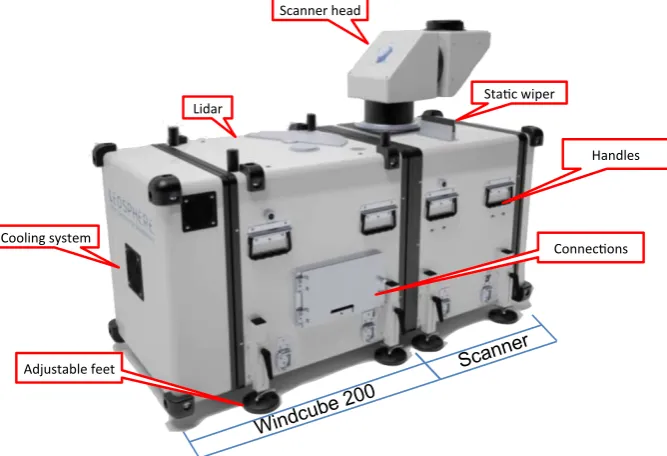
DTU Wind Energy and Leosphere engaged jointly to develop a scanning CDL long-range WindScanner (LRWS) based on the pulsed CDL Windcube 200, and a dual-axis mirror-based steerable scanner head (Figure1, Table1). Windcube 200 is based on the technology that has been developed by the French aerospace laboratory ONERA and transferred to Leosphere for commercialization [36,37]. This all-fiber lidar consists of the commercially available telecom components at 1543 nm and a high power fiber laser amplifier. The scanner head, developed by DTU Wind Energy with expert support from specialized industrial partners, was added to Windcube 200 to provide full dome arbitrary steering of the laser beam to the atmosphere. The LRWS is designed to allow assembly of the entire CDL using two standard Windcube 200 enclosures, and thus the integration of both lidar and scanner into a twin compact casing. This approach allows for the separation of mechanical and optical components during transportation and it simplifies maintenance.
Windcube 200
Scanner Scanner head
Sta+c wiper Lidar
Cooling system
Adjustable feet
Connec+ons Handles
Figure 1.The long-range WindScanner
3.1. Transmitter
Table 1.Operational parameters
Size 1.5 x 0.55 x 0. 65 m
Total weight 150 kg
Peak power consumption 1.7 kW Ingress protection code 65
Temperature range -10 to 40◦C
Eye safety IEC 60825-1
An acousto-optic modulator (AOM), driven by a pulsed radio-frequency signal from a radio-frequency (RF) drive, transforms the incoming CW laser light to the laser pulse train. Each emitted low power pulse has a predefined waveform (Gaussian shape) and frequency offset of 70 MHz. Low power laser pulses are then amplified in the Erbium doped fiber amplifier (EDFA), and emitted with a pulse-repetition frequency (PRF) between 10 and 40 kHz. The frequency offset enables detection of positive and negative Doppler shifts, and the high PRF makes it possible to maintain good range performance using a lower pulse energy [38].
Master
Oscillator AOM
RF
Driver
EDFA Circulator Telescope Scanner
Motion
Controller
Optical
Mixer
Detector Acquisition
board / FPGA CPU
Trigger signal
Input/output of servo motors
Figure 2. The long-range WindScanner block diagram. Green, blue and black arrow lines represent light, electrical and digital signals respectively.
We are using three configurations of the pulse waveform, energy content and corresponding PRFs (Table2), which provide optimization of the measurement process with respect to the desired range and probe length. The probe length in Table2represents the full-width half maximum (FWHM) of the total probe length.
Following the EDFA, the laser beam consisting of the pulse train is magnified, collimated and focused typically at around 1.2 km using a 100 mm aperture telescope. These processes optimize the laser power distribution along the laser light propagation path and decrease divergence in the far field, resulting in an improved signal-to-noise ratio (SNR) at long range.
3.2. Scanner
Table 2.LRWS characteristics
Wavelength 1543 nm
PRF 10, 20 and 40 kHz
Pulse length 400, 200 and 100 ns Probe length (FWHM) 70, 35 and 25 m Energy per pulse 100, 50 and 25µJ
Mean power 1 W
Accumulation time 10 to 10000 ms Velocity range - 30 to + 30 m/s
Range 50 to 8000 m
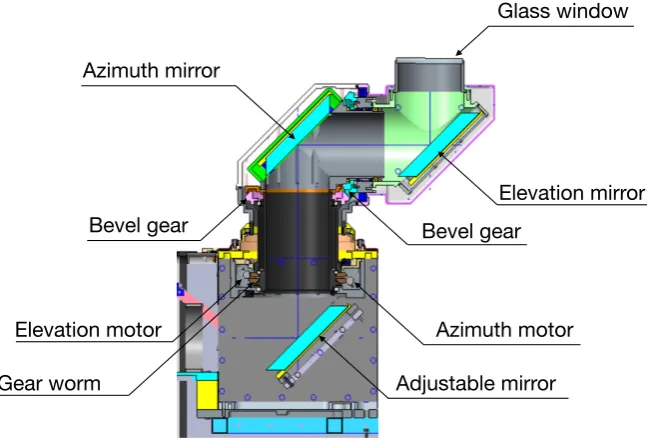
of rotational freedom (Table3, Figure3) . Each mirror is fixed to the corresponding mount using a silicon-based glue.
Azimuth mirror
Elevation mirror
Adjustable mirror
Azimuth motor
Bevel gear
Bevel gear
Gear worm
Glass window
Elevation motor
Figure 3.The scanner head vertical cross section
The mount of the adjustable mirror is installed on the non-movable part of the scanner head located next to the telescope exit, whereas the remaining two mirrors, known as the azimuth and elevation mirrors, are connected to the rotating parts of the scanner head. The rotation of the mirrors is achieved using a set of gears and two brushless DC servo motors enclosed in the compact drive unit of the scanner head.
The azimuth mirror mount is directly connected to the azimuth worm gear, which is driven by the worm attached via a flexible coupling to the motor shaft. In order to attain a minimum level of backlash the worm with coupling is pre-loaded into engagement with the worm gear using the pretension spring on each end of the worm. The gear ratio between the motor and the azimuth worm gear is 1/180.
water and solid particles (e.g. dust). The protection level corresponds to the Ingress Protection (IP) code 65. The first digit indicates the level of protection of the internal components against ingress of solid particles, while the second digit corresponds to the level of protection against ingress of water. In this specific case the IP code 65 indicates that the aluminum casing provides protection against ingress of dust (code 6, dust tight) and ingress of water jets from any direction (code 5, water jets).
The scanner head motion is governed by the Delta Tau Turbo PMAC motion controller [39] that is configured to simultaneously control the two above-mentioned servo motors and one virtual stepper motor. Specifically, the servo motors are controlled using the servo loops which fundamental inputs are commanded (i.e. user-defined) motion profiles of the scanner head and servo error (i.e. difference between the commanded and actual position of the scanner head). In the current design of the scanner head the actual position of the scanner head is acquired using the motor encoders. The resolution of the motor encoders is81921 ◦. The role of the virtual stepper motor will be explained later.
The motion profiles of the scanner head (i.e. trajectories) are coded using a controller specific programming language, which is a cross between BASIC and G-Code (RS-274). The end product of this process is a motion program that is uploaded to the motion controller and further executed (see pg. 271 in [39]). The execution of the motion programs generates 3rd order set-points (speed, acceleration, and jerk profiles) that ’drive’ servo loops. This results in the desired motion profile of the scanner head.
Table 3.Scanner characteristics
Moving load 25 kg
Maximum speed 50◦/s
Maximum acceleration 100◦/s2 Rotation mechanism Gear-box
Rotation Endless and continuous
Backlash < 0.03◦
Azimuth coverage 0 to 360◦ Elevation coverage -180 to 180◦
Clear aperture 120 mm
3.3. Receiver and signal processing
positions of the scanner head, stamped with the time information from a GPS driven clock (accuracy 250 ns) and saved to the lidar computer.
3.4. Measurement process control
As we see from the aforementioned, the LOS speed retrieval is governed by four essential processes: the laser pulse emission and steering, and backscattered light acquisition and processing. To know when and where the atmosphere is probed, a strict synchronization amongst the emission, steering and acquisition is essential. For real-time LOS measurements, the backscattered signal processing should run quasi-parallel to the above-mentioned processes, where the sampled data (time signals\spectra) should be processed in a first-in\first-out (FIFO) mode.
The synchronization of the emission, steering and acquisition is achieved by controlling them via the motion controller. The RF drive in conjunction with the AOM and acquisition\FPGA board are configured to form a laser pulse and instantly acquire the pulse echoes, respectively, each time they receive an external trigger (a short voltage pulse). Since the PRF is fixed during the emission, the laser pulses are emitted while the pulses echoes are acquired with a constant speed.
From the conceptual point of view the emission and acquisition processes are similar to the process of the constant speed rotation of a stepper motor shaft. A stepper motor produces an incremental move of the shaft (i.e. step) each time it receives an external trigger. If external triggers are sent with the constant speed to the stepper motor the stepper motor shaft will rotate with the constant speed assuming there is no payload on the shaft. Thus, any motion controller governs the stepper motor shaft motion by controlling the trigger signal (i.e. number of triggers, trigger emission frequency, etc.).
Due to the configuration of the emission and acquisition processes in a LRWS these two processes can be governed by the motion controller since for the motion controller they represent a rotation of a virtual stepper motor. Therefore, the pulse emission and the acquisition of the pulse echoes are controlled by the motion controller which sends triggers to the dedicated hardware components. Specifically, the trigger output (i.e. virtual stepper motor input) of the motion controller is split and at the same time directed to the RF drive and acquisition\FPGA board (see the splitting blue line in Figure2).
By explicitly describing the motion profiles of two real servo motors and one virtual stepper motor (using the motion programs) and executing them one single hardware component (i.e. motion controller) the emission, acquisition and steering are controlled and synchronized. A real-time LOS speed retrieval is attained by means of double buffer memory of the acquisition\FPGA board and WindScanner client software (WCS) that manages the hardware resources while processing the sampled data in the FIFO mode.
3.5. WindScanner client software
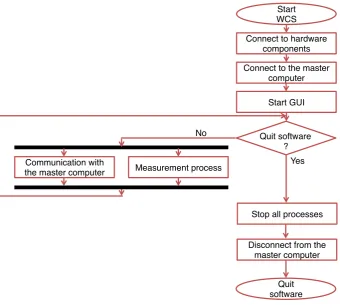
The WCS is software developed by DTU Wind Energy in the LabView environment that utilizes the aforementioned measurement process control. Essential software libraries, such as the MLE dll and hardware drivers have been provided by Leosphere. A simplified flow diagram of the WCS is shown in Figure 4. The WCS is network-based application remotely configured by additional software residing on a physically separated computer (master computer). There are two main loops in the software which run in parallel. One loop is handling the communication with the master computer, while the other loop is governing the measurement process.
of files based on simplified user inputs. The files are generate and then loaded back to the WCS to have a record of previous configurations of the WCS. Also, recording the configurations provides means to run LRWSs independently from the master computer. More complex scanning strategies are manually described by the user, which needs to code the motion program, write the range gate file and submit them to a LRWS.
Start WCS
Connect to hardware components
Connect to the master computer
Start GUI
Quit software ?
Communication with the master computer
No
Yes
Stop all processes
Quit software Disconnect from the
master computer Measurement process
Figure 4.WCS flow diagram
4. Forming a multi-lidar instrument
The long-range WindScanner system has been formed by adding an additional portable PC, which we refer to as the master computer, to the set of three LRWSs (Figure5). The master computer coordinates the three LRWSs by:
1. Configuring the WCS on each LRWS to execute certain scanning strategies 2. Issuing the measurement start time
3. Monitoring the LRWSs activities 4. Intervening if necessary
Centralizing the coordination of multiple CDLs to the master computer significantly reduces the complexity of performing field campaigns, and is necessary in order to achieve a strict synchronization among multiple CDLs.
4.1. Remote sensing communication protocol
The master computer coordinates the LRWSs by exchanging network packets with them. This network communication between the master computer and the LRWSs has been described by the remote sensing communication protocol (RSComPro [41]). The RSComPro is an open application layer protocol [42], which defines:
01
100
LRWS 1
LRWS 2 LRWS 3
Master computer
Figure 5.The long-range WindScanner system concept
2. The LRWSs actions in response to commands 3. Answers to commands
4. Alerts sent from the LRWSs to the master computer
5. Structure of network packets that encapsulate commands, responses and alerts
The RSComPro exploits both the UDP transport protocol, for fast delivery of network packets to/from the master computer, and TCP transport protocol, for reliable delivery of mission critical network packets. The size of network packets is typically about one kilobyte, so that uninterrupted and fast coordination of LRWSs is possible even in the case of a mobile network such as a 2G mobile network (i.e. GSM). In the most recent long-range WindScanner system deployments a 3G mobile network was used [43].
4.2. Master computer software
The master computer software (MCS) was developed by DTU Wind Energy in the LabView environment in accordance with the RSComPro. It is multi-platform software delivered as a light executable (5 MB). A simplified flow diagram of the MCS is shown in Figure6. The MCS provides a graphical user interface (GUI) to design, execute and monitor field campaigns with the long-range WindScanner system (Figure7). At a low-level, based on the user inputs, the MCS generates, sends, receives, processes, and displays the network packets.
Start software
Connect to LRWSs
Start GUI
Quit software
?
Communication with LRWSs
No
Yes
Disconnect from LRWSs
Quit software User inputs
Figure 6.MCS flow diagram
5. Synchronization
In a multi-lidar system, the scanning trajectories will usually be synchronized in the sense that they will start and finish at the same time. The beams may well measure at different points in space during the scanning trajectories, for example dual PPI scanning of a horizontal plane. The data analysis nearly always entails forming averaged radial velocities at a number of points and then combining these and reconstructing the mean flow field from these averages. Failure to synchronize would greatly handicap the data analysis.
A special case of synchronization is when each trajectory is formed such that the acquisition of at least one pair of radial velocities is co-located at a special point of interest. This point can be stationary or it can move. Turbulence measurements nearly always require measurements of this type since it allows a time series of wind velocity to be reconstructed at the acquisition frequency.
In the case of the long-range WindScanner system, preconditions for attaining the LRWSs’ synchronization have been met with the time control of the LRWSs’ measurement process and accurate time information from the GPS-driven clocks. However, the asynchronization between the LRWSs can still be expected due to two factors which will be explained in the following section.
5.1. Asynchronization factors
Windows 7, on which the WCS operates, is not a real-time operating system (RTOS), and as such it can introduce variability in the amount of time the execution of the sequential WCS actions takes. This results in the start time offset which we define as the difference between the commanded and actual start time of a scanning strategy. The value of the start time offset is random, thus it differs from one to another start of the scanning strategies. At best, values of a few milliseconds have been observed.
Figure 7.The master computer software screenshot
action takes by the motion controller will lag or advance in the range of +/- 50µsevery second of the
scanning strategy execution.
Since the start of the scanning strategy can be delayed, and the time actions can progressively lag or advance throughout the execution of the strategy, we should expect that multiple LRWSs will drift apart if there is no intervention. Irrespective of the number of LRWS in the long-range WindScanner system the maximum drift speed will be 100µs/s.
5.2. Asynchronization confirmation
The asynchronization was first confirmed in an experiment where two LRWSs were configured to synchronously intersect beams at two points in the atmosphere. At each point of intersection, radial velocity measurements were taken during the time of one second, while in between each intersection point only the scanner heads were moving. Once the scanning strategies were started we observed the start time offsets of 40 and 59 ms from the commanded start time, thus the two LRWSs started the scanning strategy with a 19 ms difference. Throughout the execution of the scanning strategies, the LRWSs drifted apart (Figure8). The maximum lag, which we define as the time difference when a radial velocity measurement took place at the ’fastest’ and ’slowest’ WindScanner in the system, was progressively increasing with the drift speed of 107µs/s. This result is slightly larger than the
anticipated maximum drift speed.
5.3. Synchronization concept
To keep the LRWSs synchronized, the sync routine has been developed. In this routine, the master computer monitors the maximum lag and interacts with the LRWSs when a particular maximum lag threshold is reached. The master computer sends "Synchronize" commands to the LRWSs, the execution of which slows down the LRWSs that are advancing in comparison to the slowest LRWS.
controller. Another way of slowing down the fastest LRWSs is to include G-Code command G4 in the motion program that, when triggered by the WCS, puts the execution of the lines of the motion program code which follows on hold for the period of time set by the WCS. Typically, the scanner head motion from the last measurement point back to the first measurement point is extended, thus when there are no planned measurements, or the G4 command is executed right after the last measurement point, that is, before the start of the next iteration of the same scanning strategy.
This synchronization concept with the G4 command was switched on 30 minutes after the start of the aforementioned experiment. In Figure8we can see that each time the threshold of 10 ms was reached (about every 90 s) the master computer was sending the Synchronization commands to the fastest LRWS, which resulted in the reduction of the maximum lag to about zero ms.
0 6 12 18 24 30 36 42 48 54 60
10 30 60 90 120 150 180 210
Time@minD
M
a
xi
m
u
m
lag
@
ms
D
Sync routine off Sync routine on
10 ms threshold
Figure 8.Evolution of the maximum lag over time and results of the sync routine
6. Field performances
The long-range WindScanner system has been operational since 2013, and it has been used in single-, dual-, and triple- Doppler modes. To date, 12 measurement campaigns have been done with the system, and in this section we will review several of them.
A system consisting of the three LRWSs was used to study the development of the internal boundary layer as the flow field makes a transition from the sea to the coast [45]. Also, this study was used to validate the data quality of the retrieved wind vectors from the long-range WindScanner system by comparing them with the wind vector measurements made with a sonic anemometer mounted on a 20-m mast (reference mast). The experiment took place at Høvsøre [46]. A high correlation between the retrieved lidar and sonic anemometer horizontal wind speeds has been reported, whereas limitations in the vertical wind speed retrievals have been indicated. Primarily, the cause of the poorer retrieval of the vertical wind speed was attributed to the low elevation angles employed during the measurement process. The distance between the three LRWSs and the reference mast ranged from 60 m (one LRWS) to about 1 km (two LRWSs).
The system consisting of a single LRWS was used to experimentally validate a novel scanning strategy in measuring turbulence using a six-beam method [47]. Also, this experiment took place at Høvsøre. As Høvsøre is a flat site with homogeneous and low vegetation the assumption of the horizontal homogeneity of the flow is typically satisfied. The experimental results showed high accuracy of the horizontal wind speed acquired with a six-beam method (within 1% comparing to co-located cup anemometer measurements). Improved turbulence measurements in comparison to the VAD method were reported.
LRWSs were configured to intersect the laser beams above a 116-meter met mast (reference mast), where a cup anemometer and wind vane are mounted. Since low elevation angles were used to direct the laser beams (< 6◦), the vertical wind speed could be neglected, and the horizontal wind speed and direction were directly resolved using two independent LOS measurement. At the same time, the third LRWS was configured to perform 60◦PPI scans (sector-scans) above the mast, where iVAP technique [13] was applied on the LOS measurements to retrieve the horizontal wind speed and wind direction. The distance between the three LRWSs and reference mast ranged from 1.1 km (one staring LRWS and one sector-scan LRWS) to 1.6 km (one staring LRWS). The horizontal wind speeds and wind directions retrieved in the single- and dual- Doppler configurations compared well with the measurements acquired with the top mounted cup anemometer and wind vane (Figure9). Overall, the dual-Doppler results show generally less scatter in retrieving the horizontal wind speed and wind direction compared to the single-Doppler results. Nevertheless, the single-Doppler results indicate that single sector-scanning lidar seems to be a cost-effective solution for the flat coastal and near-shore wind resource assessment. However, it should be noted that due to the presence of the wind turbines at Høvsøre only the single-Doppler retrievals acquired during the wind conditions in which the wind direction was between 118◦and 270◦were analyzed. For this range of wind directions the flow was never orthogonal to the scanned sector, but roughly parallel to it. The sector-scan configuration, specifically an optimum sector size, has been further studied in [49] based on the collected data. The study indicated that in case of the layout used in this experiment the accuracy of the single-Doppler retrievals was deteriorating when the sector size was smaller than 30◦. On the other hand the accuracy of the single-Doppler retrievals did not differ significantly for the sector size from 30◦to 60◦degree. The study proposed that an optimum sector size is in the range of 30◦to 38◦.
This study was a prequel to a large experiment that was performed under the RUNE project [50]. The RUNE project aims at reducing the uncertainty of near-shore energy estimates from meso-and micro-scale wind models by improving models’ predictions using the observations from the long-range WindScanner system. Currently, an in-depth data analysis is underway.
æ æ æ æ ææ æ æ æ ææ ææ æ æ æ æ ææ æ æ æ æ æ ææ æ ææ æ æ æ æ æ æ æ æ æ æ æ æ æ æ æ æ æ ææ æ æ æ æææ æ æææ æ ææ æ æ æ æ æ æ æ ææ ææ æ æææææææææ æ æ æ æ æ æ æ æ æ æ æ æ æ æ æ æ æ æ æ æ æ æ ææ æ æ æ æ æ æ æ æ æ æ æ æ æ æ æ æ æ æ æ ææ ææ æ æ æ æ æ æ æ ææ æ æ
4 6 8 10 12
4 6 8 10 12
Cup anemometer@msD
Single -Doppler @ m s D
y=0.96 x+0.23
R2=0.98
Σ=0.32 ms
ææ ææ æ ææ æ æ ææ ææ æ æ æ æ æææ æ ææ æ ææ æ æ æ æ æ ææ ææ æ æ æ æ æ æ æ æ æ æ æ æ ææ æ æ æææ ææææ ææææ æ æ æ æ æ æ ææ ææ ææ æ æ æ ææææ ææ æ æ æ æ æ æ æ æ ææææ æ æ æ æ æ æ æ æ æ ææ æ æ æ æ æ æ æ æ æ æ æ æ ææ æ æ ææ æ ææ æ æ æ æ æ æ æ æ æ æææ æ
4 6 8 10 12
4 6 8 10 12
Cup anemometer@msD
Dual -Doppler @ m s D
y=1.01 x-0.15
R2=0.99
Σ=0.1 ms
æ æ æ æ æ ææ æ æ æ ææ ææ æ æ æ æ æ æææ æ æ æ æ æææææ æææ æ æ æ æ æ æ æ æ æ æ æ æ æ æ ææ æ æ æ æ ææææ æ æ æ æ æ æ æ æ æ æ æææ æææ æ æ æææææææ æ æ æ æ æææ æ æ æææ æ ææ ææ ææ æææ æ æ æ æ æ æ æ æææ æ æ æ æ æææ æ æ æ æ ææ æ æ ææ æ æ æ æ ææ ææ
120 140 160 180 200 220 240 120 140 160 180 200 220 240
Wind vane@˚D
Single -Doppler @ ˚ D
y=0.97 x+8.88
R2=0.99
Σ=4.04 ˚
ææææ æ æ æ æ æ æ ææ æ æ æ æ æ æ æ æææææ æ æ æææææ æææ æ æ æ æ æ æ æ æ æææ æ æ æ ææ æ æ æ æ ææ æ ææææ æ æ æ æ æ æ æ ææææææ æ ææææææææ æ æ æ æ ææææ æææææ ææ ææ ææ ææ ææ æ æ æ æ æ æ æææ æ æ æ æ ææ æ æ æ æ æ ææ æ æ æææ æ ææ ææææ
120 140 160 180 200 220 240 120 140 160 180 200 220 240
Wind vane@˚D
Dual -Doppler @ ˚ D
y=0.98 x+4.55
R2=0.99
Σ=1.92 ˚
Figure 9.The horizontal wind speed and wind direction simultanously retrieved with the long-range WindScanner system operated in the single- and dual-Doppler mode expressed as 10-minute averages.
synchronization concept described in this paper worked well throughout the experiment. The LRWSs were synchronized within the 10 ms threshold set by the experiment’s operators. In a few instances, we had issues with the mobile network coverage, which occasionally resulted in some of the LRWSs getting disconnected from the master computer. While a shorter duration network fallout is not a significant problem since the LRWSs continue to run independently, a longer network outage results in loss of synchronization between the LRWSs.
The previously described campaigns were primarily intended to assess the accuracy of the long-range WindScanner system’s retrievals of the wind vector. Actual mapping of the wind flows with the system consisting of three LRWS was made during the Perdigão 2015 experiment [52]. This experiment was focused on creating a high quality dataset of wind flow measurements for validation of wind resource estimation, wind turbine inflow and wind turbine wake models in complex terrain. The complex flow was measured in a great many points of interest, the number of which ranged from 50 up to 12050. Several scanning strategies were designed and employed for the experiment [52]. Example of the acquired measurements are given in Figure11and Figure12. The dataset is currently being used by several research groups for models’ validation [53,54].
æ æ ææææææ æ æ æ æ æ æææ æ æ æææ ææ ææææ ææ æ ææ æ ææ æ æ æ ææ æ ææ æ æ æ æ æ æ æ ææ æ ææ ææ æ æ æ æ ææ ææææ æ æ æ æ æ ææ ææ æ ææ æ æ æ æ æ æ æææ æ æ æ æ æ æ æ æ æææ æ æ æ æ æ æ æ æ æ æ æ æ æ æ æ æ æ æææ æææ æ æ æ æ ææ æ æ æ æ ææ æ æ æ æ ææ æ æ ææ æ æ ææ æ æ æ æ ææ ææ ææ æ ææ æ æ æ æ æ æ æ ææ æ æ ææ æ ææ æ æ æ æ æ ææ æ æ æ æ æ æ æ æ ææ æ ææ æ æ æ æ ææ ææ æ æ ææææ ææ æ æ æ æ æ æ æææ ææ æ æ æææ ææ æ æ æ æ æ ææ æ ææ æææææ æ æ æ æ ææææææ æ æ æ ææ æææ æ ææææ æ æ æ æ æ æ ææ æ ææææ æ æ æ æ æ ææ æ æ æ æ æ æ æ æ æ æ æ æ æ æ æææ ææ æ æ æ æ æ ææ æ æ æ ææ æ ææ æ æ æ æææ æ æ æ æ æ æ æ æ æ ææ æ æ æ ææææ ææ æ æ æ æ ææ æ æ æ æ æ æ æ æ æ æ æ ææ æ æ æ æ æ æ ææ æ æ æ æ æ ææ æ æ æ æ æ æ æ æ æ æ æ ææ æ æ æ æ æ æ æ æ æ æ æ ææ æ æ æ æ æ æææææ æ æ æ æ æ æ æ æ æ æ æ æ æ æ æ æ ææ æ æ æ ææ ææ æ æ æææææææ æ ææ æ æ æ æ æ æ æææ æ æ æ æ æ ææææ æ æ æ æ æ æ æ æ æ æ æ æ ææ ææ æ æ æ æ æ ææææ ææ æ æ æ æ æ æ æ æ æ ææ æ æ ææ æ æ æ æ æ æ æ æ æ æ æ æ æ æ æ æ æ æ æ æ æ æ æ æææ æ ææ æ æ æ æ æ æ æ æ æ æ æ æ æææ æ æ æ æææ æ æææææ æ æ ææ ææææ æ æ æ æ æææ æ æ æ æææ æ æ æ æ æ æ æ æ æ æææ æ æ æ æ æ æ æ ææ æ æææ æ æ æ æ ææ æ æ æ æ æ æ æ æææ æ æ æ æ æææ æ æ æ æ ææ ææ æ æ æ æ æ æ æ æ æ æ æ æææ æ ææ æ æ æ æ æ æ æ æ æ æ æææ æ æææ æ æ æ æ æææ æ æ ææ ææ æ æææ æ æ æææææ æ æææ æ æ æ ææ æ æ æ æ ææ æ æ æ æ ææææ æ æ æ æ æ ææ æ æææ æ æ æ æ æ æ æ ææ æ æ æ æ ææ æ æ æ æ æ æ æ æ æ æææ æ æ æ æ æ æ æ æ ææ ææ æ æ æ æ ææ æ æææææ æ ææ æ æ æ æ æ æ æææææ ææ æ ææ æ æ æ ææææææææ æ æææ æ ææ æ æææ æ ææ æ æ æ ææ æ æ æ æ æ æ ææ æ ææ æ æ æ æ æ æ æ æ æ æ æ æ æ æ æ æ æ æ æ æ æ æ æ æ ææ æ æ æ æ æ æ æ æ æ æ æææ æ ææ ææ ææ ææ ææ æ æ æ æ æ æ æ æ æ æ æ æææææææ æ æ æ æ æ æ æ æ æ ææ ææææ æ æ ææ ææ æ æ æ æ æ æ æ æ æ ææ æ æ æ æ æ æ æ æ æ æ æ æ æ æ æ æ æ æ æ æ æ æ æ æ æææ æ æææ æ ææ æ æ ææ æ æ æ æ æ æ æ ææ æ æ æ æ æ æ æ æ æ æ æ æ æ æ ææ æ æ æ ææ æ æ ææ æ æææ æ æ ææ æ æææ æ æ æ æ æ æ æ æ æ æ æ æ ææ æ æ æææ æ ææ æ æææ æ ææææ æææ æ æ æ æ æ æ ææ æ æ ææææ æ æææ æ æ ææææ æ æ æ ææ æ æ ææ æææ æ æææ æ æ æ æ æ æ ææ æ ææææ æ æ ææ æ æ æ æ æ æ æ æ æ æ æ æ æ ææ ææ æ æ æ æ æ æ æ æ æææ æ æ ææ æææææ æ ææææ æ æ æ ææ æ æ æ æ æ æ æ æ æ ææ æ ææ æ æ ææ ææ æ æ ææææ æ æ æ æ æ æ ææ æ æ æ æ æ æ æ æ æ æ æ æ æ ææ æ æ æææ æ ææ æææ æ æ æææ æ æææ æææ æ æ æ æ æ æ æ æ æ æ ææ ææ æ æ æ æ æ æ æ ææ æ æ æ æ æ æ æ æ æ æ æ æ æ æ æ æ ææ æ æ æ æ ææ æ æ ææææ æ æ æ æ ææææææ æ ææ æ æ æ æ æææ æ æææ æ æ ææææ æ æ æææ æ æ æææææ æ æ æ æ æ æ æ æ æ ææææææ æ æ æ æ æ æ æ æææ æ æ æ æ æææ æææ æææ æ æ æ æ æ æ æ æ æ æ æ æ ææ æ æ æ ææ æ æ æ ææ æ æ æ æ ææ æ æ æ æ æ æ æ æ æ ææ æ æ æ æ ææ æ æææ æ ææ æ æ æææ ææ æ ææææ æ æ æ æ æ æææ æ æ ææ æ ææ æ æ æ æ æææææ æ æ ææ æ æ æ æ æ æ æ æ æ æ æ æ æ æ æ æ æ æ æ æ æ æ æ æ ææææ æ æææ ææ æ æ æ æ æ æ æ æææ ææ æ æææææææææ æ æ æ æææ æ ææææ æ ææ æ æææææ æ æ ææææ æ æ ææ æ æ æ æ æ æ æ æ æ æ ææ æææ æ æ æ æ æ æ æ æ æææ æ æ æ æ ææ æææ æ ææ æ æ æ æ æ æ æ ææ æ æ æ æ æ æ æ æ æ æ æ æ æ æ æ æ ææ æ æ æ ææ æ æ ææ æ æææææ ææ æ æ æ æ ææ ææææ æ æ æ æ æ æ æ æ æ æ æ æ æ æ æ æ ææ æ æ æ æ æ æ æ æ æ æ æ æ æææ æææææææææææææ æ æ ææ æ æ æ ææ æ æ æ æææ æææææææ æææ æ ææ æ æ æ æææ æ æææ æ æææææ æ æ æ æ æ æ ææææ æ æ æ ææ æ æ æ æ æ æ ææ æ æ æææ æææ æ æ æ æ æ æ æ æ æ æ æ æææ æææææææææ æ ææ ææææ æææ æ æ æ æ æ æ æææ ææ æ æææ ææææææ æ æ æ æ æææææææææ æ ææ æ æ ææ æ æ æ æ æ æ æ æ æ æ æ ææ æ æ æ æ æ æ æ æ æ æ æ æ æ æ æ æ æ æ æ æ æææææ æ ææ æ æææ æ ææ æ æ æ æ ææ æ æ æææææ æ æ æ æ ææ æ æ æ æææ æ æ æ æ æ æ æ æ æ æ æ æ ææææ æ ææ æææææ æ æ æ æ æ æ æ ææ æ æ æ ææ ææ æ æ æ æ ææ ææ æ æææ æ ææææ æ æ æ æ æ æææ æ æ æ æ æ æ æ æ æ æ æ æ æ æ ææ æ ææ æ ææææ æ æ æ æææææ æ æ æ æ æ æ æ æ ææ æ æ æ æ æ æ æ æ æ æ ææ ææ æ æ æ æ æ æ ææ æ æ æ æ æ æ æ æ æ æ ææ æ æ æ æ æ æ æ æ æ æ æ ææ æ æ æ æ ææ ææ æ æ æææ æ æ æ æ æ æææææ æ æ ææ æ æ æ æ æ æ ææ ææææ æ æ ææ æ æ ææ æææææ æ æ ææ æææ ææ ææ æ æ æ æ ææææ ææ æ æ æ æ æ æ æ æ æ æ æ æææ æ æ æ æ æ æ æ æ æ æ ææ æ æ æ ææ æ æ æ æ æ æ æ æ æ æ æ æ æ ææ æ æ æ ææ æ æ æ æ æ æ æ æ æ æ æ æ æ æ æ æ æ æ æ æ æ æ æ æ æ æ æ æææ æææ æ æææ æææ ææææ ææ ææææ ææ æ æ æææææ æ æ æ æ æ æ ææææææææææææææ ææææ æ æ æ æ æ æ ææ æ æææ æ æ æ æ æ æ æ æ ææ æ æ ææ æ æ æ æ æ æ æ æ æ æ æ æ æ æ æ æ ææ æ æ æ æ æ æ æ æ ææ æ æ ææææ æ æ æ æ æææææ æ ææ ææ ææææææææææææ æææ æ æ æ æ æææ æææ æ æææ æ ææ æ æ æ æ æ ææ æ ææææ ææ æ æ æ æ æ æ æ æ æ æ ææ æ ææ æ æ æ æ ææ æ æ æ ææ æ æ ææææ æ ææ æ æ ææ ææ æ æ æ æ ææ æ ææææ æ æ ææ æ ææ æ æ ææ æ æ æ æ ææææ ææ ææ æ æ æ æææ æ æ æ æ æ æææ æ æ æ æ æ ææ æ æ æ æ æ æ æ æ æ æ æ æ æ æ ææææ æ ææ æ æ æ æ æ æ ææ æ æ æ æ æ æææ ææ æ æ æ æ æ æ ææ æ æææ ææ æ æ ææ æ ææ ææ æ æ æ æ æ æ æææ æ æ æ æ ææ æ æ ææ æ ææ æ æ ææ æææ ææ æ æ æ æ æ æ æ ææææ æ æ æ æ ææ æ æ æ æ æ æ ææ æ æ æ æ æ æ æ æ ææ æ æ æ æ æ æ æ æ æ æ ææ æ æ æ æ æ æ æ æ æ æ æ æ æ æ æ æ æ æ æ æ æ ææ æ æ æ æ æ æææ æ æ æ æ ææ æ ææ æ æ æ æææ ææ æææ æ ææ æ ææ ææææ ææ æ æ æ æææ æ æ ææææ æ æ ææ æ æ æ æ æ æ ææ ææææ æ æ ææ æ æ æ æ æ æ æ æ æ æ æ æ æ æ æ æ æ æ æ æ æ æ æ æææ æ æ æ æ æ æ æ ææ æ æ æ æ ææææ æ æ ææ æ æ æ æ æ æ æ æ æ æ æ ææ æ æ æ æ æ æ æ æ æ æææ æ æ æ æ æ æ æ æ æææ æ æ æ æ æ æ ææ æææææ æ ææ æ ææ æ æ æ ææ æ æ ææ æ æ ææ æ æ ææ æ æ æ æ æ æææ æææ æ æ æ ææ æ æ æ æææææ æ æ æ ææ æ æ æ æ æ æ æææææ æ æ æ ææ ææ æ æ æ æ æ æ æ æ æ æ æ ææ æ æ æ æ æ æ æ æ æ æ æ æ æ æ æ æ æ ææ æ æ æææ æ æææ ææ ææ ææ ææ ææ æ æ ææ æææ æ æ æ æ ææ ææ æ ææ æ ææ æ æ ææææ æ ææ æ æ æ æ æ æ æ æææ æ æ æ æ æ æ æ æ
0 2 4 6 8 10 12
0 2 4 6 8 10 12
Sonic anemometer@msD
Windcube @ m s D
y=0.96 x+0.31
R2=0.99
Σ=0.27 ms
æ æ æ ææ æ æææ ææ æ æ æ æ ææ æ æ æ æ æ æ æ æ æ æ æ æ ææ æ ææ ææ æ æ ææ æ æ æ æ æ æ æ æ æ æ æ ææ æ æ æ æ æ æ æ æ æ æ ææ æ æ ææ ææ æ æ ææ ææ æ æ æ æ æ æ æ æ æ æ æ æ æ æ æææ æ æ æ æ æ æ æ æ æ æ æ æ æææ æ ææ æ æ æ ææ ææ æ æ æ æ æ æ æ æ æ æ æ æ ææ æ ææ æ æ ææ ææ æ æ ææææ æ æ æ æ æ ææ æ æ æ æ æ ææææææ æ æ ææ æ æ æææ æ ææ ææ æ æ ææ æ æ æ ææ ææ æ æ æææ ææ æ æææ æ æ æ æ æ æ æ æ æ æ æ æ ææ æ æ æ ææ æ ææ æ æ æ æ æ æ æææ æ æ æ æ ææ æ æ æ æ ææ ææ æ æ æ æ æææææææææ æ ææ ææ æ æ ææ æ æ ææ ææ æ æ æ ææ æ æ ææ æ æ æ æ æ æ æ ææ æ æææ æææ ææ æ æ æ æææ æ æææææ æ æ ææ æ æ æ ææ æ æ æ æ æ æ ææææ æ æ æ æ æ æ æ ææ æ æ æ æ æ æ æ æ æ æ ææ æ æ æ æ æ æ æ æ æææ ææ æ æ æ æ æ æ ææ æ ææ ææ æ æ æ æææ æ ææ æ æ æ æ ææ æ æ ææ ææ æ æ æ ææ æ æ æ æ æ æææ æææ æ æ æ ææ æ æ æ ææ æ æ æææ æ æ æ æ æ æ æ ææ ææ æ æ æ æ æ æ æ æ æ æ æ æ æ æ æ æ æ æ æ æ æ æ æ æ æ æ æ æ æ æ æææ ææææ æ ææ æ æ æ æ æ ææ æææ ææ æ æ æ æ æ æ æ æ ææ æ æ æ æ æ æ æ æ æ æ æ æ æ ææ æ æ æææææ æ æ æ æ æ æææ æ æ æ æ æ ææ æ ææææ æ æ ææ æææ æ æ ææ æ ææ æ æ æææ ææ æ ææ æææ æ æ æ æ æ æ æ æææ æ æ æ æ ææææ ææ æ æ ææ æææ ææ æ ææ ææ æ æ ææ æ æ æ æ æ æ ææ æææ ææ æ æ æ æ æ æ æ æ æ ææ æ æ æ ææ ææ æ æ æ æ æ ææ æ æ æ æ æ æ æ æ æ æ æ ææ æ æ æ æ æ æ æææææææ æ æ æææ æ æ æ æ æ æ æ æ æ æ ææææ æ æ æ æ æ æ æ æ æ æææ æ æ ææ ææ æ æ ææ ææ æ æ æ æ æ ææ æ æ æ æ æææ ææ ææ ææ æ ææææ æææ æ ææ æ æ ææææ æ æ æææææ ææ æ æ æ æ æ æ ææ æ æ æ æ æ æ æææææ æ æ æ æææ æ æ æ
0 2 4 6 8 10 12
0 2 4 6 8 10 12
Sonic anemometer@msD
Dual -Doppler @ m s D
y=1.01 x-0.03
R2=0.99
Σ=0.1 ms
æ æ æ ææ ææææ ææ æ æ æ æ ææ æ æ æ æ æ æ æ æ æ æ æ æ æ ææ ææ æ æ æ æ æ æ æ æ æ æ æ æ æ æ æ æ æ æ æ æ æ æ æ æ æ æ æ ææ æ æ ææ ææ æ æ ææ ææ æ æ æ æ æ æ æ æ æ æ æ æ æ æ æææ æ æ æ æ æ æ æ æ æ æ æ æææ æ ææ æ æ æ ææ ææ æ æ æ æ æ æ æ æææ ææ æ æææ ææ æ æ æ æ æ æ æ æ æ æ ææ æ æ æ ææ æ ææ æ æ æ æ æ ææ æ æ æ æ æ ææ æ æ æ æ ææ ææ æ æ æ æ æææ æ æ æ æææ æ ææ ææ æ æ ææ æ æ ææ ææ æ æ ææ æ æ ææ æ æ æ æ æ æ ææ æææ æ æ æææ æ æ æ æ æ æ æ æ ææ æ æ æ ææ æ æ æ æ æ æ æææ æ æ æ æ æ æ æ æ ææ æ æ æ æ æ æ æ æ ææ æ æ æ æ æ æ æ æ æææ ææ æ æ æ æ æ æ ææ æ æ æ ææ æ æ æ ææææææ æ æ æ æ ææ æ æ æææ ææ æ æ ææ æ æ æ æ æ æææ æææ æ æ æ ææ æ æ æ ææ æ æ æææ ææ æ æ æ æ æ ææ ææ æ æ æ æ æ æ æ æ æ æ æ æ æ æ æ æ æ æ æ æ æ æ æ æ æ æææ ææææ æ ææ æ æ æ æ æ ææ ææ ææ æ æ æ æ æ æ æ æ æ æ æ æ æ æ æ æ æ æ æ ææ æ æ æææææ æ æ æ æ æ æææ æ æ æ æ æ æ æ æ ææææ æ æ ææ æææ æ æ ææ æ ææ æ æ æææ ææ æ ææ æææ æ æ æ æ æ æ æ ææ æ æ æ æ æ ææææ ææ æ æææ ææææ æ æ ææ ææ æ æ ææ æ æ æ æ æ æ ææ æææ ææ æ æ æ ææ æ æ ææ æ æ æ ææ ææ æ æ æ æ æ æ æ æ æ æ æ æ æ æ æ æ æ ææ æ æ æ ææ æ æææææææ æ æ æææ æ æ æ æ æ æ æ æ æ æ ææææ æ æ æ æ æ æ æ æ æ æ æ æ æ ææ ææ æ æ æ ææ æ æ æ æ æ æ æ æ æ æ æ æææ ææ ææ ææææ ææ æ æææ æ æ æ æ æ æææ æ æ æ æ ææææ ææ æ æ æ æ æ æ ææ æ æ æ æ ææ æææææ æ æ æ æææ æ æ æ
0 2 4 6 8 10 12
0 2 4 6 8 10 12
Sonic anemometer@msD
Triple -Doppler @ m s D
y=1.01 x-0.026
R2=0.99
Σ=0.09 ms
Figure 10. The horizontal wind speed retrieved in complex terrain by the long-range WindScanner system operated in a triple- and dual- Doppler mode, and Windcube V2, in comparison to the horizontal wind speed acquired by a sonic anemometer. The results are given as 10-minute averages.
Figure 11.The result of 10-minute averaged RHI scans performed by single LRWS (red circle). Positive radial velocities indicate flow going away from the LRWS. The horizontal dashed line indicates a plane of the wake scan (see Figure12).
stack of PPI scans. The elevation angle of two consecutive scan differs for 0.01◦, while the direction of the scanner head motion is opposite (Figure13(a)).
The pole in Figure13(b)is noticeable in comparison to the surrounding air since the intensity of the light backscattered by a hard target is an order of magnitude larger than the intensity of the light backscattered by aerosol particles. Each pixel in the map defines an area of 0.01◦ x 0.01◦. We can observe in Figure13(b)that the pixels in two consecutive rows are displaced. This is the result of backlash in the gearing mechanism. Namely, when switching from the one to the next PPI scan the direction of the motion around the azimuth axis becomes reversed introducing backlash. This means that even though the azimuth motor is turning the scanner heads does not start to rotate until the clearance in the gearing mechanism is removed. The consequence is that the pole appears later in the CNR map comparing to the previous PPI scan. In the example shown in Figure13(b)the displacement of the pixels corresponds to the backlash level. In this particular example the averaged displacement is equal to 2 pixels or 0.02◦.
Figure 12. The result of 10-minute averaged wake scans performed by two LRWS. The dashed line indicates an RHI scan plane (see Figure11). The arrows represent the wind direction, while the black disc represents the area covered by the wind turbine rotor.
a multi-station (combination of theodolite and differential GPS) are given in Table4. The positions are expressed in terms of the coordinates of the spherical coordinate system which origin coincides with the LRWS scanner head. The averaged difference between the mapped and references positions is 0.08◦ and -0.14◦ for the azimuth (θ) and elevation (ϕ) angles respectively. In this example the
difference between the mapped and references positions for each survey pole compares well with the mean difference. The variation around the mean difference (maximum -0.05◦) for the elevation angle is typically attributed to imperfect leveling, whereas the mean difference represents the home position offset of the scanner head. Commonly, the home position offset is introduced to the motion controller which repositions the scanner head to the new home position. Following this step, a distant control landmark is mapped to check if the static pointing accuracy is really improved. In this example we mapped the top of the mast located approximately 3 km from the LRWS (Figure15). Based on the results given in Table4we can see that the difference between the mapped and reference position is -0.03◦and -0.05◦for the azimuth and elevation angles respectively. Therefore, indeed by introducing the home position offsets the static pointing accuracy has been improved. In case if the variation around the mean difference is significant the variation is used to calculate how much a LRWS is pitched and rolled. Based on these results either we attempt to improve leveling of the LRWS or we account for the pitch and roll offsets when coding the motion programs.
Table 4.Reference and mapped positions of landmarks (azimuth angle -θ, elevation angle -ϕ, distance -D)
Reference Mapped Difference
Landmark θr(◦) ϕr(◦) Dr(m) θm(◦) ϕm(◦) θm-θr(◦) ϕm-ϕr(◦)
HT1 0.04 -0.91 71.09 0.12 -1.10 0.08 -0.19
HT2 64.97 0.99 71.48 65.04 0.88 0.07 -0.11
HT3 104.32 3.08 70.04 104.40 2.95 0.08 -0.13
(a) PPI stack, arrows indicate the direction of PPI scans
(b) CNR map (azimuth angle -θ, elevation angle -ϕ)
Figure 13.CNR map of survery pole
The above-described test of the pointing accuracy represents a part of our standard procedure for setting up field campaigns with the long-range WindScanner system. In all our tests we found that the averaged error in laser beam pointing was about 0.05◦, the averaged backlash was approximately 0.025◦, while by mapping the same hard targets several times we found that the averaged repeatability of the scanning strategy was well within the CNR mapper resolution (i.e. 0.01◦). For the purpose of studying the static pointing accuracy in more details recently we performed a study where a large number of landmarks were employed and mapped. The results of this study will be described in a separate publication.
7. Discussion - how to make an even better long-range WindScanner system
We have developed a new pulsed scanning CDL, the LRWS. The LRWS has been engineered with novel measurement process control. The measurement process control is not only tailored for pulsed scanning CDLs. In fact, this methodology is applicable for the development of CW scanning CDLs and pulsed scanning Doppler radars, as these instruments also perform similar fundamental processes like the above-described fundamental processes of pulsed scanning CDLs. A CW scanning CDL emits and focuses CW laser beam at a single range, steers the laser beam, acquires the backscattered light from a single range, and processes the backscattered light to provide LOS retrievals. In case of pulsed scanning Doppler radars the only essential difference is that radars emit radio-wave pulses instead of laser light pulses. Both CW scanning CDLs and scanning Doppler radars require a tight synchronization among their fundamental processes for the same reasons as pulsed scanning CDLs do (i.e. knowing when and where information on the flow is retrieved).
-20 0 20 40 60 80
-20
0 20 40 60 80
Easting@mD
N
o
rth
in
g
@
m
D
Top view
LRWS HT1
HT2
HT3
Figure 14.Static pointing accuracy test of LRWS using three survey poles denotedHT1,HT2andHT3
WindScanner client software has a dedicated module for automatic scanning strategies generation, this module can only generate a limited number of scanning strategies. The arbitrary strategies are manually parametrized, and this process requires solid knowledge of the kinematics of the scanner head and how the motion controller executes the kinematic routines. We are currently working on an extension of the aforementioned module that will simplify and automatize the generation of arbitrary and time controlled scanning strategies.
(a) Mast top (b) CNR map (azimuth angle -θ, elevation angle -ϕ)
Figure 15.Mapping mast top
case the WCS would need to be provided with the information about the exact timing when each measurement will take place. By monitoring the actual time when measurements occurred the WCS would be able to calculate whether the measurement process is advancing or lagging comparing to the planned time schedule. The above-describe synchronization concept can be used either to slow down or speed up the measurement process and keep it synchronized to the established schedule. In this way the LRWSs will be synchronized without the master computer. Preferably the OS of the LRWSs should be replaced by a RTOS since this would allow more control on the timing of the software loops.
We have demonstrated high accuracy of the horizontal wind speed measurements with the long-range WindScanner system in all terrain types. Specifically, we have shown that by operating the long-range WindScanner system in a multi-Doppler mode it is possible to eliminate the CDL errors in complex terrain. However, the retrieval of the vertical wind speed remains a challenge. This component of the wind vector cannot be accurately retrieved if low elevation angles are employed. If high elevation angles are used, experimenters have to be careful about the pointing accuracy. On the other hand, assessing the pointing accuracy of the vertical staring CDL is another challenge that needs to be tackled.
in a warm climate (∼40◦C), particularly around noon, the air-conditioning system was not able to cool down the internal parts of the LRWSs, which forced us to stop measurements for several hours. This issue is probably a result of insufficient thermal isolation of the LRWSs and ill-designed air flow through the LRWSs. The short-term solution to tackle this issue is to build shades for LRWSs, which can be simple tents covering a portion or the whole of the LRWSs. Refurbishing or redesigning the casing would be a better long-term solution.
Several other reasons go in favor of redesigning the casing. During the operation of the LRWSs in wet, humid and cold climate it is necessary to replace desiccants every several weeks. Otherwise, humidity starts to build up on the internal face of the scanner head glass window, which impacts the measurement range. A heated window could be the solution to this issue. From the kinematic design perspective, the LRWSs should only have 3 feet, where each foot has only two contact points with the surface where LRWSs are installed. This would give a sufficient number of contact points to attain a kinematically constrained system, and prevent residual motion of a LRWS. Currently, the LRWSs have 8 feet, and thus we have an over-constrained system, which makes leveling of the LRWSs more complex, it can deform the LRWSs, and it leaves room for residual motion.
Similarly, we are considering redesigning the scanner head, for several reasons. The scanner head positions are acquired from the motor encoders, which do not necessarily correspond to the actual position of the scanner head due to mechanical imperfections of the gearbox components and presence of backlash. In [55] we showed that the pointing errors caused by the motor encoders read outs can be up to 0.1◦. We devised a solution to this issue in [55] by mapping the mechanical imperfections with a temporary set of encoders located on the scanner head and storing this information as a look-up table in the motion controller. Even though this solution provides a significant improvement in the pointing accuracy (errors reduced up to 5 times), due to the gear-box wear and tear the look-up table would need to be regularly updated. Despite the fact that this process can be automatized, it is still time-consuming (mapping of imperfections and backlash per one LRWS takes several days). The most appropriate solution is to have encoders directly attached to the scanner head (rather than on the motor shaft on the other side of the gear-box). However, due to the scanner head design this approach will not eliminate backlash but only reduce it. Backlash can be only eliminated by removing the gearing mechanism. This is only possible if a direct-drive scanner head is developed. Our intentions are to develop a new casing and direct-drive scanner head.
8. Conclusion
In this paper, we presented the long-range WindScanner system, a multi-lidar instrument, which represents a potential alternative for tall meteorological masts. We demonstrated the ability of the system to acquire highly accurate wind speed measurements and to map wind flow in a great many details. Over the short time period, the long-range WindScanner system became an attractive instrument for wind energy and atmospheric research. It has been widely used since 2013, and it has been selected as an important instrumentation for the New European Wind Atlas (NEWA) project [56]. In future, we expect to have frequent and extensive campaigns with the long-range WindScanner systems that will realize the full potential of the developed instrument. Furthermore, we will continue to work on improvements of the long-range WindScanner system that will make the instrument more robust, accurate, and easier to use.
Acknowledgments: Financial support for development of the long-range WindScanners has been supported by the Danish Agency for Science, Technology and Innovation through the grant number # 2136-08-0022. The first author work has been additionally funded by the Marie Curie FP7-ITN- WAUDIT Project, under the grant number # 238576. Authors would like to acknowldge skilled work of Guillaume Gorju from Leosphere, Orsay, France on the optical design of the long-range WindScanner. Also, authors would like to acknowldge expert work of Steen Andreasen from IPU, Lyngby, Denmark and Jon Howard from Heason, Slinfold, UK on the design of long-range WindScanner scanner head.
made its implementation. Guillaume Lea and Nikola Vasiljevi´c architectured and developed the WindScanner Client Software. Nikola Vasiljevic and Michael Courtney proposed the multi-lidar system architecture. Guillaume Lea and Nikola Vasiljevi´c implemented the multi-lidar system architecture. Guillaume Lea developed the Master Computer Software. Nikola Vasiljevi´c proposed the synchonization concepte and implemeted together with Guillaume Lea. Jean-Pierre Cariou was in charge of hardware architecutre and development of long-range WindScanners (single scanning lidars) with a support from Michael Courtney and Torben Mikkelsen. Field campaigns were designed and executed by Michael Courtney, Nikola Vasiljevi´c, Guillaume Lea and Jakob Mann. The paper was written by Nikola Vasiljevi´c, while all co-authors participated to the improvement of the manuscript.
Conflicts of Interest:The authors declare no conflict of interest. The founding sponsors had no role in the design of the study; in the collection, analyses, or interpretation of data; in the writing of the manuscript, and in the decision to publish the results.
Abbreviations
The following abbreviations are used in this manuscript:
ABL: Atmospheric boundary layer AOM: Acoustic optic modulator
ASCII: American standard code for information Interchange CDL: Coherent Doppler lidar
CPU: Central processing unit CW: Continuous wave DBS: Doppler beam swinging DC: Direct current
DFB: Distributed feedback
EDFA: Erbium doped fiber amplifier FFT: Fast Fourier transformation FIFO: First in first out
FPGA: Field programable gate array FWHM: Full-width half maximum
GSM: Global system for mobile communications GUI: Graphical user interface
InGaAs: Indium gallium arsenide IP: Ingress protection
ISB52: Invest-to-Save Budget project 52 IVAP: integrating velocity process JAWS: Joint Airport Weather Studies LOS: Line of sight
LRWS: Long range WindScanner MCS: Master computer software MLE: Maximum likelihood estimator MOPA: Master oscillator power amplifier MusketeerEX: Muskteer Experiment PPI: Plan position indicator
PPM: parts per million
PRF: Pulse repetition frequency RF: Radio frequency
RHI: Range height indicator
RSComPro: Remote sensing communication protocol RTOS: Real time operating system
T-REX: Terrain-Induced Rotor Experiment TCP: Transmission control protocol UDP: User Datagram Protocol VAD: Velocity azimuth display VAP: Velocity azimuth process WCS: WindScanner client software
References
1. Kristensen, L. The perennial cup anemometer.Wind Energy1999,2, 59–75.
2. IEC. Wind turbines, Part 12-1: Power performance measurements of electricity producing wind turbines. Technical report, nternational Standard 61400-12-1, International Electrotechnical Commission, 2005. 3. European Wind Energy Association.. Wind Energy - The Facts: a guide to the technology, economics and future
of wind power; Earthscan: London; Sterling, VA, 2009; pp. 32–56.
4. Taylor, P.A.; Teunissen, H.W. The Askervein Hill project: overview and background data.Boundary-Layer
Meteorology1987,39, 15–39.
5. Berg, J.; Mann, J.; Bechmann, A.; Courtney, M.S.; Jørgensen, H.E. The Bolund Experiment, Part I: Flow Over a Steep, Three-Dimensional Hill.Boundary-Layer Meteorology2011,141, 219–243.
6. Lange, J.; Mann, J.; Angelou, N.; Berg, J.; Sjöholm, M.; Mikkelsen, T. Variations of the Wake Height over the Bolund Escarpment Measured by a Scanning Lidar. Boundary-Layer Meteorology2016,159, 147–159. 7. Frehlich, R.; Hannon, S.M.; Henderson, S.W. Coherent Doppler Lidar Measurements of Wind Field
Statistics.Boundary-Layer Meteorology1998,86, 233–256.
8. Emeis, S.; Harris, M.; Banta, R.M. Boundary-layer anemometry by optical remote sensing for Wind energy applications. Meteorologische Zeitschrift2007,16, 337–347.
9. Käsler, Y.; Rahm, S.; Simmet, R.; Kühn, M. Wake Measurements of a Multi-MW Wind Turbine with Coherent Long-Range Pulsed Doppler Wind Lidar. Journal of Atmospheric and Oceanic Technology2010, 27, 1529–1532.
10. Krishnamurthy, R.; Choukulkar, A.; Calhoun, R.; Fine, J.; Oliver, A.; Barr, K. Coherent Doppler lidar for wind farm characterization. Wind Energy2013,16, 189–206.
11. Browning, K.A.; Wexler, R. The Determination of Kinematic Properties of a Wind Field Using Doppler Radar. Journal of Applied Meteorology1968,7, 105–113.
12. Strauch, R.G.; Weber, B.L.; Frisch, A.S.; Little, C.G.; Merritt, D.A.; Moran, K.P.; Welsh, D.C. The Precision and Relative Accuracy of Profiler Wind Measurements.Journal of Atmospheric and Oceanic Technology1987, 4, 563–571.
13. Liang, X. An Integrating Velocity - Azimuth Process Single-Doppler Radar Wind Retrieval Method.
Journal of Atmospheric and Oceanic Technology2007,24, 658–665.
14. Courtney, M.; Wagner, R.; Lindelöw, P. Testing and comparison of lidars for profile and turbulence measurements in wind energy. IOP Conference Series: Earth and Environmental Science2008,1, U172–U185. 15. Peña Diaz, A.; Hasager, C.; Gryning, S.E.; Courtney, M.; Antoniou, I.; Mikkelsen, T. Offshore wind
profiling using light detection and ranging measurements.Wind Energy2009,12, 105–124.
16. Bingöl, F.; Mann, J.; Foussekis, D. Conically scanning lidar error in complex terrain. Meteorologische
Zeitschrift2009,18, 189–195.
17. Bradley, S.; Strehz, A.; Emeis, S. Remote sensing winds in complex terrain - a review. Meteorologische
Zeitschrift2015,24, 547–555.
18. Bradley, S. A Simple Model for Correcting Sodar and Lidar Errors in Complex Terrain. Journal of
Atmospheric and Oceanic Technology2012,29, 1717–1722.
19. Klaas, T.; Pauscher, L.; Callies, D. LiDAR-mast deviations in complex terrain and their simulation using
CFD.Meteorologische Zeitschrift2015,24, 591–603.
20. Bradley, S.; Perrott, Y.; Behrens, P.; Oldroyd, A. Corrections for Wind-Speed Errors from Sodar and Lidar in Complex Terrain.Boundary-Layer Meteorology2012,143, 37–48.