C O N S E N S U S S T A T E M E N T
Consensus Statements of the American College of Veterinary Internal Medicine (ACVIM) provide the veterinary community with up-to-date infor-mation on the pathophysiology, diagnosis, and treatment of clinically important animal diseases. The ACVIM Board of Regents oversees selection of relevant topics, identification of panel members with the expertise to draft the statements, and other aspects of assuring the integrity of the process. The statements are derived from evidence-based medicine whenever possible and the panel offers interpretive comments when such evidence is inadequate or contradictory. A draft is prepared by the panel, followed by solicitation of input by the ACVIM membership which may be incorporated into the statement. It is then submitted to the Journal of Veterinary Internal Medicine, where it is edited before publication. The authors are solely responsible for the content of the statements.
ACVIM consensus statement: Guidelines for the identification,
evaluation, and management of systemic hypertension in dogs
and cats
Mark J. Acierno
1| Scott Brown
2| Amanda E. Coleman
2| Rosanne E. Jepson
3|
Mark Papich
4| Rebecca L. Stepien
5| Harriet M. Syme
31Department of Medicine, College of
Veterinary Medicine, Midwestern University, 5715 W. Utopia Rd, Glendale Arizona 85308
2College of Veterinary Medicine, University of
Georgia, Athens, Georgia
3Department of Clinical Science and Services,
Royal Veterinary College, London, United Kingdom
4College of Veterinary Medicine,
North Carolina State University, Raleigh, North Carolina
5Department of Medical Sciences, University
of Wisconsin School of Veterinary Medicine, Madison, Wisconsin
Correspondence
Mark J. Acierno, Department of Medicine, College of Veterinary Medicine, Midwestern University, 5715 W. Utopia Rd, Glendale AZ, 85308
Email: [email protected]
An update to the 2007 American College of Veterinary Internal Medicine (ACVIM) consensus
statement on the identification, evaluation, and management of systemic hypertension in dogs
and cats was presented at the 2017 ACVIM Forum in National Harbor, MD. The updated
con-sensus statement is presented here. The concon-sensus statement aims to provide guidance on
appropriate diagnosis and treatment of hypertension in dogs and cats.
K E Y W O R D S
blood pressure, cardiology, cardiovascular, chronic renal failure, hemodynamics, hypertension,
kidney, proteinuria, renal/urinary tract
1
|
I N T R O D U C T I O N
In 2000, a group of experts was convened to develop comprehensive
guidelines for the identification and treatment of systemic
hyperten-sion in cats and dogs. In 2007, the recommendations of this expert
panel were published as the American College of Veterinary Internal
Medicine (ACVIM) consensus statement on hypertension. Over the
past 10 years, our understanding of normal systemic arterial blood
pressure (BP) and systemic hypertension has expanded, but much
remains to be discovered. It is our hope that these revised guidelines,
Abbreviations:ACEi, angiotensin converting enzyme inhibitor; ARB, angiotensin II receptor blockers; BP, blood pressure; CCB, calcium channel blockers; CKD, chronic kidney disease; GFR, glomerular filtration rate; LVH, left ventricular hypertrophy; RAAS, renin-angiotensin-aldosterone system; SBP, systolic blood pressure; SDMA, symmetric dimethylarginine; TOD, target organ damage; UPC, urine protein to creatinine ratio; MRI, magnetic resonance imaging; IRIS, Inter-national Renal Interest Society; CNS, central nervous system; CRI, constant rate infusion
DOI: 10.1111/jvim.15331
This is an open access article under the terms of the Creative Commons Attribution-NonCommercial License, which permits use, distribution and reproduction in any medium, provided the original work is properly cited and is not used for commercial purposes. © 2018 The Authors.Journal of Veterinary Internal Medicinepublished by Wiley Periodicals, Inc. on behalf of the American College of Veterinary Internal Medicine.
based on the latest available research, will assist practitioners in the
development of a rational approach to the diagnosis and treatment of
hypertension in companion animals.
2
|
B P M E A S U R E M E N T
Diagnosing and treating hypertension in the clinical patient
necessi-tate accurate measurement of the patient's BP. Direct BP
determina-tion entails catheterizadetermina-tion of a suitable artery and assessing arterial
pressure using an electronic transducer.1–3Although this is the gold
standard, it is not practical for hypertension screening and treatment.
Clinically, noninvasive indirect estimations of BP such as Doppler and
oscillometric devices are commonly used.4–6
Ideally, BP should be measured using devices that have been
vali-dated in the species of interest and under the circumstances in which
the patient is being tested. Standards for the validation of indirect BP
measuring devices in people are well established,7but no device has
met these criteria in conscious dogs or cats. For this reason, a set of
standards for validating indirect BP devices in awake dogs and cats
has been proposed and accepted.8 Although many studies have
attempted to validate indirect BP devices in anesthetized patients,
only a few have been performed in conscious animals.9–12 In the
devices studied to date in awake animals, either a different validation
standard was used9,11,12or the device failed to meet the previously
established criteria.10
Until devices that can meet the guidelines for measuring BP in
conscious animals have been validated, it is our recommendation that
currently available devices be used with a degree of caution. Because
estimates of BP obtained using an indirect device can only be
inter-preted in light of results of appropriate validation testing in conscious
animals, devices that have not been subjected to appropriate testing
in conscious animals should not be used. Nonetheless, studies that
have relied upon indirect estimation of BP using available devices
have identified adverse effects of increased BP and benefits of
inter-vention, indicating that some of these devices can provide clinically
useful information.13,14Therefore, we recommend that, once
com-mercially available, only devices that meet the established validation
standards in conscious cats and dogs be used.
To obtain reliable results in the measurement of BP, it is
impor-tant to follow a standard protocol (Table 1). The individual taking the
measurements should be skilled and experienced in the handling of
animals and the equipment. Studies have shown that operator
experi-ence can have a significant impact on BP measurements.1,15Often the
most skilled individual is a well-trained technician and not a
veterinar-ian. Anxiety- or excitement-induced situational hypertension can be
marked,16,17but can be minimized by measuring BP in a quiet area,
away from other animals, before other procedures and only after the
patients have been acclimated to their surroundings for 5-10 minutes.
Whenever possible, the owner should be present and restraint should
be kept to a minimum. The selection of a correctly sized cuff is critical
in obtaining accurate measurements.1Some veterinary-specific
oscil-lometric devices have specially designed cuffs and these should
always be used. When using Doppler and many oscillometric units,
the width of the cuff should be 30%-40% of the circumference of the
extremity at the site of cuff placement. The first measurement should
be discarded and the average of 5-7 consecutive consistent indirect
measurements should be obtained. If there is substantial variation, the
readings should be discarded and the process repeated. In some
patients, BP trends downward as the measurement process continues.
In these animals, measurements should continue until a plateau is
reached and then 5-7 consecutive consistent values should be
recorded. Conversely in some patients, measurement of systolic blood
pressure (SBP) may result in a progressive increase in readings. When
this occurs, results must be interpreted in the clinical context of the
individual patient. The animal's position and attitude, cuff size and site,
cuff site circumference (cm), and name of the individual making the
measurements should be carefully recorded and used for future
pres-sure meapres-surements. Individual patients may be noise-sensitive, but, in
general, use of headphones by the measurer does not result in lower
BP measurements.18
3
|
N O R M A L V A L U E S F O R C A N I N E A N D
F E L I N E B P
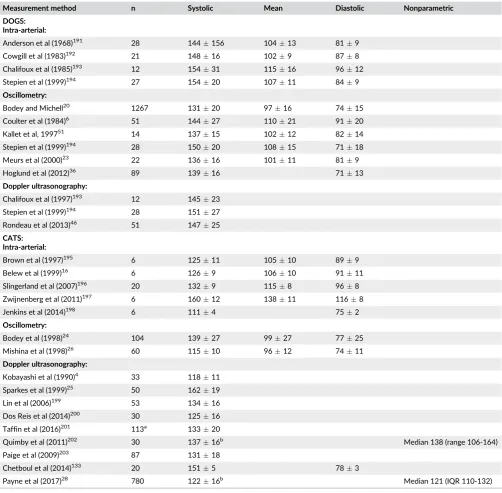
Various studies have reported values for BP in normal dogs and cats
(Table 2). These values vary, reflecting differences in subject
TABLE 1 Protocol for accurate blood pressure (BP) measurement
• Calibration of the BP device should be tested semiannually either by the user, when self-test modes are included in the device, or by the manufacturer.
• The procedure must be standardized.
• The environment should be isolated, quiet, and away from other animals. Generally, the owner should be present. The patient should not be sedated and should be allowed to acclimate to the measurement room for 5-10 minutes before BP measurement is attempted.
• The animal should be gently restrained in a comfortable position, ideally in ventral or lateral recumbency to limit the vertical distance from the heart base to the cuff (if more than 10 cm, a correction factor of +0.8 mm Hg/cm below or above the heart base can be applied).
• The cuff width should be approximately 30%-40% of circumference of the cuff site.
• The cuff may be placed on a limb or the tail, taking into account animal conformation and tolerance, and user preference. • The same individual should perform all BP measurements following a standard protocol. Training of this individual is essential. • The measurements should be taken only when the patient is calm and motionless.
• The first measurement should be discarded. A total of 5-7 consecutive consistent values should be recorded. In some patients, measured BP trends downward as the process continues. In these animals, measurements should continue until the decrease plateaus and then 5-7 consecutive consistent values should be recorded.
• Repeat as necessary, changing cuff placement as needed to obtain consistent values. • Average all remaining values to obtain the BP measurement.
• If in doubt, repeat the measurement subsequently.
populations, measurement techniques, and animal handling. This
vari-ability emphasizes the importance of standardization of technique in
veterinary practice. Additional factors affect what is considered“
nor-mal”BP. In people, age-related increases in SBP and pulse pressure
have been well characterized.19The effect of age is less clear in dogs
and cats. A small increase in BP of 1-3 mm Hg/year has been noted
with aging in dogs,20,21but such an age effect has not been observed
in all studies.22,23In 1 study, BP increased with age in a
heteroge-neous population of cats,24but no age effect was observed in 2 other
studies of normal cats.4,25In an additional study of apparently healthy
cats, a comparatively small increase of 1.5 mm Hg/year was noted for
mean BP.26More recently, a larger study identified an increase in BP
over time in cats aged >9 years of age with repeated BP
measure-ments, but the risk of developing hypertension was lower in
appar-ently healthy cats than in those with azotemic chronic kidney disease
(CKD).27A large cross-sectional study also has identified an increase
in BP with age in apparently healthy cats,28but the cats were not
screened for concurrent disease.
An effect of sex on BP was identified in 1 study of dogs20 in
which intact males had higher BP and intact females had lower BP as
compared to neutered dogs; in all cases, differences among groups
were <10 mm Hg. In other studies, no association between sex and
higher or lower BP was found.29,30Most cats evaluated by
veterinar-ians are neutered and in most studies an effect of sex has not been TABLE 2 Arterial blood pressure (mm Hg) values obtained from normal, conscious, dogs and cats
Measurement method n Systolic Mean Diastolic Nonparametric
DOGS: Intra-arterial:
Anderson et al (1968)191 28 144
156 10413 819
Cowgill et al (1983)192 21 148
16 1029 878
Chalifoux et al (1985)193 12 154
31 11516 9612
Stepien et al (1999)194 27 154
20 10711 849
Oscillometry:
Bodey and Michell20 1267 131
20 9716 7415
Coulter et al (1984)6 51 144
27 11021 9120
Kallet et al, 199751 14 137
15 10212 8214
Stepien et al (1999)194 28 150
20 10815 7118
Meurs et al (2000)23 22 136
16 10111 819
Hoglund et al (2012)36 89 139
16 7113
Doppler ultrasonography:
Chalifoux et al (1997)193 12 145
23
Stepien et al (1999)194 28 151
27
Rondeau et al (2013)46 51 147
25
CATS: Intra-arterial:
Brown et al (1997)195 6 125
11 10510 899
Belew et al (1999)16 6 126
9 10610 9111
Slingerland et al (2007)196 20 132
9 1158 968
Zwijnenberg et al (2011)197 6 160
12 13811 1168
Jenkins et al (2014)198 6 111
4 752
Oscillometry:
Bodey et al (1998)24 104 139
27 9927 7725
Mishina et al (1998)26 60 115
10 9612 7411
Doppler ultrasonography:
Kobayashi et al (1990)4 33 118
11
Sparkes et al (1999)25 50 162
19
Lin et al (2006)199 53 134
16
Dos Reis et al (2014)200 30 125
16
Taffin et al (2016)201 113a 133
20
Quimby et al (2011)202 30 137
16b Median 138 (range 106-164)
Paige et al (2009)203 87 131
18
Chetboul et al (2014)133 20 151
5 783
Payne et al (2017)28 780 122
16b Median 121 (IQR 110-132)
aIncludes 3 cats with renal azotemia.
evident in this species.24,26In a recent large study, males had higher
BP than females and neutered cats had higher BP than intact animals,
but the differences were very small.28
There are substantial interbreed differences in canine BP, most
notably for hounds (eg, Greyhounds, Deerhounds) in which BP is
higher than in mongrels31by approximately 10-20 mm Hg.20,29,31,32
The BP among other breeds varies by 7-10 mm Hg20,33perhaps based
on temperament.34–36 The panel recognizes the need for
breed-specific BP ranges to be developed. In cats, no effect of breed has
been observed on BP.24,28
Obesity is associated with increases in BP in several species.37–42
This effect has been studied experimentally in dogs.37,43 A small
(<5 mm Hg) increase in BP was noted in obese dogs by oscillometry20
but not by Doppler sphygmomanometry.22The relationship between
obesity and higher BP in dogs may be related to the prevalence of
underlying disease.30In cats, no effect of obesity on BP was observed
by oscillometry,24but cats that were underweight had slightly lower
BP when measured with Doppler than those that were of ideal body
weight or obese.28 Recent studies suggested no association among
body condition score, body weight, and SBP measurements in dogs or
cats, but muscle condition score and sarcopenia have been reported
to affect radial but not coccygeal BP measurements in the cat.44,45
Blood pressure measurement results in normal animals are highly
variable based on breed, temperament, patient position, measurement
method, operator experience, and intrapatient variability,15,17,29,46,47
and it is difficult to determine a single value and range that might be
applicable to all dogs or cats. Ranges of expected values in many
stud-ies of normal dogs and cats using various measurement techniques
are presented in Table 2. In disease-free patient populations, in which
the BP values typically are expected to be distributed normally,
expected normal values are presented as meanSD, but in
hyperten-sive patients, the frequency distribution of BP measurements tends to
be skewed with fewer patients having very high measurements.48For
this reason, the panel recommends that data from future studies of
abnormal populations be presented as median and interquartile range.
4
|
H Y P E R T E N S I O N D E F I N I T I O N S
The term systemic hypertension is applied to sustained increases in
SBP, and generally can be categorized into 1 of 3 types. It may be
caused by environmental or situational stressors, it may occur in
asso-ciation with other disease processes that increase BP (ie, secondary
hypertension), or it may occur in the absence of other potentially
causative disease processes (ie, idiopathic hypertension). Accordingly,
we suggest the definitions and criteria described below.
4.1
|
Situational hypertension
Increases in BP that occur as a consequence of the in-clinic
measure-ment process in an otherwise normotensive animal are termed
situa-tional hypertension. Situasitua-tional hypertension is caused by autonomic
nervous system alterations that arise from the effects of excitement
or anxiety on higher centers of the central nervous system. This type
of hypertension resolves under conditions that decrease or eliminate
the physiologic stimulus (eg, altering measurement conditions to
decrease the animal's anxiety and measuring BP in the animal's home
environment). In people, there is question as to whether the so-called
“white coat hypertension”actually represents a risk factor for subse-quent hypertensive damage, with some evidence suggesting increased
long-term cardiovascular risk in these, as compared to normotensive,
patients.49,50 There presently is no justification to treat situational
hypertension in dogs or cats. More importantly, anxiety- or
excitement-induced increases in BP can lead to an erroneous
diagno-sis of true pathologic systemic hypertension.22,51
Unfortunately, the effects of anxiety on BP are not predictable,
and some animals exhibit a marked increase in BP whereas others do
not. Some animals even may exhibit a decrease in BP as a result of the
measurement process.16 In human patients, awareness of the
phe-nomena of“white coat”hypertension and of“masked hypertension”
(the latter term applied to cases in which in-clinic BP measurements
are normal for a patient who is hypertensive in the nonmedical
envi-ronment) has encouraged the evaluation of ambulatory or at-home BP
as a complement to conventional in-clinic BP measurements.52,53
Whether masked hypertension is important in veterinary species is
unclear, and the use of ambulatory BP monitoring has not been
sys-tematically evaluated in veterinary medicine.
4.2
|
Secondary hypertension
Secondary hypertension represents persistent, pathologically increased
BP concurrent with a disease or condition known to cause hypertension
(Table 3), or hypertension associated with the administration of a
thera-peutic agent or ingestion of a toxic substance known to cause an
increase in BP (Table 4). Hypertension may persist despite effective
treatment of the primary condition54–56 and BP may increase after
treatment is initiated.57The presence of a condition known to cause
secondary hypertension, even if effectively resolved by therapeutic
intervention, should prompt serial follow-up evaluations.
4.3
|
Idiopathic hypertension
The term“primary”or“essential”hypertension often is used in people
to describe persistent pathological hypertension in the absence of any
identifiable underlying cause and represents a complex multifactorial
disorder involving genetic, lifestyle, and environmental factors.
Essen-tial hypertension has been reported in dogs.58–62Because subclinical
kidney disease is present frequently in people and animals with
hyper-tension, a valid diagnosis of primary or essential hypertension can be
difficult to establish. Furthermore, the presence of chronically
increased BP suggests that one or more of the neurohumoral and renal
systems responsible for regulating BP is abnormal. Thus, the panel
rec-ommends the use of the term“idiopathic”in place of“essential”for
animals in which high BP occurs in the absence of an overt clinically
apparent disease that is known to cause secondary hypertension.
A diagnosis of idiopathic hypertension is suspected when reliable
BP measurements demonstrate a sustained increase in BP concurrent
with normal CBC, serum biochemistry, and urinalysis results.
Unfortu-nately, increased BP may induce polyuria (the so-called pressure
patient with high BP does not establish that kidney disease is present.
On the other hand, the presence of concentrated urine (>1.030) makes
kidney disease less likely. Because subclinical kidney disease or other
conditions known to cause secondary hypertension may be present in
animals with idiopathic hypertension, the panel recommends that
diag-nostic tests in addition to CBC, serum biochemistry, and urinalysis be
considered in affected animals. Depending on the clinical findings, these
tests may include renal ultrasound examination (dog, cat), evaluation of
serum symmetric dimethylarginine (SDMA) concentrations (dog, cat),
measurement of glomerular filtration rate (GFR) (dog, cat), quantitative
assessment of proteinuria (dog, cat), serum thyroxine hormone
concen-tration (cat), and serum cortisol concenconcen-trations (dog). Additional tests
to consider in individual patients include serum and urine aldosterone
and catecholamine concentrations as well as adrenal ultrasound
examination.
Although secondary hypertension is most common in dogs and
cats, idiopathic hypertension is more common than previously
recog-nized, accounting for approximately 13%-20% of cases in cats.13,63,64
Approximately 12% of nonazotemic nonhyperthyroid cats were
hypertensive at baseline in one report,65and in a more recent study
of 133 apparently healthy initially normotensive cats aged≥9 years,
7% developed idiopathic hypertension over the study's follow-up
period.27
5
|
T A R G E T O R G A N D A M A G E ( T O D )
Systemic hypertension is problematic only because chronically
sus-tained increases in BP cause injury to tissues; the rationale for
treat-ment of hypertension is prevention of this injury. Damage that results TABLE 3 Diseases associated with secondary hypertension in dogs
and cats
Disease or condition
Prevalence of
hypertension (%) Reference(s)
DOGS:
Chronic kidney disease
93 191
60 192
80 192
79 204
9 20
62 81
19 205
28.8 79
14 206
47 Jacob
et al (1999) (ACVIM abstract)
Acute kidney disease
87 207
15%-37% (at admission)
208
62%-81% (during hospitalization)
Hyperadrenocorticism (naturally occurring or iatrogenic)
73 55
80 204
35 209
36.8 210
20-46.7 211
Diabetes mellitus
46 212
24 204
67 213
55 214
Obesity Small effect 20,22,30,37,43
215,216
Primary hyperal dosteronism
Rare disease
217
218
Pheochromocytoma 43% 219
86% 220
54.5-65% 221
Hypothyroidism Uncommon 222
Brachycephalic No prevalence data 223
CATS:
Chronic kidney disease
46 4
65 85
19 48
39.6% at
diagnosis of CKD
27
If normotensive at diagnosis of CKD 17% develop
Hypertension >3 months after diagnosis
29% (stable CKD over 12 months)
74
40% (progressive CKD over 12 months)
(Continues)
TABLE 3 (Continued)
Disease or condition
Prevalence of
hypertension (%) Reference(s)
Diabetes mellitus
0 111
No increase of BP 224
15% 225
Hyperthyroidism 87 4
23 85
5 pretreatment and 56
25 posttreatment
10% pretreatment
12.8% (pre) and 22% (post)
226
22% (pre) and 24% (post)
227
228
Obesity Hypertension uncommon 24
Primary
hyperaldosteronism
50%-100% 63,229–235
Uncommon disease
Pheochromocytoma Unusual disease
236
237
181
Hyperadrenocorticism 19% 238,239
from the presence of sustained high BP is commonly referred to as
end organ or TOD (Table 5) and the presence of TOD generally is a
strong indication for antihypertensive treatment.
Hypertension has been associated with proteinuria and histological
renal injury in both experimental studies and in naturally occurring
dis-ease, an effect that has been identified in several species including
humans,66,67dogs,14,68,69and cats.70,71 Proteinuria, in turn, has been
associated with more rapid progression of renal disease and increased
all-cause mortality in numerous clinical settings, including CKD and
hypertension.70,72Antihypertensive treatment generally decreases the
severity of proteinuria, at least if the hypertension is severe.13,72–74
What remains unproven, at least in dogs and cats, is whether or not this
decrease in proteinuria with antihypertensive drug treatment mitigates
renal injury, or is simply a surrogate for improved renal outcomes, such
as rate of decrease in GFR (usually assessed by measurement of serum
creatinine concentration) or renal-related mortality.13,72 Although the
benefit is unproven, hypertension-induced or hypertension-exacerbated
proteinuria currently remains an attractive target for treatment in
veter-inary patients.
Several epidemiological studies have associated hypertension
with proteinuria (and in some studies specifically albuminuria) in cats
with naturally occurring diseases.70,72,74In addition, albuminuria has
been related to an increase in BP in experimental studies of induced
renal disease in cats.75 A recent study of cats found that even
with anti-hypertensive treatment, higher time-averaged SBP was
associated with glomerulosclerosis and hyperplastic arteriolosclerosis TABLE 4 Therapeutic agents and intoxicants associated with secondary hypertension in dogs and cats
Agent Species Notes
Glucocorticoids Dog •Statistically significant, mild to moderate, dose-dependent increases in BP noted at dosages sufficient to induce signs of iatrogenic hyperadrenocorticism.240–242 •Systemic hypertension (ie, SBP≥160) is uncommon in dogs administered agents
with pure glucocorticoid activity at clinically relevant dosages.240,242–244
Mineralocorticoids Dog •At high dosages and in normal dogs, administration of desoxycorticosterone (DOC) is associated with statistically significant increases in BP,245,246most especially when combined with unilateral nephrectomy or high dietary sodium intake.247,248
•Desoxycorticosterone pivalate (DOCP), administered at clinically relevant dosage rate (2.2 mg/kg IM q 30 days) to dogs with naturally occurring
hypoadrenocorticism wasnotassociated with significant increase in BP.249
Erythropoiesis-stimulating agents
Dog, cat •Worsening or onset of systemic HT is common in animals with CKD related anemia when treated with recombinant human erythropoietin,250recombinant canine or feline erythropoietin,251,252or darbepoetin alfa.253,254
•96% of dogs administered darbepoetin alfa experienced anincreasein BP253 •37% of previously normotensive cats developed HT during darbepoetin alfa
treatment254
•HT noted in 40% and 50% of dogs and cats, respectively, treated with rhEPO250
•It is difficult to know to what degree disease progression alone contributes to observed BP increases.
Phenylpropanolamine (PPA) Dog •Normal dogs administered PPA (1.5-12.5 mg/kg PO), experience transient, significant increases in BP peak 30-120 minutes post-dose and last approximately 3-5 hours.255
•Persistent HT is uncommon when administered long-term at recommended dosage (1.5 mg/kg PO q8h) in incontinent dogs.256,257
•At high doses, acute intoxication may cause severe systemic HT.258,259 Phenylephrine
hydrochloride
Dog Systemic HT reported in normal dogs,260and those scheduled for cataract surgery,261administered topical ocular phenylephrine hydrochloride.
Ephedrine Dog Significant increases in direct BP were noted in normal dogs administered
ephedrine (1.5 mg/kg PO q12h).262
Pseudoephedrine Dog •At high doses, acute intoxication may cause systemic HT.263
•When administered for long term to dogs with urinary incontinence, significant increases in indirect BP werenotnoted.257
Toceranib phosphate Dog Systemic HT documented in 28% of previously normotensive dogs treated for various neoplastic diseases for 14 days.264
Chronic, high-dose sodium chloride
•BP in normal cats and dogs appears to be relatively salt-insensitive.134,265–267 •High-sodium diets do not appear to promote HT in cats with reduced renal
function,131,266and salt-induced HT in the dog seems to be limited to experimental models that also involve nephrectomy268,269or mineralocorticoid administration.248
•BP effects of high-sodium intake in cats and dogs with pre-existing naturally occurring systemic HT, have not been systematically evaluated.
Intoxicants with which systemic hypertension has been reported/associated:
Cocaine270,271 Dog
Methamphetamine/amphetamine272–274 Dog
5-hydroxytryptophan275 Dog
lesions after the patient's death.71However, this effect was not
repli-cated in a second, smaller, study.76
In dogs with azotemic CKD, magnitude of BP has been associated
with proteinuria, and this has been associated with shortened survival
times.14,77Hypertension also was associated with shorter renal
sur-vival, but only if proteinuria was excluded from the analysis.14
Protein-uria was directly related to the extent of increase in BP and to the
rate of decrease in GFR in an experimental study in dogs.78Dogs with
leishmaniasis frequently have proteinuria and systemic hypertension,
even when nonazotemic, although in this setting the proteinuria is
thought to relate mainly to immune-mediated glomerular lesions,
rather than occurring as a consequence of the hypertension.68,79
Hypertensive greyhounds have an increased prevalence of
microalbu-minuria, although most dogs do not have histological evidence of renal
injury.29 Hypertension may be present in any stage of CKD, and
serum creatinine concentration is not directly related to BP.4,80
Hypertensive cats and dogs often have minimal or no azotemia.81
Ocular lesions are observed in many cats with hypertension and
although prevalence rates for ocular injury vary, the frequency of
ocu-lar lesions has been reported to be as high as 100%.60,63,64,82–89
Ocu-lar lesions also are common in hypertensive dogs.14,59,60,90,91 The
syndrome91is commonly termed hypertensive retinopathy and
chor-oidopathy and has been frequently reported in dogs14,59,60,92 and
cats.63,64,84,85,93–96 Exudative retinal detachment is the most
com-monly observed finding. Other lesions include retinal hemorrhage,
multifocal retinal edema, retinal vessel tortuosity, retinal perivascular
edema, papilledema, vitreal hemorrhage, hyphema, secondary
glau-coma, and retinal degeneration.92Acute onset of blindness from
com-plete bilateral exudative retinal detachment may be a presenting
complaint in both species.60,93,94Effective antihypertensive treatment
can lead to retinal reattachment, but restoration of vision87generally
occurs in only a minority63of patients, and successful treatment of
hypertension may not resolve ocular abnormalities.92 Hypertensive
ocular injury has been reported in patients with SBP as low as
168 mm Hg,86and there is a substantially increased risk of occurrence
when SBP exceeds 180 mm Hg.60,82,93,95
Hypertensive encephalopathy97has been reported in dogs14and
cats,63,94,98and it occurs in people as a well-described entity
charac-terized by white matter edema and vascular lesions.99,100Neurologic
signs were reported in 29%63and 46%94of hypertensive cats.
Hyper-tensive encephalopathy also occurs after renal transplantation in
peo-ple101and is a cause of otherwise unexplained death in this setting in
cats.98,102,103This syndrome, in its early phases, is responsive to
anti-hypertensive treatment.75,98 Hypertensive encephalopathy is more
likely to occur in cats with a sudden increase in BP, a SBP that
exceeds 180 mm Hg, or both.75Observed clinical signs are typical of
intracranial disease and include lethargy, seizures, acute onset of
altered mentation, altered behavior, disorientation, balance
distur-bances (eg, vestibular signs, head tilt, and nystagmus), and focal
neuro-logic defects because of stroke-associated ischemia. Other central
nervous system abnormalities, including hemorrhage and infarction,
which occur with chronic hypertension in people,104also are observed
in dogs and cats.105A recent study described lesions on magnetic
res-onance imaging consistent with vasogenic edema in the occipital and
parietal lobes of the brain in affected cats and dogs with neurologic
signs.106Hypertension appears to be a risk factor for ischemic
mye-lopathy of the cranial cervical spinal cord, resulting in ambulatory
tet-raparesis or tetraplegia with intact nociception in old cats.107
Cardiac abnormalities are common in hypertensive cats63,64,82and
dogs.108When affected, the heart is a target organ and increased
car-diac output is rarely the cause of hypertension in animals.63 In both
dogs59,108 and cats,63,64,82 physical examination abnormalities may
include systolic murmurs and/or gallop sounds. The most common
car-diac change associated with hypertensive cardiomyopathy in dogs and
cats is cardiomegaly associated with left ventricular concentric
hyper-trophy (LVH),109,110 although echocardiographic findings are variable TABLE 5 Evidence of target organ damage (TOD)
Tissue Hypertensive injury (TOD) Clinical findings indicative of TOD Diagnostic test(s)
Kidney Progression of chronic kidney disease
Serial increases in SCr, SDMA, or decrease in GFR
Persistent proteinuria, microalbuminuria
Serum creatinine, SDMA and BUN Urinalysis with quantitative
assessment of proteinuria and/or albuminuria GFR measurement
Eye Retinopathy/choroidopathy Acute onset blindness Exudative retinal detachment
Retinal hemorrhage/edema
Retinal vessel tortuosity or perivascular edema Papilledema
Vitreal hemorrhage Hyphema
Secondary glaucoma Retinal degeneration
Ophthalmic evaluation including a funduscopic examination
Brain Encephalopathy
Stroke
Centrally localizing neurological signs (brain or spinal cord)
Neurological exam Magnetic resonance
or other imaging
Heart and blood vessels
Left ventricular hypertrophy Left-sided congestive
heart failure (uncommon) Aortic aneurysm/dissection (rare)
Left ventricular concentric hypertrophy Gallop sound
Arrhythmias Systolic heart murmur
Evidence of left-sided congestive failure Hemorrhage (eg, epistaxis,
stroke, and aortic rupture)
Auscultation Thoracic radiography Echocardiography Electrocardiogram
and may be indistinguishable from those associated with feline
idio-pathic hypertrophic cardiomyopathy.63,93,94,110–113Although LVH may
not be a risk factor for decreased survival time,82effective
antihyper-tensive treatment may decrease the prevalence of LVH in affected
cats.114Cardiac failure and other serious complications are infrequent,
but may occur.63,94,115
Cats with previously undiagnosed hypertension may
unexpect-edly develop signs of congestive heart failure after fluid therapy.
Fur-thermore, cats with secondary hypertension because of other causes
(eg, CKD) may die of cardiovascular complications,64as frequently is
the case in hypertensive people.116 Epistaxis, because of
hypertension-induced vascular abnormalities, has been associated
with systemic hypertension but hypertension rarely is the primary
cause of epistaxis in either species.117–119Aortic aneurysm and aortic
dissection are rare and serious complications of hypertension reported
in both dogs and cats, and typically require a high index of suspicion
and advanced imaging to diagnose.115,120,121
6
|
P R E V A L E N C E A N D S E L E C T I O N O F
P A T I E NT S F O R H Y P E R T E N S I O N S C RE E N I N G
There are 2 clear indications for evaluating BP in a patient for which
systemic hypertension may be a concern. First, BP should be
mea-sured in patients with clinical abnormalities consistent with
hyperten-sive TOD (Table 5), specifically, the presence of otherwise
unexplained clinical findings associated with systemic hypertension
should prompt BP measurement at the time of diagnosis. These
include signs of hypertensive choroidopathy or retinopathy, hyphema,
intracranial neurologic signs (eg, seizures, altered mentation, and focal
neurological deficits), renal abnormalities (eg, proteinuria,
microalbu-minuria, and azotemia), and cardiovascular abnormalities (eg, LVH,
gallop sound, arrhythmia, systolic murmur, and epistaxis). In the
absence of these clinical findings, a high index of suspicion must be
maintained to diagnose systemic hypertension and to avoid
misclassi-fication as situational hypertension. Clinical signs relating to systemic
hypertension, evident to the owner or the veterinarian, may be subtle
and attributable to aging or underlying clinical conditions that may as
yet be undiagnosed. In people, early signs of hypertension are
subjec-tive and include morning headaches, facial flushing and feelings of
anxiety. Such clinical signs would be difficult to recognize in dogs and
cats. In cats, some nonspecific clinical signs have been associated with
hypertension in the laboratory setting, including inactivity, lethargy,
photophobia, and altered (increased or decreased) appetite (S.A.
Brown, unpublished observations, 2004).
The presence of diseases or conditions causally associated with
secondary hypertension (Table 3), treatment with pharmacological
agents with a known effect on BP, or known or suspected exposure
to intoxicants that may increase BP (Table 4) comprise the second
group of indication for BP measurement. A thorough physical
exami-nation, including funduscopic evaluation, cardiac auscultation,
assess-ment of renal function including proteinuria, and neurologic
examination, should also be performed in at-risk populations to assess
for TOD. The correlation between advancing age and prevalence of
systemic hypertension is not as clear in cats and dogs as in people,
although recent data in healthy normotensive geriatric cats suggest an
expected increase in BP of 0.40.1 mm Hg per 100 days.122
Condi-tions resulting in secondary hypertension more frequently are
observed in mature to geriatric cats (eg, those with CKD or
hyperthy-roidism) and dogs (eg, those with hyperadrenocorticism) and,
there-fore, it may be prudent to screen older animals for these conditions.
The prevalence of hypertension in dogs and cats is not known.
Sur-veys of apparently healthy dogs have identified hypertension in 0.5% of
400 dogs,1230.9% of 1000 young dogs,1242% of 215 dogs,12510% of
102 dogs,22and 13% of healthy Shetland Sheepdogs.126Others have
provided evidence that suggests dogs are resistant to the development
of hypertension.20,80,127The prevalence of hypertension may be
compa-rable in cats. In a study of 104 apparently healthy cats, 2% had SBP >
170 mm Hg.24However, as noted elsewhere in these guidelines, the
lack of uniform measurement techniques, variable inclusion criteria, and
inconsistent thresholds for establishing a diagnosis of hypertension in
veterinary medicine make prevalence data difficult to interpret.
None-theless, hypertension seems to be rare in young otherwise healthy dogs
and cats. Based on available data, it is still unclear whether or not
rou-tine screening of apparently healthy dogs and cats is a reliable method
for detecting true hypertension in the population, because the risk of
false diagnosis is likely to be high with widespread screening. Therefore,
the panel does not recommend routine screening of all dogs and cats for
the presence of systemic hypertension. Some conditions (eg,
hyperthy-roidism, hyperadrenocorticism, and CKD) that result in secondary
hyper-tension are more prevalent in older animals, yet may be occult. Thus, it
is reasonable to institute annual screening of cats and dogs≥9 years of
age. Still, high BP in otherwise healthy, particularly young, animals
should be assumed to represent situational hypertension until proven
otherwise with confirmatory measurements on multiple occasions.
7
|
DI A G N O S I S O F H Y P E R T E N S I O N
The diagnosis of hypertension always should be based on reliable BP
measurements, and therapeutic decisions in cats and dogs typically
are based on SBP results (Figure 1). The presence of TOD (eg,
retinop-athy and CKD) justifies initiating treatment after a single
measure-ment session, but in most cases, results should be confirmed by
measurements repeated on multiple (>2) occasions. In cases of
prehy-pertension (140-159 mm Hg) or hyprehy-pertension at moderate risk of
TOD (160-179 mm Hg), these measurement sessions can occur over
4-8 weeks. With more severe hypertension (≥180 mm Hg), however,
the risk of TOD dictates that the measurement sessions be completed
in 1-2 weeks. Once increases in BP are determined to be persistent,
and not associated with measurement error or situational
sion, the search for conditions associated with secondary
hyperten-sion (Table 3) should begin.
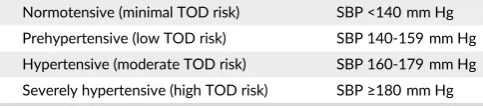
Hypertension in both dogs and cats is classified based on the risk
of TOD:
At this time, information regarding breed-specific reference
ranges is limited, but sight hounds are known to have higher
in-hospital BP than other breeds.32,128 This difference appears to be
because of situational hypertension and not a true difference in
SBP.17Nevertheless, a risk of TOD has been proposed for these dogs
when in-hospital SBP is >180 mm Hg.129These guidelines likely will
be refined as additional breed-specific information becomes available.
In people, decreasing BP in hypertensive people lowers the risk of
TOD. The precise BP at which TOD occurs in dogs and cats is not
known. Nevertheless, treatment should be instituted in any patient
that has a BP persistently in the hypertensive or severely hypertensive
category. The goal should be to decrease BP into the prehypertensive
or normotensive range.
8
|
T H E H Y P E R T E N S I V E P A T I E N T :
E V A L U A T I O N A N D D E C I S I O N T O T R E A T
Patients with BP in the prehypertensive category typically are not
treated with antihypertensive medications, but may benefit from
increased frequency of monitoring of overall condition as well as
BP. Patients in known renal risk categories (International Renal
Inter-est Society CKD stage 2 or higher) or patients with systemic diseases
associated with development of systemic hypertension (eg,
hyperthy-roidism and hyperadrenocorticism) may benefit from systemic
well-ness and BP evaluations every 6 months in order to manage systemic
disease optimally and detect systemic hypertension when and if it
develops.
Once a diagnosis of hypertension has been made and the
possibil-ity of situational hypertension has been eliminated, the search for a
possible underlying disease or pharmacologic agent associated with
secondary hypertension should be commenced. For cases in which
secondary hypertension is identified, treatment of the underlying
con-dition should be implemented immediately. Although doing so may
decrease systemic BP and make the patient's hypertension more
ame-nable to treatment, most pets fail to become normotensive and will
continue to be at risk for TOD. For this reason, treatment of a
patient's hypertension should not be postponed until the underlying
condition is controlled.
Client education is paramount. In most cases, hypertension is
silent and damage to target organs occurs over long periods of time,
and it is easy for owners to underestimate the importance of
appropri-ate treatment and follow-up. Owners must realize that control of
hypertension is likely to improve the quality of their pet's life over the
long term, but potentially with little immediate observable benefit.
The client should be provided with BP results, a working knowledge
of the complications of both hypertension and the drugs used to
man-age it, and a clear understanding for the goals of treatment. The
owner should never leave the office without a clear plan for
reevalua-tion, including a future appointment.
For most patients, the onset of hypertension has been gradual
and it can be treated and controlled as outlined below, but a few
patients may experience acute increases in BP resulting in
hyperten-sive choroidopathy, encephalopathy, or rapidly progreshyperten-sive acute
kid-ney injury. In these patients, the increase in BP should be considered
a hypertensive emergency. For recommendations regarding the
man-agement of these patients, the reader is referred to the section on
hypertensive emergencies.
Need for antihypertensive therapy established
Institute first line therapy
7-10 days (1-3 days if TOD) - Measure blood pressure
< 160 mmHg minimal goal <140 mmHg optimal goal - Recheck in 4-6 months
> 160 mmHg - Increase dosage or add additional medication < 120 mmHg and signs
of hypotension -Decrease medications
FIGURE 2 Management of hypertension involves a stepwise approach, including repeat blood pressure measurement and medication adjustments
Suspect blood pressure related TOD or compatible underlying condition
>180 mmHg
- Repeat BP twice within 14 days - Recheck for TOD
<160 mmHg - Recheck in 3-6 months
>160 mmHg
- Look for underlying condition - Recommend antihypertensive therapy 160-179 mmHg
- Repeat BP twice within 8 weeks - Recheck for TOD
<160 mmHg Recheck in 3-6 months
Measure blood pressure
>160 mmHg
- Look for underlying condition - Recommend antihypertensive therapy
No signs of TOD - Signs of TOD
8.1
|
General treatment guidelines
Because hypertension in dogs and cats often is secondary (≥80% of
cases), antihypertensive drug treatment should be initiated along with
treatment for any underlying or associated condition. Initial
consider-ations (Figure 2) always should include identification and management
of conditions likely to be causing secondary hypertension and
identifi-cation and treatment of TOD. If possible, these considerations should
be addressed with specific targeted diagnostic and therapeutic
regi-mens. Effective management of a condition causing secondary
hyper-tension may lead to complete or partial resolution of the high BP in
some, but not all, cases.4,14,55Decisions to use antihypertensive drugs
should be based on the integration of all clinically available
informa-tion, and a decision to treat (which may effectively mandate lifelong
drug treatment) warrants periodic re-evaluation.
Treatment for hypertension must be individualized to the patient
and take into account concurrent conditions. Once daily treatment is
ideal; fewer treatments always are preferred. A gradual persistent
decrease in BP is the therapeutic goal. Acute marked decrease in BP
should be avoided. If the chosen antihypertensive agent is only
par-tially effective, the usual approach is to consider increasing the dosage
or adding an additional drug. Management of highly resistant
hyper-tension in people often requires multiagent (≥2) protocols; a similar
situation often occurs in dogs, although this appears to be relatively
rare in cats. It is often helpful to discuss with the owner the
interindi-vidual variability of response to antihypertensive medications when
the first medication is prescribed, and the need for frequent
monitor-ing until a therapeutic goal is reached.
The goal of antihypertensive treatment is to decrease the
likeli-hood and severity of TOD. Hypertension generally is not an
emer-gency, and rapid decreases in BP usually should not be sought
aggressively. Studies in people indicate that reduction of risk for TOD
by antihypertensive treatment is a continuum and that the lower the
BP, the lower the risk for TOD. Results of a recent laboratory study in
dogs78suggest that BP is a continuous risk marker for progression of
kidney disease and may justify a similar treatment approach in
veteri-nary patients. The panel feels that regardless of the initial magnitude
of BP, the goal of treatment should be to maximally decrease the risk
of TOD (SBP < 140 mm Hg) and that antihypertensive treatment
should be adjusted on re-evaluation if SBP is ≥160 mm Hg, with a
minimal goal of treatment being to achieve a decrease in SBP to
≤160 mm Hg (Table 6). Blood pressure <120 mm Hg, combined with clinical findings of weakness, syncope, or tachycardia, indicates
sys-temic hypotension and treatment should be adjusted accordingly
(Figure 2).
Although frequently recommended as an initial step in the
phar-macological management of high BP (Figure 2), dietary salt restriction
is controversial,84,130,131 and available evidence suggests that
substantial sodium restriction alone generally does not decrease
BP.130–132Although sodium restriction activates the
renin-angioten-sin-aldosterone system (RAAS) axis59,131and has variable effects on
BP,130,132it may enhance the efficacy of antihypertensive agents that
interfere with this hormonal system (eg, angiotensin-converting
enzyme inhibitors [ACEi], angiotensin receptor blockers [ARB], and
aldosterone receptor blockers). Although normal cats133,134 and
dogs135generally are not salt-sensitive, high salt intake may produce
adverse consequences in some settings,136,137including animals with
CKD.84 The panel therefore recommends avoiding high dietary
sodium chloride intake. However, the selection of appropriate diet
should include other patient-specific factors, such as underlying or
concurrent diseases and palatability.
8.2
|
Management of hypertension in dogs
Once a decision is made to treat a dog with hypertension,
antihyper-tensive treatment should be individualized to the patient, based in
large part on the animal's concurrent conditions, with a therapeutic
goal of decreasing the likelihood of future TOD (ie, decreasing SBP by
at least 1 SBP substage). In most dogs, hypertension is not an
emer-gency and SBP should be decreased gradually over several weeks.
Certain disease conditions may be best addressed using specific
clas-ses of agents, such as alpha- and beta-adrenergic blockers for
hyper-tension associated with pheochromocytoma or aldosterone receptor
blockers for hypertension because of adrenal tumors associated with
hyperaldosteronism.75,138–141Otherwise, RAAS inhibitors and calcium
channel blockers (CCB) are the most widely recommended
antihyper-tensive agents for use in dogs.142 Because of their antiproteinuric
effect and the high prevalence of CKD in hypertensive dogs, RAAS
inhibitors are often chosen as first-line antihypertensive agents in
dogs. In dogs with concurrent CKD, a clinically relevant decrease in
proteinuria (ie, urinary protein-to-creatinine [UPC] ratio decreased by
≥50%, preferably to <0.5) is a secondary goal of antihypertensive treatment. Available RAAS inhibitors include ACEi, ARB, and
aldoste-rone antagonists, but most clinical experience in veterinary medicine
has been with ACEi. An ACEi (eg, 0.5-2.0 mg enalapril or benazepril/
kg PO q12h) usually is recommended as the initial drug of choice in a
hypertensive dog. An ARB (eg, 1.0 mg telmisartan/kg PO q24h) is an
alternative method for RAAS inhibition. The exception to the use of a
RAAS inhibitor as initial, sole agent, treatment is severely hypertensive
dogs (SBP > 200 mm Hg) for which the initial coadministration of a
RAAS inhibitor and a CCB (eg, 0.1-0.5 mg/kg amlodipine PO q24h) is
appropriate. The use of CCB as monotherapy in dogs should be
avoided because CCB preferentially dilate the renal afferent arteriole
potentially exposing the glomerulus to damaging increases in
glomeru-lar capilglomeru-lary hydrostatic pressure. Because ACEi and ARBs
preferen-tially dilate the renal efferent arteriole, the coadministration of a
RAAS inhibitor and a CCB may have a limited effect on glomerular
capillary hydrostatic pressures.
If an antihypertensive regimen is ineffective, the usual decision is
to increase the dosage of currently used agents or to add an
alterna-tive agent. A variety of other agents have BP-lowering efficacy
(Table 7) and these may be used as appropriate in patients for which
risk reduction is not adequate with ACEi or CCB or a combination of TABLE 6 Hypertension in both dogs and cats classified based on the
risk of target-organ damage (TOD)
Normotensive (minimal TOD risk) SBP <140 mm Hg
Prehypertensive (low TOD risk) SBP 140-159 mm Hg
Hypertensive (moderate TOD risk) SBP 160-179 mm Hg
these drugs (Figure 2). Although diuretics are frequently administered
to hypertensive people, these agents are not first-choice drugs for
veterinary patients, particularly given the prevalence of CKD in
hyper-tensive dogs and the adverse consequences of diuretic-induced
dehy-dration and volume depletion in this setting. However, diuretics can
be considered in the small subset of hypertensive animals in which
volume expansion is clinically apparent (eg, those with edema).
Antihypertensive agents in general, and RAAS inhibitors in
partic-ular, should be used with caution in dehydrated dogs in which GFR
may decrease precipitously with their use. Unless severe hypertension
with rapidly progressive TOD is present, these patients should be
carefully rehydrated and then re-evaluated before instituting
antihy-pertensive treatment.
8.3
|
Management of hypertension in cats
Despite the potential role of either the systemic or intrarenal RAAS
axis in the pathogenesis or maintenance of hypertension,26,143–148
CCB, specifically amlodipine besylate, have been the first choice
for antihypertensive treatment because of established
efficacy64,75,114,149–152in cats with idiopathic hypertension or in those
with CKD. A mean decrease in SBP of 28-55 mm Hg typically is
observed in cats in hypertensive to severely hypertensive
cats.64,149,150,152Recent data indicate that an initial starting dose of
0.625 mg per cat per day amlodipine besylate is effective in cats in
which initial SBP is <200 mm Hg, but that those cats with SBP
>200 mm Hg may benefit from a higher starting dosage of 1.25 mg
per cat per day.151Rarely, dosages of up to 2.5 mg per cat per day
however may be required. Given the efficacy of amlodipine as an
anti-hypertensive agent, careful investigation of owner compliance should
occur before increasing to the dose of amlodipine. Research
evaluat-ing plasma amlodipine concentration indicates that the need for dose
escalation to adequately control BP appears to relate to severity of
the hypertension rather than to body weight or amlodipine
pharmaco-kinetics.151Although transdermal application has been explored,
effi-cacy of this route of administration has not been established and PO
administration is therefore the preferred route of
administra-tion.153,154Adverse effects of amlodipine, including peripheral edema
and gingival hyperplasia, are rarely reported in the dog and are also
uncommon in cats. Although gingival hyperplasia has been reported in
licensing studies during administration to young healthy cats, this
seems to be relatively rare in clinical practice.155,156
Despite dramatic antihypertensive efficacy, longitudinal control
of SBP with amlodipine besylate has not been shown to increase
sur-vival time in hypertensive cats,64,157and its use may activate the
sys-temic or intrarenal RAAS.148
A key predictive factor in the survival of hypertensive cats is
pro-teinuria. A significant decrease in proteinuria has been identified in
cats that are initially either borderline proteinuric or proteinuric when
treated with CCB.157 However, although the combined use of TABLE 7 Oral antihypertensive agents
Class Drug Usual oral dosage
Angiotensin converting enzyme inhibitor Benazepril D: 0.5 mg/kg q12-24h
C: 0.5 mg/kg q12h
Enalapril D: 0.5 mg/kg q12-24h
C: 0.5 mg/kg q24h
Angiotensin receptor blocker Telmisartan C: 1 mg/kg q24h
D: 1 mg/kg q24h
Calcium channel blocker Amlodipine D/C: 0.1-0.25 mg/kg q24h
(up to 0.5 mg/kg in cats and dogs)
C: 0.625-1.25 mg per cat q24h
α1blocker Prazosin D: 0.5-2 mg/kg q8-12h
C: 0.25-0.5 mg/cat q24h
Phenoxybenzamine D: 0.25 mg/kg q8-12h or 0.5 mg/kg q24h
C: 2.5 mg per cat q8-12h or 0.5 mg/cat q24h
Acepromazine D/C: 0.5-2 mg/kg q8h
Direct vasodilator Hydralazine D: 0.5-2 mg/kg q12h
(start at low end of range)
C: 2.5 mg/cat q12-24h
Aldosterone antagonist Spironolactone D/C: 1.0-2.0 mg/kg q12h
βblocker Propranolol D: 0.2-1.0 mg/kg q8h
(titrate to effect)
C: 2.5-5 mg/cat q8h
Atenolol D: 0.25-1.0 mg/kg q12h
C: 6.25-12.5 mg/cat q12h
Thiazide diuretic Hydrochlorothiazide D/C: 2-4 mg/kg q12-24h
Loop diuretic Furosemide D/C: 1-4 mg/kg q8-24h
amlodipine and an ACEi or amlodipine and an ARB is reportedly well
tolerated,158,159 studies exploring any additional survival benefit of
add-on antiproteinuric agents in hypertensive cats that remain
protei-nuric after BP control with amlodipine besylate are lacking.
Neverthe-less, based on the potential for proteinuria to contribute to the
development and progression of renal disease in cats and its
associa-tion with survival of cats with CKD,65,160,161antiproteinuric treatment
should be considered in this situation.162,163
Telmisartan is an ARB currently licensed in Europe for the
treat-ment of feline proteinuria due to CKD.158 Initial studies in healthy
anesthetized cats undergoing radiotelemetric BP monitoring,
telmisar-tan, but not losartelmisar-tan, significantly attenuated the pressor response to
angiotensin I.164Attenuation of the SBP rise was significantly higher
than for benazepril when telmisartan was administered at a higher
than currently licensed dosage (3 mg/kg PO q24h).164More recently,
a double-blinded, randomized, placebo-controlled clinical trial has
explored the use of telmisartan administered at a dosage of 2 mg/kg/
day for the treatment of naturally occurring hypertension in cats.165In
this study, after 14 days of treatment, a significantly larger decrease
in mean SBP from baseline was identified for the telmisartan-treated
(−1922 mm Hg) compared to the placebo-treated (−917 mm
Hg; P< 0.0001) group. After 28 days of treatment, 54.6% of cats
receiving telmisartan had reached a target end point of a decrease in
SBP > 20 mm Hg, compared to 27.6% in the placebo group. However,
excluded from this study were cats with SBP >200 mm Hg, cats with
evidence of ocular or central nervous system (CNS) TOD and those
already being treated with vasoactive agents. Efficacy of telmisartan
in severely hypertensive cats and in those with overt ocular and CNS
hypertensive TOD has not been demonstrated. In addition, predefined
inclusion removal criteria included cats that developed TOD or SBP
>200 mm Hg, thus narrowing the population in the longitudinal study.
The combination of amlodipine besylate and telmisartan was shown
to be well tolerated in a small number (n = 8) of cats in which the
anti-proteinuric efficacy of telmisartan was evaluated, but the
antihyper-tensive effect of telmisartan was not a primary outcome in this
study.158
Use of ACEi in cats as a first-line antihypertensive agent is not
recommended. Although statistically significant decreases in SBP have
been identified when direct arterial BP monitoring is possible, the
decrease in SBP is small (10 mm Hg) and unlikely to be sufficient in
most cats.166However, benazepril has been used in cats that require
a second antihypertensive agent and, clinically, the combination of
ACEi and amlodipine besylate is well tolerated.159
Angiotensin converting enzyme inhibitors and ARB preferentially
dilate the renal efferent arteriole thereby decreasing intraglomerular
pressure and the magnitude of proteinuria.158,167,168However, a
sec-ondary consequence of efferent arteriolar dilatation is a theoretical
tendency for GFR to decrease. Single nephron studies indicate that
such is not necessarily the case in cats,169and indeed administration
of ACEi commonly produces only very modest increases in serum
cre-atinine concentration (<0.5 mg/dL; <50μmol/L), which is generally
well tolerated. However, in a recent study, approximately 30% of cats
with confirmed or suspected CKD experienced an increase in serum
creatinine concentration within 30 days of starting benazepril with a
>30% increase in serum creatinine concentration seen in 23.8% of
cats with confirmed CKD.170Deterioration in renal function tests and
uremic crisis also was reported as an adverse event in 2/112 cats and
1/112 cats receiving telmisartan, respectively, although the initial
stage of CKD in these cats is uncertain from data provided.73In
con-trast, no alteration in serum creatinine concentration would be
antici-pated with introduction of a CCB such as amlodipine besylate.171
Clinicians should be aware of the potential for acute exacerbation of
azotemia with concurrent ACEi and ARB, and careful monitoring is
recommended.167,169,172,173Angiotensin converting enzyme inhibitors
and ARB should not be started in dehydrated cats in which GFR may
decrease precipitously. These patients should be carefully rehydrated
and then re-evaluated before instituting ACEi or ARB treatment.
Although several other antihypertensive agents (Table 7) were
explored in early studies, their use rarely is required for treatment of
hypertension in cats. Diuretics are not routinely used as
antihyperten-sive agents in cats.63,94Beta-blockers (eg, atenolol) may be useful to
control heart rate in some tachycardic hypertensive cats (eg, those
with hyperthyroidism), but have negligible antihypertensive effect in
such patients and therefore should not be used as a sole agent for the
management of hypertension.63,94,174For cats diagnosed with
concur-rent systemic hypertension and hyperthyroidism, amlodipine besylate
remains the first-line antihypertensive agent, combined with
manage-ment of hyperthyroidism. Vasodilator drugs such as hydralazine rarely
are required for management of hypertension in cats, but they have
historically been useful in emergency situations (see emergency
management).175
In cats with primary hyperaldosteronism, management with
aldo-sterone antagonists (eg, spironolactone), potassium supplementation,
and adrenalectomy (if feasible) is necessary.176However,
antihyperten-sive treatment with amlodipine besylate often is required for adequate
BP control and should be started concurrently, particularly in those
patients presented with ocular TOD.177Medical combination treatment
can be utilized in long term for management of patients with primary
hyperaldosteronism and hypertension when surgery is not an option.177
Facial dermatitis and excoriation have been reported as a rare adverse
effect associated with the use of spironolactone in cats.178 Limited
information is available about the effect of adrenalectomy on the
ongo-ing requirements for antihypertensive treatment in cats with primary
hyperaldosteronism. Some individual affected cats have not required
treatment with amlodipine besylate postoperatively, but the frequency
of BP monitoring in these patients is not clear.177If another,
nonadre-nal, concurrent disease (such as CKD) was present and contributing to
the pathogenesis of hypertension in an individual cat, adrenalectomy
alone would not be expected to resolve systemic hypertension. In such
case, ongoing antihypertensive management with amlodipine besylate
would be required. Careful monitoring of BP therefore is recommended
in the peri- and postoperative period in cats with primary aldosteronism
treated with adrenalectomy.
Pheochromocytoma has been reported rarely in the cat.179–182
Combination treatment with phenoxybenzamine, an α1- and α2
-adrenergic blocker, and amlodipine besylate, may be required to
ade-quately control BP in affected cats.181For cats in which
tachyarrhyth-mias are of concern, beta-adrenergic blocker (eg, atenolol) treatment
may be considered, but it should only be added afterα-adrenergic
is required in the postoperative period, as persistent hypertension or
hypotension may occur.
8.4
|
Hypertensive emergencies
When marked increases in BP are accompanied by signs of ongoing
acute TOD, immediate and aggressive treatment is warranted. Clinical
trials of therapies and therapeutic strategies for acute hypertensive
cri-ses in dogs and cats have not been published, and recommendations
are anecdotal and extrapolated from recommendations made for human
patients. In dogs and cats, overt evidence of acute TOD is most likely to
be ocular (eg, retinal hemorrhage or detachment, hyphema) or
neuro-logic (eg, coma, decreased mentation, generalized, or focal facial
sei-zures). Regardless of knowledge of predisposing disease conditions,
diagnosis of SBP≥180 mm Hg (high TOD risk category) in a patient
with signs of intracranial TOD (eg, focal facial seizures) necessitates
immediate emergency treatment. The need for aggressive treatment in
such cases typically requires 24-hour care capability, and referral to
such a facility is warranted when 24-hour care is not available.
The therapeutic target in patients with acute hypertensive
emer-gencies is an incremental decrease in SBP rather than acute
normali-zation of BP. In cases of chronic hypertension, autoregulatory vascular
beds in the brain and kidneys may have adapted to higher perfusion
pressure, and acute marked BP reduction may result in hypoperfusion.
Initial SBP should be decreased by approximately 10% over the first
hour and another approximately 15% over the next few hours,183
fol-lowed by gradual return to normal BP.
Because of the requirement for incremental SBP decreases,
opti-mal acute management of hypertensive emergencies requires
paren-teral treatment that can be titrated to effect, with rapid onset and
conclusion of action. Several medications have been discussed in this
setting in hypertensive human patients, and although several of these
medications have been used anecdotally in dogs and cats, no
compar-ative studies of these drugs in severely hypertensive dogs or cats are
available. Current recommendations are based on mechanism of
action, recommendations in human medicine and reports and
anec-dotal experience in veterinary patients.
One of the most feasible parenteral medications in veterinary
clinical use (where available) may be fenoldopam,184 a selective
dopamine-1-receptor agonist currently approved for use in
hyperten-sive human emergency patients.185,186Although no veterinary studies
of this medication are available in acute hypertension in dogs or cats,
fenoldopam appears to be safe for treatment of acute kidney injury in
veterinary patients.184Through its dopamine-1 agonist action,
fenol-dopam causes renal arterial vasodilation, natriuresis, and increased
GFR in normal dogs,187and it is associated with diuresis in healthy
cats,188 all of which may be beneficial in veterinary patients with
hypertensive emergencies. Fenoldopam is delivered as a constant rate
infusion (CRI), initially at a dosage of 0.1μg/kg/min with careful (ie, at
intervals of at least 10 minutes) monitoring of BP. The dosage can be
titrated up by 0.1 μg/kg/min increments every 15 minutes to the
desired SBP, to a maximal dosage of 1.6μg/kg/min. The plasma
half-life of fenoldopam in dogs and cats is short,106,189and effects can be
expected to subside within several minutes of discontinuing the
infu-sion. Other parenteral medications that may be effective in
hypertensive dogs include labetolol (0.25 mg/kg IV over 2 minutes,
repeated to a total dosage of 3.75 mg/kg, followed by a CRI of 25μg/
kg/min), hydralazine (loading dosage of 0.1 mg/kg IV over 2 minutes,
followed by a CRI of 1.5-5.0μg/kg/min) or nitroprusside (0.5-3.5μg/
kg/min IV CRI), although none of these medications has the advantage
of renal vasodilatation. Phentolamine, a short-acting competitive
α-adrenergic blocking drug anecdotally has been used successfully to
manage intraoperative hypertension that may occur during removal of
pheochromocytomas (loading dose, 0.1 mg/kg IV; CRI, 1 to 2μg/kg/
min).190In cats, even anecdotal information regarding the use of
par-enterally administered vasodilators is sparse. Subcutaneous
adminis-tra