1
Combating recent pandemic of COVID-19 - An urgent Solution.
Indrani Roy
University College London (UCL), IRDR, [email protected]
Abstract.
This article investigates whether the weather has any role in spreading the COVID-19 and how that knowledge can be used to arrest this fast spreading disease. It highlights that Temperature and Humidity both are extremely important for transmitting the virus-
temperature being the stronger factor. A dry, cool environment is the most favourable state for spread of the virus. In fact, high temperature environment significantly reduces the risk from the virus. Regulating Temperature and Humidity level can provide drastic results to stop and arrest the outbreak. Some urgent solutions are proposed based on that knowledge. The novelty of such approach is- it can be applied overnight and implemented immediately across the globe. It is very cost effective and practically without side effects. No vast amount of funding is required to adopt these measures.
These actions are likely to reduce the spread of the disease dramatically and it is expected that these measures will be implemented on an emergency basis worldwide.
Introduction:
The recent pandemic of Coronavirus Disease 2019 (COVID-19) and its rapid spread worldwide1,2 brought our whole human civilization to a standstill. Any positive initiative to
reduce the number of infected patients and to prohibit even a single death could be most welcome. Scientists all around the globe are working tirelessly to alleviate the current emergency situation, though it will be time-consuming before that scientific research and laboratory testing can actually be implemented to human benefit. With those emergency situations in mind, some effective solutions are presented to combat that viral threat and reducing the number of infected patients and death tolls. The novelty of such approach is, it could be applied overnight, can be immediately implemented all over the globe as a part of treatment, has minimal side effects and above all cost-effective- no vast amount of funding is required to adopt those measures.
This article is based on the idea: whether the weather has any role in spreading the virus and how that knowledge can be translated to containment of the first spreading disease.
Background:
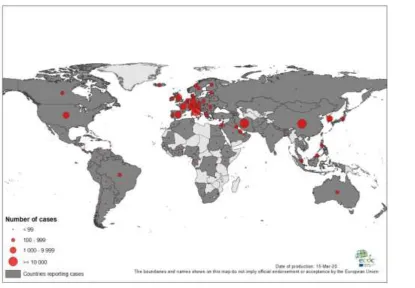
Various analyses on the COVID-19 spread in China were detailed in a recent study3. The first case of hospital admission was reported on 12th December 2019 and since then till 15th March there were 80,995 cases reported in China with 3,203 confirmed deaths2. That figure all over the globe is 151,361 and 5,758 respectively2. Geographic distribution of current COVID-19 cases worldwide are presented in Fig. 1. Several facts highlighted that the spread of recent Coronavirus pandemic showed some geographical preferences. Countries with cold climate indicated a rapid spread (UK, Italy etc.) compared to warm countries (e.g., India and African countries) 1,2.
Even on a regional basis, colder places were seen more vulnerable compared to warmer places. During February and January 2020, a sub-zero minimum temperature is noted in the Wuhan province of China where the outbreak is reported first. Wuhan experienced maximum severity in terms of the death toll and the rapid rise of infected patients. In February this
2 year, the following cities (Tehran in Iran, Rome in Italy, Seoul in South Korea) all
experienced a sub-zero minimum temperature and coincidentally showed a sharp increase in the number of infected patients. Whereas in terms of population and infrastructure, the most vulnerable countries could be India and African countries and interestingly the degree of severity is observed pretty low (2 deaths are reported in India and 6 in the whole African continent). Humidity could also play a role. Adding to temperature criteria, less humid countries (south east Asia, South Korea, Japan) showed more vulnerability. This indicates that temperature and low humidity both could have roles in the current Coronavirus regional outbreak.
Fig. 1. Geographic distribution of COVID-19 cases worldwide, as of 15 March 2020
2.Corona Virus and linkage to Temperature and Humidity:
Close connections between epidemics and seasons are previously identified for mid-latitude temperate regions; which is November till March in the Northern Hemisphere, while May to September in the Southern Hemisphere 4,5,6. In temperate regions, absolute humidity minimizes in winter which becomes more susceptible to certain virus transmission and survival5.
3 Another virus named the Middle East Respiratory Syndrome Coronavirus (MERS-CoV) that share genetic similarities with COVID-19 was shown to remain active for a long time in low humidity and low temperature7. Studies with a different Coronavirus SARS-CoV (Severe Acute Respiratory Syndrome Coronavirus) also noted the same connection 8,9,10. MERS-CoV and SARS-CoV both belong to the Coronavirus genus in the Coronaviridae family11.
Research studied strength and activity for a similar generic Coronavirus (viz. SARS-CoV) using a variable level of temperature and humidity9. It found that inactivation of the virus was faster at all humidity level if the temperature was simply raised to 20°C from 4°C. Also, the inactivation was more rapid if the temperature was further increased to 40°C from 20°C, suggesting the virus is extremely sensitive to high temperature. However, for humidity, the relationship is not linear. Moderate humidity, rather than very high or low, serves the best for inactivation. Low relative humidity at 20% level shows the highest activity of virus9.
Coronavirus usually multiplies more rapidly and remain active longer in an airborne state at low humidity than high humidity12. SARS could, however, be active for at least five days in typical airconditioned environments which has relative humidity 40-50 % and room
temperature 22 -25°C 8. The viability of the virus was lost rapidly when relative humidity was >95% and temperatures were 38°C or higher8.
Studies with various Coronavirus generic categories other than MERS and SARS also confirmed that low humidity and low temperature significantly contribute to the survival and transmission of the virus9,12.
Solutions:
The above analyses highlighted that Temperature and Humidity both are extremely important for transmissions of Coronavirus- temperature being the stronger factor. A dry, cool environment is the most favourable state for spreads of the virus. Recent facts described earlier, suggests COVID-19 also agrees with such observation. Hence following urgent measures are proposed to stop and arrest that outbreak:
1. Using the Sauna facility: Usually hotels, gyms, leisure centres etc. have existing Sauna facilities which people can start taking advantage of immediately. Mobile and Caravan Sauna facilities can also be considered by higher authority. High
temperature is very unfavourable for Coronavirus spread.
2. Portable Room Heater: As temperature is one prime factor for the activity of the virus, portable room heaters can be of great benefit. People can be close to a portable heater with comparative high temperature for say, twice a day and preferably for half an hour. Being portable in nature, it can be moved around and many people can avail that facility in a flexible way.
3. Regulate air conditioning for room temperature: People could maintain the room temperature a bit higher than usual as the virus reduces activity at high
temperatures. Checking comfort level, a high temperature threshold can be maintained inside old care homes, health centres, offices, schools, colleges and hospitals (other than special treatment units where the cold temperature is essential or recommended).
4. Using Blow dryers: Take hot air in the face a few times a day.
4 Old care homes, health care centres and hospitals can keep dehumidifiers for
additional protection. Vulnerable patients and old people can maintain that facility inside their homes.
These five measures are likely to reduce the spread dramatically and hope that these practices will be implemented on an emergency basis worldwide.
Acknowledgement. This study did not receive any funding and there is no conflict of interest.
Reference.
1. World Health Organisation: Coronavirus disease (COVID-19) outbreak.
Web site: https://www.who.int/emergencies/diseases/novel-coronavirus-2019, accessed on 15/03/2020.
2. European Centre for Disease Prevention and Control (ECDP): COVID-19:
Web site: https://www.ecdc.europa.eu/en/geographical-distribution-2019-ncov-cases, accessed 15.03.2020.
3. Li Q, Guan X, Wu P, et al. Early Transmission Dynamics in Wuhan, China, of Novel
Coronavirus-Infected Pneumonia. The New England journal of medicine. (2020). DO I: 10.1056/ NEJMoa2 001316 [ published On line First: 2020 /01/ 30].
4. Lipsitch, M and C. Viboud, Influenza seasonality: Lifting the fog, Proceedings of the National Academy of Sciences,106 (10) (2009), 3645-3646.
5. Shaman, J. and Kohn, M. Absolute humidity modulates influenza survival, transmission, and seasonality, Proceedings of the National Academy of Sciences, ,106 (9) 3243-3248,
(2009); DOI: 10.1073/pnas.0806852106.
6. Lowen A C, Mubareka, S, Steel J, Palese P. Influenza Virus Transmission Is Dependent on Relative Humidity and Temperature, PLoS Pathog. (2007); 3(10): e151.
doi: 10.1371/journal.ppat.0030151
7. Van Doremalen N, Bushmaker T, Munster V J. Stability of Middle East respiratory syndrome coronavirus (MERS-CoV) under different environmental conditions. Euro
Surveill.;18(38):pii=20590 (2013). https://doi.org/10.2807/1560-7917.ES2013.18.38.20590.
8. Chan KH, Peiris JS, Lam SY, Poon LL, Yuen KY, Seto WH. The Effects of Temperature and Relative Humidity on the Viability of the SARS Coronavirus. Adv Virol. (2011);
2011:734690, doi: 10.1155/2011/734690.
9. Casanova, L. M., Jeon, S, Rutala W. A., Weber, D.J. and Sobsev M. D. Effects of Air Temperature and Relative Humidity on Coronavirus Survival on Surfaces, Appl Environ Microbiol. (2010); 76(9): 2712–2717. doi: 10.1128/AEM.02291-09.
5 11. Gorbalenya, A.E., Baker, S.C., Baric, R.S. et al. The species Severe acute respiratory syndrome-related coronavirus: classifying 2019-nCoV and naming it SARS-CoV-2. Nat Microbiol (2020). https://doi.org/10.1038/s41564-020-0695-z.
12. Seung W. K., M.A. Ramakrishnan, P.C. Raynor, Goyal S M. Effects of humidity and other factors on the generation and sampling of a coronavirus aerosol. Aerobiologia. (2007)