REVENUE MANAGEMENT: PROGRESS, CHALLENGES AND RESEARCH PROSPECTS Xuan Lorna Wang, Cindy Heo, Zvi Schwartz, Patrick Legohérel*, Frédéric Specklin
London School of Hospitality and Tourism, University of West London École Hôtelière de Lausanne
Alfred Lerner College of Business and Economics, University of Delaware Granem, University of Angers
Disneyland Paris
ABSTRACT
This paper evaluates the main developments of revenue management (RM) over the past decade and discusses RM challenges and research prospects. It examines nine notable emerging themes: total hotel revenue management, big data analytics, distribution, rate integrity, RM and marketing strategies alignment, social media impacts on RM, revenue management system, applications of RM in non-traditional service sectors, and RM education and training. We argue that these developments have far-reaching implications for real-world RM practice and anticipate that the topic areas will continue to be popular for hospitality and tourism research in the foreseeable future.
KEYWORDS: Total revenue management, big data analytics, distribution, rate integrity, customer relationship management, social media, revenue management system, education and training
Introduction
informed us about new trends of RM practice and future research perspectives; and third, to engage and to initiate further discussions with RM practitioners about the future of RM and its implications for hospitality and tourism marketing management, which in turn should make progressive contribution to advance RM theory and practice. The next section presents the nine RM themes observed in the past ten years. Each of these is critically evaluated and their implications on RM practice and future research direction is also duly discussed.
Total Hotel Revenue Management: What it is, what it is not, who gets it right?
non-room revenue centers with the rooms’ and the other centers functions. This “computational isolationism” is likely to result in sub-optimal outcomes regardless of how effective the employed isolated optimization methods are.
Meanwhile, as noted above, the industry seems to embrace the concept of THRM and at the same time to acknowledge a gap and a need for better tools. There is a divide between the volume of discussion and buzz around the concept of THRM generated by the industry and the actual level of effective implementation. For several years now, industry leaders and hotel companies have regarded THRM as one of the most desirable advancements in the field. While there seems to be an industry-wide consensus about the necessity to switch to THRM, little is known at this time about how that could be done correctly. Consider for example the following thread of industry quotes, demonstrating the realization that something is “missing”.
An early (HSMAI, 2010) blog on the topic by the Hospitality Sales and Marketing Association International (HSMAI)'s Revenue Management Advisory Board states:
“Many companies are now realizing that there is a strong need to adopt a more holistic approach to revenue management across the enterprise. This involves two distinct components. First, there is a need to capture and track all revenue associated with hotel guests in order to segment customers more discretely based on their value -- this can come from food and beverage, spa, event venues or, in the case of a casino/hotel, gaming. Second, and equally important, operators need to begin to apply the same principles of revenue management employed at the hotel to each discrete revenue source -- there has been a strong push for revenue management in restaurants, spas, event venues and even on the casino floor”.
optimization solutions for the gaming and hospitality industries:
“…hotels employ astute controllers and support staff thoroughly capable of calculating the marginal value of, say, sleeping room profitability vs. restaurant profitability vs. lounge profitability... It is one thing to know that restaurant profitability is, on average, x%, but quite another to connect that understanding to behaviors characteristic of identifiable categories of guests. Total hotel revenue management is a most worthy objective, one that surely will be achieved in stages, but one that also will require a more disciplined, connected set of operational and analytical practices.”
Interestingly, it seems that the industry might indeed be ahead of academia in understanding the nature and challenge of true THRM. Here is an even clearer example. Origin World Lab (2014) states that THRM is not about the application of revenue management concepts to revenue streams other than rooms, such as Food and Beverage (F&B), Spa and Golf, among others (that make up the total hotel revenue) but rather it is “when the interconnected relationships across revenue streams are considered simultaneously in order to create a bundle of prices that optimizes the hotel’s total bottom line.”
Similarly, in conjunction with the announcement of their new function space-optimizing module, IDeaS (2014) states in a recently released white paper:
Academia or industry, practical challenges, and research opportunities
While we as an academic discipline might have made a late start on THRM, the practical and theoretical challenges associated with the topic present several exciting opportunities for academic research. Clearly the “Holy Grail” in this regard is the mathematics (Origin World Lab, 2014) as the complexity of the optimization increases considerably once we start adding revenue centers to the equations. While it seems that some RM solution providers are starting to offer integrated models, mostly in the area of casinos, and now meeting space, much more work is needed. Some additional interesting THRM research venues include the question of profit vs. revenue orientation, time horizon and big data analytics.
The realization that one should optimize the entire hotel rather than rooms only underscores the need to re-examine the current heavy reliance on revenue optimization. A recent study by Schwartz, Altin and Singal (2014) provided initial evidence that the assumptions regarding optimal revenue being sufficient to ensure near profit maximization is most probably less likely to hold true when more revenue centers beyond rooms are added to the mix. This issue is relevant to both the control-setting phase where most algorithms are revenue-based and the monitoring phase of the revenue management cycle where there is an industry-wide convention of almost sole reliance on revenue-based measures such as RevPAR instead of profit-based measures.
more is involved in the output functions as we add revenue centers to the mix. Since the production of the various revenue-generating departments is often interdependent, it follows that simply optimizing each department independently is most likely to generate suboptimal outcomes. The proper approach would be to optimize simultaneously while taking all departments and their interdependency into consideration or, in other words, to consider the customer’s total value across the hotel’s various revenue-generating centers.
Big data analytics
travel, loyalty patterns, time of booking, the mode of transportation, the customer’s response to various marketing efforts in the past and weather at the origin and destination among others.
When this real-time big data information is combined with similar information about other potential future guests’ reservation requests, it could be used to individually tailor the product and price combination; that is, the room and room rate quote. With the ability to best assess the individual guest needs, wants, and willingness to pay, the goal of true, most efficient optimization might be within our reach. Academia can and should play a major role in advancing our understanding of these issues and suggesting and testing proper solutions.
Revenue management and distribution
Distribution channels expansion is a mandatory step to develop business growth in the tourism and travel industry: it means to deal with new technologies, worldwide complexity and powerful partners. According to Vinod (2004), the arrival of the internet and its online supermarkets has led academicians and researchers to revisit the merchant model and to fit with demand generation via E-distribution channel. Forgacs (2010) reminds that the strategic objective of E-distribution channel management is three-fold: revenue producer, cost effective and easy to control. As specified by Vinod (2009), RM and product distribution are inextricably linked to each other, distribution being the storefront that displays products according to RM recommendations. This section focuses on the distributors, the so-called indirect channels because it raises additional revenue optimization challenges we intend to develop.
cannibalizing the existing goodwill.
For Mauri (2013), channel management has arisen as a crucial component of RM. Whether to differentiate inventory access between direct channel and trade, however, is highly debatable. For the sake of partnering principles and to facilitate the sales dialog inventory access should be strictly the same. However, revenue-speaking, the service producer should offer a wider availability of access to its own direct customers in order to reduce the volume of commissions and distributor fees. RM decisions are usually based on maximizing expected net contribution, and incremental costs are to be incorporated in the inventory control model (Phillips, 2005). Inventory access will be managed differently for direct and indirect channels when fees and costs are integrated in the revenue contribution. Then more availability opportunities will be assigned to the direct channel especially during the constrained periods and when there are few remaining unities to sell. On the other hand, the revenue contribution is calculated in gross revenue when the availability management policy is non-differentiation.
Securing availability access to partners during the most constrained periods is a major consideration. The yearly agreements could include some dedicated allocations to protect capacity for the partners instead of managing it through free sale only. These allocated capacities are managed by the RM team and the contracted capacity allocation is the result of intensive sessions between the RM and the sales division acting as a spokesperson for the partners. Introducing an allotment policy into the reservation inventory is a considerable responsibility and brings with it a weighty additional workload because it implies daily monitoring to comply with the agreed contracts while applying special sales conditions. RM performs the proper analysis to allocate the right level of capacity to trade partners by first assessing the direct channels potential as a basis and then by identifying the forecasted remaining capacities to be proposed for the partner’s allocation.
adjusted with some partnering efforts including availability guarantees, dedicated pricing or promotions to support “true friends” partners, according to customer segmentation proposed by Reinartz and Kumar (2002), over a long-term profitability vision that outweighs any short-term rate dilution.
Channels management implies the capability to build mutual agreements based on the proper tradeoffs on a yearly basis and the capacity for the RM to perform two-tier performance measurement: traditional RM performance for the direct channel and a second one including Lifetime Value for trade. The long-term risk is not negligible because the cycle of tough negotiations with major partners tends to result in the transferring of significant margins from the services producer to its distributors, and business-to-business (B2B) relationships could turn the service producer into a simple sub-contractor providing raw products with a limited margin. RM plays the role of counterbalancing the pressure by providing revenue and profitability insights, and should be associated more with strategic decisions related to channels management. According to Venkat (2009), this could be through a move from the traditional RM to profit optimization by integrating RM, Marketing Pricing and Distribution toward consistent data, synchronized analysis and coordinated actions in response to corporate requirements.
Channels management is finding the right compromise between demand generation and revenue leakage over a long-term horizon. Taking back control over product distribution is becoming a priority and efforts are made to modernize the direct channels devices: web portal designing, smart media development, search optimization engine and call center streamlining. Improvements may focus on processes and analytical tools for reinforcing the RM role, thus leveraging different fare and availability policies depending on the channel in use.
Revenue Integrity: practical challenges and research opportunities
practice in the area of revenue management”. Holloway (2008) indicated that RI efforts are to ensure as far as possible that the revenue anticipated when a reservation is accepted does actually materialize. Most pioneer authors were from airlines but, surprisingly, industries, including telecommunications and healthcare, have first taken advantage of RI in order to minimize costs and maximize revenue. RI approaches were developed later in airlines, and then were also implemented in other companies in different sectors (including hospitality and theme park).
Ten years after RI is now fully considered by the industry as an option to improve companies’ efficiency. IT businesses have developed solutions for services companies to implement RI processes; for instance, Amadeus Revenue Integrity Platform, Sabre Air Vision Revenue Integrity, and others, offer airlines solutions to implement RI processes, and improve global revenue management approaches. Literature also clearly refers to RI and considers that the RI concept and processes should be developed along with global revenue management, in order to reduce cost, stem revenue leakage, and increase benefit (Legohérel, Poutier & Fyall, 2013). Nowadays, some job employment ads even refer to specific RI profile and skills (some were offered on the job market this year - 2014).
Revenue integrity objectives and research perspectives
Niffoi (2013, in Legohérel, Poutier & Fyall) indicates that the goal of RI is to ensure the integrity of revenue; that is, the consistency of the entire commercial chain from price definition through price charging in booking systems, proper application of price conditions, and respect of yield determined sales recommendations to final invoice clearance. In most services companies, though, failures occurs both in the marketing and sales operations. This weaknesses fall into four categories: technical problems, procedure problems, communication problems and operational/behavioral problems. All weaknesses must be identified and corrected. Then, the expected gain ranges from 1% to 3% in additional revenue.
RI, but without focussing on this concept (Wishlinski, 2006). RI lies at the intersection between several disciplines, including marketing, financial and cost control issues, management (of sales teams, procedures, etc.), information technology and systems management, data tracking, human resource skills, and sales, among others. A more global view of revenue and benefit improvement has emerged, and more research is needed to investigate and improve integrated/global revenue management approaches. Some papers have recently considered this issue (including Steinhardt & Gönsch, 2012). As many practitioners agree on solutions developed and implemented in order to strengthen the robustness and efficiency of RI, in the context of a more global/integrated approach of revenue/benefit management, there is a need for academics to contribute to this relatively new area of research.
The alignment of marketing strategies and RM
One of the most noticeable revenue management movements in the past decade is the alignment of RM and marketing strategies, with a common goal, in a more integrated manner. A number of major progresses including RM and CRM integration, exploiting opportunities offered by social media and - more recently - reputation-led pricing strategies, have all positively influenced RM decision-making capability through better understanding of customer behavior, customer value and customer relationships. These improvements in turn pose new challenges for RM practitioners and require further research. Each of these areas is discussed below.
Revenue management and CRM integration
on a wide range of interviews conducted with industry leaders worldwide, Milla and Shoemaker’s (2008:110) study identifies RM and CRM integration as one of the four major areas of “having the greatest growth potential in hotel RM’” and suggest that customer will become the driver of RM in the future. Pricing, market segmentation, group revenue management and organizational structure changes to optimize RM potential are key areas that require management attention. Echoing this view, Vinod (2008) suggests that customer-centric RM is a new paradigm for RM.
Customer-value based RM is also proposed to overcome the limitation of transaction-based RM by both utilizing capacity efficiently and establishing profitable customer relationships (Von Martens & Hilbert, 2011). However, in practice, findings from the hotel industry reveal several causes of potential management conflicts that could become the hurdles for RM and CRM integration if not addressed (Wang, 2012; Wang and Bowie, 2009). These include management goals, management timescales, perceived business assets, performance indicators, and managers’ approaches to achieving individual set goals. In a B2B context, the key account management and RM integration framework developed by Wang and Brennan (2014) is one of the first to amalgamate account management and RM through comprehensive analysis of the relationship and revenue value of an account that facilitates managers to make strategic RM decisions that aim for long-term profit yield.
Revenue management and social media
How to capitalize on opportunities offered by the rapid development of social digital marketing strategies such as social media to improve RM is another area of research that has attracted much attention in recent years. The effectiveness of using social networking sites, such as Facebook, Twitter, TripAdvisor and YouTube, as means to reach prospective customers, understand customer behavior, establish and maintain customer relationships, and influence customers’ value perceptions has becoming a popular area for research. The fast growth of SM usage inevitably expands the spectrum of reputation risks and has boosted the risk dynamics (Aula, 2010; Eccless et al., 2007), thereby posing new challenges for RM practitioners. The framework for evaluating social media-related RM opportunities developed by Noon et al., (2011) undoubtedly have made progressive contribution to this relatively new stream of RM research. More sophisticated views of how consumers engage with brands have been revealed in the hospitality and tourism marketing literature, which will have profound implications for RM. For example, Hudson and Thal (2013) argue that social media have fundamentally changed the consumer decision process. They illustrate how social media make the ‘evaluate’ and ‘advocate’ stages of today’s ‘consumer decision journey’ increasingly relevant based on the four stages of the consumer decision journey: consider; evaluate; buy; and enjoy, advocate and bond (Court et al., 2009).
Industry leaders such as Patrick Landman, the CEO of XOTELS, an international hotel management company specializing in RM, predicts that a focus on corporate reputation is expected from the RM perspective in the years to come, as it is vital for companies to have a positive reputation and online review score in order to enhance its revenue performance. One of the leading RM system providers, IDeaS Revenue Solutions, launched its Advanced RM system – IDeaS G3 RMS in July 2014, which claims to be the first to allow hotels to use their current online reputations as a criterion for making pricing decisions. It is therefore fair to assume that in addition to more traditional pricing factors such as location and demand, future RM pricing decisions are likely to be made also based on a hotel’s reputation. More studies in this particular area are needed to explore contemporary issues such as how RM could embrace the opportunities offered by SM and to comprehensively examine the effects of SM, customer reviews and their implications for a company’s reputation and subsequently revenue performance.
Revenue management system
Revenue Management Systems (RMS) has its origins in the success story of the SABRE system at American Airline as described in Smith and Al (1992) and in Rothstein and Stone (1967). RMS are two embedded strategic Information Systems (ISs), a reactive loop with highly detailed data for tactics and a slower loop with aggregated information for supporting the strategy. For Queenan and Al (2011), IT is to be considered as a RM performance driver.
systems. Since RMS encompasses at least three distinct inventories (Reservation, Operations and OR tools) that are to be synchronized around a single image for the data and systems integrity, the criticality of a RMS is high because the lack of control-setting could lead to significant loss of revenue. RM is a mechanical process with most of the routine decisions made supported by the system under the guidance of an analyst inserting adequate overrides, even if some judgment bias related to the User Interface have been observed, as in Schwartz and Cohen (2004a).
The performance measurement of RMS is covered in Rannou and Melli (2003). The system performance is to be assessed including the user actions for influencing the system. As suggested by Lieberman (2003), to increase efficiency, the RM analyst has to compensate the system limits and this is facilitated when users have a general technical understanding. RMS performance is a human challenge and should become a long-term goal shared with the editors involved.
New prospects for RMS building are user-oriented with, for instance, the user friendliness of web technologies or AGILE software development methods that offer the possibility to start from the user decision-making processes for designing screens and monitoring tools. The next generation of RMS should be more customer-centric (Vinod, 2008) with the generalized implementation of hybrid demand models incorporating the customer booking behavior as buy-down when a lower fare is available, set forth in Boyd and Kallesen (2004), Fiig and Al (2010) and Walczak and Al (2010), and the integration of customer profiling and tactics-building from tracking systems. Since technologies are ready for this challenge, some additional research is needed to develop analytical methods for exploiting the opportunities offered by the big data and social media in the RM field.
Application of revenue management in non-traditional service sectors
researchers have proposed that its potential applicability extends to a number of other service industries with similar industry characteristics; in the last ten years for instance, researchers have explored various topics for the non-traditional RM industry. Chiang, Chen and Xu (2007) in particular presented research publications on the non-traditional RM industry.
Among non-traditional RM industries, restaurant RM is one of the most researched areas of the last ten years. Kimes (2008) discussed the role of technology in restaurant revenue management, Chan and Chan (2008) showed how the lunar-solar calendar-driven festivals affect Chinese restaurant operation and revenue, and a simulation study by Thompson (2009) found that reducing dining duration increases revenue only by about one-quarter of that expected. Thompson and Sohn (2009) found inaccuracies in the existing approaches to calculating RevPASH, a common metric of restaurant revenue performance, and Thompson (2010) presented a new decision-based framework for restaurant profitability. Heo et al. (2013) found the negative effects of price difference on customer’s fairness perceptions in the context of restaurant RM, and Guerriero, Miglionico, and Olivito (2014) proposed a dynamic formulation of the parties mix problem with a linear programming approximation.
application of existing techniques.
So far, revenue management systems (RMS) are available only for traditional RM industries, but in the future it is expected there will be new technologies and RM systems for non-traditional RM industries. While most current RMS for airlines and hotels are system-oriented, service-oriented RMS are to be introduced for non-traditional RM. Initial investment costs for service-oriented RMS should be lower than system-oriented ones and thus small business owners can readily utilize RMS to improve their revenue. The increasing number of smartphone users and the prevalence of Web 2.0 technologies may help non-traditional RM industries to control demand and to enhance revenue better than ever before. For example, mobile platforms and social commerce can be used for restaurant RM as distribution channels in the same way that hotels and airlines use online travel agencies. Also, location service technology will allow organizations to find customers within a defined area. Considerable additional research on non-traditional RM industries, particularly using new technology, may help organizations to maximize the benefits of RM.
Revenue management education and training
Revenue management has been credited with improving revenues in various sectors of the tourism and hospitality industry and many companies have now realized its importance. Companies have invested significant resources, in particular in RM systems, and have elevated its importance within their organizational structure. Consequently, there is an increasing demand for knowledgeable revenue managers.
offered by the Winter School of the Hong Kong Polytechnic University and the University of West London, and Pricing Analytics offered by the Center for Pricing and Revenue Management of Columbia University in the US are also available. Private institutions have also started to develop their own certificate programs and training courses, such as the Certified Revenue Management Executive from the Hospitality Sales and Marketing Association International (HSMAI). In addition, some business schools have recently started to incorporate pricing and RM into their generic management or marketing courses.
direction in a digestible way. They must also propose recommendations for an organization’s profit optimization and prepare to defend those recommendations both verbally and in writing.
Acquiring and retaining a talented revenue manager is one of the industry’s biggest challenges today. It is essential not only to find the right RM professionals but also to train them to think about the big strategic picture of organization. Retaining and training the right revenue manager are issues closely related to corporate culture and organizational commitment. The success of RM should not be judged by RevPAR alone. Having a common understanding about what is important to the organization, how it is being measured and how the revenue manager’s performance will be measured in accordance with the organizational goals helps them to focus on the key issues that are important to the business as a whole.
Thus far, the focus of research has largely been on operations, the technical sides of RM, and consumers’ perceptions of RM pricing. There has been little academic attention on HR, RM training and educational issues. Schwartz and Cohen (2004a) found that the nature of the user interface influenced the way the revenue managers adjusted the computers’ forecasts based on a study of 57 experienced revenue managers. Schwartz and Cohen (2004b) discovered that the uncertainty of estimates depends on the individual's years of industry experience, as well as on their gender. Noone and Hultberg (2011) conducted a survey of 82 sales and RM executives and suggested that hotels can foster better coordination between revenue management and sales by educating each group regarding the other group’s responsibilities. Aubke et al. (2014) identified the antecedents and consequences of group cohesion by contrasting the communication networks of 38 revenue management teams by means of social network analysis. The study findings suggest that the revenue manager plays a more active role as an information broker so as to enhance group decision making. However, there is still much research that remains to be done on these topics.
Conclusion and managerial implications
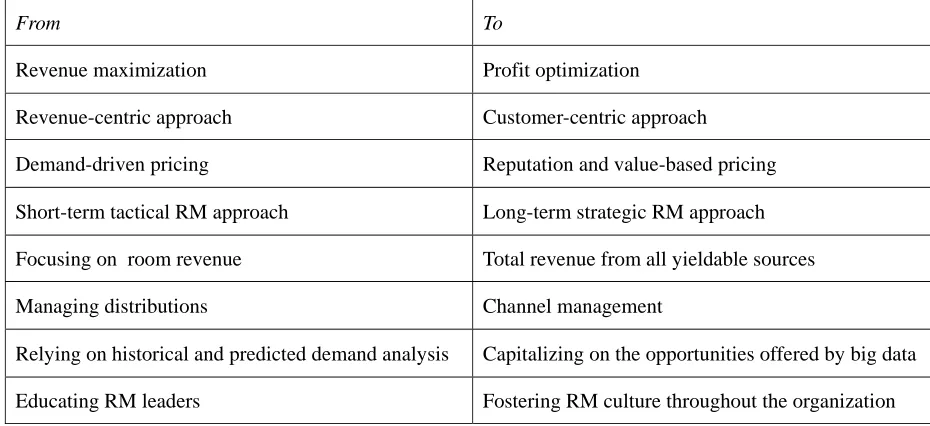
the major challenges faced by RM practitioners is how to look beyond traditional tactical RM techniques as part of operations management and incorporate RM at the strategic level in order to proactively engage with other management areas across the organization internally and with customers externally. Kimes (2010) rightly suggests that RM will become more strategic in nature and that it will encompass all revenue streams within the hotel. Although various scholars have made commendable efforts in shaping RM practice based on their research findings, our evaluation of recent emerging themes clearly shows that, as RM reaches its mature stage, more multidisciplinary studies are needed to achieve further theory development. In the previous sections, we identified nine major RM advancements since 2004, which also inform us about a range of managerial implications. We categorize them into eight areas of managerial shift where management attention is required to ensure RM success and the shaping of future RM practices. They are presented in Table 1 below.
Table 1 - Eight areas of managerial shift in revenue management
From To
Revenue maximization Profit optimization
Revenue-centric approach Customer-centric approach
Demand-driven pricing Reputation and value-based pricing Short-term tactical RM approach Long-term strategic RM approach Focusing on room revenue Total revenue from all yieldable sources
Managing distributions Channel management
Relying on historical and predicted demand analysis Capitalizing on the opportunities offered by big data Educating RM leaders Fostering RM culture throughout the organization
data are deemed to be the main exciting new opportunities or challenges for RM. Information systems may well remain as a key challenge to improve RM system performance and user satisfaction. However, it must be stressed that it also triggers ethical considerations and the need for compliance with local legal restrictions within which the organization is operating. It is also important to stress that from the HR perspective, educating future leaders in RM and a company’s ability to acquire and to retain talented RM professionals are also considered to be crucial for future RM success. It is anticipated that a more holistic approach to RM is needed to identify revenue-generating opportunities and to optimize revenue and profit generation.
Acknowledgement
We would like to thank all academic colleagues who have shared their critical views on revenue management developments over the past decade. We are also grateful to our industry partners who have offered their opinions on the progress of RM based on their invaluable experience as well as their thoughts on the future of RM practice. Lastly, we are thankful for the insightful information provided by the members of two organizations in particular - Revenue Management and Pricing International (formerly Revenue Management Society) in the UK and Revenue Management Club in France.
References
Anderson, C.K. (2012). The impact of social media on lodging performance. Cornell Hospitality Report, 12(15), 4-11.
Aubki, F. Wöber, K., Scott, N., & Baggio, R. (2014). Knowledge sharing in revenue management team: Antecedents and consequences of group cohesion. International Journal of Hospitality Management, 41, 149-157.
Aula, P. (2010). Social media, reputation risk and ambient publicity management. Strategy and Leadership, 38(6), 43-49.
Boyd, E.A.,& Kallesen R. (2004). The science of revenue management when passengers purchase the lowest available fare. Journal of Revenue and Pricing Management, 3(2), 171-177.
Buckheister, B. (2013). Total revenue management in the year 2020: A futuristic view of optimal profitability. Hospitality Upgrade, Summer, 36-37.
Chan, W.W., & Chan, L.C. (2008). Revenue management strategies under the lunar-solar calendar: Evidence of Chinese restaurant operation. International Journal of Hospitality Management, 27, 381-390.
Coleman, T. (2013) Look out revenue managers, here comes big data. Hospitality Upgrade, 6/20/2013, 36-37.
Court, D., Elzinga, D., Mulder, S., & and Vetvik, O. J. (2009). The consumer decision journey. Retrieved from http://www.mckinsey.com/insights/marketing_sales/the_consumer_decision_journey on November 22nd 2014
Cross, R.G., Higbie, J.A., & Cross, D.Q. (2009). Revenue Management’s Renaissance. A rebirth of the art and science of profitable revenue generation. Cornell Hospitality Quarterly, 50(1), 56-81.
Dana, J.D. (2008). New directions in revenue management research. Production and Operations Management, 17(4), 399-401.
Eccless, R.G., Newquist, S.C., & Schatz, R. (2007). Reputation and its risks. Harvard Business Review, 85(2), 104-114.
Farley, T. (2011). The future of revenue management is now. Retrieved from
http://www.hotelnewsnow.com/Article/7162/The-future-of-revenue-management-is-now on
November 24th 2014.
Farley T. (2013). Take it further…Total hotel revenue management. Retrieved from
http://www.hsmai.org/knowledge/summary.cfm?ItemNumber=10367 on November 4, 2014.
Forgacs, G. (2010). Revenue Management, Maximizing Revenue in Hospitality Operations. American Hotel & Lodging Educational Institute.
Guerriero, F., Miglionico, G., & Olivito, F. (2014). Strategic and operational decisions in restaurant revenue management. European Journal of Operational Research, 237, 1119-1132.
Hendler, R., & Hendler, F. (2004). Revenue management in fabulous Las Vegas: Combining customer relationship management and revenue management to maximise profitability. Journal of Revenue and Pricing Management, 3(1), 73-79.
Heo, C.Y., Lee, S., Mattila, A., & Hu, C. (2013). Restaurant revenue management: Do perceived capacity scarcity and price differences matter? International Journal of Hospitality Management, 35, 316–326.
Holloway, S. (2008). Straight and level: Practical Airlines Economics. 3rd Edition, Ashgate Publishing Ltd: UK.
Hudson, S., & Thal, K. (2013). The impact of social media on the consumer decision process: implications for tourism marketing. Journal of Travel and Tourism Marketing, 30(1/2), 156-160.
IDeaS (2014). The future is here: IDeaS Launches Advanced Revenue Management System Business Wire, July 15th 2014, New York.
IDeaS (2014). The new frontier in revenue management: Optimizing your function space for higher revenue and profits. White Paper. Retrieved from
http://www.ideas.com/files/white-papers/IDeaS%20FSRM%20White%20Paper_The%20New%20Frontier%20in%20Revenue%20Man agement_Function%20Space.pdf on November 4, 2014.
Kimes, S.E. (2008). Hotel revenue management: Today and tomorrow. Cornell Hospitality Report, 8, 4-14.
Kimes, S.E. (2008). The role of technology in restaurant revenue management. Cornell Hospitality Report, 49(3), 297-309.
Kimes, S. (2010). The future of hotel revenue management. Cornell Hospitality Report, 10(14), 4-15. Kimes, S.E. (2011). The future of hotel revenue management. Journal of Revenue and Pricing Management, 10(1), 62-72.
Kimes, S.E., & McGuire, K.A. (2001). Function-space revenue management: A case study from Singapore. Cornell Hotel and Restaurant Administration Quarterly, 42(6), 33-46.
Kimes S.E., &.Singh, S. (2009). Spa revenue management. Cornell Hospitality Quarterly, 50(1), 82-95.
Legohérel, P., Poutier, E., & Fyall, A. (2013). Revenue management for hospitality and tourism, Goodfellow Publishers, Oxford, UK.
Licata, J.W., & Tiger, A.W. (2010). Revenue management in the golf industry: Focus on throughput and consumer benefits. Journal of Hospitality Marketing & Management, 19(5), 480-502.
Lieberman, W.H. (2003). Getting the most from Revenue Management. Journal of Revenue and Pricing Management, 2(2), 103-115.
Mainzer, B.W. (2004). Future of revenue management: Fast forward for hospitality revenue management, Journal of Revenue and Pricing Management, 3(3), 285-289.
Mathies, C., & Gudergan, S. (2007). Revenue management and customer centric marketing - how do they influence travellers’ choices? Journal of Revenue and Pricing Management, 6(4), 331–346.
Milla, S., & Shoemaker, S. (2008). Three decades of revenue management: what’s next? Journal of Revenue and Pricing Management, 7(1), 110-114.
Niffoi, P. In Legohérel, P., Poutier, E. & Fyall, A. (2013). Revenue management for hospitality and tourism, Goodfellow Publishers: Oxford, UK.
Noone, B.M., Kimes, S.E., & Renaghan, L.M. (2003). Integrating customer relationship management and Revenue Management: a hotel perspective. Journal of Revenue and Pricing Management, 2(1), 7-21.
Noone, B.M., McGuire, K.A., & Rohlfs, V. (2011). Social media meets hotel revenue management: opportunities, issues and unanswered questions. Journal of Revenue and Pricing Management, 10(4), 293-305.
Origin World Lab (2014). Tackling the tall tale of total revenue management. Retrieved from http://www.forsmarthotels.com/2014/07/16/total-revenue-management-still/ on November 4, 2014.
Phillips, R.L. (2005). Pricing and Revenue Optimization. Stanford University Press, California
Queenan, C., Ferguson, M., & Stratman, J. (2011). Revenue Management performance drivers: An exploratory analysis within the hotel industry. Journal of Revenue and Pricing Management, 10(2), 172-188.
Rannou, B., & Melli, D. (2003). Measuring the impact of Revenue Management. Journal of revenue and Pricing Management, 2(3), 261-270.
Rasekh, L., & Li, Y. (2011). Golf course revenue management. Journal of Revenue and Pricing Management, 10(2), 105-111.
Reinartz, W.J., & Kumar, V. (2002). The mismanagement of customer loyalty. Harvard Business Review, 80(7), 4-12.
Rothstein, M., & Stone, A. (1967). Passenger booking levels. Proceedings of the second AGIFORS symposium, American Airline, NY.
Schwartz, Z., & Cohen, E. (2004a). Hotel revenue-management forecasting evidence of expert judgment bias. Cornell Hotel and restaurant Administration Quarterly, 45(1), 85-98.
Schwartz, Z., & Cohen, E. (2004b). Subjective estimates of occupancy forecast uncertainty by hotel revenue managers, Journal of Travel & Tourism Marketing, 16(4), 59-66.
Schwartz, Z., Altin, M., & Singal, M. (2014). Performance measures for strategic revenue management: RevPAR vs. GOPPAR. Working paper.
Smith, B., Leimkuhler, J., & Darrow, R. (1992). Yield Management at American Airline. Interfaces, 22, 8-31.
Steinhardt, C., & Gönsch, J. (2012). Integrated revenue management approaches for capacity control with planned upgrades, European Journal of Operational Research, 223, 380-391.
Sun, S., Gauri, D. K., & Webster. S. (2010). Forecasting for cruise line revenue management, Journal of Revenue & Pricing Management, 10, 306–324.
Sun, X., Jiao, Y., & Tian, P. (2011). Marketing research and revenue optimization for the cruise industry: A concise review. International Journal of Hospitality Management, 30(3), 746-755.
Talluri, K.T., & Van Rysin, G.J. (2005). The theory and practice of Revenue Management. Springer: New York.
Thompson, G.M. (2009). (Mythical) Revenue benefits of reducing dining duration in restaurants. Cornell Hospitality Quarterly, 50(1), 96-112.
Thompson, G.M., & Sohn, H.J. (2009). Time- and capacity-based measurement of restaurant revenue. Cornell Hospitality Quarterly, 50(4), 520-539.
Toh, R.S., Rivers, M.J., & Ling, T.W. (2005). Room occupancies: cruise lines out-do the hotels. International Journal of Hospitality Management, 24(1), 121-135.
Toh, R. S., Raven, P., & DeKay, F. (2011). Selling Rooms: Hotels vs Third-Parth Websites. Cornell Hospitality Quarterly, 52(2), 181-189.
Ventkat, R. (2009). The Era of Convergence in Revenue Management. In I. Yeoman & U. McMahon-Beattie (Ed) Revenue Management, a practical Pricing perspective. Palgravz Macmillan.
Vinod, B. (2004). Unlocking the value of Revenue Management in the hotel industry. Journal of Revenue and Pricing Management, 3(2), 178-190.
Vinod, B. (2008). The continuing evolution: Customer centric Revenue Management. Journal of Revenue and Pricing Management, 7, 27-39.
Vinod, B. (2009). The future of Airline Distribution and Revenue Management. In I. Yeoman, & U. McMahon-Beattie (Ed) Revenue Management, a practical Pricing perspective. Palgravz Macmillan.
Von Martens, T., & Hilbert, A. (2011). Customer-value-based revenue management. Journal of Revenue and Pricing Management, 10(1), 87-98.
Walczak, D., Mardan, S., & Kallesen, R. (2010). Customer choice, fare adjustments and marginal expected revenue data transformation: a note on using old yield management techniques in the brave new world of pricing. Journal of Revenue and Pricing Management, 9(1/2), 94-109.
Wang, X.L., & Bowie, D. (2009). Revenue management: The impact on business-to-business relationships. Journal of Services Marketing, 23(1), 31–41.
Wang, X.L., & Brennan, R. (2014). A framework for key account management and revenue management integration. Industrial Marketing Management, 43(7), 1172-1181.