A BEHAVIOURAL STUDY IN
RUN-TIME ANALYSIS
ENVIRONMENTS AND
DRIVE-BY-DOWNLOAD ATTACKS
MOHAMMAD ALLY REHAZ PUTTAROO
A thesis submitted in partial fulfilment of the
requirements of The University of West London
for the degree of Doctor of Philosophy
in
Cyber Security and Operating Systems
July 2017
1
Acknowledgements
The process of undertaking this PhD has provided a life changing process of learning and development for me. It would not have been possible to undertake the PhD without the guidance, support and experience of many people.
2 My beloved wife Imrana deserves an award for the endless emotional support and for the countless hours proof-reading my thesis and learning about honeypots just to accommodate my endless monologues, debates, doubts and reviews.
I would also like to extend my sincerest gratitude towards the supervisory team: Dr. Renato Amorim who has one of the sharpest eyes when it comes to reviewing transcripts whilst also being an amazing co-author who has read through this thesis countlessly and helped tremendously in the betterment. Professor Thomas Roth-Berghofer has also been a constant source of feedback and review. These were key individuals in the refinement of the studies.
The feedback from Anastasia, Christian and Junaid at the internal school board was very helpful and finding thesis reviewers that are willing to go through an entire thesis is a rare commodity. I would like to thank them for the time and effort put into the betterment of the work.
I extend my thanks towards the University of West London for the scholarship and sponsorship that it provided over the years and the team at the graduate school. This is extended to the IT department for accommodating my needs and experiments. It must have been terrifying for an IT department to be told that malicious website analysis needed to take place on a network and without the accommodation required, this research would not have been possible.
3 For my parents, who have firmly believed in education from the very first few years of
my life and everyone who have supported me get through the struggles PhD journey
and grow as a person.
4
Abstract
In the information age, the growth in availability of both technology and exploit kits have continuously contributed in a large volume of websites being compromised or set up with malicious intent. The issue of drive-by-download attacks formulate a high percentage (77%) of the known attacks against client systems. These attacks originate from malicious web-servers or compromised web-servers and attack client systems by pushing malware upon interaction. Within the detection and intelligence gathering area of research, high-interaction honeypot approaches have been a long-standing and well-established technology. These are however not without challenges: analysing the entirety of the world wide web using these approaches is unviable due to time and resource intensiveness. Furthermore, the volume of data that is generated as a result of a run-time analysis of the interaction between website and an analysis environment is huge, varied and not well understood. The volume of malicious servers in addition to the large datasets created as a result of run-time analysis are contributing factors in the difficulty of analysing and verifying actual malicious behaviour. The work in this thesis attempts to overcome the difficulties in the analysis process of log files to optimise malicious and anomaly behaviour detection.
5 system compromisation before filtering out behaviour within dynamic analysis log files. Consequently, this results in a significantly lower volume of data that can be analysed in greater detail. The proposed filtering approach has been implemented and tested in real-world context using a prudent experimental framework. An average of 96.96% reduction in log file size has been achieved which is transferable to behaviour analysis environments.
The other contributions of this work include the understanding of observable operating system interactions. Within the study of behaviour analysis environments, it was concluded that run-time analysis environments are sensitive to application and operating system versions. Understanding key changes in operating systems behaviours within Windows is an unexplored area of research yet Windows is currently one of the most popular client operating system. As part of understanding system behaviours for the creation of behavioural filters, this study undertakes a number of experiments to identify the key behaviour differences between operating systems. The results show that there are significant changes in core processes and interactions which can be taken into account in the development of filters for updated systems.
6
Contents
Acknowledgements ... 1
Abstract ... 4
Chapter 1 – Introduction ... 21
1.1 Motivation ... 21
1.2 Research goals ... 23
1.3 Contributions... 24
1.3.1 Methodology in developing the expert driven behavioural filters ... 24
1.3.2 Identification of differences in behavioural manifestations in different versions operating systems. ... 25
1.3.3 Observed active exploits and malicious behaviours attacking honeypots 26 1.4 Thesis organisation ... 26
1.5 Publications ... 29
Chapter 2 – Literature review ... 31
2.1 Introduction to drive-by-download and research area ... 31
2.1.1 Drive-by-download attacks ... 31
2.1.2 Detection, intelligence gathering parties and technologies ... 37
2.1.3 Collecting drive-by-download samples ... 40
2.2 Methods of analysing drive-by-downloads ... 41
2.2.1 Low-interaction ... 42
2.2.2 High-interaction ... 43
7
2.2.4 Chosen approach and rationale ... 47
2.3 Malware ... 48
2.3.1 Malware analysis ... 48
2.3.2 Research around malware analysis ... 51
2.3.3 Malware packers ... 53
2.3.4 Differentiating drive-by-download and malware analysis ... 55
2.5 Instruments for drive-by-download collection and analysis ... 56
2.5.1 Capture-HPC ... 56
2.5.2 Cuckoo sandbox ... 58
2.6 Related work ... 59
2.6.1 Malicious Domain name servers ... 59
2.6.2 Systems monitoring state change ... 59
2.6.3 JavaScript research ... 62
2.6.4 Current trends in client honeypot research ... 63
2.6.5 Applicability of machine learning ... 64
2.6.6 Clustering approaches ... 65
2.6.7 Classification approaches ... 66
2.6.8 Closely related work ... 68
2.7 Gap identification and research questions ... 70
2.7.1 Behaviour filtering in behaviour analysis environments ... 71
8
2.7.3 Windows 7 applicability and operating system behaviours ... 76
2.7.4 Research scope and summary ... 77
Chapter 3 – Methodology and experiment design ... 82
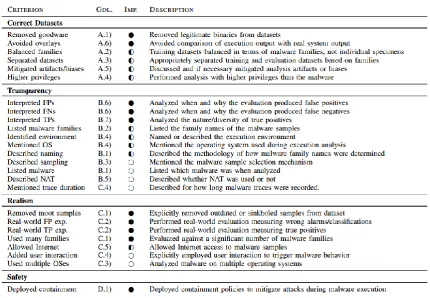
3.1 Safe, prudent and valid malware experimentation ... 86
3.1.1 Correctness in malware experimentation ... 88
3.1.2 Realism in malware experimentation ... 90
3.1.3 Transparency in malware experimentation... 92
3.1.4 Safety in malware experimentation ... 93
3.1.5 Conclusion ... 95
3.2 Drive-by-download resource gathering ... 97
3.2.1 Creation of the data corpus ... 99
3.2.2 Justification for the creation of the malware data corpus ... 101
3.2.3 Sample size evaluation ... 102
3.3 Experimental setup ... 104
3.3.1 Experimental methodology justification ... 105
3.3.2 Capture-BAT ... 106
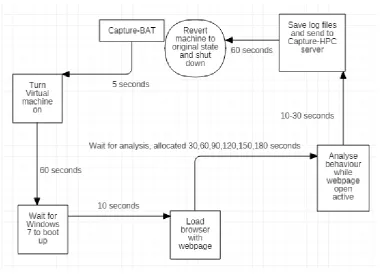
3.3.3 Duration of malicious webpage analysis ... 107
3.4 Testing the validity of experimental setup ... 111
3.5 Alternate resource gathering evaluations ... 111
3.6 Roundup ... 111
9
4.1 Background ... 116
4.2 Research requirements ... 117
4.2.1 Limitations of Capture-BAT within the Windows 7 environment ... 118
4.2.2 Identification of behavioural vectors within Windows 7 ... 119
4.2.3 Exclusion list creation rationale ... 120
4.2.4 Aims and goals of exclusion lists ... 123
4.3 Methodology used in developing expert driven behavioural filters ... 124
4.3.1 Decision making process behind classifications of behaviour ... 127
4.3.2 Processing behavioural log files to synthesise expert driven behavioural filters ... 128
4.4 Inside an exclusion list ... 130
4.4.1 Typical Windows 7 native system calls ... 133
4.4.2 System behaviours: The Windows 7 file system behaviours ... 136
4.4.3 System behaviours: The Windows 7 processes’ behaviours... 142
4.4.4 System behaviours: The Windows 7 registry behaviours ... 148
4.4.5 Differences between Windows 7 with Windows XP system calls ... 157
4.5 The development cycle of exclusion lists ... 161
4.5.1 Environment set up ... 162
4.5.3 Created exclusion lists within a Windows 7 application profile ... 166
4.5.4 Limitations of behavioural filters ... 167
4.7 Contributions to knowledge and key findings ... 168
10
5.1 Assessing the efficiency of the created behavioural filters ... 171
5.1.1 Aim ... 171
5.1.2 Hypothesis ... 171
5.1.3 Experiment description ... 172
5.1.4 Limitations & mitigations... 172
5.1.5 Experimental set-up ... 174
5.1.6 Methodology & justification... 174
5.1.7 Results ... 177
5.1.8 Conclusion ... 178
5.1.9 Evaluation ... 181
5.2 Understanding how analysis environment changes different versions of an operating system ... 182
5.2.1 Aim ... 183
5.2.2 Hypothesis ... 183
5.2.3 Experiment description ... 184
5.2.4 Limitations & mitigations... 185
5.2.5 Experimental set-up ... 186
5.2.6 Methodology & justification... 186
5.2.7 Results ... 188
5.2.8 Conclusion ... 196
5.2.9 Evaluation ... 199
11
Chapter 6 – Log file analysis and observed Windows 7 attacks ... 206
6.1 Behavioural drive-by-download log file analysis ... 206
6.1.2 Behavioural distribution analysis ... 206
6.1.3 Malicious file writes ... 210
6.1.4 Visual basic exploits within Windows 7 ... 211
6.1.5 Malicious .bat file exploits... 212
6.1.6 Observed malicious executables manifesting process behaviours ... 212
6.1.7 Observed malicious Dynamic-link library (.dll) and Temporary file (.tmp) process behaviours ... 214
6.1.8 Exploits targeting scheduled tasks within Windows 7 ... 216
6.1.9 Observed registry behaviours within the dataset ... 216
6.1.10 False positives within dataset ... 217
6.1.11 False positives and grey behaviours within the dataset and improving creating exclusion lists ... 220
6.2 Case study advanced drive-by-download exploits: Full log file analysis ... 221
6.3. Conclusion ... 226
6.4 Key findings ... 229
Chapter 7 – Conclusions ... 231
7.1 Overall conclusion ... 231
7.1.2 Chapter 4 – Behavioural exclusion list development ... 233
7.1.3 Chapter 5 – Behaviour analysis environment experiments ... 234
12
7.2 Contributions to knowledge ... 236
7.2.1 Expert driven behavioural filters ... 236
7.2.2 Identifying key behaviours within different versions of behaviour analysis environments... 238
7.2.3 Observed malicious behaviour and attack vector insight ... 239
7.3 Evaluation, limitations and delimitations ... 239
7.3.1 Evaluating Capture-BAT ... 240
7.3.2 Limitations of the research ... 240
7.3.3 Delimitations discussion ... 242
7.4 Future Work ... 245
7.5 Summary ... 246
Glossary ... 249
Bibliography ... 252
Appendix ... 269
Appendix A ... 269
Appendix B ... 276
3.4 Testing the validity of the experimental setup ... 276
3.4.1 Hypothesis ... 277
3.4.2 Test control ... 277
3.4.3 Results ... 279
3.4.4 Conclusion ... 280
13
3.5.1 Experimental purpose and background ... 282
3.5.2 Results ... 283
3.5.3 Conclusion ... 286
3.5.4 Evaluation ... 287
Appendix C ... 333
14
List of tables and figures
16 Figure 5.1: Overview of methodology used to calculate behavioural reduction in
filtered exclusion list dataset. ... 176
Table 5.1: Comparison if goodware behaviour from Alpha and Beta datasets. ... 177
Figure 5.2: The percentage reduction in benign behaviour per behaviour type from using exclusion lists in Windows 7 Capture-BATs. ... 178
Table 5.2: Additional observed behaviours for Sppsvc interactions present only in the patched dataset. ... 190
Table 5.3: Comparison of Svchost process interactions in patched and unpatched Windows 7 datasets: ... 191
Table 5.4: iexplore.exe behavioural interactions in both datasets. ... 192
Table 5.5: Services.exe behavioural interactions in both datasets. ... 192
Table 5.6 Taskhost.exe behavioural interactions in both datasets. ... 192
Table 5.7: Patched behavioural environment showing unique Rundll32.exe interactions. ... 193
Table 5.8: Shadow copy service triggering in patched dataset. ... 194
Table 5.9: Rare and native behaviours observed within patched Windows 7 behavioural analysis environment ... 196
Table 6.0: Malware analysis of the malicious file write (Svchost.exe) within the user temp folder to find signatures and family classification by Anti-Virus (AV) vendors. ... 207
Figure 6.1: Behavioural distribution analysis pie chart. ... 210
Figure 6.2: Unique behaviour distribution pie chart. ... 210
17 Table 6.2: minor differences between benign behaviours which were not being
filtered by our exclusion lists. The behavioural similarity is highlighted. ... 218
Table 6.3: Minor differences between benign behaviours which were not being filtered by our exclusion lists. The differences are highlighted. ... 219
Figure 6.3: output from Malwr.com in analysing the malicious file captured by Capture-BAT (Based on Cuckoo sandbox) ... 224
Figure 6.4a: output from VirusTotal.com in analysing the malicious file captured by Capture-BAT (Based on multiple Av-Vendors) ... 224
Figure 6.4b: output from VirusTotal.com in analysing the actual URL which was detected by Capture-BAT ac malicious. ... 225
6.5: Websense analysis of the Fadedboys webpage showed that an IFrame that points to a malicious website. ... 226
Paper 2A: Challenges in the development of Capture-HPC exclusion lists. ... 269
Figure 2C: Screenshot of Virus Total. ... 274
Figure 2D: Potential data obtainable from Virus Total part 1. ... 275
Figure 2D: Potential data obtainable from Virus Total part 2. ... 275
Table 3.4: Percentage URLs classified as malware originating from twitter when run in Capture-HPC. ... 283
Figure 4A: Example log file of figure 4.0a in full. ... 291
Figure 4B: Our Windows 7 process monitor exclusion list. ... 312
Figure 4C: Our Windows 7 File monitor exclusion list. ... 314
Figure 4D: Our Windows 7 Registry monitor exclusion list. ... 320
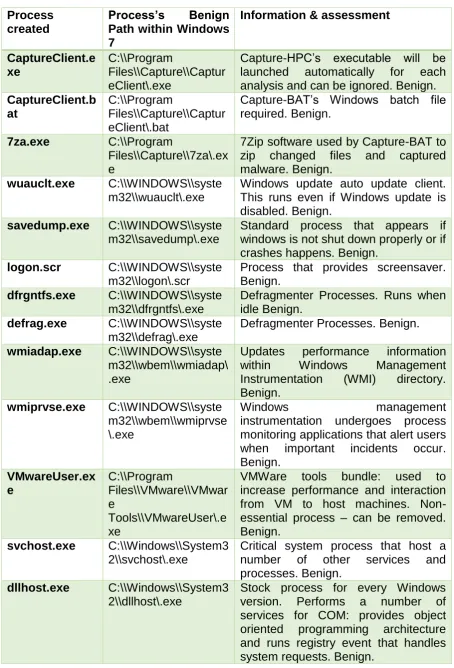
Table 4E: Process and default path table. ... 330
Table 5A: Full list of applied updates for experimental transparency. ... 333
20
CHAPTER 1
21
Chapter 1 – Introduction 1.1 Motivation
The internet that people have grown to love, depend on for livelihood, used as entertainment and carry out transactions has grown uncontrollably with the number of websites currently at over 1.1 billion (Internet Live Stats, 2017). Within the cyber security landscape, the realisation that web-based threats are one of the major attack vectors that exploit client systems which often are seen as the easier target to compromise motivates this research. It is an unsettling thought that within the world wide web, malicious websites exist to exploit information systems for monetary gains, at someone’s expense. The cybercrime landscape is no longer but a few malicious software (malware) writers in a closed community sharing malicious script: nowadays organised cybercrime is on the rise – and a significant amount of this, comes from web-based threats. 77.26% of detected attacks were caused by malicious websites (Kaspersky, 2016). Merely visiting a malicious website or a compromised website that was exploited can cause a client system to be compromised and effectively ‘owned’. Clearly within this area much more research is required to identify the methods and threats facing the user and client systems.
22 requirement as the world dives further in the cyber age. Furthermore, the design of behaviour analysis environments which are key to analysing both drive-by-download attacks and sandboxed malware is not currently sufficiently investigated. Knowledge of system behaviours from performing a behaviour study where behaviours are labelled and investigated further helps the decision-making process of understanding what happened to a system as a result of a captured behaviour.
23 as Windows is one of the most popular operating system (OS) for end users (W3C, 2014 & Net Market Share, 2016).
1.2 Research goals
The goals of this research are to facilitate the issues faced by dynamic analysis in the detection of malicious webpages. The specific goals of this research include:
Optimisation of the output from run-time analysis honeypots: One of the main
limitations faced by an analyst using dynamic analysis is the volume and variation within behavioural data that is generated and stored upon execution. By optimising the output so only anomalies and unexpected behaviours are analysed, indicators of compromise or maliciousness can be identified sooner. Detecting malicious webpages and understanding active malicious
behaviours. Investigating malicious behaviours that are captured provides insight regarding the attack vectors which can be useful in the identification of remediation or prevention of client attacks.
Understanding behaviour analysis environment interactions: Classification of
known behaviours and behaviour types into benign, malicious or grey allows the creation of labelled data sets. These can be particularly useful in the design aspect of a behaviour analysis environment as operating system, application and browser version choices can affect the output.
Application of correct, safe, transferrable and prudent framework to real-world
24
1.3 Contributions
1.3.1 Methodology in developing the expert driven behavioural filters
25 Analysis Tool (Capture-BAT) experimental setup. This is beneficial to the optimisation of the log file analysis process that is carried out by malware analysts as the sheer volume of events that can be recorded in log files as well as the number of false positives is drastically reduced.
In addition to the concept of expert driven behaviour filtering, the thesis contributes to knowledge by providing sets of labelled behaviours which were created from the analysis of real-world potentially malicious webpages. These behaviours are classified as benign behaviour, grey behaviour and malicious behaviours. The assessment and classification of behaviours were based on assessing behavioural interactions in terms of the potential risks to compromise a system and the frequency with which this behaviour is observed. This contribution has the potential to help future research that relies on Windows 7 malware that rely on dynamic analysis that filtering out noise or identifying key system behaviours that display inherent maliciousness. This artefact of the thesis can be applied directly to Windows 7 based operating systems when dynamic analysis of potentially malicious websites or samples is undertaken as the core operating system interactions are similar.
1.3.2 Identification of differences in behavioural manifestations in different versions operating systems.
26 versions of an operating system to identify the differences in observable behaviour and identify key behavioural difference. It was concluded that as a result of undertaking this investigation, there were several significantly different behavioural changes in patched and unpatched behavioural analysis environments. This suggests that careful consideration should be applied to the choice of operating systems for honeypots attempting to replicate client systems.
1.3.3 Observed active exploits and malicious behaviours attacking honeypots
A large volume of potentially malicious websites were analysed within the thesis’ experiments and data capture. From this a range of confirmed malicious log files were gathered. The malicious behaviours within log files that were observed during drive-by-download analysis were explored and evaluated. This provided knowledge in terms of popular attack vectors and exploits faced during the course of the study. The synthesised knowledge reinforces existing knowledge on a large numbers of web based attacks that target various aspects of a vulnerable operating system, browser and plugins. This contribution is important as it is concluded that evidently a large number of exploits including browser injection and malicious file writes stay active long after they have initially been detected. This finding shows the importance of the application of security patches and browser safeguard methods within client systems post outbreaks of threats within cyber security as threats remain active.
1.4 Thesis organisation
27 From this, the research questions are synthesised on a variety of gaps from creation of behavioural exclusion lists to investigating changes within operating system setups.
Chapter 3 explores the experimental methodologies applicable to identified research questions. Within the chapter, malware experimentation framework with prudent experimental guidelines is adapted and applied to meet the research demands. The chapter evaluates and discusses sample sizes, resource acquisition and gathering required data. As part of chapter 3, two experiments are carried out which are presented in Appendix B. A validation experiment of the experimental setup and analysis environment is carried out and finally Twitter is assessed as an avenue to gather potentially malicious Universal Resource Locators (URLs). It is concluded that while there are malicious URLs observed within tweets, the volume of detected maliciousness was relatively too low to merely apply dynamic filtering directly thus, unsuitable for this study.
28 Chapter 5 consists of two major experimental write-ups: Firstly, the created exclusion lists in the previous chapter is evaluated in the context of a real-world experiment within potentially malicious websites. It is concluded that the exclusion lists were able to filter a significant amount (96.96%) of known, benign behaviours. Secondly an experiment is designed and created that was tasked in understanding how the behaviour manifestations in a behaviour analysis environment change over in patched and unpatched environments. There were significant changes in observable behaviours and these key differential behaviour manifestations are explored.
Chapter 6 presents behavioural knowledge, pattern and common attack vectors that were identified in 5,132 log files. These were created in the interaction between client and 110,000 potentially malicious web servers by utilising Capture-BAT. The evidence of behavioural drift is introduced and discussed.
29
1.5 Publications
These papers were published at the time of the study.
1. Puttaroo, M, Komisarczuk, P, Amorim, R., (2014). Challenges in developing Capture-HPC exclusion lists, In The 7th International Conference on Security of Information and Networks, (SINCONF), 9-11 September 2014, ACM.
30
CHAPTER 2
31
Chapter 2 – Literature review
This chapter provides background and details regarding the research area. The detection of drive-by-download attacks and malware analysis are both highly active areas of research as seen by Amorim & Komisarczuk, (2012b), Bringer et al, (2012), and Egele et al. (2012). The technical approaches, definitions and techniques therefore needed identification and critique. Relevant detection and intelligence gathering parties involved and their contributions are identified. Drive-by-download area is then differentiated within the overall scope of malware analysis. Related work is critiqued leading to the identification of gaps within knowledge to be identified. Finally, research questions are formulated and scope of work is defined.
2.1 Introduction to drive-by-download and research area 2.1.1 Drive-by-download attacks
32
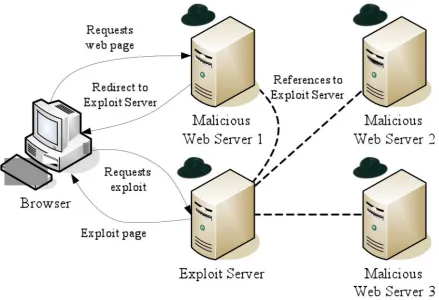
Figure 2.0: The drive-by-download problem and client side attacks illustrated based on knowledge provided by Dell'Aera & Seifert (2012).
33
Figure 2.1: Drive-by-download attacking client systems from poisoned advertisement streams (Dell'Aera, 2012).
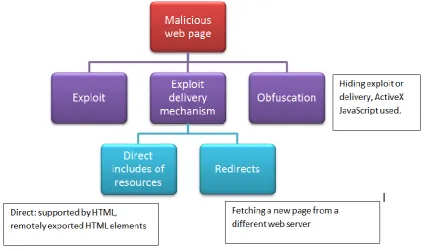
34 be compromised by a range of methods: Structured Query Language (SQL) injection attacks, search engine result redirections, cross-site scripting attacks or simply vulnerabilities in a web-server hosting software. Le et al. (2012) suggests that increased drive-by-download attacks can also be due to the increased availability of exploit packs which require the attacker to have significantly less skill set to deploy. Typical drive-by-download attack vectors are explored further in Figure 2.2. The exploit seeks to target a given vulnerability in software. The exploit delivery mechanism is the observable drive-by-download behaviour that is concerned with dropping malicious code or files onto a client machine. Obfuscation is used to hide exploits, delivery mechanisms or the insertion of JavaScript within code. This presents a challenge to detection methods that are not based on run-time analysis.
Figure 2.2 Malicious webpage attack vectors.
35 any data stored on the network, which a client is given privilege to access. Some examples include credit card details, corporate files, login and password information, cookies, temporary files and saved passwords which are for example stored in a browser. Extortion through ransomware is also a growing trend as discussed by both O’Gorman & McDonald (2012) and the FBI (2016). In order to compromise clients, malicious websites attempt to exploit vulnerabilities from the web browser (such as Internet Explorer), plug-ins (such as ActiveX and Adobe reader) or even the operating system’s built in features (such as exploiting privilege available in Command (Cmd) in Windows). Additionally, compromised client machines can be used to launch Distributed Denial of Service (DDoS) attacks and send spam messages around the internet. Khattab et al. (2004) presents work on mitigating denial of service attacks. These availability based attacks were predicted to be on the rise by Rivera (2013).
36 the application, the client operating system and plugins. This exploitation allows the drive-by-download to install malware. Malware on a client system may lead to the aforementioned damaging effects such as data exfiltration, malicious control over the computer system and using the compromised system to launch attacks or gain resources (Egele et al., 2009).
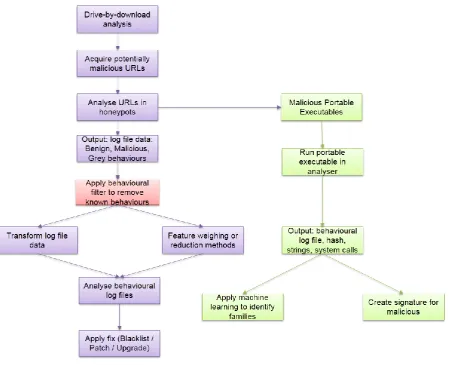
Figure 2.3: Anatomy of the creation and exploitation process.
37 of all attacks originated from malicious URLs. Malicious URLs as a percentage of all attacks observed by Kaspersky was shown to have increased to 75.76% in 2015 (Kaspersky, 2015) and again to 77.26% in their 2016 report (Garnaeva et al., 2016). Symantec (2016) in their internet security threat report suggest over ‘one million web attacks against people each and every day.’ These statistics therefore illustrate the necessary requirement of reliable security mechanisms and continued research within detection and intelligence gathering to protect client and networks systems from the ever-growing sea of web-based threats.
2.1.2 Detection, intelligence gathering parties and technologies
In addition to the research discussed above, there are several different parties involved in the detection of malicious webpages and the gathering of intelligence within the area of drive-by-download research. In this thesis, these are divided between the government, commercial services, and research communities.
38 In the United Kingdom (UK), Nominet provides a commercial ‘Domain Health’ service to help all UK-based domains that are managed by the Nominet service (Nominet, 2017). This service focuses on collecting security information from compromised web servers under the .UK domain and categorises servers into several abuse categories; abuse, command and control, compromised, associated in malware or botnet attacks, phishing and spam.
The Shadowserver Foundation (2017) is involved in the capture, analysis, monitoring and reporting of malware and botnet activity within the world wide web. Shadowserver uses the Nepenthes honeypot primarily to collect malware samples. The Honeynet project is a non-profit organisation that has been active within detection of malware and intelligence gathering for several years (Honeynet, 2014) and is a collection of nationally managed chapters. Members of the Honeynet project actively engage in a large number of research and development projects within malicious webpage discovery, and raise awareness of existing web-based threats, conduct data analysis approaches and develop of security tools.
Anti-virus software vendors are also highly active within this area of research and regularly publish statistics reflecting their findings using their data gathering networks (Garnaeva et al. 2016; Kaspersky 2015; Symantec 2016; Akamai 2016). These often include a portion of data dedicated to online (web based, drive-by-download) attacks. For instance, Garnaeva et al. (2016) provides a list of Common Vulnerabilities and Exposures (CVE), country attack distribution charts, and observed exploit vectors (such as the browser, Adobe reader, Flash player, java, …etc).
39 Anubis (http://anubis.iseclab.org) performed URL analysis and provided a report based on operating system and browser interactions and behaviours that takes place when a given URL is submitted for analysis. The lists of behaviours provided by these online analysers displayed all system interaction that took place upon analysis of a website and did not differentiate malicious from benign behaviours.
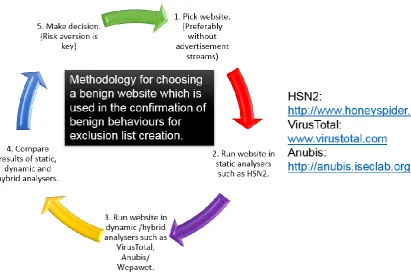
Virus Total (2016) is an online information aggregator service that uses anti-virus engines and website scanners to detect malicious content on files or malicious websites. This is a useful service that facilitates the identification of malware, and possible false positives. The ability to use multiple antivirus scanners and website scanners which are updated in real time facilitates detection. Virus Total also hosts a collection of malware hashes, malware binaries as well as malware analysis data from several anti-virus vendors such as Sophos, McAfee, Symantec and a lot more popular anti-virus. As an information aggregator, Virus Total provides a free un-biased service on a given malware sample. This makes Virus Total ideal for research without any influences from any particular parties. Within this research, Virus Total is used extensively in two ways: first, Virus Total is used to verify collected malware samples. These malicious binaries are submitted to the multitude of anti-virus vendors supported by Virus Total and assigned signatures are requested. Second, Virus Total is used as a second step validation to ensure that a given website does not show signs of maliciousness when the use of benign websites are required. Some examples of the capability of Virus Total are provided in Appendix A.
40 (IDS), firewalls, anti-viruses or data encryption and backups are a more aggressive approach to client system defence. Client honeypots are at the forefront of intelligence gathering to initiatively protect against threats to the client network. Studies can then be conducted to understand the operations and intent of a malware writer by capturing malicious activity and analysing attack patterns. Additionally, this helps in identifying vulnerabilities in client systems (Seifert, Welch & Komisarczuk, 2006). From reviewing the available literature and intelligence gathering parties, it is fair to conclude that the issue of drive-by-downloads is an active area of research within the context of cyber security.
2.1.3 Collecting drive-by-download samples
41 which still contains the same exploit that they were originally designed or injected with. This clearly has implications within cyber security research as long-lived malicious URLs, which target a specific vulnerability, are likely to have an impact on a created dataset for analysis. Newly collected datasets face the possibility of collecting slightly outdated exploits that were aimed at older operating system, application and browser vulnerabilities. In addition to this, research using the internet to build data corpuses faces a large volume of available webpages which can mean that the collection of drive-by-download samples result in data that is out-dated. Long-lived malware is not new within cyber security as samples such as research by Nazario (2006) showed samples seen in 2002 were still being distributed in 2006. More recently, Goodin (2016) discusses the Project Sauron malware which has been active for 5 years, proving the longevity of active malware. Therefore, when drive-by-downloads were being collected from the internet it is evident that there is a requirement for some sort of control to collect relevant malware within the context of the target client system utilised. Collection of malware samples can be filtered when building a data corpus based on malware that actively attack a type or version of O.S. This allowed the data corpus to exclude older websites that target older client systems although older client systems are still prevalent.
2.2 Methods of analysing drive-by-downloads
42 a drive-by-download is attempting to exploit a system and does not assume that a given binary file has been downloaded or saved on the analysis environment. Typically, this involves using a client honeypot to simulate the real-world scenario of client accessing a malicious webpage scenario and logging system behaviours for drive-by-download analysis. This will provide information on attack vectors used by malware: these can either be exploited weaknesses and vulnerabilities from the web-browser or web-web-browser plugins, as well as any applications being run. Typically, in the system life-cycle of a malware attack, drive-by-downloads would occur before a malicious binary is executed: behaviour of drive-by-downloads can be studied to understand how a given malware sample infiltrated a client environment. Thus, when referring to drive-by-download behaviours or drive-by-download analysis, the web exploit’s non-standard and malicious behaviours observed on a live system is what this thesis is referring to.
Drive-by-download analysis is typically carried out using three types of approaches; low-interaction client honeypots, high-interaction client honeypot and hybrid client honeypots. These approaches are core to the thesis and therefore are discussed before a rational for choosing high-interaction is provided.
2.2.1 Low-interaction
43 exploitable interaction with malicious websites. An example of widely used low-interaction client honeypot is Thug by Dell'Aera (2012). Thug has a number of different browser versions and plugins. These are used in the analysis of web-based threats by emulating behavioural events. The analysis relies on attack signatures and the identification of interesting breakpoints. Yet Another Low-Interaction Honeyclient (YALIH) by Mansoori et al. (2014) is another example of a currently developed low-interaction client honeypot with capabilities to emulate virtual browsers and cookie redirection. However, low-interaction systems usually tend to be ineffective at detecting new and unknown malicious behaviours as they cannot provide full emulations of client systems and use simplistic rule-based or signature checking to detect attacks. Signature based systems face evasiveness from malware writers who use obfuscation and polymorphism techniques in creation of new malware samples. Additionally, there is therefore a requirement for an attack to be known prior to website analysis, which in the world of cyber security is challenging due to the nature of the cat and mouse game between malware writers and security professionals (Riden & Seifert, 2010). Additionally, low-interaction client honeypots would face the same limitations that static detection systems face. Such an example include: Obfuscated attacks which modify patterns, code, data and behaviours in avoiding detection. Both limitations discussed can be mitigated by incorporating dynamic analysis from high-interaction systems in purely native low-interaction systems.
2.2.2 High-interaction
high-44 interaction systems can be comparable to real-world clients and can additionally be set up to simulate a certain type of user. Recorded attacks against such a client can then be analysed by studying malicious web-exploit manifestations from real-world malicious web servers in real-time. This behavioural analysis provides the benefit of identifying malware based on their behaviours as opposed to signatures, which can sometimes lead to the detection of 0-day attacks from malicious drive-by-downloads. It is imperative to state that high-interaction honeypots can provide a much deeper level of detail upon how an exploit compromises a client system in comparison to a low-interaction counterpart.
45 sometimes as these can be detected by malware which would likely not manifest full behaviour. High-interaction client honeypots are nevertheless, a good approach to capturing malicious behaviours. In line with this statement, Lau and Svajcer (2010) showed that only as little as 2% of malware sampled could detect the presence of virtual machines. This is a relatively low percentage but is likely to have increased at the time of writing.
Typically, the output of a high-interaction client honeypot is recorded as a behavioural log file. These behavioural log files contain behavioural information that can be used to understand how different components of an analysis environment interact. It is in this way that malicious behaviour can be identified: the unexpected interactions can be investigated to understand how malware is downloaded on to the system and what plugins or environment features are targeted as part of malicious attacks. This is the focus of this thesis.
2.2.3 Hybrid-interaction
46 within the sortation process where initially the low-interaction component would analyse every webpage in the list. The webpages that provided unknown responses as well as potentially known malicious responses would then be forwarded to the slower high-interaction counterpart.
The HoneySpider network 2 (2013) is highly scalable system of integrated honeypots for detecting malicious content on the web. Within the previous architecture of HoneySpider 1 integrated high and low-interaction client honeypots which were used in addition to Snort’s Intrusion detection system. However, the new HoneySpider 2 includes a more complex detection framework using a number of exploit detection mechanisms such as JavaScript analyser, PDF analyser, and Flash analyser in addition to using Capture-HPC and anti-virus scanners. This integrated framework offers the possibility of a number of different exploits to be detected from a wide range of plugins, which users rely on daily. HoneySpider 2 is not simply a honeypot as it also provides a number of services. An example of this is the storing of data and analysing of honeypot data by using a number of nuggets. Therefore, HoneySpider 2 could be described as a management platform that crawls the web in search of malicious webpages. Koo et al. (2013) also used hybrid honeypots in the detection of malicious webpages.
47 analysing websites and determining whether a website is malicious or not is very efficient at scanning large numbers of webpages, an obvious limitation would be the number of false positives obtained. In terms of identification of malicious webpages, the authors admit that the method misses a number of attacks which is concerning, but the work was focused on attempting to deal with the ever-increasing large volumes of websites active on the world wide web.
In addition to this, the methods used to identify malicious webpages are unlikely to be applicable in the current web era as behaviours and features change: the proposed decision trees would face a fairly high number of false positives which would miss a significant number of drive-by-download exploits. The decision tree proposed would require a number of updates to keep up with new exploits as the low-interaction aspect would likely require new signature updates. Song et al. (2010) agrees and mentions that malicious webpages are short-lived before they are changed or removed by the malicious black hat. As the classification model is out of date and no longer applicable to the current World Wide Web it is fair to conclude that new classification models are required to identify malicious web servers.
2.2.4 Chosen approach and rationale
48 an exploit being known beforehand. The limitations faced by low-interaction client honeypots and the interest within the observable web attacks within client systems drove this research into applying high interaction client honeypots within the study. This research used potentially malicious websites as the main resource in capturing malicious behaviour. This approach is different to Le et al. (2011) where the URLs used were unknown and required a low-interaction analyser to create a list of potentially malicious webpages. It is therefore fair to conclude that the usage of hybrid systems would be unnecessary: the URLs utilised as input for the honeypot have been pre-filtered thereby rendering the initial low-interaction analysis redundant. In addition to this, the number of potentially malicious websites retrieved from multiple black list and malware domain lists utilised in the study were not as numerous to justify the usage of hybrid client honeypots.
2.3 Malware
Malicious computer software with the intent to disrupt operation, deceive, extort, steal sensitive information, gain access to private systems, spy or advertise is known as malware. Malicious software has been on the rise and forefront of cybercrime with a vast variety of types including viruses, trojan Horses, rootkits, backdoors, spyware, worms and ransomware. Examples include: ransomware trojan – CryptoLocker or Computer worm – Stuxnet. This section outlines some key definitions and work within malware analysis with the conclusion focused on differentiating the traditional malware analysis stage with drive-by-download analysis state in the anatomy of a malware attack.
2.3.1 Malware analysis
49 availability of the computer system. Malware analysis involves dissecting a number of different components of malicious software with the intent to study the possible malicious behaviour manifestation of software within a host O.S. Malware analysis techniques include two main approaches which are sometimes combined to provide better understanding of malicious intent. These approaches are static malware analysis and dynamic malware analysis.
Figure 2.4: Overview of malware analysis approaches including requirements based on Zeltser (2016).
50 Static malware analysis involves studying a given file, specifically Portable Executable (PE) files, in Windows and understanding the file’s functionality. This sometimes can indicate the maliciousness of a PE file without having to execute the file, bringing the benefit of fast malware analysis as well as requiring less hardware to analyse malware samples. Typical tasks in static analysis include searching the file for strings, checking if the file is obfuscated or packed and learning the content of file headers.
51 would need to somewhat mimic popular real client systems on which the malware was intended to attack.
Reverse engineering program code is often done manually by a malware analyst. This can be thought of as dissecting a malware sample to obtain valuable insight: data stored on the program, algorithms and logic used within the program and revelation of all functions and possible behaviours which are not always exhibited. Disassemblers, debuggers and decompilers are used in this process. This task is highly time and labour intensive, so much so that it is currently unable to cope with even a fraction the amount of malware released every day. Additionally, the malware analyst is required to have a very rare skill set which is why the vast majority of malware studies do not use this method Zeltser (2016).
2.3.2 Research around malware analysis
52 that reside outside the analysis operating system environment that would otherwise be detected by some malware samples.
Moser et al. (2007) explores single program execution issues that are observed with dynamic analysis tools. The effect of this prompts malware to only be triggered based on a number of specific or special circumstances: e.g. a specific day, with the inclusion of a specific file being present in the environment, or when a certain command is obtained from the malware writer. The authors propose a system that allows the exploration of multiple execution paths and identifies malicious actions that are only executed when certain conditions are met. The paper uses a number of different values that try to get the executable to execute and display malicious behaviour patterns. Their experiment shows that for a significant fraction of the malware sample used, multiple execution paths were being applied.
53 being flagged up as false positives as the environment is unaffected by these specific Windows 7 attacks. The lack of focus in the most common operating system, namely Windows 7, are likely to have missed targeted attacks by only focusing on Windows 7 vulnerabilities specifically. Future research can therefore avoid this pitfall and detect more malicious behaviours by attempting to replicate common client applications and by usage of the most popular operating system. An extended discussion on the operating system’s applicability to research is undertaken later in the chapter.
2.3.3 Malware packers
54 encrypting contents of a malicious file for detection avoidance is known as Malware code obfuscation.
Packers which pack Microsoft Windows PE files support the executable format (.exe) and the Dynamic Link Libraries (.DLL) and can be written in a number of different programming languages (such as C++, Python, Visual Basic, JavaScript…etc.). It is therefore fair to state that the malware writers have a vast array of tools to pack and obfuscate their malicious scripts and original PE files should a version of a given malware be detected by an Anti-Virus vendor’s signature based approach. It is evident that in order for a malware sample to be inspected and analysed by a malware analyser, the sample needs to be stripped of packer layer(s) so that the original executables can be analysed. Malware writers utilise anti-unpacking techniques in order to avoid packed malware from being detected and Reverse Engineered (RE) (Wei et al., 2008);
Cyclic redundancy check (CRC) of a given packed file is used to check file
patching.
Redundant and jargon code is inserted between actual malicious code in
scripts to bypass static detection methods and decompilers.
Using trigger based approaches to prevent unpacking upon dynamic
debugging detection.
Self-changing code (mutation) on the original executable to prevent detection
by memory dumping based approaches.
55 it is possible to observe malicious Portable Executable files being delivered as the malware installs onto the client within the Capture-BAT log files. Examples of real and active samples are explored further in Chapter 6. Furthermore, captured drive-by-download samples were analysed through Virus Total which provides packer information about known packers that the saved Portable Executables used.
2.3.4 Differentiating drive-by-download and malware analysis
56
2.5 Instruments for drive-by-download collection and analysis
Within high-interaction analysis, a behavioural analysis environment is a created operating system and set of applications in the environment that are used in the analysis of drive-by-downloads or malware samples. These environments can then be designed to replicate similar client systems that an organisation would have with the exception of real data being substituted with falsified data. The replication of client systems allows the researcher to understand the weaknesses and vulnerabilities of similar client system by actively allowing the behaviour analysis lab to be compromised. Observation of behavioural manifestation provides key information on attack vectors and triggered system calls. It is therefore imperative that behavioural analysis environments are either designed with the goals of replicating the client system which they were designed to originally protect or designed and implemented in such a way that captures as many malicious attacks as possible. This is achieved by omitting newer patches of software that would exclude some existing vulnerabilities from the platform. The concept of environment design is of utmost importance within behaviour analysis systems which rely upon applications, plugins and specific operating system vulnerabilities that malware exploit. Only observed manifestations of malicious and unexpected behaviour classify a given malware or website, malicious or unknown. This was found to be the rationale behind a lack of malicious detection in the particular type of analysis environment used in Cova et al. (2010).
2.5.1 Capture-HPC
57 captures modified and created files. Within the thesis, as Capture-HPC forms an important aspect of this work, a thorough discussion is provided in chapters 3 and 4. In terms of real-world website analysis, analysis using Capture-HPC would be dependent on the website performing an attack against Capture’s Behaviour Analysis Tool (BAT) client in order to flag unexpected behaviour or malicious behaviour upon a web server. Capture is not dependent on knowing attacks and malware signatures beforehand, making this an ideal tool for detecting real-world, web-based malicious attacks.
A key critical factor within detectability of malware by Capture-HPC is however dependent on the installation of plugins and software that would be used by malware in the behaviour analysis environment (known as Capture-BAT) as supported by Cova et al. (2010). This makes comparing Capture-HPC’s detection rate a challenging task when compared to different systems which do not face this limitation, for instance a low-interaction counterpart dependent on signatures. In this thesis, in order to mitigate the impacts of this limitation within Capture-BAT, a number of applications, particularly those versions that were vulnerable to malware attacks, were installed in our behaviour analysis environment. Details of which can be viewed in the experimental setup in Chapter 4 (section 4.5.3.)
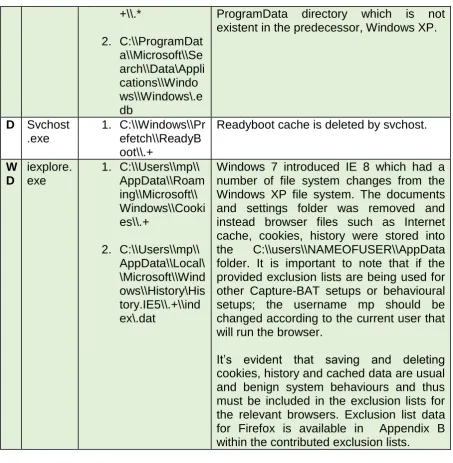
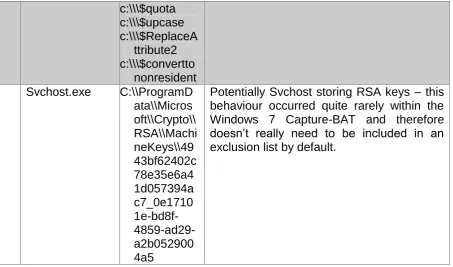
58 known as an exclusion list, that are implemented based on a given environment’s Operating System (O.S.), applications and plugins. Exclusion lists are explored in-depth within Chapter 4, along with creation goals, typical native system behaviours, proposed development lifecycle and implementation.
As outlined by Seifert’s (2010) thesis, there are substantial numbers of malicious webpages. Nowadays, only analysing half of the amount of webpages that was studied in the author’s research would be required to detect a number of threats, including zero-day threats. The clear limitation observed is the sheer amount of processing power required to scan these malicious webpages. Another possible limitation would be the current nature of malicious web servers which are short lived (Bringer et al. 2012).
2.5.2 Cuckoo sandbox
59
2.6 Related work
This section introduces some alternative work that is related to the work carried out in this thesis. In this section, gaps within the literature are identified and reviewed.
2.6.1 Malicious Domain name servers
Research by Seifert et al. (2008b) looked at a number of malicious web servers in New Zealand by observing underlying server relationships and the numbers of Domain Name Server (DNS) were counted. If a malicious web server had more than two domain name extensions and more than five unique DNS servers, it was considered malicious. This method was simple but unfortunately only tested in New Zealand in 2008. The main limitation to the current day and age is simply that the New Zealand study was limited to a country that had low levels of malicious activity. This is proven by the well-established anti-virus vendor, Kaspersky. In a threat report by Namestnikov (2011) New Zealand is revealed to be the 14th country in the world with the lowest percentage of infected computers. Evidently, research is required in countries such as the US and the Russian Federation that were marked as “high risk” due to having the highest number of attacks. More importantly, it is fair to state that the Internet provides global access to web users which are not limited to a particular country. This means client honeypot studies that seek to find current web threats should ideally contain a variety of websites to identify the current client exploits that are being targeted.
2.6.2 Systems monitoring state change
60 Willems et al. (2007). These state monitoring approaches simply track system behaviours such as interactions between the file, process, registry and (sometimes) network. These behaviours can be assessed and anomalies within expected behaviour can be identified. Behavioural based changes that these systems monitor include: files created or deleted by malware, registry key modifications, creations and deletions, process creations, injections and terminations. These dynamic analysis systems are not perfect and thus do not report the way that a malware attack originating from the web or from a malicious executable is programmed but instead the observable behaviour manifestation within a system which is a viable approach in combating malicious software when researchers are unable to combat malware using ‘methods of disassembly or reverse engineering’ Willems et al. (2007). State change systems Capture-BAT, Cuckoo sandbox and CWsandbox all output a behaviour log file of the system interactions that were captured during the analysis process. The benefit of this approach is that from the detailed behaviours that a log file displays, it is possible to identify attack vectors, infected files and processes as well as changes to the environment that was compromised. These systems were introduced in section 2.2.2 and are discussed in greater detail within Chapter 4 as state monitoring systems are used within the thesis’s major contributions. Well cited work by Provos et al. (2008) is concerned in identifying drive-by-downloads at a large scale from crawling the world wide web. Their focus was much like the work present in this thesis, where the behaviour of installed software (malicious Portable Executable dropped) is not investigated but the mechanisms used to introduce maliciousness in the system (drive-by-download analysis) are investigated.
62
2.6.3 JavaScript research
Web based malware research has also been approached from the JavaScript aspect: It is possible for malicious code to be concealed in JavaScript and avoid detection. Egele et al. (2009) studied memory based malicious code which is often found to be saved for later execution. These heap-spraying methods are common in the exploitation of client systems by targeting web browsers. The authors propose techniques to identify shell code based drive-by-downloads in a browser and implement this solution in the Mozilla Firefox browser. This run-time approach proved to be very successful at detecting JavaScript based malware when assessed as no false positives were identified.
63
2.6.4 Current trends in client honeypot research
64 methodology in designing experiments aimed at assessing the extent of aforementioned issues within their dataset. Mansoori et al. (2017) concludes with the fact that IP tracking is used in only a small subset of domains within their datasets and that there is no strong indication of network tracking is observed. This therefore shows evidence of a low level of tracking within malware domains present on the world wide web.
Work within honeypot research has also been optimised to enhance deception capability of honeypots using network service fingerprinting. This is a recurring issue in both the general cyber security landscape and intrusion detection: detection mechanisms require systems and methods which does not reveal their intentions when attempting to analyse potentially compromised systems. Dahbul et al. (2017) proposes threat modelling to identify potential threats that reveal the existence of honeypots. The author discusses various countermeasures which are tested and proven effective in the enhancement of deception capabilities of honeypots.
2.6.5 Applicability of machine learning
65 on benign and maliciousness. It is hoped that the results of this work is used to help machine learning with the decision making process of unique client behaviours as decisions are made with context to specific behaviours and their ability to undertake malicious activities. It is nevertheless important to have a discussion on the next steps of analysis within drive-by-download studies to provide perspective and comparison to the proposed approach as some studies perform varying levels of data transformation prior to analysis within cybercrime.
2.6.6 Clustering approaches
Behavioural clustering of malware is an extensively researched topic (Bailey et al., 2007; Bayer et al., 2009; Perdisci et al., 2010). These works use a number of different clustering algorithms; however, it’s important to note that these are mostly based on hierarchical clustering. The hierarchical clustering method builds a hierarchy of clusters to represent data using either a top-down or bottom-up approach. A top-down approach, sometimes called Divisive clustering simply works by splitting a cluster in two parts starting from the cluster containing all entities. A bottom-up approach, known as Agglomerative clustering simply merges two of the nearest clusters at each step of clustering (Rokach and Maimon, 2005; Mirkin, 2011).
66 of focus is one step before, on the drive-by-download stage. The main drawback of hierarchical clustering is to do with the performance issues: Amorim & Komisarczuk (2014) suggests that these hierarchical algorithms operate at a complexity of at least O(n2). This is problematic as multiple sources (Seifert, 2010; Shadowserver 2013;
Av-test, 2015) show that the quantity of malware released daily is increasingly growing. Furthermore, when applied to the behavioural malware data sets obtained from high-interaction client honeypots; the volumes of data in malicious log files are high. A gap within literature is identified as the issues faced with malicious detection research justify the need for faster performing algorithms within malware clustering and classification or alternative approaches to filtering datasets and reducing volumes of noise data. Either approach would allow a means to improve detection mechanisms in processing the enormous numbers of malicious websites.
2.6.7 Classification approaches
67 and support vector machines to detect malicious Portable Executables from benign Portable Executables by Kolter & Maloof (2004).
68
2.6.8 Closely related work
69 feature-reducing techniques to separate goodware (benign software) and malware behaviour and work by Amorim & Komisarczuk (2012) have done just that prior to clustering their malicious website dataset. In some cases, a combination of these machine learning techniques are used to are used to analyse data (Belkin, 2004). However, feature reducing methods can sometimes prove to be problematic when some features are extracted such as the file path in behavioural log files as often these can offer key indication on behavioural maliciousness. A gap is identified here as it may be possible to include these key indications in an alternative approach that performs expert driven filtering from a list of known behavioural entries prior to performing further analysis. This is very different to the unsupervised approach and the feature weighing and selecting done in previous research as it would involve confirmation of each benign behavioural entry.
70 executing the 456 samples. By focusing on the behaviours manifested in a behaviour analysis environment it may be possible to build knowledge tables of expected behaviour that visiting a benign website would trigger. Their work therefore does not seem to include the other components of an analysis environment such as the operating system or commonly installed application behaviour. Wagener et al. (2008) also carry out dynamic analysis but their experiment does not include benign or goodware which does not provide verification of expected, non-malicious system calls or the ability to create correct datasets. Within the context of dynamic analysis, an operating system running can often mean that large volumes of goodware behavioural entries as agreed by Burnap et al. (2015). If these are taken into account within analysis, It may be possible to alter the overall result. Furthermore, it is line with the prudent malware experimentation by Rossow et al. (2012) to remove goodware data from dataset. In both cases a list of known goodware and expected behaviour is not provided which makes replicability of experiments carried out difficult. An adaptive yet alternative approach to Tian et al. (2010) method of distinguishing between goodware and malware is simply to run large number of benign tests on the environment and understand the core behavioural calls that undergo while a system is active. From this an understanding of the benign system calls could be synthesised and creation of behaviour based filters could be used scalability in the search for unknown and malicious behaviours. This is the approach that the thesis intends to take in the reduction and expert driven filtering of log file based datasets.
2.7 Gap identification and research questions
71 problems that are addressed include: behaviour filtering, the creation of effective behavioural filters using real-world intelligence and the impact from a behavioural perspective of using different operating systems in performing dynamic analysis of potentially malicious webpages.
2.7.1 Behaviour filtering in behaviour analysis environments
72 around half of paper surveyed did not separate goodware from malware datasets. The thesis fills this gap in knowledge by answering the research question:
What are the key benign system behaviours observed in a Windows 7
operating system that can be filtered in a created behaviour analysis environment?
Understanding benign and normal system behaviours in behaviour analysis environments is a complex process. Often it is observed that operating systems do not always perform the exact same behavioural interactions at every boot despite the state of the operating system being kept constant. This was tested and showed variations even when the additional protection of configuring the hard drive to be in an immutable state. To overcome this limitation, it is often required to have multiple tests of an operating system using benign and goodware datasets to be able to explore and learn as much of the unknown and semi-frequently observed behavioural interactions and system calls. Within this thesis, the concept of behaviour filtering was applied through the exclusion list of the chosen behaviour analysis tool, Capture-BAT. In addition to this, within the utilised Windows 7 environment, typical observed behaviours are labelled as benign or grey (unknown). Typical observed drive-by-download behaviours are discussed and labelled in Chapter 6 from the analysis of 5,132 potentially malicious websites.
2.7.2 Expert driven filtering and exclusion lists