complicated by axillary nerve damage:
a case report
Mohsen Kazemi,
RN, DC*
An elite soccer player presented with a classic acute anterior dislocation of the glenohumeral joint
complicated by axillary nerve damage. The incidence, mechanism of injury, clinical presentation, conservative treatment and rehabilitation of the anterior
glenohumeral joint dislocation and associated axillary nerve damage are discussed in this paper.
(JCCA 1998; 42(3):150–155)
K E YW O R D S: chiropractic, conservative management,
rehabilitation, acute anterior glenohumeral dislocation, axillary nerve damage, shoulder, nerve.
* Sports Sciences Resident, Canadian Memorial Chiropractic College, 1900 Bayview Avenue, Toronto, Ontario M4G 3E6. © JCCA 1998.
Introduction
The glenohumeral joint is the most frequently dislocated major joint in the body, and in some series, glenohumeral dislocations are more common than all other joint disloca-tions combined.1,2 Anterior dislocations of the shoulder
account for between 80 and 95 percent of all shoulder girdle dislocations.3,4,5 The incidence of shoulder
disloca-tions is generally higher in men than in women at a ratio of 2:1. In adolescence this difference may not be as great and may actually be reversed after the age of 60 years.1 The
injury is common in ice hockey, wrestling, judo, rugby, football, basketball, baseball, and gymnastics. Initial trau-matic anterior dislocations may be due to a force applied directly to the posterior aspect of the humeral head, driving it anteriorly. However, the more common mechanism in
sport is an indirect force via the externally rotated and abducted limb, such as would be seen in a football player attempting to block a high pass or a hockey player sliding head first into the boards.6
There are several complications of anterior gleno-humeral dislocations, of which recurrence is the most common. Others include fracture of the greater tuberosity of the humeral head (flap fracture), rotator cuff tear (par-tial and full-thickness tears), Bankart’s lesion (avulsion of the anterior capsule and glenoid labrum from the glenoid rim), Hill-Sachs lesion (compression fracture of the pos-terosuperior humeral head), and injury to the axillary, musculocutaneous, or median nerves. Vascular injuries are rare.7
The axillary nerve is the most frequently affected nerve of the brachial plexus.8 Literature suggests that 9–18% of
patients who have anterior dislocation suffer prolonged pain due to injury of the axillary nerve.9 Subglenoid
dis-placement of the humeral head into the quadrangular
Un joueur de soccer d’élite présentait une luxation aiguë antérieure de l’articulation gléno-humérale classique accompagnée d’une atteinte nerveuse axillaire. L’article suivant examine l’incidence, le mécanisme de la
blessure, le tableau clinique, le traitement conservateur ainsi que la réadaptation de la luxation antérieure de l’articulation gléno-humérale avec lésion nerveuse axillaire associée.
(JACC 1998;42(3);150–155)
M O T S C L É S : chiropratique, traitement conservateur,
space damages the axillary nerve, causing paralysis of the deltoid muscle and loss of skin sensation in the region over the deltoid.7 Risk of injury increases with age, duration of
luxation, and degree of trauma.10 This case demonstrates
the classic presentation of an acute anterior glenohumeral dislocation complicated by axillary nerve damage and the need for referral. The essential clinical and radiographic features are reviewed in conjunction with principles of management and rehabilitation.
Case report
A 24-year-old male elite soccer player presented with dull right shoulder pain. The reported onset followed a fall onto the abducted and laterally rotated right arm during an inter-national out of country soccer game two weeks earlier. He was told he had sustained an anterior glenohumeral dislo-cation which was reduced on site by a team physician. The axillary nerve damage was not reported at the time of re-duction. The patient’s shoulder was immobilized in a sling and swathe immediately after reduction. The patient was told not to abduct or externally rotate the shoulder.
Arm movement aggravated the pain. Icing, rest and im-mobilization of the arm alleviated the pain. This was his first episode of dislocation and he reported no previous shoulder injury.
On examination, right glenohumeral joint range of movement was globally restricted and painful. Supra-spinatus test (empty can test) and drop arm test were positive. These tests suggested possible damage to the abductor muscles of the glenohumeral joint namely, su-praspinatus and deltoid muscles. Neurological examina-tion revealed decreased light touch sensaexamina-tion over the right deltoid and C5 motor strength was rated 3/5. Cervical spine ranges of motion were full and pain free, however, there was facet joint dysfunction on the right at C5–6. The radiographs of his right shoulder were unremarkable.
The patient was referred to an orthopaedic surgeon for further investigation. Partial right axillary nerve damage was confirmed by nerve conduction study. The patient was treated using electrical muscular stimulation on right del-toid, cervical spinal manipulation therapy, and was started on a rehabilitation program (emphasizing on deltoid, su-praspinatus and teres minor muscles strengthening) three times per week for 4 months. By this time, there was 80– 90% improvement in the glenohumeral ranges of motion and muscle strength.
Discussion
The glenohumeral joint is the most frequently dislocated major joint in the body, and in some series, glenohumeral dislocations are more common than all other joint disloca-tions combined.1,2 Anterior dislocations of the shoulder
account for between 80 and 95 percent of all shoulder girdle dislocations.3,4,5 Clinically, only about 20 percent of
these dislocations show minimal signs and 5 percent dem-onstrated significant evidence of neurologic involvement. Rockwood and Green have shown that there is electro-myographic evidence of nerve injury in up to 80 percent of individuals.7,11 This damage, however, is largely
sub-clinical, with the patient demonstrating no detectable weakness.7
The axillary nerve is the most commonly involved nerve of the brachial plexus.8 Literature suggests that
9–18% of patients who have anterior dislocation suffer prolonged pain due to injury of the axillary nerve.9 The
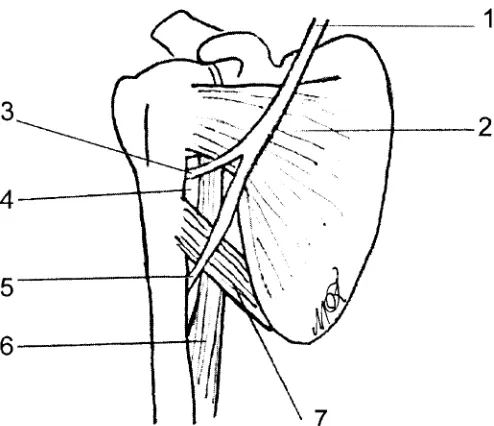
Figure 1 Vulnerability of axillary nerve damage with anterior dislocation of the shoulder.
1. Posterior cord of brachial plexus 2. Subscapularis muscle
3. Axillary nerve 4. Quadrangular space 5. Radial nerve
axillary nerve originates from the posterior cord of the brachial plexus, crosses the anterior surface of the sub-scapularis tendon, and then travels posterior and around the inferior glenohumeral capsule. Its motor innervation in-cludes the deltoid and teres minor muscles. It supplies sensation to the upper lateral arm.8 Subglenoid
displace-ment of the humeral head into the quadrangular space can damage the axillary nerve, causing paralysis of the deltoid muscle and loss of skin sensation in the region over the deltoid.7 (Figure 1) This is the most probable mechanism of
the injury in our patient. Risk of injury increases with age, duration of luxation, and degrees of trauma.10 Fortunately,
these injuries are mostly mild neuropraxic type lesions. Most of these athletes recover full function even if there is residual electromyographic evidence of denervation after one year. The patient in this case demon-strated 80–90% improvement after 4 months of treatment. Because many of the injuries do not clinically involve the sensory component of the nerve, there is a tendency to overlook this injury initially.6 However, in this case, there
was decreased light touch sensation over right deltoid. Electromyography is the definitive diagnostic test used to confirm the clinical diagnosis of axillary nerve injury. The
nerve conduction portion of an electromyogram evaluates nerve function directly and is therefore abnormal soon after the nerve injury. This study confirmed the axillary nerve damage in our case. The muscular portion of the electro-myogram infers the axillary nerve injury by showing ab-normal function of either the teres minor or deltoid muscles.9
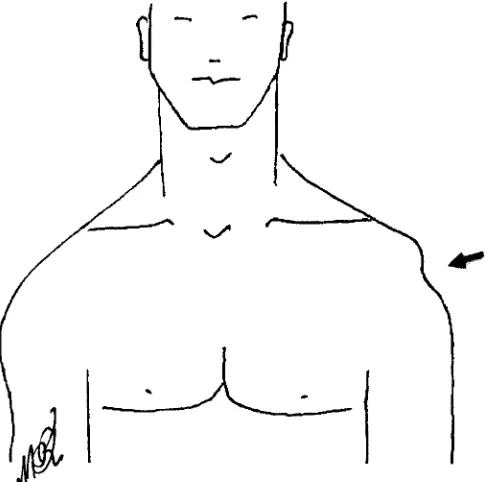
Athletes with anterior glenohumeral dislocation sup-port the arm adducted and across the trunk. There is a characteristic hollow underneath the acromion (sulcus sign; Figure 2) and loss of deltoid contour. There is global loss of shoulder range of motion with exquisite pain on internal or external rotation. The athlete in this case also presented with global restriction of the range of motion of the right glenohumeral joint. Swelling and bruising is also present over the anterior aspect of the glenohumeral joint, axilla and superoanterior aspect of the humerus.
Neurological and peripheral vascular examination of the limb is of utmost importance to ensure proper care and to establish a neurological and vascular baseline immedi-ately pre and post reduction. This is done to inform the practitioner of any complication as a result of the reduction process. Radiological examination should be obtained before and after reduction to confirm the diagnosis and to rule out any associated fractures.6,7 Two views
perpendicu-lar to one another are mandatory for diagnosis of a condi-tion radiographically. An AP and a transthoracic view of the shoulder might be ordered for detection of anterior dislocation of the glenohumeral joint. However, the trans-thoracic view is usually taken if there is an indication of possible posterior dislocation of the glenohumeral joint. In the case presented above, there was not such an indication and therefore, no transthoracic view was taken. A classic radiographic presentation of anterioinferior glenohumeral dislocation on anteroposterior (AP) view of the shoulder is demonstrated in Figure 3. This radiograph does not belong to our patient but serves as a good representative of our case. The head of the humerus has migrated inferiorly and medially overlying the inferior aspect of the glenoid fossa leaving the glenoid fossa empty. This is the reason for the sulcus sign. The incidental finding is the calcified soft tissue over the greater tuberosity of the humerus.
A complete cervical spine examination is necessary to rule out any neck involvement usually associated with this dislocation due to the mechanism of injury.
Reduction of a first episode of an anterior glenohumeral
dislocation, or a repeat after a long stable interval, should be performed in a hospital or where emergency operation facilities are available due to the risk of neurovascular damage associated with the reduction process. However, a glenohumeral dislocation should be reduced as early as possible to minimize the risk of complications, such as degeneration or neurovascular insult.12,13 There are
sev-eral methods of reduction such as the Kocher method, Hippocratic method, Milch method, scapular manipula-tion, Stimson method and self-reduction.8
As for chiropractors (in Canada, Ontario) reduction of a dislocation remains beyond the scope of practice.14
How-ever, after reduction chiropractors can provide care for the patient.
Usually the glenohumeral joint dislocations are reduced by closed means with adequate anaesthesia. Indications for surgical open reduction include: irreducibility by closed reduction; the presence of a large flake of avulsed bone on the inferior glenoid margin, which will potentially contribute to future instability; a significantly displaced glenoid fracture involving a third or more of the articular surface; vascular impairment; and an associated tuberosity fracture.6,7
The results of nonoperative management of the initial shoulder dislocation has been reported by several investi-gators.15 The success of treatment has been determined
principally by the rate of redislocation with age being the most important prognostic factor. A 90–96% recurrence rate in patients less than 20 years of age, a 50–79% recurrence rate in patients 20–40 years of age, and a 10–14% recurrence rate in patients greater than 40 years of age are reported.15 In an attempt to decrease the high
recurrence rate in young patients, different periods of immobilization from a few days to few weeks have been advocated with inconsistent results.15,16,17 However, for
the young, a period of 3 weeks immobilization appears to be beneficial, but it seems to be even more important to avoid stressing the joint, consciously avoiding external rotation and abduction for 3 to 6 weeks, and possibly even up to 3 months in athletes.1 In the case of an elderly
patient, because of the low risk of recurrence and the high risk of frozen shoulder, the immobilization period should be short, possibly as long as pain persists.8 Immobilization
usually entails a sling and swathe that holds the arm in adduction and internal rotation. This prevents the patient from abducting or externally rotating the arm, thereby risking dislocation recurrence.8 The athlete’s shoulder in
this case was immobilized in a sling and swathe for three weeks immediately after the reduction.
Immediately after the reduction to reduce inflammation and pain, the use of ice, transcutaneous electrical nerve stimulation (TENS), interferential therapy, non-steroidal anti-inflammatory drugs (NSAID) and ultrasound are
ommended.6,7 In the case above, interferential therapy and
icing was used initially. Electrical muscle stimulation was utilized later to stimulate deltoid muscle and decrease its atrophy.
Magee and Reid7 report that an adequate early
control-led immobilization is the main point in acute anterior dislocation treatment. They recommend a program of strong isometric deltoid, shoulder abductor, adductor, and biceps work within the limits of pain and tolerance in the first 2 weeks after reduction. They believe that this mini-mizes muscle wasting as the edema and haemorrhage resolve and the shoulder becomes more comfortable. The swathe is removed for exercises several times each day from 2 to 6 weeks after injury. The athlete begins small-range, gentle pendular exercises. Isometric exercises of the medial and lateral rotators are added. In addition, concentric exercise through a limited range is initiated at the third week since the capsular healing is well under way at 3 weeks. These authors recommend that the limits of the range of motion are determined by pain and the athlete’s ability to comfortably control the movement. They believe that controlled active movements apply small amounts of stress to the joint structures which decreases the adverse effects of immobilization on the glenohumeral joint. They caution against abduction and forward flexion beyond 90 degrees, and lateral rotation past neutral during this time. In older individuals, in whom the danger of stiffness from immobilization is greater than the risks of redislocation, the movement program should be initiated sooner. Reid6
suggests that from 6 weeks on, the emphasis should be on strengthening for about 4 weeks, allowing range of motion to resume with gentle, active motion. After this time, he recommends range of motion to be actively pursued and become a major rehabilitation goal. He cautions against the passive stretching during the first 12 weeks after dislocation. Proprioceptive activities should be included in the later stages of rehabilitation to increase the patient’s control in terms of strength, endurance, and movement direction. This can be achieved by proprioceptive neuro-muscular facilitation (PNF) techniques, closed-chain pro-prioceptive activities such as pushups (progressing from a wall to a table to the floor), weight shifting, rhythmic stabilization, shifting from a quadruped to a tripod tion, ball rolling to cause sudden alterations in joint posi-tion, sitting pushups, cycling devices for the upper limb, hand balancing or using a balance board, hand
stair-climb-ing, and hand treadmill walking.7 It is important to
main-tain the athlete’s cardiovascular fitness during rehabilita-tion to avoid decondirehabilita-tioning. The cardiovascular fitness exercises should be as specific to the athlete’s sport as possible. Ultimately, the athlete can return to full contact sport when isokinetic values are 85% of the uninjured side or more.6
The rehabilitation program for axillary nerve damage with anterior glenohumeral dislocation is the same as above with more emphasis on deltoid and teres minor muscles strengthening and stimulation. As in the rehabili-tation of the above patient, the emphasis was on the strengthening of these two muscles.
Conclusion
In conclusion, the glenohumeral joint is the most fre-quently dislocated major joint in the body. Anterior dislo-cations of the shoulder account for between 80 and 95 percent of all shoulder girdle dislocations. The axillary nerve is the most often affected nerve as a result of anterior glenohumeral dislocation. Literature suggests that 9–18% of patients who experience anterior glenohumeral joint dis-location, suffer prolonged pain due to injury of the axillary nerve.
This case demonstrates the classic presentation of axil-lary nerve injury as a result of acute anterior glenohumeral dislocation and the need for appropriate referral.
Reduction of a dislocation is beyond the chiropractor’s scope of practice (in Canada, Ontario), however, a chiro-practor can play a valuable role in management and reha-bilitation of this condition following reduction.
Acknowledgements
References
1 Yu J. Anterior shoulder dislocation. J Fam Pract (USA), Nov 1992, 35(5):p567–571,575–576.
2 Higgs GB, Weinstein D, Flatlow EL. Evaluation and treatment of acute anterior glenohumeral dislocation. Sports Med Arthrosc Rev 1993; 1:190–201.
3 Cave EM. Fractures and Other injuries. Chicago, Year Book, 1961.
4 Loeb PE, Andrews JR, Wilk KE. Arthroscopic
debridement of rotator cuff injuries. Andrews JR, Wilk KE (eds): The Athlete’s Shoulder. New York, Churchill Livingston, 1994.
5 Mohtadi NG. Advances in the understanding of anterior instability of the shoulder. Clin Sport Med 1991; 10:863–870.
6 Reid DC. Sports injury Assessment and Rehabilitation. New York, Churchill Livingston, 1992:963–977.
7 Zachazewski JE, Magee DJ, Quillen WS. Athletic Injuries and Rehabilitation. Philadelphia, Saunders, 1996:520–527. 8 Souza TA. Sports Injuries of the Shoulder, Conservative
Management. New York, Churchill Livingston, 1994:342–355.
9 Tuckman GA, Devlin TC. Axillary nerve injury after anterior glenohumeral dislocation: MR findings in three patients. AJR 1996; 167:695–697.
10 Blom S, Dahlback LO. Nerve injuries in dislocations of the shoulder joint and fractures of the neck of the humerus. Acta Chir Scand 1970; 136:461.
11 Rockwood CA, Green DP. Fractures in Adults. Philadelphia, JB Lippincott, 1984.
12 Aronen JG. Anterior shoulder dislocations in sports. Sports Med 1986; 3:224.
13 Danzing L, Resnick D, Greenway G. Evaluation of unstable shoulders by computed tomography. Am J Sports Med 10:138, 1982.
14 Office consolidation, Regulated Health Professions Act, 1991. Statutes of Ontario, 1991, Chapter 18; 27(2), as amended by: 1993, Chapter 37. Jan, 1994.
15 Arciero RA, St. Pierre P. Acute shoulder dislocation, indications and techniques for operative management. Clin in Sports Med 1995; 14(4):937–953.
16 Aronen JG, Regan K. Decreasing the incidence of recurrence of first time anterior shoulder dislocations with rehabilitation. Am J Sports Med 1984; 12:283–291. 17 Arciero RA, Wheeler JH, Ryan JB et al. Arthroscopic