22
Tourism education and curriculum design:
a practitioner perspective
Paul Fidgeon
|
The London School of Hospitality and Tourism,
University of West London
Academic and practitioner courses in travel and tourism have developed
substantially in the past thirty years. The force behind this change can be
attributed to the growth of tourism as an activity and the organisations involved
in meeting the needs of tourists expanding to cater for this demand. This growth,
combined with the increasing professionalism of tourism suppliers, played its part
in prompting educational institutions to meet the demands and opportunities
created by tourism employers. It also contributed to the strong vocational
orientation of many of these programmes.
In the early years of the development of the subject, the curriculum was informed
by extra disciplinary knowledge – knowledge from industry, government, think
tanks, interest groups, research institutes and consultancies. Curriculum planners
have also supplemented the curriculum with multidisciplinary knowledge, drawing
various ideas, skills and methodologies from other subject disciplines. The
subsequent maturity of the subject has come to be reflected in the creation of
interdisciplinary knowledge whereby scholars have been able to draw upon more
than one discipline to explain a solution to specific industry-related problems and
issues.
Almost without exception, tourism courses stress the vocational nature of the
subject and the extensive range of career opportunities found in tourism. Here the
development of management skills and the ability to apply these skills to various
public and private sector operational tasks and problems are seen as central to
academic philosophy from craft (National Vocational Qualifications (NVQ) levels
1 to 3) to the postgraduate level.
Research conducted by the author suggests a large and diverse range of courses
in the subject area; the dominance of BA and in particular combined studies
awards; a relatively small Higher National Diploma (HND) and Higher National
Certificate (HNC) market largely replaced by foundation degrees and extensive
postgraduate provision. In such an educational milieu, discussion has focused
on whether the market can support such a large number of courses and how
individual institutions might seek to establish unique selling points. These factors
have become increasingly apparent in the light of the rising cost of education in
2012, international competition and new industry-led initiatives, namely 16-19
Diplomas and industrially sponsored foundation degrees.
Keywords |
Tourism degrees; Higher National Diplomas; National Vocational
Qualifications; Vocational relevance and work-based learning;
23
Introduction
This paper examines the growth and
development of tourism education within Great Britain, with specific reference to the situation in England and Wales. Tourism education has received relatively scant attention since the publication of a number of seminal papers produced in the mid to late 1990’s and in the last decade (Goodenough and Page (1993), Koh (1995) Tribe (1997, 1999) and Johnson and Airey (1999) and Airey (2002)). The paper reviews how tourism education has developed from relatively humble origins into a major subject of academic and scholarly activity taught in a wide variety of educational institutions. The writer seeks to evaluate what programmes aim to achieve in terms of knowledge, skills development and preparing students to meet the labour needs of the tourism industry. The writer also reflects on where tourism education is going in terms of courses, course philosophy, levels of study, subject content, and teaching and learning strategies.
The ensuing discussion seeks to address the rationale for tourism courses and the search for academic respectability for tourism as a subject. It will be shown that programmes have sought to balance the needs of employers with those of a traditional academic educational system that has emphasised academic rigor and the pursuit of core subject disciplines. This has resulted in a series of guidelines, articles and discussion papers covering the development of a national curriculum including papers by Holloway (1995), Botterill and Tribe (2000), and Tribe (2006).
Writing in 2005, Tribe concluded that while 86 percent of pedagogic research investigated curriculum related matters only five percent concentrated on curriculum design and planning issues. Therefore there is a need to address a lack of literature found in this area and critically review the issues in relation to tourism education.
The paper considers the thinking behind developing various higher educational programmes in travel and tourism in England and Wales. The writer will review how underlying philosophical considerations have influenced the aims and objectives of programmes. Undergraduate and
24
The antecedents of tourism
education
It is over 40 years since tourism first appeared as a distinct area of study (Airey 2005). Airey argues that its origins can be traced back to the study of some of its component sectors, namely hotel operations and catering, or component activities such as leisure and recreation. These all date to pre-World War II. Prior to this, specialist academic disciplines, notably geography and economics, broached aspects of the subject when discussing issues such as regional studies and foreign trade. Here the works of Ogilvie (1933), Norval (1936), Brunner (1945) and Pimlott (1947) are illustrative.
These early developments remain relatively isolated and restricted to certain sectors and scholars. Indeed it was not until the 1960s and a number of key changes in the nature of tourism activity, higher education and society that tourism emerged as a clear area of study in its own right that could be followed as an undergraduate discipline and a research activity.
Other factors have also contributed to the expansion of tourism education. Foremost among these has been a general expansion in the number of students enrolling onto further and higher education programmes. Dearing noted a doubling in numbers between 1977 and 1997 (National Committee of Enquiry into Higher Education, 1997). This has been coupled with the development of vocational education throughout the western world. Prompted by changes in the world of work and the development of the service economy together with the need to maintain competitive advantage, governments have encouraged vocational education. As a growing sector of economic activity, the tourism industry has been perceived by many students as having good employment prospects. This has been a further driver for vocationalism and has consolidated tourism’s position in the wider educational curriculum.
Airey (1979) catalogues the vocational origins of tourism in higher education within Great Britain. He notes its earliest provision, in the mid-1960s, was in the form of optional components on other programmes notably in hotel and catering administration. The first Higher National Diplomas (HND) in tourism started at the end of the 1960s. Perhaps more important regarding the future development of tourism as a field of study was the development of two postgraduate master degree programmes developed at the universities of Surrey and Strathclyde in 1972 (Airey 2005). With these came the recognition of tourism as a separate area of study within its own right, linked to university hotel and catering management departments.
An important development circa 1990 was the appearance of tourism as a subject of study in the 16- to 18-year-old age category (referred to in Great Britain as Further Education (FE)). Given the rapid growth of tourism as a subject discipline perhaps it is not surprising that certain criticisms have been raised (The Observer, 1995). Initially these centred upon tourism lacking serious content or academic rigour.
25
A pedagogical research
foundation
Research in tourism education has developed considerably since Ritchie and Jafari published their seminal work in the Annals of Tourism Research in 1981. The issues they addressed in the aforementioned paper, namely the definition of tourism, the need to develop a body of knowledge in tourism and the perceived weaknesses of tourism education have now all largely been addressed (Holloway 1995; Middleton and Ladkin, 1996 and Tribe 1997, 1999).
Their research has sought to consolidate earlier work undertaken by Medlik (1965) whose analysis of higher education and research on tourism in Europe was pioneering in this area. The 1988 International Conference for Tourism Educators hosted by the University of Surrey gave what Tribe (2005b) described as a fillip to educational research in tourism attracting a broad range of papers. The development of The Association for Tourism and Leisure Education, a European organisation (ATLAS) gave further impetus to the development of educational research through hosting two major conferences Tourism and Leisure Education in Europe: Trends and Prospects (1994) and Tourism in Central and Eastern Europe: Educating for Quality (1995).
Curriculum research has tended to focus on general issues pertaining to the curriculum such as curriculum planning models and critical reviews of the curriculum. Further critical reviews of the tourism curriculum include those by Amoah and Baum (1997) and Ryan (1995). The former have described the formulation and implementation of tourism education in the UK as ad hoc.
Specific perspectives on the development of tourism education in various countries have been provided by Walsh (1992), Formica (1997), Sims (1999), King and Craig Smith (2005), Leal and Padilha (2005), Lewis (2005), Zhang and Fan (2005), Venema (2005), and Singh and Singh (2005). Comparative analysis between various educational systems has been undertaken in Europe by Cooper and Messenger (1991) and by Formica (1996) - the latter examining similarities and differences between Europe and North America.
Whether tourism represents a separate discipline with its own body of knowledge and distinct methodology remains controversial. More attention has been given to teaching, learning and assessment strategies, and examples of successful teaching, learning and assessment methods in tourism education are somewhat legion (Learning and Teaching Support Network (LTSN), 2005). However in the UK the 1993 Council for National Academic Awards (CNAA) report on tourism degree courses and the Quality Assurance Agency for Higher Education (QAA) subject review of 2000-2001 raised serious issues pertaining to academic progression and the demonstration of ‘graduateness’. This discussion has subsequently extended to include the need for benchmarks for progression from HNDs to honours degrees (Fidgeon 2003).
The travel and tourism industry
in context
To a large extent the justification for the provision and development of a wide number of tourism programmes lies in the size and significance of the tourism industry and its perceived career opportunities as noted by Airey and Johnson (1999) and Airey and Tribe (2005).
Globally 238,277,000 jobs are in the tourism industry. This equates to eight-and-a-half percent of total employment or one job in every 11.9 individuals. Nine percent of global Gross Domestic Product and 11 percent of export earnings can be attributed to tourism expenditure – the latter put at £1,502 billion (World Travel & Tourism Council (WTTC) 2010).
If the British tourism industry is to continue to remain competitive, education will play a key role (Visit Britain, 2010). In recognising this role, successive governments have supported educational institutions in their provision of tourism curricula. It is against this backdrop that an expansion in tourism education must be seen.
The origins of tourism education in England and Wales can be traced back to the Business Education Council (BEC) and Technical Education Council (TEC) programmes
26
The Universities of Surrey and Strathclyde pioneered postgraduate teaching in this area, offering the first Masters awards in 1972.
The late 1980s was characterised by a race for the first degree in tourism studies. This was eventually won by New College Durham in 1986 and their Association of British Travel Agents (ABTA) sponsored programme. They were closely followed by three colleges of Higher Education (Bournemouth, Ealing and Bristol) all of whom were to benefit from the abolition of Council for National Academic Awards (CNAA) control over the development of their course curricula and the onset of self-accreditation in 1994. Initially these courses were criticised as being nothing more than a re-branded Higher National Diploma (Fidgeon 1996).
The entry of the traditional universities into the undergraduate market came in the late 1990s - witnessed by developments at the University of Hull and University College London.
Tourism Education in the twenty-first century has been characterised by developments in the 16- to 19-year-old age category (Further Education) and the growth of Professional Qualifications. This has been reflected in the introduction of National Vocational Qualifications (NVQs) and Advanced Vocational Certificates of Education (AVCEs).
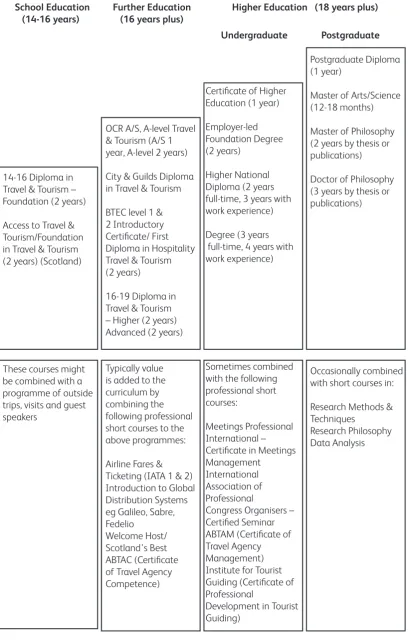
The rise of the professional qualification such as the Meetings Professional International (MPI) Certificate in Meetings Management, or International Association of Professional Congress Organisers (IAPCO) certified one-week seminar completes the eclectic mix of tourism qualifications. Table 1 illustrates the possible progression to the professional qualification and outlines the range of tourism qualifications found in Great Britain.
The academic origins of tourism education in Scotland is sufficiently different from its counterparts south of the border to warrant special attention. Here the work of the Scottish Hotel School (SHS) was pre-eminent. Founded in 1944 as part of the Glasgow and West Scotland Commercial College, the SHS was absorbed into the University of Strathclyde in 1963. On the1st August 2006 the SHS was abolished and its work incorporated into a new Department of Hospitality and Tourism. This has now ceased to exist and courses and staff have been amalgamated into a generic business studies department. This rebranding of the SHS has effectively come to define what the teaching of tourism in
Scotland incorporates, much more than just the study of hotels, rather a broad spectrum of studies focused on professional management education.
More recently the provision of tourism education in Scotland has been overseen by the Scottish Qualifications Authority (SQA). This has provided a coherence and a structure to the delivery of tourism education, something that has been somewhat lacking in England and Wales.
From colleges of Further Education to Russell Group Universities tourism programmes have truly come of age providing everything from foundation programmes targeted at 14- to 16-year-olds to PhDs. In doing so, they have reached out to students with widely differing intellectual abilities and career aspirations. Initiatives have spanned the length and breadth of Great Britain and have incorporated different educational philosophies.
27
Table 1 - Qualification
(Typical full-time duration in brackets)
School Education Further Education Higher Education (18 years plus)
(14-16 years) (16 years plus)
Undergraduate Postgraduate
14-16 Diploma in Travel & Tourism – Foundation (2 years)
Access to Travel & Tourism/Foundation in Travel & Tourism (2 years) (Scotland)
These courses might be combined with a programme of outside trips, visits and guest speakers
OCR A/S, A-level Travel & Tourism (A/S 1 year, A-level 2 years)
City & Guilds Diploma in Travel & Tourism
BTEC level 1 & 2 Introductory Certificate/ First Diploma in Hospitality Travel & Tourism (2 years)
16-19 Diploma in Travel & Tourism – Higher (2 years) Advanced (2 years)
Typically value is added to the curriculum by combining the following professional short courses to the above programmes:
Airline Fares & Ticketing (IATA 1 & 2) Introduction to Global Distribution Systems eg Galileo, Sabre, Fedelio
Welcome Host/ Scotland’s Best ABTAC (Certificate of Travel Agency Competence)
Certificate of Higher Education (1 year)
Employer-led Foundation Degree (2 years)
Higher National Diploma (2 years full-time, 3 years with work experience)
Degree (3 years full-time, 4 years with work experience)
Sometimes combined with the following professional short courses:
Meetings Professional International – Certificate in Meetings Management
International Association of Professional
Congress Organisers – Certified Seminar ABTAM (Certificate of Travel Agency Management) Institute for Tourist Guiding (Certificate of Professional
Development in Tourist Guiding)
Postgraduate Diploma (1 year)
Master of Arts/Science (12-18 months)
Master of Philosophy (2 years by thesis or publications)
Doctor of Philosophy (3 years by thesis or publications)
Occasionally combined with short courses in:
Research Methods & Techniques
Research Philosophy Data Analysis
28
Approaches to curriculum design
A number of somewhat dated studies have suggested various models for curriculum design. These include Tyler (1949), Eraut et al. (1975), Rowntree (1982), and Mainwaring and Elton (1984). Each suggests a typical sequence of design that might be summarised as: • Establish rationale• Conduct market research and consultation to establish demand
• Define aims and objectives
• Establish a modular structure including progression between levels and compulsory or elective merits
• Choose modules
• Establish learning outcomes for modules • Determine assessment strategy
• Determine teaching and learning strategy • Develop a system for validation, evaluation, review and improvement.
Such a process still largely holds good today. However tourism curriculum design has been beset with issues pertaining to the nature of tourism, its academic or vocational focus, stakeholder involvement and the need to address a national curriculum. All are issues that have informed debate about what should constitute the tourism curriculum and how that curriculum should be structured. Almost without exception, tourism courses stress the vocational nature of the subject and the extensive range of career opportunities found in this area. Here the development of management skills and the ability to apply these skills to various public and private sector operational tasks and problems are seen as central to their academic philosophy.
For the curriculum planner the choice is whether to adopt a similar strategy or seek to differentiate themselves from the competition. Given the vocational aspirations of students, experience from the University of West London would suggest the latter approach could potentially alienate as much as 80% of the student market (Fidgeon, 2008).
Course numbers
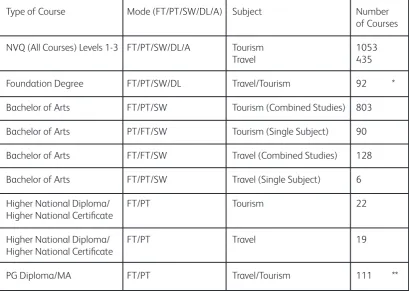
2010 figures from the Universities and Colleges Applications Service (UCAS), What Course? Hobson’s Postgraduate and the Learning Skills Agency suggest:
• A large number and diverse range of courses • The dominance of BA and in particular combined studies awards
• A relatively small HND/HNC market
• A substantial number of foundation degrees • Extensive postgraduate provision
The most recently available data for 2010 is outlined in Table 2.
29
Table 2 - The provision of tourism
courses in Great Britain
Type of Course
NVQ (All Courses) Levels 1-3
Foundation Degree
Bachelor of Arts
Bachelor of Arts
Bachelor of Arts
Bachelor of Arts
Higher National Diploma/ Higher National Certificate
Higher National Diploma/ Higher National Certificate
PG Diploma/MA
Mode (FT/PT/SW/DL/A)
FT/PT/SW/DL/A
FT/PT/SW/DL
FT/PT/SW
PT/FT/SW
FT/FT/SW
FT/PT/SW
FT/PT
FT/PT
FT/PT
Subject
Tourism Travel
Travel/Tourism
Tourism (Combined Studies)
Tourism (Single Subject)
Travel (Combined Studies)
Travel (Single Subject)
Tourism
Travel
Travel/Tourism
Number of Courses
1053 435
92 *
803
90
128
6
22
19
111 **
* This figure underestimates the true figure as it excludes courses in, for example, Heritage Management, Visitor Attractions, Management and Leisure Management
** These figures also include teacher training programmes in this area and make no distinction between MA and MSc programmes FT (full-time) PT (part-time) SW (sandwich) DL (distance learning) A (apprenticeship)
30
Tourism as a subject of serious
academic study
Within Great Britain the study of tourism has always struggled to be taken seriously as an academic discipline (Hall, 2005). Indeed, it has often been seen as a ‘candyfloss industry’ and a subject devoid of abstract theory and its own intellectual property or cognate body of knowledge (Goeldner and Ritchie 2006).
In its search for credibility, initially the subject was guilty of drawing upon other more established subjects such as Geography and Economics (Airey, 2005). Concepts such as the environmental impacts of tourism, tourism demand, tourist motivation and the processes and typologies of tourist development all became central to the tourism curriculum thanks largely to the work of Holloway (1984), Pearce (1989) and Burton (1991) who drew their theoretical frameworks from other established disciplines.
During the 1990s the subject made considerable strides in developing its own subject material and literature. Here the work of Page (1994), Swarbrooke and Horner (1995), Davidson and Maitland (1997) and Cooper, Fletcher, Gilbert, Wanhill and Shepherd (1998) are illustrative. Such developments allowed curriculum planners greater scope in terms of developing their curricula as witnessed by new degrees in, for example, the Anthropology of Tourism (at Roehampton Institute) Public Sector Tourism (at South Glamorgan Institute), Adventure Tourism (at Birmingham College of Food Tourism & Creative Studies) and Events Management (at Leeds Metropolitan University).
In the market driven university environment of the late 1990s and early C21st some of the more traditional academic concerns were lost as tourism courses proved themselves to be highly popular with students and extremely cost effective (Airey, 2002). The latter was based on: high student to staff ratios; the ability of the subject to share resources such as key business texts; Higher Education Funding Council (HEFC) higher-band funding; limited resource constraints as the teaching of tourism often did not require extensive capital outlay (unlike for example hospitality courses) and the opportunity for staff redeployment from other under-recruiting programmes. Faced with such insurmountable evidence even some
of the traditional universities were forced to bury their prejudices and welcome tourism into their institutions, albeit under the guise of Sustainable Tourism or Travel Journalism (currently offered at UCL and Kings London by the departments of Geography and English respectively).
Business studies or tourism
studies
In the early 1990s combining the study of business with tourism was seen as the ideal curriculum model (CNAA, 1992). There were several reasons for this. Traditional business studies subjects such as Marketing and Corporate Strategy were thought to give tourism a degree of academic credibility and much needed theoretical underpinning.
Having the word business in the title of any tourism programme became de rigeur in the 1990s. BA Business and Tourism Management (University of Wolverhampton), BA Business Studies and Tourism (Trinity College Carmarthen), BA Tourism Business Management (Westminster College) and BA Business with Tourism (Northumbria University) all continue to testify to the extent to which tourism and business studies enjoy almost a symbiotic relationship in the minds of curriculum planners.
Tourism Programme Leaders were also quick to learn that by adding a few suffixes to the word tourism, namely the terms business or management, this could make a substantial difference to overall student numbers. At Thames Valley University the forerunner to the University of West London undergraduate applications increased by 33 percent in one year just by simply rebranding their travel and tourism programme to BA Tourism Management (TVU Recruitment Statistics, 1992-2001).
31 Towards the end of the decade came the first
evidence that employers were starting to trade up, that is, to choose students with a degree in tourism as opposed to those with an HND. The aforementioned discussion raises interesting questions for curriculum planners. Serious questions can be raised as to the future of HNDs. Indeed Touzin (2009) speaking at the West London Lifelong Learning Network questioned the longevity of such qualifications and their associated awarding body BTEC, given the move towards vocationally relevant qualifications and the dominance of People 1st, the Skills Council given responsibility to oversee the development of technical qualifications in travel and tourism. However the ethics of developing unrealistic programme aims and objectives is also debatable. With large numbers of graduates entering what is at present a depressed labour market in search of that illusive management position and the jet-set lifestyle, perhaps the time is long overdue for a review of learning outcomes and curriculum content?
Educational philosophy
For the curriculum planner the nature of tourism as a subject discipline is such that it allows the subject to be studied from a variety of different perspectives. Hall (2005) notes no fewer than sixteen different disciplinary approaches to tourism.Lawton (1983, 1996) in writing about curriculum design has stressed the importance of reflecting on educational philosophy. His injunction maintains that fundamental questions about the aims and meaning of (tourism) education must be addressed at the outset. This is because it determines the whole educational experience.
Given the importance of educational philosophy in determining curriculum design, it is surprising that little tourism literature discusses the aims and values that frame the curriculum. Worthy of study is the work of Apple (1990) and Barnett (1990). While neither specifically approaches tourism as a subject discipline they raise a series of interesting questions about the purposes of any curriculum and the implications for programme structure.
Balancing academic and
work-related skills
Tribe (2002) argues the merits and highlights the pitfalls of adopting various philosophic approaches to curriculum design. While he argues in favour of balancing both vocational and academic aims, he is forced to conclude that there neither is, nor should there be, any overriding principles for ordering the tourism curriculum. As such, curriculum planners find themselves in the difficult position of having to assess the relative balance of academic and work-related skills.
Exponents of a more vocational approach to curriculum design stress the acquisition of skills, qualities, attitudes and knowledge that are judged to be important for the world of work (Pring, 1993). Both Haywood and Maki (1992) and Koh (1995) have found that the tourism industry has valued practical and general transferable skills including computer literacy, human resource management, managerial accounting and managing service quality – see Table 3. All elements in Table 3 are skills and actions practiced by those employed in various sectors of the tourism industry. The aim of any programme adopting such an approach to curriculum design is, according to Birch (1988), to enable students to become operational and make a smooth transition into the world of work. Technical skills and knowledge underpin the curriculum with students earmarked for the role of the potential manager.
Table 3
-Key elements of the
tourism curriculum
• Theories of human resource management • Written communication skills
• Marketing theory
• Hotel & restaurant operations • Managerial accounting
• Introduction to the travel & tourism industry • Microcomputer literacy
• Ethics and social responsibility • Entrepreneurship & innovation • Managing service quality • Interpersonal relation skills • Principles of tourism development • Practicum
32
More liberal or academic approaches to the tourism curriculum stress the open acquisition of knowledge and the understanding of all aspects of the discipline. Typically curriculum planning is characterised by adopting a multidisciplinary approach drawing upon subjects as diverse as geography, sociology and politics. Students are encouraged to see the bigger picture, find their own voices and develop critical agendas (Goodlad, 1995).
However, just as vocationalism can imply closure of the curriculum to certain concepts, skills and ideas deemed not to be of utility or relevance, a tourism curriculum framed solely for liberal ends may be criticized as one which has turned its back to the world of work (Goodlad, 1995). As Goodlad notes, programmes with little emphasis on knowledge or skills and limited practical application or preparation for course related employment can risk a ‘detachment of the individual from any realistic perception of what is either socially desirable or practically meaningful’ (1995, p. 28). Birch’s reference to academic enclaves and ivory towers is pertinent here since more liberal approaches to the tourism curriculum are always at risk of being criticized as being divorced from, and unconnected to, the world of business (Birch, 1988).
The principles underpinning the development of a curriculum for philosophic practitioners are firmly rooted in the world of day to day vocational actions, aiming to be competent and efficient. Such programmes aim to deliver better services, but also contribute to the construction of a better tourism world (Tribe, 2002, p. 351). Business ends implicit in vocationalism and free ends contemplated in liberalism are given equal weight. Elsewhere the epistemological key to the curriculum for philosophic practitioners is that knowledge is used from the whole field of tourism studies and not just business studies, albeit that it might be the dominant contributor. The important issue is to avoid domination by any particular interest. While principles such as efficiency, profit and effectiveness might be valued, they are set alongside and are given equal standing to social equality, justice, ethics and environmentalism, for example.
In search of a national curriculum
The multiplication of new courses in tourism, especially since the early 1990s and greater diversity of approach to curriculum design has caused uncertainty among curriculum planners about what to include and exclude in a tourism curriculum (Holloway, 1995). The expansion of the tourism literature base and efforts to internationalise the curriculum has only served to intensify these pressures. At the same time there has been an understandable reluctance to jettison material which has stood the test of time (Busby, 2003).Debate contributed to the establishment of a national conference bringing together academics and members of the tourism industry in December 1994. At this conference seven areas of knowledge were advanced by a National Liaison Group (NLG) for Higher Education in Tourism, an academic body established one year earlier.
The areas of knowledge identified included: • Understanding the meaning and nature of tourism: this was taken to include definitions, social and other conditions and determinants of tourism and tourism motivations.
• The structure of the industry: this was to encompass a description and
interrelationship of the main component sectors of the tourism industry and their operating characteristics.
• Dimensions of tourism and issues of measurement: here the scope of the tourism industry, its spatial dimension, patterns and determinants of demand, the resource base of tourism and sources of tourism data and management information would all be broached.
• The significance and impact of tourism: this was to consider the costs and benefits of tourism from a social economic and environmental perspective.
• The Marketing of tourism: this included general marketing theory and an analysis of consumer behaviour as it applies to tourism. • Tourism Planning and Development: destination and site planning, the financial implications of planning, partnership issues and sustainable tourism were all considered appropriate areas for study.
33 The extent to which institutions took on
board these recommendations reflected their philosophical perspective and the significance of tourism within their programme areas (Airey, 2002). The case for and against a core curriculum has been extensively argued (e.g. Cooper, 1994; Middleton, 1998; Tribe, 2006). In essence debate has centred on how a core curriculum would guarantee a reliable supply of educated professionals to a developing and expanding worldwide industry.
Perhaps the major contribution of a debate on a core curriculum has been its ability to determine and make clear the basic philosophy and aims of vocational tourism programmes. In this sense it has proved invaluable to curriculum planners. Emphasis on marketing and financial management issues in tourism have been questioned by those who believe a place should be found for information technology and human resource management. To this debate can be added: what role for languages? A testament to the confidence placed in the idea of a national curriculum in tourism was the issuing of a series of subject benchmarks by the government’s regulatory body, the Quality Assurance Agency (QAA) in 2000.
Specialist, generalist, combined
and international curriculum
For curriculum planners, the dangers oftargeting a specific tourism market has become apparent on certain tourism programmes. The University of Glamorgan, for example, was forced to close its BA Public Sector Tourism degree. Merrist Wood Agricultural College (BA Rural Tourism) experienced a similar fate. In both instances, the institutions found the market for such programmes was finite. Establishing a unique selling point in a highly competitive market has to be balanced against other factors, including securing work placement opportunities for students with specialist career aspirations. Highly specific aims and objectives can also limit flexibility when seeking to achieve synergy across programme areas. The latter is an issue that is not lost on students wishing to develop a range of transferable skills and educational institutions seeking economies in course provision (Fidgeon, 2008).
Building flexibility into
programme design
In a continually changing student market, no curriculum planner can fail to ignore the importance of building flexibility into course design. Flexibility begins with adopting a liberal philosophy and accepting that aims and objectives cannot be written in stone (Tribe, 2002). It is taken further by providing for a variety of different modes of study namely full-time, part-time, sandwich (thick or thin) and credit accumulation (Brunt, 2006).
It has been the introduction of modular courses that have given curriculum planners artistic licence to develop some really unusual and interesting tourism programmes. The need for flexibility in curriculum design has also caused planners to consider their entry requirements and progression onto, for example, final year honours degree programmes. Experience at the University of West London has shown the need to introduce a suitable support structure for these students in the form of an Adapting to Advanced Study module. This has placed emphasis on developing skills such as research academic writing and critical thinking.
Flexibility in programme design can be interpreted in terms of preparing students for an ever-changing employment market (People 1st, 2010). The challenge to curriculum planners is therefore how to build the development of transferable skills into the curriculum. The answer lies in the establishment of innovative teaching learning and assessment strategies (Stergiou, 2005; Wheeller, 2005; Becket, 2005).
34
Learning through work experience
It has become common practice to incorporate an element of learning through workexperience on many tourism programmes (Busby et al.,1997; Busby, 2005; Cave, 1997; Cave, 1999; Walmsley et al., 2006). This is primarily achieved by supporting and accrediting a compulsory element of work experience attached to a relevant company or organisation. The main methods of achieving work-based learning include incorporating a supervised industrial placement, accreditation of part-time or voluntary work and prior experience and learning (APEL). All have been successfully developed across the full range of tourism programmes from NVQ Travel and Tourism at Brooklands College Surrey (where a placement system has been adopted) to BA Business Studies with Tourism at the University of the West of England (that accredits part-time and voluntary work).
Traditionally the incorporation of learning through work experience has not been included in postgraduate programmes (Witney, 2005). The incorporation of learning through work experience raises some interesting issues for curriculum planners. The case for vocational reflection and action has been extensively debated (Moscardo et al., 1997). Work placements in particular can contribute to vocational reflection especially where there is an opportunity to debrief students on their experiences (Busby, Brunt and Baber, 1997). A key argument in favour of work placements continues to be their ability to enhance the student’s awareness of his/her preferences, strengths and weaknesses in relation to a range of job opportunities (Callan, 1997; Kusluvan, 2003).
The incorporation of work experience into any curriculum requires students to receive learning support throughout their programme of study in order that they might engage in the process of reflective learning. It is, however, by attaching a period of supervised work experience to an individual module that many tourism programmes have developed the principal medium for the delivery and assessment of learning through work (as at the University of West London, University of Plymouth and Bournemouth University). Such modules appear under a variety of different names from to Managing People in Practice (at the University of West London), Off-Campus
Study Period (at Sheffield Hallam University) to Sandwich Placement (at the University of Hertfordshire).
The rationale behind the positioning of a period of supervised work experience on undergraduate programmes can be explained simply. As noted, common practice is to include such a period mid-way through the programme. Curriculum planners consistently argue that students need a breadth of
knowledge and a range of skills to enable them to perform successfully whilst on placement. It is also felt that the industrial experience gained as part of any placement can form an essential and integral part of further study.
The extent to which placements will be easy to find during the current period of economic uncertainty is difficult to determine. Experience from the University of West London and their Airline and Airport Management programme (where students have traditionally spent forty weeks working in airline or airport operations) suggests this has become increasingly problematic. Such a change has prompted some universities to question the wisdom of including a placement or moving to a system of accrediting part-time or seasonal work (as at Buckinghamshire New University).
The teaching of tourism at
University of West London (UWL)
Given the number and sheer diversity of tourism programmes within Great Britain it is difficult to come up with any definitive programme structure. Much depends on the level of study, the academic philosophy and commitment to structural principles such as modularisation and inter-institutional credit accumulation (Tribe, 2005a).35 All the programmes enjoy a close working
relationship with the tourism industry with each academic level on each programme being sponsored by an industrial partner. Specialist options in tourism also appear throughout the university. They are included on programmes as diverse as BA Media Studies and MBA.
The University of West London and its former institutions, namely Ealing College of Higher Education, the Polytechnic of West London and Thames Valley University have been teaching the subject for over forty years. During that time it has built considerable pedagogic and subject expertise. Alumni statistics reveal that 87 percent of its students find employment within three months of completing their course - a feature also reflected in a recent Guardian Poll that placed the university number one in the graduate employment market (Guardian, 2009).
In 2002 the University was designated as a National Centre of Excellence in the QAA Subject Review. It has since pioneered the development of the first degrees in Airline and Airport Management (2002) and Business Tourism (2003) and co-ordinates the West London Life-Long Learning Network. In 2009 it was awarded the unique honour of the Queen’s Award for Industry for its services to vocational education. The university has long since established a number of formal links with international institutions in this area. Indeed, it co-ordinated the first EU Erasmus network in Tourism in 1990 in conjunction with partners in the UK (Christ Church and Hereford Colleges) and the universities of Lille (France), Faro (Portugal), Hojeschool Amsterdam (Holland) and University College Cork (Ireland).
It is this experience that is brought to bear on the ensuing discussion. Here curriculum planners are offered an insight into the philosophy, structure and content of The University of West London’s undergraduate and postgraduate tourism programmes. Issues arising from the operation of these programmes are discussed including that of academic progression and market maturity. As a point of comparison the reader’s attention is also drawn to Busby’s paper that considers the modular content of BSc (Honours) Tourism Management at the University of Plymouth (Busby, 2001).
An issue of progression
Implicit in the structure of tourism programmes within Great Britain is the concept of
progression. The staircase of tourism
qualifications conceived by Page et al., (2001) and formalised by government educational policy effectively allows for student progression from NVQ to PhD.
For curriculum planners talk of academic progression is linked to developing a curriculum structure where modules have been designed that arise from, and have grown out of, other underpinning modules thereby increasing intellectual breadth and depth. In this way a module on the impact of tourism taught on the foundation year of a degree programme might be seen as providing the underpinning for developing a final year module that advocates the need for tourism planning. A similar argument might be put forward as to how the technical skills acquired on a NVQ level 3 programme could provide the operational understanding to develop a critical evaluation of operational procedures and practices traditionally discussed on undergraduate degrees.
The study of tourism in a
maturing market
Figures from UCAS (2010) suggest that the demand for undergraduate courses in tourism is starting to decline. At the postgraduate level, the sheer number and diversity of courses must bring into question how many students are applying and subsequently being enrolled on these programmes. In the case of the latter, market research linked to the revalidation of the MA in Tourism Management at the University of West London in February 2010 revealed no fewer than forty-seven such courses located in London and the South East.
For curriculum planners these market trends raise some interesting dilemmas. For example, should planners close programmes that fail to recruit and redirect resources elsewhere? British universities have not been afraid to adopt such a strategy as witnessed by the closure of a number of high profile chemistry and physics departments in recent years.
36
teaching learning and assessment strategies with the aims of making their programmes more student-centred, simplifying the structure of the curriculum, extending the range of options and increasing the diversity of work placement opportunities. The adding of value to the curriculum through a formal programme of trips and workplace visits, guest speakers and additional short courses has also been shown to pay dividends here.
In an effort to maintain their position in a competitive market, Foundation degree (FdA) and BA Programme Leaders at the University have sought to provide a varied diet of learning and teaching materials. Module evaluation had previously indicated to staff the popularity of role play and gaming techniques in the delivery of the curriculum. Workshops had also been shown to build confidence in the use of handling data, particularly when applied to real-world situations. For these reasons, computer modelling and additional case study analysis was built into the curriculum.
The future of tourism education
in Great Britain
The future points towards retraction and consolidation in the undergraduate and postgraduate markets (UCAS, 2010, Hobson’s Educational Directory, 2010). This will be offset by an expansion of the teaching of tourism at the FE level (Travel & Tourism Diploma Development Partnership, 2007). The latter see this as a product of new course provision and the attempts by government to expand the FE sector.
Current discussion in tourism education has centred on the development of 14-19 Diplomas due to be launched in 2010 and Industry-led Foundation degrees. Since 2007 tourism academics and representative from industry under the auspices of Go Skills and People 1st (the Sector Skills Councils for passenger transportation) have debated the development of a new Sector Qualification Strategy. They reported their findings to the Sector Skills Development Agency in March 2008 (People 1st, 2008). The latter supported the development of a new qualification – the 14-19 Diploma in Travel and Tourism, deigned to match employer needs. This will be linked to existing awarding bodies including Edexcel and Oxford Cambridge and RSA Examinations (OCR).
The focus for learning providers in the consultation and subsequent process of delivery will be how to address the challenges presented by the Sector Qualification Strategy. Questions have already been raised. What units should be developed in any such diploma? How might they be delivered? How could teaching learning and assessment strategies be linked to the demands of the workplace? What new technologies should be utilised in the delivery of the curriculum and the execution of assessment? How might any diploma build on current examples of good practice?
37 The OCR website (OCR 2011) contains detailed
module specifications and learning outcomes for each of the aforementioned modules. It also contains guidelines pertaining to teaching learning and assessment.
It is tempting to believe that such an initiative is irrelevant to the teaching of tourism in HE. However, a number of Tourism Programme Leaders working in this sector have been shocked to learn the extent to which ideas for the 14-19 Diploma approach what might be termed the traditional undergraduate curriculum. While it is inevitable that 14-19 Diplomas will lack the intellectual breadth and depth of awards in HE, the challenge for HE programmes will nevertheless remain how to position their programmes as conceptually different from their FE counterparts and add value. Failure to convince potential students of the merits of additional study might only serve to intensify the problem of market consolidation and falling applications for degree programmes.
Foundation Degrees were introduced by the UK government in 2001 as a new vocational qualification. They were specifically designed to be employer demand-led. This meant that employers were required to lead the design and development of the curriculum thereby ensuing that any skills and knowledge developed were in keeping with current employment needs. As a result any organisation could potentially custom build their own foundation degree to meet their specific business needs.
The development of Foundation Degrees in travel and tourism also warrant mention as an emerging educational initiative. Foundation Degrees in Travel and Tourism (of which there are currently eighty-seven in Great Britain) are validated by universities and are deemed to be an equivalent qualification to the first two years of an honours degree. They are, however, distinctive from most honours degree qualifications in that they require students to demonstrate a much higher level of workplace competence. Unlike other qualifications where learning through work can be somewhat peripheral to the academic aims of the programme, in foundation degrees the workplace is considered to be central to the educational experience and a learning environment just as important as a lecture theatre (Dewhurst, 2006).
Table 4 - The structure of the
14-19 Diploma in Travel & Tourism
Level 1 (Foundation Level)
Units – (hours of learning equivalents in brackets)
• Planning journeys (30)
• Introducing travel & tourism destinations (30)
• Tourism and its impacts (30) • Looking after customers in the travel and tourism sector (60)
• Introducing the world of work (30) • Team working in the travel and tourism sector (60)
Level 2 (Higher) Equivalent to 5 A*-C grades at GCSE
• Exploring travel and tourism destinations (60) • Scope and scale of the UK travel and tourism sector (60)
• Delivering customer experiences in the travel and tourism sector (60)
• Working in the travel and tourism sector (60) • The travel and tourism business environment (60)
• Promotion and sales in the travel and tourism sector (60)
• Team working in the travel and tourism sector (60)
Level 3 (Advanced) Equivalent to 3 A-levels given access to further/higher education
• Opportunities in travel and tourism (60) • Enhancing the customer’s experience in the travel and tourism sector (30)
• Destinations and cultures in travel and tourism (60)
• Environmental impacts and pressures on the travel and tourism sector (60)
• Image and perception in the travel and tourism sector (60)
• Political and economic influences on the travel and tourism sector (60)
• Technological developments in the travel and tourism sector (60)
• Changes and trends in the travel and tourism sector (60)
• Project management in the travel and tourism sector (90)
38
Foundation Degrees offer students a tailored progression route initially from apprenticeships (NVQ) and Vocationally Relevant Qualifications (VRQ) through to the final year of an honours degree and beyond. Critical to the concept of academic progression is that on completion of a Foundation Degree students are awarded a minimum of 240 credits at Level 5.
Flexibility of delivery and innovative teaching learning and assessment strategies are considered to be the hallmarks of Foundation Degrees (Dewhurst, 2006). This is because they are often designed around the requirements of the workplace and the commitments of the employee. They can be studied full-time or part-time. They can also involve day release, block release at agreed points or they can be delivered entirely by distance learning with support from tutors and workplace mentors – the latter being agreed between employers and educational intuitions.
While nothing is especially new about Foundation Degrees, what is new are proposals to extend the number and range of such programmes. These include two new foundation degrees in Travel Operations Management and Airport Management. These initiatives are a joint collaboration between the universities of Coventry and Wolverhampton and University College Birmingham (UCB). They have been led by two employers TUI UK Ltd and Birmingham International Airport (BIA) working in association with the Sector Skills Council People 1st.
While not without problems, both proposals fully embrace the philosophy of a foundation degree and seek to develop a qualification that is employer-driven and specifically designed to suit the needs of students who wish to engage in a higher educational qualification in the workplace. Discussion is well advanced, particularly with respect to a foundation degree in Travel Operations Management, where UCB has already started recruiting students onto its programme. At Coventry and Wolverhampton graduate profiles, programme structure, content, credit ratings, modes of delivery and procedures for the accreditation of prior experiential learning onto the Foundation Degree in Airport Management have all been formalised, albeit that at Coventry subsequent problems with BIA has seen their degree being temporarily placed on hold.
The strengths of the two programmes undoubtedly relate to the two employers behind the initiatives. Both enjoy a high profile and are synonymous with market innovation. In addition, the three co-ordinating institutions have an established track record in the teaching of tourism and the delivery of Foundation Degrees (People 1st, 2008). TUI and Birmingham International Airport have proved themselves to be willing partners and have been actively involved in the development of the curriculum since November 2005. The implications of such a development is that universities that already specialise in the teaching of aviation management or inclusive tour operations (such as Buckinghamshire New University, University of West London and Newcastle College) can expect to
experience formidable competition from these programmes in subsequent years.
Critics of Foundation Degrees (Street, 2006) point to the limited impact these degrees have had on the [tourism] market. Street notes, in many instances, an inability to attract and retain students together with many universities and colleges finding it difficult to recruit suitable industrial partners. Academic purists argue that foundation degrees are little more than training exercises and lack the criticality and reflection of a liberal education (Birch, 2007). The narrow focus of foundation degrees might conceivably limit the development of a wide range of transferable skills thereby restricting career development (Fidgeon, 2005). Whether some of the older and more established traditional universities would want to be associated with such initiatives is also debatable. For many Russell Group universities their status and prestige almost guarantees buoyant recruitment irrespective of the merits of their programmes.
39 the more technical elements of modules and
become involved in setting live client briefs. The extent to which a dedicated foundation degree might allow for additional industrial involvement in the curriculum is consequently somewhat marginal.
Conclusion
This paper has shown how tourism education has come of age (Airey, 2005). Analysis of course structures reveal a wide variety of programmes taught at different academic levels combining both a generic and sector-specific focus.
Increasingly the subject has been recognised as a credible academic discipline having developed its own theoretical framework. This has given curriculum planners the confidence to develop new programmes drawing on ideas, concepts and methodologies beyond that of business management and the social sciences. The influence of the latter on the tourism curriculum nevertheless remains all-pervasive as witnessed by the content of many tourism programmes.
It has been shown that tourism courses have proved popular with students (Airey, 2002; UCAS, 2008). This can be explained by growth in the tourism industry, student perception of significant employment opportunities and general developments in vocational education. This expansion has also generated considerable income for universities and colleges prompting new entrants into the market – including the traditional universities in the UK.
For curriculum planners discussion has centred on what academic level to pitch the curriculum (FE or HE; undergraduate or postgraduate) and what should be the academic philosophy of any such programme? Issues such as how to balance work-related and academic skills, the wisdom of including work experience and the need to take on board subject benchmarks have proved similarly vexing (Tribe, 2002, 2005). The incorporation of flexibility into curriculum design has been matched by the development of a staircase of tourism qualifications and efforts to facilitate the seamless transfer of students between academic levels.
This, in turn, has only served to raise questions as to how to differentiate programmes in the educational hierarchy, add value and establish a unique selling point.
In a highly competitive market with an increasingly aware student population
differentiation will be critical. The development of new industry-led Foundation Degrees and 14-19 Diplomas pose particular challenges to existing educational providers both in further and higher education. They will require curriculum planners to review their offer taking on-board sector skill requirements while refining and redefining the structure and content of their programmes.
In terms of structuring the HE curriculum it is interesting to reflect on whether tourism programmes will return to their generic business studies roots with tourism essentially flavouring a business-based curriculum. Page and Connell (2006) and Hall (2008) have provided evidence to suggest that has already happened in countries such as New Zealand and Australia.UK evidence suggests that a too specialised and liberal curriculum runs the risk of alienating both industry and the majority of the student market (Cooper and Shepherd, 1997; Leslie and Richardson, 2000).
40
References
Airey, D. (1979) Tourism education in the United Kingdom. Revue de Tourisme, 2(79), p. 13-15.
Airey, D. (2002) Growth and change in tourism education. In: Vukonic, B. & Cavlek, N. (eds.)
Rethinking of education and training for tourism, p. 13-22. Zagreb: University of Zagreb, Graduate School of Economics and Business.
Airey, D. and Johnson, S. (1999) The content of tourism degree courses in the UK, Tourism Management, 20, p.229-235
Airey, D. and Tribe, J. (eds.) (2005) An international handbook of tourism education. Oxford: Elsevier.
Amoah, V. and Baum, T. (1997) Tourism education: policy versus practice. International Journal of Contemporary Hospitality
Management, 9(1), p. 5-12.
Apple, M. (1990) Ideology and the curriculum. London: Routledge.
Barnett, R. (1990) The idea of higher
education. Buckingham: Open University Press.
Becket, N. (2005) Teaching learning and assessment – assessment. In Airey, D. and Tribe, J. (eds.) (2005) An international handbook of tourism education, p. 319-336. Oxford: Elsevier.
Birch, W. (1988) The challenge to higher education. Buckingham: Open University Press.
Birch, W. (2007) New skills for new students: the role of higher education in the twenty first century. Leeds: Institute for Research in Higher Education, Leeds Metropolitan University.
Botterill, D. and Tribe, J. (2000) Guideline 9: benchmarking and the higher education curriculum. London: NLG for Higher Education in Tourism.
Brunner, E. (1945) Holidaymaking and the holiday trades. London: Oxford University Press.
Brunt, P. (2006) Personal communication:
Validation proceedings – BA Tourism Management, Oxford: Oxford Brookes University.
Burton, R. (1991) Travel geography. London: Pitman.
Busby, G. Brunt, P. and Baber, S. (1997) Tourism sandwich placements: an appraisal. Tourism Management, 18, p. 105-110.
Busby, G. (2001) Vocationalism in higher level tourism courses: The British perspective. Journal of Further and Higher Education, 25(1), p. 29-43.
Busby, G. (2003) Tourism degree internships: A longitudinal study. Journal of Vocational Education and Training, 55(3), p. 319-334.
Busby, G. (2005) Work experience and industrial links. In Airey, D. and Tribe, J. (2005) An international handbook of tourism education, p. 93-110, Oxford: Elsevier.
Callan, R. (1997) Supervised work experience in Europe: a profile of UK undergraduate perceptions. International Journal of
Contemporary Hospitality Management, 9(1) p. 35-39.
Cave, P. (1997) Placements in industry: experience in the Lancashire Business School.
Preston: NLG in Higher Education in Tourism.
Cave, P. (1999) Best practice in tourism placements. Preston: NLG for Tourism in Higher Education.
Cooper, C. and Messenger, S. (1991) Tourism education and training for tourism in Europe: a comparative framework. A paper presented at the International Congress for Education and Training in Tourism Professionals, Milan, Italy.
Cooper, C. (1994) Tourism and hospitality education. Guildford: University of Surrey.
Cooper, C., Fletcher, J., Gilbert, D., Shepherd, R. and Wanhill, S. (1998) Tourism principles and practice, 2nd Edition. Harlow: Pearson Education.
41 Council for National Academic Awards (1992)
Review of tourism studies degree courses.
London: CNAA.
Davidson, R. and Maitland, R. (1997) Tourism destinations. London: Hodder and Stoughton.
Dewhurst, H. (2006) An employer led foundation degree for the travel sector.
Wolverhampton: University of Wolverhampton, Foundation Degree Forward.
Dowling, S. (2007) Foundation degrees: do they add value? - an analysis of hospitality programmes. London: SSC for London.
Eraut, M. (1975) The analysis of curriculum materials. Occasional Paper No.2. Brighton: University of Sussex.
Fidgeon, P.R. (1996) Tourism degrees – so what’s new? A paper presented at the ITT Annual Conference. Bruges, Belgium.
Fidgeon, P.R. (2003) HND-BA guidelines for progression. TVU policy statement.
London: School of Tourism and Hospitality Management, Thames Valley University.
Fidgeon, P.R. (2005) BA Business Tourism: submission document. London: Thames Valley University.
Fidgeon, P.R. (2008) Annual monitoring report – undergraduate and postgraduate tourism courses. London: School of Tourism
and Hospitality, Thames Valley University.
Formica, S. (1997) The development of hospitality and tourism education in Italy.
Journal of Tourism and Hospitality Education,
9(3), p. 48-54.
Goeldner, C.R. and Brent, J.R. (2006) Tourism: principles practices philosophies. 10th ed. New York: Wiley.
Goodenough, R.A. and Page, S.J. (1993) Planning for tourism education and training in the 1990’s: bridging the gap between industry and education. Journal of Geography in Higher Education, 17(1), p. 57-72.
Goodlad, S. (1995) The quest for quality. Buckingham: Open University Press.
Guardian (2009) A review of vocational education in the UK. 3rd May 2009.
Hall C.M. (2005) Tourism: rethinking the social science of mobility. Harlow: Prentice Hall.
Hall, C.M. (2008) Tourism planning: policies processes and relationships. 2nd ed. Hounslow: Prentice-Hall. Harlow.
Haywood, K. and Maki, M. (1992) A conceptual model of the education/employment interface for the tourism industry. In World Travel and Tourism Review, J.R.B. Brent Ritchie and D. Hawkins, eds. p. 237-248, Wallingford: CAB International.
Hobson’s , 2010 A guide to courses and colleges in higher education. London: Hobson’s Educational Directory.
Holloway, J.C. (1984) The business of tourism.
London: BTEC Books.
Holloway, J.C. (1995) Towards a core curriculum for tourism: a discussion paper. London: The National Liaison Group for Higher Education in Tourism.
Johnson, D. and Pere-Verge, L. (1993) Attitudes towards graduate employment in the SME sector. International Small Business Journal,
11(4), p. 65-70.
Koh, K. (1995) Designing the four-year tourism management curriculum: a marketing approach. Journal of Travel Research, 33(1) p. 68-72.
Kusluvan, S. (2003) Managing employee attitudes and behaviours in the tourism and hospitality industry. New York: Nova Science Publishers.
Lawton, D. (1983) Curriculum studies and educational planning. London: Hodder and Stoughton
Lawton, D. (1996) Beyond the National Curriculum, London: Hodder and Stoughton.
42
Leslie, D. and Richardson, A. (2000) Tourism and cooperative education in UK undergraduate courses: are the benefits being realised? Tourism Management, 21, p.489-498.
Lewis (2005) International tourism education in the Caribbean. In Airey D. and Tribe J. (Eds.) An international handbook of tourism education, p. 133-149. Oxford: Elsevier.
Learning and Teaching Support Network (2005) Towards industry-led foundation degrees. LTSN-SHU.
Mainwaring, G, and Elton, L. (1984) Working on course design. In Cryer, P. (ed.) Training activities for teachers in higher education (Vol. 2), Windsor: NFER-Nelson.
Medlik, S. (1966) Higher education and research in tourism in Western Europe.
Guildford: University of Surrey.
Middleton, V.T.C. and Ladkin, A. (1996) The profile of tourism degree courses in the UK.
London: NLG for Higher Education in Tourism.
Middleton, V.T.C. (1998) The case for and against a core curriculum for vocational tourism degrees – Caveat Emptor, a paper produced for the Tourism Education Exchange, 5th February 1998. London: TEE.
Morrison A. (2004) Tourism education – the US experience. Occasional paper series. West Lafayette (IN): Purdue University.
National Committee of Enquiry into Higher Education (1997) Higher education in the learning society. HMSO.
Norval, A.J. (1936) The tourist industry: a national and international survey. London: Pitman.
Observer Newspaper. (1995) New focus, second class citizens, p.15, 3 September.
Ogilvie, F.W. (1933) The tourist movement. London: Staples Press.
Oxford Cambridge and RSA Examinations. (2009) Diplomas (for 2010) Travel and Tourism. Available at www.ocr.org.uk/qualifications/ type/diploma_2010/travel-tourism [Accessed 23.02.10].
Page, S. (1994) Transport for tourism. London: Routledge.
Page, S et al. ( 2001) Tourism: A modern synthesis. London: Thomson.
Page, S. and Connnell, J. (2006) Tourism: a modern synthesis, 2nd ed. London: Thomson.
Pearce, D. (1989) Tourist development. Harlow: Longman.
People 1st. (2010) A skills strategy for the hospitality, leisure, travel & tourism sector in England. London: People 1st.
Pimlott, J.A.R. (1947) The Englishman’s holiday
London: Faber and Faber.
Pring, R. (1993) Liberal education and vocational preparation. In Beyond liberal education, Barrow, R and White, P. (eds.), p. 41-75, London: Routledge.
Quality Assurance Agency for Higher Education (2000) Subject benchmark statement
for hospitality, leisure, tourism and sport.
Gloucester: QAA.
Ritchie, J.R.B. and Jafari, J. (1981) Towards a framework for tourism education. Annals of Tourism Research, 8(1), p. 14-34.
Rowntree, D. (1982) Educational technology in curriculum development. London: Harper & Row.
Ryan, C. (1995) Tourism courses: new concerns for new times? Tourism Management, 16(2), p. 97-100.
Sims, W. (1999) Tourism and hospitality education in Australia: an overview. In Chon, K. (ed.) Conference Proceedings of the First Pan-American Conference on Latin American Tourism in the New Millennium, p. 95-100.
Sheenan, J. and Monk, C. (2007) A critical review of foundation degrees. In People First (2007) Quarterly Compact Review. October, 2007.
43 Stergiou, D. (2005) Teaching learning &
assessment – Teaching. In Airey, D. and Tribe, J. (eds.) (2005) An international handbook of tourism education, p. 285-298. Oxford: Elsevier.
Street, M. (2006) Foundation Degrees – Do they serve a purpose? In Canham, M. (2007)
New developments in education. Oxford: Eastlight Publications.
Swarbrooke, J. and Horner, S. (1995) The development and management of visitor attractions, 1st ed., Butterworth-Heinemann.
Travel and Tourism Diploma Development Partnership. (2007) Developing a 14-19 Diploma in Travel and Tourism. Go Skills and People 1st, T&T SSC
Tribe, J. (1997) The indiscipline of tourism.
Annals of Tourism Research, (24), p. 638-657.
Tribe, J. (1999) The developing curriculum. A paper delivered at the NLG annual conference, University of Luton, 1st December 1999.
Tribe (2003) Balancing the vocational: the theory and practice of liberal education.
The International Journal of Tourism and Hospitality Research, 2(1), p. 9-26.
Tribe, J, (2005) Overview of research. In Airey, D., and Tribe, J., (eds.) (2005) An international handbook of tourism education, p. 25-43. Oxford: Elsevier.
Tribe, J. (2002) The philosophic practitioner.
Annals of Tourism Research, (29), p. 338-357.
Tribe, J. (2005a) Tourism knowledge and the curriculum. In Airey, D. and Tribe, J. (eds.) (2005) An international handbook of tourism education. Oxford: Elsevier.
Tribe, J. (2005b) Issues for the future. In Airey, D. and Tribe, J., (eds.) (2005) An international handbook of tourism education, p. 501-506. Oxford: Elsevier.
Tribe, J. (2006) National curriculum for tourism higher education, Guideline 9, Available from: www.athe.orguk/ATHEframeset.htm
Tyler, R. (1949) Basic principles of curriculum and instruction. Chicago: University of Chicago Press.
UCAS (2008) Course Listings 2008.
Cheltenham: UCAS.
UCAS. (2010) The application of students to courses in higher education 2009-2010.
Cheltenham: UCAS.
Venema (2005) International tourism education in the Netherlands. In Airey. D. and Tribe, J. (eds.) The international handbook of tourism education, p.211-223. Oxford: Elsevier.
Visit Britain (2010) see The United Kingdom Tourism Survey (UKTS) accessed via www. staruk.com
Walsh, M.E. (1992) Some recent innovations in tourism education in Ireland. Tourism Management, 13(1) p. 130-133.
Wheeller, B. (2005) Issues in teaching and learning. In Airey, D. and Tribe, J. (eds.) (2005) An international handbook of tourism education, p.309-318. Oxford: Elsevier.
Witney, D. (2005) Learning through work experience. Leeds: LTSN
World Travel & Tourism Council. (2010) Tourism research: tourism satellite accounts. London: WTTC.