3473
Application Of
Planning-Programming-Budgeting System In Planning For Provision Of
Instructional Resources In Secondary Schools In
Anambra State
Ugodebe, Benedette N. (Mrs.) Dr. P. N. Okorji
Abstract: The purpose of this study was prompted to determine the extent planning-programming-budgeting system (PPBS) is applied in planning for the provision of instructional resources in public secondary schools in the state. Two research questions guided the study and two null hypotheses were tested. The study adopted the descriptive survey research design. Population of the study comprised 279 respondents made up of 14 Educational Planners and 256 principals of secondary schools in Anambra state. The entire population was studied. Instrument for data collection was questionnaire developed by the researchers. The instrument was validated by three experts and its reliability was determined using Cronbach alpha method. This yielded coefficients of 0.75 and 0.74 for the internal consistency. Data were collected through direct hand-delivery process by the researchers and research assistants. Data collected were analyzed using mean ratings and standard deviation for answering the research questions, while the t-test was used to test the hypotheses at 0.05 level of significance. Findings among others indicated that ed uc ati o nal pl an n ers and principals of secondary schools apply school programme memoranda to low extent in planning for the provision of instructional resources in secondary schools in Anambra State. It was also found that there is no sig nif icant dif f erence in t he mean rating s of e ducational planners and principals of secondary schools on the extent they apply school p r o g r a m m e m e m o r a n d a i n p l a n n i n g f o r t h e p r o v i s i o n o f i n st r u c t i o n a l r e so u r c e s i n s e c o n d a r y s c h o o l s i n A n a m b ra State. It was recommended among others that educational planners and secondary school principals in Anambra State should attend refresher courses on the application of programme memoranda components of PPBS for proper planning of instructional resource provision in secondary schools in the state.
Keywords: Planning-Programming-Budgeting System; Planning; Instructional Resources; Programme Structure; Programme Memorandum.
——————————
——————————
1. NTRODUCTION
Education plays important roles in the society. It is a tool for adjustment, civilization and development. Education is also one of the means of improving students' capabilities, characters and preparing them for useful living in the society. The acceptance of education as the means for upward social mobility has therefore increased and the role of education in national development has also received considerable attention from government, private sector organizations and individuals. This has resulted in the expansion of education in Nigeria (Madueke, 2015). In Nigeria, education is provided at three levels namely: primary, secondary and tertiary. The focus of this study is on secondary education which is the type of education students receive after primary education (Onuorah, 2015). The objectives of secondary education others include to prepare recipients for useful living in society and as well, lay the foundation for tertiary education by providing the fundamental principles and knowledge needed by the students to proceed to tertiary level. In order to achieve the above goals and objectives of secondary education, instructional resources are needed. Instructional resources refer to teaching aids which help teachers to teach better and learners to learn effectively ( Nwankwo, 2014).
The use of instructional resources helps students to learn faster and be able to retain the learnt materials. In this regard, Oni (2006) categorized instructional resources into three namely, visual, audio and audio-visual instructional resources. According to Nwankwo (2014) visual instructional resources are those that can be seen and touched in teaching-learning situations. Examples include real objects, pictures, maps and atlases. The audio resources are those that can only be heard such as radio and tape recorders. The audio-visual resources are those that involve both sense of sight and hearing such as films and televisions. In this regard, Olaniyan and Okemakinde (2008) observed that instructional resources have the potentiality of enhancing teaching and learning processes. Again, Oxfam (2014) maintained that the major goal in the use of instructional resource is to facilitate teaching and learning in schools. This therefore requires proper planning and provision of instructional resources in the schools. Planning as a concept has been defined by different authors. Olaniyan and Okemakinde (2008) for instance, defined planning as analytical activity carried out to aid in the selection of an organization’s objectives and then to examine courses of action that could be taken in the pursuit of objectives. In this regard, planning poses the question as to whether some particular course of action would contribute more to the attainment of the organization’s goal than its various alternatives. In this study, planning is operationalized as the selection or identification of the overall, long-range objectives of the organization and the systematic analysis of various courses of action in terms of relative cost and benefits. Thus, proper and worthwhile education to serve the people should be anchored on adequate planning. In Nigeria, planning and provision of instructional resources in schools are among the ______________________________
Ugodebe, Benedette N. (Mrs.) is currently pursuing her Masters Degree in Educational Planning in Nnamdi Azikiwe University, Awka, Nigeria.
responsibilities of the Ministry of Education. The Ministry is expected to involve principals in the discharge of this responsibility by requesting them to submit proposals for their schools. The school principals are also expected to plan and submit their school plans as proposals to the planning unit of the Ministry who will co-ordinate and harmonize the planning functions of school principals. As Nzekwe (2007) rightly noted, school principals are to be highly engaged in the planning and implementation stages of school programmes and activities. Thus, principals are involved in the planning and provision of instructional resources in the schools. In Anambra State, personal observation of the researcher indicated that there seemed to be no planning technique put in place to unify the planning, programming and budgeting functions in secondary schools. In the schools, there seemed to be no analysis or research in the school programme formulation processes especially in the area of instructional resource provision. Again, there seem to be no planning research to select particular courses of action for the provision of instructional resources. The schools’ annual budget does not seem to be derived directly from the schools’ approved programme and financial plan. Thus, in Anambra State, there seems to be autonomy in planning, programming and budgeting functions in the schools due to the seemingly lack of procedures and work flows established to prescribe direct links among these basic school functions. This has resulted in the instructional resource related problems that face most schools in the State (Agbunno, 2016). In an earlier study, Onuorah (2005) reported instructional resource decay in some secondary schools in Anambra State. According to Madueke (2015), the Anambra State government donated instructional resources such as computers and whiteboard to secondary schools in the state but they are not accessible to students because, in most village schools, they are either kept in the homes of traditional rulers or town union presidents for security reasons. Agbunno (2016) also reported that, in some schools in urban areas, students are taught even practical lessons without instructional resources. He further noted that, in some schools, instructional resources where they exist are kept under lock and key only to be opened when supervisors visit the school. There is therefore need for adequate planning and provision of instructional resources in secondary schools for effective teaching and learning. Proper planning requires the use of appropriate technique. One technique that comes to mind at this stage is planning-programming-budgeting system (PPBS). PPBS is a technique for modernizing planning, management and decision-making at all levels of organizations including schools. According to Piercy (2016), PPBS is an integrated system to improve the information base for policy, programme and resource -allocation decisions. This means that PPBS is a unifying and comparing process for higher level review and analysis of programme alternatives. In the same manner, Gipson (2016) noted that PPBS provides, through narrative and numerical expression, an explicit determination of relative efficiency and economy of allocating limited resources to alternate plans for achieving concrete objectives. Thus, PPBS is a means for revealing the long-range consequences (in terms of estimated costs and benefits) of annual or short-range decisions and actions on plans, programmes and resource allocations.
3475 for the schools are kept in the homes of traditional rulers or
town union presidents for safety. Again, in some areas, most students are not advanced in age or knowledge to handle some of the resources. The above scenario indicates that some of these resources could last many decades in the schools without being used. More worrisome is that in most schools, the instructional resources are left at the mercy of hash or unfourable weather, rodents and termites. In view of the above, one wonders if some planning techniques such as PPBS is adequately applied in the planning for the provision of instructional resources in the state. Put in question form, the problem of the study is: "What is the extent educational planners in the Ministry of Education and the secondary school principals apply programme structure and programme memorandum of PPBS in planning for the provision of instructional resources in secondary schools in Anambra State?"
1.1 Purpose of the Study
The main purpose of the study is to determine the extent PPBS is applied in planning for the provision of instructional resources in secondary schools in Anambra State.
Specifically, the study determined the extent to which: 1. Educational planners and principals of secondary
schools in Anambra State apply school programme structure in planning for the provision of instructional resources in secondary schools in the state.
2. Educational planners and principals of secondary schools in Anambra State apply school programme memoranda in planning for the provision of instructional resources in secondary schools in the state.
1.2 Research Questions
The following research questions guided the study:
1. To what extent do educational planners and principals of secondary schools apply school programme structure in planning for the provision of instructional resources in secondary schools in Anambra State?
2. To what extent do educational planners and principals of secondary schools apply school programme memoranda in planning for the provision of instructional resources in secondary schools in Anambra State?
1.3 Hypotheses
The following hypotheses were tested at 0.05 level of significance:
1. There is no significant difference in the mean
ratings of
educational planners and principals of secondary schools on the extent they apply school programme structure in planning for the provision of instructional resources in secondary schools in Anambra State.
2. There is no significant difference in the mean ratings of educational planners and principals of secondary schools on the extent they apply
school programme memoranda in planning for the provision of instructional resources in secondary schools in Anambra State.
2. RESEARCH METHOD
This study was conducted in Anambra State. The descriptive survey research design was adopted for this study. The population for this study is 272 respondents made up of all the 14 educational planners in the Ministry of Education, Anambra State and all the 258 public secondary school principals in the State. The entire population was studied. A questionnaire developed by the researcher titled "PPBS Application Questionnaire (PPBSAQ)" was used for data collection. The items were structured on a four point scale of Very High Extent (VHE=4), High Extent (HE=3), Low Extent (LE=2), and Very Low Extent (VLE=1). The validity of the instrument was determined using three experts. The reliability of the instrument was determined by administering copies of the questionnaire on 20 principals of secondary schools and 10 educational planners in the Ministry of Education, Enugu State. The scores obtained from the respondents were collated to determine the correlation of internal consistency of the scores for the items in each section. This was done using Cronbach Alpha Reliability Coefficient and the reliability coefficients of 0.75 and 0.74 were obtained for the clusters respectively. The researcher administered the instrument directly to the respondents with the help of six research assistants. The distribution and collection of the questionnaire last for three weeks. Out of the 272 copies of the instrument administered, 270 copies that were correctly filled, retrieved, were used for data analysis. Mean scores and standard deviations were used to answer the research questions while t- test was used to test the hypotheses at 0.05 level of significance.
3. PRESENTATION OF RESULTS
3.1 Research Questions
Research Question 1: To what extent do educational planners and principals of secondary schools apply school programme structure in planning for the provision of instructional resources in secondary schools in Anambra State?
Table 1: Mean Ratings of Educational Planners and Principals on the Application of PPBS Programme Structure
in Planning for Instructional Resource Provision in the Secondary Schools
S / N
In Planning for Instructional Resource Provision, to what Extent do You Apply the Following:
Edu. ̅ Pl an. (N =1 4)
Prin. ̅
(N=2 56) Dec.
1 Relevance of the instructional
resources to classroom lessons. 3.12 HE 3.40 HE
2
Relevance of the instructional resource with respect to the ages of the students.
3.04 HE 2.53 HE
3
Relevance of the instructional resource in terms of the intellectual abilities of the students.
2.51 HE 2.54 HE
interests.
5 School syllabus provided by
examination bodies. 3.50 HE 2.12 HE
6 Scheme of work provided by ministry
of education. 3.42 HE 2.88 HE
7 School curriculum provided by
Federal Government. 3.02 HE 2.61 HE
Mean of means 3.16 HE 2.85 HE
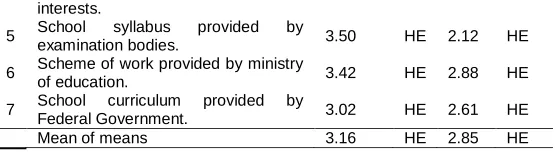
Table I presents the mean ratings of educational planners and principals on the application of programme structure component of PPBS. The educational planners mean ratings of 3.12, 3.04, 2.5, 2.5; 3.51, 3.50; 3.41 and 3.02 for items 1;2;3;4;5;6 and 7 respectively indicate high extent. In the same manner, the principals mean ratings of 3.40; 2.53; 2.54; 2.60; 2.72; 2.88 and 2.61 for items 1 to 7 respectively also indicate high extent. The mean of means for educational planners is 3.16 while that of the principals is 2.75 and both indicate high extent. The finding here is that educational planners and principals apply the programme structure component of PPBS to a high extent.
Research Question 2: To what extent do educational planners and principals of secondary schools apply school programme memoranda in planning for the provision of instructional resources in secondary schools in Anambra State?
Table 2: Mean Ratings of Educational Planners and Principals on the Application of PPBS Programme Memoranda in Planning for Instructional Resource
Provision in the Secondary Schools
S/ N
In Planning for Instructional Resource Provision, to what Extent do You Apply the Following:
Edu. ̅
Pl an. (N =1 4)
Prin .
̅ (N= 256 ) Dec . 8 Specified instructional objectives. 2.51 HE 2.54 HE
9 Articulated feasible alternatives for
providing the resources. 3.11 HE 2.51 HE
10 Documented plans for instructional
resource provision. 1.05
VL
E 1.30 VLE
11 Periodically reviewed instructional resource provision plans. 1.42
VL
E 1.45 VLE
12 Analytical resource provision alternatives. studies of instructional 1.84 LE 1.80 LE
13 Results obtained by checking for
available instructional resources. 1.72 LE 1.60 LE
14 Objectives of the programme being
pursued. 2.31 LE 1.60 LE
15 Financial requirements of the
programme. 3.06 HE 2.53 HE
16 Expected benefit from the instructional
resource. 2.56 HE 3.00 HE
Mean of means 2.18 LE 2.13 LE
Table 2 presents the mean ratings of educational planners and principal on the application of the programme memoranda component PPS. The mean ratings of educational planner on items 8, 9, 15, and 16 tall within high extent decision rule. In the same manner, the mean ratings of the same items by the principals also fall with the high extent decision rule. On the other hand, educational planner’s and principals’ mean ratings for items 12; 13 and 14 fall within the less extent decision rule. Again, the respondents mean ratings for item 10 and 11 fall within the
very low extent decision rule. On the whole, the mean of means for the respondents (Edu. Planners =2.18 and principals = 2.13) fall within the low extent decision rule. This indicate that the respondents apply school programme memoranda to a low extent in planning for the provision of instructional resources in secondary schools in Anambra State.
3.2 Test of Hypotheses
H01: There is no significant difference in the mean
ratings of
educational planners and principals of secondary schools on the extent they apply school programme structure in planning for the provision of instructional resources in secondary schools in Anambra State.
Table 3: t-test of Educational Planners and Principals on the Application of PPBS Programme Structure in Planning
for Instructional Resource Provision in the Secondary Schools
Grou p
Sa mp le Siz e
̅
SD. df. t-C al .
t-Crit. Decision
Edu.
Plan 14 3.16 0.10
26 8
-0. 2 9
±1.965 0
Not Significan
t (NS) Princ
ipal 25
6 2.85 0.77
The result as shown in Table 3 revealed that, the t-test calculated is -0.29, while the t-test critical table value is ±1.9650. Thus the t-calculated is less than the critical observed table value which is ±1.9650 and falls within the acceptable region. The null hypothesis (H0) of no significant difference in the mean ratings is thus accepted indicating that there is no significant difference in the mean ratings of educational planners and principals of secondary schools on the extent they apply school programme structure in planning for the provision of instructional resources in secondary schools in Anambra State.
H02: There is no significant difference in the mean
ratings of educational planners and principals of secondary schools on the extent they apply school p rog ramm e memo rand a in p la nn ing f o r th e p rov is ion o f instructional resources in secondary schools in Anambra State.
Table 4: t-test of Educational Planners and Principals on the Application of PPBS Programme Memoranda in Planning for Instructional Resource Provision in the
Secondary Schools
Group
Samp le Size
̅ SD. df
. t-Cal.
t-Crit. Decision
Edu.
Plan 14 2.18 0.87 2
6 -0.88
±1.9 650
3477 Principal 256 2.13 0.84
8 (NS)
The result as presented in Table 4 showed that, the t-test calculated is -0.88, while the t-test critical table value is ±1.9650. This value calculated is less than the critical observed table value which is ±1.9650 and falls within the acceptable region. The null hypothesis (H0) of no significant difference in the mean ratings is thus accepted indicating that there is no significant difference in the mean ratings of educational planners and principals of secondary schools on the extent they apply school p rog ramm e memo rand a in p la nn ing f o r th e p rov is ion o f instructional resources in secondary schools in Anambra State.
4. SUMMARY OF FINDINGS
Based on the data analysis, the summary of major findings are as follows:
1. Educational planners and principals apply the programme structure component of PPBS to a high extent in planning for the provision of instructional resources in secondary schools in Anambra State.
2. Educational planners and principals of secondary schools apply school programme memoranda to a low extent in planning for the provision of instructional resources in secondary schools in Anambra State. 3. There is no significant difference in the
mean ratings of educational planners and principals of secondary schools on the extent they apply school programme structure in planning for the provision of instructional resources in secondary schools in Anambra State.
4. There is no significant difference in the mean ratings of educational planners and principals of secondary schools on the extent they apply school p rog ramm e memo rand a in p lann in g fo r the pr ov is ion o f instructio nal resources in secondary schools in Anambra State.
4.1 Discussion of Results
The first major finding of this study indicated that educational planners and principals apply the programme structure component of PPBS to a high extent. This finding indicates that they consider a lot of things in planning for instructional resource provision in the secondary schools. They, to a high extent, consider such factors like relevance of the instructional resources with respect to age, intellectual ability and interest of the learner. They also consider school syllabus, scheme of work and curricular in making the plans. The above considerations are very important in selecting appropriate instructional resources for teaching and learning processes. The findings of this study agree with Carlson (2013) who found that principals applied the programme structure in planning for the provision of instructional resources. They however differ in the respondents used. Carlson studied principals only but the current work studied both principals and educational planners. The findings of the study also indicated that
principals and educational planners did no differ in their mean ratings on their application of programme structure in planning for instructional resource provision. This finding differed from Cox (2016) who found significant difference in the mean ratings of principals and teachers on planning for the provision of instructional resource. The difference could be attributed to respondents used. Cox used principals and teachers while the current work studied educational planners and principals as respondents. The findings of this study indicated that educational planners and secondary school principals in Anambra State apply the programme memoranda component of PPBS to a low extent. It was also found that the educational planners and the principals did not differ in their mean ratings on the application of programmed memoranda component of PPBS in planning for instructional resource provisions in secondary schools. The findings of the study are illustrative of the fact that principals and educational planners are not consulted or their opinions sought before instruction materials are procured and distributed to schools. In most cases, politicians do what they feel that are good for the schools without consulting experts or those at the implementation levels. This could be the reason for the low extent ratings of the programme memoranda components. The no significant difference in their mean ratings seems to indicate that educational planners and principals pass through the same experience and adapt the same practice. They, to a low extent, apply the programme memoranda. This could result in ineffective provision of instructional resources. The findings of this study are similar to others in literature. For instance, Onuroah (2015) found that there is low extent application of programme memoranda in the provision of instructional resources across primary schools in Awka Education Zone. Though the findings of the studies are similar, their scopes differ. Onurah studied primary schools in Awka Education zone but the present study focused on secondary schools in Anambra State. Furthermore, Onuorah found no significant difference in the mean ratings of their respondents with respect to instructional resource provision.
5. CONCLUSION
The conclusions of the study are as follows:
1. The programme structure elements of PPBS are applied to a high extent in planning for the provision of instructional resources in Anambra State;
2. The programme memoranda component of PPBS was applied to a low extent in planning for instructional resource provision in the secondary schools.
6. RECOMMENDATIONS
Based on the findings of this study, the following recommendations are made:
2. They should attend in-service training programme on programme memoranda components of PPBS for proper planning of instructional resource provision. This will improve their knowledge and skills on programme memoranda and its application in planning for instructional resource provision.
3. The state government should organize public enlightenment programmes for educational planners and school principals on the application of PPBS in educational sector.
4. Tertiary institutions in the state should float programmes on PPBS for educational planners and school principals.
5. PPBS should be officially included as a programme in the Faculty of Education in the state university to equip graduates in the faculty with knowledge and skills in PPBS.
7 REFERENCES
[1]. Agbuuno, C.P. (2016). The application of PPBS approach to Nigerian public libraries’ personnel administration. Unpublished masters thesis, University of Nigeria.
[2]. Alioto, R. F, & Jungherr, A. (2016). Operational PPBS for education: a practical approach to effective decision making. New York: Harper & Row.
[3]. Bendix, D. (2014). Regional processing for public libraries, a survey. Library Resources and Technical Services, 2 (3), 155-158.
[4]. Carlson, J. W. (2013). The status and next steps for planning, programming, and budgeting, in Public expenditures and policy analysis. Chicago: Markham.
[5]. Cox C. R. (2016). Centralized and cooperative cataloging. News Notes of California Libraries, 50 (4), 355-358.
[6]. Gipson, J..S. (2016). ―Total cost of acquisitions in a community college. College and Research Libraries, 28 (7), 273-276.
[7]. Held, V. (2016). PPBS comes to Washington. The Public Interest, 4(2), 102-115.
[8]. Madueke, J (2015). Evaluation of planning techniques of Anambra State primary Education Board. Population of Education Review, 22(2) 255-298.
[9]. Novick, D. (1969). Program budgeting: New York: Holt, Rinehart and Winston.
[10]. Nwankwo I.N. (2014). Learner-centred and instructional management. Awka: Love- Isaac Consultancy Services.
[11]. Nzekwe, A. (2007). Analysis of principals’ accountability in managing secondary school funds in Anambra State. Academic Group Journal, 1(23), 44-50.
[12]. Olaniyan, U. & Okemakinde, F.(2008). Educational management. Port Harcourt, Nigeria: Rodi Printing and Publishing.
[13]. Oni, T. M. (2006). A passionate teacher: Teacher commitment and use of instructional resources in learning. International Journal of Academic
Research in Progressive Education and Development, 2 (1), 437 – 442.
[14]. Onuorah, M. (2015) Effective planning for resource provision for universal basic education in Awka Education Zone. Journal of Human Resources, 20(4), 583-04
[15]. Oxfam, A. (2014). A Study of how teachers effectively use instructional materials in the Kingdom Of Bahrain. Journal of ICT and Education, 2(1), 13-16.