174
Business Process Optimization Through Soa And
Cloud Integration Using Soa- Ra Model
Syed Ejaz Ali Shah, Dr. Ibrahim Abunadi
Abstract: Business processes workflow architecture based on agility and flexibility plays an important role in the success of any enterprise. In new era most of the processes are automated and they are supported by IT-Services in the form of Service Oriented Architecture (SOA) components. Due to mobility and scalability as well as high performance computing and distributed working environment it is crucial to focus on an architecture which is agile, optimized, cost effective and easy to implement. In this paper, we have conducted a research study on layer based BPM, SOA and cloud integrated architecture. The main contribution of the research study is to propose an agile, cost effective and scalable solution framework based on Architectural Building Blocks (ABBs) following a SOA-RA layered model to integrate BPM, SOA and cloud services.
Keywords: Architectural Building Blocks (ABBs), Business Process Management (BPM), Cloud Computing, Service Oriented Architecture (SOA), SOA Reference architecture (SOA-RA).
————————————————————
1
I
NTRODUCTIONWe are living in an era where technology evolves and business goals are becoming dynamic. These goals are results of different business activities which require continuous resource-alignment, workflow analysis, process optimization and budget control. In past days, business processes were supported by human resources due to lack of technology such as machines which were not interconnected together as there was no internet. In contrast, these days almost all devices are becoming smart and ―internet of things‖ make it possible to interconnect different sensors, tablets, smartphones and workstations to a centralized access point or a central information system. A business process (BP) is a set of many business activities within organizational environment or outside organizations achieving a business goal [1]. SOA is business-driven architectural model of IT services and BPM services are usually supported and operated through IT infrastructure [2]. Modeling workflows based on IT services make more sense as they are supported by IT technologies and they can be easily reengineered or modified [3]. BPM and SOA combination helps business process experts to make agile, flexible and easy to implement architecture fulfilling their strategic goals. BPM and SOA has natural relationship [4]. SOA exposes the services and BPM is related to process flow model [5]. Cloud computing also known as on-demand computing is one of the emerging fields in computer science. Cloud computing services enable organizations and enterprises to run and manage their applications much faster, secure, reliable, scalable, cost effective and highly available. Cloud computing has four deployment models [6]:
1) Public cloud 2) Private cloud
3) Community cloud and 4) Hybrid cloud
From service perspective cloud computing has different layers most commonly three categories [7]:
1) Infrastructure as a Service (IaaS) 2) Platform as a Service (PaaS) and 3) Software as a Service (SaaS)
The above three services models are alternatives to On-premises IT systems used by Small and Medium Enterprises (SMEs) in order to reduce the cost and increase efficiency [8]. But some studies suggest other cloud services models such as Integration Platform as a Service (iPaaS) and Application Platform as a Service (aPaaS) where on-premises functionalities can be integrated into cloud platforms using business-to-business (B2B) and application-to-application (A2A) service models [9]. SOA is a natural component of cloud computing due to its interoperability allowing it to fully benefits from software services in a cloud [10]. BPM, SOA and Cloud services could be integrated within defined architectural framework of an enterprise. Software architecture is a set of smaller flexible components based on building blocks [11]. Due to the heterogeneous environment and complexities of different functional components, it is important to define an enterprise service bus (ESB) which works as a middleware. In the context of SOA, ESB works as a multiprotocol message backbone bus where loosely coupled, highly distributed and event-driven SOA services are interconnected together [12]. In spite of that we need to explore the core elements of SOA to find its mutual characteristics with BPM and cloud computing services. The Open Group Architecture Framework (TOGAF) provided a standard for SOA Reference architecture (SOA-RA) based on 9 layers [13] as shown in figure 2. The rest of the paper is organized in the following way. Section 2 briefly outlines the relationships among BPM, SOA and cloud computing. Section 3 is dedicated for SOA-RA model based on ABBs. In section 4 we have introduced the proposed integration model including its key elements and some of its major advantages. Conclusion and future work are summarized in the section 5.
2
BPM,
SOA
ANDC
LOUD RELATIONSHIPSCombination of BPM and cloud based SOA can bring enormous benefits to organization or enterprise in the shape of agility, cost reduction and process optimization. In this section we are going to elaborate the relationships among BPM and SOA and cloud computing.
————————————————
Syed Ejaz Ali Shah is student of Master of Science in Software Engineering at Prince Sultan University (PSU), Riyadh, KSA.
2.1 BPM and SOA combination
BPM and SOA are correlated naturally [4]. SOA exposes the services and BPM is related to process flow model [5]. Research studies [14] [4] suggested that when BPM and SOA combined architecture is implemented in top-down manner it is driven by BPM, in contrast if it is viewed from bottom-up it exposes the SOA components. Some of the key benefits of combing elements of both business processes and IT resources are mentioned below [15] [16] [17] [18] [15]:
Better alignment with business goals as SOA driven processes are dynamic and can be changed according to business requirements.
Agility and flexibility are key advantages of BPM-SOA integration.
Cost effective services because of reusable services and components.
Reusability because of loosely coupled business and IT resources.
Process optimization through Business Intelligence (BI) techniques and tracking by Key Performance Indicators (KPIs).
2.2 SOA and cloud integration
Cloud computing and SOA have mutual characteristics and they support each other [19]. SOA is considered to be an architectural pattern which enables business people to create and manage reusable components, whereas cloud computing is collection of flexible, platform independent, and high performance technologies enabling enterprises to create their own tailored SOA solutions [20]. As we have outlined the benefits of combing BPM and SOA in previous section, integrating SOA into cloud computing services make more sense as both share common characteristics. A service provider might be in cloud or non-cloud, on the other hand service consumer can be a cloud user or non-cloud. In all scenarios there is a common channel of service request and service consumer which clearly shows the mutual nature of SOA and cloud computing services. Some of the business and technical benefits of SOA and cloud integration are [21] [22] [23] [24] [25] [26]:
Organizational agility by using reusable cloud hardware and software components.
Cost reduction due the reusability of cloud services as well as virtualization of hardware resources.
Better performance due to the grid computing and better resource utilization and scalabilities.
Highly secure infrastructure such as migrating to private cloud computing.
Reusability by adapting general web services standards such as SOAP, REST, XML and WSDL.
Service availability because of dynamic resource management and cluster computing.
3
SOA-RA
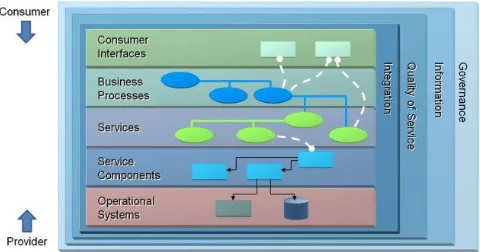
MODELSOA-RA is a set of different functional layers which contain Architectural Business Blocks (ABBs). ABBs provides a solution framework where business processes, services, components and operational systems are separated in different layers in order to design an agile, cost effective, reusable and scalable workflow model. As seen in figure 1, there are 5 horizontal (functional) and 4 vertical (non-functional) layers.
Figure 1: The Open Group SOA Reference Architecture
Table 1 briefly summarizes the responsibilities of each layer [27]. In the next section we will propose a solution framework based on SOA-RA model and its relationship with BPM and cloud computing services.
4
P
ROPOSED SOLUTION FRAMEWORKIn previous sections we have conducted research study on some of the important concepts of BPM, SOA and cloud computing services and deployment models. We have also explored their mutual relationships and benefits of combining BPM, SOA and cloud services together. In section III we highlighted the SOA-RA model based on ABBs. Table 1 shows some of the important functionalities of each layer. In this section we are going to propose our solution model for integrating business processes and cloud based SOA services. Figure 2 illustrates our proposed integration model. Some of the key elements of this model are as follows:
4.1 Key Elements
A: Nine layers based on ABBs capabilities
The SOA-RA model has nine layers (see table 1) five are horizontal and four of them are vertically defined. Research studies suggest that SOA-RA can be tailored and customized based on the requirements and organizational needs. In recent times cloud computing is must for the success of business that’s why we have integrated cloud Enterprise service bus (ESB) using iPaaS cloud servicing model. These SOA layers have relationships with cloud computing services and deployment models through ESB.
B: Cloud computing framework
Our proposed architecture is based on integration framework (integration layer). SOA has similar characteristics as cloud computing components as discussed in section II. SOA and cloud integration brings several advantages including agility, cost reduction, scalability, performance, security, reusability and availability. On-premises services are mapped to cloud computing services through cloud based ESB. Finally, we have used iPaaS (integration platform as a service) where ESB is located and works as middleware between different technologies and components.
C: ESB (Enterprise service bus) within cloud
176 ESB is not traditional SOA based model, it is based on iPaaS
integration solution framework. iPaaS has cloud-based capabilities [28] such as highly interoperable, quickly business aligned, cost effective and agile.
D: Adapters
These are web services adapters which solve the issues of message formats by transforming messages into required standard [29]. In figure 3 adapters using XML, SOAP, JSON and REST are connected to ESB which transform messages of different sources into a required standard. Using these adapters help organizations to integrate services running on different platforms into a single heterogeneous ESB.
4.2 Advantages
A: Visibility
In distributed software engineering solutions, hardware and software components are located in different locations. Relocation of those hidden dependencies and interfaces, testing and understanding the relationship among different components are most important factors specifically from security perspectives [30]. As seen in the figure, services, components and operation resources are clearly visible which increases its traceability
Layer No.
Layer
Name Functions
1 Consumer Interfaces
This layer provides an interface where applications can communicate to other applications through standard patterns such as Asynchronous JavaScript and XML (Ajax). In order to reduce the complexity and development costs, consumer layer provides reusable front-end building blocks based on standardized patterns. Controlling unauthorized access by integrating security and user authentication services is also one of this layer’s job.
2 Business Processes
In this layer individual business processes, single activity or process and composite services are defined by using some workflow visualization tools. Business process layer plays an important role in defining services which are loosely coupled, cost reduced, reusable and optimized.
3 Services
Business-aligned IT services or functions are invoked by consumers in platform-independent environment exposed by service providers. Service specifications can be described using Web Service Deification Language (WSDL). Services are also exposed through some standards like XML, HTML, Voice XML so they can work on multi-platforms.
4 Service Components
Supporting the services in terms of functionality and QoS. These components comply with the specifications of Service Component Architecture (SCA) and Service Data Objects (SDO). Business flexibility is achieved by implementation of flexible IT services and layering. IT flexibility is defined by encapsulating and hiding complexity of systems from consumers.
5 Operational Systems
Facilitating the existing software systems to run applications (e.g. J2EE and Microsoft.Net), transaction processing systems, legacy systems, existing databases and packaged solutions such as ERP, CRM, SAP and Oracle.
6 Integration
Works as a middleware between different operating systems, language platforms and other technological differences. By using ESB this layer can enable point-to-point service integrations through some set of capabilities. Transportation of request services to correct service providers using smart routing and working as a bridge between different protocols are some of key features of integration layer.
7 Quality of Service (QoS)
QoS is one of the most important layers in SOA-RA model. Taking care of nonfunctional requirements (NFRs) by capturing, monitoring and logging issues that are required for quality of SOA layer. Availability, scalability, security and reliability are also some of the non-functional requirements covered in this layer.
8 Information Information architecture layer includes XML-based metadata for business intelligence purpose. Some business intelligence activities like data mining and analytical modeling of data are also covered here.
9 Governance
B: Traceability
During the requirements specification, elements are decomposed into different categories such as systems, sub-systems, hardware or software components. Traceability is the relationships or associations between requirements and the implemented elements at the same or different levels [31]. As it is obvious in our proposed architecture, functional and non-functional requirements can be easily traced within specific layers.
C: Flexibility
As we argued in previous sections, our solution model is not only flexible in terms of business and IT alignment but also agile from SOA and cloud integration perspectives. Flexibility is also dependent on the visibility and traceability as well as reusability of any architecture.
D: Granularity
The services and components are defined clearly in different levels based on the business and technical requirements which probably reduce the complexity among different services and components. The integration of cloud components is also based on different services (SaaS, PaaS and IaaS) and deployment models (private, public and hybrid) of cloud computing where granularities of services are already defined based on the scope of each layer.
E: Standardization
We have used standard UML notations such as BPMN (Business Process Model and Notation) for graphical representations of different workflow models. The proposed SOA-RA solution model is also following the standard defined by TOGAF which is internationally recognized standard framework model for enterprise architecture.
F: Legacy support
In some organizations, it’s very difficult or too costly to replace the existing legacy systems which are already in service. The best and popular approach is by not changing the underlying systems and expose their functionalities by defining service interfaces [32]. SOA offers several features best suited for migrating legacy systems into modern technical environment. These features include replacement of entire existing systems or applications, adopting reverse engineering approaches to add functionalities to SOA, wrapping of existing components to make them accessible through interfaces, and migration of current system into more suitable SOA environment while the original data and functionality remain unchanged [33]. We have used ESB as a middleware which acts as bridge between new systems and old legacy components.
G: Compatibility
SOA has some core characteristics such as interoperability which enables SOA components to be compatible in cross-platform and cross-language environments. To make a component compatible internal complexities and designing details can be encapsulated by representing component's functions as interfaces [34]. For example; WSDL, XML, SOAP, REST and JSON standards [27] can be used to facilitate interactions between different components. In our solution we have used different adapters integrated into ESB which work as interfaces to other components making them compatible despite their internal complexities.
H: Extensibility
Due to the emergence of new technologies, there are always new demands from customers for upgrading existing systems. Extensibility of components can be defined as how easily the functionalities of the current system can be extended without losing capabilities in the existing system [35]. Our proposed architecture is layer based which helps developers to define, reengineer or replace new business activities in the business layer and map them to new or existing services in service layer without changing the core functionalities of current components.
5 C
ONCLUSION&
FUTURE WORKCombination of BPM, SOA and cloud computing brings business and technical advantages. We have introduced an integrated architecture based on business oriented SOA-cloud based services following a standard SOA reference model. There are key advantages of implementing this model such as flexibility, cost reduction, service granularities, process optimization, traceability, scalability and compatibility. Our future plan is to implement it on a real time case study and analyze the results.
R
EFERENCES[1] Weske, Mathias, "Introduction," in Business process management: concepts, languages, architectures, Second ed., Springer Science & Business Media, 2012, p. 5.
[2] Liu, Yang, Enzhao Hu, and Xudong Chen, "Architecture of information system combining SOA and BPM," Information Management, Innovation Management and Industrial Engineering, vol. 1, no. ICIII'08. International Conference on, 2008.
[3] Juric, Matjaz B., and Kapil Pant, usiness process driven SOA using BPMN and BPEL: from business process modeling to orchestration and service oriented architecture, Packt Pub, 2008.
[4] John Brunswick, "Extending the Business Value of SOA through Business Process Management," Oracle,
September 2008. [Online]. Available:
http://www.oracle.com/technetwork/articles/bpm-and-soa-097534.html. [Accessed 14 March 2016].
[5] D. G. K. Behara, "BPM and SOA: A Strategic Alliance," BPTrends, www.bptrends.com, 2006.
[6] Zhang, Qi, Lu Cheng, and Raouf Boutaba, "Cloud Computing: state-of-the-art and research challenges," Journal of internet services and applications, vol. 1.1, pp. 7-18, 2010.
[7] Armbrust M et al, "Above the clouds: a Berkeley view of cloud computing," UC Berkeley Technical Report, 2009.
[8] Feuerlicht, George, "Next generation SOA: can SOA survive cloud computing?," Advances in Intelligent Web Mastering-2, pp. 19-29, 2010.
178 [10]Sharma, Ritu, Manu Sood, and Divya Sharma, "Modeling
Cloud SaaS with SOA and MDA," Advances in Computing and Communications, pp. 511-518, 2011.
[11]Krafzig, Dirk, Karl Banke, and Dirk Slama, Enterprise SOA: service-oriented architecture best practices, Prentice Hall Professional, 2005.
[12]Chappell, David, "SOA in an Event-Driven Enterprise," in Enterprise service bus, O'Reilly Media, Inc., 2004, p. 1.
[13]"Using TOGAF to Define and Govern SOAs : Using TOGAF for Enterprise SOA," 2016. [Online]. Available:
https://www.opengroup.org/soa/source-book/togaf/entsoa.htm. [Accessed 18 March 2016].
[14]Fuhua Ge, Shaowen Yao, "Architecture Combining SOA and BPM," in Computer Science and Service System (CSSS) 2011 International Conference on, 2011.
[15]Hansen, D, "Blueprint for Successful SOA Integration," Oracle Paper, March 2008.
[16]Bajwa, Imran Sarwar, et al, "SOA and BPM Partnership: A paradigm for Dynamic and Flexible Process and IT Management," World Academy of Science, Engineering and Technology, vol. 45, no. 4, pp. 16-22, 2008.
[17]Li, Baoan, and Weizhen Zhou, "Research and Design of EERP:End-to-End Resource Planning Based on SOA and BPM," Wireless Communications, Networking and Mobile Computing, vol. WiCOM'08. 4th International Conference on., 2008.
[18]Michael Madsen, "Unlocking the Power of SOA with Business Process," CGI Group Inc, 2006.
[19]X. Yang and H. Zhang, "Cloud Computing and SOA Convergence Research," Computational Intelligence and Design (ISCID), vol. 1, pp. 330,335, 28-29 Oct 2012. [20]Wei-Tek Tsai, Xin Sun, Janaka Balasooriya,
"Service-Oriented Cloud Computing Architecture," Infromation Technology: New Generations (ITNG), April 2010.
[21]Geoffrey Raines, "Cloud Computing and SOA," vol. Availalbe at: http://www.mitre.org/soa, no. The MITRE Corporation, 2009.
[22]L. Tang, J. Dong, Y. Zhao and L.-J. Zhang, "Enterprise Cloud Service Architecture," Cloud Computing (CLOUD), no. 2010 IEEE 3rd International Conference, pp. 27,34, 5-10 July 205-10.
[23]M. Hirzalla, "Realizing Business Agility Requirements through SOA and Cloud Computing," Requirements Engineering Conference (RE), no. 2010 18th IEEE International, pp. 379,380, 27 Oct 2010.
[24]D. Chappell and D. Berry, "SOA – Ready for Primetime: The Next-Generation, Grid-Enabled Service-Oriented Architecture," SOA Magazine, Sept. 2007.
[25]Peralta, Mario, et al., "Workflow Models: Management and Quality of Process in the Cloud," Information Technology: New Generations (ITNG), 2014 11th International Conference on, no. IEEE, 2014.
[26]J. Zhang and R. Wang, "Applied Research on A Cloud-Based ERP Service System within the SOA Framework," Computational and Information Sciences (ICCIS), no. 2013 Fifth International Conference, pp. 1401,1404, 21-23 June 2013.
[27]Ali Arsanjani, Liang-Jie Zhang, Michael Ellis, Abdul Allam, Kishore Channabasavaiah, "Design an SOA solution using a reference architecture," DeveloperWorks, no. IBM Corporation 2007, pp. 1,18, 2014.
[28]"Integration Platform as a Service: The next generation of ESB, Part 1," IBM, 20 July 2015. [Online]. Available: http://www.ibm.com/developerworks/cloud/library/cl-ipaas-next-generation-of-esb1-trs/. [Accessed 11 April 2016].
[29]Douglas K Barry, "Web Services Adapters," 2000 - 2016. [Online]. Available: http://www.service-
architecture.com/articles/web-services/web_services_adapters.html. [Accessed 11 April 2016].
[30]Orso, Alessandro, Mary Jean, and David Rosenblum, "Component metadata for software engineering tasks," Engineering Distributed Objects, pp. 129-144, 2001.
[31]"Managing Your Requirements 101 – A Refresher. Part 4: What is Traceability?," IBM, 23 Jan 2013. [Online]. Available:
https://www.ibm.com/developerworks/community/blogs. [Accessed 13 April 2016].
[32]Lewis, Grace, Edwin Morris, and Dennis Smith, "Analyzing the reuse potential of migrating legacy components to a service-oriented architecture," no. IEEE, 2006.
[33]Almonaies, Asil A., James R. Cordy, and Thomas R. Dean, "Legacy system evolution towards service-oriented architecture," International Workshop on SOA Migration and Evolution, 2010.
[34]D. C. Craig and W. M. Zuberek, "Compatibility of Software Components - Modeling and Verification," 2006 International Conference on Dependability of Computer Systems, pp. 11-18, 2006.
[35]Henttonen, K., et al., "Integrability and Extensibility Evaluation from Software Architectural Models- A Case Study," The Open Software Engineering Journal, vol. 1.1, pp. 1-20, 2007.