International Journal of Scientific & Technology Research Volume 1, Issue 4, May 2012 ISSN 2277-8616
94
AN EFFICIENT ALGORITHM FOR CRASHING
B. R. Kharde, G. J. Vikhe Patil
Abstracts:Time-Cost Trade-off in Projects (TCTP), Least-Cost Schedule (LCS) or crashing technique is used to find optimum project duration to minimize the total cost. In crashing an activities, the direct cost (DC) increases while indirect cost(IC) reduces. So it is double beneficiary technique for managers to decrease the project duration as well as total cost. The goal in crashing is to find the optimum duration or Leas t Cost Schedule (LCS) where the total cost of the project is least. Unit Time Method (UTM) is the powerful procedure for crashing; yields always optimum solution and is used widely for CPM networks. But much iteration (one for crashing one unit of time) are needed to get to LCS. This is a disadvantage of UTM if project is to be crashed for double figure or more time. Say project crashing for 30 days – 30 iterations! Other short cuts avoiding UTM are error porn and errors are observed in few cases (literature). We propose new algorithm which works on UCM logic but requires less iteration. In some problems iterations are reduced to just number of activities crashed till LCS. Algorithm can be viewed as modified Unit Time Method; would always yield the optimum in very less iterations (10 to 30% approximately).
Index Terms- CPM, PERT, Crashing, time-cost trade-off, Least Cost Schedule, Economic Crash Limit, Unit Time Method
————————————————————
1.
INTRODUCTION
CPM is for deterministic times while PERT is for stochastic times. In CPM project duration which is Critical path length (CPL) need to shorten for various requirements of project. Crashing technique is very powerful tool for managers to expedite and reduce the project cost. Smith (1997) shows the different algorithms comparison in excursions. Various algorithms (Liu (1995), Reda (1989), Senouci (1996) …) basically written in the angle of Computer engineering, do not take much in account of the users from construction industry. Senouci (1996) presents dynamic programming approach, but DP is not liked by most of users for its questionable simplicity. Reda (1989) developed LPP model but its application to construction industries is questionable. Gupta (2006) crashes cheapest activity of the network.
Always crash activity only from critical path; if MCS, TCTP
or economical duration for the project is the goal Stevens
(1996) illustrates networks, dummy adding method of drawing AOA, and Unit Time Method (UTM) for crashing. UTM is the best techniques. In this cheapest activity from the critical path is always crashed for unit time (day/week/…). Its optimal solution is at cost of one-iteration for one-unit-time crashing. If project requires crashing of double figure time (that is what generally required in industries); it is challenging. We present algorithm, with same logic, yields optimal solution but takes very less iterations.
We set bounds/limits for crashing an activity without affecting next path to become critical. The basic goal is to minimize the total cost of project keeping intact the technological constraints. The problem is not solved by LPP; but by algorithmic approach to yield the optimal.
Crashing a Network is as follow: 1. Compute the network critical path 2. Establish an objective total duration 3. Identify the crash time for each activity 4. Prioritize the activities on the critical path(cost
slope)
5. Shorten the highest-priority activity by one time period and
6. compare total duration with objective 7. Verify critical path
8. Continue activity reduction (step 4 & 5) until economic crash limit is reached
9. Select next priority activity and continue reduction (steps 4 through 6)
The weakness of crashing unit time is explored such that one activity could be crashed for more than unit time in most of the situations.
________________________
Prof. B.R. Kharde,
Production department, Amrutvahini College of Engineering, Sangamner, India, 422608 [email protected]
Dr. G.J. Vikhe Patil,
Principal, Amrutvahini College of Engineering, Sangamner, India, 422608
International Journal of Scientific & Technology Research Volume 1, Issue 4, May 2012 ISSN 2277-8616
2.
NOTATION
i Start event ' i' for an activity
j End event 'j' for an activity
A ij Activity having start event ' i' and end event 'j' T ij time or duration for A ij
NT ij Normal time for A ij CT ij Crash time for A ij
ij NT ij -CT ij
K NTK -CT K
NC ij Normal Cost for A ij CC ij Crash Cost for A ij CS ij Cost slope for A ij =
CC ij - NC ij
= --- NT ij - CT ij
CSK Cost slope for Activity K
TCSij = CS ij for least cost slope activities from different CPs = CS ij for least cost slope activity from
critical path
CL ij Crash length for activity ij = CT ij - CT ij NC ij Normal Cost for A ij
CPK Project path "K" which happens to be critical
CPLK Length for critical path 'K, CPK = T ij for A ij K
NPK the path of the project just shorter(Next) to critical path 'K' NPK NNPK the path of the project just shorter(Next) to NPK path 'K' NPK
NPLK Length (duration) for the path of the project just shorter(Next) to critical path 'K" CPNK
= T ij for A ij N
NNPLK Length (duration) for the path of the NNPK
FK Critical Path(K) Float Limit or Difference between critical path length and length of next to critical
path = CPLK - NPLK
NFK Critical Path(K) Float Limit or Difference between critical path length and length of next to next to
critical path, = CPLK - NNPLK
CTLij Crash-Time-Limit or maximum limit activity ' i-j ' could be crashed in one stretch,
= min { FK , (NT ij - CT ij)}
NCTLij Crash-Time-Limit or maximum limit activity ' i-j ' could be crashed in one stretch when crash
activity is common to CP and NP, = min { NFK , (NT ij - CT ij)} = min { NFK , ij)
3.
NETWORK AND CRITICAL PATH
We use Activity On Arc (AOA) however AON network could be used. Crashing could be done without network preparation by path table.
Critical Path Float Limit
Projects have many paths which are evident from the network. These paths are denoted by number, 1, 2, 3…, K,… (Table 3.1) Each path has length. Critical path/s is/are the path/s with longest duration. This length is denoted by CPLK. The path which is just shorter than critical path (K) is
denoted by NPK and its length by NPLK.
Definition: The difference in these two paths is defined as Critical Path Float Limit, FK = CPLK - NPLK Activities on critical path have no floats. All floats for critical activities are zero (Total Float, Free float, Safety float, Independent float, and Interfering float). The new definition is not activity float but path float.
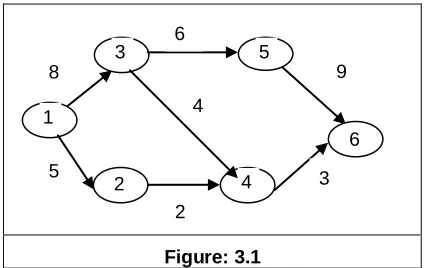
Figure: 3.1
Consider AOA network showing activity durations in Figure 3.1. Three different paths are evident as listed in Table 3.1.
Table 3.1 – Path Table
Path Length
1 1-3-5-6 8+6+9 = 23 2 1-3-4-6 8+4+3 = 15 3 1-2-4-6 5+2+3 = 10 5
8 1
3
4 4 6
9
3 2
6 5
International Journal of Scientific & Technology Research Volume 1, Issue 4, May 2012 ISSN 2277-8616
96
The network have three paths namely path 1, 2 and 3. Path 1 is longest and hence critical path; CP1 have
length CPL1 = 23 week.
Next path just short to critical path is path 2 and its length is 15 weeks. This path is relative to critical path 1; NP1 have length NPL1 = 15 week.
The difference between these paths is 8. So with notations, it is Critical Path Float Limit for critical path 1: F1 = CPL1 - NPL1 = 23 - 15 = 8 week
When activity on CP is crashed, the length of CP would be reduced by crashed time. Its effect on NP is observed:
Case 1: No change in NPL Case 2: NPL reduction
E.g. If activity 3-5 is crashed by 1 week, then CPL1 = 23-1 = 22 week
NPL1 = 15 NPL unchanged
F1 = 22-15 = 7 week
Instead of crashing 3-5, if common activity to CP and NP; 1-3 is crashed by 1 week then:
CPL1 = 7+6+9 = 22 week
NPL1 = 7+4+3 = 14 week
NPL1 is reduced from 15 to 14 week
F1 = 22-14 = 8 week
Theorem 1: If activity on CP is crashed by unit time; NPL might be unchanged or would also reduce by unit time. Theorem 2: If activity on CP is crashed by unit time; Critical Path Float Limit might be reduced by unit time or unchanged. In Case 2: Critical Path Float Limit is unchanged, and have no effect on criticality (CP is CP and NP is NP). This would continue till common activity which is being crashed; could not be crashed any further. But consider case 1; here for crashing one time unit, CPL reduces by one unit but NPL unchanged. So the crashing could continue for one more time unit, so on. A time would come when CPL and NPL are equal or both are CP. The situation changes now, crashing can not be done with logic of one CP. This point is when CP is crashed by the difference in (CPL – NPL) or Critical Path Float limit (FK).
This is the worst case situation. This infers:
Theorem 3: Activity on CP could be crashed by Critical Path Float Limit without affecting Criticality of NP (CP is CP and NP is NP).
Please note cost economics is not considered here. Crash-Time-Limit for an Activity
Theorem 4: Any activity on CP could be crashed maximum to crash period, ij or (NT ij - CT ij). This is
technological constraint on the activity and could not be violated. From theorem 3 and 4 it is evident
Theorem 5: Any activity on CP could be crashed to Crash-Time-Limit in one stage such that Crash- Crash-Time-Limit; CTLij
= min {FK; ij} = min {FK; K} Theorem 5 is evident because
out of two possibilities (bounds) only least bound could be explored in one stage and it will not violate criticality. Our addition of theorem 3, 4 and 5 are implemented in Crashing. Instead of crashing one unit time, activity could be crashed by CTL, without any problem.
Crash-Time-Limit for an Activity when it is common on CP and NP
When activity 'K' is common to CP and NP; both paths would be shortened after the crashing. Hence FK does not
put any constraint on Crash limit. Under such case NNPK
should be taken for consideration. for calculation. NFK =
CPLK - NNPLK Crash activity is common to CP, NP and
NNP; then further path just shorter than NNPLKN should be
considered. Such cases are rare but can not be neglected. NCTL for crashing when activity is common in CP and NP, NCTLK = min {NFK; ij} = min {NFK; K}
4.
COST SHEET
In literature no common standards are followed for crashing. We use cost sheet format from Stevens (1996).
Cost Sheet 4.1
Activity Crash time Cost slope Time shortened
i-j ij CSij
Time Cut (crash) //////// Project duration
Incremental Cost //////// Direct Cost
Indirect Cost Total Cost Where with notation
Time Cut (crash) = CTL ij
Project duration = CPLK
Incremental cost (IncC) = CTLij * TCSij
Direct Cost(DC) = NCij + InC
International Journal of Scientific & Technology Research Volume 1, Issue 4, May 2012 ISSN 2277-8616
5.
ALGORITHM USING CRASH-TIME-LIMIT
(CTL) FOR CRASHING
We propose CTL algorithm as follow: Step 1: Prepare table showing activity,
Immediate Predecessors, Normal time, Crash time, Normal cost and Crash cost for each activity Tabulate cost slope (CSij) or incremental cost per unit time for
each activity
CS ij = (CC ij - NC ij ) / (NT ij - CT ij)
Step 2: Prepare Cost-sheet with CS and CTL, Direct and Indirect cost,
Step 3: Prepare AON or AOA diagram.
Show NT on network. Prepare a Path-table showing different paths and find lengths of the each path. Note CP, NP, CPL, NPL and FK from Path table.(No need to
run Forward/backward passes)
Step 4: Noting CPL, prepare (1st column of ) Cost-Sheet and Total Direct cost(TNC), Total Indirect cost and Total cost of the project
Step 5: If no activity from any one CP could not be crashed, Then Stop, It is crash limit.
If more than one critical path(CP), then go to Step 6, Else go to step 7
Step 6: If any activity/ies is/are common to all CPs which could be crashed
Then note the common activity with least cost slope from CPs (CSC)
And Note one least cost slope activity which could be
crashed* from each CP
CSTotal = add cost slope of these activities If (CSC < CSTotal) then go to step 8: Else
1. Find Crash Time Limit for each such activity 2. Take minimum CTL
3. Reduce each least cost slope activity by minimum CTL
4. Reduce CTL in Network Diagram
5. Update path Table and note CPs, new CPL, new FK
6. Update Cost sheet for this CPL (Total Incremental cost, DC, Indirect Cost and TC)
7. Go To Step 9
Step 7: Note the activity (K) with least cost slope which
could be crashed* from CP,.
If crash activity(K) is common to CP and NP; Then crash it by NCTLK; Else crash by CTLij
Step 8:
1. Find CTL or NCTL as applicable
2. Reduce activity to be crashed(K) by CTL or NCTL as applicable in network
3. Update Path table. 4. Find CP, CPL, FK
5. Update Cost sheet for CPL (Total incremental cost, DC, IC, TC)
Step 9: If Total cost of the project is increased Then Stop; least total cost is the optimum period; solution; Else go to Step 5:
6.
ILLUSTRATION
Problem data is given in table 6.1 and AOA network diagram 6.1
Table 6.1
Activity IP Duration (days) Cost ('000 $)
- event Normal Crash Normal Crash
- ' i –j' NTij CTij NCij CCij
A 1-2 - 20 14 1600 2170
B 2-4 A 10 6 140 220
C 2-3 A 20 12 800 1720
E 4-5 B, C 40 30 800 1050
F 3-5 C 10 8 1000 1050
Indirect cost of the project is $ 100,000 per day
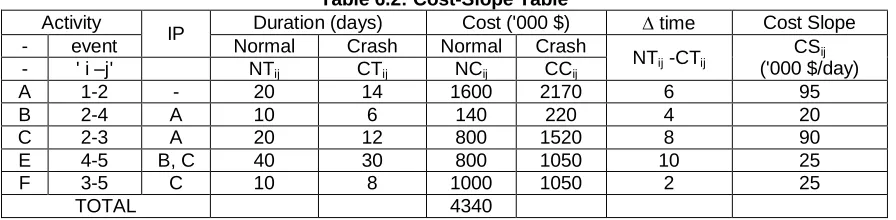
Step 1: prepare Cost-Slope Table (Table 6.2)
Table 6.2: Cost-Slope Table
Activity
IP Duration (days) Cost ('000 $) time Cost Slope
- event Normal Crash Normal Crash
NTij -CTij
CSij
('000 $/day)
- ' i –j' NTij CTij NCij CCij
A 1-2 - 20 14 1600 2170 6 95
B 2-4 A 10 6 140 220 4 20
C 2-3 A 20 12 800 1520 8 90
E 4-5 B, C 40 30 800 1050 10 25
F 3-5 C 10 8 1000 1050 2 25
International Journal of Scientific & Technology Research Volume 1, Issue 4, May 2012 ISSN 2277-8616
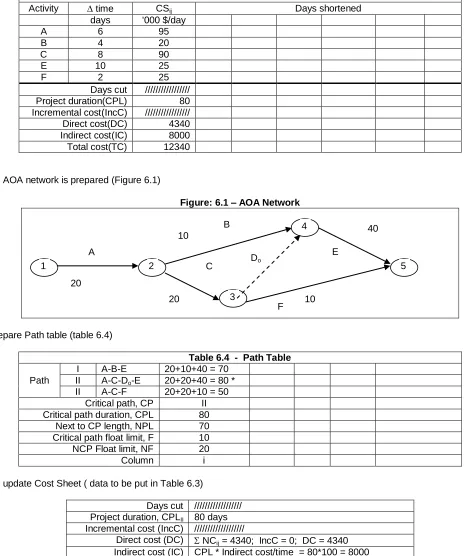
98 Step 2: prepare Cost sheet (Table 6.3)
Table 6.3 - Cost Sheet
Activity time CSij Days shortened
days '000 $/day
A 6 95
B 4 20
C 8 90
E 10 25
F 2 25
Days cut ///////////////// Project duration(CPL) 80 Incremental cost(IncC) ///////////////// Direct cost(DC) 4340 Indirect cost(IC) 8000 Total cost(TC) 12340
Step 3: AOA network is prepared (Figure 6.1)
Figure: 6.1 – AOA Network
1. Prepare Path table (table 6.4)
Table 6.4 - Path Table
Path
I A-B-E 20+10+40 = 70
II A-C-Do-E 20+20+40 = 80 *
II A-C-F 20+20+10 = 50 Critical path, CP II Critical path duration, CPL 80
Next to CP length, NPL 70 Critical path float limit, F 10 NCP Float limit, NF 20
Column i
Step 4: update Cost Sheet ( data to be put in Table 6.3)
Days cut ////////////////// Project duration, CPLII 80 days
Incremental cost (IncC) ///////////////////
Direct cost (DC) NCij = 4340; IncC = 0; DC = 4340
Indirect cost (IC) CPL * Indirect cost/time = 80*100 = 8000 Total cost(TC) = DC+ IC = 12340
Step 5: CP is path II; Only one path; go to Step 7:
Do
4
10 40
1 2
3
5
10 20
20 A
B
C
F
International Journal of Scientific & Technology Research Volume 1, Issue 4, May 2012 ISSN 2277-8616 Step 7: Path II is critical path; Critical activities are A, C
and E (from Path table, path II). From Cost sheet: CSA =
95; CSC = 90; and CSE = 25 *****
Least cost slope activity is E from CP; It is common to CP(II)and NP(I) but not common to NNP(III)
NFII = CPLII - NNPLIII = 80 - 50 = 30 days
NCTLII = min { NFII ; E} = min { 30,10 } = 10 days. Activity E to be crashed by 10 days
Step 8:
Activity 'E' is reduced by 10 days in network Update Network.
Update Path table (column ii; Table 6.5-not shown). CP is path II; CPLII = 70 days; NP is path I ; NPLII = 60
days; FII = 70 - 60 = 10 days
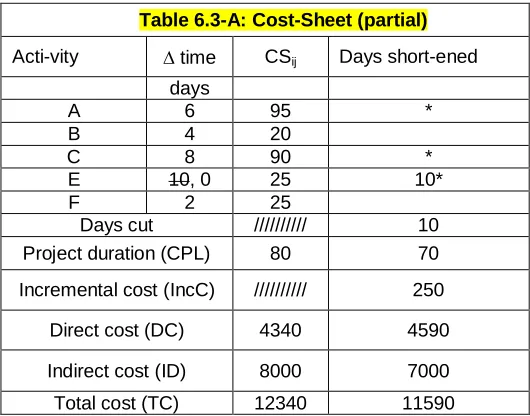
1. Cost sheet updating( Cost-Sheet 6.4-A): Activity E is crashed by 10 days; E is reduced by 10 days
from 10 to 0;
Days cut = CTL = 10 days; Activity E is crashed by 10 days @ CSE
IncC = 10 * CSE = 10 * 25 = 250
DC = 4340 + 250 = 4590; IC = 100 * 70 = 7000; and TC = DC + IC = 4590 + 7000 = 11590.
Step 9: TC (previous) = 12340; TC (after crash) = 11590. As Total cost is reduced, go to step 5:
Step 5: Critical path is path II; only one. go to step 7:
Step 7: Path II is critical path; Critical Activities which can be crashed; are A and C (from Cost sheet; E have E = 0).
From Cost sheet: CSA = 95 and CSC = 90**
Least cost slope activity is C and C = 8 days (From Cost
sheet)
So Activity C could be crashed. Activity C is not common to CP and NP.
For activity C; C = 8 days (cost sheet) and FII = 10 days
(Path table)
CTLC = min {C; FII} = min {8, 10} = 8 day Activity 'C' to
be crashed by 8 days
Step 8: Activity 'C' is reduced by 8 days in network 1. Update Network.
2. Update Path table (column iii; Table 5.3): CP is path II; CPLII = 62 days; NP is path I ;
NPLII = 60 days; FII = 62 - 60 = 2 days
3. Cost sheet updating: Activity C is crashed by 8 days; C is reduced by 8 days from 8 to 0; Days
cut = CTL = 8 days. Activity C is crashed by 8 days@ CSC. IncC = 8 * CSC = 8 * 90 = 720.
DC = 4590 + 720 = 5310; IC = 100 * 62 = 6200 and TC = DC + IC = 5310 + 6200 = 11510
Step 9: TC (previous) = 11590 and TC (after crash) = 11510. Total cost is reduced, go to Step 5:
Step 5: Critical path is path II; only one; go to step 7: Step 7: Path II is critical path;
Critical Activities are A, C and E (from Path table).
From Cost sheet: only Activity A could be crashed.
As E = C = 0; CSA = 95 ***
Least cost slope activity is A; It is common to CP (II), NP(I) and NNP(III). It does not constraint the FII. However finding NCTL:
NFII = CPLII - NNPLIII = 56 – 36 = 20;
NCTLII = min { NFII ; K} = min { 20,6 } = 6 days
Activity A to be crashed by 6 days
Step 8:
1. Activity 'A' is reduced by 6 days in network
2. Update the Network: Update the Path table (column iii; Table 5.3):
CP is path II; CPLII = 56 days; NP is path I ; NPLII = 54
days; FII = 56 - 54 = 2 days
Cost sheet updating:
Activity C is crashed by 6 days; A is reduced by 6
days from 6 to 0;
Days cut = CTL = 6 days; Activity A is crashed by 6 days @ CSA
IncC = 6 * CSA = 6 * 95 = 570;
DC = 5310 + 570 = 5880; IC = 100 * 56 = 5600; and TC = DC + IC = 5880 + 5600 = 11480
Step 9: TC (previous) = 11510 and TC (after crash) = 11480
Table 6.3-A: Cost-Sheet (partial)
Acti-vity time CSij Days short-ened
days
A 6 95 *
B 4 20
C 8 90 *
E 10, 0 25 10*
F 2 25
Days cut ////////// 10
Project duration (CPL) 80 70
Incremental cost (IncC) ////////// 250
Direct cost (DC) 4340 4590
Indirect cost (ID) 8000 7000
Total cost (TC) 12340 11590
International Journal of Scientific & Technology Research Volume 1, Issue 4, May 2012 ISSN 2277-8616
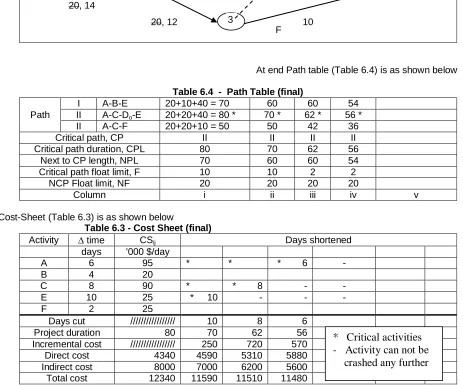
100 At end Figure 6.1 is as shown below
Figure: 6.1 – AOA Network (final)
At end Path table (Table 6.4) is as shown below
Table 6.4 - Path Table (final)
Path
I A-B-E 20+10+40 = 70 60 60 54
II A-C-Do-E 20+20+40 = 80 * 70 * 62 * 56 *
II A-C-F 20+20+10 = 50 50 42 36
Critical path, CP II II II II
Critical path duration, CPL 80 70 62 56
Next to CP length, NPL 70 60 60 54
Critical path float limit, F 10 10 2 2
NCP Float limit, NF 20 20 20 20
Column i ii iii iv v
At end Cost-Sheet (Table 6.3) is as shown below
Table 6.3 - Cost Sheet (final)
Activity time CSij Days shortened
days '000 $/day
A 6 95 * * * 6 -
B 4 20
C 8 90 * * 8 - -
E 10 25 * 10 - - -
F 2 25
Days cut ///////////////// 10 8 6
Project duration 80 70 62 56
Incremental cost ///////////////// 250 720 570
Direct cost 4340 4590 5310 5880
Indirect cost 8000 7000 6200 5600
Total cost 12340 11590 11510 11480
Step 7: Path II is critical path;
No Critical Activities can be crashed as (from Cost sheet)
E, C and A have: E = C = A = 0;
No activity from critical path could be crashed. Economic Crash limit is obtained
Stop.
Solution: Least cost schedule = 56 days and Total minimum cost = $ 11,480, 000 Crashing needed:
Activity Crashed by Days Crash Cost ($)
A 6 570,000
C 8 720, 000
E 10 250,000
* Critical activities
- Activity can not be
crashed any further
4
10 40, 30,
1 2
3
5
10 20, 12
20, 14
A
B
C Do
F
International Journal of Scientific & Technology Research Volume 1, Issue 4, May 2012 ISSN 2277-8616
7.
CONCLUSION:
The new algorithm has given the solution for test problem in
threeiterations. This solution by Unit Time Method would
require 10+8+6 = 24 iterations. It requires fewer efforts for manual solutions. Definitely this test problem can not be solved manually (24 iterations!) while with our algorithm it is possible.
1. New algorithm requires fewer iterations (12% or 3/24 in test problem)
2. It quickly gives the optimum solution
3. It finds application for almost all problems in CPM 4. Definitely this is great addition in literature
5. CTL Algorithm has been framed for more critical paths. 6. Its application to PERT or stochastic times is still area
for further research
7. Its application when more than five or more critical paths exits; is also an area for further research
REFERENCES
:
1. Arisawa, S. and Elmaghram, S. E. (1979), Optimal time-cost trade-off in GERT Networks. Management Science, 8(11): 589-599.
2. Hillier, F. S., M. S. Hillier and G. J. Lieberman, (2000), Introduction to Management Science, Irwin-McGraw-Hill, Boston,
3. Gupta, P.K. and Hira D.S. (2006), "Network Analysis in Network Planning"; Operations Research; book, pp 1141-1244
4. Liu, L., Burns, S. and Feng, C. (1995b) Construction Time-Cost Trade-off Optimization System, Proceedings: The Second Congress held in Conjunction with A/E/C Systems ’95, Atlanta, GA, ASCE, Vol. 2, 5-8 June, pp. 1142-1149.
5. Reda et al. (1989), "Time-Cost Trade-off Among Related Activities, Journal of Construction Engineering and Management, ASCE, Vol. 115, No. 3, pp. 475-486.
6. Robinson, D.R. (1975), A Dynamic Programming Solution to Cost-Time Trade-off for CPM, Management Science, Vol. 22, No. 2, pp. 158-166.
7. Sakellaropoulos et al (2004), "Project time-cost analysis under generalized precedence relations". Advances in Engineering Software, 35; pp 715-724. 8. Senouci A.B. and Eldin N.N. (1996), "A time-cost
trade-off algorithm for non-serial linear projects", Canadian J. of Engineering, Vol.23, pp.134-149.
9. Siemens, N. (1971) "A Simple CPM Time-Cost Trade-off Algorithm", MS, Vol. 17. No. 6, pp. B-354-363. 10. Smith, L.A. (1997) , "Comparing Commercially
Available CPM/PERT Computer Programs", Journal of IE, Vol. 10, N°4,
11. Stevens, J.D. (1996), "Techniques for Construction Network Scheduling",
12. Talbot, F.B. (1982), ―Resource Constrained Project Scheduling with Time-Resource Tradeoffs:‖ Management Science, Vol. 28, pp 1197-1210.