Hd Video Transmission Over Wireless Network
Using Batching And Patching Technique
M. Ramya, S. Girija, M. Bharathy Devi, S. Gnanavel M.E (Phd)
Abstract: In recent advances the high speed video transmission over the wireless network has gained popularity among the users. To gain the improved quality of the video on the receiver side without time delay on multiple users accessing the server at the same time is being the challenging task. To transmit the video on wireless network the VIDEO ON DEMAND (VoD) system and services are used. A video on demand system can be designed with centralized, networked and distributed are the three major network configurations, The VoD system on the internet is categorized into three approaches client/server and peer to peer. A true video on demand system provides the users with the freedom to select videocontent at any time and to perform VCR-like user interactions. Though the true video on demand supports full interactivity with potential to start immediately when requested with full VCR functionality of fast forward, pause, rewind and play the video. The VoD requires a dedicated video stream for each customer request; incoming customer requests result in a significant load on the server and network resources. This is due to the high bandwidth and long duration of video content. Thus we propose a NETWORK CODING EQUIVALENT CONTENT DISTRIBUTION (NCECD) scheme in which the video will be divided into the segment and the segment is also further divided into blocks.Then the blocks are distributed to various peers for local storage.In existing method,the new client can only search for parent peers which consist of that specific segment.But here,the NCECD uses the network coding to cache equivalent content,so that the new client can pick any parent without any additional search. Second, we review the bandwidth-saving streaming schemes such as broadcasting, batching, patching, and merging, which use multicast streaming technologies and user buffer memory.
Keywords: Video on Demand(VoD); Video Cassette Recorder (VCR); Network Coding Equivalent Content Distribution (NCECD); Batching and Patching.
————————————————————
1. Introduction:
The Video on Demand is an important application in the entertainment domain to broadcast videos. The VoD system on the internet has three approaches client/server and peer to peer. Client/server: The video content is stored at the server. Each client connects to the server and plays the requested video from the server, independently fromotherclients transactions. The server workload may be heavy if there are many client requests. Proxy servers can be deployed to reduce this load[2]. Alternatively, clients requesting the same video can be grouped into a single multicast sent by the server. The client /server approach is used in most commercial VoD products.[2]Peer to Peer (P2P): The motivation for P2P is due to the bottleneck problem at the server side. In this approach, not only the video server, but also clients can provide video content to each other, thus saving server bandwidth.[2]Transmission of video streams requires high network bandwidth and can be the most expensive resource in a VoD system. It is the major hurdle in providing an affordable true video on demand service. Techniques such as batching and patching have been proposed to reduce the bandwidth requirements of a video on demand system. The NCECD technique is also proposed when the users perform a large number of interactions on the system. Therefore this paper proposes the video on demand to improve the level of interaction and efficiency, reduce bandwidth and reduce the server overload.
2. Supporting schemes and Techniques:
2.1. Batching and Patching Technique:
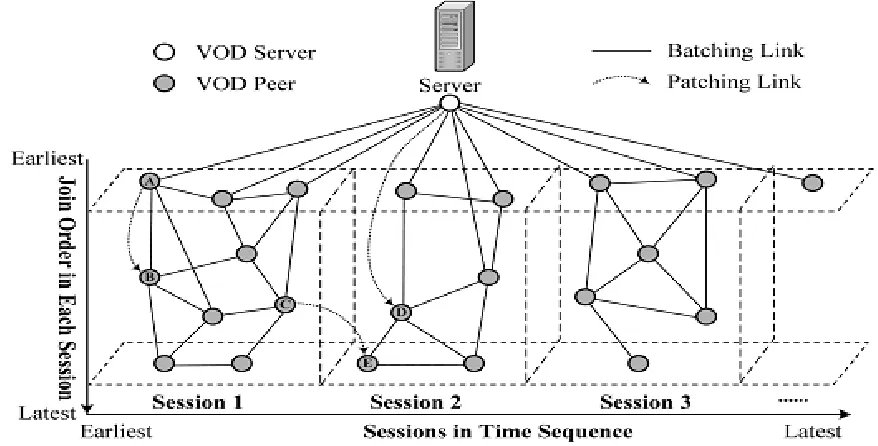
The server containing the stored video content is connected to the number of peers. The server provides the requested content video file to the peers to be played. The serving of video to the peers by the server is faster and error free only until the server capacity notexceeded. If the load on the server exceeds then the batching technique is used. The requests arrived at the server for a video within a period can be batched together and served with a single multicast stream this is batching. With the help of batching many request of for the same video served simultaneously and utilized the proper bandwidth of the network.[1] In general service provider is to batch many request as possible, science the profitability of the system is directly related to batch sized. Batching could be used to provide acceptable service with the limited server capacity. The transmission of the requested video is intentionally delayed by a fixed time interval, called the batching interval. This enables following requests for the similarvideo arriving during the present batching break to be utilized using a one I/O stream. Batching is effectively used when multiple users request the same video. Patching is a technique is used to download the missing portion of the video. Patching is a technique developed for internet that enable video on demand services to utilize the multicast service at the network layer. The basic idea of patching is allowing the client to join the existing multicast for remainder of the video and download the missing portion of the video over a dedicated patching stream.in patching the regular video stream is dynamic and the video stream can be expanded according to their new request. If any other peer request for the same video,then the server starts caching the video in its local disk.When the server is in a need of a stream in order to transmit the leading portion of the video called as the patching stream. When the leading portion of the video is transmitted,the remaining video will be sent from the data which are already stored in the local disk[3]. Using this technique, channels are used only briefly to broadcast the first few _______________________
M. RAMYA, S. GIRIJA, M. BHARATHY DEVI, S. GNANAVEL M.E (PhD)
Students of Information Technology, SKP Engineering College, Tiruvannamalai.
AsstProfessor, Departmentof Information and Technology, SKP Engineering College, Tiruvannamalai. E-mail:[email protected], [email protected],
150 minutes of the video, then they will active for the complete
duration of the playback. Patching has been seen as the multicasting technique for VoD systems where multiple users can share a single channel. The main limitation of patching is that a late request can only join a multicast that transmits the video in its entirety. In wireless technology the
patching technique is implemented at the media server. This application of patching has limited scalability due to fact that every media stream has to come from the server. To improve scalability patching wireless architecture is used.[1]
Fig 1: Batching and Patching Technique
2.2. Peer to peer video streaming scheme:
In a peer to peer system, each peer requests multimedia content from specific supplying peers. Then after receiving this data, it is cached in local storage so that this receiver can become a new supplier for other peers. Avitalcontest in a P2P collaborative streaming system is the data distribution scheme among peers. This scheme should be able to support a dynamic network,where automatic peers can able to connect and disconnect to the system at any time and any place in the network. This scheme is further critical to support random access, such as the Video Cassette Recorder (VCR) operations of pause/resume, jump, fast forward, and rewind. Such VCR operations may occur frequently. They have a high cost in current approaches. This scheme is proposed to offer a more efficient approach to support the VCR operations in the P2P- based interactive video on demand (VoD) system.
2.3. Cache and Relay Technique:
Many methods currently exist to achieve VCR operations, but each has its disadvantages. A simple solution is to download the complete video prior tostart playback, but this causes a long startup delay.[4] Thus to avoid the long startup delay, ―cache and relay‖ technique is used. This technique is used to keep the recently played data in the cache of the receiver, so that it can be forwarded to other users. The cache and relay technique has difficulty with VCR operations.[5].Let us consider a scenario for VCR controls.In which we assume a peer can prefetch the unique segments and the another peer can prefetch D unique segments.And HR1 is the percentage of requests
satisfied by the segments prefetched on the current peer, HR2 is the percentage of request satisfied by the segments prefetched on the neighboringpeer.V={all the segments possibly to be requested by the VCR control}.Vi be the prefetching set of peer and Ph be the probability that therequested segments belongs to the set Vi.
HR1 =Ph ×d
Vi , HR1+HR2 = Ph ×D
Vi
For random prefetching,
HR1′= d V ′ , HR1
′+ HR2′ = D V
HR 1 HR 1′ =
HR 2 HR 2′ =
Ph × V Vi ≈
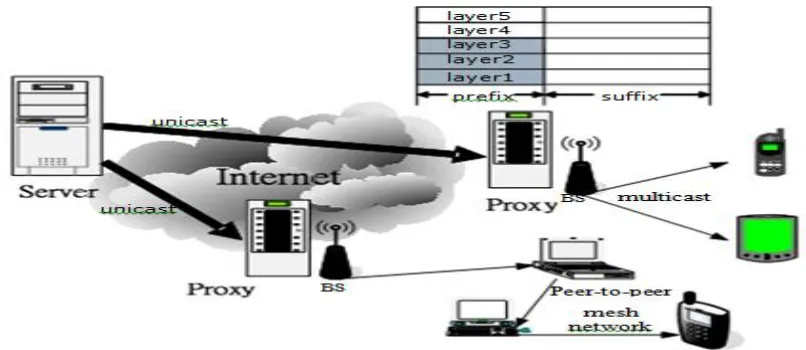
Fig 2: Caching and Relay Technique
2.4. Static Local Storage:
The video can be forwarded between the peers using the cache and relay technique without startup delays. While the child peer receiving the video from its parent peer for instance, the parent peer might jump to another playpoint in the video. This would prevent it from forwarding a continuous stream, thus requiring its child peers will all have tosearch for a new parent. And this delay propagates
because these child peers may have their own children.[4] This problem of delay is avoided by adopting the additional static local storage. It is used instead of sliding window playback buffering to efficiently support user’s interactive operations and decrease complexity. The advantage of using the additional storage is that any user interactivity of a peer does not affect itschildren for continuing to receive its stored media data.[5]
Fig 3: Architecture Diagram
3. Proposed System:
3.1. NetworkCoding Equivalent Content Distribution Scheme (NCECD):
A network coding equivalent content distribution scheme is used to decrease server stress. The random access operations are difficult to be effectively supported, due to asynchronous interactive characteristic of users and the non- static nature of peers. In NCECD, the videos will be divided into segments and the segment is further divided into blocks. These blocks are distributed to the various peers for local storage. With NCECD, a new client can be able to connect to any parent peer in order to view the
entire video and also to perform the various operations. Whereas most existing methods,the new must search for the parent peer containing that particular segment of the video. NCECD uses the properties of network coding to cache equivalent content on which they does not have any additional search. The analysis of system parameters shows that it reduces the packet loss for peer-to –peer interactive video-on-demand streaming.[5]
3.2Working of Network Coding Equivalent Content Distribution Scheme:
A novel Network Coding Equivalent Content Distribution (NCECD) scheme is proposed for the multi-sources peer to
Server
server
Client
client
Request,IPAddress
Request,IPAddress
Response,Port
no
Response,Port
no
Late peer
Redirection
Redirection
Request
Redirect
request
Redirectionrespons
e
VOVO
152 peer bases interactive VoD system. NCECD combines
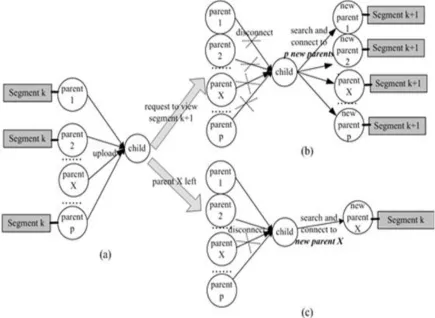
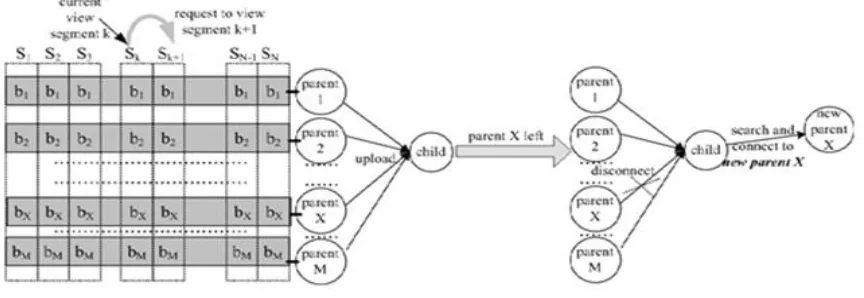
linear network coding with an interleaved block distribution. The interleaving block distribution means that each peer caches discontinuous blocks from different segments, instead of caching contiguous blocks from one segment ofa video. On conditions of parents departure or the child peers want to see another segment, the linear network coding is used to generate an encoding block of one segment by encoding all blocks in this segment. If there are enough encoding blocks received by a child peer, the child peer can decode the original segment. Thus linear network coding combined with the interleaving block distribution results in one child peer only needs to find sufficient parent peers to able to view any segment of the video , the child peer does not have to search new parent peers for viewing the next segment or performing interactive operations (eg, jump and rewind). Furthermore, when a parent peer left, the child peer still can receive some encoding blocks from other parents to able to decode the original segment. Besides, the child peer can locate any peer that caches encoding blocks of the requested video in the peer to peer networks as its parent peer, thereby obtains the optimal video segments search performance.[5][2] A NCECD scheme also uses multiple parents, but our objective is on-demand streaming and data distribution, which required extra
designs and schemes to meet asynchronous clients and morecomplicated VCR operations. Moreover, in our scheme, data downloading from multipleparents notonly address the parent departure problem, but also allows child peers without reconnecting to new parents when requesting new video segments.[5]
3.3 NCECD in Peer to Peer System:
The network coding is practical in a P2P system due to it only generates little overhead, both in terms of CPU processing and I/O activity, and it incurs smooth, quick downloads, and effective server utilization. Network coding used in P2P, VoD services by efficiently distributing and scheduling segments that achieves high performance. By network coding technique, the server can reduce duplicate storage, remove the requirement for tight synchronization between the senders, and be simply combined with TCP protocol. The linear network-coding features are adopted in P2P content distribution scheme which does not need to costly maintain an index data structure and network topology to locate parents peers that cache target segments and thus P2P- based VCR operations are effectively and naturally supported[5].
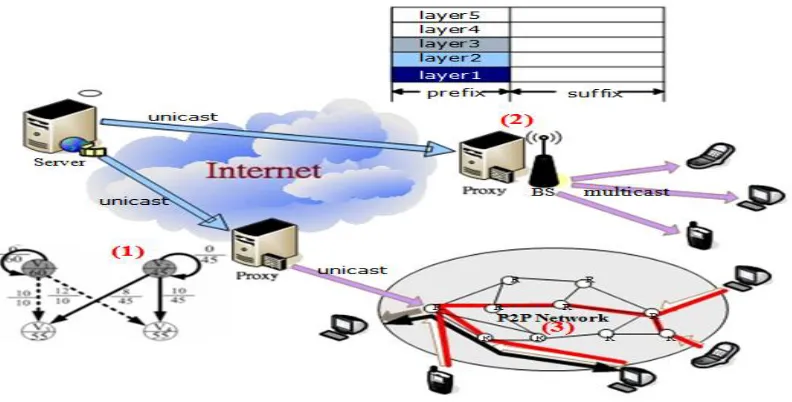
Fig 4:Streaming Layered Video on the Network
3.4. Proxy- Assisted Transmission schemes:
The proxy assisted transmission scheme is being proposed in this paper. The variety of clients connected through network to a server via a proxy located at a base station. The clients receiving videos streamed across the internet from a server. Clients receive different layers of the video based on their capabilities, such as storage capacity, rendering power and network bandwidth. The clients are always assumed to request playback from the beginning of a video. A video is divided into two parts: one is prefix part that is cached at the proxy and the other is suffix part that is not cached at the proxy and only can be provided by the server. The proxy determines which layers and prefix length of each video should be cached to achieve the maximum benefit. The proxy intercepts the client request. If a prefix of exact or more layers of the requested videos is already stored at the proxy, then the proxy streams the prefix directly to the client. If the complete video is not stored at
3.5.The Three Parts of Network Coding Equivalent Content Distribution Scheme:
The transmission of video in a network within a peer to peer system is achieved by using NCECD technique. The number of peers connected to the server for the video transmission. Each video for transmission is divided into N number of segments, and segments are further divided into M blocks. The divided M block is encoded in the same segment using the network coding approach. The each peer connected to the server separately stores one encoded block from one segment of a video. The peers storing the encoded blocks are called as parent peers that can forward the blocks of video to other peers. Thus the encoded blocks would be distributed on all parent peers in
the network.[5] When a client would request the server for a video, the server locates parent peers of the video in the peer-to-peer network. Thus the server forward the clients request to the parent peers of the video in the peer-to-peer network, requesting those parent peers for downloading the video. Those parent peers with sufficient uploading bandwidth would serve the requesting client peer. If there are not enough parent peers to collaboratively serve the requesting peer, the requesting peer would directly connect to the media server for the service. Since each parent peer can provide N encoded blocks, a newly arriving client needs to find M parent peers to be able to view the whole video(N × M blocks) .
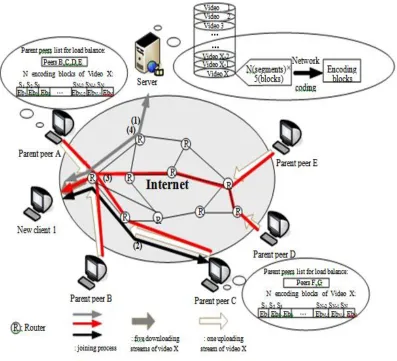
Fig 5: Video Transmission using NCECD In the figure, the media server stores Xvideos. The each X
videos are divided into N number of segmentsand further the each segments divided into 5 blocks. The media server holds N×5 blocks for each video. Five blocks of each segment of all videos are encoded into several linear independent encoded blocks by linear network coding. Parent peers A, B, C, D, and E each stores N encoded blocks of video X and the information of some other parent peers. For example, parent peer A maintains the
information of parent peers B, C, D, and E, while parent peer D maintains the information of parent peers F and G. the joining procedures of a newly arriving client are:
1. The new client randomly connects to some candidate parent peers based on the network location, in this case, peers A, B, C, D and E.
154 client can find a replacement candidate by
askingany of the other parent peers for a new suggestion. Since the parents sent to the client all have parts of this video, they will also have their own parent lists, which they can forward. In this case of figure , parent C can forward the IP address of Parent peers F and G to the new client .This request to a parent avoids overloading the server.
3. When the new client has connected to sufficient parent peers (parent peers A, B, C, D and E), then the client starts to receive the video and to play it once enough data has been received to fill up its buffer. In the mean time, the new client uses its remaining bandwidth to download and store other encoded video blocks from other parent peers (or possibly from the server) into its local cache. The cached content would then be used to serve other peers.
4. New client 1 that finishes downloading and storing the assigned video blocks by the NCECD scheme can act as a parent peer.[5]
3.6. Network Coding Equivalent Content Distribution Scheme:
The interleaving distribution approach of segments is introduced to distribute blocks of segments to peers. This
scheme avoids locating new parent peers while the child peer requests a new segment. Network coding approach is presented for simplifying the search for a new parent peer when a previous parent departs.[5]
3.7. Interleaving Distribution of Segments:
The NCECD approach, considers a system where each peer caches interleaved data from all segments of the video. Parent peer 1 caches the 1st block of all N segments, parent peer 2 caches the 2nd block of all N segments,…, parent peer M caches the M-th block of all N segments. When a newly arriving child connects to M parents that each caches N blocks, and together cache all M blocks for N segments of the video. The child would not need to search new parents for the whole video length even when requesting the next segment or performing jump operations because all N segments of the video are saved among the M peers. Though playing the video is fast, but the startup time is high. Because it must locate parents that all cache different blocks. Furthermore, whenever a parent holding block X of all segments leaves, the child peer pays the cost of locating a new parent that maintains the same block. This motivates us to integrate network coding into our scheme to further reduce the startup time and search cost. Novel content distribution strategy is used in NCECD to avoid the high costs of parent searches.
Fig 7: Interleaving Distribution of Segments
3.8. Linear Network Coding of Segments:
The linear network coding technology is utilized to reduce the cost of finding parents in media data distribution. This scheme generates an encoded block from all original blocks within one segment. A user receives specific number of encoded blocks can decode these original blocks.[5]
4. Features:
The proposed scheme can lead to VCR oriented,scalability,flexibility,short latency, connecting to a new parent delay and less server resources. Hence, the proposed scheme on integration can be used to build an effective video streaming platform for providing high performance and high quality video transmission services to a diversity of clients.
Fig 8: Reducing Server Stress
156
5. Conclusion:
The transmission of video over wireless network is achieved using the batching and patching technique and also the support of NCECD technique. Due to high bandwidth, transmission cost and the server load it is difficult to obtain the quality of the video on the receiver side. The NCECD technique proposed for the equivalent content distribution and linear coding of segments by use of batching and patching technique. The batching and patching technique help in reducing the server overload and also the quality improvement and cost reduction.
6. References:
[1]. Bandwidth Efficient Video-on-demand Algorithm (BEVA), SantoshKulkarni, Telstra Research Labs, Clayton,
VIC3168,[email protected]. com
[2]. Broadcasting Techniques for Video-on-Demand in Wireless Networks, Duc A. Tran\ and Thinh Nguyen, Department of Computer Science, University of Dayton, Dayton, OH 45469, School of EECS, Oregon State University, Corvallis, OR 97331
[3]. Transmission schemes, caching algorithms and P2P content distribution with network coding for efficient video streaming services
[4]. Optimised Batch Patching with Classes of Service-Paul P. White and Jon Crowcroft
[5]. A Network Coding Equivalent Content Distribution Scheme for Efficient Peer-to-Peer Interactive VoD Streaming (IEEE-2012)
[6]. Survey of User Behavior in VoD Service and Bandwidth-Saving Multicast Streaming Schemes (IEEE-2012)
M. RAMYA (RAMYAMURALI )
Pursuing her Bachelor of Technology degree in Information Technology from SKP Engineering College Affiliated to Anna University Chennai.Her current project is on HD video transmission on wireless networks using Batching and Patching Technique.
S. GIRIJA (SELVAKUMAR GIRIJA)
Pursuing her Bachelor of Technology degree in Information Technology from SKP Engineering College Affiliated to Anna University Chennai.Her current project is on HD video transmission on wireless networks using Batching and Patching Technique.
M. BHARATHY DEVI
Pursuing her Bachelor of Technology degree in Information Technology from SKP Engineering College Affiliated to Anna University Chennai.Her current project is on HD video transmission on wireless networks using Batching and Patching Technique.