D E B A T E
Open Access
Scoping studies: advancing the methodology
Danielle Levac
1*, Heather Colquhoun
1, Kelly K O
’
Brien
1,2Abstract
Background:Scoping studies are an increasingly popular approach to reviewing health research evidence. In 2005, Arksey and O’Malley published the first methodological framework for conducting scoping studies. While this framework provides an excellent foundation for scoping study methodology, further clarifying and enhancing this framework will help support the consistency with which authors undertake and report scoping studies and may encourage researchers and clinicians to engage in this process.
Discussion:We build upon our experiences conducting three scoping studies using the Arksey and O’Malley
methodology to propose recommendations that clarify and enhance each stage of the framework. Recommendations include: clarifying and linking the purpose and research question (stage one); balancing feasibility with breadth and comprehensiveness of the scoping process (stage two); using an iterative team approach to selecting studies (stage three) and extracting data (stage four); incorporating a numerical summary and qualitative thematic analysis, reporting results, and considering the implications of study findings to policy, practice, or research (stage five); and incorporating consultation with stakeholders as a required knowledge translation component of scoping study methodology (stage six). Lastly, we propose additional considerations for scoping study methodology in order to support the advancement, application and relevance of scoping studies in health research.
Summary:Specific recommendations to clarify and enhance this methodology are outlined for each stage of the
Arksey and O’Malley framework. Continued debate and development about scoping study methodology will help to maximize the usefulness and rigor of scoping study findings within healthcare research and practice.
Background
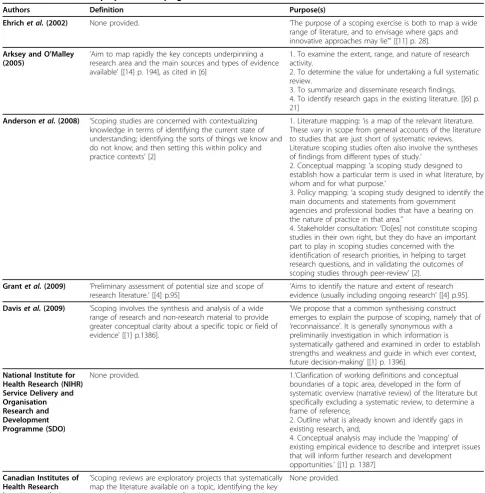
Scoping studies (or scoping reviews) represent an increasingly popular approach to reviewing health research evidence [1]. However, no universal scoping study definition or purpose exists (Table 1) [1,2]. Defini-tions commonly refer to ‘mapping,’a process of sum-marizing a range of evidence in order to convey the breadth and depth of a field. Scoping studies differ from systematic reviews because authors do not typically assess the quality of included studies [3-5]. Scoping stu-dies also differ from narrative or literature reviews in that the scoping process requires analytical reinterpreta-tion of the literature [1].
Researchers can undertake a scoping study to examine the extent, range, and nature of research activity, deter-mine the value of undertaking a full systematic review,
summarize and disseminate research findings, or identify gaps in the existing literature [6]. As such, researchers can use scoping studies to clarify a complex concept and refine subsequent research inquiries [1]. Scoping studies may be particularly relevant to disciplines with emerging evidence, such as rehabilitation science, in which the paucity of randomized controlled trials makes it difficult for researchers to undertake systematic reviews. In these situations, scoping studies are ideal because researchers can incorporate a range of study designs in both published and grey literature, address questions beyond those related to intervention effective-ness, and generate findings that can complement the findings of clinical trials.
In an effort to provide guidance to authors undertaking scoping studies, Arksey and O’Malley [6] developed a six-stage methodological framework: identifying the research question, searching for relevant studies, selecting studies, charting the data, collating, summarizing, and reporting the results, and consulting with stakeholders to inform or
* Correspondence: [email protected] 1
School of Rehabilitation Science, McMaster University, 1400 Main Street West, Room 403, Hamilton, Ontario, Canada
Full list of author information is available at the end of the article
Table 1 Definitions and purposes of scoping studies
Authors Definition Purpose(s)
Ehrichet al.(2002) None provided. ’The purpose of a scoping exercise is both to map a wide range of literature, and to envisage where gaps and innovative approaches may lie"’[[11] p. 28].
Arksey and O’Malley (2005) ’
Aim to map rapidly the key concepts underpinning a research area and the main sources and types of evidence available’[[14] p. 194], as cited in [6]
1. To examine the extent, range, and nature of research activity.
2. To determine the value for undertaking a full systematic review.
3. To summarize and disseminate research findings. 4. To identify research gaps in the existing literature. [[6] p. 21]
Andersonet al.(2008) ’Scoping studies are concerned with contextualizing knowledge in terms of identifying the current state of understanding; identifying the sorts of things we know and do not know; and then setting this within policy and practice contexts’[2]
1. Literature mapping:‘is a map of the relevant literature. These vary in scope from general accounts of the literature to studies that are just short of systematic reviews. Literature scoping studies often also involve the syntheses of findings from different types of study.’
2. Conceptual mapping:‘a scoping study designed to establish how a particular term is used in what literature, by whom and for what purpose.’
3. Policy mapping:‘a scoping study designed to identify the main documents and statements from government agencies and professional bodies that have a bearing on the nature of practice in that area.’’
4. Stakeholder consultation:‘Do[es] not constitute scoping studies in their own right, but they do have an important part to play in scoping studies concerned with the identification of research priorities, in helping to target research questions, and in validating the outcomes of scoping studies through peer-review’[2].
Grantet al.(2009) ’Preliminary assessment of potential size and scope of
research literature.’[[4] p.95] ’
Aims to identify the nature and extent of research evidence (usually including ongoing research’[[4] p.95].
Daviset al.(2009) ’Scoping involves the synthesis and analysis of a wide range of research and non-research material to provide greater conceptual clarity about a specific topic or field of evidence’[[1] p.1386].
’We propose that a common synthesising construct emerges to explain the purpose of scoping, namely that of ‘reconnaissance’. It is generally synonymous with a preliminarily investigation in which information is systematically gathered and examined in order to establish strengths and weakness and guide in which ever context, future decision-making’[[1] p. 1396].
National Institute for Health Research (NIHR) Service Delivery and Organisation Research and Development Programme (SDO)
None provided. 1.’Clarification of working definitions and conceptual
boundaries of a topic area, developed in the form of systematic overview (narrative review) of the literature but specifically excluding a systematic review, to determine a frame of reference;
2. Outline what is already known and identify gaps in existing research, and;
4. Conceptual analysis may include the‘mapping’of existing empirical evidence to describe and interpret issues that will inform further research and development opportunities.’[[1] p. 1387]
Canadian Institutes of Health Research http://www.cihr-irsc.ca
’Scoping reviews are exploratory projects that systematically map the literature available on a topic, identifying the key concepts, theories, sources of evidence, and gaps in the research. They are often preliminary to full syntheses, undertaken when feasibility is a concern–either because the potentially relevant literature is thought to be especially vast and diverse (varying by method, theoretical orientation or discipline) or there is suspicion that not enough literature exists. These entail the systematic selection, collection and summarization of existing knowledge in a broad thematic area for the purpose of identifying where there is sufficient evidence to conduct a full synthesis or where insufficient evidence exists and further primary research is necessary.’[15]
validate study findings (Table 2). While this framework provided an excellent methodological foundation, pub-lished scoping studies continue to lack sufficient metho-dological description or detail about the data analysis process, making it challenging for readers to understand how study findings were determined [1]. Arksey and O’Malley [6] encouraged other authors to refine their fra-mework in order to enhance the methodology.
In this paper, we apply our experiences using the Arksey and O’Malley framework to build on the existing metho-dological framework. Specifically, we propose recommen-dations for each stage of the framework, followed by considerations for the advancement, application, and rele-vance of scoping studies in health research. Continual refinement of the framework stages may provide greater clarity about scoping study methodology, encourage researchers and clinicians to engage in this process, and help to enhance the methodological rigor with which authors undertake and report scoping studies [1].
Discussion
We each completed a scoping study in separate areas of rehabilitation using the Arksey and O’Malley framework [6]. Goals of these studies included: identifying research priorities within HIV and rehabilitation [7], applying motor learning strategies within pediatric physical and occupational therapy intervention approaches [8], and exploring the use of theory within studies of knowledge translation [9]. The amount of literature reviewed in our studies ranged from 31 (DL) to 146 (KO) publications. Upon discovering that we had similar challenges imple-menting the scoping study methodology, we decided to use our experiences to further develop the existing framework. We conducted an informal literature search
on scoping study methodology. We searched CINAHL, MEDLINE, PubMed, ERIC, PsycInfo, and Web of Science databases using the search terms ‘scoping,’
‘scoping study,’ ‘scoping review,’and‘scoping methodol-ogy’for papers published in English between January 1990 and May 2010. Reference lists of pertinent papers were also searched. This search yielded seven citations that reflected on scoping study methodology, which were reviewed by one author (DL). After independently considering our own experiences utilizing the Arskey and O’Malley [6] framework, we met on seven occasions to discuss the challenges and develop recommendations for each stage of the methodological framework.
Recommendations to enhance scoping study methodology
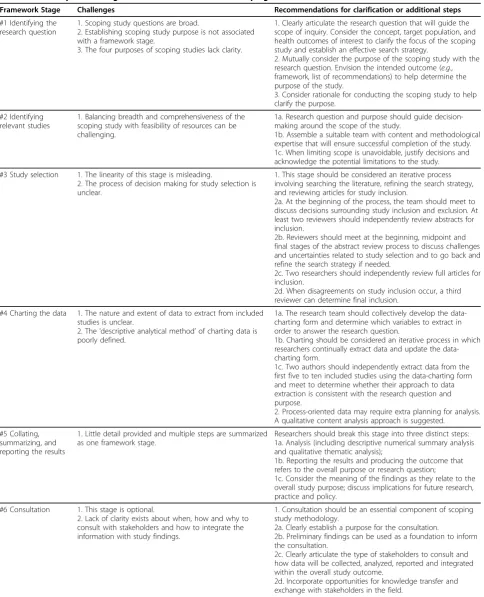
We outline the challenges and recommendations asso-ciated with each stage of the methodological framework (Table 3).
Framework stage one: Identifying the research question Scoping study research questions are broad in nature as the focus is on summarizing breadth of evidence. Arksey and O’Malley [6] acknowledge the need to maintain a broad scope to research questions, however we found our research questions lacked the direction, clarity, and focus needed to inform subsequent stages of the research process, such as identifying studies and making decisions about study inclusion. To clarify this stage, we recommend that researchers combine a broad research question with a clearly articulated scope of inquiry. This includes defining the concept, target population, and health outcomes of interest to clarify the focus of the scoping study and establish an effective search strategy.
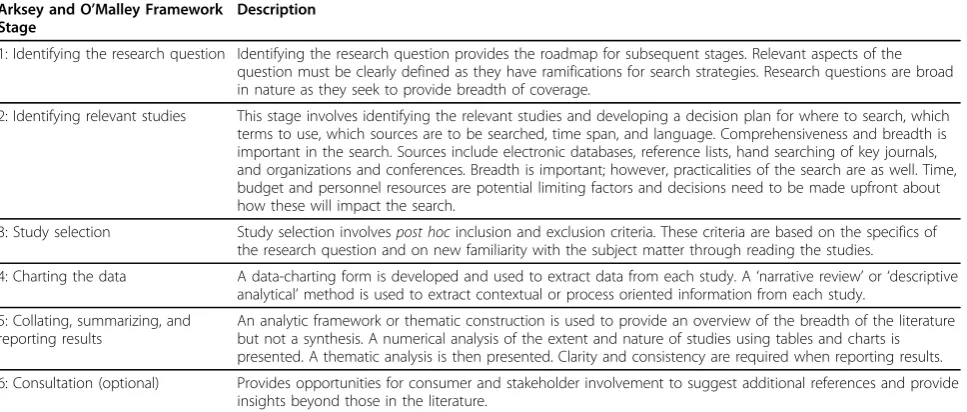
Table 2 Overview of the Arksey and O’Malley methodological framework for conducting a scoping study
Arksey and O’Malley Framework Stage
Description
1: Identifying the research question Identifying the research question provides the roadmap for subsequent stages. Relevant aspects of the question must be clearly defined as they have ramifications for search strategies. Research questions are broad in nature as they seek to provide breadth of coverage.
2: Identifying relevant studies This stage involves identifying the relevant studies and developing a decision plan for where to search, which terms to use, which sources are to be searched, time span, and language. Comprehensiveness and breadth is important in the search. Sources include electronic databases, reference lists, hand searching of key journals, and organizations and conferences. Breadth is important; however, practicalities of the search are as well. Time, budget and personnel resources are potential limiting factors and decisions need to be made upfront about how these will impact the search.
3: Study selection Study selection involvespost hocinclusion and exclusion criteria. These criteria are based on the specifics of
the research question and on new familiarity with the subject matter through reading the studies.
4: Charting the data A data-charting form is developed and used to extract data from each study. A‘narrative review’or‘descriptive
analytical’method is used to extract contextual or process oriented information from each study.
5: Collating, summarizing, and reporting results
An analytic framework or thematic construction is used to provide an overview of the breadth of the literature but not a synthesis. A numerical analysis of the extent and nature of studies using tables and charts is presented. A thematic analysis is then presented. Clarity and consistency are required when reporting results.
6: Consultation (optional) Provides opportunities for consumer and stakeholder involvement to suggest additional references and provide
Table 3 Summary of challenges and recommendations for scoping studies
Framework Stage Challenges Recommendations for clarification or additional steps
#1 Identifying the research question
1. Scoping study questions are broad.
2. Establishing scoping study purpose is not associated with a framework stage.
3. The four purposes of scoping studies lack clarity.
1. Clearly articulate the research question that will guide the scope of inquiry. Consider the concept, target population, and health outcomes of interest to clarify the focus of the scoping study and establish an effective search strategy.
2. Mutually consider the purpose of the scoping study with the research question. Envision the intended outcome (e.g., framework, list of recommendations) to help determine the purpose of the study.
3. Consider rationale for conducting the scoping study to help clarify the purpose.
#2 Identifying relevant studies
1. Balancing breadth and comprehensiveness of the scoping study with feasibility of resources can be challenging.
1a. Research question and purpose should guide decision-making around the scope of the study.
1b. Assemble a suitable team with content and methodological expertise that will ensure successful completion of the study. 1c. When limiting scope is unavoidable, justify decisions and acknowledge the potential limitations to the study.
#3 Study selection 1. The linearity of this stage is misleading.
2. The process of decision making for study selection is unclear.
1. This stage should be considered an iterative process involving searching the literature, refining the search strategy, and reviewing articles for study inclusion.
2a. At the beginning of the process, the team should meet to discuss decisions surrounding study inclusion and exclusion. At least two reviewers should independently review abstracts for inclusion.
2b. Reviewers should meet at the beginning, midpoint and final stages of the abstract review process to discuss challenges and uncertainties related to study selection and to go back and refine the search strategy if needed.
2c. Two researchers should independently review full articles for inclusion.
2d. When disagreements on study inclusion occur, a third reviewer can determine final inclusion.
#4 Charting the data 1. The nature and extent of data to extract from included studies is unclear.
2. The‘descriptive analytical method’of charting data is poorly defined.
1a. The research team should collectively develop the data-charting form and determine which variables to extract in order to answer the research question.
1b. Charting should be considered an iterative process in which researchers continually extract data and update the data-charting form.
1c. Two authors should independently extract data from the first five to ten included studies using the data-charting form and meet to determine whether their approach to data extraction is consistent with the research question and purpose.
2. Process-oriented data may require extra planning for analysis. A qualitative content analysis approach is suggested.
#5 Collating, summarizing, and reporting the results
1. Little detail provided and multiple steps are summarized as one framework stage.
Researchers should break this stage into three distinct steps: 1a. Analysis (including descriptive numerical summary analysis and qualitative thematic analysis);
1b. Reporting the results and producing the outcome that refers to the overall purpose or research question;
1c. Consider the meaning of the findings as they relate to the overall study purpose; discuss implications for future research, practice and policy.
#6 Consultation 1. This stage is optional.
2. Lack of clarity exists about when, how and why to consult with stakeholders and how to integrate the information with study findings.
1. Consultation should be an essential component of scoping study methodology.
2a. Clearly establish a purpose for the consultation.
2b. Preliminary findings can be used as a foundation to inform the consultation.
2c. Clearly articulate the type of stakeholders to consult and how data will be collected, analyzed, reported and integrated within the overall study outcome.
For example, in one author’s (KO) scoping study, the research question was broadly ‘what is known about HIV and rehabilitation?’Defining the concept of ‘ rehabi-litation’was essential in order to establish a clear scope to the study, guide the search strategy, and establish parameters around study selection in subsequent stages of the process [7].
Although Arskey and O’Malley [6] outline four main purposes for undertaking a scoping study, they do not articulate that purpose be specified within a specific fra-mework stage. We recommend researchers simulta-neously consider the purpose of the scoping study when articulating the research question. Linking a clear pur-pose for undertaking a scoping study to a well-defined research question at the first stage of the framework will help to provide a clear rationale for completing the study and facilitate decision making about study selec-tion and data extracselec-tion later in the methodological pro-cess. A helpful strategy may be to envision the content and format of the intended outcome that may assist researchers to clearly determine the purpose at the beginning of a study. In the abovementioned HIV study, authors linked the broadly stated research question with a more specific purpose ‘to identify the key research priorities in HIV and rehabilitation to advance policy and practice for people living with HIV in Canada’[7]. The envisioned outcome was a thematic framework that represented strengths and opportunities in HIV rehabili-tation research, followed by a list of the key research priorities to pursue in future work.
Finally, the purposes put forth by Arksey and O’ Mal-ley [6] require more debate. We concur with Anderson
et al. [2] and Daviset al. [1], who state that researchers may benefit from further clarification of the purposes for undertaking a scoping study. The first purpose, as articulated by Arksey and O’Malley [6], is to summarize the extent, range, and nature of research activity; how-ever, researchers are not required to reflect on their underlying motivation for doing so. We recommend that researchers consider the rationale for why they should summarize the activity in a field and the implica-tions that this will have on research, practice, or policy. The second purpose is to assess the need for a full sys-tematic review. However, it is difficult to determine whether a systematic review is advantageous when a scoping study does not involve methodological quality assessment of included studies. Furthermore, it is unclear how this purpose differs from existing methods of determining feasibility for a systematic review. The third purpose is to summarize and disseminate research findings, but we question how this differs from other narrative or systematic literature reviews. Lastly, the fourth purpose of undertaking a scoping study – to identify gaps in the existing literature –may yield false
conclusions about the nature and extent of those gaps if the quality of the evidence is not assessed. The purpose
‘to identify the key research priorities in HIV and reha-bilitation to advance policy and practice for people liv-ing with HIV in Canada’does not explicitly align with one of the four Arskey and O’Malley purposes [7]. How-ever, it appears authors inherently first summarized the extent, range, and nature of research (purpose one) and identified gaps in the existing literature (purpose four) in order to subsequently identify the key research priori-ties in HIV and rehabilitation (author purpose). This suggests authors might have an overall study purpose with multiple objectives articulated by Arksey and O’Malley that are required in order to help achieve their overall purpose.
Framework stage two: Identifying relevant studies A strength of scoping studies includes the breadth and depth, or comprehensiveness, of evidence covered in a given field [1]. However, practical issues related to time, funding, and access to resources often require researchers to consider the balance between feasibility, breadth, and comprehensiveness. Brien et al. [5] reported that their search strategy yielded a vast amount of literature, making it difficult to determine how in depth to carry out the information synthesis. Although Arksey and O’Malley [6] identify these con-cerns and provide some suggestions to support these decisions, we also struggled with the trade-off between breadth and comprehensiveness and feasibility in our scoping studies. As such, we recommend that research-ers ensure decisions surrounding feasibility do not compromise their ability to answer the research ques-tion or achieve the study purpose. Second, we recom-mend that a scoping study team be assembled whose members provide the methodological and context expertise needed for decisions regarding breadth and comprehensiveness. When limiting scope is unavoid-able, researchers should justify their decisions and acknowledge the potential limitations of their study.
Framework stage three: Study selection
include, variables to extract on the data-charting form, and the nature and extent of detail to conduct the data extraction process. This raised questions related to rigor and led to our recommendations for undertaking a sys-tematic team approach to conducting a scoping study.
Specifically, we recommend that the team meet to dis-cuss decisions surrounding study inclusion and exclu-sion at the beginning of the scoping process. Refining the search strategy based on abstracts retrieved from the search and reviewing full articles for study inclusion is also a critical step. We recommend that at least two researchers each independently review abstracts yielded from the search strategy for study selection. Reviewers should meet at the beginning, midpoint, and final stages of the abstract review process to discuss any challenges or uncertainties related to study selection and to go back and refine the search strategy if needed. This can help to alleviate potential ambiguity with a broad research question and to ensure that abstracts selected are relevant for full article review. Next, two reviewers should independently review the full articles for inclu-sion. When disagreements occur, a third reviewer can be consulted to determine final inclusion.
Framework stage four: Charting the data
This stage involves extracting data from included stu-dies. Based on our experiences, we were uncertain about the nature and extent of information to extract from the included studies. To clarify this stage, we recommend that the research team collectively develop the data-charting form to determine which variables to extract that will help to answer the research question. Secondly, we recommend that charting be considered an iterative process in which researchers continually update the data-charting form. This is particularly true for process-oriented data, such as understanding how a theory or model has been used within a study. Uncertainty about the nature and extent of data that should be extracted may be resolved by researchers beginning the charting process and becoming familiar with study data, and then meeting again to refine the form. We recommend an additional step to charting the data in which two researchers independently extract data from the first five to ten studies using the data-charting form and meet to determine whether their approach to data extraction is consistent with the research question and purpose. Researchers may review one study several times within this stage. The number of researchers involved in the data extraction process will likely depend upon the number of included studies. For example, in one study, authors had difficulty developing one data-charting form that could apply to all included studies representing a range study designs, reviews, reports, and commentaries [7]. As a preliminary step, authors decided to classify
the included studies into three areas –HIV disability, interventions, and roles of rehabilitation professionals in HIV care – to help determine the nature and extent of information to extract from each of the types of stu-dies [7].
Arksey and O’Malley [6] refer to a‘descriptive analyti-cal method’that involves summarizing process informa-tion, such as the use of a theory or model in a meaningful format. Our experiences indicated that this is a highly valuable, though challenging aspect of scop-ing studies, as we struggled to chart and summarize complex concepts in a meaningful way. Arksey and O’Malley [6] indicate that synthesis of material is critical as scoping studies are not a short summary of many articles. We agree, and feel that additional direction in the framework might help to navigate this crucial but challenging stage. Perhaps synthesizing process informa-tion may benefit from utilizainforma-tion of qualitative content analysis approaches to make sense of the wealth of extracted data [11]. This issue also highlights the overlap with the next analytical stage. The role and relevance of analyzing process data and using qualitative content analysis within scoping study methodology requires further discussion.
Framework stage five: Collating, summarizing, and reporting the results
consider using qualitative content analytical techniques [10] and qualitative software to facilitate this process.
Second, when reporting results, we recommend that researchers consider the best approach to stating the outcome or end product of the study and how the scop-ing study findscop-ings will be articulated to readers (e.g., through themes, a framework, or a table of strengths and gaps in the evidence). This product should be tied to the purpose of the scoping study as recommended in framework stage one.
Finally, in order to advance the legitimacy of scoping study methodology, we must consider the implications of findings within the broader context. As a result, we recommend that researchers consider the meaning of their scoping study results and the broader implications for research, policy, and practice. For example, for the question‘how are motor-learning strategies used within contemporary physical and occupational therapy inter-vention approaches for children with neuromotor condi-tions?,’the author (DL) presented themes that described strategy use. Results yielded insights into how research-ers should better describe interventions in their publica-tions and provided further considerapublica-tions for clinicians to make informed decisions about which therapeutic approach might best fit their clients’needs. Considering the overall implications of the results as an explicit fra-mework stage will help to ensure that scoping study results have practical implications for future clinical practice, research, and policy. This recommendation leads to the final stage of the framework.
Optional stage six: Consultation
Arksey and O’Malley [6] suggest that consultation is an optional stage in conducting a scoping study. Although only one of our three scoping studies incorporated this stage, we argue that it adds methodological rigor and should be considered a required component. Arksey and O’Malley [6] suggest that the purposes of consulting with stakeholders are to offer additional sources of information, perspectives, meaning, and applicability to the scoping study. However, it is unclear when, how, and why to consult with stakeholders, and how to ana-lyze and integrate these data with the findings. We recommend researchers clearly establish a purpose for the consultation, which may include sharing preliminary findings with stakeholders, validating the findings, or informing future research. We suggest researchers use preliminary findings from stage five (either in the form of a framework, themes, or list of findings) as a founda-tion from which to inform the consultafounda-tion. This will enable stakeholders to build on the evidence and offer a higher level of meaning, content expertise, and perspec-tive to the preliminary findings. We also recommend that researchers clearly articulate the type of
stakeholders with whom they wish to consult, how they will collect the data (e.g., focus groups, interviews, sur-veys), and how these data will be analyzed, reported, and integrated within the overall study outcome.
Finally, given that consultation requires researchers to orient stakeholders on the scoping study purpose, research question, preliminary findings, and plans for dissemination, we recommend that this stage addition-ally be considered a knowledge transfer mechanism. This may address Brien et al.’s [5] concern about the usefulness of scoping studies for stakeholders and how to translate knowledge about scoping studies. Given the importance of knowledge transfer and exchange in the uptake of research evidence [12,13], the consultation stage can be used to specifically translate the prelimin-ary scoping study findings and develop effective dissemi-nation strategies with stakeholders in the field, offering additional value to a scoping study.
One scoping study included a consultation phase com-prised of focus groups and interviews with 28 stake-holders including people living with HIV, researchers, educators, clinicians, and policy makers [7]. Authors shared preliminary findings from the literature review phase of the scoping study with stakeholders and asked whether they may be able to identify any additional emer-ging issues related to HIV and rehabilitation not yet pub-lished in the evidence. The team proceeded to conduct a second consultation with 17 new and returning stake-holders whereby the team presented a preliminary frame-work of HIV and rehabilitation research and stakeholders refined the framework to further identify six key research priorities on HIV and rehabilitation. This series of con-sultations engaged community members in the develop-ment of the study outcome and provided opportunities for knowledge transfer about HIV and rehabilitation research. This process offered an ideal mechanism to enhance the validity of the study outcome while translat-ing findtranslat-ings with the community. Nevertheless, further development of steps for undertaking knowledge transla-tion as a part of the scoping study framework is required.
Additional considerations for scoping studies to support the advancement, application, and relevance of scoping studies in health research
Scoping study terminology
clarification. Lack of a universal definition for scoping studies is also problematic to researchers trying to clearly articulate their reasons for undertaking a scoping study. Finally, we advocate for labeling the methodology as the‘Arksey and O’Malley framework’to provide con-sistency for future use.
Quality assessment
Another consideration for scoping study methodology is the potential need to assess included studies for metho-dological quality. Brien et al.[5] state that this lack of quality assessment makes the results of scoping studies more challenging to interpret. Grant and Booth [4] imply that a lack of quality assessment limits the uptake of scoping study findings into policy and practice. While our research questions did not directly relate to any quality assessment debate, we recognize the challenges in assessing quality among the vast range of published and grey literature that may be included in scoping stu-dies. This also raises the question of whether and how evidence from stakeholder consultation is evaluated in the scoping study process. It remains unclear whether the lack of quality assessment impacts the uptake and relevance of scoping study findings.
A final consideration for legitimization of scoping study methodology includes the development of a criti-cal appraisal tool for scoping study quality [5]. Anderson
et al. [2] offer criteria for assessing the value and utility of a commissioned scoping study in health policy con-texts, but these criteria are not necessarily applicable to scoping studies in other areas of health research. Devel-oping a critical appraisal tool would require the ele-ments of a methodologically rigorous scoping study to be defined. This could include, but would not be limited to, the minimum level of analysis required and the requirements for reporting results. Overall, the issues surrounding quality assessment of included studies and subsequent scoping studies require further discussion.
Limitations
This paper responds to Arksey and O’Malley’s [6] request for feedback to their proposed methodological framework. However, the recommendations that we pro-pose are derived from our subjective experiences under-taking scoping studies of varying sizes in the rehabilitation field, and we recognize that they may not represent the opinions of all scoping study authors. Other than our individual experiences with our own stu-dies, we have not yet implemented the full framework recommendations. Hence, readers can determine how strongly to interpret and implement these recommenda-tions in their scoping study research. We invite others to trial our recommendations and continue the process of refining and improving this methodology.
Summary
Scoping studies present an increasingly popular option for synthesizing health evidence. Brienet al. [5] argue that guidelines are required to facilitate scoping review reporting and transparency. In this paper, we build on the existing methodological framework for scoping stu-dies outlined by Arksey and O’Malley [6] and provide recommendations to clarify and enhance each stage, which may increase the consistency with which researchers undertake and report scoping studies. Recommendations include: clarifying and linking the purpose and research question; balancing feasibility with breadth and comprehensiveness of the scoping process; using an iterative team approach to selecting studies and extracting data; incorporating a numerical summary and qualitative thematic analysis; identifying the implica-tions of the study findings for policy, practice, or research; and adopting consultation as a required com-ponent of scoping study methodology. Ongoing consid-erations include: establishing a common accepted definition and purpose(s) of scoping studies; defining methodological rigor for the assessment of scoping study quality; debating the need for quality assessment of included studies; and formalizing knowledge transla-tion as a required element of scoping methodology. Continued debate and development about scoping study methodology will help to maximize the usefulness of scoping study findings within healthcare research and practice.
Acknowledgements
DL is supported by a Doctoral Award from the Canadian Child Health Clinician Scientist Program, a strategic training initiative of the Canadian Institutes of Health Research (CIHR), and the McMaster Child Health Research Institute. HC is supported by a Doctoral Award from the CIHR, the CIHR Quality of Life Strategic Training Program in Rehabilitation Research and the Canadian Occupational Therapy Foundation. KO is supported by a Fellowship from the CIHR, HIV/AIDS Research Program and a Michael DeGroote Postdoctoral Fellowship (McMaster University). The authors acknowledge the helpful feedback of Dr. Cheryl Missiuna on an earlier draft of this manuscript.
Author details
1School of Rehabilitation Science, McMaster University, 1400 Main Street West, Room 403, Hamilton, Ontario, Canada.2Department of Physical Therapy, University of Toronto, 160-500 University Avenue, Toronto, Ontario, Canada.
Authors’contributions
DL and HC conceived of this paper. DL undertook the literature review process. DL, HC and KO developed challenges and recommendations. All authors drafted the manuscript. All authors read and approved the final manuscript.
Authors’information
University. She is also a Lecturer in the Department of Physical Therapy at the University of Toronto.
Competing interests
The authors declare that they have no competing interests.
Received: 11 June 2010 Accepted: 20 September 2010 Published: 20 September 2010
References
1. Davis K, Drey N, Gould D:What are scoping studies? A review of the nursing literature.Int J Nurs Stud2009,46:1386-1400.
2. Anderson S, Allen P, Peckham S, Goodwin N:Asking the right questions: scoping studies in the commissioning of research on the organisation and delivery of health services.Health Res Policy Sys2008,6:7. 3. Rumrill P, Fitzgerald S, Merchant W:Using scoping literature reviews as a
means of understanding and interpreting existing literature.Work2010,
35:399-404.
4. Grant M, Booth A:A typology of reviews: an analysis of 14 review types and associated methodologies.Health Info Libr J2009,26:91-108. 5. Brien S, Lorenzetti D, Lewis S, Kennedy J, Ghali W:Overview of a formal
scoping review on health system report cards.Implement Sci2010,5:2. 6. Arksey H, O’Malley L:Scoping studies: Towards a Methodological
Framework.Int J Soc Res Methodol2005,8:19-32.
7. O’Brien K, Wilkins A, Zack E, Solomon P:Scoping the field: identifying key research priorities in HIV and rehabilitation.AIDS Behav2010,14:448-458. 8. Levac D, Wishart L, Missiuna C, Wright V:The application of motor
learning strategies within functionally based interventions for children with neuromotor conditions.Peds Phys Ther2009,21:345-355.
9. Colquhoun H, Letts L, Law M, MacDermid J, Missiuna C:A scoping review of the use of theory in studies of knowledge translation.Can J Occup Ther.
10. Ehrich K, Freeman G, Richards S, Robinson I, Shepperd S:How to do a scoping exercise: continuity of care.Res Pol Plan2002,20:25-29. 11. Hsieh HF, Shannon SE:Three approaches to qualitative content analysis.
Qual Health Res2005,15:1277-1288.
12. Graham ID, Logan J, Harrison MB, Straus SE, Tetroe J, Caswell W,
Robinson N:Lost in knowledge translation: time for a map?J Contin Educ Health Prof2006,26:13-24.
13. Schuster M, McGlynn E, Brook R:How good is the quality of healthcare in the United States?Milbank Q2005,83:843-895.
14. Mays N, Roberts E, Popay J:Synthesising research evidence.InStudying the organization and delivery of health services: research methods.Edited by: Fulop N, Allen P, Clarke A, Black N. London: Routledge; 2001:194. 15. Canadian Institutes of Health Research:Knowledge Translation.[http://
www.cihr-irsc.gc.ca/e/29418.html].
doi:10.1186/1748-5908-5-69
Cite this article as:Levacet al.:Scoping studies: advancing the methodology.Implementation Science20105:69.
Submit your next manuscript to BioMed Central and take full advantage of:
• Convenient online submission
• Thorough peer review
• No space constraints or color figure charges
• Immediate publication on acceptance
• Inclusion in PubMed, CAS, Scopus and Google Scholar
• Research which is freely available for redistribution