United Kingdom Vol. V, Issue 7, July 2017
Licensed under Creative Common Page 442
http://ijecm.co.uk/
ISSN 2348 0386
EFFECT OF PROCUREMENT CONTRACT DETERMINANTS
ON ORGANIZATION PERFORMANCE
A CASE OF NAIROBI COUNTY, KENYA
Walter P. Karungani
KCA University, School of Business & Public Management, Nairobi, Kenya [email protected]
George Ochiri
KCA University, School of Business & Public Management, Nairobi, Kenya [email protected]
Abstract
This research was conducted to evaluate the impact of procurement contract determinants on
the organizational performance. The research was conducted based on a positivist research philosophy and quantitative research design. Purposive sampling was used to select 87 personnel from the procurement department of Nairobi County Government. Data was collected
using structured questionnaires and analyzed using descriptive analysis and regression analysis. The results also showed that internal procurement processes enhance purchase
quality, purchase controls in addition to managing self interests in effect leading to improved organizational performance. The findings also show that policy and regulatory framework within
the procurement sector plays a very important role in improving organizational performance. The findings of the research also show that leadership and management support towards
procurement positively impact on organizational performance. The findings showed that a robust ICT infrastructure in procurement improves communication, enhances efficiency,
enhances monitoring and control, makes work easier as well as improving service delivery.
Licensed under Creative Common Page 443 INTRODUCTION
Procurement is increasingly becoming the pillar of developing economies whereby the percentage of GDP spent on public procurement ranges from 10% to 40% (Amayi and Ngugi, 2013). Procurement is not only important in the public it is equally important in the private sector. According to Namusonge (2016) private business entities spent approximately a third of their annual expenditure on procurement related activities. However, despite the large amount of financial resources spent on procurement and related activities, public private entities have not been able to get value for their money spent on procurement activities. This can be attributed to lack of transparency within the procurement process leading to huge losses of financial resources to corrupt dealings.
In Kenya, reforms have been made to the procurement process since mid 1990s in a bid to improve transparency openness and enhance organizational performance. Despite such reform efforts, little has been achieved because funds to be lost to corrupt dealings in the procurement processes. There is, therefore, need to evaluate factors that influence organizational performance in regard in procurement. This research has been conducted to find out the effect procurement contract determinants on organizational performance based on the study of Nairobi County Government.
Statement of the Problem
Licensed under Creative Common Page 444 Research Objective and Hypothesis
The aim of this research is to evaluate the impact of procurement contract determinants on organizational performance in Nairobi County Government. The Study was guided by the following hypotheses:
(H1): Internal procurement processes does not have effect on organizational performance.
(H2): Policy regulatory framework has no effect on organizational performance.
(H3): Leadership and management support has no effect on organizational performance. (H4): The ICT infrastructure support has no effect on organizational performance.
LITERATURE REVIEW
Theoretical framework
The resource based view theory advocates for the use of a firm’s internal resources to attain competitive advantage (Ordanini and Rubera, 2008). Based on the resource based view internal resources and capabilities enhance the procurement and its contribution to organizational performance. Internal procurement process efficiency as well as process integration capabilities positively impact on organizational performance.
The Hegelian dialectic theory is based on the premises that conflicting forces shape the world in which an organization exists (McTaggart, 2012). Change only occurs when pro-change forces override the status quo forces. In the context of policy and regulatory framework, policies can only be adopted and adequately complied with if pro-change forces override the status quo forces.
The systems theory is based on the assumptions that organisations are made up of internal and external facets that must interact with one another. When the leadership views an organisation as a system it is able to support such aspects as procurement processes (Hanson, 2014).
According to the technology acceptance model, people adopt a particular new technology based on its perceived usefulness and perceived ease of use(Ku, 2009). This model can be used to understand the useful of procurement ICT infrastructure in organizational performance.
Empirical Review
Licensed under Creative Common Page 445 effective of the procurement process and overall firm performance. According to Siricha and Theuri (2016) the effectiveness of internal procurement processes such as payment processing, order processing and information sharing has a direct positive impact on organizational performance. Therefore, to bring forth improved organizational performance, it is essential for the management to ensure that internal procurement processes are conducted at the highest level of effectiveness. Ordanini and Rubera (2008) also argues that improvement in such aspects of information sharing, order processing and payment process can bring forth enhanced organizational process particularly when internet technology is applied within the procurement process.
According to Nyaboke et al. (2013) policy regulatory framework in procurement has a significant impact on integrity, accountability, professionalism and fairness. Additionally, the research findings showed that policy regulatory framework maximizes the level of service provision within the organisation. Therefore regulatory framework leads to improvement in organizational performance. Awino and Marendi-Getuno (2014) a comprehensive procurement policy regulatory framework governs all stages of the procurement process including issues related to transparency, ethics and all methods within the procurement process. The research further showed that good policy regulatory framework within the procurement process brings forth improvement in organizational performance by bringing forth transparency, openness, impartiality, integrity and fair competition. Organisations have high chances of delivering superior levels of performance when they operate in environments of openness, impartiality and fair competition. Therefore, comprehensive procurement regulatory policy frameworks bring forth enhanced organizational performance.
Mose et al. (2013) believe that for any procurement imitative to be successful, it must enjoy full management support. The top management is charged with the responsibility coming up with goals and visions of the organisation, enhancing commitment to change in the organization’s structure and processes as well as in formulating strategies and policies
Licensed under Creative Common Page 446 According to Wachira et al. (2014) the use of ICT infrastructure in procurement improves organizational performance in a number of ways. Firstly, ICT infrastructure improves the level of coordination between various firms within the supply chain network in effect lowering inventory costs. ICT infrastructure also improves external communication between the firm and its suppliers leading to reduced inefficiencies that could be causes by lack of coordination. ICT infrastructure also increases the speed as well as the reliability of transfer and processing of information between members of the supply chain in effect leading to reduced transaction costs and coordination costs. The outcome is improved value of procurement transactions. Barngetuny and Kimutai (2010) also believes that the use of ICT in procurement significantly reduced the transaction costs bringing forth improving in organizational performance. ICT infrastructure improves the exchange of information between players within the supply chain network in effect leading to improved coordination and overall organizational performance.
RESEARCH METHODOLOGY
Sampling Design
The sample frame refers to a section of the target population that is finally selected to be studied (Johnson and Christensen, 2012). In the current research, the sample was composed of 87 employees from county government’s procurement department. The current research was
conducted based on the purposive sampling method. Purposive sampling was chosen because it makes it possible for the researcher to select the most appropriate respondents for the study based on their knowledge and experience in procurement within the Nairobi County Government.
Data Collection
The current research employed questionnaires(self-designed) in the data collection. In particular, simple structured questionnaires were used in the data collection process. Simple structured questionnaires were chosen because they are easy to fill in and, therefore, would bring forth high response rate improving the quality of research findings.
Data Analysis
The collected data was analyzed using descriptive analysis, regression analysis and correlation analysis. The descriptive analysis was conducted to find out the respondents’ profile in terms of
Licensed under Creative Common Page 447 FINDINGS AND DISCUSSION
Out of 87 questionnaires issued to respondents, the researcher collected 81 completely filled-in questionnaires. The response was 93.1%. According to Oliver (2010) a response rate of 60% is good enough and, therefore, in current research the 93.1% response rate is exceptional. Amongst them 40.7% of the participants were female while 59.3% were male. According to Mitchell and Jolley (2012) it is important to get balanced views of both male and female respondents in a research for high quality outcomes.
Regression Analysis Results
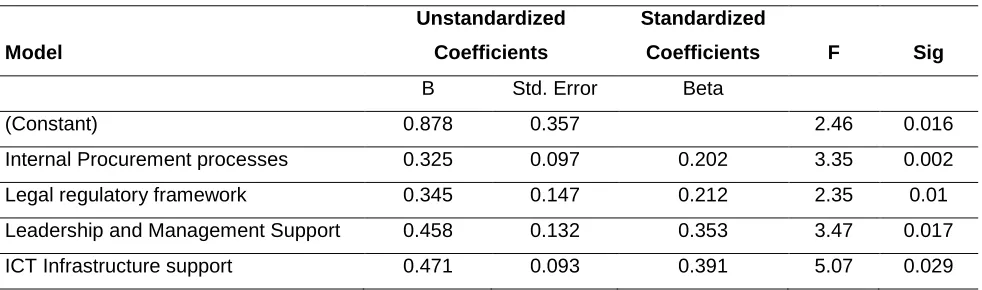
The ratings of the extent to which the four contract determinants influence performance were regressed against performance and the following results were obtained.
Table 1: Model Coefficients and Significance
Model
Unstandardized Coefficients
Standardized
Coefficients F Sig
B Std. Error Beta
(Constant) 0.878 0.357 2.46 0.016
Internal Procurement processes 0.325 0.097 0.202 3.35 0.002
Legal regulatory framework 0.345 0.147 0.212 2.35 0.01
Leadership and Management Support 0.458 0.132 0.353 3.47 0.017
ICT Infrastructure support 0.471 0.093 0.391 5.07 0.029
The study produced statistically significant results as shown in table 1 above. Therefore, the 4 contract determinants: Internal Procurement processes (sig. 0.002), Legal regulatory framework (sig. 0.01), Leadership and Management Support (sig. 0.017), and ICT Infrastructure support (sig. 0.029) were statistically significant and hence the four variables do influence organizational performance. The results are in line with findings of a research conducted by Wilson et al. (2015) which established that robust ICT infrastructure essential in bringing forth improved organizational performance particularly within the procurement department.
SUMMARY AND RECOMMENDATIONS
Licensed under Creative Common Page 448 performance. Also, the results show that leadership and management support towards procurement positively impact on organizational performance. The findings showed that a robust ICT infrastructure in procurement improves communication, enhances efficiency, enhances monitoring and control, makes work easier as well as improving service delivery. Thus we reject the null hypothesis and accept the alternative hypothesis that the procurement contract determinant does influence organizational performance. The study further recommends that county governments should adopt and bolster those attributes to attain efficiency, effectiveness and success by attaining better procurement function.
WAY FORWARD
The study findings showed that independent variables had significant effect on organizational performance. However further research areas of study should include the influence of internal and external integration on the relationship between the variables.
REFERENCES
Amayi, F. K. & Ngugi, G. K. (2013). ‘Determinants of public procurement performance in Kenya: Case Ministry of Environment, Water and Natural Resources’, International Journal of Social Sciences and Entrepreneurship, 1 (5), pp. 647-667.
Amemba, C.S., Nyaboke, P.G., Osoro, A. & Mburu, N. (2013). ‘Challenges affecting public procurement performance process in Kenya’, International Journal of Research in Management, 3(4), pp. 41-55. Awino, Z.B. & Marendi-Getuno, P.N. (2014). ‘Public procurement legal framework implementation challenges and organizational performance’, DBA Africa Management Review, 4(2) pp. 103-117.
Barngetuny, D.C. & Kimutai, G. (2010). ‘Effects of E-Procurement on Supply Chain Management Performance in Elgeyo-Marakwet Country’, IMPACT: International Journal of Research in Business Management, 3(11), pp. 43-56.
Chebichii, B.D., Sakwa, M., Biraori, O.E. & Wamalwa, W.R. (2014). ‘Effects of Internal Organization Communication Channels on Efficiency in the Procurement Function In Public Institutions in Kenya: Case of Kenya Seed Company’, International Journal of Recent Research in Commerce Economics and Management, 1(3), pp. 39-52.
Gravetter, F. & Forzano, L. (2015). Research Methods for the Behavioral Sciences. London: Cengage Learning.
Hanson, B.G. (2014).General Systems Theory -: Beginning with Wholes. New York: Taylor & Francis. Johnson, B. & Christensen, L. (2012).Educational Research: Quantitative, Qualitative, and Mixed Approaches London: Sage.
Koech S.K. & Namusonge S. G. (2015). ‘Factors affecting procurement performance of the national treasury in Kenya’, International Journal of Social Sciences Management and Entrepreneurship, 2(2), pp. 115-131.
Ku, C. (2009). Extending the Technology Acceptance Model Using Perceived User Resources in higher education web-based online learning courses. Ml: ProQuest.
Licensed under Creative Common Page 449 Lohr, S. L. (2010). Sampling: Design and analysis. Boston: Brooks.
McTaggart, J. M. T. E. (2012). Studies in the Hegelian dialectic. Cambridge: Cambridge Univ. Press. Mitchell, M.L. & Jolley, J.M. (2012).Research Design Explained. London: Cengage Learning.
Mose, J.M., Njihia, J.M. & Magutu, P.O. (2013). The critical success factors and challenges in e-procurement adoption among large scale manufacturing firms in Nairobi, Kenya’, European Scientific Journal, 9(13), pp. 375-401.
Namusonge, G.S. (2016). ‘Influence of information technology practices in procurement on organization performance in public institutions in Kenya: a case of Jomo Kenyatta University of agriculture and technology’, International Journal of Economics, Commerce and Management, 4(5), pp. 484-502.
Nyaboke, J. M., Arasa, R. & Ombui, K. (2013). ‘Effects of public procurement policies on organizational performance: A case of Water Services Regulatory Board’, International Journal of Social Sciences and Entrepreneurship,1 (5), pp. 89-103.
Oliver, P. (2010). The student's guide to research ethics. Berkshire: Open University Press.
Ordanini, A. & Rubera, G. (2008). ‘Strategic capabilities and internet resources in procurement A resource-based view of B-to-B buying process’, International Journal of Operations & Production Management, 28(1), pp. 27-52.
Siricha, P.S. & Theuri, F.S. (2016). ‘The Effects of Electronic Procurement on Organizational Performance In Kenya Ports Authority’, Imperial Journal of Interdisciplinary Research, 2(11), pp. 1761-1783.
Wachira, D.M., Muturi, P.N. & Sirma, J. (2014). ‘An Evaluation of the Perceived Effect of ICT’s on the Performance of Sacco’s in Kenya: Case of Licensed Sacco’s, Nairobi County’, Information and Knowledge Management, 4(12), pp. 14-32.