2083
Volume 65 213 Number 6, 2017
https://doi.org/10.11118/actaun201765062083
USING MULTIPLE CORRESPONDENCE
ANALYSIS TO EVALUATE SELECTED
ASPECTS OF BEHAVIOUR OF CONSUMERS
PURCHASING LOCAL FOOD PRODUCTS
Petra Šánová
1, Jitka Svobodová
2, Adriana Laputková
31 Department of Trade and Finance, Faculty of Economics and Management, Czech University of Life Sciences
Prague, Kamýcká 129, Prague 6 – Suchdol, Czech Republic
2 Department of Statistics, Faculty of Economics and Management, Czech University of Life Sciences Prague,
Kamýcká 129, Prague 6 – Suchdol, Czech Republic
3 Department of Languages, Faculty of Economics and Management, Czech University of Life Sciences Prague,
Kamýcká 129, Prague 6 – Suchdol, Czech Republic
Abstract
ŠÁNOVÁ PETRA, SVOBODOVÁ JITKA, LAPUTKOVÁ ADRIANA. 2017. Using Multiple Correspondence Analysis to Evaluate Selected Aspects of Behaviour of Consumers Purchasing Local Food Products. Acta Universitatis Agriculturae et Silviculturae Mendelianae Brunensis, 65(6): 2083 – 2093. The paper compares selected aspects of behaviour of consumers when purchasing local food products in the Czech Republic or food products labelled as local or regional using correspondence analysis vis‑à‑vis customer gender. Its purpose is to identify aspects which each group of the consumers (that is men vs. women) consider important when purchasing local food products. Information about the preferences of customers purchasing local food is important for marketing activities of retailers and producers. Data from 269 respondents have been processed in total according to gender and purchasing frequency. Correspondence analysis was used in order to evaluate consumer preferences and to identify their behaviour. MCA is an exploratory multivariate statistical analysis that allows investigation of several qualitative parameters. Appearance and information on the packaging, qualitative parameters (visually declared), anticipated health benefits and declared nutritional values were the focus of the research. This paper is significant in terms of using sign schemes, correlation and correspondence analysis, therefore the analysis demonstrates differences in these aspects between men’s and women’s behaviour when purchasing local food products inter alia, according to their purchasing frequency, which previous papers have not considered while using multivariate statistical methods.
Keywords: Local food, regional food, correspondence analysis, behaviour, gender, perceptual map, Czech Republic.
INTRODUCTION
“Local food” is a movement which aims to connect food producers and food consumers in the same geographic region in order to develop more self‑reliant and resilient food networks, improve local economies, or to have an impact on the health, environment, community, or society of a particular place (Feenstra, 2002). Ittersum et al. (2003) defines a regional product as the one the quality and/or renown of which can be connected with the region and whose marketing is based on the name of the region of its origin. Musil (2010) understands
A number of researchers have identified numerous aspects which influence a store choice of various consumers, for example the product quality, assortment, price, one‑stop purchase, speed and the quality of service as well as the atmosphere of their in‑store experience (Morschett et al., 2005) or importance of customers’ overall comfort in the purchasing process (Briesch, 2009). McEntee (2010) emphasises the aspects of food origin, since customers’ interest in local foods as an alternative to imported food products is on the increase. A carbon footprint or environmental taxes also influence consumers’ and producers’ behaviour (Smutka et al., 2015). Other authors have investigated differences in consumer behaviour according to age (Netopil et al., 2014), price and convenience (Zeithaml, V., 1988).
Czech consumers have also moved their demand to food products with higher added value; they place more emphasis on perceived quality, longer durability and special product characteristics (Turčínková and Stávková, 2009). Highlighting the local origin of food products can be their competitive advantage (Turčínková and Kalábová, 2011). Consumers’ interest in local foods results in greater popularity of farmers’ markets (Dodds, et al., 2014). Qualitative parameters are perceived by the consumer of local food products similarly to organic foods (Hempel and Hamm, 2016). Local food products appear fresher, more palatable, safer to consumers and reach better quality and safety than those produced on the opposite side of the world (Conner, et al., 2010; Roosen et al., 2003; Schupp and Gillespie, 2001). By preferring these products, the consumer supports local producers and domestic economy (Keeling‑Bond, et al., 2006). Local food attributes can connect with the consumer on multiple cognitive and emotional levels (Delind, 2006) and they influence the consumer’s willingness to pay for local products (Campbell et al, 2014).
Regional foods have become an interesting marketing article and the subject of research interest. Starzyczna et al. (2013) emphasises that understanding customer motivation and behaviour (when purchasing local food) is a prerequisite for lasting customer relationships. Selection of a store is also recognized as a cognitive process. The choice of retail mix elements is crucial for vendors (Milosavljevic et al., 2011). Some authors discuss specific brands of regional food products (for instance Chalupová et al., 2012), support of local economy (Writhgen, 2008) or a particular local product (D’amico, M., et al., 2014).
One of the methods used to investigate consumer behaviour is correspondence analysis (for example Nielsen, 1998; Ngapo, 2007, de Hooge et al., 2017). This paper compares selected aspects of consumer behaviour (men and women) when purchasing local food products in the Czech Republic or products labelled as local or regional using this analysis with regard to purchasing frequency. Its purpose is to identify aspects which this group of consumers (that is men vs. women) consider important when
purchasing local foods. The price is not included in the aspects since Finn and Louviere (1996) have ascertained that low price is crucial for 86 % of consumers in order to change their in‑store choice. The importance of price for Czech consumers, chiefly the older ones, has been confirmed for example by Netopil (2014). The aspects which can further be focused on by marketing are the subject of this paper. The research questions are as follows: (1) Are there statistically significant differences between perception and preferences in selected aspects between genders? The aspects include food appearance (packaging) and information on the packaging, declared qualitative parameters and, predominantly, declared nutritional values and anticipated health benefits. (2) Which aspects in making a purchase are preferred by men and which by women?
MATERIALS AND METHODS
Since there is no standard for what “local food” is, consumer research usually defines the term relatively narrowly as purchasing from farmers’ markets, purchasing groceries with a logo/label such as “Regionální potravina” (Regional Food), Klasa (national label for quality product), Český výrobek/Česká potravina (Czech product/Czech Food), Biozebra – biopotravina, (organic food with the logo authorised by the national inspection institute), protected geographical indication, protected designation of origin and traditional speciality guaranteed. Furthermore, these brands often receive state support. For instance, in order to support brands Klasa and “Regionální potravina” (Regional Food), the Ministry of Agriculture allocated more than 2.463 million CZK during 2008 and 2013. However, the effectiveness of these campaigns has not been monitored (SAO, 2016). According to CNA (2016), promotion of the Klasa brand only was put out to another tender for 298 million CZK. Purchasing regional/local foods might represent declaration of one’s sense of belonging, their support of local economy, employment etc. This is also manifested in the presentations and marketing campaigns run by the Ministry of Agriculture of the CR (MA, 2017). Identification of customer behaviour might enable better targeting of marketing activities for these brands.The gender aspect has recently started to be monitored as a part of consumer behaviour, predominantly where it might be influenced for example by ethical questions or social responsibility. (e.g. Bryant and Thompson, 2016; Jones et al., 2017; Kayal et al., 2017), which also includes declaration of origin, quality, production methods, use of ingredients in local foods. For this reason, the gender aspect has been considered in this study as well.
and February 2016. The respondents were selected based on their active participation in purchasing food, purchasing local food products and age between 20 and 50. No other socio‑economic characteristics have been considered. The research primarily focuses on the influence of the purchacing frequency on consumer behaviour in the field of local food. As Hye‑Jung Park et al. (2008) state, purchasing frequency is the most influential factor in shopping, followed by conformity, age, consumer ethnocentrism, social recognition, and pocket money, respectively. In total, 269 respondents have been evaluated according to their gender and purchasing frequency. The variable gender is the main factor in the observation since women are more willing to pay a higher price for local food (Darby et al., 2006). Appearance and information on the packaging, qualitative parameters (visually declared), anticipated health benefits and declared nutritional values have been the focus of the research.
Two random variables X and Y with two values only: 0 and 1 have been considered. When these are considered, tables 2x2 were obtained, including frequencies a, b, c, d with one degree of freedom, and then a simplified formula was used to calculate the chi‑square statistic:
(
)
(
)
(
)
(
) (
)
2
2 n ad bc
a b a c b d c d
χ = −
+ ⋅ + ⋅ + ⋅ + (1)
The table must be sufficiently occupied in order for the chi‑square test to be valid. Therefore, the following two criteria are considered: a + b ≈ c + d > 5 or a + b > 5, c + d > (a + + c)/3. Provided the occupancy of the table cells is lower, Fisher’s test is used instead of the chi‑square test (Hendl, 2012). The Phi‑coefficient can be used when a 2×2 contingency table can be created based on the available data. Should variables with more than two categories appear, a measure of association called Cramer’s V can be used. The correlation coefficient Phi 0.1–0.29 is regarded as low to medium correlation, 0.3–0.49 is regarded as medium to strong, 0.5–0.69 as strong to very strong, and 0.7–0.99 very strong to perfect for categorical
variables (Mareš et al., 2015). A sign scheme was calculated for the correlations in which some intensity of correlation has been verified, where the symbol “o” represents no difference between the measured count and the expected count, “+” the measured count is higher than the expected count of measurement, “‑” the measured count is lower than the expected count of measurement, one sign at the 95 % significance level, two signs at 99 % and three at the 99.9 % level of significance.
Correspondence analysis is an exploratory technique used to illustrate relations in a two‑dimensional contingency table of frequencies in a way that suitably derives two dimensions that represent row and column table categories. Its use thus enables explanation of the chi‑square value, and the independence test statistic in the contingency table. A correspondence map illustrates and helps to interpret the relations and variability in the correspondence table (Hair et al., 2010; Hendl, 2012).
The technique is used prevalently within the ambit of explorative‑descriptive analyses (DiFranco, 2015).
Detection of dependence was processed using IBM SPSS Statistics 24. The MCA ordination results and the corresponding relationships were generated and then interpreted along with the two dimensional biplot diagram. A biplot of objects and variables can be used to visualise similarities and differences among the conceptual profiles. (Jaeger and MacFie, 2010). Correlations of variables in a biplot are related to the angles between the vectors. The distances between the points correspond to the similarities between the profiles of observations. These correlations between variables are detected by the angle of their vectors, and the similarity of the observations profiles is depicted by the closeness of their points (Williams, 1998).
RESULTS AND DISCUSSION
The survey has been conducted on 269 respondents from the Czech Republic aged between 20 and 50 who stated that they purchased
I: Frequency – combination of gender and purchasing frequency
Frequency Percentage Cumulative
Percentage
man-fortnightly or less 2 0.7 0.7
man-once a week 18 6.7 7.4
man-several times a week 69 25.7 33.1
man-daily 31 11.5 44.6
woman-fortnightly or less frequently 3 1.1 45.7
woman-once a week 21 7.8 53.5
woman-several times a week 91 33.8 87.4
woman-daily 34 12.6 100.0
Total 269 100.0
local food, 149 women and 120 men. Secondary education (39 %) and higher education (22 %) predominated. The average age of respondents is 38. 63 % of the respondents are from Prague and the Central Bohemian Region and 37 % from other regions. Since the questions were interconnected and some of them were only complementary or explanatory, the following text contains interpretation of the most important responses as well as information related to the research questions.
Tab. I illustrates the distribution of the respondents according to their gender and purchasing frequency. Consumers purchasing several times a week (that is 2–3× a week) occur most frequently and, by contrast, those purchasing once a week or fortnightly and less frequently are represented marginally. Women purchasing once a week represent the median category based on cumulative frequency (53.5 %).
In addition, the following relations between variables have been tested which can demonstrate the differences between purchasing behaviour and preferences of men and women who purchase local foods. Appearance and primary information on the packaging are some of the monitored aspects in purchasing. The packaging attracts attention and is an important instrument for marketing. Foret (2006) states that although no dependence between the customer’s income and influence of packaging has been confirmed in his research, some impact of the packaging on the selection of food has been mentioned by 55 % of the respondents. Information on the packaging is defined (and restricted) mainly by Act about foodstuffs no. 110/1997 Coll., on the amendment and supplementation of some related acts.
On the other hand, according to the study for the EU (Ipsos – London Economics EAHC, 2013) the Czech Republic together with France, Portugal and Italy occupies the third place of ranking according to the number of labelling schemes (following Spain and Germany). This might be an advantage for consumers’ interest in particular information although, on the contrary, this might cause consumers’ lack of interest in this information
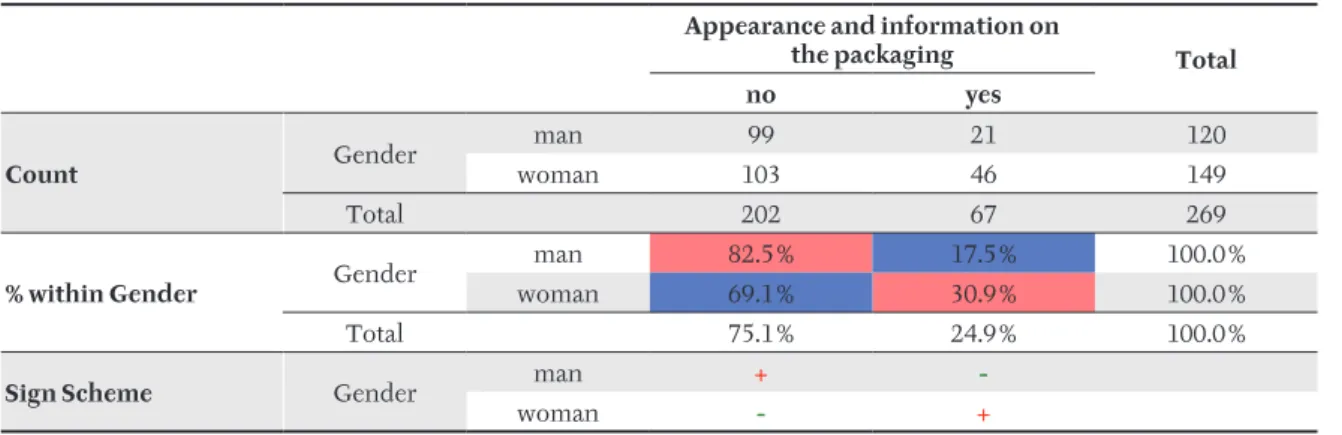
if it is is not fully understood. It might be anticipated that consumers of local food are aware of these schemes and the need for information as well as the attractiveness of the packaging will be the aspects which is important for purchasing food and can be used by marketing. The input data were thus transferred to the crosstab in Tab. II.
The results indicate that appearance and information on the packaging are less important aspects to this group of respondents. Concurrently, higher proportion of men (82.5 %) does not consider the appearance of packaging and information stated on the product important. On the contrary, women (69.1 %) consider this aspect more important. The results are also confirmed by the sign scheme which indicates that there is a higher frequency than expected with men who disregard appearance, and regarding information on the packaging with women who consider appearance and information on the packaging.
According to the chi‑square test at the significance level 5 % it has been ascertained that there is a statistically significant correlation between gender and appearance and information on the packaging (p‑value = 0.012). The coefficient of association Phi 0.154 represents low to medium degree of dependence.
Regarding women who purchase local food products, the aspects of appearance and information on the packaging are partially exploitable by marketing. The question is which group of female respondents consider this information important.
Subsequently, the relationship between gender, purchasing frequency and the aspects of appearance and information on the packaging are illustrated using correspondence analysis in the two dimensional biplot diagram (see Fig. 1).
This statement implies that appearance and information on the packaging is important predominantly to women who make their purchases daily, however, it is completely unimportant to women who make their purchase once a week. Women who make their purchase several times a week consider this aspects as rather unimportant.
II: Crosstab for gender and appearance and information on the packaging
Appearance and information on
the packaging Total
no yes
Count Gender
man 99 21 120 woman 103 46 149
Total 202 67 269
% within Gender Gender
man 82.5 % 17.5 % 100.0 % woman 69.1 % 30.9 % 100.0 % Total 75.1 % 24.9 % 100.0 %
Sign Scheme Gender man +
-woman - +
Nevertheless, some hesitation is evident here which might create potential space for marketing activities.
Quality is a major criterion and the most important parameter to consumers in food retailing according to research by Xiaojun (2012). Qualitative parameters which are clearly declared on the product are additional aspects which might be perceived by the consumer. This does not concern flavour, smell or colouring, but attributes declared in writing (for instance, the content of meat in meat products, the content of proteins, the content of
cocoa mass, absence of additives and other aspects). The quality might also be represented by a logo which guarantees its standard (for example, organic food, Klasa, regional food).
It might thus be assumed that these parameters are important to consumers of local food products when they are selecting them. The Tab. III again illustrates distribution of men and women with regard to importance of these qualitative parameters to them.
1: Two dimensional biplot for the relationship of appearance and information on the packaging vis-à-vis gender and food purchasing frequency combination group.
Sources: own research (2016)
III: Crosstab for gender and qualitative parameters
Appearance and information on
the packaging Total
no yes
Count Gender
man 101 19 120 woman 108 41 149
Total 209 60 269
% within Gender Gender
man 84.2 % 15.8 % 100.0 % woman 72.5 % 27.5 % 100.0 % Total 77.7 % 22.3 % 100.0 %
Sign Scheme Gender man +
-woman - +
It is rather surprising that the majority of the respondents stated that visually declared qualitative parameters are not important to them. Again, qualitative parameters are regarded as unimportant by men (84.2 %) than women (72.5 %). The sign scheme suggests that the measured frequency is higher than expected with men who disregard qualitative parameters and with women who consider qualitative parameters.This corresponds with the findings that men tend to be less interested in nutritional values and healthy nutrition (Shupp et al., 2001).
According to the chi‑square test at the importance level of 5 % it has been ascertained that there is a statistically significant difference between gender and visually declared qualitative parameters (p‑value = 0.022). The coefficient of association Phi is 0.140. This represents low to medium degree of dependence.
Subsequently, the relationship between gender, purchasing frequency and visually declared qualitative parameters is illustrated using correspondence analysis in a two‑dimensional biplot (see Fig. 2).
Qualitative parameters are definitely important to women who make their purchase daily and rather important to men who make their purchase
daily. Women’s and men’s purchasing frequency once a week or several times a week deviates to the statement “rather not” and “certainly not”. Consumers who make their purchase every fortnight remain completely differentiated. Purchasing frequency “daily” might suggest consumers (women) who prefer freshness, which is one of the qualitative attributes and for this reason they might be interested in monitoring other qualitative parameters.
Further investigation was conducted at the level of a gender relationship and the anticipated health benefits which has demonstrated similar findings at a percentage level, although without any further important connections. 68.4 % of the respondents in total have stated that they do not monitor the aspects when making their purchase, or that they do not attribute greater importance to them. According to the chi‑square test at the significance level of 5 % it has been ascertained that there is no statistically significant relationship between gender and anticipated health benefits (p‑value = 0.613).
Based on the results of correspondence analysis, anticipated health benefits are monitored mainly by women who make a purchase several times a week and partially by women who make their purchase daily. Men purchasing once or several times a week
2: Two dimensional biplot for the relationship of visually declared qualitative parameters vis-à-vis gender and food purchasing frequency combination group
consider this information important only partially. In contrast, men who make their purchase daily or every fortnight consider this aspect completely uninteresting. From a marketing viewpoint, this aspect could appeal to consumers who are interested in healthy lifestyle and who adjust their purchases accordingly. Local food products can, under some circumstances, show characteristics of “foods beneficial to health”, nevertheless, consumers of local food do not monitor this attribute primarily.
Declared nutritional value is specific information on the packaging which becomes involved in anticipated health aspects of purchased food. Based on the previous results, disinterest was anticipated from consumers in this parameter. Greater disinterest from men (50 % in real) was anticipated than from women (25.5 % in real). The findings have been processed to create a crosstab (see Tab. IV).
The results suggest that predominantly men are interested in declared nutritional values. 50 % of male respondents consider this aspect important
IV: Crosstab for gender and declared nutritional value
Appearance and information on
the packaging Total
no yes
Count Gender
man 60 60 120 woman 111 38 149
Total 171 98 269
% within Gender Gender
man 50.0 % 50.0 % 100.0 % woman 74.5 % 25.5 % 100.0 % Total 63.6 % 36.4 % 100.0 %
Sign Scheme Gender man --- +++
woman +++
---Source: own research (2016)
3: Two dimensional biplot for the relationship of visually declared nutritional values vis-à-vis gender and food purchasing frequency combination group
when they are selecting food. On the contrary, 74.5 % of women stated that they are not interested in this aspect or that it is not important when making a decision about purchasing food. The sign scheme implies that the measured frequency is higher than expected with men who consider declared nutritional values and with women who disregard them. This contradicts the findings of a number of authors (for example Nayga et al., 1998, Kim et al., 2001, Annunziata, 2016) who state that considering individual characteristics, several works converge on the conclusion that women are generally more interested in nutritional and health information than men.
According to the chi‑square test at the significance level 5 % it has been ascertained that there is a statistically significant relationship between gender and declared nutritional values (p‑value = 0.000). The coefficient of association Phi shows negative correlation (Phi = −0.253). The degree of dependence is low to medium.
Processing data using correspondence analysis (see Fig. 3) leads to the findings that declared nutritional values are rather important to men who make their purchase daily and probably for men making their purchase fortnightly and to men who make their purchase once a week. By contrast, men who make their purchase several times a week have marked this aspects definitely unimportant.
The final investigated aspect was current promotions (leaflets, advertising spots). 80.8 % out of the total number of men stated that this aspect is unimportant when they make their purchase, this was equally stated by 75.2 % of women. According to the chi‑square test at the significance level of 5 % it has been ascertained that there is no statistically significant relationship between gender and current promotions (leaflets, advertising spots) (p‑value=0.267). Correspondence analysis has not confirmed any interesting correlation between
gender, purchasing frequencies and the given aspects. Had the respondents’ experience with the product and their recommendations on it been included in the aspects, then based on the conducted correspondence analysis this aspects would be important predominantly for women who make their purchase several times a week, and women making their purchase daily and men making their purchase once a week. However, the relationship is not statistically significant.
In a number of cases, the conducted survey demonstrates different consumer behaviour of men and women when purchasing local/regional foods with regard to purchasing frequency. This aspect appears to be constant in time (see Darby et al., 2006).
Women who make their purchase daily should thus be the target group for marketing activities connected with these products. Purchasing frequency might demonstrate that they represent predominant food shoppers. This aspect has also been highlighted by Zepeda and Li (2006).
The qualitative aspect tends to be perceived by the consumer through information on the packaging. This might be declared by stating the origin, by brand, logo, composition or nutritional values. It has been ascertained again that in the Czech Republic it is women who make their purchase daily that react well to the quality. This is in contrast to, for example, Slovakia. According to Horská et al. (2011), the symbol of quality reaches rather low perception values by the Slovaks. A significant number of consumers do not recognize the food name with the symbol on the packaging. On the other hand, packaging with the quality symbol influences Polish consumers very positively. Also, Hempel and Hamm (2016) say, that quality aspect “local” complements “organic” in purchase decisions of organic‑minded consumers in Germany.
CONCLUSION
Consumer behaviour is differentiated in a number of aspects depending on the type of the product, external and internal environment, income, education, gender, and other elements. This paper investigates aspects which a particular group of consumers considers important when purchasing local food products, namely differences in preferences between men and women with respect to frequency of their purchases.
of aspects which the consumer can focus on when making a purchase is broad and these aspects will be the subject of further research.
Acknowledgements
This paper was supported by Internal Grant Agency of the Faculty of Economics and Management, Czech University of Life Sciences [nr. 20171015 – Consumer behavior and motivation in buying local food in the Czech Republic].
REFERENCES
ANNUNZIATA, A., POMARICI, E., VECCHIO, R. and MARIANI, A. 2016. Nutritional information and health warnings on wine labels: Exploring consumer interest and preferences. Appetite, 106: 58 – 69. BRIESCH, R., CHINTAGUNTA, P. and FOX, E. 2009 How does assortment affect grocery store choice? Journal
of Marketing research, 46(2): 176 – 189.
BRYANT, M. M. and THOMPSON, S. A. 2016. Ratings, Reviews, and Revenues: Do Gender Signals Play a Role in Influencing Consumer Behavior and Shop Performance on Social Commerce Sites? An Examination Using Etsy. Com. In: 2016 SMA Proceedings, pp. 450 – 459.
CAMPBELL, J., DiPIETRO, R. B., and REMAR, D. 2014. Local foods in a university setting: Price consciousness, product involvement, price/quality inference and consumer’s willingness‑to‑pay. International Journal of Hospitality Management, 42: 39 – 49.
CHALUPOVÁ, M., ROJÍK, S. and PROKOP, M. 2012. Znalost regionálních značek potravin v Kraji Vysočina.
Trendy v podnikání, 2(3): 70 – 81.
CONGRESS OF THE UNITED STATES OF AMERICA. 2008. An Act To provide for the continuation of agricultural programs through fiscal year 2008 and for other purposes. [Online]. Available at: https://www.gpo.gov/fdsys/pkg/ BILLS‑110hr2419enr/pdf/BILLS‑110hr2419enr.pdf [Accessed: 2016, September 12].
CONNER, D., COLASANTI, K., ROSS, B. R. and SMALLEY, S. B. 2010. Locally grown foods and farmers markets: consumer attitudes and behaviours. Sustainability, 2(3): 742 – 756.
CZECH NEWS AGENCY. 2016. Tender for 298 millions to promote Klasa won by four agencies.
Marketing&Media. [Online]. Available at: https://mam.ihned.cz/marketing/c1‑65231240‑tendr‑za‑298‑ milionu‑na‑propagaci‑klasy‑vyhraly‑ctyri‑agentury [Accessed: 2016, April 1].
D’AMICO, M., DI VITA, G., CHINNICI, G., PAPPALARDO, G., and PECORINO, B. 2014. Short food supply chain and locally produced wines: Factors affecting consumer behavior. Italian Journal of Food Science, 26(3): 329 – 334.
DARBY, K. et al. 2006. Willingness to pay for locally produced foods: A customer intercept study of direct market and grocery store shoppers. Selected Paper prepared for presentation at the American Agricultural Economics Association Annual Meeting, Long Beach, California.
DE HOOGE, I. E., OOSTINDJER, M., ASCHEMANN‑WITZEL, J., NORMANN, A., LOOSE, S. M. and ALMLI, V. L. 2017. This apple is too ugly for me!: Consumer preferences for suboptimal food products in the supermarket and at home. Food Quality and Preference, 56, 80 – 92.
DELIND, L. 2006. Of bodies, place, and culture: re‑situating local food. J. Agric. Environ. Ethics, 19(2): 121–146. DI FRANCO, G. 2016. Multiple correspondence analysis: one only or several techniques? Quality & Quantity,
50(3), 1299 – 1315.
DODDS, R., HOLMES, R., ARUNSIPHA, M, CHIN, V., LE, N., MAUNG, T., and SHUM, M. 2014. Consumer choice and farmers’ markets. Journal of agricultural and environmental ethics, 27(3): 397 – 416.
DRICHOUTIS, A.C., LAZARIDIS, P., NAYGA R.M., KAPSOKEFALOU M. and CHRYSSOCHOIDIS, G. 2008. A theoretical and empirical investigation of nutritional label use. The European Journal of Health Economics, 9(3): 293–304
FEENSRA, G. 2002. Creating space for sustainable food systems: lessons from the field. Agriculture and Human Values, 19(2): 99 – 106.
FINN, A. and LOUVIERE, J. J. 1996. Shopping center image, consideration, and choice: anchor store contribution. Journal of business research, 35(3): 241 – 251.
FORET, M. 2006. The households purchase behavior and visitors shopping – amusing centre Olympia. Acta univ. agric. et silvic. Mendel. Brun., 54(6): 47–56
HAIR, J. F., BLACK, W. C., BABIN, B. and ANDERSON, R. 2010. Multivariate data analysis. 7th Edition. Upper
Saddle River, NJ: Prentice‑Hall.
HEMPEL, C. and HAMM, U. 2016. How important is local food to organic‑minded consumers? Appetite, 96(1): 309 – 318.
HENDL, J. 2012. Přehled statistických metod: analýza a metaanalýza dat. 4th Edition. Praha: Portál.
PARK, H‑J., RABOLT, N. J., JEON, K. S. 2008. Purchasing global luxury brands among young Korean consumers. Journal of Fashion Marketing and Management: An International Journal, 12(2): 244 – 259.
IPSOS and LONDON ECONOMICS CONSORTIUM. 2013. Consumer market Study on the functioning of voluntary food labeling schemes for consumers in the European Union EAHC/ FWC/2012 86 04. European Union. Available at: http://ec.europa.eu/consumers/consumer_evidence/market_studies/food_labelling/docs/ final_report_food_labelling_scheme_full_en.pdf [Accessed: 2016, September 12].
ITTERSUM VAN, K., CANDEL, M. J. and MEULENBERG, M. T. G. 2003. The Influence of the Image of a Product‘s Region of Origin on Product Evaluation. Journal of Business Research, 56(3): 215 – 226.
JONES, R. J., REILLY, T. M., COX, M. Z. and COLE, B. M. 2017. Gender makes a difference: Investigating consumer purchasing behavior and attitudes toward corporate social responsibility policies. Corporate Social Responsibility and Environmental Management, 24(2): 133 – 144.
KAYAL, G. G., SIMINTIRAS, A. C. and RANA, N. P. 2017. Investigating gender differences in consumers’ experience of guilt: A comparative study. Journal of Retailing and Consumer Services, 39: 71 – 78.
KEELING‑BOND, J., THILMANY, D. and BOND, C. A. 2006. Direct marketing of fresh produce: understanding consumer purchasing decisions. Choices, 21(4): 229 – 235.
KIM, S.Y., NAYGA JR. R. M. and CAPPS JR., O. 2001. Food label use, self‑selectivity, and diet quality.
The Journal of Consumer Affairs, 35(2): 346–363
LOBB, A. E., ARNOULT, M. H., CHAMBERS, S. and TIFFIN, R. 2006. Willingness to Pay for, and Consumers’
Attitudes to, Local, National and Imported Foods: A UK Survey. Unpublished Working Paper of the Department for Agricultural and Food Economics, University of Reading.
MINISTRY OF AGRICULTURE. 2017. We promote healthy, quality domestic food. eAgri. [Online]. Available at: http://eagri.cz/public/web/en/mze/food/ [Accessed: 1 April 2016].
MAREŠ, P., RABUŠIČ, L. and SOUKUP, P. 2015. Analýza sociálně vědních dat (nejen) v SPSS. Brno: Masarykova univerzita.
MARSDEN, T. and SMITH, E. 2005. Ecological Entrepreneurship: Sustainable Development in Local Communities Through Quality Food Production and Local Branding. Geoforum, 36(4): 440 – 451.
MARTINEZ, S. 2010. Local Food Systems: Concepts, Impacts, and Issues. Economic Research. Report Number 97. USDA, Economic Research Service.
MCENTEE, J. 2010. Contemporary and Traditional Localism: Conceptualisation of Rural Local Food. Local Environment, 15(9): 785 – 803.
MILOSAVLJEVIC, M., KOCH, CH. and RANGEL, A. 2011. Consumers can make decisions in as a little as a third of a second. Judgment and Decision making, 6(6): 520 – 530.
MORSCHETT, D., SWOBODA, B. and SCHRAMM‑KLEIN, H. 2005. Perception of store attributes and overall attitude towards grocery retailers: The role of shopping motives. The international review of Retail, Distribution and Consumer Research, 15(4): 423–447.
MUSIL, J. 2010. Regional food [in Czech: Regionální potravina]. Zemedelec.cz. [Online]. Available at: http:// zemedelec.cz /regionalni‑potravina/ [Accessed: 3 November 2016].
NAYGA JR., R. M., LIPINSKI, D. and SAVUR, N. 1998. Consumers’ use of nutritional labels while food shopping and at home. The Journal of Consumer Affairs, 3(21): 106–120.
NETOPIL, T., ANTOŠOVÁ, V. and TURČÍNKOVÁ, J. 2014. Retirees: How do they Choose their Grocery Store? How do They Shop? Procedia Economics and Finance, 12: 480 – 488.
NGAPO, T. M., MARTIN, J. F. and DRANSFIELD, E. 2007. International preferences for pork appearance: I. Consumer choices. Food Quality and Preference, 18(1): 26 – 36.
NIELSEN, N. A., BECH‑LARSEN, T. and GRUNERT, K. G. 1998. Consumer purchase motives and product perceptions: a laddering study on vegetable oil in three countries. Food Quality and Preference, 9(6): 455 – 466. SUPREME AUDIT OFFICE. 2014. Financial resources expended on the services aiming to support agricultural products and foods on domestic market. Information from SAO audit no. 13/36. [Online]. Available at: https://www.nku. cz/assets/media/informace‑13‑36.pdf [Accessed: 2016, June 20].
ROOSEN, J., LUSK, J. L. and FOX, J. A. 2003. Consumer Demand for and Attitudes toward Alternative Beef Labeling Strategies in France, Germany, and the UK. Agribusiness, 19(1): 77 – 99.
ROOSEVELT, M. 2006. The Lure of the 100‑Mile Diet. Time. [Online]. Available at: http://content.time.com/ time/magazine/article/0,9171,1200783,00.html [Accessed: 2006, June 11].
JAEGER, S. R. and MACFIE, H. (Eds.). 2010. Consumer-driven innovation in food and personal care products. Elsevier. SCHUPP, A. and GILLESPIE, J. 2001. Consumer Attitudes toward Potential Country‑of‑Origin Labeling
Fresh or Frozen Beef. Journal of Food Distribution Research, 32(3): 34 – 44.
SMUTKA, L., BENESOVA, I. and TOMSIK, K. 2015. European Sugar Market – Quo Vadis? in: 18th International Conference on Enterprise and the Competitive Environment Location. Univ Mendel, Fac Business Econom, Brno, MAR 05 – 06, 2015.
STARZYCZNÁ, H., STOKLASA, M. and SÝKOROVÁ, P. 2013. Behaviour of Czech customers when buying food products. Acta Universitatis Agriculturae et Silviculturae Mendelianae Brunensis, 61(7): 2801–2810.
TURČÍNKOVÁ, J. and KALÁBOVÁ, J. 2011. Preference regionálních potravinářských produktů v České republice a na Slovensku. In: PETRANOVÁ, D. and ČÁBYOVÁ, Ľ. (Eds.). Špecifiká regionálneho a neziskového marketingu. Trnava: Fakulta masmediálnej komunikácie, Univerzita sv. Cyrila a Metoda v Trnavě, pp. 206 – 209.
TURČÍNKOVÁ, J. and STÁVKOVÁ, J. 2009. Changes in consumer behavior on the market with food. Acta univ. agric. Et silvic. Mendel. Brun., 57(3): 173–178.
JACOBY, W. G. 1998. Statistical Graphics for Visualizing Multivariate Data. Thousand Oaks, CA: Sage.
XIAOJUN, W. and DONG, L. 2012. A dynamic product quality evaluation based pricing model for perishable food supply chains. Omega, (40): 906 – 917.
ZEITHAML, V. 1988. Consumer perception of price, quality and value: A means‑end model and synthesis of evidence. Journal of marketing, 52(3), 2 – 22.
ZEPEDA, L. and LI, J. 2006. Who buys local food? Journal of Food Distribution Research, 37(3): 1 – 11.
Contact information Petra Šánová: [email protected]