Modeling and Detecting Gravitational Waves
from Compact Stellar Objects
Thesis by
Michele Vallisneri
In Partial Fulfillment of the Requirements
for the Degree of
Doctor of Philosophy
California Institute of Technology
Pasadena, California
2002
c
2002
Michele Vallisneri
Acknowledgements
As I sit down to write these acknowledgments, I realize what a happy journey the last four years
have been, how many special and talented people I have met here at Caltech, and how many equally
special people have supported me from afar. I am so lucky!
So, first of all, I wish to thank Kip Thorne, who has been everything that an advisor can be,
and more. I hope I can live up to his enthusiastic and painstaking efforts to teach me, mostly by
example, how to be a good scientist, how to do sound, thorough and timely research, how to live in
the scientific community, and how to write clear English prose.
Kip is first, but during these years I have had other wonderful teachers. I thank Lee Lindblom
for our daily chats: I never came away from them without learning something new. I thank Joel
Tohline for introducing me to the wonderful world of numerical simulations, and for being a perfect
host on my visit to Baton Rouge. I thank Massimo Pauri for his unfailing support of my American
adventure, and for revealing to me the charm and surprise of spacetime physics. Of the other Caltech
faculty that I had the good luck of interacting with, I wish to thank in particular Tom Prince, Ken
Libbrecht, Marc Kamionkowski, Roger Blandford, and Sterl Phinney.
Alessandra Buonanno was a precious collaborator and a valued friend. I am thankful to her, and
to Yanbei Chen, for the tremendous nonstop effort they put into the final rush to finish Chap. 4 of
this thesis. As one point, I would work in the morning, Alessandra would elaborate on my output
during the afternoon, and make lists of things for Yanbei to do at night. At Caltech research can
truly be a 24/7 endeavor!
For support, inspiration, friendship and useful discussions (in any combination), I thank also
C. Alabiso, B. Allen, L. Bildsten, L. Blanchet, L. Burko, M. Casartelli, D. Chernoff, G. M. Cicuta,
R. Co¨ısson, J. Creighton, C. Cutler, E. D’Ambrosio, T. Damour, R. De Pietri, J. Frank, J.
Fried-man, S. Gon¸calves, G. Gonzalez, V. Kalogera, D. Kennefick, A. Lazzarini, L. Lehner, Yu. Levin,
G. Mambriani, J. Mason, D. Meier, E. Onofri, M. Ortaggio, B. Owen, F. Piazza, R. Price, J. Pullin,
C. Rovelli, B. Sathyaprakash, M. Scheel, A. Scotti, N. Stergioulas, K. Strain, L. Superchi, M. Tinto,
G. Ushomirsky, A. Vicer`e, and everybody else that I forget about now.
For kindling my love of the English language, and for helping me conceive and realize the dream
I wish to thank also all the fellow Tapirs of the last four years, and in particular the other Kiplings,
Kashif Alvi (a true friend if there is one), Mihai Bondarescu, Teviet Creighton, Scott Hughes, Patricia
Purdue, Yuk Tung Liu, and Richard O’Shaughnessy. We have shared many scientific discussions
and many nonscientific ones. I loved both kinds.
For making my life in California much happier and fuller that it could have been otherwise, I
thank all the wonderful friends I met here, and in particular my trio of pals, Alexei, Ed and Jason;
and then Tina, Andrew, Rob, Bill (especially Bill!), and all the Phys. Rev. Netters. My roommate
Mika was a lot of fun to live with, and an inexhaustible resource on literally any computing machine
ever made or conceived.
Chris Mach was a friend and a teacher; he taught me system administration and he fed me
garlic breadsticks with Alfredo sauce. What more can you ask? Shirley Hampton, Donna Driscoll
and Jo-Ann Hasbach always joined their utmost professionality with the warmest welcoming smile.
Jo-Ann Ruffolo’s advice was perhaps the strongest element in my favor during my job search; and
her kindness andjoie de vivre were always refreshing in the middle of that otherwise anxiety-ridden
process.
My thanks a my love go to my family, back in Italy (Dad, Mom, Cecilia, my aunts Alberta and
Maria, my mother-in-law Vittoria and brother-in-law Francesco) and here in the States (Ted and
Mada). Finally, thanks to my best men, faithful friends, and fellow travelers through life, Kola and
Filippo. All that is gold does not glitter, not all those who wander are lost.
Last but most important of all, I thank my love, Elisa, for being always on my side, for marrying
me, and for making my life happier every day. It is possible that this thesis might have been
completed even without her—but it would have been a joyless and somber exercise.
Now for the institutional acknowledgments: I thank CACR for access to the HP V2500 computers
at Caltech, where the primary simulations featured in Chap. 3 were performed; Mark Bartelt in
particular was always very helpful. Through the years, this research was supported by NSF grants
AST-9731698, AST-9987344, PHY-9796079, PHY-9900776, PHY-9907949, and PHY-0099568, and
by NASA grants NAG5-4093 and NAG5-8497, and NAG5-10707. I thank also Caltech for awarding
me a Special Institute Fellowship during my first year of graduate school, and the PMA Division for
Abstract
In the next few years, the first detections of gravity-wave signals using Earth-based
interferomet-ric detectors will begin to provide precious new information about the structure, dynamics, and
evolution of compact bodies, such as neutron stars and black holes, both isolated and in binary
systems. The intrinsic weakness of gravity-wave signals requires a proactive approach to modeling
the prospective sources and anticipating the shape of the signals that we seek to detect. Full-blown
3-D numerical simulations of the sources are playing and will play an important role in planning
the gravity-wave data-analysis effort. This thesis explores the interplay between numerical source
modeling and data analysis, looking closely at three case studies.
1. I evaluate the prospects for extracting equation-of-state information from neutron-star tidal
disruption in neutron-star–black-hole binaries with LIGO-II, and I estimate that the
obser-vation of disrupting systems at distances that yield about one event per year should allow
the determination of the neutron-star radius to about 15%, which compares favorably to the
currently available electromagnetic determinations.
2. In collaboration with Lee Lindblom and Joel Tohline, I perform numerical simulations of the
nonlinear dynamics of the r-mode instability in young, rapidly spinning neutron stars, and I
find evidence that nonlinear couplings to other modes will not pose a significant limitation to
the growth of ther-mode amplitude.
3. In collaboration with Alessandra Buonanno and Yanbei Chen, I study the problem of detecting
gravity waves from solar-mass black-hole–black-hole binaries with LIGO-I, and I construct two
families ofdetectiontemplates that address the inadequacy of standard post-Newtonian theory
Contents
Acknowledgements iii
Abstract v
1 Introduction 1
1.1 Gravitational waves as a probe into the structure and dynamics of neutron stars . . 2
1.1.1 Neutron stars as GW sources . . . 2
1.1.2 Neutron-star tidal disruption as a probe into the equation of state of dense nuclear matter . . . 3
1.1.3 Gravity waves from ther-mode instability of nascent neutron stars . . . 10
1.2 Gravitational waves from coalescing binaries of compact stellar objects . . . 14
1.2.1 The statistics of coalescing binaries . . . 15
1.2.2 Detecting BH–BH binaries with LIGO-I . . . 16
1.2.3 Detection templates for BH–BH binaries . . . 18
1.3 Bibliography . . . 19
2 Prospects for gravitational-wave observations of neutron-star tidal disruption in neutron-star–black-hole binaries 23 2.1 Introduction . . . 23
2.2 Neutron-star model . . . 24
2.3 Parameter estimation . . . 26
2.4 Conclusion . . . 28
2.5 Bibliography . . . 29
3 Numerical evolutions of nonlinear r-modes in neutron stars 32 3.1 Introduction . . . 32
3.2 Basic hydrodynamics . . . 34
3.3 Radiation-reaction force . . . 36
3.5 Evaluating the saturation amplitude . . . 41
3.5.1 Evolution of ther-mode amplitude . . . 43
3.5.2 A mechanism forr-mode saturation . . . 43
3.5.3 Radial structure of ther-mode amplitude . . . 45
3.5.4 Evolution of ther-mode frequency . . . 46
3.5.5 Growth of differential rotation . . . 48
3.5.6 Consistency of the radiation-reaction force . . . 50
3.5.7 Density oscillations and mode saturation . . . 51
3.5.8 Limits on mode–mode coupling . . . 52
3.5.9 Dependence on the grid spacing . . . 55
3.6 Testing the saturation amplitude . . . 56
3.7 Free evolution . . . 58
3.8 Repeated spindown episodes? . . . 61
3.9 Conclusions . . . 65
3.10 Appendix. Useful expressions in cylindrical coordinates . . . 66
3.11 Bibliography . . . 67
4 Detection template families for gravitational waves from the final stages of binary– black-hole inspirals 69 4.1 Introduction . . . 69
4.2 The theory of matched-filtering signal detection . . . 73
4.2.1 The statistical theory of signal detection . . . 73
4.2.2 Template families and extrinsic parameters . . . 76
4.2.3 Imperfect detection and discrete families of templates . . . 80
4.2.4 Approximations for detector noise spectrum and gravitational-wave signal . . 83
4.3 Adiabatic models . . . 84
4.3.1 Adiabatic PN expanded models . . . 84
4.3.2 Adiabatic PN resummed methods: Pad´e approximants . . . 89
4.4 Nonadiabatic models . . . 95
4.4.1 Nonadiabatic PN expanded methods: Hamiltonian formalism . . . 95
4.4.2 Nonadiabatic PN expanded methods: Lagrangian formalism . . . 98
4.4.3 Nonadiabatic PN resummed methods: the effective-one-body approach . . . . 99
4.5 Comparison between the two-body models . . . 104
4.6 Performance of the Fourier-domain detection templates . . . 104
4.6.1 Internal match and metric . . . 108
4.6.3 Construction of the detection templates bank: parameter density . . . 114
4.6.4 Parameter estimation with the detection templates . . . 116
4.7 Performance of the time-domain detection templates . . . 117
4.8 Summary . . . 121
List of Figures
2.1 Plot of noise spectral density for different LIGO configurations . . . 24
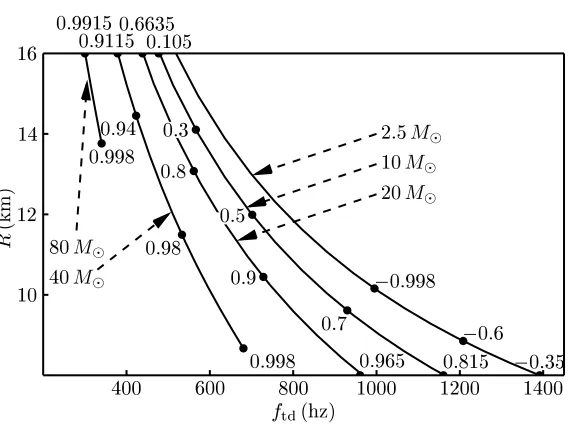
2.2 NS radiusR vs. disruption-onset frequencyftd, form= 1.4M andM = 2.5–80M. 26 3.1 Evolution of ther-mode amplitude in a slowly rotating star . . . 39
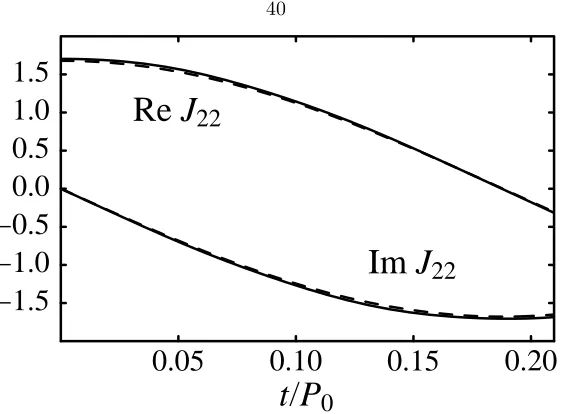
3.2 Real and imaginary parts of the current multipole momentJ22for run C1 . . . 40
3.3 Frequency of them= 2 r-mode for run C1 . . . 41
3.4 Numerical evolution of ReJ22 in production run C3 . . . 42
3.5 Numerical evolution of ther-mode amplitudeαin production run C3 . . . 42
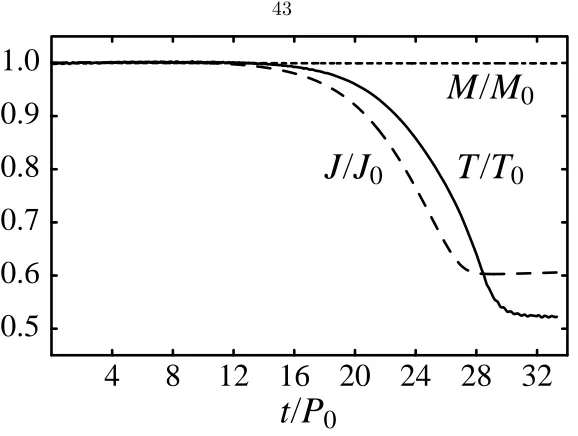
3.6 Evolution of total mass, total angular momentum, and total kinetic energy in produc-tion run C3 . . . 43
3.7 Theoretical and numerical evolution of the total energy in production run C3 . . . 44
3.8 Isodensity surfaces showing breaking waves near the end of production run C3 . . . . 45
3.9 Radial amplitude densityα(r) of them= 2r-mode in production run C3 att= 22.5P0 46 3.10 Evolution of the phase-coherence function ∆φ in production run C3 . . . 47
3.11 Numerical evolution of ther-mode frequencyω in production run C3 . . . 47
3.12 Numerical evolution of the average stellar angular velocity ¯Ω in production run C3 . . 48
3.13 Numerical evolution of the differential rotation ∆Ω in production run C3 . . . 49
3.14 Meridional structure of the differential rotation in production run C3 . . . 49
3.15 Numerical evolution of the mass momentQ32 and of ther-mode amplitudeαin pro-duction run C3 . . . 52
3.16 Numerical evolution of ther-mode amplitudeαin low-resolution run C3* and in run C3 55 3.17 Numerical evolution of ther-mode amplitudeαin production runs C3–C5 . . . 57
3.18 Numerical evolution of ther-mode frequencyω in production runs C3–C5 . . . 57
3.19 Numerical evolution of the differential rotation ∆Ω in production runs C3–C5 . . . . 58
3.20 Numerical evolution of ther-mode amplitudeαin production runs C6–C8 . . . 59
3.21 Numerical evolution of ther-mode frequencyω in production runs C6 and C7 . . . . 60
3.22 Numerical evolution of the differential rotation ∆Ω in production runs C6–C8 . . . . 60
3.23 Numerical evolution of ther-mode amplitudeαin the extended run C4 . . . 62
3.25 Differential rotation ∆Ω through the extended run C4 . . . 63
3.26 Meridional structure of differential rotation at the end of production run C4 . . . 64
4.1 Square root of the noise spectral densitySn(f) for LIGO-I and VIRGO . . . 83
4.2 (i) Normalized flux functionFTN/FNewt at various PN orders for η= 0.25. (ii) Effect of the parameterθon the normalized flux function at 3PN and 3.5PN orders . . . 85
4.3 (i) Energy functionETN at different PN orders forη= 0.25. (ii) Percentage difference in the energy function at the LIGO-I peak-sensitivity GW frequency . . . 86
4.4 Frequency-domain amplitude for T models at different PN orders . . . 89
4.5 (i) Normalized flux functionFPN/FNewt at different PN orders. (ii) Percentage differ-ence in the flux function between the T- and P-approximants . . . 90
4.6 (i) Energy functionEPN at different PN orders. (ii) Percentage difference in the energy function between 2PN and 3PN P-approximants . . . 91
4.7 Percentage difference between T- and P-approximants to the energy function, at the LIGO-I peak-sensitivity GW frequency . . . 93
4.8 Frequency-domain amplitude for the P models . . . 94
4.9 Frequency-domain amplitude of the HT and HP models . . . 97
4.10 Frequency-domain amplitude of the EP models . . . 104
4.11 Binding energyE(v) for equal-mass BBHs . . . 105
4.12 Signal-to-noise ratio at 100 Mpc versus total massM for selected PN models . . . 106
4.13 Iso-match contours for the functionh(ψ0, ψ3/2), h(ψ0+ ∆ψ0, ψ3/2+ ∆ψ3/2); values of ∆fcut(versusfcut) required to obtain matchesh(fcut), h(fcut+ ∆fcut)of 0.95, 0.975 and 0.99. . . 110
4.14 Projection of the ET(2,5/2) waveforms onto the frequency-domain detection template space . . . 111
4.15 Projection of the PN waveforms onto the Fourier-domain detection templates . . . 113
4.16 Projection of PN waveforms onto the P(2,5/2) detection template space . . . 119
4.17 Projection of PN waveforms onto the EP(3,7/2) detection template space . . . 120
List of Tables
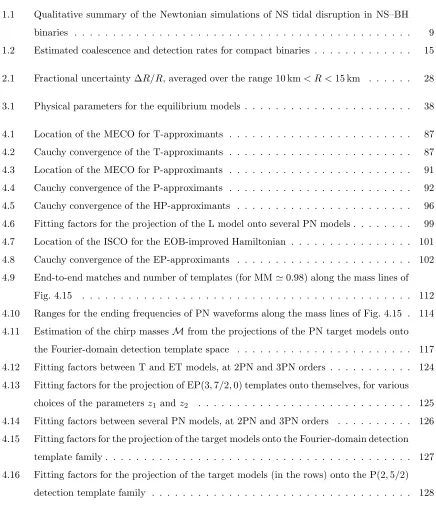
1.1 Qualitative summary of the Newtonian simulations of NS tidal disruption in NS–BH
binaries . . . 9
1.2 Estimated coalescence and detection rates for compact binaries . . . 15
2.1 Fractional uncertainty ∆R/R, averaged over the range 10 km< R <15 km . . . 28
3.1 Physical parameters for the equilibrium models . . . 38
4.1 Location of the MECO for T-approximants . . . 87
4.2 Cauchy convergence of the T-approximants . . . 87
4.3 Location of the MECO for P-approximants . . . 91
4.4 Cauchy convergence of the P-approximants . . . 92
4.5 Cauchy convergence of the HP-approximants . . . 96
4.6 Fitting factors for the projection of the L model onto several PN models . . . 99
4.7 Location of the ISCO for the EOB-improved Hamiltonian . . . 101
4.8 Cauchy convergence of the EP-approximants . . . 102
4.9 End-to-end matches and number of templates (for MM0.98) along the mass lines of Fig. 4.15 . . . 112
4.10 Ranges for the ending frequencies of PN waveforms along the mass lines of Fig. 4.15 . 114 4.11 Estimation of the chirp massesMfrom the projections of the PN target models onto the Fourier-domain detection template space . . . 117
4.12 Fitting factors between T and ET models, at 2PN and 3PN orders . . . 124
4.13 Fitting factors for the projection of EP(3,7/2,0) templates onto themselves, for various choices of the parametersz1 andz2 . . . 125
4.14 Fitting factors between several PN models, at 2PN and 3PN orders . . . 126
4.15 Fitting factors for the projection of the target models onto the Fourier-domain detection template family . . . 127
4.17 Fitting factors for the projection of the target models (in the rows) onto the EP(3,7/2,0)
Chapter 1
Introduction
In the course of the next decade, the inception of gravity-wave (GW) astronomy will open an
exciting new window on the physics of compact, strongly gravitating bodies, such as neutron stars
(NSs) and black holes (BHs), both as isolated objects and in binaries; it will provide information
complementary to that available from electromagnetic and neutrino observations; and it will produce
important insights into unsolved questions such as the equation of state (EOS) of matter at nuclear
densities, the evolutionary channels that create NSs and BHs, and the mechanisms behind
gamma-ray bursts.
Meanwhile, sophisticated three-dimensional numerical simulations of GW sources are coming
of age, allowing unprecedented investigations into the effect of the internal dynamics of compact
objects on their GW emission, and slowly but surely moving toward the goals of modeling the fully
relativistic dynamics of close and merging NS and BH binaries. Learning to interface numerical
simulations with other general-relativistic approximation techniques and with the GW data-analysis
algorithms will be of paramount importance as detector data become available. At the same time,
the theory of GW detection and data analysis has become firmly established as a mature subfield
of GW science. Yet the very sources that arguably give us our best chance of detecting GWs in the
first ground-based searches (binary BHs with total mass∼10–40M) lie at the very boundary of
the current data-analysis capabilities.
The interplay between analytical and numerical source modeling and data analysis is the
un-derlying theme of this thesis. Chapter 2 and (briefly) Sec. 1.1.2 below deal with the prospects for
extracting EOS information from NS tidal-disruption waves. Chapter 3 and Sec. 1.1.3 below
dis-cuss the numerical simulations of the NSr-mode instability that I have completed in collaboration
with Lee Lindblom and Joel Tohline. Finally, Chapter 4 and Sec. 1.2.2 below report my work (in
progress, and in collaboration with Alessandra Buonanno and Yanbei Chen) on providing detection
1.1
Gravitational waves as a probe into the structure and
dynamics of neutron stars
Neutron stars are truly wondrous objects. They pack the mass of our Sun within diameters of 20–30
km; and they manage to be both a bona fide test case for the theory of general relativity, and a
laboratory for the physics of matter at extreme density and temperature. Although more than a
thousand NSs are known today from electromagnetic observations (most of them detected as radio
pulsars), the first GW detections of these objects are eagerly awaited.
1.1.1
Neutron stars as GW sources
Detailed reviews of GW sources, of the expected event rates, and of the physics that these sources
could teach us are available elsewhere [1, 2, 3]. Here I shall list briefly the most promising types of
astrophysical systems from which we could learn about NSs using ground-based GW interferometers,
such as LIGO and VIRGO.
1. NS–NS and NS–BH binaries in the last few minutes of their inspirals. For a long time, these
inspiraling systems have been the prototype for the category of short-lived chirp signals
de-tectable using ground-based interferometers. The reason, of course, is that NS–NS binaries
have actually been observed in our galaxy [4], but also that the part of the inspiral accessible
to the interferometers (with GW frequencies between 40 and 1000 Hz) sits well before the final
merger of the binary, so it is described very accurately by the well-developed post-Newtonian
equations for point masses (see Chap. 4). The successful observation of GWs from these
in-spirals will teach us about the masses, spins and locations of NSs, but not about their internal
structure.
By contrast, the detection of GWs from the endpoint of NS–BH inspirals should produce
detailed information about NS structure and EOS. For a wide range of binary parameters, the
NS will be torn apart by the tidal field of the BH well before the final plunge into the hole,
and the tidal-disruption waves will be well inside the frequency range of good interferometer
sensitivity. NS–BH binaries have also been proposed as engines for gamma-ray bursts [5] and
as suitable environments for the production of heavy nuclei in r-processes [6]. These systems
are the subject of Sec. 1.1.2 and Chap. 2. The expected measured-event rates are shown in
Table 1.2 and discussed briefly in Sec. 1.2.1.
2. Rapidly spinning, deformed NSs. This class includes the known and unknown pulsars (when
their gravitational ellipticity is high enough to provide strong GWs), and the systems known
as low-mass X-ray binaries (LMXB), where the NS is accreting matter and angular momentum
3 ms; it is conjectured that the angular momentum being accreted is lost to the emission of
GWs [7].
To detect rapidly spinning NSs, it will be necessary to integrate the GW signal for times up to
several months, so the Doppler frequency modulations caused by the earth’s spin and motion
(both around the Moon and the Sun) will make it much harder to detect previously unknown
sources [8]. At the same time, the shapes of these modulations will make it possible to obtain
the position of the source in the sky [9], and in some cases to match the GW source with one
of the objects known from electromagnetic observations.
If any GWs are detected from spinning NSs, their features will be very informative, in particular
when examined in correlation with electromagnetic signals from the same source. For instance,
the ratio of the GW frequency to the NS angular frequency could give information about the
nature of the inhomogeneities that give rise to the GW emission, and the evolution of the
GW amplitude and frequency could provide interesting data about NS physics such as crust
structure and dynamics, crust–core interactions, magnetic fields, viscosity, superfluidity, and
more [3].
3. Proto-neutron stars. Finally, NSs could be observed as the rapidly spinning, strongly
asym-metric remnants of stellar-core collapse, or as the proto-NSs produced by the accretion-induced
collapse of white dwarfs. Proto-NSs that spin very fast can hang up centrifugally at a stage
where their radius is still large compared to that of the final NS. Such a configuration might be
unstable to a bar mode, giving rise to an elongated object that would emit very strong GWs
[10]. The newborn NSs might also develop a GW-induced instability in their r-modes [11]. I
will discuss this possibility more extensively in Sec. 1.1.3 and Chap. 3.
For the NS in all these systems, GWs would provide information complementary to that made
available by neutrino observations, focusing on the density structure and asymmetry of the collapsed
stellar core rather than on its thermal structure.
1.1.2
Neutron-star tidal disruption as a probe into the equation of state
of dense nuclear matter
Although modern equations of state for dense nuclear matter have benefited greatly from
sophis-ticated theoretical computations and experimental measurements of nucleon–nucleon interactions
[13, 14], our knowledge of the internal structure of NSs is still plagued by a considerable uncertainty
that will be resolved only by setting stringent observational constraints.
All measurable NS parameters are relevant to this task, but it is especially promising to exploit
is possible. The relativistic model of nonrotating NSs may be considered as a mapping from the
(barotropic) NS EOS,p(ρ), through the Oppenheimer–Volkoff (OV) equations,
dm(r)
dr = 4πr
2ρ(r), dρ(r)
dr =−[ρ(r) +p(r)]
m(r) + 4πr3p(r)
r(r−2m(r)) , (1.1)
to equations that involve macroscopic NS quantities, such as a mass-radius curve M(R). [In Eq.
(1.1)ρ(r) andp(r) are the density and pressure of the spherically symmetric NS at the radiusr, and
m(r) is the mass inside the radiusr.] Let us work through the details of this mapping. First, we set
the central densityρc; then, we solve the OV equations and compute the NS radiusR=R(ρc) and
total massM =M(ρc); finally, we eliminate ρc from these two equations, completing our mapping
of the EOSp(ρ) into the mass–radius relationM(R).
Lindblom [15] has shown how to invert the OV mapping using even a fewM(R) data points (see
also [14]). If p(ρ) is known up to a certain densityρmax from other observations and experiments,
we can start with the least dense observed NS, and integrate the OV equations backward, from the
surface of the star [where we knowR andM(R)] down to the radius whereρ=ρmax. We are left
with a stellar core of known mass and radius, and we can use an analytic approximation for the
solution of the OV equations (or a numerical shooting technique) to get pc and ρc; we then add
the point pc(ρc) to the EOS, and repeat for the next NS. The result is a sequence of points along
the curve p(ρ). This analysis can be generalized to include rotationally deformed models, and to
account for the statistical uncertainty in theM(R) data1.
Unfortunately, although many parameters, including mass and radius, have been measured for
most of the ∼ 1200 known NSs [13, 14, 17], to date there are no joint determinations of M and
R, and the few values available for the radius are woefully imprecise, as we discuss in the next
subsection.
The electromagnetic determination of NS masses
The masses of more than twenty NSs in binary pulsars have been measured by studying the
modu-lations in the pulsar signal induced by the orbital dynamics [4]. The best measurements come from
the six known NS–NS binary pulsars, but less accurate determinations are still possible for binaries
where the companion is a white dwarf or a main-sequence star. This is because the measurement
of both masses from orbital effects alone (except for eclipsing binaries) requires the detection of at
least two of the post-Keplerian parameters that characterize relativistic effects such as periastron
advance, second-order Doppler effect and gravitational redshift, Shapiro time delay, and orbital
de-cay due to GW emission. Relativistic effects are easier to measure in short-period, eccentric NS–NS
1Recently, Harada [16] has shown how other macroscopic parameters of NSs (such as moments of inertia, baryonic
binaries, while binaries with white dwarfs or main-sequence stars tend to have larger periods and
smaller eccentricities. In this case, the NS mass can be recovered if the companion mass is
deter-mined reliably from its electromagnetic spectrum. In any case, all results are compatible with a very
narrow underlying Gaussian distribution,M = 1.36±0.04M[4].
The measurement of NS masses is also possible in X-ray pulsars and bursters. The former
are believed to be NSs accreting matter from a high-mass companion (Mc10M); the pulses are
emitted from the matter accreting on the magnetic poles, modulated with the period of the accreting
star. Masses are measured from X-ray pulse delays, optical radial velocities and X-ray eclipses. X-ray
bursts, by contrast, are believed to originate from the thermonuclear explosion of matter accreted
onto the surface of an NS from a low-mass companion (M 1.2M). The determination of masses is obtained from a combination of time-delay effects, optical radial-velocity curves, and constraints
on the inclination from X-ray eclipses. According to recent determinations, the X-ray pulsar Vela
X-1 has M = 1.87+0−0..2317M [18], while the X-ray burster Cygnus X-2 has M = 1.8±0.4M [19]. These masses are higher than the values determined in radio pulsars, and they probably reflect the
presence of the matter accreted from the companion. Last, NS masses can be constrained from the
quasi-periodic oscillations (QPOs) of X-rays emitted from the gas accreting onto NSs from nearly
circular orbits in binaries with low-mass companions. There is evidence that the oscillations mirror
the orbital frequency of the accreting matter, which sets a tentative constraint on the NS mass [20].
The electromagnetic determination of NS radii
The determination of NS radii is much harder. The best prospects come perhaps from the direct
measurement of the so-calledthermal radius for objects like Geminga (RX J1856.5-3754). This is
the nearest known NS candidate (estimated at 120 pc from parallax and circumstantial evidence),
and it is not a pulsar, which should prevent contamination of the thermal emission by magnetic
effects2. The surface temperature is6·105K, and the application of the Stefan–Boltzmann law yields a red-shifted radiusR∞=R/1−2GM/R= 15 km, which impliesR12 km [21] (but the
1σerror forRis 7 km!). Quite interestingly, a recent reinterpretation [24] of the Chandra data for
Geminga using a nonmetallic atmospheric model (as seems appropriate given that no distinct lines
were found in the spectrum) suggests thatR∞3.8–8.2 km, too small for most current NS models,
but not for an even denser object such as astrange star.
In June 2003, Geminga will pass within 0.3 sec of a background star of magnitude 26.5, displacing
the apparent position of this star by aboutδϕ= 0.6 mas. This displacement is proportional to the
NS mass; so ifδϕcan be measured to a precision ∼0.1 mas (as might be feasible with the Hubble
Space Telescope enhanced by the Advanced Camera for Surveys), the NS mass will be determined
with an error∼15% ([22]; see however [21]).
The thermal radius can also be derived from the measured flux of X-ray bursts, if the distance
to the star is known and if the spectrum can be considered approximately thermal; however, the
bursts are likely to come from restricted hot spots on the NS surface, which will result in the
underestimation of thephysical radius. Perhaps more promising is the extraction ofM/Rfrom
X-ray–burst oscillations. The burst amplitude is always strongly modulated by the rotational period
of the NS; however, even when the hot spot is on the far side of the star, the signal received on
Earth does not vanish completely, because of the strong light bending in the gravitational field on
the NS. The strength of this effect constrains the value ofM/R, and therefore the value ofR ifM
is already known; for the binaries 4U 1636-53 and 4U 1728-34,M/R0.16 with a 90% confidence [23].
Finally, it was hoped that absorption lines in the photosphere of NSs would provideM/R and
M/R2 through, respectively, gravitational redshift and pressure broadening (a simple hydrostatic
argument shows that in stellar atmospheres pressure is approximately proportional to gravity).
However, in practice it has been very hard to detect any usable absorption lines [17]. The bottom
line is that, to date, NS radii have not been determined by electromagnetic observations with errors
better than a factor of two.
The gravity-wave determination of NS masses and radii
In 1987, Thorne suggested that the GWs from the NS–BH inspirals that end in the tidal disruption
of the NS can be used to determine the NS radius [25]. NS–BH mergers are one of the standard GW
sources for second-generation interferometers (see Table 1.2). The waveforms generated by these
events will contain two kinds of information. The early part of the inspiral (during which the NS
and BH are still relatively distant, and the dynamics can be described accurately by post-Newtonian
equations of motion in the point-mass approximation) will tell us about the masses and the spins of
the NS and BH. The late part of the inspiral, depending on the binary parameters, can see the BH
tidal field become so strong that it disrupts the NS on a dynamical timescale. Physical intuition
then suggests that the details of the disruption process, as encoded in GWs, should carry useful
information about the internal structure of the NS, and in particular about its EOS. In Chap. 2
(and, briefly, in the next subsection) I present my estimation of the prospects for extracting this
information from the GWs that could be measured from a realistic event.
Saijo and Nakamura [26] have suggested that it might be possible to measure the NS radius
directly from the spectrum of the GWs emitted in NS–BH coalescences. These authors have used
BH perturbation theory to compute the spectrum of GWs emitted by a disk of dust inspiraling into
a rotating BH. When the radiusRdiskis larger than the wavelength of the quasi-normal modes of the
NS–BH binaries, providing direct information about the radius. However, two key issues are left
unaddressed. First, the particles of the disk move along geodesics, and the large relative deviation
of the geodesics in the vicinity of the BH seems to be a necessary condition for the appearance of the
spectral features; but in reality, NS matter is strongly constrained by the gravitation and pressure
of the star (except, perhaps, in the regime of severe tidal disruption). Second, for coalescence
events that happen at realistic distances the signal strength might be too low to let us resolve the
form-factor structure in the spectrum.
A simple analytical model for NS tidal disruption
In the next few paragraphs I present a short synopsis of my analysis of the prospects for the GW
measurement of NS radii, which I carry out in Chap. 2.
The simplest possible representation of an NS inspiraling into a BH is a quasi-equilibrium
se-quence of relativistic Roche-Riemann ellipsoids. These ellipsoids are equilibrium configurations of
a self-gravitating, polytropic, Newtonian fluid, moving on circular, equatorial geodesics in the Kerr
spacetime, and subject to the BH relativistic tidal field [27]. For these configurations, once the
orbital separationrand the BH massM and spinaare set, we can still choose the NS massmand
radiusR.
As it inspirals toward the BH, an NS with parametersm and R would be represented by the
appropriate Roche-Riemann ellipsoid at each separationr, until we reach acriticalrcr, beyond which
no more equilibrium configurations exist. I identify this end of the equilibrium sequence with the
onset of dynamical tidal disruption, and from rcr I obtain the GW frequency at tidal disruption,
ftd=ftd(m, R, M, a). I find thatftddepends strongly on the NS radius, and that, for the standard
NS mass 1.4M and for a variety of likely BH masses, the disruption waveforms lie in the band of
good interferometer sensitivity for the advanced interferometers such as LIGO-II. It follows that, in
principle, we could use the waveforms from an NS tidal-disruption event to measure both the NS
mass and the NS radius.
To see how well we could measure them, I call on the theory of matched-filtering parameter
estimation([28]; see also Chap. 4). The general idea is that GWs will be detected by correlating the
measured signalsto a bank of theoreticaltemplates {ui}, which represent our best approximation of the realistic GW signal as a function of the binary parameters (labeled byi). If thematch s, ui
(the correlation betweenui ands) is much higher than the matchui, n that the template would
give, on the average, with noise alone, then we claim that we have a detection. To know how well we
can estimateR, we ask how probable it is that a particular realization of detector noise would lead
us to mistake the templateuR(appropriate for the NS radiusR) with the nearby templateuR+∆R:
the answer is given in terms of the matchuR, uR+∆R.
be correlations in the ways that different parameters modify the templates. In my simple model,
I assume that all parameters except ftd (and consequently, R) are already known well from of
the early part of the inspiral signal, so all that is left to do is to find R. Thus, to compute the
matchuR, uR+∆RI construct a bank of signal templates that differ only in the GW frequency at
the onset of tidal disruption. Because I am not interested in modeling accurately the relativistic
dynamics of the binary, but only the effects of tidal disruption, I choose to generate my waveform
templates from simple quadrupole-governed Newtonian inspirals [29], cutting off the signal more or
less abruptly3 when the instantaneous GW frequency reachesftd. Computing the match between
nearby templates, I estimate the granularity to whichftdcan be measured for a given signal strength
(inversely proportional to distance), and propagate this error to the NS radius. The final result of
this exercise is that, employing advanced ground-based interferometers, such as LIGO-II [3], we
should be able to measure the NS radius to 15%, for tidal-disruption events at distances that may
yield from∼10−2to 20 events per year (see Table 1.2 below). This estimated 15% error seems very
competitive with respect to the electromagnetic determinations ofRsurveyed above. Lattimer and
Prakash [14] argue that a single determination of an NS radius with error∼10% might be enough
to constrain the NS EOS significantly.
Numerical simulations of neutron-star tidal disruption
Detailed relativistic numerical simulations are still needed to confirm these prospects, and will be
essential as a foundation to interpret any tidal-disruption waveforms that might be measured in
reality. The first Newtonian simulations [31] of NS–BH systems, carried out using both smooth
particle hydrodynamics [6, 32] and Eulerian techniques [5, 33], show that the ultimate fate of the
system depends strongly on the stiffness of the EOS, and confirm that disruption events have much
to teach us about the NS EOS.
Specifically, Lee and Kluzniak [6, 32] have performed smooth-particle–hydrodynamics (SPH)
simulations, where the NS is modeled as a self-gravitating Newtonian polytrope, and the BH is
represented by an M/r potential with an absorbing membrane at the event horizon; the NS is
subject to an effective radiation-reaction force computed from the motion of its center of mass.
These authors have considered both irrotational and tidally locked initial configurations (where,
respectively, the NS has no spin, or is rotating with the orbital angular velocity), with mass ratios
of a few.
Janka and colleagues [5, 33] have performed Eulerian simulations where the NS is modeled as
a self-gravitating Newtonian fluid with a physical equation of state, and the BH is again an M/r
potential with absorbing membrane; a radiation-reaction force is introduced in the approximation
3Bildsten and Cutler [30] estimate that complete disruption would take place in∼1–3 orbital periods, while the
NS EOS tidal disruption accretion disk tidal tails GW after disruption
very stiff
incomplete; light remnant on elliptical orbit
for higher
mass ratios never
lower-amplitude inspiral signal from remnant
stiff almost complete always in irrotational
binaries sudden shutoff
soft complete always always sudden shutoff
Table 1.1: Qualitative summary of the Newtonian simulations [6, 32, 5, 33] of NS tidal disruption in NS–BH binaries.
we just mentioned. These authors considered irrotational, tidally locked and counterrotating initial
configurations, with mass ratios of a few.
The behavior observed in these simulations is summarized in Table 1.1. Simply put, the loss
of angular momentum to GWs decreases the orbital separation until Roche overflow occurs; then
a mass-transfer stream appears and there is a rapid, violent accretion episode onto the BH. What
follows depends on the stiffness of the NS EOS:
1. For very stiff EOSs (with polytropic index n = 0.5), the NS is not completely accreted and
survives as a remnant (probably unstable) in an eccentric orbit; secondary accretion episodes
are possible; and an accretion disk is formed, but only ifMNS/MBH>0.5.
2. For stiff EOSs (n= 0.66), the NS is almost completely disrupted, and there is always a thick
accretion disk of 0.2–0.3M; irrotational initial configurations lead to more violent encounters
where larger tidal bulges deform the NS, and eventually long tidal tails are formed with enough
energy to escape the binary.
3. For soft EOSs (n > 0.66), tidal disruption is always complete regardless of the initial mass
ratio; both a massive accretion disk and a large one-armed spiral are formed.
Altogether, these simulations show that hydrodynamical effects play an important role in the global
behavior of the system at small separations; the mass-transfer process is always unstable, and it can
by itself destabilize the orbit. The outcome of the coalescence process is very sensitive to the assumed
stiffness of the EOS, which bodes well for the extraction of EOS parameters from tidal-disruption
waveforms; and except for the stiffest EOS, the gravity-wave shutoff at tidal disruption is sudden
and complete, which shows that the sudden-shutoff approximation, used in my simple models (see
Sec. 2 above and Chap. 2), might not be too far off the truth.
It is possible to improve on these simulations; indeed, in collaboration with Lee Lindblom and
Joel Tohline, I have begun to work toward this goal. We are setting up a framework for Eulerian
numerical simulations that will follow the evolution of the NS in its freely falling reference frame,
of our computational power (and memory) to modeling the hydrodynamics of the NS, which is the
most important and interesting aspect of the tidal-disruption process. We plan to obtain the orbital
evolution of the binary by solving post-Newtonian expanded equations for the general-relativistic
two-body problem; and we plan to model the star as a Newtonian, polytropic fluid that is evolving in
the inertial reference frame centered on the NS center of mass, and that is subject to the relativistic
tidal field of the BH. We should improve on the Lee et al. [6, 32] simulations because Eulerian
hydrodynamics is inherently more accurate than SPH in modeling violent processes involving fluid
interfaces, such as the surface of the NS; and we should improve on the Janka et al. [5, 33] simulations
because we will be able to resolve the NS more finely; finally, we should improve on both sets of
simulations by including relativistic corrections to the orbital evolution and to the BH potential that
acts on the NS.
1.1.3
Gravity waves from the
r
-mode instability of nascent neutron stars
All rotating stars possess a class of circulation modes (r-modes) that are driven toward instability by
gravitational radiation reaction; in hot, rapidly rotating young NSs, this destabilizing effect might
be so strong that it dominates viscous dissipation. Once an r-mode achieves sufficient amplitude,
the star is quickly spun down as angular momentum is lost to gravitational radiation [11, 12]. For
stars with initial angular velocity Ω∼1000 Hz, the timescale for the growth of the most unstable
r-mode is ∼ 40 s. In recent years, r-modes have attracted considerable interest as a promising
GW source for ground-based detectors, and as a possible explanation for the failure to observe any
young pulsars that are rotating at angular velocities close to their theoretical spin limit (such rapidly
rotating NSs were expected, but not by everybody, in supernova remnants).
However, the astrophysical relevance of r-modes is still in doubt, pending judgment on two
separate issues. First, this instability (discovered by analyzing the linearized Euler equations for
perfect fluids) might not be confirmed after all the complicated physics that occurs in NSs is taken
into account, including relativistic effects, physical-EOS effects, solid crust effects, magnetic fields,
rotation laws, exotic sources of viscosity, and so on [11, 12]. Second, the amount of angular
momen-tum removed from the star and the strength of the GW radiation emitted depend critically on the
maximum mode amplitude that can be reached; but the growth of the mode might be limited to a
very small saturation amplitude by magnetic-field effects [34], by turbulent boundary-layer effects
at the crust-core interface [35], or by leakage of energy to other (damped) modes through nonlinear
hydrodynamical couplings.
There have been several attempts to investigate the nonlinear dynamics of ther-modes, including
leakage of energy to other modes, by means of second-order Lagrangian perturbation theory ([36],
In addition, in collaboration4 with Lee Lindblom and Joel Tohline, I have carried out Newtonian
numerical simulations that include radiation reaction as an effective force. Much in the spirit of this
thesis, this work is a good illustration of how numerical techniques can be employed to supplement
analytical work in the modeling of GW sources, and to guide data-analysis strategies. It is the
subject of the next section and, more in detail, of Chap. 3.
Numerical evolutions of nonlinearr-modes in neutron stars
The simulation of NS instabilities is a difficult task. First, the hydrodynamical timescale (which,
through the Courant condition, determines the lengths of time that can be explored within a given
allotment of CPU time) is much shorter than the timescales for the growth of instabilities (in
the case of r-modes, this is the GW radiation-reaction timescale). Second, the microscopic and
macroscopic physics of NSs can be very complex, with important effects arising from such different
physical ingredients as the proton/neutron fractional composition of the nucleon gas, the possibility
of superfluid phases, the presence of strong magnetic fields, and so on. Third, relativistic corrections
can be important, but fully relativistic hydrodynamics (with the Einstein metric being evolvedon a
par with the fluid variables) is still somewhat beyond the capabilities of current codes and machines
[43]. Even the less ambitious codes that implement the Cowling approximation [43] (where the
dynamics of the fluid are played out in a fixed background metric) are still rather unwieldy, and
saddled by very large numerical viscosities with respect to their Newtonian counterparts.
Lindblom, Tohline, and I address the second and third concerns by choosing to work with a simple
Newtonian polytropic fluid. Our rationale is that the structure of r-modes is not very sensitive to
the underlying EOS, and we expect that the qualitative features of the nonlinear hydrodynamics
should also be essentially correct in our simplified model. Other physical processes (magnetic fields,
superfluidity) can be very important for the overall picture of the instability, but they probably have
little bearing on the issue of nonlinear couplings. We do need to include at least one relativistic effect:
radiation reaction, which drives the mode unstable, is added as an effective force [44] proportional
to the derivatives of the current multipole moments.
We address the first concern (the long instability timescale) by increasing the strength of the
ef-fective radiation-reaction force by a factor of about 4500, to bring down ther-mode growth timescale
to values comparable to the rotation period. Even with this kludge, the physical behavior that we
ob-serve should still be realistic,if the nonlinear dynamics of the mode (including its couplings to other
modes) happens at the hydrodynamical timescale, which is modeled correctly in our simulations.
(However, see Sec. 4 below.)
4The respective contributions to this project can be characterized as follows. Joel Tohline provided his proven
Our simulations were based on a second-order–accurate finite-difference code developed at LSU
by Tohline and his students [38] to tackle a variety of astrophysical problems. The LSU code was
parallelized [39] in the domain-decomposition paradigm using the well-known MPI [40] library. We
ran it for a 128×64×128 cylindrical grid on 16 nodes of the HP V-2500 supercomputers at Caltech’s
Center for Advanced Computing Research [41].
We solved the Newtonian Euler and Poisson equations, after setting up the initial equilibrium
configuration as a simple, rigidly rotating polytrope (with n = 1, M = 1.4M, R = 12.5 km,
and rotation periodP0 = 1.21 ms), obtained by solving self-consistently the Bernoulli and Poisson
equations [42]. We then added a seed mode (a small-amplitude, slow-rotation approximation to the
most unstabler-mode, the one with l =m= 2) to the initial velocity distribution of the NS. The
seed mode was set to the dimensionless amplitudeα= 0.1 (equivalent to mode velocities ∼10% of
the rigid-rotation velocity).
We then let the star evolve, and we monitored the r-mode amplitude by extracting the (l =
2, m= 2) current multipole from the NS velocity field. Ther-mode frequency was determined from
the quasi-periodic oscillations of this multipole. The behavior that we observed was very surprising.
The mode grew exponentially (in good accord with theory) until α∼2; then the growth began to
be limited by some unidentified nonlinear process; eventually, the amplitude peaked atα = 3.35,
and then fell down to very low values within few rotation periods. Our movie of the growing, then
crashingr-mode can be found on the Web [46].
What nonlinear process was responsible for limiting the growth of ther-mode, and for causing
its rapid demise? We discovered a clue when we examined the evolution of the energy and angular
momentum in the course of the simulation. Even after the emission of angular momentum into GWs
fell to zero, the star continued to lose energy; surely, something other than GWs must be responsible
for this loss. Our explanation was the following. To first order in its characteristic amplitude, the
r-mode is only avelocitymode; to second order, however, there is an associated density perturbation
that appears as a traveling wave with four crests (two in each hemisphere) on the surface of the
star; see our movie [46]. As the amplitude reached its maximum, these propagating crests turned
into large, breaking waves, and the edges of the waves developed strong shocks that began to dump
kinetic energy into thermal energy, eventually killing ther-mode.
In the traditional scenario for GW emission fromr-modes [47], the unstabler-mode would grow
until it reached a dimensionless amplitude of about one, and then it would saturate and persist
at that amplitude (for several months) until it would have lost most of its angular momentum;
during that time, the frequency of the r-mode would decrease in proportion to the NS spin. The
prospective picture ofr-mode GW signals that emerges from our evolutions is quite different. Most
interestingly, ther-mode spindown episodes are faster (only a few minutes), and the GW frequency
r-mode signals changes from a month-long, pulsar-like search (which must account for the Doppler
shifts generated by Earth’s movement in the solar system) to an easier, shorter chirp-like search,
with encouraging prospects for detection [48].
Our code provided a nice laboratory to perform several more evolutions and tests.
1. We performed basic tests of the robustness of the code and of our diagnostics, evolving stars
with different angular velocities, with or without r-mode perturbations, and at different grid
resolutions.
2. We investigated the dependence of the saturation amplitude on the artificial amplification
of radiation reaction. Our computing budget made it impossible to increase the
radiation-reaction timescale; instead, we reduced it even more, finding that ther-mode saturated faster,
but at essentially the same amplitude.
3. We studied the unforced evolutions of unit-amplitude r-modes, finding that they were
es-sentially stable for as long as we could evolve them. These results are compatible with the
relativistic evolutions (also unforced) performed by Stergioulas and Font [37].
Recent developments
In two recent papers, Arras and colleagues [36] study the saturation of r-modes by three-mode
nonlinear coupling to other inertial (Coriolis-restored) modes in neutron stars. They identify two
relevant saturation mechanisms: in the weak driving limit, the unstable parent r-mode transfers
energy by way ofparametric resonance[49] to a pair of quasi-resonant, overdampeddaughter modes.
When the parent mode becomes large enough, it starts to excite these daughter modes. Eventually,
they get to amplitudes such that essentially all the energy that the radiation reaction imparts to
the parent mode is immediately transferred to them and dissipated. The saturation amplitude of
the parent mode depends on the strength of the parent-mode driving, and on the daughter-mode
damping coefficients and quality factors.
In the strong driving limit, the nonlinear energy transfer is faster than the damping of the
daughter modes; eventually a large family of daughter modes (spread over an inertial range)
be-comes excited, and the parent mode is saturated by leakage of energy out of the inertial5 range to
other damped modes; in this case, the saturation amplitude of the parent mode depends only on
the efficiency of nonlinear energy transfer to the daughter modes. After evaluating the nonlinear
coupling coefficients and the damping rates for inertial modes, Arras and colleagues conclude that
this strong driving scenario is relevant to the case of r-modes, both for rapidly spinning nascent
stars and for recycled stars in low mass X-ray binaries; they obtain a saturation amplitude of
∼0.7·10−2(ν
star/1kHz)5/2, or∼0.4·10−2for the star in our simulation [64]. They also argue that
the results discussed in the previous section are artifacts of our unphysically large driving force.
Also recently, Jones suggested [51] and Owen and Lindblom verified [50] that, if the NS core
contains hyperons in addition to neutrons and protons, then bulk viscosity due to the nonleptonic
weak interactions
n+n⇔p+ Σ−, n+p⇔p+ Λ (1.2)
will suppress the r-mode instability after the core temperature drops below 3·109 K. Now, the
standard modified URCA process6 will cool the NS to 3·109 K in one day; however, for modern,
proton-rich EOSs, direct URCA will cool the NS to 3·109 K within a few s. It seems that the
window of opportunity for ther-mode instability is shrinking more and more.
Still, in the end, I believe it is fair to argue that there is such uncertainty about the structure and
dynamics of NSs that the final verdict on ther-mode instability will come only from their detection
with GW interferometers, or from the failure to detect them; so it is reasonable to devote some
resources to GW searches forr-mode signals (perhaps with shapes similar to those predicted by our
simulations).
1.2
Gravitational waves from coalescing binaries of compact
stellar objects
Binaries of compact stellar object are the standard source for the class ofchirp signals that will be
sought by ground-based GW interferometers. There are many reasons for this, not least the fact
that the effects of GWs have been first observed (albeit indirectly) in such a binary, the Hulse–
Taylor pulsar. But there is more to it: because they are the incarnation of the (unsolved)
general-relativistic two-body problem, binaries have come to represent the very essence of Einstein’s theory
of gravitation. This is especially true for binaries consisting of two BHs, objects made of pure
spacetime curvature.
6Direct URCA processes are simplyβ-decay and its inverse,
n⇔p+e−+ ¯νe, p⇔p+e++νe, (1.3) or the similar processes involving a hyperon. On the other hand, modified URCA sees the participation of a spectator nucleon,
LIGO-I LIGO-II
system event rate visible to det./yr visible to det./yr
NS–NS 1 to 500 GEM 20 Mpc 3×10⁻⁴to 0.3 300 Mpc 1–800
NS–BH 0.1 to 100 GEM 43 Mpc 4×10⁻⁴to 0.6 650 Mpc 1–1500
BH–BH (field) 0.1 to 10 GEM 100 Mpc 4×10⁻³to 0.6 z= 0.4 30–4000
BH–BH (clusters) 1 to 10 GEM 100 Mpc 0.04–0.6 z= 0.4 300–4000
Table 1.2: Estimated coalescence and detection rates for compact binaries [GEM ≡(events in our galaxy)/Myr]. From [52, 3]. LIGO-II numbers are for a wideband optical configuration and sapphire test masses. The rates for BH–BH binaries distinguish between sources in standard galaxies and in globular and other star clusters, which can act as incubators for binaries (single BHs, heavier than most stars in the cluster, sink to the center via tidal friction, where they find and capture other BHs; three-body interactions then harden the resulting binaries, and often eject them from the cluster [53]; recent investigations [54] suggest that four-body interactions might actually cause the binaries to coalesce within the clusters, creating a hierarchy of BHs with masses∼100–1000M).
1.2.1
The statistics of coalescing binaries
The estimated galactic coalescence rates for binaries of compact objects are shown in Table 1.2,
together with their expected detection rates, computed for first- and second-generation LIGO
inter-ferometers by extrapolating out through the universe [52, 3]. The rates for NS–NS binaries, which
have actually been observed as radio pulsars in our galaxy [4], are best estimated by modeling the
selection effects intrinsic to pulsar surveys. For each observed binary i, Phinney ([55]; see also
Kalogera et al. [52]) computes the scale factor
Si=
Volume(galaxy)
Volume(searched), (1.5)
which gives (roughly) the number of systems similar toithat are present in the galaxy. The galactic
coalescence rate is then approximated as iSi/τi, where τi is the lifetime of the binary i. The
determination of the Si is very delicate, because it must account for all the selection effects that
limit the observability of pulsars from Earth surveys (such as beaming, faintness, spatial distribution,
and so on). This procedure is fragile also because of the very limited sample of observed objects. It
gives the galactic event rate, 1 to 500 GEM, shown in Table 1.2.
Because no BH–NS or BH–BH binaries have yet been identified reliably, predictions on their
coalescence rates can be obtained only from theoretical population-synthesis models [52]. These
involve complex Monte Carlo computations that must include reasonable representations of poorly
understood processes, such as the formation of stars and binaries, and their evolution (including
single-star evolution, orbital evolution and decay, mass transfer episodes, core collapse and supernova
explosions, and so on). As a consequence, the resulting event rates are very uncertain. For NS–
NS binaries the theoretical predictions are in good agreement with the extrapolations from pulsar
To extrapolate the galactic event rate to the volume of universe accessible to GW interferometers,
we assume that the coalescence rate is proportional to the rate of formation of stellar progenitors,
and that the properties of primordial binaries in other galaxies are similar to those in ours. Then
we can use scaling arguments based on B-band luminosity density, galaxy number density, or cluster
number density. Kalogera and colleagues [52] obtain a scaling factor∼10−2Mpc forh= 0.65.
The last step toward detection rates is the determination of the volume of universe where GW
detectors can actually observe a given source. The distance from Earth that can be probed by a
given detector is inversely proportional to the strength of the signal, which scales as M5/6 [for a binary with masses m1 and m2, the chirp mass M is given by M = (m1m2)3/5/(m1+m2)1/5].
This scaling gives an intrinsic advantage, detection-wise, to the heavier NS–BH and especially BH–
BH binaries over NS–NS binaries. Barring surprises, if LIGO-I detects a coalescing binary, it will
probably be made of two BHs.
1.2.2
Detecting BH–BH binaries with LIGO-I
The final chapter of this thesis reports my work (in collaboration7 with Alessandra Buonanno and
Yanbei Chen) on templates for the detection of GW signals from the coalescence of nonspinning
BH–BH binaries with total masses between 10 and 40M. These are among the most promising
sources for first-generation ground-based interferometers, but the possibility of detecting them with
standard matched-filtering techniques is seriously imperiled by our ignorance about the gravitational
waveforms that they generate. The spins of the two BHsareexpected to play a very significant role
in the late stages of the inspiral [57], so the analysis of nonspinning binaries reported in Chap. 4 is
preliminary to considering the effects of spin, which is currently work in progress.
Most GW signals sought by ground-based GW interferometers are so weak that they can be
detected only8 if we have a previous knowledge of their shape, by correlating the interferometer
output with a theoretically determined signal template ([28]; see also Sec. 4.2). The higher the
correlation, the more confidence we have that a signal closely resembling the template is actually
present in the experimental data. This detection scheme (and the estimation of upper limits if no
detection is made) depends on the assumption that the equations used to compute the theoretical
templates represent faithfully the evolution of the actual physical system.
The present knowledge of the weak-gravity regime of GR justifies the assumption that the
post-Newtonian (PN) approximation [59] can model accurately the inspiral stage of NS–NS coalescences,
at least for GW frequencies within the range of good interferometer sensitivity. [The PN
approxima-7All three authors have contributed to all the different analytical and numerical tasks inherent in this project,
but I have been responsible most especially for assembling aMathematicapackage capable of synthesizing waveform templates from several phasing and orbital equations and of evaluating theoverlapsbetween template families, while Alessandra Buonanno has paid attention especially to the analytical framework.
8The principal exception is merger waves for BH–BH binaries, if they last for very few cycles. In this case, filtering
tion is essentially a perturbative expansion of the Einstein equations in the characteristic Keplerian
velocity v= (πM fGW)1/3, whereM is the total mass of the binary, andfGW is the instantaneous
GW frequency.] Since NS–NS binaries have been for a long time the standard chirp source, this
assumption has in fact guided the development of the theory of GW data analysis.
Unfortunately, the same does not hold true for BH–BH binaries with total masses between 10
and 40M. These enter the LIGO frequency range at a very late stage in their inspiral, when only
50–800 orbits are left before the merger, and when the post-Newtonian expansions used to compute
waveform templates fail to converge properly. Several techniques have been suggested to accelerate
the convergence of the PN series, but they have been shown to lead to very different waveforms, so
no particular template family based on any such technique can be trusted to represent adequately
the physical signals.
To address this concern, we considered all the PN approximation schemes (fornonspinning BHs)
that have appeared in the literature, including:
1. Adiabatic models, where we apply the energy balance equationd(PN energy)/dt=−(GW flux)
to evolve the binary through a sequence of quasi-stationary circular orbits; different ways to
resum the PN energy and flux functions generate distinct models [60].
2. Hamiltonian schemes, where we solve the Hamilton equations obtained from the PN
Hamilto-nian (possibly resummed) [60].
3. Direct schemes, where we use the PN analog of the Newtonian equations of motion, including
radiation-reaction terms [61].
Under the hypothesis (admittedly, a strong one) that the variety of signals thus obtained spans
enough volume in signal space to encompass the actual physical signals, we then looked for an
effective family of templates that can approximate all of these target models equally well, and
interpolate between them. With luck (if, as it were, the various PN models are not all wrong in
the same direction) the effective family will also be a reasonable approximation to the true physical
signals.
The effective family need not be one of the PN models, and in general it will not be indexed by
the same physical parameters [such as total massM and mass ratio ν=m1m2/(m1+m2)2] as the
PN models are. Instead, we should see the effective family as a collection of signal shapes selected
phenomenologically to approximate the physical waveforms (at least in our wishful thinking). Such a
family will be useful mainly for the purpose of signal detection, rather than for parameter estimation.
Under the same hypothesis, we can use thedistance (in signal space) that separates the effective
template family from the target models to estimate the distance between the effective family and
the real physical signals. As we shall see in Chap. 4, in the theory of matched-filtering detection