Automatic Speech Recognition
Wendy J. Holmes
Speech Research Unit, D ER A M alvern
A thesis submitted to the UNIVERSITY OF LONDON
for the degree of DOCTOR OF PHILOSOPHY
Department of Phonetics and Linguistics UNIVERSITY COLLEGE LONDON
ProQuest Number: 10045590
All rights reserved
INFORMATION TO ALL USERS
The quality of this reproduction is dependent upon the quality of the copy submitted. In the unlikely event that the author did not send a complete manuscript and there are missing pages, these will be noted. Also, if material had to be removed,
a note will indicate the deletion.
uest.
ProQuest 10045590
Published by ProQuest LLC(2016). Copyright of the Dissertation is held by the Author. All rights reserved.
This work is protected against unauthorized copying under Title 17, United States Code. Microform Edition © ProQuest LLC.
ProQuest LLC
789 East Eisenhower Parkway P.O. Box 1346
Abstract
This thesis describes work developing an approach to automatic speech recognition which incorporates a more realistic underlying model of speech than the currently-successsful technique of hidden Markov models (HMMs). Whereas HMM states are associated with individual (frame-based) feature vectors, the new models represent sequences or “segments” of features. The segment models described in this thesis are referred to as '"segmentai HMMs’\ and incorporate the concept of trajectories to describe how features change over time together with a novel representation of segmental variability. Extra-segmental variability between different examples of a sub-phonemic speech segment is modelled separately from intra-segmental variability within any one example. The extra-segmental component of the model is represented in terms of variability in the trajectory parameters, and can be regarded as providing a prior constraint on the possible observation sequences that can be generated by the model. The work which forms the basis for the thesis has concentrated on investigating the representation of the two types of variability in relation to characteristics of speech data and to recognition performance.
Acknowledgements
I would like to thank my supervisors, Martin Russell at the Speech Research Unit (SRU) and Mark Huckvale at University College London, for help, advice and many valuable discussions, and also for careful reading and constructive criticism of earlier drafts of this thesis. Martin developed the concept and the original theory of segmental HMMs, and provided guidance for my experimental investigations and later theoretical developments. Mark gave a different perspective on the work, helping especially in my studies of the speech data characteristics in relation to modelling assumptions and with the emphasis on evaluating hypotheses about models o f speech and not just on recognition performance figures.
In would like to thank Phil Gamer for useful discussions on aspects of the modelling theory, and in particular for checking my mathematical derivations associated with the “trajectory- independent” work described in Chapter 12. I also wish to thank my father, John Holmes, for reading and commenting on various drafts of thesis chapters, and for all the general support he has given me in my work.
Contents
1 Background and general aim s... 17
2 HMMs as models of speech... 21
2.1 Introduction 21
2.2 Challenges for automatic speech recognition 21
2.3 Approaches to automatic speech recognition 22
2.3.1 Knowledge-based approaches 22
2.3.2 Self-organizing approaches 23
2.4 Relating ASR approaches to speech perception models 25 2.5 Advantages of HMMs as an approach to speech recognition 28
2.5.1 Architecture 2 8
2.5.2 Completeness 29
2.5.3 Flexibility 30
2.6 Limitations of HMM formalism and possible improvements 31
2.7 Conclusions 35
3 Modelling speech segments... 37
3.1 Introduction 37
3.2 General segment-modelling framework 37
3.2.1 Segment-model notation and probability calculations 39 3.2.2 Recognition and training with segment models 40
3.3 Example of a simple segment model 42
3.4 Duration modelling 42
3.5 Acoustic feature modelling 43
4 Approaches to modelling feature dynamics... 45
4.1 Introduction 45
4.2 Segmental features 46
4.3 Constrained mean trajectory (independent observations) 49
4.3.2 Parametric models 51
4.3.3 Discussion 53
4.4 Modelling temporal correlations 53
4.4.1 Representing full correlation structure 53
4.4.2 Describing general correlations 54
4.4.3 Discussion 55
4.5 Models using conditional observation probabilities 56 4.5.1 HMMs incorporating dependence on previous observations 56 4.5.2 Segment models involving dependence on previous observations 58
4.5.3 Discussion 59
4.6 Dynamical system models 60
4.7 Nonlinear models 63
4.8 Models based on multiple trajectories 65
4.8.1 Segment-level mixture of trajectories 65
4.8.2 Alternative state sequences for representing different trajectories 69 4.8.3 Trajectories taking into account characteristics of observations 70
4.8.4 Interpolation-based models 7 0
4.8.5 Discussion 73
4.9 Overview of relationships between different models 73
5 Choosing a segment-modelling approach... 75
5.1 Introduction 75
5.2 Modelling issues 75
5.2.1 Traj ectory description 7 5
5.2.2 Choice of modelling unit 77
5.2.3 Nature of trajectory in relation to observed acoustic features 77
5.2.4 Modelling correlation within a segment 7 8
5.2.5 Effect o f segment duration on trajectory realisation 79 5.2.6 Modelling dependencies across segment boundaries 80
5.2.7 Modelling speaker-dependent effects 81
5.2.8 Type of acoustic features 82
5.3 A new segment modelling approach 85
6 Theory of segmental H M M s... 87
6.1 A stochastic model of feature-vector trajectories 87
6.2 General formulation of a trajectory-based segmental HMM 89
6.3 Example segmental HMMs 92
6.3.1 The static GSHMM 92
Contents 9
6.4 Segmental-HMM probability calculations 102
6.5 Evaluating SHMMs as acoustic-phonetic models 102
7 Framework for digit-modelling experiments... 107
7.1 Introduction 107
7.2 Modelling tasks 108
7.3 Speech data 109
7.3.1 Test set 109
7.3.2 Training sets 109
7.4 Acoustic features 110
7.5 Unit inventory and model structure 110
7.5.1 Phonetic transcriptions and units for modelling 100
7.5.2 Model sets 111
7.5.3 Model structure 111
7.5.4 Interpretation of model variance 112
7.6 Procedure for connected-recognition experiments 113
7.6.1 Recognition algorithm 113
7.6.2 Scoring algorithm 113
7.7 Training and recognition for standard HMMs 113
7.7.1 Baseline experiments 114
7.7.2 Improved acoustic-phonetic modelling 115
8 Static GSHMMs of observation sequences... 117
8.1 Introduction 117
8.2 Segmental-HMM training procedure 118
8.3 Trained-model characteristics 119
8.4 Recognition results 120
8.4.1 Comparison with baseline standard HMMs 120
8.4.2 Comparison with improved standard HMMs 120
8.5 Discussion 122
8.5.1 Effect of model sophistication on GSHMM recognition performance 122
8.5.2 Comparing GSHMMs with conventional VFR 122
8.5.3 Comparing GSHMMs with two-component-mixture HMMs 12 3
8.6 Conclusions 123
9 Analyses of speech d ata... 125
9.1 Introduction 125
9.2 General method 126
9.3.1 Method 127
9.3.2 Results and discussion 127
9.4 Trajectory fits to speech data 129
9.4.1 Method 129
9.4.2 Results and discussion 131
9.5 Distributions describing segmental variability 131
9.5.1 Method for computing distributions 131
9.5.2 Results and discussion 134
9.6 Conclusions 142
10 Static GSHMMs of sub-phone segm ents... 143
10.1 Initial digit-recognition experiments 14 3
10.1.1 Method 144
10.1.2 Trained-model characteristics 145
10.1.3 Recognition results and discussion 146
10.2 Trained-model representations of segmental variability 147
10.2.1 Introduction 147
10.2.2 Method 147
10.2.3 Results and discussion 148
10.3 Theory of intra-segment-mixture static GSHMMs 151
10.3.1 Model representation 151
10.3.2 Parameter re-estimation 152
10.4 Experiments with intra-segment-mixture static GSHMMs 154
10.4.1 Training procedure 154
10.4.2 Trained-model characteristics 156
10.4.3 Recognition results 157
10.4.4 Discussion 157
11 Linear GSHMMs of sub-phone segments... 159
11.1 Initial experiments with single-Gaussian models 159
11.1.1 Method 159
11.1.2 Trained-model characteristics 161
11.1.3 Recognition results and discussion 162
11.2 Trained-model representations of segmental variability 163
11.2.1 Method 163
11.2.2 Results and discussion 164
11.3 Theory of intra-segment-mixture linear GSHMMs 168
11.3.1 Model representation 168
11.3.2 Parameter re-estimation 169
Contents 11
11.4.1 Training procedure 169
11.4.2 T rained-model characteristics 170
11.4.3 Recognition results and discussion 172
11.4.4 Comparison with a constrained mean linear traj ectory model 173
11.5 General discussion and conclusions 175
12 An alternative to cptimal-trajectory probabilities... 177
12.1 Introduction 177
12.2 Static GSHMMs using target-independent probabilities 178 12.2.1 Relation o f target-independent with optimal-target probability 178 12.2.2 Duration-dependent correction for optimal-target probability 180 12.2.3 Re-estimation formulae for target-independent model 181
12.2.4 Recognition experiment 183
12.2.5 Discussion 184
12.3 The traj ectory-independent linear GSHMM 185
12.3.1 Relation o f traj ectory-independent with optimal-traj ectory probability 185 12.3.2 Duration-dependent correction for optimal-traj ectory probability 187 12.3.3 Re-estimation formulae for traj ectory-independent model 189
12.3.4 Recognition experiment 191
12.4 Discussion 193
12.5 Comparisons with HMMs using time derivative features 194
12.6 Conclusions 195
13 Phonetic classification experiments... 197
13.1 Introduction 197
13.2 Phonetic classification task 198
13.2.1 Speech data 198
13.2.2 Acoustic features 198
13.2.3 Unit inventory and model structure 199
13.3 Baseline experiments with standard HMMs 203
13.3.1 Training procedure 203
13.3.2 Classification performance 203
13.4 Experiments with segmental HMMs 204
13.4.1 Method 204
13.4.2 Classification results and discussion 205
13.4.3 Comparison with published results for other models 207 13.4.4 Effect o f phone class on discrimination capability 208
14 Conclusions and current issues for research... 211
14.1 Review of main findings 211
14.2 Issues for further development of the segmental HMM 215 14.3 Modelling underlying structure in speech: towards a unified model 222
for speech pattern processing
References... 225
Appendices... 241
A Derivation of optimal trajectory parameters for single-Gaussian SHMMs 241
A .l Static model 241
A.2 Linear model 242
B Derivation of optimal trajectory parameters for intra-segment 245 mixture GSHMMs
B.l Static model 245
B 2 Linear model 247
C Analysis of the target-independent static GSHMM 251
C. 1 Derivation of expression for output probability 251
C 2 Derivation of re-estimation formulae 251
D Analysis of the trajectory-independent linear GSHMM 257 D. 1 Derivation of expression for output probability 257
D 2 Derivation of re-estimation formulae 260
13
List of figures
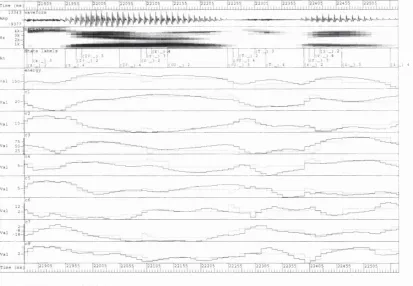
2.1 Wide-band spectrogram of an utterance of the words “zero one” 32
3.1 Generation o f sequences of observations by HMM states for frames and segments 38
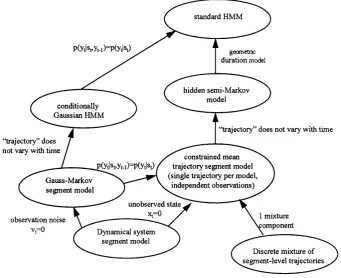
4.1 Family tree relating some different (Gaussian) stochastic models 72
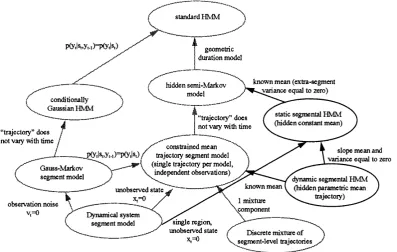
6.1 Modelling extra- and intra-segmental variability with a segmental HMM 88 6.2 Family tree showing relationship of GSHMMs with some other stochastic models 97
8.1 Log probability of the digit training set for simple static GSHMMs 118
9.1 Duration distributions for different model states 128
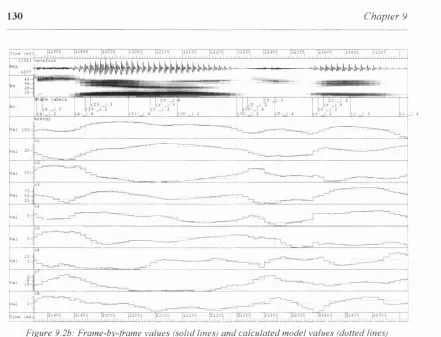
9.2 Frame-by-frame features with calculated values for different model assumptions 129 9.3 Distributions illustrating total variability for different model states 133 9.4 Distributions according to static and linear GSHMM assumptions 135 9.5 Target/mid-point distributions plotted for individual segment durations 136 9.6 Linear model slope distributions plotted for individual segment durations 137 9.7 Intra-segment distributions according to static GSHMM assumptions 139 9.8 Intra-segment distributions according to linear GSHMM assumptions 139 9.9 Intra-segment distributions for static GSFIMM assumptions (different durations) 140 9.10 Intra-segment distributions for linear GSHMM assumptions (different durations) 140
10.1 Log probability of digit training set for left-right and self-loop static GSHMMs 146 10.2 Duration distributions for HSMMs and left-right GSHMMs 148 10.3 Intra-segment distributions for left-right static GSHMMs 149 10.4 Intra-segment distributions for self-loop static GSHMMs 150 10.5 Log probability of digit training set for intra-segment mixture static GSHMMs 155 10.6 Intra-segment distributions for intra-segment mixture static GSHMMs 156 10.7 Duration distributions for intra-segment mixture static GSHMMs 157
11.4 Intra-segment distributions for flexible-slope linear GSHMMs 166 11.5 Intra-segment distributions for constrained-slope linear GSHMMs 167 11.6 Log probability of digit training set for intra-segment mixture linear GSHMMs 170 11.7 Slope distributions for flexible-slope intra-segment mixture linear GSHMMs 171 11.8 Intra-segment distributions for flexible-slope intra-segment mixture 171
linear GSHMMs
11.9 Intra-segment distributions for constrained-slope intra-segment mixture 171 linear GSHMMs
12.1 Value of the optimal-target correction term as a function of segment duration 181 12.2 Log probability of the digit training set for target-independent static GSHMMs 184 12.3 Value of the optimal-traj ectory correction term as a function of segment duration 188 12.4 Log probability of digit training set for trajectory-independent linear GSHMMs 191
List of tables
15
7.1 Connected-digit recogniti 7.2 Connected-digit recognit
8.1 Connected-digit recognit 8.2 Connected-digit recognit
10.1 Connected-digit recognit: 10.2 Connected-digit recognit:
11.1 11.2 11.3 12.1 12.2 12.3 13.1 13.2 13.3 13.4 Connected-digit recognit: Connected-digit recognit: Connected-digit recognit:
on results for standard HMMs (baseline)
ion results for different initialisation and training conditions
ion results for simple self-loop static GSHMMs ion results for two sets of improved standard HMMs
ion results for two sets of static GSHMMs
ion results for intra-segment mixture static GSHMMs
ion results for four sets of linear GSHMMs
ion results for intra-segment mixture linear GSHMMs ion results for constrained mean linear trajectory HSMMs
Cormected-digit recognition results for static GSHMMs (target-independent) Connected-digit recognition results for linear GSHMMs (trajectory-independent) Connected-digit recognition results for HMMs and HSMMs using time-derivatives
114 116 120 121 147 157 162 172 174 184 192 194
17
Chapter 1
Background and general aims
Over the last ten years there have been significant and steady advances in the capabilities of automatic speech recognition (ASR) technology, such that an acceptable level of performance can now be achieved on a variety of tasks within limited domains. Almost perfect accuracy can be obtained with speaker-independent isolated-digit recognition, and there are typically only 2-3% digit string errors when the digit sequence is spoken in a naturally connected manner by non-specific talkers (Juang and Rabiner, 1991). There have also been considerable achievements in recognition o f large vocabularies, and some systems for automatic dictation applications are now commercially available. Examples are ‘DragonDictate’ (Baker, 1991) and the dictation system developed by Philips (Steinbiss et al., 1995). Such systems typically achieve an acceptable level o f performance by being speaker-dependent and also by being designed for a specific application with a fairly predictable syntactic structure.
incorporation of increasingly sophisticated language models, as well as considerable refinements in the acoustic-phonetic models and acoustic feature sets.
Currently, the acoustic-phonetic components of the most successful large-vocabulary ASR systems are almost exclusively based on hidden Markov models (HMMs) of some phonetically-defined sub-word units, with a very similar specification for all the systems (a description o f one successful system is given by Young (1995)). The typical approach is to use a large inventory of context-dependent phone models, trained on a vast quantity of speech data. The models themselves tend to be gender-dependent but otherwise “speaker- independent”, possibly with on-line adaptation to any particular speaker. Using this approach, impressive performance has been achieved on recognition of read speech. For example, the lowest word error-rate of the 1994 ARP A evaluations was 7.2 % (Woodland et al., 1995), using a vocabulary of 65,000 words. However, the general level of performance dropped once the task was less controlled in terms o f recording conditions and speaking style, such that the best reported performance of the 1996 evaluations was an overall word error rate of 27.1% (Gauvain et al., 1997).
Background and general aims 19
Impressive word recognition performance has been achieved on a range of tasks by systems using HMMs, yet these models are simply general statistical pattern matchers. They do not take advantage of the constraints inherent in the speech production process and make certain assumptions which are inappropriate from a speech-modelling viewpoint. It seems plausible that the performance of HMMs as acoustic models for unconstrained recognition tasks is limited by this inability to model the characteristics of speech differently from those of any random signal. At the most general level, the motivation for the work described in this thesis has been to develop a more appropriate model as the basis for the acoustic-phonetic component of speech recognition systems. By constraining the model more according to the nature of the speech signal, the aim was to provide a more accurate description of different speech sounds. The constraints o f the model were intended to reduce the extent to which acoustic variation needs to be treated as random, and so were expected to lead to greater predictive power and hence improved discrimination capabilities.
When developing a new acoustic-phonetic model, it is important to consider how to evaluate it. From a practical viewpoint of automatic speech recognition, the ultimate aim is higher recognition accuracy. However, as pointed out by Bourlard (1995) at the EUROSPEECH conference (and expanded in Bourlard, Hermansky and Morgan, 1996), new paradigms cannot necessarily be expected to give performance gains immediately. Many years of research may be required before new models can compete with an established formalism. The general sentiment of Bourlard's presentation was an encouragement to explore new techniques, even if the immediate consequence is an increase in word error rate. This message is a valuable one, but of course what is really important is an understanding of the effects of modelling assumptions on the way in which speech sounds are represented and how this is reflected in acoustic matching scores and hence in recognition performance. Evaluating the relationship between modelling assumptions and behaviour in recognition tasks should be a powerful tool in the search for a new approach to training and recognition based on an accurate and constraining model for the characteristics of speech signals. The emphasis of the experiments described in this thesis has therefore been to gain insights into the modelling of speech patterns by performing these types o f evaluations for models which offer theoretical advantages over HMMs.
21
Chapter 2
HMMs as models of speech
2.1. Introduction
The basic HMM formalism does not take advantage of many of the well-known characteristics of speech, and in addition makes certain assumptions about the speech signal which are clearly incorrect. In view of the potentially quite serious disadvantages, this chapter considers issues of why these statistical models have actually been very successful for characterizing speech and why and how they provide a good starting point for developing a more appropriate model.'
2.2. Challenges for automatic speech recognition
The ASR task is to extract the underlying linguistic message from a complex acoustic pattern containing many sources of variability. Types of variability to be accommodated include: • Phonetic context effects, both from coarticulation with immediately surrounding sounds
and from larger context such as position in a whole sentence. • Differences between speakers due to sex, age, accent and so on.
• Occasion-to-occasion differences for any one speaker. These variations can arise from speed or loudness of speaking, effects of stress, or from having a cold or sore throat. • Environmental variations, such as the surrounding noise level. There may be noise which
masks some sounds, or even whole words.
A speech recognition system needs to treat the many possible variants of any one phoneme as the same, while being sensitive to the differences between different phonemes spoken by one
speaker in the same phonetic environment.
Understanding fluent spoken sentences is not simply a case of extracting the sequence of phonemes from the acoustic signal: this signal contains information at several levels, including syntax, semantics and pragmatics. By using information at all these different levels, it is possible to take advantage of the redundancy which exists in speech and so resolve any ambiguities at any one level and comprehend a message even when parts of it are missing. Ideally, a system for ASR should use the information at all these levels in order to assist with the difficult problem of coping with all the sources of acoustic variability.
2.3. Approaches to automatic speech recognition
Generally speaking, approaches to ASR can be divided into two types which can be classed as "knowledge-based" and "self-organizing" (Mariani, 1991). These terms reflect a contrast between systems which are based on explicit formulation of knowledge about thé characteristics of different speech sounds, and systems where a much more general framework is used and the parameters are learned from training data.
2.3.1 Knowledge-based approaches
HMMs as models o f speech 23
approach is that it is inevitably limited by the accuracy of the acoustic-phonetic decoding: it is still not possible to reliably extract phonetic information from the speech signal.
More recently, several systems have been developed based on "expert systems" modelling the human ability to interpret spectrograms or other visual representations of the speech signal (see O'Brien (1993) for a review). Such systems separate the knowledge that is to be used in a reasoning process from the reasoning mechanism which operates on that knowledge. The knowledge is usually manually entered, and is based on the existence of particular features (such as "a silence followed by a burst followed by noise" for an aspirated voiceless stop). A vast amount of knowledge would be needed for speaker-independent continuous speech recognition of large vocabularies (Mariani, 1991). The problem with a system based on a large set of rules is that it is difficult to imagine all of the ways in which the rules are interdependent, so inevitably some rules compete with each other to explain the same phenomenon while others are in direct contradiction (Levinson, 1985a).
Some knowledge-based systems have been developed which reduce this problem by specifying only the set of features to be used: the values of the features and the weights given to different features in the recognition process are learned from training data. An example of this type of approach is Allerhand's (1987) knowledge-based statistical classifier. The success of this approach is however still very dependent on appropriate selection of the feature set and on the correct extraction o f these features from the acoustic data.
2.3.2 Self-organizing approaches
relevant word, based either on computing an average over all examples or on selecting the most representative example according to some distance criterion. For speaker-independent recognizers, which need to recognize a wide range of speakers' voices, templates can be derived from examples of the words spoken by a variety o f different speakers. For each word, a clustering algorithm can be applied to the examples, in order to generate a set of templates which represent the main different pronunciations of that word.
Template matching was the predominant approach to ASR from the late 1970s up until the mid 1980s, and was the basis for most commercial systems during this period (for example, recognizers produced by Votan). In this period almost all commercial systems were speaker- dependent. Good recognition performance was achieved with constrained tasks for which the vocabulary was quite small and words were spoken in isolated form. However, performance deteriorated for tasks involving larger vocabularies or connected speech. This deterioration is a result of inherent limitations in the nature of the approach. There is some allowance for variations in pronunciation and speaking rate by using multiple reference templates and applying dynamic programming in recognition. In real speech, however, there will be a range of plausible variants of each speech sound, some of which are more likely than others. The extent and type of possible variation, both in time scale and in spectrum, will be different for different sounds.
HMMs as models o f speech 25
speaker (Young, 1995). These systems use sub-word units and a statistical language model together with huge quantities of training data.
There are also approaches to ASR, with origins in work on artificial intelligence and parallel computation, which use Artificial Neural Networks such as multi-layer perceptrons (MLPs). An MLP consists o f a network of interconnecting units, with an input layer, an output layer and one or more hidden layers. The output units represent the set of speech units to be recognized, and the recognition process relies on the weights of the connections between the units. The connection weights are trained in a procedure whereby input patterns are associated with output labels. MLPs are therefore learning machines in the same way that HMMs are, but have the advantage that the learning process maximizes discrimination ability, rather than just accurately modelling each class separately. However, MLPs have a serious disadvantage in that, unlike HMMs, they are unable to deal easily with the time-sequential nature of speech. Good recognition results have been reported for isolated-word recognition (e.g. Peeling and Moore, 1988) by storing the entire input sequence to be recognized in a buffer at the input to the MLP. The problem is that this approach does not generalize to connected speech or to any task which requires finding the best explanation of an input pattern in terms of a sequence of output classes. To circumvent this problem, there has been an interest in approaches which are a hybrid o f HMMs and neural networks. These are discussed further in Section 2.6, as they are in fact one way of improving HMM systems.
As an underlying approach, the HMM framework has so far shown clear performance superiority over alternative recognition structures. The existence of simple-to-implement, elegant and efficient algorithms for both training and recognition has been suggested as the reason for the popularity and success of the approach (e.g. Gales and Young, 1993a). General appropriateness of the models for characterizing speech is however obviously also important for them to be successful. It is therefore useful to briefly consider models of human speech perception, before discussing in more detail possible justifications for tackling speech recognition by machine from an HMM framework.
2.4. Relating ASR approaches to speech perception models
considerably better than that offered by current technology. An accurate, complete model of human speech perception in a form amenable to computational simulation would obviously be relevant for approaches to ASR. A variety of models for various aspects of speech perception have been proposed from different theoretical viewpoints (see Klatt (1989) for a review, and Allen (1994) for an up-to-date re-evaluation of some very early work by Fletcher (1953)). Many of these models, proposed in the context of speech perception, have strong parallels with a corresponding approach to ASR. A few examples are considered here.
There have been a number of attempts to specify "phonetic features" and ways that they might be extracted from the acoustic signal (e.g. Pisoni and Luce, 1987). These approaches suffer the same limitations as knowledge-based approaches to ASR, in that they are dependent on the ability to reliably identify meaningful features: there has been only limited success in specifying a useful set of features that can be consistently extracted (Klatt, 1986).
An alternative model of perception, LAFS (Lexical Access From Spectra), was suggested by Klatt (1979, 1986), influenced by some aspects of the computational strategies created in the ARP A speech-understanding project (Klatt, 1977). This model originated from the belief that
HMMs as models o f speech 27
powerful enough to make fine phonetic discriminations in the face of the kinds of spectral variability seen in real data.
Models based on neural networks are inherently attractive from a perception viewpoint, due to the rather naive analogy with the architecture of the human brain. One model which grew out of work in the area o f parallel distributed processing (PDF) is the TRACE model (McClelland and Elman, 1986). The PDF philosophy of distributing knowledge through a network of interacting units was seen as a natural way to capture the integration of multiple sources of information in speech perception. The TRACE model involves a very large number of units organized into three levels: the feature, phoneme and word levels. The network is highly interconnected with bi-directional facilitory connections between levels that share common properties (e.g. between a word and the phonemes composing that word), and inhibitory connections within levels (e.g. if fh! is activated it will tend to suppress activity for related phonemes, such as /p/). The entire network of units is called the trace, because the pattern of activation left by a spoken input is a trace of the analysis of the input at each of the three processing levels. The positive feedback paths between the phonemic level and the lexical level can be used to explain our perceptual bias towards hearing phonetic patterns that make up real words and the fact that we can sometimes make early decisions about lexical candidates even though the entire word has not yet been heard. A simulation was implemented, and McClelland and Elman have argued that it showed characteristics which are appropriate for what is known about human speech perception. Although there are attractive aspects of the TRACE model, there are also some quite serious problems: as with any feature-based approach, there is dependence on being able to extract appropriate features from the acoustic signal. However, the main problem with the model is that, like other neural network approaches to speech recognition, it does not provide any real modelling of temporal variability in speech.
2.5. Advantages of HMMs as an approach to ASR
This section discusses the reasons for the success of the HMM approach to ASR in more detail, by considering the issue from three perspectives:
• Architecture: Basic characteristics of the mathematical framework that are useful for speech recognition.
• Completeness: Advantages of providing a complete (even if not very accurate) description of speech signals, as an alternative to the knowledge-based approach of representing specific characteristics of different speech sounds.
• Flexibility: Ways in which speech knowledge can be incorporated into HMMs, in the form of constraints on the basic flexible structure.
2.5.1 Architecture
The HMM methodology provides a tractable mathematical structure that can be examined and studied analytically; it includes the provision of straightforward algorithms for training and recognition. In the model, the short-time spectral characteristics (associated with the individual states) and the temporal relationship among the processes (the Markov chain) are treated as separate aspects of a single dynamic process (i.e. speech) using one consistent framework. The combination o f these two aspects is such that the calculation of the probability of a given set of observations being produced by a particular model can be decomposed simply into a summation o f the joint probability of the observations and the state sequence, either taken over all state sequences (total likelihood) or Just the most likely state sequence (maximum likelihood). Therefore, when performing recognition, the segmentation of an utterance arises automatically as a simultaneous part of the recognition process. Similarly, a set of models can be trained given a set of labelled, but not necessarily pre-segmented, speech data.
HMMs as models o f speech 29
in turn act as the "states" in syntax models, which can even be part of a higher level which uses semantics to provide dialogue control. Thus, the HMM framework allows for an integrated recognition system whereby the best match is found at all levels simultaneously, taking into account constraints imposed at each level. As Levinson (1985b) pointed out, this use of multiple constraints has the great advantage o f increasing redundancy as all levels contribute, and so reliability of classification should be improved. The integration of all the levels also has the property of delayed decision making which, as pointed out by Klatt (1989) in relation to human speech perception, is very desirable as it eliminates problems which might arise if the input to a level contains errors which have been introduced at a separate lower level. By making only one decision, all the information is available to all levels of modelling.
2.5.2 Completeness
The comparatively poor recognition performance shown by knowledge-based ASR systems is generally agreed to be due to the difficulties involved in specifying all the required knowledge for performing speech recognition in an appropriate way, combined with the fact that this knowledge is still limited and may even sometimes be erroneous. These observations led Makhoul and Schwartz (1986) to point out the advantages of "ignorance modelling", whereby the parameters of a model are automatically trained using a large amount of training data but very little speech knowledge, apart from a general structure which integrates the modelling of both spectral and temporal variation. The training process determines the important model characteristics based on optimizing the models for the given data, using some objective criterion by which all the model parameters are trained consistently. Zue (1985) has argued for the incorporation of speech knowledge to improve standard recognition algorithms, while also pointing out that, where such knowledge is limited, "sophisticated ignorance models can make optimal use of whatever knowledge we do have".
HMMs as being a powerful theory of speech. However, he does point out that specialized knowledge about speech can and should be used to constrain the models by limiting the number of degrees of freedom.
2.5.3 Flexibility
The performance of the flexible model structure provided by HMMs can be improved by appropriate use of speech knowledge within the stochastic modelling framework (Lee, 1988). All of the successful current HMM-based recognition systems use knowledge about speech to some extent. For example, it is usual to choose a method o f acoustic feature analysis which enhances phonetically important spectral characteristics while being relatively insensitive to spectral differences which do not reflect differences in meaning, such as pitch and overall loudness. It is also common to use a perceptually-motivated frequency scale, such as the mel scale, which uses a finer frequency resolution for low frequencies than high frequencies. In addition to the static spectral feature vectors computed for each frame, most systems also include some form of dynamic features in order to capture phonetically-important temporal changes in the spectra. First-order dynamic feature vectors are typically calculated either by deterniining the rate of change of the static vectors over a duration of around 50 ms (Furui, 1986), or by simple differencing between the values for two frames (Lee, 1988). Many large- vocabulary systems now also include second-order time derivative features (e.g. Young, 1995), so as to represent information about change in rate of spectral change, which is likely to be particularly useful in regions of major acoustic-phonetic boundaries.
HMMs as models o f speech 31
whole-word models, as only the phonologically relevant parts of words will be represented by different models.
The fact that the HMM is an inherently time-sequential generative model means that the changing speech signal can easily be related to a progression through the states. It is usual to allow only a subset o f the possible transitions between the states, by using fairly simple left-to- right models which allow for time scale variability by including self-loop transitions and possibly also skip transitions so that some acoustic segments are optional. Furthermore, it is possible to tailor the structure of the model for each individual sound; the model topology and the number of states in each model can be allocated according to the typical duration, spectral complexity and variability of the sound being modelled (Holmes, 1991). All the above ways of using HMMs are constraining the basic flexible model to reflect known characteristics of speech signals.
2.6. HMM limitations and possibie improvements
In the previous section it has been argued that, in addition to their practical advantages in providing an easy-to-implement, sound mathematical framework for building ASR systems, HMMs are in fact useful as a basis for speech modelling. They provide a flexible framework, which can be constrained by knowledge about the nature o f the speech they are being used to model, but with the model parameters learned from training data. This type of approach avoids the inevitable problems which arise when trying to actually specify knowledge about speech in a way which is useful for a speech recognizer. In terms of general principle, self organizing approaches to ASR are comparable with the human language acquisition process: we may be predisposed towards recognizing speech-like sounds, but the learning itself is dependent on hearing spoken language. This learning process results in "knowledge" about speech which is implicit, as it is with trained statistical models.
m odelling, but there are also asp ects o f the acou stic-p hon etic m odelling w hich can be improved. A lthough the H M M structure is typ ically constrained so that it is m ore appropnate for m odelling speech, the fram ework still treats a large part o f the acou stic variation in speech as random (M oore, 1994) and therefore unpredictable. H ow ever, a spectral representation such as the w ide-band spectrogram show n in Figure 2.1 reflects the characteristics o f speech production, in that the spectrum changes continuously in a w a y w hich is m ostly sm ooth so that there is a considerable elem ent o f predictability.
19 9 0 w
5 k (49dBf^
3 0 . 6 2 9 . 9
Time ( s )
Figure 2.1: W ide-ban d sp ectro g ra m o f an u tteran ce o f the w ords “ze ro o n e ” (49 dB d yn a m ic range). P honem e sym b o ls a re shown a b o v e the spectrogram .
For the H M M form alism , there are som e fundam ental asp ects o f the m odels th em selves w hich are actually at variance with w hat w e do know about the nature o f speech production and its relationship w ith acou stic realisation. In particular, the follow in g three assu m p tions w hich are made by the H M M form alism are clearly inappropriate for m odelling speech patterns:
• P ie c e -w ise sta tio n a r ity The H M M fram ework assu m es that a sp eech pattern is produced by a p iece-w ise stationary p rocess, w ith instantaneous transitions betw een stationary states. This is in direct contradiction with the fact that speech patterns are derived from signals produced by a con tinu ously m oving p hysical system - the vocal tract.
• T h e in d e p e n d en ce a ssu m p tio n In H M M s, the probability o f a given aco u stic vector corresponding to a given state depends only on the vector and the state, and is otherw ise
HMMs as models o f speech 33
takes no account of the dynamic constraints of the physical system which has generated a particular sequence of acoustic data, except inasmuch as these can be incorporated in the feature vector associated with a state. In a typical speaker-independent HMM recogniser where each modelling unit is represented by a multi-modal Gaussian distribution to include all speakers, the model in effect treats each frame of data as if it may have been spoken by a different speaker.
State duration distribution A consequence of the independence assumption is that the probability of a model staying in the same state for several frames is determined only by the self-loop transition probability. Thus the state duration in an HMM conforms to a geometric probability density function (pdf) which assigns maximum probability to a duration of one frame and exponentially decreasing probabilities to longer durations.
The impact of these inappropriate assumptions can be reduced by, for example, using a fairly generous allocation of states which allows a sequence of piece-wise stationary segments to better approximate the dynamics and also makes a duration of one frame per state more appropriate. The improved recognition performance which has been demonstrated from using variable frame-rate (VFR) analysis (Peeling and Ponting, 1991) can also be regarded as a way of reducing the impact of the erroneous HMM assumptions. VFR analysis is used to replace sequences of similar vectors by a representative single vector. Vectors in the relatively stationary regions of speech patterns are highly correlated, which is contrary to the independence assumption. Discarding vectors in these regions results in observation sequences which are more consistent with the formalism, and also has the effect that the (phonetically important) dynamic regions will have more influence in the recognition process.
differences. Linear discriminant analysis was used to reduce the dimensionality of the total feature space to a manageable level. All of the above techniques provide a way of compensating to some extent for the model’s treatment of successive frames as independent, which is achieved by representing the dependencies within the acoustic features. However, although such techniques have been shown to be of practical benefit in improving recognition performance, the independence assumption actually becomes even less valid because the observed data for any one frame are used to contribute to a time span of several feature vectors.
Rather than trying to modify the data to fit the model, it should be better to make the model more appropriate for speech signals. The inappropriate assumptions of HMMs are linked with their frame-synchronous characteristic, whereby states are associated with single acoustic feature vectors. In order to improve the underlying model, it is really necessary somehow to incorporate the concept of modelling frame sequences rather than individual frames. Artificial Neural Networks such as the MLP provide a potential solution to this problem: unlike HMMs, they do not need to treat successive features as independent, as they can incorporate multiple constraints and find optimal combinations of constraints for classification. However, as explained in Section 2.3, they have difficulty in modelling the time-sequential nature of speech and have therefore not been very successful at recognizing cormected utterances. To avoid this problem, most of the recent work using neural networks has focused on using hybrid systems which exploit the advantages of connectionist models while preserving the HMM formalism to integrate over time and to segment continuous speech (Bourlard, Morgan and Renais, 1992). One approach has been to use a neural network as a post-processing stage to an N-best HMM system (Austin, Zavaliagkos, Makhoul and Schwartz, 1992). An alternative is to use MLPs to compute HMM emission probabilities (Morgan and Bourlard, 1990) with better discriminant properties and without any hypotheses about the statistical distribution of the data. Long-term context can be represented efficiently by incorporating of feedback into the MLP, so giving a recurrent net (Robinson, 1994). By using a recurrent net for phone probability estimation in an HMM system, Robinson reported results on phone recognition of TIMIT data which are better than those typically obtained with conventional HMM systems.
HMMs as models o f speech 35
of this type should effectively impose further speech-like constraints on the allowed parameters and should ultimately require less parameters than standard HMMs or combined HMM/MLP systems. The overall aim for such a model should be to provide an accurate model of speech dynamics across an utterance, with an appropriate representation o f variability which takes into account predictable factors such as speaker continuity.
2.7. Conclusions
37
Chapter 3
Modelling speech segments
3.1. Introduction
From the perspective of segmental modelling for automatic speech recognition, the term “segment” will be taken as referring to any sequence of frames representing some linguistically meaningful speech unit. Typically, these units correspond to phones or to sub-components of phones, but other units such as diphones have been used (e.g. Ghitza and Sondhi, 1993). The choice of unit does not affect the probabilistic formalism, but is important when considering the most appropriate way of describing the acoustic feature dynamics. In addition, longer units have advantages in providing greater constraints on the pattern of the features over time, but have computational disadvantages due to the greater variability in length that must be accommodated and the larger number o f units needed to describe a language.
3.2. General segment-modelling framework
The task of recognising a word sequence with any statistical model involves fmding the
sequence of labels that is most likely given a sequence of acoustic feature
vectors y f . This task can be formulated as follows :
=argmax p { u ^ \ y ' () = argmax p { u ^ ) . p { y j| w ^ ) .
N ,u \ N ,u\
Any one label w, can correspond to a word or to any other unit (such as a phone or sub component of a phone) that can be mapped to a word sequence. The above equation uses Bayes’ theorem to express the probability of a label sequence given the acoustic observations
H M M s provide one w ay o f calculating acou stic m odel probabilities ( o f observations given m odels), and the focu s here is on segm ent-based approaches to com puting these p rob ab ilities’,
H M M probability calcu lations are performed on a fram e by fram e b asis, and an H M M state is thus associated with a sin gle acou stic feature vector j v In contrast, a segm ent m odel describes a variable-length segm ent y = { > v , . . . , y ^ } ( 5 > r > r , y ^ e m u lti-d im e n sio n a l sp ace F ) . This
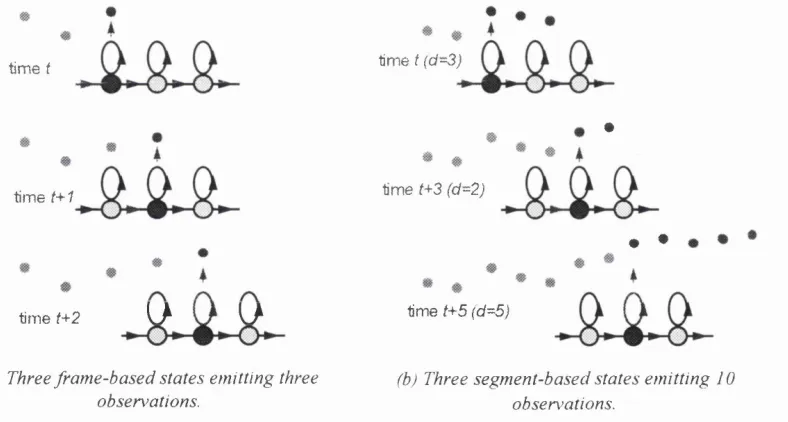
difference betw een the tw o m odels is illustrated in Figure 3.1 from the perspective o f a generative m odel o f speech. In H M M s, the on ly sequence constraints are provided by the p ossib le state sequences in the underlying M arkov chain. On the other hand, segm ental m odels
provide a fram ework for exp licitly incorporating w ithin-segm ent dependencies and segm ent duration constraints. It is usual for p ossib le sequences o f segm ents to be controlled w ith a M arkov chain, but for segm ents to be otherw ise treated as independent.
time t
time t+1
time t (d-3)
#
time t+3 (d-2)
• •
tim e f+ 2 L A L A time t+ 5 (d = 5 j
(a) Three fr a m e -b a s e d sta te s em ittin g three (b) Three se g m e n t-b a se d sta te s em ittin g 10
obsen m tion s. observation s.
F igure 3.1: G en eration o f seq u en ces o f o b se rv a tio n s b y H M M s ta te s a s s o c ia te d with (a) in d ivid u a l fr a m e s a n d (b) v a ria b le-d u ra tio n seq u en ces (" se g m e n ts”) o ffr a m e s , using the sam e m ode! topology’ with tra n sitio n s on to the n ext sta te a n d ba ck to the sam e state. In both cases, the illu s tr a te d p r o c e s s sta rts in sta te I, m a k es a tran isition to sta te 2 a n d then m a k es a self-lo o p tran sition b a c k to s ta te 2.
’ Most segm ent m odels use this concept o f computing the probabilities o f observations given labels
{P(y\u))-One exception is the use o f a posteriori distribution m odelling (see Section 4.2), whereby P { u y ) is
Modelling speech segments 39
A general segment model specifies the probability for a sequence of / observations y \ = y y I being generated by a model unit i, according to the density
P { y \ , . . . , y i , l \ 0 = P { y \ , . . . , y i I / , 0 • ^ ( / 10 = b i i { y [ ) . P{ l \ t ) .
The model for segment i thus has two components:
• A duration distribution P{1 |/) which specifies the likelihood for a segment duration of / frames, where / e j , the set of all possible durations.
• A family of output densities !^ ij{ y \)',l which represents likelihoods of all possible
observation sequences, where these sequences are of variable duration. The model can optionally include an explicit representation of the effect of variation in segment length / on the trajectory realisation.
3.2.1 Segment-model notation and probability calculations
A segment model can be expressed as an extended, more general form of HMM, whereby a model unit M is represented by a sequence of N segments corresponding to states a , (/ = 1,...,A) in a Markov chain. The generative process can be visualised as follows: at some time ti, the process enters state o y and randomly selects a duration I according to the duration distribution P{1 |/). It then produces a sequence of / acoustic vectors according to the pdf bi i . Then at time it randomly moves from state o , to state a y according to a state transition probability matrix A.
Consider an observation sequence y = y \,...,y T iy t and a particular state sequence x = x i ,. .. ,x s (x_5 6 {a 1,...,o ^ }) with S distinct state occupancies. Each state occupancy Xs
is associated with an entry time =1; 1 < < T for 5 = 2,...,5') and the sum of the durations o f the individual state occupancies must be equal to T. Assuming that there is only one possible starting state X], the joint probability o f y and x given model M is:
S
3.2.2 Recognition and training with segment modeis
Although the details depend on the characteristics of individual segment models, the principles of training and recognition extend quite straightforwardly from HMMs to segment-based models (Ostendorf, Digalakis and Kimball, 1996). As already explained, the recognition task for a statistical model involves finding the most likely sequence of labels given a sequence of acoustic feature vectors, the probability o f which can be separated out into a probability for the language model and a probability for the acoustic model. The usual approach to computing the acoustic-model probability for a given model (P(y\M)) is to use Viterbi decoding to compute the joint probability P(y,x\M) for the most likely state sequence, thus:
P{y\M ) = m sx P {y,x\M) . X
The above probability can be computed efficiently by dynamic programming, thus: first define (()f(/) to be the probability of the first t observations y\,...,yt for the most likely state sequence (with associated segmentation) ending with the f " state at time t such that a transition occurs between times t and t+1. The quantity ())((/) can be calculated recursively as follows,
4 > f ( ; ) = m a x I m a x {(|)6 ( / ) . a ^ .6y ) . f ( ( r - Ô ) | y ) } l (3.1)
where D represents the maximum segment duration (which may be state-dependent). The value of P(y[iW) is then given by the highest value of (j)?- ( j), considered for all possible ending states in the model M. The dynamic programming operation can also be applied across model units (with the inclusion of language-model probabilities), so enabling the most likely unit sequence to be identified.
The Viterbi recognition algorithm is more computationally intensive for segment models than for HMMs, as can be seen by comparing the above expression (3.1) for (j), {j) with the corresponding HMM-based expression, which is as follows:
max{(()^_i(O.üTÿ.A ( y j ) .
Modelling speech segments 41
computation associated with a full optimal search is therefore effectively multiplied by the maximum segment duration, in addition to any increased cost associated with calculating the segment-based output probabilities themselves. The segment modelling search cost can be reduced by adopting some technique whereby only a subset of possible segmentations are considered (e.g. Digalakis, Ostendorf and Rohlicek, 1992). Another possibility is to adopt a multi-pass approach, whereby an HMM system first generates a set of sentence hypotheses which can then be rescored by a segment model (e.g. Richardson, Ostendorf and Rohlicek, 1995). Any method of reducing the search space may of course introduce some errors, but at the same time can give considerable savings in computation time. However, as the aim of the current work was to investigate the properties of the segment models themselves, it was not considered appropriate to risk introducing any search errors and a full search was used for all the experiments described in this thesis.
The training task is to compute suitable values for the model parameters given a quantity of representative speech data. It is usual to assume that the model unit sequence is known (or at least tightly constrained, with just a few alternative word pronunciations for example), but that the locations of the boundaries between the units are not known. A typical training criterion is one of maximum likelihood, whereby the aim is to determine model parameters that maximise the probability P(y|A/). Due to the hidden state component associated with both HMMs and probabilistic segment models, the optimum values for the model parameters cannot be computed directly and some form of iterative re-estimation algorithm is required.
Ostendorf et al. (1996). The effect on computation is similar to that encountered in recognition, as re-estimation for segment models incurs additional computational cost associated with the need to consider at each frame time all durations for all possible segment labels.
3.3. Example of a simple segment model
Considering the nature of the segment model itself, the simplest distribution assumption involves using a single output distribution and assuming that successive observed frames are independent and identically distributed within given segment boundaries. The probability of the observed segment given state i and duration / is then simply the product of the probabilities of each individual observation, hence;
I 0 -t=\
The segment model thus reduces to a one-state HMM with the advantage of an explicit duration model in place of the typical implicit geometric HMM duration model. This model has been described as a hidden “semi-Markov” model (Russell and Moore, 1985) and as a continuously variable duration HMM (Levinson, 1986). To obtain the full benefit from the segmental framework it is however necessary to adopt more appropriate distribution assumptions in b^ i, to specify the probability of the sequence of observations in a segment. The development of a suitable model for the output distribution across a segment has the potential to offer much greater benefits than is possible with improved duration modelling alone. The current HMM representation of observation probabilities is not sufficiently accurate for duration probabilities to have a great influence on the total probability calculation. The following section discusses durations briefly, and the remainder of the thesis then concentrates on acoustic distribution modelling.
3.4. Duration modelling
Modelling speech segments 43
duration variation, but can be difficult to train robustly and need to be smoothed to avoid being too influenced by chance variations in the training data (Ostendorf, Kannan, Kimball and Rohlicek, 1992). Examples of parametric models which have been investigated are the Poisson distribution (Russell and Moore, 1985) and the gamma distribution (Levinson, 1986). These distributions have the advantage of using a small number of parameters to provide a plausible and general model. In practice, any reasonable distribution can perform well by disallowing completely implausible segment durations and providing some assistance in cases where alternative models are not well-distinguished by spectral match alone. The detailed shape of the duration distribution does not have much influence in a typical current recognition system because the contribution of the duration probability is small relative to the segment observation probability.
3.5. Acoustic feature modelling
An ideal model of observation distributions needs to incorporate appropriate constraints such that it only allows patterns which are appropriate for speech signals, while maximising distinctions between different sounds. At the same time, it is important to retain the practical advantages of the HMM approach, including automatic training from speech data and simultaneous segmentation with recognition, in models which use a manageable number of free parameters and have feasible computational requirements. A successful model should be one which effectively represents the constraints and characteristics of speech production in such a way that it can (automatically) make best use of a sensible quantity of training data. An accurate representation of the systematic variability associated with the dynamic nature of speech will reduce the proportion of the total acoustic variation which has to be treated as random and should thus provide models with good discriminative power.
When developing a model of speech dynamics and the associated variability within a segmental modelling framework, several issues need to be considered from the perspectives both of speech modelling and of practicality. These issues include the following questions:
2. What is the best type and size of model unit to use with segment models? 3. Should the trajectory be hidden or directly observed?
4. How should within-segment correlations between successive features be modelled?
5. How should segment length affect the realisation of the trajectory describing the evolution of acoustic features over time?
6. How can correlations and dependencies across segment boundaries be represented?
7. Which is the most appropriate way to represent speaker-dependent effects on the realisation o f trajectories?
8. Which are the best acoustic features to use with segment models?
45
Chapter 4
Approaches to modelling feature dynamics
4.1. Introduction
In this chapter, approaches to segment modelling are reviewed in some detail, to provide the necessary background for the development of the new modelling approach which has formed the basis of the current work. The extent and variety o f different segment-modelling approaches is such that the review is extensive, but the main characteristics and the relationships between different models are summarised in Section 4.9 at the end of the chapter.
When considering different approaches to segment modelling, it is helpful to categorise them into general types based on the nature of the model used to represent feature dynamics. A useful categorisation of this type is provided by Ostendorf, Digalakis and Kimball (1996), in their comprehensive review of segment-modelling approaches. In the following description, their terminology for categorising different representations of dynamics has been adopted’. The models of segment dynamics have been divided into seven general types. The first category represents models which rely on segmental features, derived by transforming sequences of frame-based acoustic feature vectors. The other six types o f model all represent sequences of frame-based feature vectors. The simplest o f these characterises a segment by a
single sequence of distributions (constrained mean trajectory) but assumes that the observations are independent given the position in the sequence. This model can be elaborated to incorporate correlations to represent the relationship between the observations in a sequence. A different type of representation is provided by approaches using conditional observation probabilities, which provide a more restricted model of correlations by describing direct (linear) dependencies of a current observation on specific previous observations. A linear model which is more robust to variation in the dependencies is provided by dynamical system approaches. An alternative is to use a nonlinear model of the dependencies between observations. Instead of or as well as modelling the relationship between successive features, it is possible to model systematic variation in the underlying trajectory by including multiple trajectories for any one model unit. The inclusion of different trajectories can be achieved either with multiple mixture components at the segment level or by some other representation of alternative trajectories.
4.2. Segmental features
A major initial motivating factor for the development of “segmental” acoustic models was probably the opportunity to exploit acoustic features which are apparent at the segmental but not at the frame level. For example, the segmental-modelling work of Zue and his colleagues at MIT (e.g. Zue, Glass, Philips and Seneff, 1989; Meng and Zue, 1991) was driven by the goal of using linguistically-defined distinctive features such as voicing. On a vowel classification task, Meng and Zue demonstrated similar performance using either extracted acoustic attributes or the original spectral representation as input to an MLP classifier. This approach is critically dependent on the ability to reliably extract the required segmental features for all acoustic variation across different examples representing the same model unit.