Short communication
Cognitive performance and liver function among recently
abstinent alcohol abusers
John F. O’Mahony*
School of Psychology, University of New England, Armidale, NSW, 2351 Australia St. Patrick’s Hospital, Dublin, Ireland
Abstract
It has frequently been suggested that some of the enduring subtle cognitive impairments seen in sober alcohol-dependent persons may be a result of subclinical liver dysfunction. Cognitive performance and liver function among 85 recently abstinent alcohol-dependent persons were assessed by means of a neuropsychological examination and the GGT test of liver function. Unlike some previous studies, no relationships were found between the two areas of functioning. It is argued that lack of statistical power did not account for the failure to find an association between the two domains. The proposition that residual cognitive impairment in abstinent alcoholic persons is (partly) mediated by earlier liver dysfunction rests on slight empirical foundations and remains speculative.
D2004 Elsevier Ltd. All rights reserved.
Keywords:Cognitive impairment; Liver function; Alcohol abuse
1. Introduction
A number of studies have examined the relationship between subtle liver dysfunction, evidenced only by laboratory tests, and cognitive impairment.Irwin et al. (1989) found that alcoholics without overt liver disease, but who showed abnormal liver functioning (by GGT > 40 IU/l) performed less well on four neuropsychological tests than those with normal GGT readings.Richardson et al. (1991)found that alcoholics, without overt liver disease but with elevated (>80 IU/l) GGT tests on hospital admission scored more poorly on a variety of
0306-4603/$ – see front matterD2004 Elsevier Ltd. All rights reserved. doi:10.1016/j.addbeh.2004.05.008
* Tel.: +61-2-6773-3764; fax: +61-2-6773-3820.
neuropsychological tests administered 21 days after last drink. Schafer et al. (1991), whose sample partially overlapped that of Irwin et al., also screened their alcoholic participants for overt liver disease and found that liver impairment (measured by bilirubin direct) on admission to an inpatient treatment program predicted poorer concurrent performance on two out of four neuropsychological tests, after controlling for age and vocabulary. Taken severally, these studies suggest an association between subclinical liver malfunction and neuropsychological performance when these are measured at about the same time and in the context of very recent alcohol consumption. However, the evidence is not quite consistent.
Walton and Bowden (1997) examined 47 alcohol-dependent males who had been abstinent for an average of 3 weeks, and found no reliable or substantial association between a variety of measures of liver function, including serum albumin and GGT, and several cognitive tests. Additionally, Schafer et al. failed to find a liver/neuropsychological-function association after 28 days of inpatient treatment, or at 3-month follow-up. These negative findings question the existence of a link between liver dysfunction (measured at any time) and residual cognitive impairment. This study provides data bearing on the issue.
2. Method
2.1. Participants
The sample consisted of 85 outpatients of an Irish private psychiatric hospital selected from a total of 136 referrals for examination of suspected cognitive impairment secondary to alcohol abuse. All had a firm diagnosis of the alcohol dependence syndrome (ADS) according to ICD-9 criteria. Exclusion criteria for the study were as follows: (i) a primary diagnosis other than that of ADS; (ii) history of head injury, cerebrovascular accident, or illness (including frank liver disease), which could potentially affect neuropsychological function-ing; (iii) history of psychotropic drug abuse, apart from alcohol; and (iv) less than 3 weeks abstinence from alcohol prior to neuropsychological examination. Of the sample, 74% were male; the mean age was 54 years (S.D. = 13).
2.2. Measures
The examination schedule consisted of subtests from the WAIS and the WAIS-R: digit symbol, block design, and digit span, selected for their established sensitivity as measures of alcoholic cognitive impairment; and vocabulary and picture completion as indicators of premorbid intellectual functioning (Chelune & Parker, 1981). The WAIS was used with 49 participants; the WAIS-R, over a somewhat later period, had 36 participants. Memory was measured by Russell’s (1988) adaptation of the logical memory and visual reproduction subtests of the Wechsler Memory Scale. Trail making tests A and B, which are sensitive to the effects of alcohol abuse (Chelune & Parker, 1981), were also administered.
measure of liver function on admission to the program in the standard hospital package of laboratory tests was GGT. The examiner was blind to the results of the GGT test.
2.3. Data treatment
Using manual and other appropriate norms, all cognitive test scores were age adjusted and expressed as scores from distributions with means of 10 and standard deviations of 3. Abnormal GGT was defined by hospital policy as >56 IU/l.
3. Results
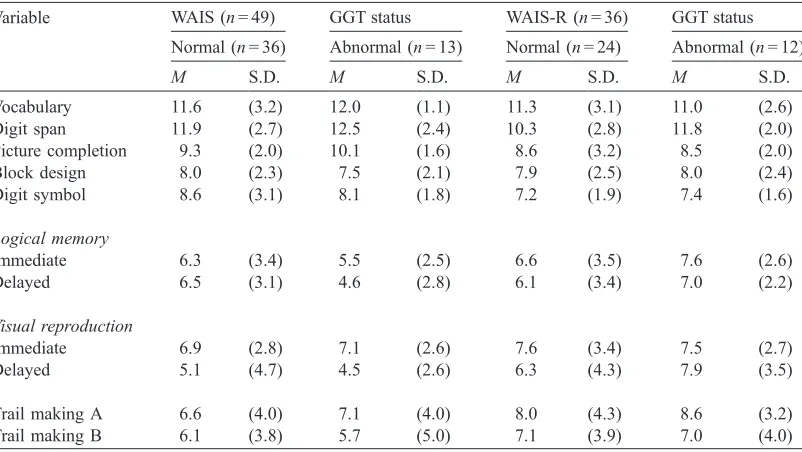
Scores on the cognitive tests appear in Table 1. Both the WAIS and the WAIS-R tests differed significantly from the manual age-graded normative populations withM= 10, S.D. = 3 [for the WAIS group, multivariate F(5,29) = 23.1, P< .001; for the WAIS-R group, multi-variateF(5,29) = 28.2,P< .001]. Follow-up z tests with P set at .01 to achieve experimenter-wise a< .05 showed that, for both groups, relative to the norm of 10, participants scored significantly higher on vocabulary and significantly lower on block design and digit symbol. An analysis of the memory and trails variables for both WAIS groups combined also demonstrated a significant departure from a normative 10 [multivariate F(6,53) = 24.1,
P< .001]. Follow-upztests withPset at .007 to achieve experimenterwiseaofP< .05 showed that, in every case, the memory and trials variables were significantly less than a normative 10.
Table 1
Means and standard deviations on age-scaled cognitive variables for persons with and without liver dysfunction
Variable WAIS (n= 49) GGT status WAIS-R (n= 36) GGT status
Normal (n= 36) Abnormal (n= 13) Normal (n= 24) Abnormal (n= 12)
M S.D. M S.D. M S.D. M S.D.
Vocabulary 11.6 (3.2) 12.0 (1.1) 11.3 (3.1) 11.0 (2.6) Digit span 11.9 (2.7) 12.5 (2.4) 10.3 (2.8) 11.8 (2.0) Picture completion 9.3 (2.0) 10.1 (1.6) 8.6 (3.2) 8.5 (2.0) Block design 8.0 (2.3) 7.5 (2.1) 7.9 (2.5) 8.0 (2.4) Digit symbol 8.6 (3.1) 8.1 (1.8) 7.2 (1.9) 7.4 (1.6)
Logical memory
Immediate 6.3 (3.4) 5.5 (2.5) 6.6 (3.5) 7.6 (2.6)
Delayed 6.5 (3.1) 4.6 (2.8) 6.1 (3.4) 7.0 (2.2)
Visual reproduction
Immediate 6.9 (2.8) 7.1 (2.6) 7.6 (3.4) 7.5 (2.7)
Delayed 5.1 (4.7) 4.5 (2.6) 6.3 (4.3) 7.9 (3.5)
Table 1 shows scores of the two GGT groups on the cognitive variables. Those with normal and abnormal GGT levels did not differ on the WAIS subtests [multivariate
F(5,38) = 1.12, P=.37], the WAIS-R subtests [multivariate F(5,30) = 1.05, P=.38], or the memory and trials A and B variables, taking both groups together [multivariate
F(7,58) = 0.24, P=.96]. There is no systematic difference between the two GGT groups on any of the cognitive variables.
4. Discussion
Overall participants’ scores on alcohol-vulnerable cognitive measures were substantially below normative values for the general population. However, there was no association between this residual impairment (‘‘residual’’ because participants had a mean number of 49 alcohol-free days prior to neuropsychological examination) and GGT status on admission to the treatment program. This study fails to replicate that ofRichardson et al. (1991), although the two are procedurally similar in many respects. Of relevance here also is the null finding of
Walton and Boden (1997) whose participants had extremely elevated GGT levels.
The statistical power of analyses reporting null findings when one wishes to assert the proposition of no effect is an issue. We need first to consider what the effect size might be. In this sample and others (e.g., Richardson et al., 1991) cognitive differences between impaired alcoholic and nonalcoholic (or normative) participants can be psychometrically substantial— between 0.5 and over 1 standard deviation unit—‘‘large’’ effect sizes inCohen’s (1992)terms. A number of analyses were run addressing power issues. For some variables (WMS and trials variables), the two groups could be combined, and in this situation, there is adequate (>.80) power for multivariate(Stevens, 1992)and univariate(Cohen, 1992)analyses. Not one of the differences (multivariate and univariate) between the two GGT groups was significant, even at a lenientP< .10 level. The sheer consistency of the lack of differences in the means ofTable 1
also suggests it is unlikely that a lack of power accounts for the present findings.
In previous demonstrations of an association between liver function and cognitive impair-ment, liver and neuropsychological status were assessed concurrently or with a short (21 days) interval between them and neuropsychological status was assessed after only brief abstinence from alcohol. There has been no demonstration of a liver function/cognitive status association when persons have been alcohol free for a period longer than 21 days. Perhaps, then, the liver function/impairment relationship holds only acutely. That is, intellectual impairment will only be found when the liver is actively dysfunctional. At the present time, it is difficult to make a case for a relationship between liver dysfunction during the active drinking phase and the enduring cognitive dysfunction found in some abstinent alcohol abusers.
References
Cohen, J. (1992). A power primer.Psychological Bulletin,112, 155 – 159.
Irwin, M., Smith, T. L., Butters, N., Brown, S., Baird, S., Grant, I., & Schuckit, M. A. (1989). Graded neuro-psychological impairment and elevated g-glutamyl transferase in chronic alcoholic men.Alcoholism, Clinical and Experimental Research,13, 99 – 103.
Richardson, E. D., Malloy, P. F., Longabaugh, R., Williams, J., Noel, N., & Beattie, M. C. (1991). Liver function tests and neuropsychological impairment in substance abusers.Addictive Behaviors,16, 51 – 55.
Russell, E. W. (1988). Renorming Russell’s version of the Wechsler Memory Scale. Journal of Clinical and Experimental Neuropsychology,40, 235 – 249.
Schafer, K., Butters, N., Smith, T., Irwin, M., Brown, S., Hanger, P., Grant, I., & Schuckit, M. (1991). Cognitive performance of alcoholics: A longitudinal evaluation of the role of drinking history, depression, liver function, nutrition and family history.Alcoholism, Clinical and Experimental Research,15, 653 – 660.
Stevens, J. (1992). Applied multivariate statistics for the social sciences. (2nd ed.). Hillsdale, NJ: Lawrence Erlbaum.