O R I G I N A L A R T I C L E
Open Access
Mapping quantitative trait loci responsible
for resistance to Bakanae disease in rice
R. Abdul Fiyaz
1,5, Ashutosh K. Yadav
1, S. Gopala Krishnan
1, Ranjith K. Ellur
1, Bishnu M. Bashyal
2, Nitasha Grover
1,
Prolay K. Bhowmick
1, M. Nagarajan
3, K. K. Vinod
3, Nagendra K. Singh
4, Kumble V. Prabhu
1and Ashok K. Singh
1*Abstract
Background:Bakanae or foot rot disease caused byFusarium fujikuroi[teleomorph:Gibberella fujikuroi(Sawada) Ito] is emerging as a serious disease in rice. The disease causes both quantitative and qualitative losses to the grains under the field conditions. Breeding for resistance to Bakanae disease is a promising strategy to manage this emerging disease. In this study, we used a population of 168 F14recombinant inbred lines (RILs) derived from two indicarice parents Pusa 1342, a highly resistant variety and Pusa Basmati 1121, a highly susceptible variety to map quantitative trait loci (QTLs) governing resistance against Bakanae disease.
Results:The disease reaction of 168 F14RILs were measured on the seedlings inoculated usingFusarium fujikuroi
culture using high-throughput screening protocol under glasshouse conditions. Utilizing inclusive composite interval mapping, three QTLs governing resistance to Bakanae were identified, namelyqBK1.1,qBK1.2andqBK1.3
which accounted 4.76, 24.74 and 6.49 % of phenotypic variation, respectively. The major effect QTL designated
qBK1.2was mapped in 0.26 Mb region between RM5336 and RM10153. A total of 55 annotated genes were identified within the identified QTL regionqBK1.2.
Conclusions:The novel QTLs identified in this study are useful resource for efficiently breeding rice cultivars resistant to Bakanae disease. This is the first report on identification of QTLs governing resistance against Bakanae in rice using inclusive composite interval mapping strategy in a RIL population.
Keywords:Rice, Bakanae, Foot rot,Fusarium fujikuroi, QTL mapping, Resistance
Background
Rice is one of the most important staple food crops in the world which is grown under diverse ecological conditions and thus gets exposed to different biotic and abiotic stresses. Among the biotic stresses, insect pests and diseases caused by bacteria, fungi, nematodes and vi-ruses are the major factors affecting the rice production. Among the potentially important diseases of contempor-ary importance, Bakanae or foot rot disease, caused by Fusarium fujikuroi (Nirenberg), [teleomorph: Gibberella fujikuroi(Sawada) Ito] has emerged as a disease of major concern (Bashyal et al. 2016). The disease can cause upto 70 % yield loss and impairs the grain quality as well, under the field conditions (Fiyaz et al. 2014). Bakanae disease of rice occurs widely throughout Asia and sporadically in
other areas of rice production (Sun and Snyder 1981; Webster and Gunnell 1992). The term ‘Bakanae’ is of Japanese origin meaning ‘bad’,‘naughty’ or ‘foolish’ seed-ling, indicating the unusual early elongation of seedlings due to the production of gibberellin on infection process. The typical symptom also includes yellowing of the af-fected seedlings. The fungus produces both gibberellins and fusaric acid, and the seedling elongation is attributed to the former and stunting to the later. The type of symp-toms and the severity of the disease are dependent on the quantity of the two metabolites produced, which varies with different strains of the fungus and the resistance levels of the host. Since the pathogen is both seed-borne and soil-borne, infection may occur either by sowing in-fected seeds in non-infested fields or by sowing uninin-fected seeds in infested fields or by sowing infected seeds in infested fields. Generally, the seed-borne inoculum pro-vides initial foci for secondary infection. Under favourable environmental conditions, infected plants in different foci * Correspondence:[email protected]
1Division of Genetics, ICAR-Indian Agricultural Research Institute, New Delhi
110012, India
Full list of author information is available at the end of the article
have the capacity to produce numerous conidia that sub-sequently infect proximate healthy plants, which results in yield loss (Rosales and Mew 1997).
The pathogen has a wide host range and is widespread throughout the world. On rice,F. fujikuroi(F. moniliforme) induces several symptoms such as seedling elongation, foot and seedling rot, grain discoloration and sterility (Ou 1985). In older plants, the roots, crowns, stems, leaf sheaths and panicles can be infected. The fungus was reported in 1919 as Lisea fujikuroiSawada, which was renamed in 1931 to Gibberella fujikuroi (Ito and Kimura 1931). The asexual stage was reported as Fusarium moniliforme (Sun and Snyder 1981). Rice plants after transplanting may also be infected, resulting in weak tillering and poor grain filling (Ou 1985; Jeff 2001). Disease at a later stage usu-ally causes a yield loss of ~ 10–20 %, and under severe infection, the loss could go higher than 70 % (Ito and Kimura 1931; Ou 1985; Rood 2004). In recent times, use of new methods for raising seedlings, especially growing in seed boxes for mechanical transplanting (Rosales and Mew 1997) and dry seed-bed raising for hybrid rice, have favoured conditions for several minor diseases, that are not considered serious under open field nurseries. Among these, Bakanae disease is fre-quently encountered and has become more and more serious (Li and Luo 1997; Yang et al. 2003) leading to outbreaks in many countries like Japan, Korea and is becoming a serious threat in some rice growing regions of India and Philippines (Cumagun et al. 2011, Bashyal et al. 2014; Fiyaz et al. 2014).
Basmati is the specialty rice of India which fetches pre-mium price in the international market for its unique cooking quality characteristics and aroma. ICAR-Indian Agricultural Research Institute (ICAR-IARI), New Delhi has developed the world’s longest cooked kernel Basmati rice variety, Pusa Basmati 1121 (PB 1121), which alone
occupies > 65 % (1.35 mha.) of the total Basmati area in India, with an annual foreign exchange earning of ~ $ 4.0 billion (Singh et al. 2011). The variety is highly suited to the low input conditions, hence fits well in organic cultivation. It matures in 145 days and yields 45–50 q/ha. PB 1121 is an exquisite Basmati variety known for its extra-long slender grain, exceptionally high kernel length elongation on cooking (up to 22 mm) with an elongation ratio of 2.5, good volume expansion of more than four times, intermediate amylose content and strong aroma. Despite the aforesaid advantages, PB 1121 is highly sus-ceptible to various diseases and pests among which Bakanae or foot rot disease has emerged as a major concern. Recently, there have been outbreaks of Bakanae disease in other Basmati rice varieties such as CSR-30, Pusa Basmati 1509 and Pusa Basmati 6 (Bashyal et al. 2016). Although Bakanae can be managed to a certain ex-tent using chemical fungicides (Iqbal et al. 2011) through seed treatment and soil amendment, more sustainable so-lution is to impart genetic resistance to the disease. There are varying level of genotype response to this disease in rice, but so far there has been limited work to identify genes governing resistance to this disease. Therefore, the present study was carried out with the objective of identi-fying QTLs governing resistance to Bakanae disease of rice using a RIL population.
Results
Phenotypic Variation in Parents and the RIL Population Significant phenotypic differences were detected between the two parents for Bakanae disease reaction (Fig. 1). The inoculated seeds of the genotype PB 1121, exhibited in-creased seedling elongation as compared to uninoculated seeds of PB 1121 (Table 1). Under inoculated conditions, the mean seedling height of PB 1121 was 24.0 ± 0.0 cm which was significantly higher than in the uninoculated
control (20.7 ± 0.4 cm). However, in the resistant genotype Pusa 1342, there was no significant increase in mean seed-ling height under inoculated condition (12.9 ± 0.2) as com-pared to uninoculated condition (12.3 ± 0.5).
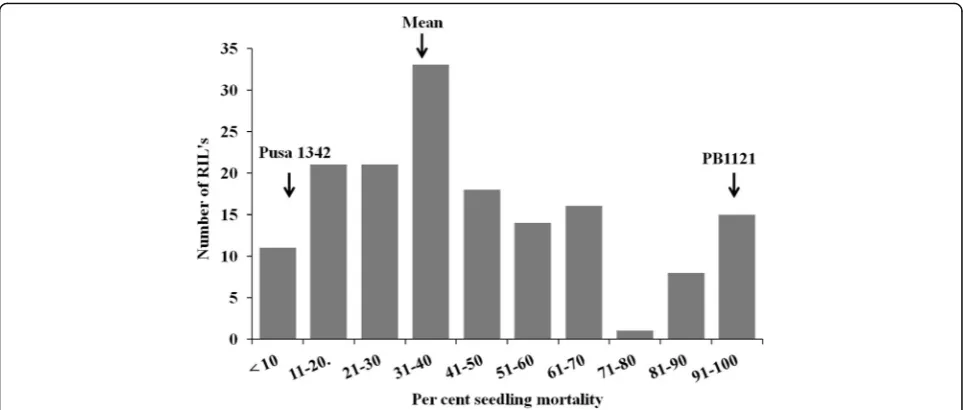
Under uninoculated conditions, both the parents and the RILs had complete survivability. However, under in-oculated conditions, significant phenotypic differences for seedling mortality were observed among the parents and the RILs (Table 2). The susceptible parent PB1121 and the resistant parent Pusa 1342 showed seedling mortality of 99.3 and 2.3 %, respectively. Further, among the RILs, disease reaction ranged from no mortality to 100 % mortality with very high broad sense heritability (99.97 %). The frequency distribution of disease reaction in the RILs showed higher frequency of resistant plants (less than mean mortality %) than the susceptible plants (Fig. 2).
Genotyping of RILs and Construction of Molecular Genetic Map
Identification of sufficient number of markers revealing polymorphism among the parental lines is a prerequisite for the construction of a genetic linkage map. In this study, a genome wide parental polymorphism survey was carried out between parents (Pusa Basmati 1121 and Pusa 1342) using a total of 732 SSR markers spanning 12 rice chromosomes (http://www.gramene.org/) and 119 SSR markers were found polymorphic (Table 3). The average per cent polymorphism between PB1121 and Pusa 1342 was low (13.98 %). The segregation distortion was ana-lysed for all the 119 SSR loci usingχ2test, and 15 markers that deviated significantly from the expected 1:1 ratio at 5 % probability level (χ2> 10.5) were eliminated from fur-ther analysis and the markers showing normal Mendelian segregation distributed over all the 12 rice chromosomes
were used for the construction of molecular linkage map using QTL IciMapping software (Meng et al. 2015).
The linkage map covering a total length of 1524.22 cM was constructed using 104 SSR markers, with an average coverage of 14.42 cM per marker. Relatively, more num-ber of polymorphic markers were found on chromosome 1 with a polymorphism of 30.99 %, while, lowest level of polymorphism was found in chromosome 7 (6.67 %). Chromosome wise marker density varied from 6.21 cM/ marker in chromosome 11 to 19.25 cM/marker on chromosome 3 (Table 3).
QTL Mapping for Bakanae Resistance
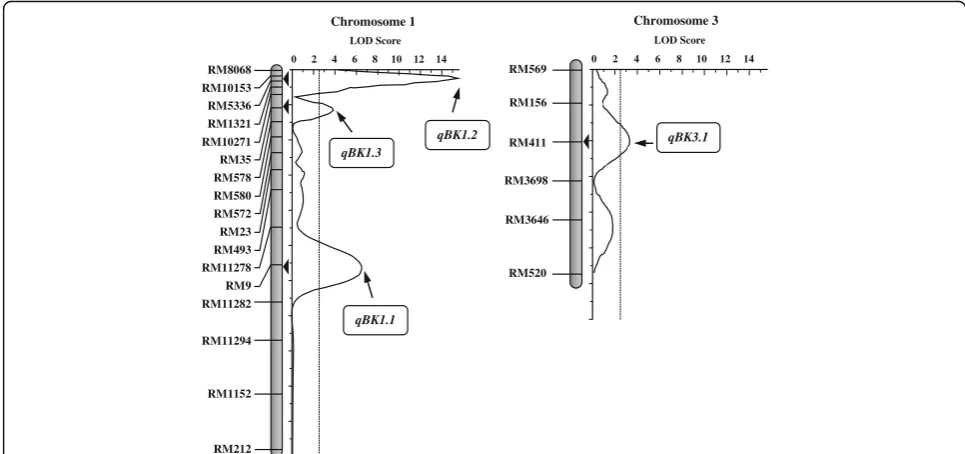
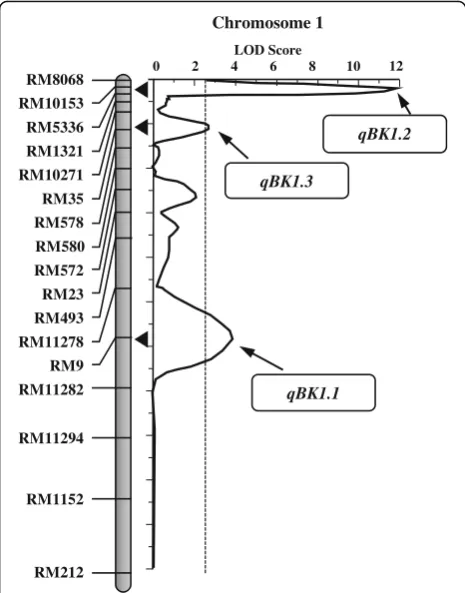
The major objective of the present study was to identify and map QTLs for Bakanae disease resistance using the RIL population. The whole genome was scanned for de-tecting QTLs using QTL IciMapping software with a LOD threshold of 2.5. The analysis of the RIL population identified four QTLs for the Bakanae disease resistance located on chromosomes 1 and 3, respectively (Fig. 3). Interval mapping (IM) identified four QTLs for Bakanae disease reaction, three mapped on chromosome 1 and one on chromosome 3 (Table 4). Among the identified QTLs, the one QTL located in the marker interval flanked by RM10153 and RM5336 on chromosome 1 with a LOD score of 15.69 explained as high as 40.59 % of phenotypic variance (PVE) for per cent seedling mor-tality having an additive effect of −17.63 %. Of the remaining two QTLs on chromosome 1, the QTL present in the marker interval RM9-RM11282 reported an LOD of 6.48 explaining 18.76 % of phenotypic vari-ation with an additive effect of −11.96 %, followed by QTL located between RM10271 a LOD of 3.76 with a PVE value of 10.45 %. The QTL identified on chromo-some 3 was located between the markers RM411 and RM3698 with LOD of 3.31 and explained 9.10 % of the phenotypic variation. Following the QTL naming con-ventions, the QTLs detected on chromosome 1 were named as qBK1.1, qBK1.2 and qBK1.3 and the QTL on chromosome 3 asqBK3.1.
Refining the results of IM, inclusive composite interval mapping (ICIM) identified a total of three QTLs on chromosome 1, one major QTL and two minor QTLs associated to seedling mortality due to Bakanae infection. All the three QTLs were also identified by IM approach (Table 4). The major QTL, designated as qBK1.2, was Table 1Bakanae reaction of the two contrasting parents Pusa 1342 and PB1121 and their derived recombinant inbred population
Trait Uninoculated Inoculated Inoculated RILs
Pusa 1342 PB 1121 Pusa 1342 PB 1121 Range Mean
Seedling mortality (%) 0.0 0.0 2.3 99.3 0.0-100.0 32.6
Seedling height (cm) 15 DAS 12.3 ± 0.5 20.7 ± 0.4 12.9 ± 0.2 24.0 ± 0.0 -
-DASdays after sowing
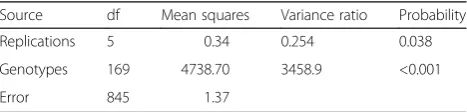
Table 2Analysis of variance (ANOVA) for percent seedling mortality under Bakanae infection
Source df Mean squares Variance ratio Probability
Replications 5 0.34 0.254 0.038
Genotypes 169 4738.70 3458.9 <0.001
Error 845 1.37
dfdegrees of freedom, Environmental variance,σ2
e = 1.37; phenotypic variance,σ2
p = 4738.70; genotypic variance,σ2
mapped between the flanking markers RM10153 and RM5336, explaining a phenotypic variance of 24.74 %. This QTL had an additive effect of −13.8 % in mortality unit. Other two QTLs identified,qBK1.1andqBK.1.3, ex-plained a cumulative phenotype variation of 11.25 % for seedling mortality rate among the RILs.
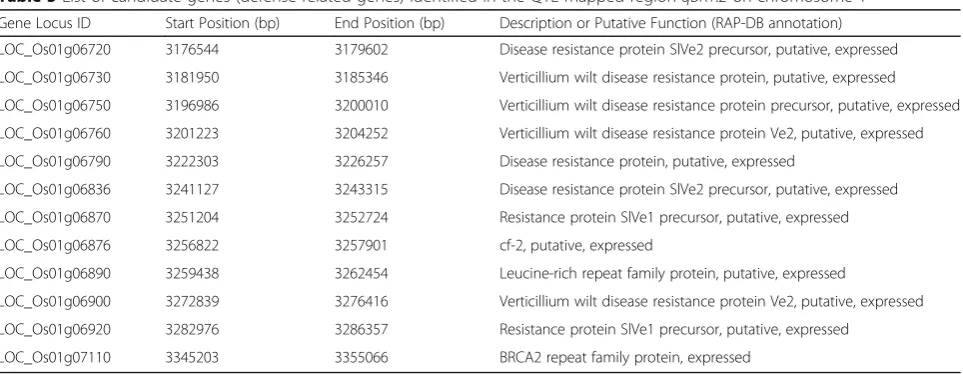
In SilicoSearch for Annotated Putative Candidate Genes The results of annotated gene search in Michigan State University–Rice Annotation Project (MSU-RAP) database using the sequences flanked by the markers RM10153 and RM5336 denoting the QTLqBK1.2is given in Table 5. A total of 55 genes were found annotated between the markers RM10153 and RM5336 flanking the major QTL
qBK1.2, among which 12 genes were known to have de-fence related functions including Verticilliumwilt resist-ance, Leucine-rich repeat family protein, putativecf2gene, BRCA2 repeat family protein and unclassified resistance genes (Table 5).
Discussion
Identification of genes conferring resistance to plant dis-eases and the development of resistant cultivars are con-sidered the most economic, effective and environmentally friendly measure for controlling plant diseases (Singh et al. 2011, 2012, 2013; Simko et al. 2013; Fukuoka et al. 2014; Khanna et al. 2015; Ellur et al. 2016). Researchers have made limited progress in identifying resistant sources
Fig. 2Frequency distribution of percent seedling mortality due to Bakanae infection among 168 F14individuals derived from the cross (PB1121/ Pusa 1342)
Table 3Details of the linkage map constructed using Pusa 1342/ PB1121 RIL population
Chromosome Total number of markers Number of Polymorphic markers* Polymorphism % Map length (cM) Marker density (cM/marker)
1 71 22 30.99 403.52 18.34
2 60 08 13.33 153.26 19.15
3 63 06 9.52 115.26 19.25
4 81 13 16.05 218.72 16.82
5 41 04 9.76 65.71 16.42
6 81 08 9.88 56.87 7.10
7 45 03 6.67 55.25 18.41
8 71 11 15.49 121.45 11.04
9 49 04 8.16 52.85 13.21
10 38 07 18.42 91.5 13.07
11 81 08 9.88 49.72 6.21
12 51 10 19.61 140.114 14.01
Total 732 104 13.98 1524.22 14.42
against the Bakanae disease due to lack of reliable, repro-ducible and rapid assay to screen large number of germ-plasm against the disease. The field inoculation techniques are inherently poor in terms of reproducibility as a result of uneven inoculum distribution, interaction with other pathogens, and variations in weather and other envir-onmental factors which may affect disease severity. This lack of information has slowed the progress of breeding programs.
In our previous study, we have developed a high throughput screening technique to screen large number of germplasm and to identify resistant sources against Bakanae disease. Using this method, we have identified Pusa Basmati 1121 as highly susceptible and Pusa 1342 as highly resistant genotypes (Fiyaz et al. 2014). A map-ping population developed earlier in our lab using the above lines as parents (Amarawathi et al. 2008) was available for mapping QTLs conferring resistance to Bakanae disease. The marker polymorphism between the two parental lines was low, which can be attributed to the narrow genetic variation as the parents were indica ecotypes and adapted to the same rice ecosystem. Sev-eral reports are in support of low level of polymorphism between the parents in the intra-sub specific (Ali et al. 2000; Subashri et al. 2009; Gomez et al. 2010; Yadav et al. 2015) and in inter-sub specific crosses of rice (McCouch et al. 1988; Price and Tomos 1997). The poly-morphic markers were filtered for their usefulness in mapping through segregation analysis because any segre-gation distortion can seriously affect the QTL mapping results (Xu et al. 1997).
For identifying QTLs, phenotypic measurement is very important because quantitative traits are largely affected by environment. The phenotypic frequency distributions observed in this study indicated quantitative inheritance of seedling mortality due to Bakanae disease (Fig. 2) indi-cating that the resistance/ susceptibility is under polygenic control. However, there was predominance of resistant progenies over susceptible ones, indicating the presence of major genetic loci in the population governing resistance. The QTL mapping technique aids to identify genetic regions affecting quantitative traits (Collard et al. 2005) that may contain or may reside proximally to the genes responsible for the trait. In this study, we have used two robust QTL mapping methods, such as IM and ICIM, of which former is a commonly used method for mapping QTLs from biparental crosses (Li et al. 2007). ICIM is an improvement over the commonly implemented composite interval mapping (CIM) algorithm, in which selection of marker is done through a stepwise regression taking into consideration of all markers simultaneously, leaving the flanking markers at the current interval. The phenotype values are adjusted for all the remaining markers retained in the regression model, and IM is then performed using the adjusted phenotype values. ICIM is therefore simple, faster and achieve model convergence efficiently, while keeping all the advantages of IM and simultaneously avoiding the complicated selection of background control markers used in CIM. ICIM is reported to have increased QTL detection power, while controlling false discovery with less biased QTL estimates than IM (Li et al. 2007).
In the current study, a total of four QTLs were identified for seedling mortality among the RILs, wherein three
QTLs were detected in common by both the methods. While, IM reported four QTLs, ICIM identified only three indicating better control of QTL detection ICIM (Figs. 4 and 5). All the detected QTLs had an additive effect in the negative direction for percent seedling mortality indicating that the susceptibility alleles are contributed by the female parent, PB1121 which was highly susceptible to the patho-gen and the resistant alleles by the male parent, Pusa 1342, the resistant parent. Among the QTLs identified, two QTLs qBK1.2 and qBK1.3 detected on the short arm of chromosome 1 are novel as there are no previous reports of detection of QTLs governing Bakanae resistance in this region of chromosome 1. The major QTL, qBK1.2, is a strong candidate that can be used for marker assisted introgression of Bakanae resistance. One of the minor QTLs identified in the present study,qBK1.1was mapped in the same genomic region in the long arm of chromo-some 1, where QTL qBK1 was reported earlier by Hur et al. (2015). TheqBK1was mapped in the 520 kb region between RM8144 and RM11295 at corresponding physical position of 23.20 and 23.72 Mb, respectively with RM9 as the peak marker within this interval explaining 65 % of phenotypic variation. In this study, qBK1.1was identified
between markers RM9 and RM11282 spanning from 23.32 Mb to 23.34 Mb (20 kb). Because of the
co-localization of this QTL with qBK1 and RM9 being
the common marker, it is likely thatqBK1.1 identified in this study andqBK1identified by Hur et al. (2015), are the same QTL. Furthermore, all the QTLs identified in this study are distinct from another QTL, qB1 identified by Yang et al. (2006), which was mapped between markers RM7180 and RM486 at corresponding physical position of 34.10 and 34.95 Mb, respectively. To our knowledge, this is the first report on two novel QTLs for resistance to Baka-nae disease in rice,qBK1.2andqBK1.3, identified based on ICIM strategy, a more robust method for QTL detection.
Typical symptoms of Bakanae disease include infected plants several inches taller than the normal plants in the seedbed and field. The elongation is attributed to gibber-ellins (GA) and stunting to fusaric acid, both of which are produced by the fungus (Yabuta and Hayasi 1935; Takahashi et al. 1955). These symptoms are similar to seedlings treated with gibberellic acid (GA3) with a posi-tive correlation existing between the GA3 response and the pathogenic behaviour of F. fujikuroi (Thakur 1974; Sunder and Satyavir 1998; Ma et al. 2008) indicating the Table 4Identification of QTLs for Bakanae disease resistance using recombinant inbred lines derived from Pusa 1121/Pusa1342 cross using interval mapping (IM) and inclusive composite interval mapping (ICIM)
Method QTL Chr. Position (cM) Left Marker Right Marker LOD PVE (%) Additive effect (%)*
IM qBK1.1 1 124.65 RM9 RM11282 6.48 18.76 -11.96
qBK1.2 1 6.65 RM10153 RM5336 15.69 40.59 -17.63
qBK1.3 1 23.65 RM10271 RM35 3.76 10.45 -9.01
qBK3.1 3 41.89 RM411 RM3698 3.31 9.10 -8.34
ICIM qBK1.1 1 123.00 RM9 RM11282 3.86 6.49 -7.03
qBK1.2 1 5.65 RM10153 RM5336 12.07 24.74 -13.77
qBK1.3 1 24.65 RM10271 RM35 2.73 4.76 -6.08
IMInterval mapping,ICIMInclusive composite interval mapping,QTLQuantitative trait loci,Chr.chromosome,PVEpercentage of variance explained, *additive effect has the same unit as the phenotype (% seedling mortality)
Table 5List of candidate genes (defense related genes) identified in the QTL mapped regionqBK1.2on chromosome 1
Gene Locus ID Start Position (bp) End Position (bp) Description or Putative Function (RAP-DB annotation)
LOC_Os01g06720 3176544 3179602 Disease resistance protein SlVe2 precursor, putative, expressed
LOC_Os01g06730 3181950 3185346 Verticillium wilt disease resistance protein, putative, expressed
LOC_Os01g06750 3196986 3200010 Verticillium wilt disease resistance protein precursor, putative, expressed
LOC_Os01g06760 3201223 3204252 Verticillium wilt disease resistance protein Ve2, putative, expressed
LOC_Os01g06790 3222303 3226257 Disease resistance protein, putative, expressed
LOC_Os01g06836 3241127 3243315 Disease resistance protein SlVe2 precursor, putative, expressed
LOC_Os01g06870 3251204 3252724 Resistance protein SlVe1 precursor, putative, expressed
LOC_Os01g06876 3256822 3257901 cf-2, putative, expressed
LOC_Os01g06890 3259438 3262454 Leucine-rich repeat family protein, putative, expressed
LOC_Os01g06900 3272839 3276416 Verticillium wilt disease resistance protein Ve2, putative, expressed
LOC_Os01g06920 3282976 3286357 Resistance protein SlVe1 precursor, putative, expressed
role of gibberellins in the elongation behaviour. However, Kim et al. (2014) also reported that the GA3 response alone is insufficient as a direct indicator for Bakanae disease resistance, as some rice varieties display higher sensitivity to GA3treatment but show resistance to Bakanae disease.
In silicosearch for putative candidate genes in a region spanning 0.26 Mb of the Bakanae resistance QTLqBK1.2 using MSU-RGAP database identified a total of 12 genes associated with disease resistance. These genes could be possible candidates governing resistance to Bakanae dis-ease. However, additional molecular markers needs to be screened for identifying potential recombination events which can help in higher resolution mapping to determine the gene underlying qBK1.2 precisely. A detailed insight into such candidate genes will help in understanding the nature of interaction at molecular level governing the re-sistance to Bakanae disease, a step forward towards func-tional genomics.
Conclusions
A novel major QTL qBK1.2 conferring resistance to
Bakanae disease has been identified in the present study using ICIM approach in a RIL population. The QTL qBK1.2has been putatively mapped between SSR markers RM10153 and RM5336, which can help in marker assisted introgression of this QTL for developing rice varieties with inbuilt resistance to Bakanae disease. Further, we identified two minor QTLs, which can be used to augment the resistance while developing new cultivars with improved resistance to this important disease. Fine mapping and cloning the genes for Bakanae disease resistance can not
only help in developing gene based markers for use in future rice breeding but also in understanding resistance mechanisms and aid in precise selection through marker-assisted selection for development of Bakanae disease resistant cultivars.
Methods Plant Material
A mapping population of 168 RILs (F14 generation) de-rived out of a cross between PB 1121, a Bakanae suscep-tible variety and Pusa 1342, a highly resistant variety using single seed descend method (Amarawathi et al. 2008) was used in the study. Pusa Basmati 1121, is a Basmati quality aromatic extra long slender grain variety with high alkali spreading value (low gelatinization temperature), inter-mediate amylose content and exceptionally high cooked kernel length, developed at the ICAR-IARI, New Delhi (Singh et al. 2002). Pusa 1342 developed from a complex pedigree involving IR8, TKM 6, Basmati 370, Pusa 1154-2 and Pusa 1201-92-1, etc., is a non aromatic elite breeding line with new plant type features, medium grain length, high amylose content, low alkali spreading value and medium kernel elongation upon cooking. The parent ge-notypes were identified from a germplasm screening study in which 92 genotypes were studied for Bakanae response on artificial inoculation (Fiyaz et al. 2014). Well before this screening experiment, the RIL mapping population, between PB1121 and Pusa 1342 was already available at the Division of Genetics, ICAR-IARI, New Delhi. This RIL population was developed by Amarawathi et al. (2008) for mapping quality related traits in Basmati. RM212
RM1152 RM11294 RM11282 RM9 RM11278 RM493 RM23 RM580 RM578 RM35 RM10271 RM1321 RM5336 RM10153 RM8068
0 2 4 6 8 10 12 14 LOD Score
Chromosome 1
RM572
qBK1.3
qBK1.2
qBK1.1
RM520 RM3646 RM3698 RM411 RM156
RM569 0 2 4 6 8 10 12 14 LOD Score
Chromosome 3
qBK3.1
Phenotyping of F14RIL Population
The experiment was conducted in the glasshouse of ICAR-IARI, New Delhi, India. The reactions of 168 RILs to Bakanae disease along with their parents were assessed by artificial inoculation of a virulent isolate ofF. fujikuroi, F250 (NCBI Gene bank accession number - KM50526) through a high throughput screening protocol developed by Fiyaz et al. (2014). In this method, the disinfected seeds of each of the 168 RILs were soaked in 10 ml of inoculum suspension containing 1×10⁶spores ml-1for 24 h at room temperature. Uninoculated seeds were disinfected before soaking in sterile water for 24 h. Inoculated and unin-oculated seeds were sown in 7×14 plastic pottrays (one pottray per RIL/ 98 seeds per pottray) containing auto-claved mixture of soil and sand in the ratio of 3:1. The glass house temperature was maintained at 30/25(±3) °C day/night temperature regime, 60/80(±10) % day/night relative humidity, with natural sunlight. Pottrays with seedlings were watered every day to keep them in satu-rated condition. No additional fertilisation was done in pottrays. Post inoculation, the seedlings were carefully ob-served for the symptoms of Bakanae infection. Data on number of seedling mortality were observed everyday upto 15 days (Wulff et al. 2010). The phenotyping of the RILs
was repeated six times to avoid any error in phenotyping. Due to uneven elongation of RIL seedlings under Bakanae infection, the seedlings elongation trait was not used for mapping studies. Since there was no
seedling mortality under uninoculated conditions,
among both the parents and the RILs, the statistical analysis of the seedling mortality was confined only to inoculated system, and the data were analysed using standard procedures.
Construction of Molecular Linkage Map
A total of 732 simple sequence repeat (SSR) markers were used for the parental polymorphism survey between the re-sistant (Pusa 1342) and susceptible (PB 1121) parent. The total genomic DNA of the RILs was extracted with slight modification to the protocol of Murray and Thompson (1980). Polymerase chain reaction (PCR) was performed in a thermal cycler (Applied Biosystems® Veriti®, California, USA) using a total reaction volume of 10μl. This contained 30 ng of template DNA, 5 pmol of each primer (synthe-sized from Sigma Inc., St. Louis, MO, USA), 1.5 mM
MgCl2, 0.2 mM dNTPs (MBI, Fermentas, Vilnius,
Lithuania) and 0.5 U of Taq polymerase (Bangalore Genei, Bangalore, Karnataka, India). Polymerase chain reaction comprised one cycle of denaturation at 95 °C for 5 min, followed by 35 cycles at 95 °C for 30 s, 55 °C for 30 s and 72 °C for 1 min, with a final extension of 72 °C for 7 min. The amplified products were resolved on 3.5 to 4.0 % MetaphorTM Agarose gel containing 0.1 mg/ml of ethidium bromide (Amresco, Solon, OH, USA) along with a DNA size standard 50 bp ladder (MBI, Fermentas) and visualized on ultraviolet transillumi-nator (Gel DocTMXR + Imager, Bio-Rad Laboratories Inc., U.S.A). The polymorphic SSR markers identified from the parental polymorphism survey were used for genotyping of 168 RIL population along with parental lines. Data generated after genotyping of 168 RILs by polymorphic SSR markers were tested using the χ2 goodness of fit test for checking segregation distortion. A linkage map was constructed by using the linkage mapping function implemented in the QTL IciMapping software (Meng et al. 2015). The map distances were calculated based on Kosambi’s mapping function (Kosambi, 1944).
QTL Mapping
QTL mapping was performed by interval mapping (IM) and inclusive composite interval mapping (ICIM) functions implemented in the QTL IciMapping v3.3 (www.isbreeding.net). Two or more closely linked markers that showed significant association were assumed to iden-tify the same QTL. To determine the precise location of the putative QTLs, interval mapping and inclusive com-posite interval mapping functions were used. Inclusive RM212
RM1152 RM11294 RM11282 RM9 RM11278 RM493 RM23 RM580 RM578 RM35 RM10271 RM1321 RM5336 RM10153
RM8068 0 2 4 6 8 10
LOD Score
Chromosome 1
12
RM572
qBK1.3
qBK1.2
qBK1.1
composite interval mapping (Wang 2009) was used to es-timate QTL effects such as log-likelihood ratio (LOD) score, phenotypic variation explained (PVE), and additive effect of the QTL loci. The threshold LOD value was de-termined by a permutation test involving 3000 runs at a significance level ofp= 0.05. The LOD test statistic used was -2ln (L0/L1), where L0/L1is the ratio of the likelihood under the null hypothesis (there is no QTL in the interval) and the alternative hypothesis (there is a QTL in the inter-val). The QTLs were deemed to exist only at positions where an LOD score exceeded the corresponding signifi-cant threshold. Estimation of position, genetic effects and phenotypic variation percentage of the QTLs were done at the significant LOD peak in the region under consider-ation. QTL nomenclature followed that described by McCouch et al. (1997).
In SilicoSearch for Annotated Putative Candidate Genes For the identified major QTL, that explained high level of phenotypic variation, an in-silicosearch was done for the chromosomal interval based on the physical location of the flanking markers for the presence of candidate defense responsive genes associated with Bakanae disease resistance using Michigan State University–Rice Annota-tion Project (MSU-RAP) database version 7.0 (Kawahara et al. 2013) available at http://rice.plantbiology.msu.edu. The hypothetical and expressed genes present in chromo-some 1 starting from 3099428 to 3367663 bp region was collected as the list of annotated genes in the QTL region. The annotated putative genes were further explored for their known role in defense mechanisms including disease resistance.
Acknowledgement
The research work was funded by Indian Council of Agricultural Research, New Delhi, India under the project“Molecular genetic analysis of resistance/ tolerance to different stresses in Rice, Wheat, Chickpea and Indian Mustard including sheath blight complex genomics”in the XII Plan Scheme“Incentivizing Research in Agriculture”. The study is part of the Ph.D. research of the first author. The first author would like to acknowledge the Post Graduate School, ICAR-IARI, New Delhi for providing all the facilities during the course of the study.
Authors’contributions
AKS and GKS conceptualized the idea and supervised all the experiments; AKS, GKS, MN, RAF involved in development of RILs; RAF, BMB, AKY, NG performed phenotyping of RILs for Bakanae disease; RAF, RKE, KKV, AKS, GKS, PKB did the statistical analysis and formulated the manuscript; AKS, GKS, RKE, KKV, KVP and NKS revised the manuscript. All authors read and approved the final manuscript.
Competing interests
The authors declare that they have no competing interests.
Author details
1Division of Genetics, ICAR-Indian Agricultural Research Institute, New Delhi
110012, India.2Division of Plant Pathology, ICAR-Indian Agricultural Research Institute, New Delhi 110012, India.3Rice Breeding and Genetics Research Centre, ICAR-Indian Agricultural Research Institute, Aduthurai 612101, India. 4ICAR-National Research Centre on Plant Biotechnology, New Delhi 110012,
India.5Present address: ICAR-Indian Institute of Rice Research, Hyderabad 500030, India.
Received: 24 March 2016 Accepted: 1 September 2016
References
Ali ML, Pathan MS, Zhang J, Bai G, Sarkarung S, Nguyen HT (2000) Mapping QTLs for root traits in a recombinant inbred population from two indica ecotype in rice. Theor Appl Genet 101:756–766
Amarawathi Y, Singh R, Singh AK, Singh VP, Mohapatra T, Sharma TR, Singh NK (2008) Mapping of quantitative trait loci for basmati quality traits in rice (Oryza sativaL.). Mol Breed 21:49–65
Bashyal BM, Aggarwal R, Banerjee S, Gupta S, Sharma S (2014) Pathogenicity, ecology and genetic diversity of theFusariumspp. Associated with an emerging bakanae disease of rice (Oryza sativaL.) in India. In: Microbial Diversity and Biotechnology in Food Security, (In: Kharwar, et al. Eds.), New Delhi, Springer India pp 307-314
Bashyal BM, Aggarwal R, Sharma S, Gupta S, Rawat K, Singh D, Singh AK, Gopala Krishnan S (2016) Occurrence, identification and pathogenicity of Fusarium species associated with Bakanae disease of Basmati rice in India. European J Plant Pathol 144(2):457–466
Collard BCY, Jahufer MZZ, Brouwer JB, Pang ECK (2005) An introduction to markers, quantitative trait loci (QTL) mapping and marker-assisted selection for crop improvement: the basic concepts. Euphytica 142:169–196 Cumagun CJR, Arcillas E, Gergon E (2011) UP-PCR analysis of the seedborne
pathogenFusarium fujikuroicausing bakanae disease in rice. Int J Agric Biol 13:1029–1032
Ellur RK, Khanna A, Yadav A, Pathania S, Rajashekara H, Singh VK, Gopala Krishnan S, Bhowmick PK, Nagarajan M, Vinod KK, Prakash G, Mondal KK, Singh NK, Prabhu KV, Singh AK (2016) Improvement of Basmati rice varieties for resistance to blast and bacterial blight diseases using marker assisted backcross breeding. Plant Sci 242:330–341
Fiyaz RA, Gopala Krishnan S, Rajashekara H, Yadav AK, Bashyal BM, Bhowmick PK, Singh NK, Prabhu KV, Singh AK (2014) Development of high throughput screening protocol and identification of novel sources of resistance against Bakanaedisease in rice (Oryza sativaL.). Indian J Genet 74(4):414–422 Fukuoka S et al (2014) Multiple functional polymorphisms in a single disease
resistance gene in rice enhance durable resistance to blast. Sci Rep 4:4550. doi:10.1038/srep04550
Gomez SM, Manikanda BN, Kumar S, Ramasubramanian T, Zhu C, Jeyaprakash P, Senthil A, Chandra Babu R (2010) Molecular mapping and location of QTLs for drought-resistance traits in indica rice (Oryza sativaL.) lines adapted to target environments. Acta Physiol Plant 32:355–364
Hur Y, Lee SB, Kim TH, Kwon T, Lee J, Shin D, Park S, Hwang U, Cho JH, Yoon Y, Yeo U, Song Y, Kwak D, Nam M, Park D (2015) Mapping ofqBK1, a major QTL forBakanaedisease resistance in rice. Mol Breeding 35:78. doi:10.1007/s11032-015-0281-x
Iqbal M, Javed N, Sahi ST, Cheema NM (2011) Genetic management ofBakanae disease of rice and evaluation of various fungicides againstFusarium moniliformeIn vitro. Pak J Phytopathol 23(2):103–107
Ito S, Kimura J (1931) Studies on theBakanaedisease of the rice plant. Rep Hokkaido Agric Exp Stn 27:1–95
Jeff O (2001) New threat: foolish seedling disease pops up in California. Rice J 104:20–21
Kawahara Y, de la Bastide M, Hamilton JP, Kanamori H, McCombie WR, Ouyang S, Schwartz DC, Tanaka T, Wu J, Zhou S, Childs KL, Davidson RM, Lin H, Quesada-Ocampo L, Vaillancourt B, Sakai H, Lee SS, Kim J, Numa H, Itoh T, Buell CR, Matsumoto T (2013) Improvement of theOryza sativaNipponbare reference genome using next generation sequence and optical map data. Rice 6:4 Khanna A, Sharma V, Ellur RK, Shikari AB, Gopala Krishnan S, Singh UD, Prakash G,
Sharma TR, Rathour R, Variar M, Prashanthi SK, Nagarajan M, Vinod KK, Bhowmick PK, Singh NK, Prabhu KV, Singh BD, Singh AK (2015) Development and evaluation of near isogenic lines for major blast resistance gene(s) in Basmati rice. Theor Appl Genet 128(7):1243–1259
Kim MH, Hur YJ, Lee SB, Kwon TM, Hwang UH, Park SK, Yoon YN, Lee JH, Cho JH, Shin DJ, Kim TH, Han SI, Yeo US, Song YC, Nam MH, Park DS (2014) Large-scale screening analysis for the evaluation of bakanae disease in rice. J Gen Pl Path 80(5):408–414
Kosambi DD (1944) The estimation of map distances from recombination values. Ann Eugen 12:172–175
Li H, Ye G, Wang J (2007) A modified algorithm for the improvement of composite interval mapping. Genetics 175:361–374
Ma L, Ji Z, Bao J, Zhu X, Li X, Zhuang J, Yang C, Xia Y (2008) Responses of rice genotypes carrying different dwarf genes toFusarium moniliformeand gibberellic acid. Plant Produc Sci 11(1):134–138
McCouch SR, Kochert G, Yu ZH, Wang ZY, Khush GS (1988) Molecular mapping of rice chromosomes. Theor Appl Genet 76:815–829
McCouch SR, Cho YG, Yano M, Paul E, Blinstrub M (1997) Report on QTL nomenclature. Rice Genet Newsl 14:11–13
Meng L, Li H, Zhang L, Wang J (2015) QTL IciMapping: Integrated software for genetic linkage map construction and quantitative trait locus mapping in biparental populations. Crop J 3:269–283
Murray HG, Thompson WF (1980) Rapid isolation of high molecular weight DNA. Nucl Acids Res 8:4321–4325
Ou SH (1985) Rice diseases, 2nd edn. Commonwealth Mycological Institute, Kew, pp 247–256
Price AH, Tomos AD (1997) Genetic dissection of root growth in rice Mapping quantitative trait loci using molecular markers. Theor Appl Genet 95:143–152
Rood MA (2004)Bakanaein field yield loss. Rice J 15:8–10
Rosales AM, Mew TW (1997) Suppression ofFusarium moniliformein rice by rice-associated antagonistic bacteria. Plant Dis 81:49–52
Simko I et al (2013) Identification of QTLs conferring resistance to downy mildew in legacy cultivars of lettuce. Sci Rep 3:2875. doi:10.1038/srep02875 Singh VP, Singh AK, Atwal SS, Joseph M, Mohapatra T (2002) Pusa 1121: A rice
line with exceptionally high cooked kernel elongation and basmati quality. Intl Rice Res Notes 27:25–26
Singh AK, Gopala Krishana S, Singh VP, Prabhu KV, Mohapatra T, Singh NK, Sharma TR, Nagarajan M, Vinod KK, Singh D, Singh UD, Chander S, Atwal SS, Seth R, Singh VK, Ellur RK, Singh A, Anand D, Khanna A, Yadav S, Goel N, Singh A, Shikari AB, Singh A, Marathi B (2011) Marker Assisted Selection: a paradigm shift in Basmati breeding. Indian J Genet 71:1–9
Singh VK, Singh A, Singh SP, Ellur RK, Choudhary V, Sarkel S, Singh D, Gopala Krishnan S, Nagarajan M, Vinod KK, Singh UD, Rathore R, Prashanthi SK, Aggrawal PK, Bhatt JC, Mohapatra T, Prabhu KV, Singh AK (2012) Incorporation of blast resistance into“PRR78”, an elite Basmati rice restorer line, through marker assisted backcross breeding. Field Crops Res 128:8–16
Singh VK, Singh A, Singh SP, Ellur RK, Singh D, Gopala Krishnan S, Bhowmick PK, Nagarajan M, Vinod KK, Singh UD, Mohapatra T, Prabhu KV, Singh AK (2013) Marker-assisted simultaneous but stepwise backcross breeding for pyramiding blast resistance genesPiz5andPi54into an elite Basmati rice restorer line‘PRR78’. Plant Breed 132(5):489–495
Subashri M, Robin S, Vinod KK, Rajeswari S, Mohanasundaram K, Raveendran TS (2009) Trait identification and QTL validation for reproductive stage drought resistance in rice using selective genotyping of near flowering RILs. Euphytica 166:291–305
Sun SK, Snyder WC (1981) TheBakanaedisease of the rice plant. In: Nelson PE, Toussoun TA, Cook RJ (eds)Fusarium: diseases, biology and taxonomy. The Pennsylvania University Press, University Park, pp 104–113
Sunder S, Satyavir S (1998) Vegetative compatibility, biosynthesis of GA3and virulence ofFusarium moniliformeisolates fromBakanaedisease of rice. Plant Pathol 47:767–772
Takahashi N, Kitamura H, Kawarada A, Seta Y, Takai M, Tamura S, Sumiki Y (1955) Biochemical studies onBakanaefungus. Bull Agric Chem Soc Jpn 19:267–277 Thakur KSS (1974) Role of gibberllic acid, fusaric acid anc pectic enzymes in the
foot rot disease of rice. Riso 23:191–207
Wang J (2009) Inclusive composite interval mapping of quantitative trait genes. Acta Agronomica Sin 35:239–245
Webster RK, Gunnell PS (1992) Compendium of rice diseases. The American Phytopathological Society Press, St. Paul
Wulff ED, Sorensen JL, Lubeck M, Nlelson KF, Thrane U, Torp J (2010)Fusarium spp. associated with riceBakanae: ecology, genetic diversity, pathogenicity and toxigenicity. Environ Microbiol 12(3):649–57
Xu Y, Zhu L, Xiao J, Huang N, McCouch S (1997) Chromosomal regions associated with segregation distortion of molecular markers in F2, backcross, doubled haploid, and recombinant inbred populations in rice (Oryza sativaL.). Mol Gen Genet 253:535–545
Yabuta T, Hayasi T (1935) Biochemistry of theBakanaefungus of rice. Agric Hortic 10:17–22
Yadav S, Anuradha G, Kumar RR, Vemireddy LR, Sudhakar R, Donempudi K, Venkata D, Jabeen F, Narasimhan YK, Marathi B, Siddiq EA (2015)
Identification of QTLs and possible candidate genes conferring sheath blight resistance in rice (Oryza sativaL.). Springer Plus 4:175
Yang HF, Wang ZY, Wu HZ, Zhu CH (2003) Study on the variation of riceBakanae under the different methods of seedling raising. J Anhui Agric Sci 31:119–124 Yang CD, Guo LB, Li XM, Ji ZJ, Ma LY, Qian Q (2006) Analysis of QTLs for
resistance to riceBakanaedisease. Chin J Rice Sci 6:657–659
Submit your manuscript to a
journal and benefi t from:
7Convenient online submission
7Rigorous peer review
7Immediate publication on acceptance
7Open access: articles freely available online
7High visibility within the fi eld
7Retaining the copyright to your article