O R I G I N A L A R T I C L E
Impact properties of bamboo bundle laminated veneer lumber
by preprocessing densification technology
Fuming Chen• Jianchao Deng•Haitao Cheng•
Haidong Li•Zehui Jiang•Ge Wang•
Qingchao Zhao• Sheldon Q. Shi
Received: 24 March 2014 / Accepted: 18 July 2014 / Published online: 2 August 2014
ÓThe Japan Wood Research Society 2014
Abstract The objective of this study was to investigate the deformation behavior of bamboo bundle laminated veneer lumber (BLVL) manufactured with veneer prepro-cessing densification technology under low velocity impact loading. The influence of different preprocessing temper-atures, times, and stacking sequences was studied with respect to impact loading. Laminates with bamboo bundles parallel to the length direction were labeled as type I, and cross-ply was labeled as type II. The results indicated that delamination and fiber breakage were the main damage models for BLVL made with veneer preprocessing densi-fication technology, and its impact performance under a veneer prepressing temperature of 90°C and a time of 10 min was fairly comparable to that of BLVL without preprocessing densification. The impact index decreased as the densification temperature increased. The impact prop-erties for type II were better than that of type I. The curve characteristic of impact deflection vs. time presented a linear trend, while the curve of impact velocity first decreased and then tended to level off as time elapsed.
Keywords Bamboo bundle laminated veneer lumber Veneer prepressing densificationStacking sequence Impact performanceEnergy curve
Introduction
The utilization of high-performance bamboo-based engi-neering material is a valuable alternative to using wood, polymeric, or metal material due to its great practical benefits, e.g., high specific strength and stiffness-to-weight ratio, low cost and energy consumption in processing, ample availability, fast growth rate, and being eco-friendly [1,2]. These structural components during the service life are known to be susceptible to various loading types. Among them, the most serious and complex is the impact loading, as invisible damage of various kinds occurs easily in the composites [3,4]. These failures, including matrix cracking, interfacial debonding, fiber breakage, and delamination, have a deleterious effect on the mechanical and physical properties of the composites [5–7].
In recent years, laminated bamboo fibrillated-veneer lumber (LBL) has been extensively manufactured and applied in China due to its high strength and modulus along with improved resource utilization rates above 90 % for bamboo [8, 9]. However, some defects still exist, such as high density (above 1.2 g/cm3), uneven distribution of stress, and poor dimensional stability, severely limiting its usage and development as a structural and engineering material. As a structural material, bamboo-based compos-ites not only are required to possess high strength and stiffness but also must manifest good stability, namely uniformity performance and designed intension. Inspired by the successful experience of laminated veneer lumber (LVL), the quantity of each bamboo bundle veneer should
F. ChenJ. DengH. Cheng (&)H. LiZ. JiangG. Wang International Centre for Bamboo and Rattan,
Beijing 100102, China
e-mail: [email protected]
Q. Zhao
Research Institute of Wood Industry, China Academy Forestry, Beijing 100091, China
S. Q. Shi
Mechanical and Energy Engineering, University of North Texas, Denton, TX 76203-1277, USA
be strictly controlled, thereby guaranteeing the properties of bamboo bundle laminated veneer lumber (BLVL) during the manufacturing process [10–12].
Aided by the initial adhesion of resin, two separated layers of fibrillated bamboo bundle impregnated with thermosetting resins could be linked together as a whole under the combined effect of temperature and pressure. This method is herein defined as veneer preprocessing densification technology. Using this method, a uniform veneer could be produced and can be applied to the man-ufacture of long-span bamboo-based engineering material with continuous length. However, as the solids content of the water-soluble impregnated resin was relatively low, the initial adhesion of resin was unacceptable for bonding the bamboo bundles. Therefore, the adhesive needed to be heated to give the required degree of crosslinking, so that holding and fixing of the bamboo bundle along the width and thickness direction could occur. Simultaneously, some pre-cured adhesion of veneer may result in interfacial strength decrease and brittleness increase for the board in secondary compound shaping. The interfacial properties of the composites were vital to the delamination failure under impact loading [13]. For example, interfacial delamination as one of the typical damage modes was related to energy absorption of the laminated composite plates under impact loading.
Preprocessing densification conditions, e.g., hot-press-ing temperature, presshot-press-ing time, and stackhot-press-ing sequence, have an important influence on the interfacial strength of BLVL. Yu et al. [10] studied the low-velocity impact properties and damage mechanisms for bamboo scrimber and bamboo/wood scrimbers with different densities and concluded that bamboo scrimber with higher density showed better impact performance. Jiang et al. [7] inves-tigated the impact properties of bamboo bundle corrugated laminated composites with three stacking sequences and found that the effect of the corrugated shape on the impact properties of composites was positive for bamboo bundles parallel to the corrugated waves, but negative for cross-ply board. However, the curing state of adhesion for the board made with preprocessing densification technology was completely different from the analysis above. Moreover, the lack of testing data under impact loadings used for describing the impact characteristics of BLVL was another concern [14]. Hence, a comprehensive understanding of the impact behavior is essential to the design and manufacture of a novel bamboo bundle laminated veneer lumber (BLVL) with veneer preprocessing densification technology.
The specific objectives of this paper were as follows: (1) to explore the technical feasibility of manufacturing BLVL with veneer preprocessing densification technology, (2) to
investigate the impact behavior of BLVL with different veneer preprocessing densification conditions, and (3) to compare the impact response of different stacking sequences.
Materials and methods
Bamboo bundle sheet
Three-year-old Cizhu bamboo (Neosinocalamus affinis) was obtained from Yibin, Sichuan Province, China. The bamboo culm (about 900 mm longitudinally and about 4294.2 mm in cross section) were selected from the middle of the trunk. The bamboo material had an initial moisture content (MC) of about 65 %. For material prep-aration, bamboo tubes were first split into four pieces of approximately the same size. The bamboo nodes were removed using a hatchet. An untwisting machine was used to broom and roll the bamboo strips into a loosely lami-nated sheet. The untwisting machine was made up of drive unit, idler wheels, and an adjustment device (to regulate the pressure between the idler wheels). By adjusting the dis-tance of the upper and lower pressure rollers, the teeth could realize different brooming and decongesting effects during the bamboo feeding process. The laminated sheet was cross-linked in the width direction with no fracture along the length direction and was nearly uniform in thickness, maintaining the original bamboo fiber arrange-ment. The laminated sheets were finally cut into pieces 300 mm in length and air-dried to a MC between 8 and 12 %.
Veneer preprocessing densification technology
Preparation of BLVL
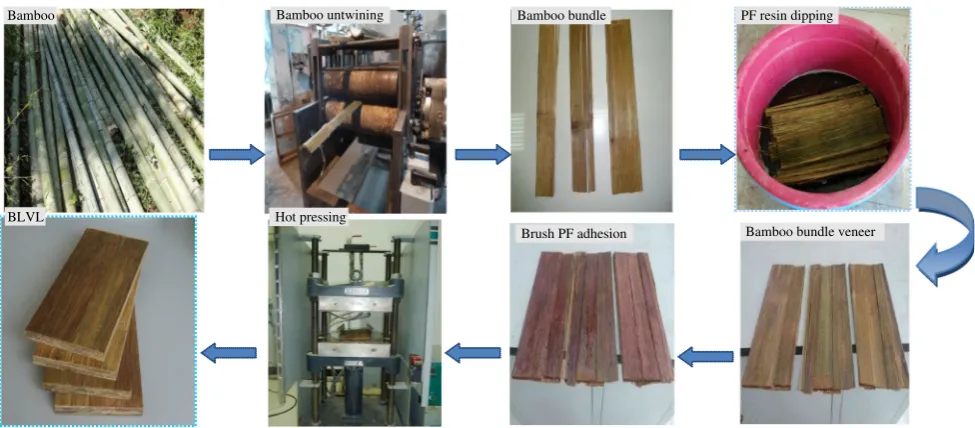
Bamboo bundle veneers manufactured by preprocessing densification technology were covered with PF adhesive at 160–170 g/m2 for a single-sided surface. Three layers of treated veneer overlaid each other along the fiber direction. A 300 mm9300 mm CARVER Auto M-3895 hot press with a PressMAN control system (Carver Inc., USA) and a custom designed mold was used to press the BLVL at a platen temperature of 155°C. The dimensions of the BLVL were 300 mm (length)9150 mm (width) 912.5 mm (thickness). The target density was 1.0 g/cm3. The hot press time was 30 min (10 min for press closing, 10 min of pressure at the target thickness, and 10 min for press opening). A bamboo bundle without veneer pressing den-sification was used as the control specimen. The special processing of BLVL is shown in Fig.1.
Low-velocity impact tests
The low-velocity impact is the impact event that is long enough for the whole structure to respond to the impactor by absorbing energy elastically. The impact tests were performed using a drop weight impact test machine (IN-STRON Dynatup 9250HV). The dimensions of the BLVL were 100 mm9100 mm912.5 mm. A hydraulic fixture device and square frame jigs were used to clamp the BLVL with square boundary conditions. A hemispherical steel impactor with a diameter of 12.7 mm and a total weight of 3.54 kg was used for the impact tests. The punch was guided to drop at the corrugated ridge in the center of the window. The impact energy was set to about 120 J so the
specimen could be penetrated completely. Five replicates were used for each BLVL treatment.
The dropping velocity and punch mass was measured before impact, and the total impact energyU0was deter-mined by Eq.1,
U0¼
1 2mv
2
0 ð1Þ
wheremis the drop punch mass, andv0is the instantaneous speed of the impactor contacting with the specimen.
U, obtained from Eq.2, represents the absorption energy of impact failure, wherevtis the maximum bouncing speed of the impactor and the expression 12mv2t is the kinetic energy from elastic deformation.
U¼1 2mðv
2
0v
2
tÞ ð2Þ
The impact load (Ft) can be calculated from Eq. 3, where V(t) is the instantaneous speed during the impact process. And displacement (Dt) was obtained from Eq.4. Ft¼m
oVðtÞ
ot ð3Þ
Dt¼
Z t
0
VðtÞdt ð4Þ
Results and discussion
The effect of preprocessing temperature on impact behavior
The effect of impact loading on the deformation of testing specimens was induced by the longitudinal stress wave parallel to the fiber direction and by the transverse stress
Bamboo bundle Bamboo untwining
Bamboo
Bamboo bundle veneer Hot pressing
BLVL
PF resin dipping
Brush PF adhesion
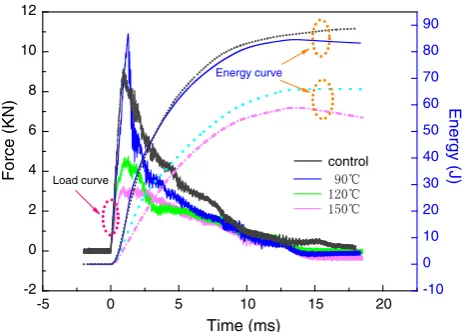
wave along the dropping direction of the impactor hammer [15, 16]. The stress wave composed of the longitudinal wave and transverse stress wave was generated outward from the impact point. It could arrive at the edges of the structural element of specimen, resulting in the phenomena of full-vibration response. Therefore, the response above is also controlled by the local performance of the material in the neighborhood of the impacted zone. The role of the longitudinal stress wave was to make the bamboo bundles sheet fracture due to tension. However, the transverse stress wave could drive the fibers forward with the dropping hammer, resulting in transverse strains through the lami-nated layers of board. In comparing longitudinal tension strength, the load capacity in the transverse direction of fibers and the bonding strength between interfaces were much lower. Thus, delamination and fibers cutting off were the key fracture phenomena for the laminated panel under the impact loadings, as reported by Mili and Necib [17]. For the preprocessed densification board with weak inter-facial shearing strength, the material may be prone to be ahead of delamination, making the stiffness and strength decrease rapidly. The selection of preprocessing tempera-ture had a significant influence on the BLVL interfacial strength, as demonstrated by Chen et al. [11]. Figure2 shows the typical load/time and energy/time curves for BLVL made at pressing densification temperatures of 90, 120, and 150°C, and for control specimens.
As the veneer densification temperature increased, the peak values for both the load/time and energy/time curves presented decreasing trends for the board tested. Taking BLVL without veneer preprocessing densification as the reference sample, the load/time curve was slightly steeper and higher and the energy/time curve slightly lower and gentler for the board manufactured with the 90°C veneer densification. The values of total absorption energy, peak
load, and deflection at peak load were 84.5 J, 10.9 kN, and 14.1 mm for the board fabricated at a veneer densification temperature of 90°C and 88.7 J, 9.2 kN, and 16.8 mm for the control specimen. These clearly indicated that the impact absorption capacity and impact toughness for the board made with 90°C veneer densification was similar to the control BLVL. This is generally related to the low degree of pre-curing for the PF during the 15 min of veneer densification preparation. PF resin has a relatively low curing rate at the preprocessing temperature of 90°C, as reported by Tang [18]. The load/time and energy/time curves for the densification temperatures of 120 and 150 °C significantly decreased, with the total absorption energies and peak loads at only about 65.7 J, 4.76 kN and 58.84 J, 3.23 kN, respectively. The results concerning impact properties clearly implied that the impact resistance decreased for the boards manufactured at 120 and 150°C. At higher veneer densification temperatures, the degree of pre-cured PF resin on bamboo bundle veneers increased. So, when these veneers were prepared to fabricate BLVL, the interfaces during veneers would have more degree of being impaired. The amount of micro-cracks generated on the laminated interfaces accelerated the delamination fail-ure of the boards at preprocessing temperatfail-ures of 120 and 150 °C. The analysis above was in agreement with previ-ously published data stating that the MOE and MOR of BLVL manufactured at preprocessing temperatures of 90, 100, 120, and 150 °C were reduced by 5.47, 9.77, 14.18, and 49.32 %; and 8.87, 22.86, 48.14, and 71.93 %, respectively [11].
The effect of preprocessing time on impact behavior The curing degree of PF adhesive was moreover deter-mined by the hot-pressing time when the pressing tem-perature was kept constant. If the preprocessing time for bamboo bundle densification veneer was too short, its handling ability was likely to be poor. However, at longer preprocessing times for the densification veneer, the curing degree of PF resin increased, which has a negative effect on the interfacial strength of BLVL.
Table1 compares the shear strength and impact prop-erties of BLVL formed at preprocessing densification times of 10 and 15 min. As shown in Table1, the values of total absorption energy, peak load, energy absorption at peak, and fracture deflection for type I were higher than those for type II. These indicated that the influence of 10 min of preprocessing densification on interfacial properties was lower than that of 15 min. Chen et al. [11] investigated the effect of preprocessing temperature on the bending prop-erties of BLVL and concluded that as the densification temperature increased, the MOE and MOR of the board decreased. Compared with the control specimen, the values
-5 0 5 10 15 20
-2 0 2 4 6 8 10 12
Energy curve
Time (ms)
Energy (J)
Force (KN) Load curve
-10 0 10 20 30 40 50 60 70 80 90
control
Fig. 2 The effect of densification temperature on the impact
of total absorption energy, peak load, energy at peak load, fracture energy, and total time for types I and II decreased by 2.19, 1.67, 16.57, 4.39, and 15.51 %; and 8.46, 2.99, 21.28, 19.35, and 21.76 %, respectively. This is consistent with the trend of shear strength variation, where the values of shear strength for types I and II were 8.8 and 15.9 % lower than that of control BLVL, respectively.
The effect of stacking sequence on impact behavior The results of impact property testing of BLVL fabricated with two types of stacking sequence and the rupture appearance on the front and back sides of the boards are illustrated in Figs.3and4, respectively.
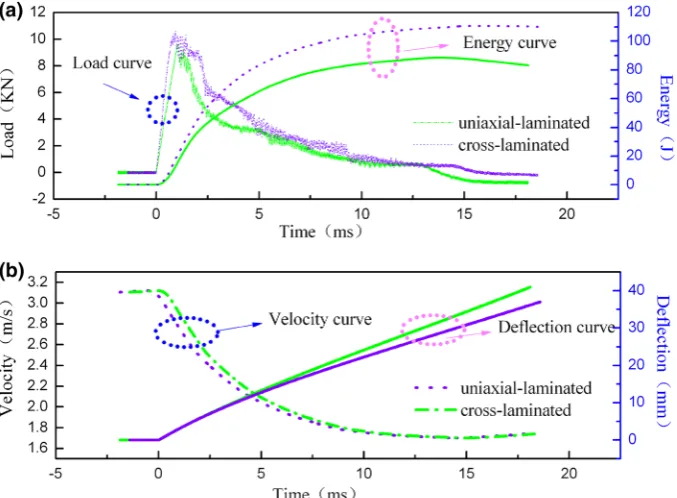
As shown in Fig.3a, the curves of the impact load and absorption energy for cross-laminated BLVL were both higher than those of the uniaxial-laminated board. These indicated that the impact properties of the 0°/90°stacking type board were superior to those of uniaxial lamination.
This is because the fibers could achieve balance at the 0° and 90° directions and could bear impact stresses by weaving together when adopting the cross-laminated type. At the same time, the pavement structure of the cross-laminated type increased the fracture toughness of the board. When the transverse stress wave acted on the thickness direction of plate, the cross-laminated structure could disperse stress effectively, inhibiting the develop-ment of micro-cracks in the interfacial and pavedevelop-ment lay-ers. Therefore, the resistance impact capability of board was improved by the continuous accumulation of energy absorption. The board manufactured with all the fibers parallel in the length direction had a lower strength in the transverse direction due to the lack of reinforcement. Under the effect of the plane longitudinal stress wave, in the width direction of BLVL without enhanced fibers could be rup-tured first and then the board was subjected to uniaxial load only in length direction, bringing about stress distribution imbalance. Once the cracks developed, many
micro-Table 1 The effect of preprocessing time on the impact properties of BLVL
Index Shearing strength (MPa)
Total energy (J)
Peak load (KN)
Energy at peak load (J)
Energy at fracture (J)
Fracture load (KN)
Total time (ms)
Deflection at fracture (mm) Type I 22.72 (1.87) 80.00 (5.23) 8.68 (0.33) 21.36 (3.06) 66.68 (9.54) 1.60 (0.31) 12.66 (3.38) 17.55 (2.34) Type II 20.95 (1.98) 74.88 (6.78) 8.57 (0.54) 20.15 (5.78) 56.25 (8.34) 2.07 (0.32) 11.72 (4.67) 12.43 (3.40) Control 24.92 (1.60) 81.80 (4.21) 8.83 (0.13) 25.60 (2.06) 69.75 (5.16) 1.75 (0.18) 14.98 (1.23) 15.96 (1.99) Type I and II are BLVL formed at veneer preprocessing densification times of 10 and 15 min, respectively. The data in the parentheses are standard deviation. Shearing strength of BLVL was tested according to the standard of ‘‘Laminated veneer lumber’’ GB/T 20241-2006 published in China. Total energy is the sum of the absorption energy of impact failure and impact machine, energy at peak is the absorption energy of specimen at the peak of loading, and energy at fracture represents the absorption energy of specimen at fracture
Fig. 3 The effect of stacking
fissures extended and merged in laminated layers to form cracks along the fiber direction, leading to the fracture failure of the board.
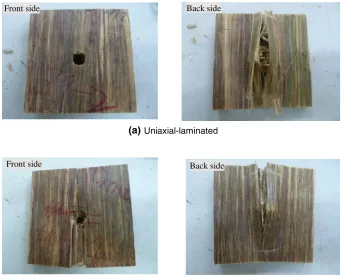
It can be seen from Fig.3b that the impact velocity/time curve displayed an S shape, i.e., it decreased gradually until it leveled off. While the deflection/time curve regarding impact loading demonstrated a linear increasing trend. When the impactor began to touch the board surface, matrix cracks first occurred along the fiber direction. At that state, the energy absorption of the board as well as the ratio of velocity decreased were very low. Then, a number of cracks started to generate, develop, and expand among interlayers, generating delamination. The energy absorp-tion vs. time for the board increased gradually, and impact velocity decreased as the impactor energy decreased. After this occurrence, the reinforced bamboo bundle fibers (cross-laminated board) were subjected to compression, tensile, and shear stress under the effect of in-plane and transverse impacting stress waves [19]. The fibers of lam-inated layers were transversely deformed, which was demonstrated by pulling off or shearing out from the back side of the board, as seen in Fig.4. At that moment, the energy absorption for the board increased quickly as the impact velocity rate decreased (Fig.3).
As more fractional fibers of the board became involved in sharing the impact stress and the whole deformation increased, the drop impactor was subjected to more
resistance. This resulted in a continuous decrease of impact velocity. The deflection of the board gradually increased until the impactor punctured through the board. Further-more, the drop rate of the impact velocity curve for the cross-laminated BLVL was lower than that of the uniaxial-laminated board. In contrast, the fracture deflection for the cross-laminated board was higher than that for the uniaxial lamination. This clearly indicated that the cross-laminated board had higher fracture toughness due to the orthogonal pavement as compared to the parallel stacking style. The analysis above could be correspondingly demonstrated by the observation of the fracture appearance in Fig.4, in which the delaminated area on the front side of the cross-laminated board was higher than that of the uniaxial-lam-inated BLVL. The break degree on back side of the cross-laminated board, however, was lower than that of the uniaxial pavement panel.
Conclusions
A novel bamboo bundle laminated veneer lumber (BLVL) was successfully fabricated using veneer preprocessing densification technology. Its mechanical behavior when subjected to low-velocity impact loading was investigated. Different densification temperatures and hot-pressing times along with two types of stacking sequences for BLVL were Front side
Front side
Back side
Back side (a)
(b)
Uniaxial-laminated
Cross-laminated
Fig. 4 Classic morphologies of
compared under impact loading. The optimum conditions for manufacturing BLVL using the veneer preprocessing densification method were obtained. The highest impact performance for BLVL could be realized using a densifi-cation temperature of 90°C for 10 min with cross-lami-nated pavement. The velocity–time curve for BLVL exhibited a decreasing S shape, and the deflection–time curve regarding impact loading displayed a linear increasing trend. Delamination along with fiber tensile fracture was the main failure model for the BLVL with preprocessing densification technology.
Acknowledgments The authors would like to express sincere
thanks to State Forestry Administration Key Laboratory for Bamboo and Rattan Science & Technology. This research was funded by the National Scientific and Technical Supporting 12th Five-year Plan Project (2012BAD23B0203) and the National Forestry Public Wel-fare Scientific Research Program (201204701).
References
1. Jiang ZH, Chen FM, Wang G, Liu XE, Shi QS (2012) The cir-cumferential mechanical properties of bamboo with uniaxial and biaxial compression tests. BioResources 7:4806–4816
2. Chen FM, Jiang ZH, Wang G, Shi QS, Liu XE (2013) Bamboo bundle corrugated laminated composites (BCLC) I: three dimensional stability in response to corrugating effect. J Adhes 89:225–238
3. Avila AF, Soares MI, Neto AS (2007) A study on nanostructured laminated plates behavior under low-velocity impact loadings. Int J Impact Eng 34:28–41
4. Gonza´lez EV, Maimı´ P, Camanho PP, Lopes CS, Blanco N (2011) Effects of ply clustering in laminated composite plates under low-velocity impact loading. Compos Sci Technol 71:805–817
5. Soutis C, Curtis PT (1996) Prediction of the post-impact com-pressive strength of CFRP laminated composites. Compos Sci Technol 56:677–684
6. Fu YM, Mao YQ, Tian YP (2010) Damage analysis and dynamic response of elasto-plastic laminated composite shallow spherical shell under low velocity impact. Int J Solids Struct 47:126–137 7. Jiang ZH, Chen FM, Wang G, Liu XE, Shi QS, Yu ZX (2013)
Bamboo bundle corrugated laminated composites (BCLC) II: damage analysis under low velocity impact loading. BioRe-sources 8:923–932
8. Meng FD, Yu YL, Zhu RX, Zhang YH, Yu WJ (2011) Effect of resin impregnation rate on physical and mechanical properties of laminated bamboo fibrillated veneer lumber. China Wood Ind 25:1–3
9. Qiu YX, Wang G, Chen FM (2013) Uniformity characteristic for the physical and mechanical properties of bamboo-bundle lami-nated veneer lumber. China Forest Prod Ind 40:47–49
10. Yu ZX, Jiang ZH, Wang G (2012) Impact resistance properties of bamboo scrimber. J Northeast For Univ 40:46–48
11. Chen FM, Zhang D, Wang G (2013) Prepress densification technology for manufactured bamboo bundle laminated veneer lumber and its properties. China Forest Prod Ind 40:52–54 12. Chen FM, Deng JC, Jiang ZH, Wang G, Zhang D, Zhao QC, Cai
LP, Shi QS (2014) Evaluation of the uniformity of density and mechanical properties of bamboo-bundle laminated veneer lum-ber (BLVL). BioResources 9:554–565
13. Richardson MOW, Wisheart MKJ (1996) Review of low-velocity impact properties of composite materials. Compos A Appl Sci Manuf 27:1123–1131
14. Wang G, Jiang ZH, Chen FM, Cheng HT, Sun FB (2014) Man-ufacture situation and problem analysis on large size bamboo engineering material in China. China Forest Prod Ind 41:48–52 15. Aslan Z, Karakuzu R, Okutan B (2003) The response of
lami-nated composite plates under low-velocity impact loading. Compos Struct 59:119–127
16. Choi I (2008) Low-velocity impact analysis of composite lami-nates under initial in-plane load. Compos Struct 86:251–257 17. Mili F, Necib B (2001) Impact behavior of cross-ply laminated
composite plates under low velocities. Compos Struct 51:237–244
18. Tang XH (2002) Adhesion for wood product. Chemical Industry Press, Beijing