ORIGINAL PAPER
A review of fuzzy methods in automotive
engineering applications
Valentin Ivanov
1Received: 26 October 2014 / Accepted: 18 August 2015 / Published online: 27 August 2015 #The Author(s) 2015. This article is published with open access at SpringerLink.com
Abstract
Purpose
The paper addresses evolution of fuzzy systems for
core applications of automotive engineering.
Methods
The presented study is based on the analysis of
bib-liography dedicated to fuzzy sets and fuzzy control for ground
vehicles. A special attention is given to fuzzy approaches used
in the following domains of automotive engineering: vehicle
dynamics control systems, driver and driving environment
identification, ride comfort control, and energy management
of electric vehicles.
Results
The bibliographical analysis, supplemented with
sta-tistics of relevant research publications, has allowed to
allo-cate the most important fuzzy application cases for each
do-main. In particular, it concerns driver identification,
human-machine interface, recognition of road conditions, and
control-lers of vehicle chassis and powertrain systems. It is found out
that fuzzy methods have the primary use most of all for tasks
requiring identification and forecasting procedures, especially
in conditions of limited informational space. Additional
ob-servation that can be also derived from the presented survey
points to reasonable integration of fuzzy technique with other
control engineering methods to improve the performance of
automotive control systems.
Conclusions
In the aggregate the performed review indicates
that fuzzy computing can be considered as a versatile tool for
automotive engineering applications of different nature.
Keywords
Fuzzy systems . Road vehicles . Automotive
control systems . Vehicle dynamics control . Electric vehicles
1 Introduction
Fuzzy logic, among other computational intelligence
methods, attracts increased attention of engineers and
re-searchers involved in the development of complex control
solutions for road vehicles and their subsystems. A possibility
to overcome various nonlinear models and to use intuitive
logical rules makes fuzzy control and fuzzy identification
pro-cedures useful tools by rapid system prototyping and on early
design stages. It is of particular relevance for intelligent
vehi-cle functions and systems requiring the prediction of
manoeu-vres dynamics, identification of driving environment
parame-ters and objects, and interaction with the driver. For the
men-tioned topics, the development of models of objects and
rele-vant controllers of on-board systems can meet essential
prob-lems with feasibility, sufficient level of complexity and other
features demanded for real-time automotive applications.
These issues can be efficiently handled with the computational
intelligence methods, which are known as reasonable and
powerful tools in solving non-well-posed analytical problems.
Among different computational intelligence methods like
neu-ral networks, swarm intelligence computing et al. the fuzzy
logic can be of special relevance for intelligent automotive
systems. The reason is that the fuzzy logic has good
applica-bility for identification tasks and pre-emptive control under
strong presence of data and model uncertainty.
The above-listed arguments are motivated the study
outlined in this paper. The main goal of the study is to give a
survey of existing fuzzy methods and systems that are finding
applications in the automotive area. Because the subject of the
study is characterized by a high degree of interdisciplinarity,
* Valentin Ivanov1 Automotive Engineering Group, Ilmenau University of Technology, Ehrenbergstr. 15, 98693 Ilmenau, Germany
the discussed review can be of particular interest for
re-searchers working on topics of Ground Vehicle Engineering,
Control Engineering, and Computational Intelligence.
Specific objectives of the presented work can be formulated
as follows:
–
Define research topics that are most relevant to
automo-tive fuzzy systems and tools;
–
Identify the main application cases for each defined topic;
–
Estimate development trends for each defined topic;
–
Analyse particular matters of automotive fuzzy systems
from viewpoint of (i) industrial applications and (ii)
inte-gration with other control techniques.
The results of the performed survey are given in next
sec-tions in accordance with the listed objectives. The article
in-cludes also extensive bibliography aimed at the representation
of various research schools around the world in context of the
discussed topics.
2 Review background
The history of fuzzy systems in vehicle-related areas begins
with several research works of founders of fuzzy logic
dedi-cated to practical applications of fuzzy sets. An example is the
intersection controller that reduced junction-related delay of
vehicle driving proposed by Pappis and Mamdani in [1]. Later
Sugeno and Murakami in [2] and Sugeno and Nishida in [3]
have introduced the fuzzy realization of driver’s logic for the
cases of an automated car parking system and handling the
desired vehicle trajectory. Then, from early 1990s, more and
more automotive systems with fuzzy logic are subjected both
to academic and industrial areas. This resulted in a
consider-able amount of publications and patents.
An analysis of the published studies and works allows to
allocate a number of domains, where fuzzy logic has found the
most acceptance. These domains can be conditionally called
as
B
Driver
^
,
B
Vehicle Dynamics
^
,
B
Ride comfort
^
,
B
Electric
vehicles
^
, and
B
Driving environment
^
. Results of analysis of
publications relevant to the fuzzy modeling and control of
automotive systems in the listed engineering areas are further
introduced in the paper.
The presented review uses the methodology proposed and
partially implemented in [4]. The analysis uses only
English-language scientific publications found in Scopus abstract and
citation database of peer-reviewed literature (http://www.
elsevier.com/online-tools/scopus). The following limitations
of the analysis are accepted within the framework of this
paper: The works are analyzed in relation to the ground and
road vehicles only. Mobile robots and machines with
non-holonomic constraints are excluded from the analysis due to
their less relevance to automotive applications.
The overview is accompanied by statistics of
peer-reviewed journal articles from two recent decades (dated
1994
–
2013) in each domain. (Conference papers are excluded
from statistical analysis to avoid the consideration of
duplicat-ed content. The elimination has been also done for those
pa-pers, which content was already published in another journal.
This is because it was observed that in particular cases the
same content is repeated with minor variations in several
con-ference papers published by the same authors.)
Additional section of the paper will analyse the
publica-tions of SAE International (http://www.sae.org) as one of the
most recognized informational source worldwide for
automotive engineering and presenting mainly the studies,
which are providing experimental verification and close to
industrial application.
3 Fuzzy methods for driver modelling and driver
assistance systems
The domain
B
Driver
^
, proposed for the classification,
impli-cates topics related to the driver models, driver behavior, and
driver assistance systems. These topics are of special
rele-vance for fuzzy applications because almost emotional and
psychological facets of human behavior carry more semantic
as numerical uncertainty. It complicates the formulation of the
driver in simulation and control tasks through non-soft
com-puting methods. The first applications of fuzzy sets to the
modeling of the driver are arisen in 1980s. In particular,
Kramer and Rohr in [5] and Kramer in [6] proposed to use a
fuzzy model for the representation of perception
characteris-tics of the driver and illustrated this approach on the driving
simulator. Nagai, Kojima and Sato [7] suggested the fuzzy
driver model describing the subjective recognition, judgment
and control of the vehicle speed. This model was built from
the accident analysis data. Then Kageyama and Pacejka [8]
and Ehara and Suzuki [9] developed the first fuzzy models of
the human reasoning for more complex driving situations.
Analysis of relevant journal publications, Fig.
1, and
confer-ence papers allows to allocate the most typical applications of
fuzzy methods within the domain
„Driver
B
:
–
Identifications and classifications of the drivers regarding
fatigue, emotions and other human attributes, including
the procedures of driver state recognition and forecasting
through monitoring of various physiological parameters
like electroencephalography-estimated brain activity, eye
movement, gestures et al. [10–15],
–
Structure and controllers of driver assistance systems and
devices of human machine interface [16–18],
simulation of vehicle maneuvers on driving simulators;
controllers of pedal and steering wheel robots [19–22],
–
Simulation of driver reasoning for controllers of (semi-)
automated and unmanned ground vehicles [23
–
25],
–
Understanding of subjective evaluation of vehicle
dy-namics; driver feeling of vehicle dynamics parameters
like velocity, road friction and other [26
–
29],
–
Advisory functions of human-machine interface systems
supporting the driver in eco- and low-emission vehicle
operation [30
–
32].
From practical viewpoint, the fuzzy logic gives valuable
opportunity to develop controllers of human machine
inter-face and driver assistance, which can be integrated with other
automotive systems responsible for active safety control
through the correction of vehicle dynamics by active chassis
and powertrain subsystems. The controllers of these
subsys-tems can also implement different fuzzy methods that will be
discussed in next section.
4 Fuzzy methods for vehicle dynamics control
and ride comfort
Within the framework of the presented review the domain
B
Vehicle Dynamics
^
relates to the systems controlling the lateral
and longitudinal vehicle motion. The corresponding
representa-tives are anti-lock braking (ABS) and traction control systems,
torque vectoring, electronic stability control, electronic
differen-tials et al. The systems responsible for the vertical dynamics of the
vehicle are allocated to another domain
B
Ride Comfort
^
due to
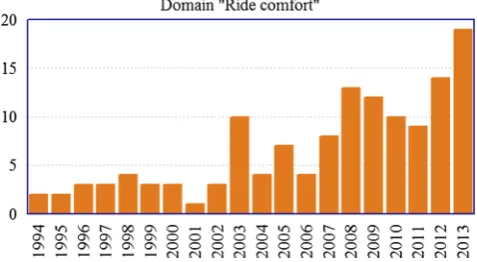
considerable amount of relevant publications. Statistics of journal
papers for both mentioned domains is depicted in Figs.
2
and
3.
The first applications of fuzzy methods to the vehicle
dynam-ics were related to the formalization of tire parameters, which are
used in the brake and acceleration control. It can be explained
with the fact that automotive tires have nonlinear characteristics
of friction and slip, which cannot be measured by on-board
sen-sors and require therefore real-time estimation with the help of
various numerical methods. Several early examples of fuzzy
computing for tire parameters estimation are described in works
of Stumpf, Arendt and Lux [33], and Madau, Yuan, Davis Jr. and
Feldkamp [34]. Among vehicle dynamics control systems, ABS
belongs to the classical examples of automotive control
applica-tions to verify and to define functional properties of different
control methods, including fuzzy computing. In particular, Intel
Corporation has proposed MCS 96 microcontroller family for
the first fuzzy braking processors [35]. Later
Siemens AG
has
applied fuzzy coprocessors C99A for brake-by-wire systems
[36]. Progress in vehicle dynamics control (VDC) systems has
given many opportunities for practical implementation of fuzzy
logic. Whereas the first VDC systems have used only brakes and
engine as actuators, the actual trend is to enable other chassis
systems such as steering and suspension in an integrated control
circuit. As a result, the domain
B
Vehicle Dynamics
^
includes a
series of the research problems where fuzzy methods found use:
–
Brake control including architecture and algorithms of
anti-lock braking systems [37–40]
–
Vehicle traction control including solutions for engine
control, electronic differentials, powertrain and driveline
control in general [41–43],
–
Control of lateral vehicle dynamics, in particular, in terms
of yaw rate and vehicle sideslip control [44–48],
Fig. 1 Number of journal publications related to fuzzy methods indomainBDriver^and cited in Scopus database
Fig. 2 Number of journal publications related to fuzzy methods in domainBVehicle Dynamics^and cited in Scopus database
–
Steering control including solutions for electric power
steering; active front and rear steering [49–51]
–
Estimation of vehicle state (linear velocity, yaw rate,
ve-hicle sideslip angle et al.) from the sensors and
experi-mental data [52–54],
–
Integrated sequential or parallel control on vehicle
dy-namics through independent subsystems (e.g. brakes,
steering, suspension, driveline) [55–58],
–
Identification and estimation of parameters of tire-road
interaction [59–63].
It was found during the analysis of research literature that
studies of semi-active and active suspension control take up a
larger share comparing with publications in other of automotive
systems based on fuzzy methods. The reason can be that the
ride control systems are characterized by complex nonlinear
oscillating behaviour influencing simultaneously several
prop-erties like comfort, handling, or NVH (noise, vibration,
harsh-ness). The use of soft computing methods can certainly simplify
the control on these vehicle properties. The earliest variants of
fuzzy architecture of active suspension controllers were
pro-posed by
Yester and McFall
[64], and
Lin and Lu
[65]. Then
many other studies related to the fuzzy applications in the
do-main
B
Ride comfort
^
are arisen with the trend to continuous
growth of research in this area. The main topics within the
domain
B
Ride comfort
^
can be subjected as follows:
–
Methods of objective evaluation and control of the
vehi-cle ride comfort [66–68],
–
Control algorithms of suspension actuators and shock
ab-sorbers with adaptation to environmental and operational
conditions such as road roughness, vehicle dynamic
var-iables and other [69–73]
–
Special control strategies of electrorheological,
magnetorheological, and electrical dampers and specific
suspension elements [74–77].
It should be noted that in spite of numerous publications in
the domain
B
Ride comfort
^
, there are few reports about
indus-trial variants of fuzzy suspension controllers. Overwhelming
majority of analyzed investigations belongs to the
fundamen-tal or conceptual applied research.
Now many classes of ground vehicles require the
manda-tory installation of VDC systems. This fact can encourage
more intensive investigations on fuzzy approaches in vehicle
dynamics and ride control.
5 Fuzzy methods and vehicle
—
environment
interaction
Both driver assistance and vehicle dynamics control systems,
discussed in previous sections, can benefit from new
information and communication technologies allowing closer
interaction of the vehicle with the driving environment.
Impactful control solutions improving vehicle safety and
en-ergy efficiency are being proposed now with the help of
var-ious on-board and on-road sensors as well road infrastructure
services. All these aspects including the technologies for
(semi-)autonomous driving are subjected to the domain
B
Driving Environment
^
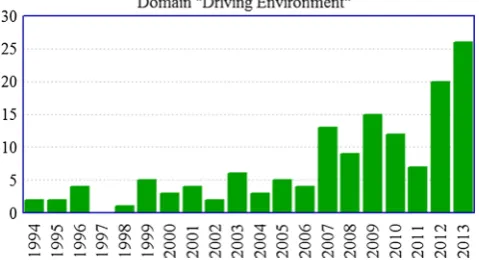
, which has been also analysed in the
presented study, Fig.
4. It should be mentioned that specific
topics of traffic control and architecture of Intelligent
Transport Systems are excluded from the review because they
are related mainly to Transport Engineering, but not to
Automotive Engineering.
The first research works relevant to fuzzy systems in the
domain
B
Driving Environment
^
have investigated path
plan-ning algorithms for an autonomous vehicle supported by a
navigation system or equipped with advanced set of sensors,
which are able to percept external parameters like distance
between the vehicles or to identify external objects. The
stud-ies of Hogle and Bonissone [78] and Freisleben and
Kunkelmann [79] can be mentioned in this context. These
and other topics are in scope of standing research interest from
middle of 1990s and now the main subjects of fuzzy
applica-tions for the domain
B
Driving Environment
^
can be classified
as follows:
–
Adaptive cruise control for the vehicles controlled by the
driver; road following control for automated driving;
col-lision prevention systems [80–82],
–
Processing sensor information; recognition of driving
en-vironment parameters; vehicle localization [83
–
89],
–
Coordination of road vehicle platoon systems [90–92],
–
Control architecture of autonomous vehicles [93–96];
–
Specific problems of brake, traction and steering control
systems of autonomous vehicles [97–99];
–
Automated parking systems [100–102].
In accordance with the short- and long-term projection, the
mass-produced cars with functions of autonomous driving
will be stepwise introduced on the market in coming decade.
This fact should stimulate more intensive research in various
topics of the domain
B
Driving Environment
^
.
6 Fuzzy methods for electric vehicles
Hybrid electric vehicles, full electric vehicles, fuel cell
electric vehicles are at the centre of permanent attention
of researchers and developers of fuzzy systems. This
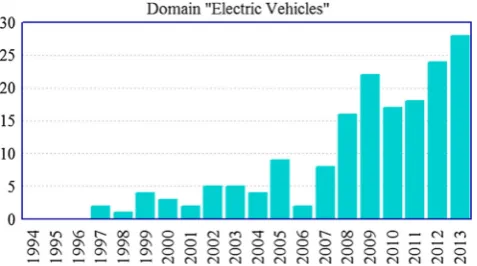
tendency is growing now because of sweeping
develop-ment of technologies for
B
Green Mobility
^
, Fig.
5. Early
studies have introduced fuzzy energy management (EM)
of electric vehicles in general. In particular, Farrall and
Jones in [103] and Cerruto, Consoli, Raciti and Testa in
[104] have proposed different fuzzy EM systems for
hybrid vehicle, which were responsible for efficient
powertrain control. Then, comparing with other
automo-tive applications, fuzzy methods found many-sided use
in the domain
B
Electric vehicles
^
. An analysis of
rele-vant research works allows to mention the following
applicative areas for fuzzy methods:
–
Global energy management of electric vehicles; hybrid
powertrain control of operational modes (internal
com-bustion engine / electric motor) [105–110];
–
Traction control, anti-lock braking and regenerative
brak-ing control of electric vehicles [111–113];
–
Internal controllers of electric motors, starters, inverters;
electric propulsion controllers [114
–
116];
–
Forecast and optimization of driving range [117,
118];
–
Estimation of battery performance and algorithms for
bat-tery charging [119
–
121].
A number of other aspects like interaction of electric
vehicles with the road and urban infrastructure are
among further promising fuzzy applications in this
re-search area.
7 Fuzzy methods for miscellaneous applications
In addition to previously introduced domains, various
unclas-sified or rarely studied examples of automotive fuzzy systems
are also presented in analyzed research publications.
In particular, the most interesting variants cover the
follow-ing topics: Transmission control includfollow-ing gear shiftfollow-ing
algo-rithms and clutch control [122], Systems for diagnosing
dif-ferent vehicle systems and elements [123–125], Methods for
the assessment of passive safety [126,
127], Thermal and
NVH comfort control systems [128,
129], Vehicle body
de-sign [130], etc. Figure
6
shows the statistics of relevant journal
publications. Hence, fuzzy methods can be considered as
well-established research tools in different aspects of
automo-tive engineering.
8 Fuzzy methods in applied and industrial research
One of the interesting results of the analysis is that a
serious gap still persists between pure research and
in-dustrial applications of fuzzy methods in automotive
en-gineering. To support this statement, Fig.
7
displays
statistics of publications related to industrial or
ready-to-installation specimens of road vehicle systems with
fuzzy controllers or fuzzy models embedded into the
processing units. This selection reflects the analysis of
technical papers published by SAE International as one
of the most recognized information sources worldwide
for automotive engineering. The preliminary search has
found only few publications every year with information
about application of fuzzy methods in automotive area.
The deep analysis detected neither the clear-cut growth
of fuzzy applications nor their regularity in individual
domains. The reason for the available gap between
the-oretical studies and industrial systems can be explained
by the fact that most of traditional automotive control
systems have well-established variants of system
archi-t e c archi-t u r e a n d c o r r e s p o n d i n g r e a l - archi-t i m e f u n c archi-t i o n a l
Fig. 5 Number of journal publications related to fuzzy methods in domainBElectric Vehicles^and cited in Scopus database
realizations, which are most often based on rule-based,
nonlinear, optimal and other control approaches that are
not directly related to computational intelligence
methods. Therefore, until recently the progress in the
vehicle control systems has been related first of all to
the implementation of more powerful and efficient
hard-ware accompanied with cautious modification of
soft-ware part. However an increased demand for on-board
systems, communicating with the driver and performing
adaptation and learning in accordance with human
be-haviour, shows certain limitations in traditional, non-soft
computing control techniques.
Nevertheless, it should be noted that some applicative areas
for fuzzy methods are especially most commonly addressed in
published industrial research studies. This is particularly true
for on-board systems like the cruise control, lane change
as-sistant et al., which require identification of the driver
behav-iour. The research of Ford Motor on the driver characterization
for the car following [131,
132] and for the vehicle destination
prediction [133] can be mentioned in this regard. A reasonable
applicability of fuzzy methods to this topic has been also
dem-onstrated in studies with the participation of Centro Richerce
Fiat for the driver distraction modelling [134]. Other work
[135], performed under coordination of researchers from
Renault, has indicated an efficient implementation of fuzzy
sets and fuzz y sp ace win dowin g for the p sych
o-physiological characterization of drivers within the context
of the car following.
An analysis of industrial white papers and analytical
pub-lications indicates trends to further consistent growth of
intel-ligent automotive systems with the logic based on fuzzy
methods [136]. This statement can be also confirmed with
numerous industrial patents for fuzzy algorithms and
control-lers, claimed by automotive OEMs and suppliers. It allows to
expect that the mentioned gap between pure research and
in-dustrial applications should be overcome in near future.
9 About compatibility of fuzzy methods
in automotive engineering
Eventual barriers for more intensive dissemination of fuzzy
methods in automotive engineering can be removed through
their integration with other analytical and numerical methods.
In particular, such integration can improve robustness and
adaptivity of controllers with simultaneous keeping of
straightforward formalization of control tasks. The fact that
fuzzy logic remains one of the most inviting approaches in
basic and applied sciences it can be supported by the
impor-tant indicator of high compatibility of fuzzy methods with
other computing and control techniques. The analyzed
re-search publications offer many examples of integration of
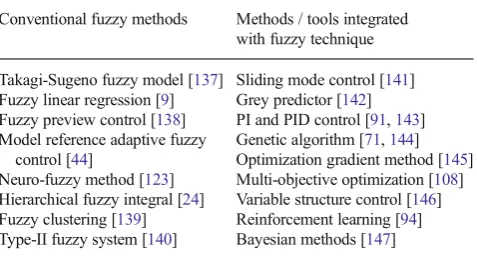
fuzzy sets and fuzzy logic that are summarized in Table
1.
10 Conclusions
Analysis of research literature, especially results of published
experimental works, demonstrates that fuzzy methods have
solid background and good prospects for the implementation
Fig. 7 Selected SAEpublications related to fuzzy methods
Table 1 Examples of methods used in automotive applications
Conventional fuzzy methods Methods / tools integrated with fuzzy technique
Takagi-Sugeno fuzzy model [137] Fuzzy linear regression [9] Fuzzy preview control [138] Model reference adaptive fuzzy
control [44]
Neuro-fuzzy method [123] Hierarchical fuzzy integral [24] Fuzzy clustering [139] Type-II fuzzy system [140]
in automotive engineering applications. The following
posi-tions can be especially mentioned in this context:
–
For the selected topics each—Driver, Vehicle Dynamics
Control, Electric Vehicles, Driving Environment—the
analysis has discovered a series of fuzzy application cases
of different nature that points to good versatile and
flex-ible feasibility of fuzzy methods for automotive
engineer-ing tasks;
–
Relevant publication statistics indicates continuous
growth of fuzzy-related research activities in the selected
topics each;
–
Despite the currently available gap between theoretical
research and industrial implementations, a strong demand
in automotive systems with intelligent functions and
in-volving more intuitive interaction with the driver and
en-vironment will stimulate a more wide adoption of fuzzy
tools and systems on serial vehicles.
The most feasible breakthrough in further development of
fuzzy systems and tools for automotive engineering
applica-tions can be expected from two kinds of
B
fusion
^
. From
the-oretical side, the fusion of fuzzy methods with other methods
of soft computing or nonlinear control opens very promising
prospects. From technological side, the fusion of many
vehi-cle controllers and estimators on common fuzzy basis can get
over numerical and linguistic uncertainties accompanying
complex processes of vehicle dynamics and
vehicle-driver-environment interaction. These trends would encourage the
researchers and engineers in seeking for novel applicative
fuzzy solutions in automotive engineering.
Open AccessThis article is distributed under the terms of the Creative Commons Attribution 4.0 International License (http:// creativecommons.org/licenses/by/4.0/), which permits unrestricted use, distribution, and reproduction in any medium, provided you give appropriate credit to the original author(s) and the source, provide a link to the Creative Commons license, and indicate if changes were made.
References
1. Pappis CP, Mamdani EH (1977) A fuzzy logic controller for a traffic junction. IEEE Trans Syst Man Cybernet SMC-7(10): 707–717
2. Sugeno M, Murakami K (1984) Fuzzy parking control of model car, Proc. IEEE Conf Decis Control, pp. 902–903
3. Sugeno M, Nishida M (1985) Fuzzy control of model car. Fuzzy Sets Syst 16:103–113
4. Ivanov V (2001) Fuzzy methods in ground vehicle engineering : state-of-the-art and advanced applications, in Proc. 8th International Conference on Structural Dynamics, EURODYN 2011, Leuven, Belgium, paper MS19-270
5. Kramer U, Rohr G (1982) A model of driver behaviour. Ergonomics 25(10):891–907
6. Kramer U (1985) On the application of fuzzy sets to the analysis of the system driver-vehicle-environment. Automatica 21(1):101–107 7. Nagai M, Kojima Y, Sato H (1987) Driver’s decision and control
process during right-turning at intersections (application of fuzzy linguistic model for accident analysis), SAE Technical Papers Series, paper no. 871250
8. Kageyama I, Pacejka HB (1991) On a new driver model with fuzzy control. Veh Syst Dyn 20(suppl 1):314–324
9. Ehara N, Suzuki K (1991) Estimation of human reasoning state in machine operation using fuzzy linear regression. Trans Jpn Soc Mech Eng Part C 57:3907–3912
10. Lin C-T, Tsai S-F, Ko L-W (2013) EEG-based learning system for online motion sickness level estimation in a dynamic vehicle en-vironment. IEEE Trans Neural Netw Learn Syst 24(10):1689– 1700,art. no. 6587600
11. Kuhn K-P, Heidinger A (1997) On-line driver type classification. Int J Veh Des 18(6):616–625
12. Lee D, Donnell ET (2007) Analysis of nighttime driver behavior and pavement marking effects using fuzzy inference system. J Comput Civ Eng 21(3):200–210
13. Wu J-D, Chen T-R (2008) Development of a drowsiness warning system based on the fuzzy logic images analysis. Expert Syst Appl 34(2):1556–1561
14. Boyraz P, Acar M, Kerr D (2008) Multi-sensor driver drowsiness monitoring. Proc IMechE Part D J Automob Eng 222(11):1857–1878 15. Wahab A, Quek C, Tan CK, Takeda K (2009) Driving profile modeling and recognition based on soft computing approach. IEEE Trans Neural Netw 20(4):563–582
16. Maeda M (1995) Fuzzy drive expert system for an automobile. Inf Sci Appl 4(1):29–48
17. Willumeit H-P (1997) Driver models: how to avoid critical yaw movements of vehicles. Int J Veh Des 18(6):652–667
18. Nigro J-M, Loriette-Rougegrez S, Rombaut M (2002) Driving situation recognition with uncertainty management and rule-based systems. Eng Appl Artif Intell 15(3–4):217–228
19. Hong C-W, Shio T-W (1996) Fuzzy control strategy design for an autopilot on automobile chassis dynamometer test stands. Mechatronics 6(5):537–555
20. Hong C-W (1997) Tuning the fuzzy control autopilot strategy for driving pattern simulation of road vehicles. Int J Veh Des 18(1):35–52 21. Lee MC, Park MK, Yoo WS, Son K, Han MC (2003) Sliding mode control of real-time PNU vehicle driving simulator and its performance eveluation. JSME Int J Ser C Mech Syst Mach Elem Manuf 46(2):557–564
22. Takahashi H, Ukishima D, Kawamoto K, Hirota K (2007) A study on predicting hazard factors for safe driving. IEEE0 Trans Ind Electron 54(2):781–789
23. Matthews ND, An PE, Roberts JM, Harris CJ (1998) A neurofuzzy approach to future intelligent driver support systems. Proc IMechE Part D J Automob Eng 212(1):43–58
24. Takahashi H, Kuroda K (1999) Intelligent vehicle control consid-ering driver’s visual perception, Proc. IEEE Conference on Intelligent Transportation Systems, pp. 252–257
25. Chen G, Zhang W-G, Zhang X-N (2013) Fuzzy neural control for unmanned robot applied to automotive test. Ind Robot 40(5):450– 461,art. no. 17094477
26. Laurence P, Basset M, Coutant P, Gissinger G (2000) Lateral ve-hicle behaviour: comparison of subjective/objective assessment using the Choquet integral. Veh Syst Dyn 34(5):357–379 27. Ma X, Andréasson I (2007) Statistical analysis of driver behavior
data in different regimes of the car-following stage. Transportation Research Record, no. 2018, pp. 87–96
29. Hurwitz DS, Wang H, Knodler MA Jr, Ni D, Moore D (2012) Fuzzy sets to describe driver behavior in the dilemma zone of high-speed signalized intersections. Transport Res F: Traffic Psychol Behav 15(2):132–143
30. Vangi D, Virga A (2003) Evaluation of energy-saving driving styles for bus drivers. Proc IMechE Part D J Automob Eng 217(4):299–305
31. Syed FU, Filev D, Ying H (2007) Fuzzy rule-based driver adviso-ry system for fuel economy improvement in a hybrid electric ve-hicle, Proc. of Annual Conference of the NAFIPS, no. 4271056, pp. 178–183
32. Luu HT, Nouvelière L, Mammar S (2010) Ecological and safe driving assistance system: Design and strategy, Proc. of IEEE Intelligent Vehicles Symposium, no. 5548012, pp. 129–134 33. Stumpf H, Arendt G, Lux F (1988) Linking evaluation of
subjec-tive handling tests on the road with objecsubjec-tively measured data by using fuzzy-set-theory, SAE Technical Papers Series, paper no. 885006
34. Madau DP, Yuan F, Davis Jr LI, Feldkamp LA (1993) Fuzzy logic anti-lock brake system for a limited range coefficient of friction surface, 1993 I.E. International Conference on Fuzzy Systems, pp. 883–888
35. Gullett C, Elting D, Kowalczyk R, Fennich M, Hellenthal B (1995) Intel fuzzy logic tool simplifies ABS design, Intel Corporation Application Note, No. 272595–001, pp. 1–8 36. Eichfeld H, Mertens A, Brandmeier T, Waidelich F, Graumann R,
Schwab M (1998) Applications of SAE 81C99x fuzzy coproces-sors. Proc IEEE Int Conf Fuzzy Syst 1:19–24
37. Mauer GF (1995) Fuzzy logic controller for an ABS braking sys-tem. IEEE Trans Fuzzy Syst 3(4):381–388
38. Chen F-W, Liao T-L (2000) Nonlinear linearization controller and genetic algorithm-based fuzzy logic controller for ABS systems and their comparison. Int J Veh Des 24(4):334–349
39. Kim S, Kim H, Sung Y-G (2001) Electronic control of braking force distribution for vehicles using a direct adaptive fuzzy con-troller. KSME Int J 15(1):66–80
40. Kuti I (2004) An adaptive fuzzy control to antilock non-straight line braking using three dimensional (finite element) vehicle mod-el. Int J Veh Des 34(4):327–339
41. Klaus K, Hasemann M (1995) An embedded fuzzy anti-slippage system for heavy duty off road vehicles. Inf Sci Appl 4(1):1–27 42. Hiller M, Schmitz T, Schuster C (1996) Design of a fuzzy traction
control system using spatial vehicle dynamics simulation. Heavy Veh Syst 3(1–2):240–248
43. Trebi-Ollennu A, Dolan JM, Khosla PK (2001) Adaptive fuzzy throttle control for an all-terrain vehicle. Proc IMechE Part I J Syst Control Eng 215(3):189–198
44. Hessburg T, Tomizuka M (1995) An adaptation method for fuzzy logic controllers in lateral vehicle guidance. Mechatronics 5(8): 873–898
45. Boada BK, Boada MJL, Díaz V (2005) Fuzzy-logic applied to yaw moment control for vehicle stability. Veh Syst Dyn 43(10): 753–770
46. Chadli M, El Hajjaji A, Oudghiri M (2008) Robust output fuzzy control for vehicle lateral dynamic stability improvement. Int J Model Identif Control 3(3):247–257
47. Du H, Zhang N, Smith W (2009) Robust yaw moment control for vehicle handling and stability. SAE Int J Passenger Cars Mech Syst 2(1):772–779
48. Ivanov V, Shyrokau B, Augsburg K, Gramstat S (2010) Advancement of vehicle dynamics control with monitoring the tire rolling environment. SAE Int J Passenger Cars Mech Syst 3(1):199–216
49. Szosland A (2000) Fuzzy logic approach to four-wheel steering of motor vehicle. Int J Veh Des 24(4):350–359
50. Huh K, Kim J (2001) Active steering control based on the esti-mated tire forces. J Dyn Syst Meas Control Trans ASME 123(3): 505–511
51. Jalali K, Uchida T, McPhee J, Lambert S (2013) Development of an advanced fuzzy active steering controller and a novel method to tune the fuzzy controller. SAE Int J Passenger Cars Electron Electr Syst 6(1):241–254
52. Basset M, Zimmer C, Gissinger GL (1997) Fuzzy approach to the real time longitudinal velocity estimation of a FWD car in critical situations. Veh Syst Dyn 27(5–6):477–489
53. Hwang JK, Song CK (2005) Fuzzy estimation of vehicle speed using an accelerometer and wheel sensors. Int J Automot Technol 6(4):359–365
54. Cheli F, Sabbioni E, Pesce M, Melzi S (2007) A methodology for vehicle sideslip angle identification: comparison with experimen-tal data. Veh Syst Dyn 45(6):549–563
55. Zeyada YF, Elbeheiry EM, Elarabi ME (2000) Fault diagnosis and
μ-estimation for integrated chassis control of vehicles in emergen-cy maneuvers. J Eng Appl Sci 47(4):665–681
56. Yoshimura T, Emoto Y (2003) Steering and suspension system of a full car model using fuzzy reasoning and disturbance observers. Int J Veh Auton Syst 1(3–4):363–386
57. March C, Shim T (2007) Integrated control of suspension and front steering to enhance vehicle handling. Proc IMechE Part D J Automob Eng 221(4):377–391
58. Song J (2012) Integrated control of brake pressure and rear-wheel steering to improve lateral stability with fuzzy logic. Int J Automot Technol 13(4):563–570
59. Ergun M (2007) Estimation of friction coefficient of asphalt con-crete road surfaces using the fuzzy logic approach. Can J Civ Eng 34(9):1110–1118
60. Shyrokau BN, Ivanov VG (2008) Alterable fuzzy sets in automo-tive control applications. Int J Model Identif Control 3(3):305–317 61. Li L, Song J, Li H-Z, Shan D-S, Kong L, Yang CC (2009) Comprehensive prediction method of road friction for vehicle dynam-ics control. Proc IMechE Part D J Automob Eng 223(8):987–1002 62. Ivanov V, Shyrokau B, Augsburg K, Algin V (2010) Fuzzy
eval-uation of tyre-surface interaction parameters. J Terrramech 47(2): 113–130
63. Ivanov V (2011) Fuzzy architecture of systems with alterable in-formation: case study for tyre–ground friction estimators. Int J Reliab Saf 5(3/4):398–419
64. Yester JL, McFall RH (1992) Fuzzy logic controller for active suspension. Proc Soc Automot Eng P-260:259–270
65. Lin Y-J, Lu Y-Q (1993) Toward better ride performance of vehicle suspension systems via intelligent control. Am Soc Mech Eng Dyn Syste Control Div (Publ) DSC 48:105–112
66. Jianghong Z, Long T (1994) An evaluation of comfort of a bus seat. Appl Ergon 25(6):386–392
67. Eslaminasab N, Biglarbegian M, Melek WW, Golnaraghi MF (2007) A neural network based fuzzy control approach to improve ride comfort and road handling of heavy vehicles using semi-active dampers. Int J Heavy Veh Syst 14(2):135–157
68. Suzuki T, Takahashi M (2010) Robust active suspension control for vibration reduction of passenger’s body. Trans JSME Part C 76(762):380–387
69. Cherry AS, Jones RP (1995) Fuzzy logic control of an automotive suspension system. IEE Proc Control Theory Appl 142(2):149–160 70. Yoshimura T, Isari Y, Li Q, Hino J (1997) Active suspension of
motor coaches using skyhook damper and fuzzy logic control. Control Eng Pract 5(2):175–184
72. Sie W-T, Lian R-J, Lin B-F (2006) Enhancing grey prediction fuzzy controller for active suspension systems. Veh Syst Dyn 44(5):407–430
73. Kaldas MMS, Çalişkan K, Henze R, Küçükay F (2013) Rule optimized fuzzy logic controller for full vehicle semi-active sus-pension. SAE Int J Passenger Cars Mech Syst 6(1):332–344 74. Choi S-B, Park D-W, Suh M-S (2002) Fuzzy sky-ground hook
c o n t r o l o f a t r a c k e d v e h i c l e f e a t u r i n g s e m i - a c t i v e electrorheological suspension units. J Dyn Syst Meas Control Trans ASME 124(1):150–157
75. Giuclea M, Sireteanu T, Stancioiu D, Stammers CW (2004) Model parameter identification for vehicle vibration control with magnetorheological dampers using computational intelligence methods. Proc IMechE Part I J Syst Control Eng 218(7):569–581 76. Zheng L, Li YN, Baz A (2009) Fuzzy-sliding mode control of a full car semi-active suspension systems with MR dampers. Smart Struct Syst 5(3):261–277
77. Lee S, Kim W-J (2010) Active suspension control with direct-drive tubular linear brushless permanent-magnet motor. IEEE Trans Control Syst Technol 18(4):859–870,art. no. 5286231 78. Hogle RA, Bonissone PP (1994) Fuzzy algorithm for path
selec-tion in autonomous vehicle navigaselec-tion. Proc IEEE Conf Decis Control:898–900
79. Freisleben B, Kunkelmann T (1993) Combining fuzzy logic and neural networks to control an autonomous vehicle, 1993 I.E. International Conference on Fuzzy Systems, pp. 321–326 80. Blöchl B, Tsinas L (1994) Automatic road following using fuzzy
control. Control Eng Pract 2(2):305–311
81. Chakroborty P, Kikuchi S (1999) Evaluation of the general motors based car-following models and a proposed fuzzy inference mod-el. Transp Res Part C Emerg Technol 7(4):209–235
82. Naranjo JE, González C, Reviejo J, García R, De Pedro T (2003) Adaptive fuzzy control for inter-vehicle gap keeping. IEEE Trans Intell Transp Syst 4(3):132–142
83. Qiao MS, Takeda H (1995) Learning algorithm of environmental recognition in driving vehicle. IEEE Trans Syst Man Cybernet 25(6):917–925
84. Stover JA, Hall DL, Gibson RE (1996) A fuzzy-logic architecture for autonomous multisensor data fusion. IEEE Trans Ind Electron 43(3):403–410
85. Goebel KF, Agogino AM (2001) Sensor validation and fusion for automated vehicle control using fuzzy techniques. J Dyn Syst Meas Control Trans ASME 123(1):145–146
86. Rigatos G, Tzafestas S (2007) Extended Kalman filtering for fuzzy modelling and multi-sensor fusion. Math Comput Model Dyn Syst 13(3):251–266
87. Kim SY, Choi HC, Won WJ, Oh SY (2009) Driving environment assessment using fusion of in- and out-of-vehicle vision systems. Int J Automot Technol 10(1):103–113
88. Broggi A, Cerri P, Ghidoni S, Grisleri P, Jung HG (2009) A new approach to urban pedestrian detection for automatic braking. IEEE Trans Intell Transp Syst 10(4):594–605,art. no. 5290131 89. Filev DP, Kolmanovsky I (2012) Markov chain modeling and
on-board identification for automotive vehicles. Lect Notes Control Inf Sci 418:111–128
90. Bauer M, Tomizuka M (1996) Fuzzy logic traction controllers and their effect on longitudinal vehicle platoon systems. Veh Syst Dyn 25(4):277–303
91. Lee GD, Kim SW, Yim YU, Jung JH, Oh SY, Kim BS (1999) Longitudinal and lateral control system development for a platoon of vehicles, IEEE Conference on Intelligent Transportation Systems, Proceedings, ITSC, pp. 605–610
92. Kim K, Kim J, Huh KS, Yi K, Cho D (2006) A real-time multi-vehicle simulator for longitudinal controller design. Veh Syst Dyn 44(5):369–386
93. Pasquier M, Quek C, Toh M (2001) Fuzzylot: a novel self-organising fuzzy-neural rule-based pilot system for automated ve-hicles. Neural Netw 14(8):1099–1112
94. Dai X, Li CK, Rad AB (2005) An approach to tune fuzzy control-lers based on reinforcement learning for autonomous vehicle con-trol. IEEE Trans Intell Transp Syst 6(3):285–293
95. Milanés V, Villagrá J, Pérez J, González C (2012) Low-speed longitudinal controllers for mass-produced cars: a comparative study. IEEE Trans Ind Electron 59(1):620–628,art. no. 5759771 96. Pérez J, Milanés V, Godoy J, Villagrá J, Onieva E (2013) Cooperative controllers for highways based on human experience. Expert Syst Appl 40(4):1024–1033
97. Kim HM, Dickerson J, Kosko B (1996) Fuzzy throttle and brake control for platoons of smart cars. Fuzzy Sets Syst 84(3):209–234 98. Naranjo JE, Reviejo J, González C, García R, De Pedro T (2004) A throttle and brake fuzzy controller: towards the automatic car. Lect Notes Comput Sci (Incl Subseries Lec Notes Artif Intell Lect Notes Bioinforma 2809:291–301
99. Naranjo JE, González C, García R, De Pedro T, Haber RE (2005) Power-steering control architecture for automatic driving. IEEE Trans Intell Transp Syst 6(4):406–415
100. Ryu Y-W, Oh S-Y, Kim S-Y (2008) Robust automatic parking without odometry using an evolutionary fuzzy logic controller. Int J Control Autom Syst 6(3):434–443
101. Chen C-Y, Feng H-M (2009) Hybrid intelligent vision-based car-like vehicle backing systems design. Expert Syst Appl 36(4): 7500–7509
102. Shiao Y, Yu C-J (2012) Automatic parking control for vehicles with stereo vision. Adv Sci Lett 8:49–54
103. Farrall SD, Jones RP (1993) Energy management in an automo-tive electric/heat engine hybrid powertrain using fuzzy decision making, Proc. 1993 International Symposium on Intelligent Control, pp. 463–468
104. Cerruto E, Consoli A, Raciti A, Testa A (1994) Fuzzy logic based efficiency improvement of an urban electric vehicle. IECON Proc (Ind Electron Conf 2:1304–1309
105. Vermeiren L, Guerra TM, Paganelli G (1997) Application of fuzzy set theory to electric car control. Cybern Syst 28(8):675–693 106. Baumann BM, Washington G, Glenn BC, Rizzoni G (2000)
Mechatronic design and control of hybrid electric vehicles. IEEE/ASME Trans Mechatron 5(1):58–72
107. Schouten NJ, Salman MA, Kheir NA (2002) Fuzzy logic control for parallel hybrid vehicles. IEEE Trans Control Syst Technol 10(3):460–468
108. Ippolito L, Loia V, Siano P (2003) Extended fuzzy C-means and genetic algorithms to optimize power flow management in hybrid electric vehicles. Fuzzy Optim Decis Making 2(4):359–374 109. Ahn H-S, Lee NS, Moon CW, Jeong G-M (2007) Fuel economy
improvement for fuel cell hybrid electric vehicles using fuzzy logic-based power distribution control. Int J Automot Technol 8(5):651–658
110. Solano Martínez J, Mulot J, Harel F, Hissel D, Péra M-C, John RI, Amiet M (2013) Experimental validation of a type-2 fuzzy logic controller for energy management in hybrid electrical vehicles. Eng Appl Artif Intell 26(7):1772–1779
111. Yoshimura T, Uchida H, Nasu H, Hino J, Ueno R (1997) Traction force control of an electric vehicle in 2WS-4WD mode using fuzzy reasoning. Int J Veh Des 18(5):442–454
112. Pusca R, Ait-Amirat Y, Berthon A, Kauffmann JM (2002) Fuzzy logic based control for electric vehicle with four separate traction drives. Proc IEEE Veh Technol Conf 4:2089–2097
114. Huang H (1999) Electrical two-speed propulsion by motor wind-ing switchwind-ing and its control strategies for electric vehicles. IEEE Trans Veh Technol 48(2):607–618
115. Sepe RB Jr, Miller JM (2002) Real-time collaborative experimen-tation via the internet: fuzzy efficiency optimization of a hybrid electric vehicle starter/alternator. Int J Veh Auton Szstems 1(1): 63–82
116. Ferreira AA, Pomilio JA, Spiazzi G, de Araujo Silva L (2008) Energy management fuzzy logic supervisory for electric vehicle power supplies system. IEEE Trans Power Electron 23(1):107– 115
117. Quigley CP, Ball RJ, Jones RP (2000) Fuzzy modelling approach to the prediction of journey parameters for hybrid electric vehicle control. Proc IMechE Part D J Automob Eng 214(8):875–885 118. Cunningham I, Burnham K (2013) Online use of the fuzzy
trans-form in the estimation of electric vehicle range. Meas Control (UK) 46(9):277–282
119. Chau KT, Wu KC, Chan CC, Shen WX (2003) A new battery capacity indicator for nickel-metal hydride battery powered elec-tric vehicles using adaptive neuro-fuzzy inference system. Energy Convers Manag 44(13):2059–2071
120. Albertus P, Couts J, Srinivasan V, Newman J (2008) A combined model for determining capacity usage and battery size for hybrid and plug-in hybrid electric vehicles. J Power Sources 183(2):771– 782
121. Fleischer C, Waag W, Bai Z, Sauer DU (2013) On-line self-learn-ing time forward voltage prognosis for lithium-ion batteries usself-learn-ing adaptive neuro-fuzzy inference system. J Power Sources 243:728– 749
122. Hayashi K, Shimizu Y, Dote Y, Takayama A, Hirako A (1995) Neuro fuzzy transmission control for automobile with variable loads. IEEE Trans Control Syst Technol 3(1):49–52
123. Halfmann C, Ayoubi M, Holzmann H (1997) Supervision of ve-hicles’tyre pressures by measurement of body accelerations. Control Eng Pract 5(8):1151–1159
124. Hissel D, Candusso D, Harel F (2007) Fuzzy-clustering durability diagnosis of polymer electrolyte fuel cells dedicated to transporta-tion applicatransporta-tions. IEEE Trans Veh Technol 56(5 I):2414–2420, art. no. 4305501
125. Kim MH, Lee S, Lee KC (2011) A fuzzy predictive redundancy system for fault-tolerance of x-by-wire systems. Microprocess Microsyst 35(5):453–461
126. Murè S, Demichela M, Piccinini N (2006) Assessment of the risk of occupational accidents using aBfuzzy^approach. Cognit Technol Work 8(2):103–112
127. Mon Y-J (2007) Airbag controller designed by adaptive-network-based fuzzy inference system (ANFIS). Fuzzy Sets Syst 158(24): 2706–2714
128. Khayyam H, Nahavandi S, Hu E, Kouzani A, Chonka A, Abawajy J, Marano V, Davis S (2011) Intelligent energy management con-trol of vehicle air conditioning via look-ahead system. Appl Therm Eng 31(16):3147–3160
129. Nopiah ZM, Junoh AK, Ariffin AK (2013) Noise annoyance fuzzy index in passenger car cabin. Int J Veh Noise Vib 9(3–4): 216–233
130. Farkas L, Moens D, Donders S, Vandepitte D (2012) Optimisation study of a vehicle bumper subsystem with fuzzy parameters. Mech Syst Signal Process 32:59–60
131. Filev D, Lu J, Tseng F, Prakah-Asante K (2011) Real-time driver characterization during car following using stochastic evolving models, IEEE International Conference on Systems, Man and Cybernetics, pp. 1031–1036
132. Lu J, Filev D, Tseng F (2015) Real-time determination of driver’s driving behavior during car following. SAE Int J Passenger Cars Electron Electr Syst, vol. 8, no. 2
133. D. Filev, F. Tseng, J. Kristinsson, and R. McGee, Real-time deter-mination of driver’s driving behavior during car following, IEEE Symposium on Computational Intelligence in Vehicles and Transportaion Systems, pp. 87–91, 2011
134. Tango F, Minin L, Tesauri F, Montanari R (2010) Field tests and machine learning approaches for refining algorithms and correla-tions of driver’s model parameters. Appl Ergon 41(2):211–224 135. Dubart D, Loslever P, Popieul JC, Moessinger M (2011) Multiple
correspondence analysis of fuzzyfied task performance and psycho-physiological test data: Use in real car following situa-tions, 12th IFAC, IFIP, IFORS, IEA Symposium on Analysis, Design, and Evaluation of Human-Machine Systems
136. Gusikhin O, Filev D, Rychtyckyi N (2008) Intelligent vehicle system: Applications and new trends, Lecture Notes in Electrical Engineering, col. 15, pp. 3–14
137. Dahmani H, Chadli M, Rabhi A, El Hajjaji A (2013) Vehicle dynamic estimation with road bank angle consideration for roll-over detection: Theoretical and experimental studies. Veh Syst Dyn 51(12):1853–1871
138. Yeh EC, Tsao YJ (1994) Fuzzy preview control scheme of active suspension for rough road. Int J Veh Des 15(1–2):166–180 139. Cheok KC, Smid GE, McCune DJ (2000) Multisensor-based
col-lision avoidance system with application to a military HMMWV, IEEE Conference on Intelligent Transportation Systems, Proceedings, ITSC, pp. 288–292
140. Economou JT, Colyer RE (2006) Fuzzy-hybrid modelling of an Ackerman steered electric vehicle. Int J Approx Reason 41(3): 343–368
141. Yang JH, Yang CC (2008) Adaptive sliding mode control for vehicle brake systems with fuzzy composition. Int J Model Identif Control 4(2):112–126
142. Chou J-H, Chen S-H, Lee F-Z (1998) Grey-fuzzy control for ac-tive suspension design. Int J Veh Des 19(1):65–77
143. Li Y, Ling Z, Liu Y, Qiao Y (2005) Method of fuzzy-PID control on vehicle longitudinal dynamics system, Lecture Notes in Artificial Intelligence, no. 3613 (PART I), pp. 822–832 144. Huang S, Ren W (1999) Use of neural fuzzy networks with mixed
genetic/gradient algorithm in automated vehicle control. IEEE Trans Ind Electron 46(6):1090–1102
145. Kataoka H, Sado H, Sakai I, Hori Y (2001) Optimal slip ratio estimator for traction control system of electric vehicle based on fuzzy inference. Electr Eng Jpn (Engl Transl Denki Gakkai Ronbunshi) 135(3):56–63
146. Guglielmino E, Stammers CW, Stǎncioiu D, Sireteanu T, Ghigliazza R (2005) Hybrid variable structure-fuzzy control of a magnetorheological damper for a seat suspension. Int J Veh Auton Syst 3(1):34–46