O R I G I N A L A R T I C L E
Evaluation of the concentrations of hydrogen and methane
emitted by termite using a semiconductor gas sensor
Yoshiyuki Yanase•Masahiro Miura•
Yoshihisa Fujii•Shogo Okumura•
Tsuyoshi Yoshimura
Received: 21 November 2012 / Accepted: 9 January 2013 / Published online: 26 January 2013 ÓThe Japan Wood Research Society 2013
Abstract A gas detection apparatus equipped with a semiconductor gas sensor was employed for qualitative and quantitative measurement of hydrogen and methane emit-ted by termites. A gas sample of 2.5 ml was injecemit-ted into the semiconductor gas sensor through the gas detection apparatus, and the maximum voltage of the sensor was converted into gas concentration. The gas samples were collected from three distinct experiments: (1) five combi-nations of workers and soldiers ofCoptotermes formosanus with and without a wood specimen; (2) C. formosanus under six temperature conditions; and (3) four different termite species, C. formosanus, Reticulitermes speratus, Incisitermes minor, and Zootermopsis nevadensis. The hydrogen and methane concentrations increased with an increase in the number of termites. Concentrations were higher in samples with a wood specimen than without it. Both hydrogen and methane concentrations were the highest for the samples at 35°C and were lowest at 15 and 5°C. The concentrations were very low at 45°C because all the termites had died in a few hours. The concentrations of hydrogen and methane were highest forZ.nevadensis, the dampwood termite, among the four species, and no
methane was detected forI.minor, the drywood termite, at 28°C and 75 % RH.
Keywords Nondestructive detectionHydrogen
Methane Termite attackSemiconductor gas sensor
Introduction
At present, termite (Isoptera: Termitidae) attacks on wood are almost always detected by visual inspection, but it is difficult to detect the early stages of termite attack by visual inspection alone. Currently, nondestructive methods of inspecting termite attack are not widely used in Japan. In the future, however, efficacious and nondestructive detec-tion methods will be required to assist in termite control to reduce the use of termiticide or to implement a chemical-free management scheme.
Several methods for nondestructive detection of termite attacks have been investigated and developed. They are classified into two categories: detection of termite activity in the wooden constructions and evaluation of mass loss of wooden objects. An example of the former is acoustic emission (AE) monitoring, which utilizes the detection of small elastic waves called acoustic emissions (AEs), gen-erated by the feeding activity of worker termites in wood [1–4]. Technology to detect reflection of micro or milli-meter waves from termite movement in the wood has also been developed and applied [5, 6]. One of the latest methods is the detection of inner cavities by measuring the velocity or attenuation of the sound or elastic wave prop-agating in wood. A scanning radar apparatus at 1.4 GHz, which detects the reflection of the wave radiated onto the wood, was applied for the nondestructive detection of an inner defect in wood such as a cavity [7].
Y. Yanase (&)Y. FujiiS. Okumura
Graduate School of Agriculture, Kyoto University,
Kitashirakawa Oiwake-cho, Sakyo-ku, Kyoto 606-8502, Japan e-mail: [email protected]
M. Miura
DAIKEN Corporation, 6-20, Dojima, 1-chome, Kita-ku, Osaka 530-8210, Japan
T. Yoshimura
Detection of odors from termite colonies with the help of trained dogs could be a possible solution. The abilities of the dogs to detect varying numbers of subterranean ter-mites, differentiate between five termite species, discrimi-nate termites from termite-damaged wood, and distinguish cockroaches and carpenter ants from subterranean termites have been investigated [8]. Trained dogs were 96 % accurate in finding over 40 termite workers and incorrectly indicated the presence of termites in only 2.7 % of the containers without termites. The ability of trained beagles and electronic odor sensing devices to detect gases given off by termites has been also investigated [9]. In the experiments using wooden blocks with different densities of subterranean termites, the percentage of blocks correctly identified by beagles was reportedly 81 %. This was higher than that obtained using electronic odor sensing devices (48 % accuracy) that primarily detect methane gas. These findings demonstrate the ability of trained dogs to detect termites; although, the cost and time employed in training the dogs are not always practical.
It was reported that the most common and abundant gases emitted from termite colonies are CO2, CH4, and other gases, such as CHCl3, N2O, CO, and H2 [10, 11]. There is a possibility that the detection of these gases provides a nondestructive method to detect early termite attack. Recently, semiconductor gas sensors with high sensitivity to detect odor, methane, and hydrogen were developed [12,13], and these sensors can possibly detect termite attacks with accuracy and efficiency. With respect to the detection of metabolic gases generated by a small number of termites using three types of semiconductor gas sensors, the performance of the hydrogen sensor was found to be better than that of the odor and methane sensors [14]. However, basic information on the performance of the gas sensor, especially for the quantitative estimation of the detected gas concentration associated with the termite activity, remains unclear.
In this study, a gas detection apparatus equipped with a semiconductor gas sensor was applied for nondestructive detection of termite attack in wood, and its feasibility was examined through the measurement of hydrogen and methane concentrations emitted by the termites under several conditions.
Materials and methods
Termites and rearing conditions
A termite group composed of workers and soldiers were starved for 2 days and placed in a 450 ml glass bottle. The bottle had a metal lid with an opening (11 mm diameter) plugged with a butadiene rubber septum. The termites were
held for 24 h in these tightly sealed bottles. Gas samples (2.5 ml) were aspirated by a syringe through the butadiene rubber septum, and the concentrations of hydrogen and methane were measured. Three bottles were prepared for each group for the replication of the measurement. Three experiments were conducted for the different termite groups.
Experiment 1
Subterranean termites, Coptotermes formosanus, were collected from a colony maintained by the Research Institute for Sustainable Humano-sphere, Kyoto Univer-sity. Five termite groups of a constant ratio (10:1) of workers and soldiers in varying numbers were used; (1) 20:2, (2) 50:5, (3) 100:10, (4) 200:20, and (5) 500:50. Each termite group was put into a glass bottle with or without a small air-dried wood specimen of Scots pine (Pinus syl-vestris) with a dimension of 35(R)935(T)95(L) mm. The glass bottles were sealed and placed in a thermohy-grostat set at 28 °C and 75 % relative humidity (RH). Experiment 2
100 workers and 10 soldiers ofC.formosanuswere put into the glass bottle with or without a wood specimen of P.sylvestris. The bottles were placed in a thermohygrostat set at 5, 15, 25, 28, 35, and 45 °C under a constant humidity of 75 % RH for 24 h.
Experiment 3
Four termite species,C.formosanus,Reticulitermes speratus (subterranean termite), Incisitermes minor (drywood ter-mite), and Zootermopsis nevadensis (dampwood termite) were used. R.speratus, I. minor, and Z. nevadensis were collected from a field colony at Kyoto University, a colony found in a wooden construction in Wakayama Prefecture, and a field colony from Hyogo Prefecture, respectively. Glass bottles with 20 workers of each species were placed in a thermohygrostat at 28°C and 75 % RH for 24 h. A wood specimen of P. sylvestris, 35(R)935(T)95(L) mm, of approximately 100 % moisture content by soaking in water was put into theC.formosanus,R.speratus, andZ.nevadensis bottles, and an air-dried flake ofP.sylvestriswas put into the I.minorbottle for feeding it easily.
Measurement of gas concentration
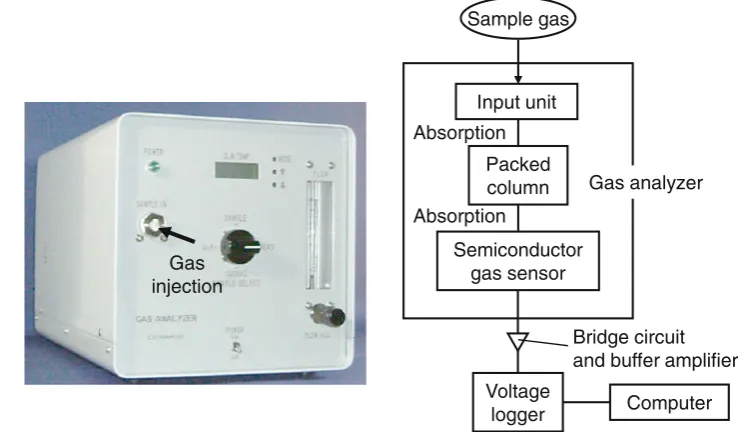
of 2.5 ml collected with a syringe was injected into an input unit. The sample was introduced into a column filled with active carbon along with clean air. The gas components passed through the column with different retention times depending on the molecular size. Each gas component was detected by a semiconductor gas sensor made of tin oxide (SnO2). At the initialized stage of the sensor, oxygen is adsorbed on the sensor surface in the state of negative charged O-. When a combustible gas component, such as hydrogen and methane, accesses the sensor heated at a fixed operating temperature between 300 and 450°C, it is combined with the adsorbed oxygen (oxidized) and the oxygen simultaneously releases an electron. This results in an increase in the elec-trical conductivity of the sensor (SnO2), which is monitored as a decrease in electrical resistance of the unit. This change is measured through a bridge circuit and a buffer amplifier, recorded on a voltage logger, and finally post-processed by a computer. The measured voltage was converted into the gas concentration by a calibration curve.
As shown in Fig.2, peaks recorded at retention times of 20 and 150 s corresponded to hydrogen and methane,
respectively, and the sensitivity of the gas sensor for methane was lower than that for hydrogen. The recorded peak voltage was transformed into the gas concentration using the calibra-tion curve obtained in preliminary experiments using the target gas of hydrogen or methane with a known concentration.
Results and discussion
Effect of the number of termites
The concentrations of hydrogen and methane measured in Experiment 1 are shown in Figs.3and4. For all the termite groups, the concentrations were higher in the bottles with the wood specimen than those without it. This implies that hydrogen and methane were emitted by the feeding activ-ity, which is the amount of wood consumption, of worker termites and was produced in the guts of these termites by the termite-symbiont system in atmosphere [11]. Signifi-cant levels of hydrogen and methane were also detected from the bottles without the wood specimen, although, the concentration was very low. This was probably due to the emission of residual gas in the guts of termites after starving for 2 days. The concentrations of both gases increased with the number of termites in the bottle. Termite groups of a constant ratio (10:1) of workers and soldiers were employed in Experiments 1 and 2, because the feeding activity of workers together with soldiers of 5–10 % was higher than that of only workers [1]. These findings lead to a hypothesis that only worker termites emitted hydrogen and methane at a constant rate during feeding for 24 h, and this was supported by the finding in a preliminary experiment that slight hydrogen and no meth-ane were detected in the bottles with only soldiers. The gas
Gas analyzer
Absorption Sample gas
Computer Absorption
Bridge circuit and buffer amplifier Packed
column Input unit
Semiconductor gas sensor
Voltage logger Gas
injection Fig. 1 Gas analyzer (left) and
schematic outline of gas analysis (right)
50 100 150 200 250
10 20 30 40 50 60 70
0
Methane Hydrogen
Retention time (s)
V
o
ltage (mV)
emissions per worker per unit time can be estimated from concentrations for five groups with wood specimens in Figs.3 and4. The emission rates, average of five termite groups, for hydrogen and methane were 0.405±0.088 (SD) and 0.318±0.056 nmol/h/worker, respectively. Effect of ambient temperature
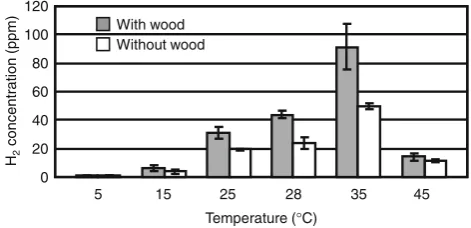
The concentrations of hydrogen and methane for different bottle temperatures in Experiment 2 are shown in Figs.5 and6. For both hydrogen and methane, the concentration was the highest at 35°C, which implies that the feeding activity of workers was the most active at this temperature. The average hydrogen- and methane-emission rates at 35°C were estimated to be 0.766±0.131 (SD) and 0.441±0.074 nmol/h/worker, respectively. At lower temperatures, 15 and 5°C, the concentrations of hydrogen and methane were less than 6 and 15 ppm, respectively, and there was no significant difference in concentration with and without the wood specimen. This coincided with the observations that no active feeding behavior was found at these temperatures. At 45°C, the concentrations were low (less than 14 ppm) because all termites inside the bottle died within a few hours. It has been reported that the
temperature in the nests ofC.formosanusranged from 5 to 35°C throughout the year, and the largest number of AEs generated by the attack of worker termites in the wooden construction members were detected at 35°C [15]. This strongly supports the present findings.
Comparison among the four termite species
The concentrations of hydrogen and methane for four ter-mite species in Experiment 3 are shown in Fig.7. A sig-nificant difference in the concentration of hydrogen and methane between the species was revealed by one way analysis of variance (ANOVA) [F(3, 8)=7.59,p\0.01]. The differences may be attributed to the difference in weight among four species, since the concentration of hydrogen was the highest for Z. nevadensis (average weight of 20 workers was 27 mg) and the lowest concen-tration was observed forR.speratus(1.5 mg). On the other hand, the concentration of hydrogen was much lower (under 4 ppm) for I. minor than C. formosanus (over 10 ppm), although the average weight of 20 workers of the I. minor workers (5.2 mg) was greater than that of the C.formosanusworkers (3.0 mg). This implies that not only the weight but also the feeding activity of termites possibly affects gas emission.
50 100 150 200 250 0 300 H2 concentr ation (ppm) W: 50 S: 5 W: 100 S: 10 W: 200 S: 20 W: 500 S: 50 Number of workers (W) and soldiers (S) W: 20
S: 2
With wood Without wood
Fig. 3 Hydrogen concentrations for five termite groups of different number of workers and soldiers ofC.formosanus.Error barsindicate standard deviations of three replications
50 100 150 200 0 CH 4 concentra tion (ppm) W: 50 S: 5 W: 100 S: 10 W: 200 S: 20 W: 500 S: 50 Number of workers (W) and soldiers (S) W: 20
S: 2
With wood Without wood
Fig. 4 Methane concentrations for five termite groups of different number of workers and soldiers ofC.formosanus.Error barsrefer to Fig.3
Temperature (°C)
20 0 60 80 100 40 120 45 35 28 25 15 5 H2 concentr ation (ppm) With wood Without wood
Fig. 5 Hydrogen concentrations for a termite group of 100 workers and 10 soldiers ofC.formosanusunder the six temperatures at 24 h after sealing.Error barsrefer to Fig.3
20 40 60 0 80 45 35 28 25 15 5 CH 4 concentra tion (ppm)
Temperature (°C)
With wood Without wood
The concentration of methane was the highest for Z. nevadensis among four termite species. There was no distinct difference in concentration betweenC.formosanus and R. speratus. No methane was detected for I. minor. Sugimoto et al. [11] reported that the probability of colo-nization by methanogens during the evolution of the ter-mite-symbiont system may be lower in dry wood feeders than in wet and damp wood feeders, and the inhabitation of termite species in dry wood may also be responsible for the low probability of colonization by methanogens. However, the probability may be high for other three species of C.formosanus,R.speratus, andZ.nevadensisbecause of a contact with soil, which contains methanogens, by inhab-iting damp wood in contact with soil, nesting in the soil, and foraging through gallery on/in the soil. Thus, the lack of methane detection inI.minorwas probably because of the rearing and experimental conditions, feeding dry wood, and the fact that it is difficult to have colonization by methanogens without contact with soil.
As mentioned above, it is necessary to take the indi-vidual weight of worker termites into consideration for estimation of gas emission rates. The gas emissions from a
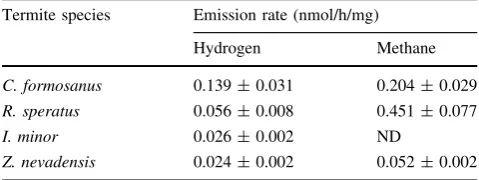
worker termite were estimated using the same method as in Figs. 3 and 4, and they were converted to the emission rates per individual weight of worker termites (Table1). There was a significant difference in the emission rates of hydrogen and methane among four species [F(3, 8)=
7.59,p\0.01]. The hydrogen- and the methane-emission rates were the highest forC.formosanusand forR. spera-tus, respectively. This implies that the difference in the concentration of hydrogen and methane among termite species was affected by the metabolic system and feeding activity of termite species. It is necessary to examine fur-ther these biological effects on gas concentrations. It is also necessary to investigate the difference in the concentrations among wood species as food materials as only one wood species was employed in this study.
Conclusion
Hydrogen and methane generated by termites in bottles were detected using a gas analyzer equipped with a semi-conductor gas sensor, using different number of workers and soldiers, under different bottle temperatures, and using four termite species.
Major findings of this study were:
1. The concentrations of hydrogen and methane were higher in bottles with the wood specimen than those without the wood specimen irrespective of the number of termites. This implies that hydrogen and methane were emitted by the feeding activity of worker termites.
2. The gas concentrations increased almost in accordance with the number of termites.
3. The gas concentrations were the highest at 35°C, very low at 15 and 5 °C, and low at 45°C because the termites had died within a few hours.
4. Dampwood termites (Z.nevadensis) emitted relatively high levels of hydrogen and methane, whereas the drywood termite, I. minor, emitted no methane at 28°C and 75 % RH.
Acknowledgments We thank Dr. Toru Maekawa and Mr. Kengo Suzuki of New Cosmos Electric Co., Ltd. for providing a semicon-ductor gas sensor.
References
1. Fujii Y, Noguchi M, Imamura Y, Tokoro M (1990) Using acoustic emission monitoring to detect termite activity in wood. For Prod J 40:34–36
2. Noguchi M, Fujii Y, Owada M, Imamura Y, Tokoro M (1991) AE monitoring to detect termite attack on wood of commercial dimension and posts. For Prod J 41:32–36
10 20 30 40
0
10 20 30 40
0 H2
concentr
ation
(ppm)
CH
4
concentra
tion (ppm)
C. formosanus R. speratus I. minor Z. nevadensis
Fig. 7 Hydrogen and methane concentrations for 20 workers of four termite species.Error barsrefer to Fig.3
Table 1 Emission rates of hydrogen and methane normalized to individual termite weight
Termite species Emission rate (nmol/h/mg)
Hydrogen Methane
C. formosanus 0.139±0.031 0.204±0.029 R. speratus 0.056±0.008 0.451±0.077 I. minor 0.026±0.002 ND
3. Fujii Y, Yanase Y, Imamura Y, Okumura S, Oka S (1998) Detection of termite attack in wooden buildings with AE moni-toring: case study at a traditional Japanese warehouse (in Japa-nese). Jpn J Environ Entmol Zool 9:101–105
4. Yanase Y, Fujii Y, Okumura S, Imamura Y, Kozaki M (1999) Detection of termite attack in wooden buildings using AE mon-itoring: a case study at a house of wooden panel construction (in Japanese). Jpn J Environ Entmol Zool 10:160–168
5. Evans TA (2002) Assessing efficacy of TermatracTM; a new microwave based technology for non-destructive detection of termites (Isoptera). Sociobiology 40:575–583
6. Fujii Y, Fujiwara Y, Yanase Y, Okumura S, Narahara K, Nagatsuma T, Yoshimura T, Imamura Y (2007) Nondestructive detection of termites using a millimeter-wave imaging technique. For Prod J 57:75–79
7. Fujii Y, Yanase Y (2001) Nondestructive evaluation of decay and insect attack in wood using acoustic emission (AE) monitoring and a radar technique. Tools for maintaining wood in outdoor applications. In: Imamura Y (ed) High-performance utilization of wood for outdoor uses. Press-Net, Kyoto, pp 145–160
8. Brooks SE, Oi FM, Koehler PG (2003) Ability of canine termite detectors to locate live termites and discriminate them from non-termite material. J Econ Entomol 96:1259–1265
9. Lewis VR, Fouche CF, Lemaster RL (1997) Evaluation of dog-assisted searches and electronic odor devices for detecting the western subterranean termite. For Prod J 47:79–84
10. Khalil MAK, Rasmussen RA, French JRJ, Holt JA (1990) The influence of termites on atmospheric trace gases: CH4, CO2, CHCl3, N2O, CO, H2, and light hydrocarbons. J Geophy Res 95:3619–3634
11. Sugimoto A, Inoue T, Tayasu I, Miller L, Takeichi S, Abe T (1998) Methane and hydrogen production in a termite-symbiont system. Ecological Res 13:241–257
12. Suzuki K, Takada T (1995) Highly sensitive odour sensors using SnO2thick films. Sens Actuators B Chem 24–25:773–776 13. Katsuki A, Fukui K (1999) Applications of gas sensors for
security and control systems in use of hydrogen. In: Proceedings of the 5th Korea-Japan Joint Symposium ’99 on Hydrogen Energy, Yusong, pp 183–191
14. Yanase Y, Fujii Y, Okumura S, Yoshimura T, Imamura Y (2006) Non-destructive evaluation of termite attack in wood and wooden constructions using acoustic emission (AE) monitoring and ceramic gas sensors. In: Proceedings of JSPS Japan and Hungary Research Cooperative Program/Joint Seminar, Noshiro, October 16–19, pp 54–62