Volume 2011, Article ID 839412,11pages doi:10.1155/2011/839412
Research Article
Integrating the Projective Transform with
Particle Filtering for Visual Tracking
P. L. M. Bouttefroy,
1A. Bouzerdoum,
1S. L. Phung,
1and A. Beghdadi
21School of Electrical, Computer & Telecom. Engineering, University of Wollongong, Wollongong, NSW 2522, Australia 2L2TI, Institut Galil´ee, Universit´e Paris 13, 93430 Villetaneuse, France
Correspondence should be addressed to P. L. M. Bouttefroy,[email protected]
Received 9 April 2010; Accepted 26 October 2010
Academic Editor: Carlo Regazzoni
Copyright © 2011 P. L. M. Bouttefroy et al. This is an open access article distributed under the Creative Commons Attribution License, which permits unrestricted use, distribution, and reproduction in any medium, provided the original work is properly cited.
This paper presents the projective particle filter, a Bayesian filtering technique integrating the projective transform, which describes the distortion of vehicle trajectories on the camera plane. The characteristics inherent to traffic monitoring, and in particular the projective transform, are integrated in the particle filtering framework in order to improve the tracking robustness and accuracy. It is shown that the projective transform can be fully described by three parameters, namely, the angle of view, the height of the camera, and the ground distance to the first point of capture. This information is integrated in the importance density so as to explore the feature space more accurately. By providing a fine distribution of the samples in the feature space, the projective particle filter outperforms the standard particle filter on different tracking measures. First, the resampling frequency is reduced due to a better fit of the importance density for the estimation of the posterior density. Second, the mean squared error between the feature vector estimate and the true state is reduced compared to the estimate provided by the standard particle filter. Third, the tracking rate is improved for the projective particle filter, hence decreasing track loss.
1. Introduction and Motivations
Vehicle tracking has been an active field of research within the past decade due to the increase in computational power and the development of video surveillance infrastructure. The area of Intelligent Transportation Systems (ITSs) is in need for robust tracking algorithms to ensure that top-end decisions such as automatic traffic control and regulation, automatic video surveillance and abnormal event detection are made with a high level of confidence. Accurate trajectory extraction provides essential statistics for traffic control, such as speed monitoring, vehicle count, and average vehicle flow. Therefore, as a low-level task at the bottom-end of ITS, vehicle tracking must provide accurate and robust informa-tion to higher-level modules making intelligent decisions. In this sense, intelligent transportation systems are a major breakthrough since they alleviate the need for devices that can be prohibitively costly or simply unpractical to imple-ment. For instance, the installation of inductive loop sensors generates traffic perturbations that cannot always be afforded
in dense traffic areas. Also, robust video tracking enables new applications such as vehicle identification and customized statistics that are not available with current technologies, for example, suspect vehicle tracking or differentiated vehicle speed limits. At the top-end of the system are high level-tasks such as event detection (e.g., accident and animal crossing) or traffic regulation (e.g., dynamic adaptation and lane allocation). Robust vehicle tracking is therefore necessary to ensure effective performance.
for example, in case of severe occlusion [8, 9]. Particle filters offer the advantage of relaxing the Gaussian and linearity constraints imposed upon the Kalman filter. On the downside, particle filters only provide a suboptimal solution, which converges in a statistical sense to the optimal solution. The convergence is of the orderO(NS), whereNSis the number of particles; consequently, they are computation-intensive algorithms. For this reason, particle filtering techniques for visual tracking have been developed only recently with the widespread of powerful computers. Particle filters for visual object tracking have first been introduced by Isard and Blake, part of the CONDENSATION algorithm [10, 11], and Doucet [12]. Arulampalam et al. provide a more general introduction to Bayesian filtering, encompassing particle filter implementations [13]. Within the last decade, the interest in particle filters has been growing exponentially. Early contributions were based on the Kalman filter models; for instance, Van Der Merwe et al. discussed an extended particle filter (EPF) and proposed an unscented particle filter (UPF), using the unscented transform to capture second order nonlinearities [14]. Later, a Gaussian sum particle filter was introduced to reduce the computational complexity [15]. There has also been a plethora of theoretic improvements to the original algorithm such as the kernel particle filter [16, 17], the iterated extended Kalman particle filter [18], the adaptive sample size particle filter [19,20], and the augmented particle filter [21]. As far as applications are concerned, particle filters are widely used in a variety of tracking tasks: head tracking via active contours [22, 23], edge and color histogram tracking [24, 25], sonar [26], and phase [27] tracking, to name few. Particle filters have also been used for object detection and segmentation [28, 29], and for audiovisual fusion [30].
Many vehicle tracking systems have been proposed that integrate features of the object, such as the traditional kinematic model parameters [2, 7, 31–33] or scale [1], in the tracking model. However, these techniques seldom integrate information specific to the vehicle tracking prob-lem, which is key to the improvement of track extraction; rather, they are general estimators disregarding the particular traffic surveillance context. Since particle filters require a large number of samples in order to achieve accurate and robust tracking, information pertaining to the behavior of the vehicle is instrumental in drawing samples from the importance density. To this end, the projective fractional transform is used to map the vehicle position in the real world to its position on the camera plane. In [35], Bouttefroy et al. proposed the projective Kalman filter (PKF), which integrates the projective transform into the Kalman tracker to improve its performance. However, the PKF tracker differs from the proposed particle filter tracker in that the former relies on background subtraction to extract the objects, whereas the latter uses color information to track the objects. The aim of this paper is to study the performance of a particle filter integrating vehicle characteristics in order to decrease the size of the particle set for a given error rate. In this framework, the task of vehicle tracking can be approached as a specific application of object tracking in
a constrained environment. Indeed, vehicles do not evolve freely in their environment but follow particular trajecto-ries. The most notable constraints imposed upon vehicle trajectories in traffic video surveillance are summarized below.
Low Definition and Highly Compressed Videos. Traffic mon-itoring video sequences are often of poor quality because of the inadequate infrastructure of the acquisition and transport system. Therefore, the size of the sample set (NS) necessary for vehicle tracking must be large to ensure robust and accurate estimates.
Slowly-Varying Vehicle Speed. A common assumption in vehicle tracking is the uniformity of the vehicle speed. The narrow angle of view of the scene and the short period of time a vehicle is in the field of view justify this assumption, especially when tracking vehicles on a highway.
Constrained Real-World Vehicle Trajectory. Normal driving rules impose a particular trajectory on the vehicle. Indeed, the curvature of the road and the different lanes constrain the position of the vehicle. Figure1illustrates the pattern of vehicle trajectories resulting from projective constraints that can be exploited in vehicle tracking.
Projection of Vehicle Trajectory on the Camera Plane. The trajectory of a vehicle on the camera plane undergoes severe distortion due to the low elevation of the traffic surveillance camera. The curve described by the position of the vehicle converges asymptotically to the vanishing point.
(a)
0 20 40 60 80 100 120 140
P
o
sit
ion
on
the
image
(
x
)
0 50 100 150 200 250 300 350 400 450 500 Ground distance from the camera (r)
(b)
Figure1: Examples of vehicle trajectories from a traffic monitoring video sequence. Most vehicles follow a predetermined path: (a) vehicle trajectories in the image; (b) vehicle positions in the image w.r.t. the distance from the monitoring camera.
2. Bayesian and Particle Filtering
This section presents a brief review of Bayesian and particle filtering. Bayesian filtering provides a convenient framework for object tracking due to the weak assumptions on the state space model and the first-order Markov chain recursive properties. Without loss of generality, let us consider a system with statexof dimensionnand observationzof dimension m. Letx1:k {x1,. . .,xk} and z1:k {z1,. . .,zk}denote,
respectively, the set of states and the set of observations prior to and including time instanttk. The state space model can be expressed as
xk=f(xk−1) +vk−1, (1)
zk=h(xk) +nk, (2)
when the process and observation noises, vk−1 and nk, respectively, are assumed to be additive. The vector-valued functionsfandhare the process and observation functions, respectively. Bayesian filtering aims to estimate theposterior
probability density function (pdf) of the state x given the observationzasp(xk |zk). The probability density function is estimated recursively, in two steps: prediction and update. First, let us denote byp(xk−1|zk−1) theposteriorpdf at time
tk−1, and let us assume it is known. The prediction stage relies
on the Chapman-Kolmogorov equation to estimate the prior pdfp(xk|zk−1):
p(xk|zk−1)=
p(xk|xk−1)p(xk−1|zk−1)dxk−1. (3)
When a new observation becomes available, the prior is updated as follows:
p(xk|zk)=λkp(zk|xk)p(xk|zk−1), (4)
where p(zk | xk) is the likelihood function and λk is a normalizing constant, λk = p(zk | xk)p(xk | zk−1)dxk. As the posterior probability density function p(xk | zk) is
recursively estimated through (3) and (4), only the initial densityp(x0|z0) is to be known.
Monte Carlo methods and more specifically particle filters have been extensively employed to tackle the Bayesian problem represented by (3) and (4) [36,37]. Multimodality enables the system to evolve in time with several hypotheses on the state in parallel. This property is practical to corrobo-rate or reject an eventual track after several frames. However, the Bayesian problem then cannot be solved in closed form, as in the Kalman filter, due to the complex density shapes involved. Particle filters rely on Sequential Monte Carlo (SMC) simulations, as a numerical method, to circumvent the direct evaluation of the Chapman-Kolmogorov equation (3). Let us assume that a large number of samples{xik,i = 1· · ·NS}are drawn from the posterior distribution p(xk | zk). It follows from the law of large numbers that
p(xk|zk)≈ NS
i=1
wi kδ
xk−xik
, (5)
where wik are positive weights, satisfying wki = 1, and δ(·) is the Kronecker delta function. However, because it is often difficult to draw samples from the posterior pdf, an importance densityq(·) is used to generate the samples
xi
k. It can then be shown that the recursive estimate of the posterior density via (3) and (4) can be carried out by the set of particles, provided that the weights are updated as follows [13]:
wki ∝wik−1 p
zk|xik
pxik|xik−1 qxik|xik−1,zk
=wik−1γkpzk|xik
.
(6)
The choice of the importance densityq(xki | xik−1,zk) is crucial in order to obtain a good estimate of the posterior pdf. It has been shown that the set of particles and associated weights{xi
H θ/2
D x o r
α β
d Xvp
dp
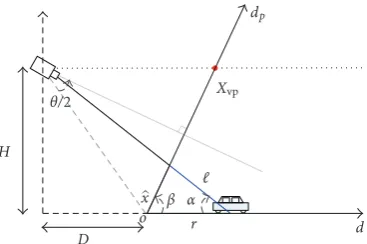
Figure2: Projection of the vehicle on a plane parallel to the image plane of the camera. The graph shows a cross-section of the scene along the directiond(tangential to the road).
and a large number of samples will have negligible weight [38]. In such a case, and because samples are not drawn from the true posterior, the degeneracy problem cannot be avoided and resampling of the set needs to be performed. Nevertheless, the closer the importance density is from the true posterior density, the slower the set {xik,wik}will degenerate; a good choice of importance density reduces the need for resampling. In this paper, we propose to model the fractional transform mapping the real world space onto the camera plane and to integrate the projection in the particle filter through the importance densityq(xki |xki−1,zk).
3. Projective Particle Filter
The particle filter developed is named Projective Particle Filter (PPF) because the vehicle position is projected on the camera plane and used as an inference to diffuse the particles in the feature space. One of the particularities of the PPF is to differentiate between the importance density and the transition prior pdf, whilst the SIR (Sampling Importance Resampling) filter, also called standard particle filter, does not. Therefore, we need to define the importance density from the fractional transform as well as the transition prior p(xk|xk−1) and the likelihoodp(zk |xk) in order to update the weights in (6).
3.1. Linear Fractional Transformation. The fractional trans-form is used to estimate the position of the object on the camera plane (x) from its position on the road (r). The physical trajectory is projected onto the camera plane as shown in Figure 2. The distortion of the object trajectory happens along the directiond, tangential to the road. The axisdpis parallel to the camera plane; the projectionxof the vehicle position ondpis thus proportional to the position of the vehicle on the camera plane. The value ofxis scaled by Xvp, the projection of the vanishing point ondp, to obtain
the position of the vehicle in terms of pixels. For practical implementation, it is useful to express the projection along the tangential directiondonto thedpaxis in terms of video footage parameters that are easily accessible, namely:
(i) angle of view (θ),
(ii) height of the camera (H),
(iii) ground distance (D) between the camera and the first location captured by the camera.
It can be inferred from Figure2, after applying the law of cosines, that
x2=r2+2−2rcos(α), (7)
2=x2+r2−2rxcosβ, (8)
where cosα = (D + r)/
H2+ (D+r)2 and β =
arctan(D/H) +θ/2. After squaring and substituting2in (7),
we obtain
r2x2+r2−2rxcosβcos2α=r2−rxcosβ2. (9)
Grouping the terms inxto get a quadratic form leads to
x2cos2α−cos2β+ 2xr1−cos2αcosβ
+r2cos2α−1=0. (10)
After discarding the nonphysically acceptable solution, one gets
x(r)= rH
(D+r) sinβ+Hcosβ. (11)
However, because D H and θ is small in practice (see Table 1), the angle β is approximately equal to π/2 and, consequently, (11) simplifies tox = rH/(D+r). Note that this result can be verified using the triangle proportionality theorem. Finally, we scalexwith the position of the vanishing pointXvp in the image to find the position of the vehicle in
terms of pixel location, which yields
x= Xvp
limr→ ∞x(r)x(r)= Xvp
H x(r). (12)
(The position of the vanishing point can either be approx-imated manually or estapprox-imated automatically [39]. In our experiments, the position of the vanishing point is estimated manually). The projected speed and the observed size of the object on the camera plane are also important variables for the problem of tracking, and hence it is necessary to derive them. Letv = dr/dt and ˙x = dx/dt. Differentiating (12), after substituting forx(x =rH/(D+r)) and eliminatingr, yields the observed speed of the vehicle on the camera plane:
˙
x= fx˙(x)=
Xvp−x
2
v XvpD
, (13)
The observed size of the vehiclebcan also be derived from the positionxif the real size of the vehiclesis known. If the center of the vehicle isx, its extremities are located atx+s/2 andx−s/2. Therefore, applying the fractional transformation yields
b= fb(x)= sDXvp DXvp/(Xvp−x)
2
−(s/2)2
Table1: Video sequences used for the evaluation of the algorithm performance along with the duration, the number of vehicles, and the setting parameters, namely, the height (H), the angle of view (θ) and the distance to field of view (D).
Video sequence Duration No. of vehicles Camera height (H) Angle of view (θ) Distance to FOV (D)
Video 001 199 s 74 6 m 8.5±0.10 deg 48 m
Video 002 360 s 115 5.5 m 15.7±0.12 deg 75 m
Video 003 480 s 252 5.5 m 15.7±0.12 deg 75 m
Video 004 367 s 132 6 m 19.2±0.12 deg 29 m
Video 005 140 s 33 5.5 m 12.5±0.15 deg 80 m
Video 006 312 s 83 5.5 m 19.2±0.2 deg 57 m
Video 007 302 s 84 5.5 m 19.2±0.2 deg 57 m
Video 008 310 s 89 5.5 m 19.2±0.2 deg 57 m
Video 009 80 s 42 5.5 m 19.2±0.2 deg 57 m
Video 010 495 s 503 7.5 m 6.9±0.15 deg 135 m
Video 011 297 s 286 7.5 m 6.9±0.15 deg 80 m
Video 012 358 s 183 8 m 21.3±0.2 deg 43 m
Video 013 377 s 188 8 m 21.3±0.2 deg 43 m
Video 014 278 s 264 6 m 18.5±0.18 deg 64 m
Video 015 269 s 267 6 m 18.5±0.18 deg 64 m
3.2. Importance Density and Transition Prior. The projective particle filter integrates the fractional transform into the importance density q(xik | xki−1,zk). The state vectorx is modeled with the position, the speed and the size of the vehicle in the image:
x= ⎛ ⎜ ⎜ ⎜ ⎜ ⎜ ⎜ ⎜ ⎜ ⎜ ⎝ x
y
˙ x
˙ y
b ⎞ ⎟ ⎟ ⎟ ⎟ ⎟ ⎟ ⎟ ⎟ ⎟ ⎠
, (15)
wherexand yare the Cartesian coordinates of the vehicle, ˙
xand ˙yare the respective speeds andbis the apparent size of the vehicle; more precisely, b is the radius of the circle best fitting the vehicle shape. Object tracking is traditionally performed using a standard kinematic model (Newton’s Laws), taking into account the position, the speed and the size of the object (The size of the object is essentially maintained for the purpose of likelihood estimation). In this paper, the kinematic model is refined with the estimation of the speed and the object size through the fractional transform along the distorted direction d. Therefore, the process functionf, defined in (1), is given by
f(xk−1)=
⎡ ⎢ ⎢ ⎢ ⎢ ⎢ ⎢ ⎢ ⎢ ⎢ ⎣
xk−1+fx˙(xk−1)
yk−1+ ˙yk−1
fx˙(xk−1)
˙ yk−1
fb(xk−1)
⎤ ⎥ ⎥ ⎥ ⎥ ⎥ ⎥ ⎥ ⎥ ⎥ ⎦
. (16)
It is important to note that since the fractional transform is along thex-axis, the function fx˙provides a better estimate
than a simple kinematic model taking into account the
speed of the vehicle. On the other hand, the distortion along the y-axis is much weaker and such an estimation is not necessary. One novel aspect of this paper is the estimation of the vehicle position along thex axis and its size through fx˙ and fb(x), respectively. It is worthwhile
noting that the standard kinematic model of the vehicle is recovered when fx˙(xk−1) = xk˙ −1 and fb(x) = bk−1. The
vector-valued function g(xk−1) = {f(xk−1) | fx˙(xk−1) =
˙
xk−1,fb(x) = bk−1}denotes the standard kinematic model
in the sequel. The samples of the PPF are drawn from the importance densityq(xk|xk−1,zk)=N(xk,f(xk−1),Σq) and the standard kinematic model is used in the prior density p(xk |xk−1)=N(xk,g(xk−1),Σp), whereN(·,µ,Σ) denotes the normal distribution of covariance matrixΣcentered on
µ. The distributions are considered Gaussian and isotropic to evenly spread the samples around the estimated state vector at time stepk.
3.3. Likelihood Estimation. The estimation of the likelihood p(zk | xik) is based on the distance between color his-tograms, as in [40]. Let us define an M-bin histogram H ={H[u]}u=1···M, representing the distribution ofJ color pixel valuesc, as follows:
H[u]=1 J
J
i=1
δκci−u, (17)
HtandHx, respectively. The Bhattacharyya distance between
two histograms is defined as
Δ(x)=
⎛ ⎝1−M
u=1
Ht[u]Hx[u] ⎞
⎠. (18)
Finally, the likelihoodp(zk|xki) is calculated as
pzk|xik
∝exp−Δxik. (19)
3.4. Projective Particle Filter Implementation. Because most approaches to tracking take the prior density as importance density, the samplesxki are directly drawn from the standard kinematic model. In this paper, we differentiate between the prior and the importance density to obtain a better distribution of the samples. The initial state x0 is chosen
as x0 = [x0,y0, 10, 0, 20]T where x0 and y0 are the initial
coordinates of the object. The parameters are selected to cater for the majority of vehicles. The position of the vehicles (x0,y0) is estimated either manually or with an automatic
procedure (see Section 4.2). The speed along the x-axis corresponds to the average pixel displacement for a speed of 90 km·h−1 and the apparent size b is set so that the
elliptical region for histogram tracking encompasses at least the vehicle. The size is overestimated to fit all cars and most standard trucks at initialization: the size is then adjusted through tracking by the particle filters. The valuex0is used
to draw the set of samplesx0i :q(x0|z0)=N(xi0,f(x0),Σq). The transition prior p(xk | xk−1) and the importance
density q(xk | xk−1,zk) are both modeled with normal distributions. The prior covariance matrix and mean are initialized as Σp = diag([6 1 1 1 4]) and µp = g(x0),
respectively, andΣq=diag([1 1 0.5 1 4]) andµq=f(x0),
for the importance density. These initializations represent the physical constraints on the vehicle speed.
A resampling scheme is necessary to avoid the degeneracy of the particle set. Systematic sampling [41] is performed when the variance of the weight set is too large, that is, when the number of the effective samplesNeff falls below a given
thresholdN, arbitrarily set to 0.6NSin the implementation. The number of effective samplesNeffis evaluated as
Neff=N 1
S
i=1
wik2
. (20)
The implementation of the projective particle filter algorithm is summarized in Algorithm1.
4. Experiments and Results
In this section, the performances of the standard and the projective particle filters are evaluated on traffic surveillance data. Since the two vehicle tracking algorithms possess the same architecture, the difference in performance can be attributed to the distribution of particles through the importance density integrating the projective transform. The experimental results presented in this section aim to evaluate
Require:xi
0∼q(x0|z0) andwi0=1/NS fori=1 toNSdo
Computef(xi
k−1) from (16)
Drawxi
k∼q(xki |xik−1,zk)=N(xki,f(xik−1),Σq)
Compute the ratioγk=p(xki |xki−1)/q(xik|xik−1,zk)
Update weightswi
k=wik−1×γkp(zk|xk) end for
Normalizewi k ifNeff< N then
l=0
fori=1 toNSdo
σi=cumsum(wki)
while l
NS
< σido
xl k=xik
wl k=1/NS
l=l+ 1
end while end for end if
Algorithm1: Projective particle filter algorithm.
(1) the improvement in sample distribution with the implementation of the projective transform,
(2) the improvement in the position error of the vehicle by the projective particle filter,
(3) the robustness of vehicle tracking (in terms of an increase in tracking rate) due to the fine distribution of the particles in the feature space.
The algorithm is tested on 15 traffic monitoring video sequences, labeled Video 001 to Video 015 in Algorithm1. The number of vehicles, and the duration of the video sequences as well as the parameters of the projective transform are summarized in Table1. Around 2,600 moving vehicles are recorded in the set of video sequences. The videos range from clear weather to cloudy with weak illumination conditions. The camera was positioned above highways at a height ranging from 5.5 m to 8 m. Although the camera was placed at the center of the highways, a shift in the position has no effect on the performance, be it only for the earlier detection of vehicles and the length of the vehicle path. On the other hand, the rotation of the camera would affect the value of D and the position of the vanishing point Xvp. The video sequences are low-definition (128×
160) to comply with the characteristics of traffic monitoring sequences. The video sequences are footage of vehicles traveling on a highway. Although the roads are straight in the dataset, the algorithm can be applied to curved roads with approximation of the parameters over short distances because the projection tends to linearize the curves in the image plane.
the particle set indicates the degree of fitting of the importance density through the number of effective sam-ples Neff (see (20)), the frequency of particle resampling
is an indicator of the similarity between the posterior and the importance density. Ideally, the importance density should be the posterior. This is not possible in practice because the posterior is unknown; if the posterior were known, tracking would not be required.
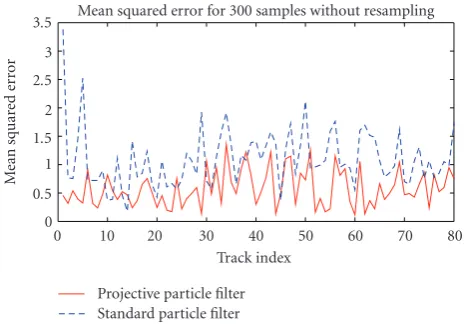
First, the mean squared error (MSE) between the true state of the feature vector and the set of particles is presented without resampling in order to compare the tracking accu-racy of the projective and standard particle filters based solely on the performance of the importance and prior densities, respectively. Consequently, the fit of the importance density to the vehicle tracking problem is evaluated. Furthermore, computing the MSE provides a quantitative estimate of the error. Since there is no resampling, a large number of particles is required in this experiment: we chose NS = 300. Figure 3 shows the position MSE for the standard and the projective particle filters for 80 trajectories in Video 008 sequence; the average MSEs are 1.10 and 0.58, respectively.
Second, the resampling frequencies for the projective and the standard particle filters are evaluated on the entire dataset. A decrease in the resampling frequency is the result of a better (i.e., closer to the posterior density) modeling of the density from which the samples are drawn. The resampling frequencies are expressed as the percentage of resampling compared to the direct sampling at each time stepk. Figure 4displays the resampling frequencies across the entire dataset for each particle filter. On average, the projective particle filter resamples 14.9% of the time and the standard particle filter 19.4%, that is, an increase of 30% between the former and the latter.
For the problem of vehicle tracking, the importance density q used in the projective particle filter is therefore more suitable for drawing samples, compared to the prior density used in the standard particle filter. An accurate importance density is beneficial not only from a compu-tational perspective since the resampling procedure is less frequently called, but also for tracking performance, as the particles provide a better fit to the true posterior density. Subsequently, the tracker is less prone to distraction in case of occlusion or similarity between vehicles.
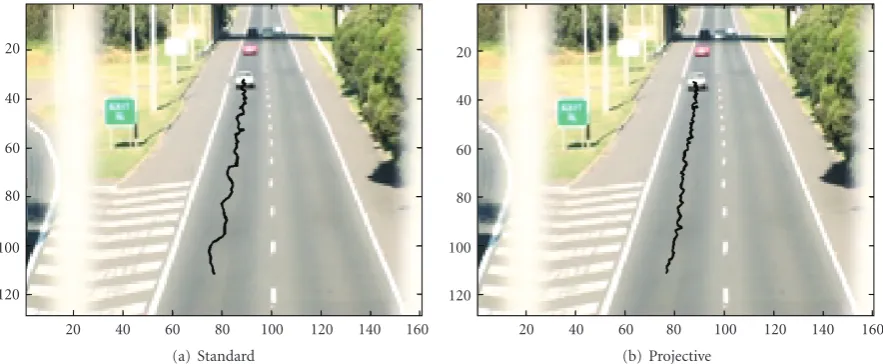
4.2. Trajectory Error Evaluation. An important measure in vehicle tracking is the variance of the trajectory. Indeed, high-level tasks, such as abnormal behavior or DUI (driving under the influence) detection, require an accurate tracking of the vehicle and, in particular, a low MSE for the position. Figure5displays a track estimated with the projective particle filter and the standard particle filter. It can be inferred qualitatively that the PPF achieves better results than the standard particle filter. Two experiments are conducted to evaluate the performance in terms of position variance: one with semiautomatic variance estimation and the other one with ground truth labeling to evaluate the influence of the number of particles.
0 0.5 1 1.5 2 2.5 3 3.5
Me
an
sq
u
ar
ed
er
ro
r
0 10 20 30 40 50 60 70 80
Track index
Mean squared error for 300 samples without resampling
Projective particle filter Standard particle filter
Figure3: Position mean squared error for the standard (solid) and the projective (dashed) particle filter without resampling step.
0 5 10 15 20 25 30 35 40 45
(%)
M2U00010 M2U00012 M2U00012b M2U00015 M2U00145 M2U00149 M2U00150 M2U00151 M2U00152 M2U00158 M2U00159 M2U00160 M2U00161 M2U00186 M2U00187
Percentage of resampling
Standard particle filter Projective particle filter
Figure4: Resampling frequency for the 15 videos of the dataset. The resampling frequency is the ratio between the number of resampling and the number of particle filter iteration. The average resampling frequency for the projective particle filter is 14.9%, and 19.4% for the standard particle filter.
120 100 80 60 40 20
20 40 60 80 100 120 140 160
(a) Standard
120 100 80 60 40 20
20 40 60 80 100 120 140 160
(b) Projective
Figure5: Vehicle track for (a) the standard and (b) the projective particle filter. The projective particle filter exhibits a lower variance in the position estimation.
20 40 60 80 100 120
Pix
el
value
along
the
d
-axis
0 50 100 150 200 250
Time
Theoretic and ground truth track after alignment
Theoretic track Ground truth track
Figure6: Alignment of theoretic and extracted trajectories along thed-axis. The difference between the two tracks represents error in the estimation of the trajectory.
Table2: MSE for the standard and the projective particle filters with 100 samples.
Video sequence Video 005 Video 006 Video 008 Avg. MSE Std PF 2.26 0.99 1.07 Avg. MSE Proj. PF 1.89 0.83 1.02
are matched against their respective generated tracks and visually inspected to ensure adequate correspondence. The average MSEs for each video sequence are presented in Table2for a sample set size of 100. It can be inferred from Table2that the PPF consistently outperforms the standard particle filter. It is also worth noting that the higher MSE in this experiment, compared to the one presented in Figure5 for Video 008, is due to the smaller number of particles— even with resampling, the particle filters do not reach the accuracy achieved with 300 particles.
1 2 3 4 5 6
Me
an
sq
u
ar
ed
er
ro
r
0 50 100 150 200 250 300
Number of particles (NS)
Position MSE for standard and projective particle filters
Projective particle filter Standard particle filter
Figure7: Position mean squared error versus number of particles for the standard and the projective particle filter.
2 4 6 8 Me an sq u ar ed er ro r
1 2 3 4 5
Track index
Position MSE for 20 particles and 5 different tracks
Projective particle filter Standard particle filter
(a) 1 2 3 4 Me an sq u ar ed er ro r
1 2 3 4 5
Track index
Position MSE for 100 particles and 5 different tracks
Projective particle filter Standard particle filter
(b)
Figure8: Position mean squared error for 5 ground truth labeled vehicles using the standard and the projective particle filter. (a) with 20 particles; (b) with 100 particles.
0 10 20 30 40 50 60 70 80 90 100 Vi d eo 001 Vi d eo 002 Vi d eo 003 Vi d eo 004 Vi d eo 005 Vi d eo 006 Vi d eo 007 Vi d eo 008 Vi d eo 009 Vi d eo 0010 Vi d eo 0011 Vi d eo 0012 Vi d eo 0013 Vi d eo 0014 Vi d eo 0015
Vehicle tracking performance
Standard particle filter Projective particle filter
Figure 9: Tracking rate for the projective and standard particle filters on the traffic surveillance dataset.
identical in the comparison, is due to the finer estimation of the sample distribution by the importance density and the consequent adjustment of the weights.
4.3. Tracking Rate Evaluation. An important problem encountered in vehicle tracking is the phenomenon of tracker drift. We propose here to estimate the robustness of the tracking by introducing a tracking rate based on drift measure and to estimate the percentage of vehicles tracked without severe drift, that is, for which the track is not lost. The tracking rate primarily aims to detect the loss of vehicle track and, therefore, evaluates the robustness of the tracker. Robustness is differentiated from accuracy in that the former is a qualitative measure of tracking performance while the latter is a quantitative measure, based on an error measure as in Section4.2, for instance. The drift measure for vehicle tracking is based on the observation that vehicles are converging to the vanishing point; therefore, the trajectory of the vehicle along the tangential axis is monotonically decreasing. As a consequence, we propose to measure the number of steps where the vehicle position decreases (pd)
and the number of steps where the vehicle position increases or is constant (pi), which is characteristic of drift of a tracker. Note that horizontal drift is seldom observed since the distortion along this axis is weak. The rate of vehicles tracked without severe drift is then calculated as
Tracking Rate= pd
pd+pi. (21)
The tracking rate is evaluated for the projective and standard particle filters. Figure9displays the results for the entire traffic surveillance dataset. It shows that the projective particle filter yields better tracking rate than the standard particle filter across the entire dataset. The projective particle filter improves the tracking rate compared to the standard particle filter. Figure9also shows that the difference between the tracking rates is not as important as the difference in MSE because the second one already performs well on vehicle tracking. At a high-level, the projective particle filter still yields a reduction in the drift of the tracker.
4.4. Discussion. The experiments show that the projective particle filter performs better than the standard particle filter in terms of sample distribution, tracking error and tracking rate. The improvement is due to the integration of the pro-jective transform in the importance density. Furthermore, the implementation of the projective transform requires very simple calculations under simplifying assumptions (12). Overall, since the projective particle filter requires fewer samples than the standard particle filter to achieve better tracking performance, the increase in computation due to the projective transform is offset by the reduction in sample set size. More specifically, the projective particle filter requires the computation of the vector-valued process function and the ratioγk for each sample. For the process function, (13) and (14), representing fx˙(x) and fb(x),
The projective particle filter performs better on the three different measures. The projective transform leads to a reduction in resampling frequency since the distribution of the particles carries accurately the posterior and, con-sequently, the degeneracy of the particle set is slower. The mean squared error is reduced since the particles focus around the actual position and size of the vehicle. The drift rate benefits from the projective transform since the tracker is less distracted by similar objects or by occlusion. The improvement is beneficial for applications that require vehicle “locking” such as vehicle counts or other applications for which performance is not based on the MSE. It is worthwhile noting here that the MSE and the tracking rate are independent: it can be observed from Figure9that the tracking rate is almost the same for Video 005, Video 006, and Video 008, but there is a factor of 2 between the MSE’s of Video 005 and Video 008 (see Table2).
5. Conclusion
A plethora of algorithms for object tracking based on Bayesian filtering are available. However, these systems fail to take advantage of traffic monitoring characteristics, in particular slow-varying vehicle speed, constrained real-world vehicle trajectory and projective transform of vehicles onto the camera plane. This paper proposed a new particle filter, namely, the projective particle filter, which integrates these characteristics into the importance density. The projective fractional transform, which maps the real world position of a vehicle onto the camera plane, provides a better distribution of the samples in the feature space. However, since the prior is not used for sampling, the weights of the projective particle filter have to be readjusted. The standard and the projective particle filters have been evaluated on traffic surveillance videos using three different measures representing robust and accurate vehicle tracking: (i) the degeneracy of the sample set is reduced when the fractional transform is integrated within the importance density; (ii) the tracking rate, measured through drift evaluation, shows an improve-ment in robustness of the tracker; (iii) the MSE on the vehicle trajectory is reduced with the projective particle filter. Furthermore, the proposed technique outperforms the standard particle filter in terms of MSE even with a fewer number of particles.
References
[1] Y. K. Jung and YO. S. Ho, “Traffic parameter extraction using video-based vehicle tracking,” inProceedings of IEEE/IEEJ/JSAI International Conference on Intelligent Transportation Systems, pp. 764–769, October 1999.
[2] J. M´elo, A. Naftel, A. Bernardino, and J. Santos-Victor, “Detec-tion and classifica“Detec-tion of highway lanes using vehicle mo“Detec-tion trajectories,” IEEE Transactions on Intelligent Transportation Systems, vol. 7, no. 2, pp. 188–200, 2006.
[3] C. P. Lin, J. C. Tai, and K. T. Song, “Traffic monitoring based on real-time image tracking,” inProceedings of IEEE Interna-tional Conference on Robotics and Automation, pp. 2091–2096, September 2003.
[4] Z. Qiu, D. An, D. Yao, D. Zhou, and B. Ran, “An adaptive Kalman Predictor applied to tracking vehicles in the traffic monitoring system,” inProceedings of IEEE Intelligent Vehicles Symposium, pp. 230–235, June 2005.
[5] F. Dellaert, D. Pomerleau, and C. Thorpe, “Model-based car tracking integrated with a road-follower,” inProceedings of IEEE International Conference on Robotics and Automation, vol. 3, pp. 1889–1894, 1998.
[6] J. Y. Choi, K. S. Sung, and Y. K. Yang, “Multiple vehicles detection and tracking based on scale-invariant feature trans-form,” inProceedings of the 10th International IEEE Conference on Intelligent Transportation Systems (ITSC ’07), pp. 528–533, October 2007.
[7] D. Koller, J. Weber, and J. Malik, “Towards realtime visual based tracking in cluttered traffic scenes,” inProceedings of the Intelligent Vehicles Symposium, pp. 201–206, October 1994. [8] E. B. Meier and F. Ade, “Tracking cars in range images using
the condensation algorithm,” inProceedings of IEEE/IEEJ/JSAI International Conference on Intelligent Transportation Systems, pp. 129–134, October 1999.
[9] T. Xiong and C. Debrunner, “Stochastic car tracking with line-and color-based features,” inProceedings of IEEE Conference on Intelligent Transportation Systems, vol. 2, pp. 999–1003, 2003. [10] M. A. Isard,Visual motion analysis by probabilistic propagation
of conditional density, Ph.D. thesis, University of Oxford, Oxford, UK, 1998.
[11] M. Isard and A. Blake, “Condensation—conditional density propagation for visual tracking,” International Journal of Computer Vision, vol. 29, no. 1, pp. 5–28, 1998.
[12] A. Doucet, “On sequential simulation-based methods for Bayesian filtering,” Tech. Rep., University of Cambridge, Cambridge, UK, 1998.
[13] M. S. Arulampalam, S. Maskell, N. Gordon, and T. Clapp, “A tutorial on particle filters for online nonlinear/non-Gaussian Bayesian tracking,” IEEE Transactions on Signal Processing, vol. 50, no. 2, pp. 174–188, 2002.
[14] R. Van Der Merwe, A. Doucet, N. De Freitas, and E. Wan, “The unscented particle filter,” Tech. Rep., Cambridge University Engineering Department, 2000.
[15] J. H. Kotecha and P. M. Djuri´c, “Gaussian sum particle filtering,” IEEE Transactions on Signal Processing, vol. 51, no. 10, pp. 2602–2612, 2003.
[16] C. Chang and R. Ansari, “Kernel particle filter for visual tracking,”IEEE Signal Processing Letters, vol. 12, no. 3, pp. 242– 245, 2005.
[17] C. Chang, R. Ansari, and A. Khokhar, “Multiple object tracking with kernel particle filter,” in Proceedings of IEEE Computer Society Conference on Computer Vision and Pattern Recognition (CVPR ’05), pp. 568–573, June 2005.
[18] L. Liang-qun, J. Hong-bing, and L. Jun-hui, “The iterated extended kalman particle filter,” inProceedings of the Inter-national Symposium on Communications and Information Technologies (ISCIT ’05), pp. 1213–1216, 2005.
[19] C. Kwok, D. Fox, and M. Meilˇa, “Adaptive real-time particle filters for robot localization,” inProceedings of IEEE Interna-tional Conference on Robotics and Automation, pp. 2836–2841, September 2003.
[20] C. Kwok, D. Fox, and M. Meilˇa, “Real-time particle filters,”
Proceedings of the IEEE, vol. 92, no. 3, pp. 469–484, 2004. [21] C. Shen, M. J. Brooks, and A. D. van Hengel, “Augmented
[22] Z. Zeng and S. Ma, “Head tracking by active particle filtering,” in Proceedings of IEEE Conference on Automatic Face and Gesture Recognition, pp. 82–87, 2002.
[23] R. Feghali and A. Mitiche, “Spatiotemporal motion boundary detection and motion boundary velocity estimation for track-ing movtrack-ing objects with a movtrack-ing camera: a level sets PDEs approach with concurrent camera motion compensation,”
IEEE Transactions on Image Processing, vol. 13, no. 11, pp. 1473–1490, 2004.
[24] C. Yang, R. Duraiswami, and L. Davis, “Fast multiple object tracking via a hierarchical particle filter,” in Proceedings of the 10th IEEE International Conference on Computer Vision (ICCV ’05), pp. 212–219, October 2005.
[25] J. Li and C.-S. Chua, “Transductive inference for color-based particle filter tracking,” inProceedings of IEEE International Conference on Image Processing, vol. 3, pp. 949–952, September 2003.
[26] P. Vadakkepat and L. Jing, “Improved particle filter in sensor fusion for tracking randomly moving object,” IEEE Transactions on Instrumentation and Measurement, vol. 55, no. 5, pp. 1823–1832, 2006.
[27] A. Ziadi and G. Salut, “Non-overlapping deterministic Gaus-sian particles in maximum likelihood non-linear filtering. Phase tracking application,” inProceedings of the International Symposium on Intelligent Signal Processing and Communication Systems (ISPACS ’05), pp. 645–648, December 2005.
[28] J. Czyz, “Object detection in video via particle filters,” in
Proceedings of the 18th International Conference on Pattern Recognition (ICPR ’06), pp. 820–823, August 2006.
[29] M. W. Woolrich and T. E. Behrens, “Variational bayes inference of spatial mixture models for segmentation,”IEEE Transactions on Medical Imaging, vol. 25, no. 10, pp. 1380– 1391, 2006.
[30] K. Nickel, T. Gehrig, R. Stiefelhagen, and J. McDonough, “A joint particle filter for audio-visual speaker tracking,” in
Proceeding of the 7th International Conference on Multimodal Interfaces (ICMI ’05), pp. 61–68, October 2005.
[31] E. Bas¸, A. M. Tekalp, and F. S. Salman, “Automatic vehicle counting from video for traffic flow analysis,” inProceedings of IEEE Intelligent Vehicles Symposium (IV ’07), pp. 392–397, June 2007.
[32] B. Gloyer, H. K. Aghajan, K.-Y. Siu, and T. Kailath, “Vehicle detection and tracking for freeway traffic monitoring,” in
Proceedings of the Asilomar Conference on Signals, Systems and Computers, vol. 2, pp. 970–974, 1994.
[33] L. Zhao and C. Thorpe, “Qualitative and quantitative car tracking from a range image sequence,” inProceedings of the IEEE Computer Society Conference on Computer Vision and Pattern Recognition, pp. 496–501, June 1998.
[34] P. L. M. Bouttefroy, A. Bouzerdoum, S. L. Phung, and A. Beghdadi, “Vehicle tracking using projective particle filter,” in Proceedings of the 6th IEEE International Conference on Advanced Video and Signal Based Surveillance (AVSS ’09), pp. 7–12, September 2009.
[35] P. L. M. Bouttefroy, A. Bouzerdoum, S. L. Phung, and A. Beghdadi, “Vehicle tracking by non-drifting mean-shift using projective kalman filter,” in Proceedings of the 11th International IEEE Conference on Intelligent Transportation Systems (ITSC ’08), pp. 61–66, December 2008.
[36] F. Gustafsson, F. Gunnarsson, N. Bergman et al., “Particle filters for positioning, navigation, and tracking,”IEEE Trans-actions on Signal Processing, vol. 50, no. 2, pp. 425–437, 2002.
[37] Y. Rathi, N. Vaswani, and A. Tannenbaum, “A generic framework for tracking using particle filter with dynamic shape prior,”IEEE Transactions on Image Processing, vol. 16, no. 5, pp. 1370–1382, 2007.
[38] A. Kong, J. S. Lui, and W. H. Wong, “Sequential imputations and bayesian missing data problems,”Journal of the American Statistical Assocation, vol. 89, no. 425, pp. 278–288, 1994. [39] D. Schreiber, B. Alefs, and M. Clabian, “Single camera lane
detection and tracking,” inProceedings of the 8th International IEEE Conference on Intelligent Transportation Systems, pp. 302– 307, September 2005.
[40] D. Comaniciu, V. Ramesh, and P. Meer, “Kernel-based object tracking,”IEEE Transactions on Pattern Analysis and Machine Intelligence, vol. 25, no. 5, pp. 564–577, 2003.