Activity Recognition with Evolving Data Streams: A Review
Zahraa S. Abdallah, Faculty of Information Technology, Monash University, Australia
Mohamed Medhat Gaber, School of Computing & Digital Technology, Birmingham City University, UK Bala Srinivasan, Faculty of Information Technology, Monash University, Australia
Shonali Krishnaswamy, AIDA Technologies Pte Ltd, Singapore
Activity recognition aims to provide accurate and opportune information on people’s activities by leveraging sensory data available in today’s sensory rich environments. Nowadays, activity recognition has become an emerging field in the areas of pervasive and ubiquitous computing. A typical activity recognition technique processes data streams that evolve from sensing platforms such as mobile sensors, on body sensors, and/or ambient sensors. This paper surveys the two overlapped areas of research of activity recognition and data stream mining. The perspective of this paper is to review the adaptation capabilities of activity recognition techniques in streaming environment. Categories of techniques are identified based on different features in both data streams and activity recognition. The pros and cons of the algorithms in each category are analysed and the possible directions of future research are indicated.
CCS Concepts: rGeneral and reference → Surveys and overviews; rTheory of computation → Streaming models; Machine learning theory; rComputing methodologies → Transfer learning; rHardware→Sensor applications and deployments; Sensor devices and platforms;
ACM Reference Format:
Zahraa Said Abdallah, Mohamed Medhet Gaber, Bala Srinivasan, and Shonali Krishnaswamy. Activity recognition in evolving data streams: A review.ACM Computing SurveysV, N, Article A (January YYYY), 41 pages.
DOI:http://dx.doi.org/10.1145/0000000.0000000
1. INTRODUCTION
Sensors are becoming more pervasive. They exist ubiquitously around us and are em-bedded in our phones, cameras, clothing, buildings, cars, and in all kinds of everyday objects. Massive amounts of data are generated from these sensors continuously. The availability of real time sensory information through these sensors has led to the emer-gence of research into “Activity Recognition” (AR). Activity recognition aims to provide accurate and opportune information based on people’s activities and behaviours. Ac-tivity recognition has become an emerging field in the areas of pervasive sensory data processing and ubiquitous computing. Many applications have demonstrated the use-fulness of activity recognition. These include applications in healthcare [Tentori and Favela. 2008; Do et al. 2013; Wu et al. 2008; Mohomed et al. 2008; Zhang et al. 2008; S ´anchez et al. 2008], social networks [Miluzzo et al. 2008], environmental monitor-ing [Mun et al. 2009], surveillance, and emergency response [Zhang et al. 2008; Nait-Charif and McKenna 2004]
Activity recognition has been widely studied using different approaches and from various perspectives. Probabilistic, statistical and logical reasoning approaches have been applied to understand and predict various user activities. Additionally, machine learning approaches based on sensory data have also been leveraged for activity
recog-Author’s addresses: Z. S. Abdallah and B. Srinivasan, School of Information Technology, Monash University, Melbourne, Australia; Mohamed Medhat Gaber, School of Computing & Digital Technology, Birmingham City University, UK; Shonali Krishnaswamy, AIDA Technologies Pte Ltd, Singapore.
Permission to make digital or hard copies of part or all of this work for personal or classroom use is granted without fee provided that copies are not made or distributed for profit or commercial advantage and that copies bear this notice and the full citation on the first page. Copyrights for third-party components of this work must be honored. For all other uses, contact the owner/author(s).
c
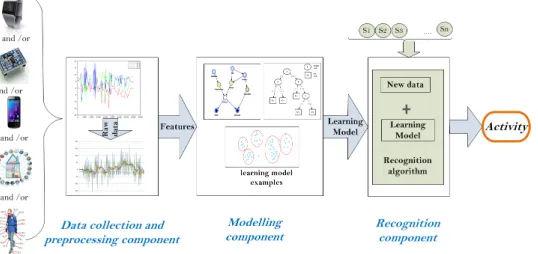
nition. The premise underlying the use of machine learning in activity recognition is that activities can be recognised and even anticipated using prior knowledge of previ-ously collected data representing different activities. Typical activity recognition pro-cess consists of three main components: namely, data collection and preprocessing,
modelling, and finally recognition. Thedata collection and preprocessing component
that gathers annotated sensory data evolves from diverse data sources such as on body wearable sensors, mobile sensors, and/or smart environment sensors. Then, raw sensory data is processed into features that help discriminate between activities. The
modelling component uses the extracted features to train a baseline learning model that is then deployed to predict activities from new incoming sensory data by the recog-nition component.
State of the art activity recognition techniques rely strongly on prior knowledge to recognise activities based on models built from samples of the population. However, typical activity recognition techniques deal with data that is continuously streaming from various sensors. Sensory data is a data stream that contains unbounded data which arrives at high speed. Therefore, it is unrealistic in activity recognition to as-sume that data is static over time. Dynamic changes in activities that reflect variations in user’s activities are expected and natural. Change of existing activities or emergence of novel activities occur in evolving activity data.
In this paper, we survey the area of research concerning activity recognition in data streams. The focus of this paper is on the research gaps and challenges that are faced by activity recognition approaches when dealing with data streams. We start the sur-vey by discussing the scope of this sursur-vey across activity recognition and stream min-ing disciplines in Section 2. Within this scope, we first discuss different learnmin-ing ap-proaches for activity recognition in Section 3. Then, section 4 explores apap-proaches to mine changes in data streams in general. Section 5 represents the research area com-prising the intersection of stream mining and activity recognition approaches. Section 6 surveys key activity recognition systems applied in streaming settings. We further present in Section 7 the current research challenges and gaps, along with a compar-ison of key systems. Section 8 discusses future directions of research. The paper is summarised and concluded in Section 9.
2. SURVEY SCOPE
Activity recognition is a wide research area that has been investigated from many per-spectives. A well investigated research perspective focuses on managing the process of data collection. This perspective concerns issues related to the kinds of sensors and sensing platforms. Yet, immense research has been directed towards learning meth-ods for recognising activities from sensory data. The literature covers a wide variety of learning techniques applied for activity recognition. This research focuses on learn-ing in activity recognition, yet, in streamlearn-ing environments. Although the literature represents subsets of the research themes across activity recognition and stream min-ing disciples, this survey primarily focuses on the holistic approach that merges both activity recognition and stream mining.
In the light of the survey’s scope, we introduce different learning techniques for activity recognition with data streams. To explain the scope, we first introduce the known term of i.i.d. in statistical and probability theory, which refers to data that is both independent and identically distributed. A key challenge with learning from sensory data in a streaming environment is that it requires learning beyond identically distributed and independent conditions. In machine learning, a collection of dataD is defined as independent and identically distributed if all samples inD : X1, X2, ....Xn
Many state-of-the-art statistical and machine learning approaches rely on process-ing the data that follows the i.i.d. conditions. These approaches assume that data instances are independent and follow the same distribution. Thus, the prediction of new data relies strongly on prior knowledge. In the ubiquitous environment, either of thei.i.d.conditions or even both can be violated. The distribution condition is clearly challenged with the basic concepts of data streaming. In a streaming dynamic envi-ronment, we can not assume the fulfilment of the identical distribution condition, as a typical data stream evolves over time. There is an increasing interest in the domain of learning from data that is not identically distributed. Changes in data distribution leads to concept drifts that are formally defined using the Bayes rule as the change in the prior and/or the likelihood. A concept drift can be abrupt, gradual, incremental, or recurrent. The appearance of new concept corresponds to concept evolution. While, outliers can be considered as a new concept that only occurred once. A main difference between outliers and concept evolution is the recurrence of the concept and action required upon detecting. In concept evolution, we expect more points in the stream that represent the new concept and therefore the classification model is required to be adapted to include the novel concept. On the other hand, outliers are mostly sparse and not forming a concept. The action required for outliers is filtration rather than adaptation. Indeed, these methods still preserve data independence. Other areas of research focus on the violation of the independent data condition. These approaches deal with data that is dependent while the distribution is fixed. Stationary time se-ries and Markov Chains are examples of approaches that challenge the dependency assumption.
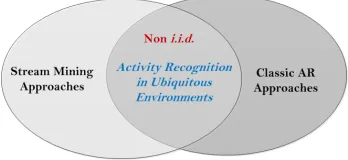
Activity recognition data that represents a sequence of performed activities is intu-itively dependent. Therefore, an efficient activity recognition system focuses on dealing with the dependency among data for predicting performed activities. Furthermore, in a streaming environment, activity recognition violates not only the assumption of in-dependence but also identical distribution. Changes in activity recognition context can also be abrupt (e.g., change in walking pattern after an accident), gradual (e.g., change in walking pattern for toddlers), incremental (change in walking pattern during heal-ing from an injury), or recurrent (e.g., repeated change of walkheal-ing pattern accordheal-ing to situations). However, new activities performed frequently represent novel concepts or concept evolution (e.g., using a gym instrument for the first time). On the other hand, a new activity performed once can be an outlier (e.g., sudden fall or malicious be-haviour). Figure 1 depicts the intersection of the two research areas of stream mining and activity recognition. In the following sections, we survey methods for both activity recognition and data stream mining as well as the intersection between them.
3. ACTIVITY RECOGNITION TECHNIQUES
We survey in this section the main body of research in activity recognition. Differ-ent from traditional probabilistic and logical approaches, other approaches that con-sider activity recognition from the machine learning perspective have been studied. In general, approaches in machine learning for activity recognition can be broadly divided into two major strands. The first strand concerns the underlying learning ap-proach. That includes supervised, unsupervised, and semi-supervised learning. The second strand focuses on the dynamic capabilities of the recognition system beyond the learning phase. This includes personalisation and adaptation of a learning model and the concept of transfer learning.
3.1. Overview
Activity recognition is one of the emerging applications in the area of ubiquitous com-puting. Systems that can recognise human activities opened the door to many impor-tant applications such as:
— Health and wellness [Longstaff et al. 2010; Karantonis et al. 2006; Hong et al. 2010; S ´anchez et al. 2008; Do et al. 2013]: Progressive research in activity recogni-tion has provided the foundarecogni-tion for many applicarecogni-tions in health and wellness. In recent years, fitness tracking applications have attracted much attention in activity recognition. Devices and applications, such as fitbit1, monitor distances walked and corresponding burned calories. More advanced fitness applications aim at tracking Activities of Daily Living (ADL) [Hong et al. 2010]. Recognition and monitoring of the type and frequency of ADL is essential for creating what is known as an ac-tivity diary/log [Yang 2009]. These diaries help users to understand their personal lifestyle patterns and effect healthy changes (e.g. increase physical exercise, reduce number of hours sitting in front of the computer). Such activity recognition appli-cations are important for preventing medicine and avoiding chronic illness such as cardiovascular diseases, diabetes and obesity. Other applications in health monitor-ing are concerned with the remote supervision of home based patients or at risk elderly people. Medical professionals believe that one of the best ways of early de-tection and prevention of emerging medical conditions is to recognise changes and abnormality in different activities [Lawton and Brody 1969].
— Activity-based crowdsourcing and surveillance [Bodor et al. 2003; Wilson and Atke-son 2005]: Recognising activities for crowds leads to interesting applications. A case of a large number of people running in a place where they normally walk or sit in-dicates a possible emergency or disaster [Lockhart et al. 2012]. Also, surveillance applications that are able to understand and model people’s activities could pre-dict intent and motive as people interact with the environment. Therefore, activity recognition applications aim to proactively detect abnormal behaviours in busy en-vironments [Niu et al. 2004]. An example is a suspicious person who is spending longer than usual time on a train platform.
— Targeted advertising [Intille 2004; Sricharan et al. 2006]: Activity recognition in real time is an important component of applications that interact with users to de-liver context relevant information and services. Applications in this category target conveying the right message at the right place and at the right time using activ-ity recognition. Examples include personalised advertisements or discount deals in smart shopping scenarios. The term Know Your Customer (KYC) [Woodruff and Gardial 1996], which has been used by businesses, refers to understanding customer needs and provides them with satisfying services. Activity recognition contributes
to KYC analytics by inferring the general interests of customers and thus helps in providing them with relevant information and services.
Typical activity recognition process consists of three main components: data collec-tion and preprocessing, modelling, and finally recognicollec-tion. The flow of the learning process through different components in activity recognition is illustrated in Figure 2 The data collection and preprocessing component that gathers annotated sensory data evolves from diverse data sources such as on body wearable sensors, mobile sensors, and/or smart environment sensors. Then, raw sensory data is processed into features that help discriminate between activities. The modelling component uses the extracted features to train a baseline-learning model that is then deployed to predict activities from new incoming sensory data by the recognition component.
Fig. 2: Activity Recognition Components
Data collection and preprocessing component represents the very initial step of any activity recognition process. Data collection includes issues related to the sensing plat-form such as types and locations of the sensors. Both types and locations vary based on the aim of the recognition. For instance, recognising hand gestures may require ac-celerometer sensors attached to hands or fingers. Variously, spatiotemporal activities require collection of GPS data that could be from a user’s device that they carry. Atomic activities such as sitting and walking may also be recognised using accelerometer data embedded in a mobile device or attached as wearable sensors. Another consideration for the data collection concerns the annotation or labelling of activities in the collected data. The process of data collection is followed by a preprocessing and feature extrac-tion steps, which aim to prepare the raw collected data for the following component of modelling.
Popular features include mean, standard deviation, maximum, peak-to-peak, root-mean-square, and correlation between values of modality axes. Autoregressive mod-elling can also be applied on raw data to form augmented-feature vectors. Survey on features used for activity recognition can be found in [Bulling et al. 2014]. Section 3.2 discusses learning techniques related to modelling and recognition components in Activity Recognition process.
3.2. Learning Approaches
Typical activity recognition systems deploy supervised learning methods such as Naive Bayes, Decision Trees, Hidden Markov Models, Nearest Neighbour, Support Vector Machines, and different Boosting techniques for activity classification. Moving beyond fully supervised settings, researchers have started studying the feasibility of other ma-chine learning techniques for activity recognition: unsupervised and semi-supervised learning.
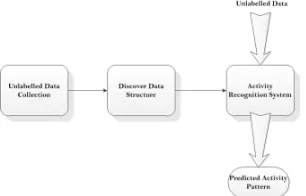
Supervised learningis applied pervasively for activity recognition. Basically, la-belled data is collected to train a static classification model for recognising a set of activities. The classification model built from labelled data is used to recognise the in-coming unlabelled data. Figure 3 explains the supervised learning process. Supervised learning is categorised as either generative, discriminative or hybrid approach [Rubin-stein et al. 1997]. Algorithms that follow the generative approach models the class con-ditional distribution. Naive Bayes is an effective generative approach that is applied pervasively for activity recognition such as in [Ravi et al. 2005]. Hidden Markov Mod-els are also generative methods that have been successfully applied for recognising activities [Patterson et al. 2005; Ward et al. 2006]. Discriminative models on the other hand learn the boundaries between classes. Decision trees [Bao and Intille 2004; Logan et al. 2007] and nearest neighbour [Maurer et al. 2006; Lee and Mase 2002] are well-studied examples of the discriminative approach for activity recognition. Moreover, a hybrid approach is the one that combines the two approaches into a single classifier. In [Viola and Jones 2001], authors applied a modified version of AdaBoost that combines a set of static classifiers for recognising activities. They demonstrated the efficiency of combining discriminative and generative classifiers for smooth recognition of activities [Lester et al. 2005]. The hybrid approach discriminatingly selects useful features and learns an ensemble of static classifier to recognise different activities. In [Yuan and Herbert 2014], a hybrid classifier was developed that combines both threshold based and machine learning methods to select the most suitable classifier dynamically on the cloud. Artificial Neural Networks rely on a hybrid generative-discriminative ap-proach. Authors in [Do et al. 2013] developed a system based on stream reasoning and Artificial Neural Networks for recognising activities from mobile phone sensors.
A wide range of supervised methods commonly used for activity classification was reviewed in [Preece et al. 2009; Peterek et al. 2014]. One main characteristic of these methods is the necessity of a significant amount of labelled data to build the classifica-tion model. The assumpclassifica-tion that labelled data is consistently available is unrealistic. Due to many reasons, activities may vary while time evolves for the same person or across different individuals. For each activity, data is required to be collected for each user to attain an accurate recognition. However, the annotation process is a time con-suming, error prone, and mostly tedious process. Therefore, researchers investigated an unsupervised learning approach for activity recognition to overcome the limitations of the supervised approaches.
Fig. 3: Supervised Learning in Activity Recognition
Dustdar 2011; Huynh and Schiele 2006; Ye et al. 2014]. Lee et al.[Lee et al. 2009] used unsupervised learning for abnormality detection. To detect whether a pattern is reg-istered or not, a probability model based on the past activity pattern is created. The Expectation-Maximisation (EM) algorithm is applied with the feature vectors to de-cide whether the activity has abnormal behaviour. In another study, Li and Dustdar [Li and Dustdar 2011] studied the feasibility of applying a specific type of unsuper-vised learning to high-dimensional, heterogeneous sensory input. The correspondence between clustering output and classification input is proposed as well. Although clus-tering is a promising approach in discovering data structure and patterns, at least a few labels have to be provided for performing the actual recognition of activities. Also, the feasibility of traditional clustering approach is questionable for high dimensional streaming data [Li and Dustdar 2011]. Furthermore, methods for unsupervised learn-ing require a large pool of unlabelled data in order to find interestlearn-ing patterns.
Fig. 4: Unsupervised Learning in Activity Recognition
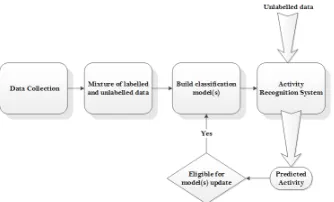
highest confidence is added to the training seed for rebuilding the classification model. Self learning has been successfully applied in many applications such as text analysis [Yarowsky 1995] and image processing [Li et al. 2007]. Continuing research is being conducted to study self-learning techniques for activity recognition. Longstaff, Reddy, and Estrin [Longstaff et al. 2010] investigated methods of further training classifiers after a user begins to use them using semi-supervised learning techniques.
Fig. 5: Semi-supervised Learning in Activity Recognition
Co-learning was first developed by Blum and Mitchell [Blum and Mitchell 1998]. It uses two classifiers, each trained on different perspective of the data. Each classifier adds its most confidently predicted label to the training set and rebuilds the model. Guan et al. [Guan et al. 2007] applied co-learning with three classifiers from the same view of data. They also used majority voting to choose the most confident label to augment the training data. Stikic, Laerhoven, and Schiele [Stikic et al. 2008] applied various semi-supervised techniques for enhancing accuracy of recognising users’ activ-ities. Lee et al. [Lee and Cho 2014] presented a method to recognise a person’s activities from sensors in a mobile phone using mixture-of-experts model.
Authors in [Stikic et al. 2009; Stikic et al. 2011] proposed multi-graph based methods that propagate information through a graph containing both labelled and unlabelled data. These methods deploy two different ways of combining multiple graphs based on feature similarity and time. Each node of the graph corresponds to an instance while every edge encodes the similarities between a pair of nodes as a probability value. Ali, King and Yang [Ali et al. 2008] implemented a Multiple Eigenspaces (MES) technique based on the Principal Component Analysis combined with Hidden Markov Models. The system is designed to recognise finger gestures with a laparoscopic gripper tool. Huynh and Schiele [Huynh and Schiele 2006] combined Multiple Eigenspaces with Support Vector Machines to recognise eight ambulation and daily activities.
Semi-supervised approaches can be categorised in general as transductive or induc-tive. The concept of transductive learning has been introduced in 1998 [Gammerman et al. 1998] in contrast to inductive learning. In transductive learning the aim is to predict the labels of unlabelled test data without building a model that maps between the input and output space. According to the transductive approach, there is no need to build a generic model to identify specific labels, as it will add unnecessarily com-putation overhead. Instead, in transductive learning, unlabelled test data is directly labelled based on the labelled training data.
data stream on later recognition/testing phase that mostly occurs online. It is compu-tationally inefficient in streaming environment to keep both training and testing data available if applying induction methods. Second, the deployment domain may differ from the development domain. I.e., data that is used for training and testing is drawn from completely different sets (of users). Therefore, using induction approach to build a general classification model that maps between training and testing would be more suitable to avoid possible overfitting.
Despite the ongoing research on semi-supervised learning, most of the developed techniques rebuild the whole classification model upon predicting the most confident label. Yet, this is impractical for real time recognition in streaming settings. Also, the focus of aforementioned methods was mainly to minimise the labelled data required for building the initial classification model rather than improving the classifier itself, especially with confusing data [Longstaff et al. 2010].
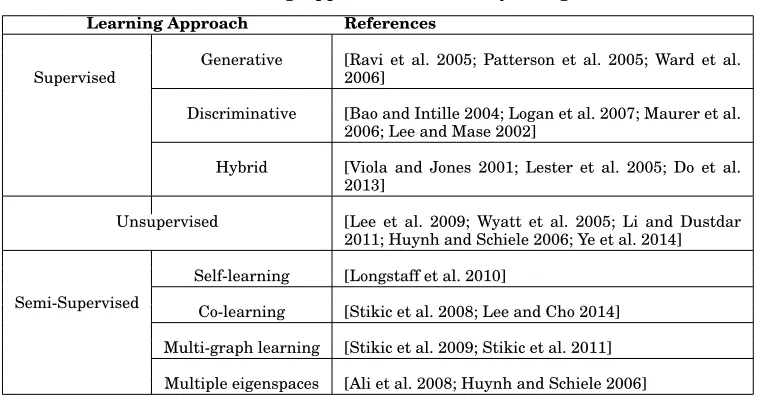
Active learning is another approach in the semi-supervised learning category. Unlike self learning and co-learning, active learning requires user input to label data with the true label. According to Muslea, Minton, and Knoblock [Muslea et al. 2000], the main goal of active learning algorithm is to find the more profitable and less costly data to label. Kapoor and Horvitz [Kapoor and Horvitz 2008] compared different methods to decide upon the selection of profitable data. While Stikic et al. [Stikic et al. 2008] employed a multi-sensor approach to choose important data to be labelled. The data is selected for active learning based on two approaches. One approach chooses the data with the lowest classification confidence. The other approach chooses the data that causes a high degree of disagreement between two classifiers. Results showed im-proved performance when active learning is applied. State-of-the-art active learning techniques in activity recognition assume the retraining of models. This is not appli-cable in streaming settings. Alternatively, dynamic update to tune the classification model in real time are crucial in a streaming environment. Improving active learning methods to consider the value of label compared to the cost of interrupting the user is essential in the context of activity recognition. Also, estimating the time taken to pro-vide true labels and their effect on the prediction accuracy in real time requires more investigations. Table I summarises basic learning approaches in activity recognition.
Table I: Learning Approaches in Activity Recognition
Learning Approach References
Supervised
Generative [Ravi et al. 2005; Patterson et al. 2005; Ward et al. 2006]
Discriminative [Bao and Intille 2004; Logan et al. 2007; Maurer et al. 2006; Lee and Mase 2002]
Hybrid [Viola and Jones 2001; Lester et al. 2005; Do et al. 2013]
Unsupervised [Lee et al. 2009; Wyatt et al. 2005; Li and Dustdar 2011; Huynh and Schiele 2006; Ye et al. 2014]
Semi-Supervised
Self-learning [Longstaff et al. 2010]
Co-learning [Stikic et al. 2008; Lee and Cho 2014]
Multi-graph learning [Stikic et al. 2009; Stikic et al. 2011]
In this section, we have reviewed the three main approaches of activity recognition according to the underlying learning approaches. Traditional activity recognition sys-tems are based on fully supervised learning approaches. However, these techniques require all data to be annotated which is impractical, especially when applied in a streaming environment. On the other hand, unsupervised learning finds pattens in un-labelled data. Unsupervised learning is not capable of finding the actual predicted la-bel of activity without at least some lala-belled data presenting the ground truth. There-fore, semi-supervised learning is a recent trend in activity recognition that employs only a small set of labelled data for training. In semi-supervised learning, the recog-nition system continuously learns from unlabelled data either automatically with self learning or similar approaches or interactively with user input via an active learning approach.
3.3. Dynamic capabilities
In this section we aim to review the dynamic capabilities of the recognition system ac-cording to the objective of a system update. In the literature, two reasons urge model update beyond the learning phase: model personalisationto best fit a specific user; modeladaptationby adding new activities or deleting abandoned ones. The wide con-cept oftransfer learningis also presented to explain the different kinds of anticipated changes in activity recognition and the proposed techniques to handle these changes. We represent, in the following, the literature contribution to each category.
3.3.1. Model personalisation. It is hard to generate one learning model that fits all users
in activity recognition. Due to many reasons, different individuals might perform the same activity but in different ways. A “walking” activity for one person, for instance, might seem to be “running” for another. The most accurate recognition results can be obtained if we train the learning model with the annotated data for a specific user. This assumption is invalid in a ubiquitous environment when labelled data is scarce. Therefore, continuous learning approach for tailoring the model to best fit a specific user is crucial for improving recognition accuracy. We define model personalisation as
the process of tuning a general model to represent a user’s personalised way of perform-ing different activities.
The vast majority of activity recognition research did not consider the personalisa-tion issue. Only few studies investigated the impact of training model on personalised data and compared it to training the model on general data collected from different users. The researchers showed the improved accuracy when deploying subject-specific data for training instead of the general model [Kwapisz et al. 2011; Weiss and Lock-hart 2012]. Weiss and LockLock-hart [Weiss and LockLock-hart 2012] demonstrated the improved accuracy if a personalised model is deployed even using only a small amount of user-specific training data. Whereas Kwapisz et al. [Kwapisz et al. 2011] created models individually for each user, then deployed a personalised model for recognition.
binary decision trees applied in the aforementioned studies are not efficient with large scale data and complicated scenarios. Gomes et al. [Gomes et al. 2012b] constructed a personalised activity recognition system that is deployed in a streaming environment. Despite the efficiency of the developed system, their model still required user specific annotated data to achieve personalisation. Similarly, Reiss and Stricker [Reiss and Stricker 2013] used a set of classifiers as a general model which is later updated with new labelled data from a specific user. In [Vo et al. 2013], authors adjusted the learn-ing model from person A with a selected confident sample for another person B. The proposed algorithm is an integration of an SVM classifier and clustering approach for updating the model automatically. However, the proposed system has not been evalu-ated in a streaming setting. The deployment of activity recognition system in stream-ing environment imposes more challenges as the change of data distribution while a stream evolves may cause the model to drift away from the actual data distribution.
3.3.2. Model adaptation.The other dynamic feature of the recognition system concerns
its ability to capture significant data changes. It is impractical to assume that there is always a static set of activities along evolving data streams. In the recognition system, the initial data represents a set of activities that is collected to train the primitive model. Then, the learning model is deployed for the actual recognition of incoming un-labelled sensory data. However, state-of-the-art approaches in activity recognition do not consider the appearance of new activities that did not exist in the initial training data [Yang et al. 2010]. New activities appear because of two common reasons. First, it is unrealistic to collect annotated sensory data for all kind of activities that exist in a domain. A typical activity recognition system contains only a few activities that are annotated with experts or with a means for assistance such as videos. Other activities may appear beyond the learning phase. Therefore, the set of activities may need to be extended later after deployment because of the scarcity of annotated data in the learning phase. Second, novel activities include also sudden activities. It is impractical to collect data representing sudden activities for training the model. An example of this kind of sudden activity is a sudden fall for an elderly person in the application of health care. Due to the difficulties of collecting annotated data for such sudden activi-ties, other approaches have to be considered for detecting novel activities. Traditional methods solve this problem by rebuilding the entire model based on the training data of the new set of activities. This is impractical for real time activity recognition and especially in a streaming environment.
Developing a recognition system that can recognise new activities and assimilate it with existing model for further recognition is essential for real life recognition. The same concept applies for the removal of abandoned activities that are no longer rel-evant to a particular user. Model adaptation is a key criterion for the flexibility and accuracy of any activity recognition system with an evolving data stream that changes over time. There is no notion of adaptation/refinement of the learning models in the literature. Models do not detect activities that may emerge over a period of time (post the data collection) or changes in a user’s patterns, which are both completely realistic in the context of a mobile user. The adaptation process needs to update the recognition model to recent changes in a real life user’s activities in real time. Different from model personalisation that only tunes existing models, model adaptation enforces changes to core activities with incremental assimilation of new discovered activities or elimina-tion of abandoned activities.
3.3.3. Transfer Learning.A major assumption in activity recognition is that the
and tasks. Transfer learning concerns “developing systems that can leverage experience from previous tasks into improved performance in a new task which has not been en-countered before” [Cook et al. 2013]. The power of transfer learning is in the flexibility of mapping between training and deployment. Thus, we can reuse knowledge learned previously to solve a new problem faster or in a more efficient way.
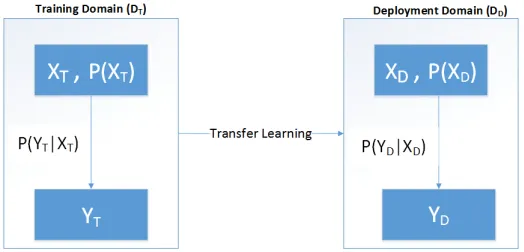
We first define basic notations of transfer learning. The notations in this paper are consistent with Pan [Pan and Yang 2010] and Weiss [Weiss et al. 2016] definitions. Transfer learning adapts between training (DT) and deployment domain (DD). Each
domain is defined by a feature space X and labelsY, whereXT, YT pairs represent
the training space, XD, YD depicts the deployment space. The marginal probability
distribution ofX isP(X). While the predictive function learned from label pairsxi,yi
isf(.)wherexiinX andyiinY. The prediction function is also termed as conditional
probability distribution of the domainP(Y|X). Basic notations of transfer learning are illustrated in Figure 6.
Fig. 6: Illustration of Transfer Learning
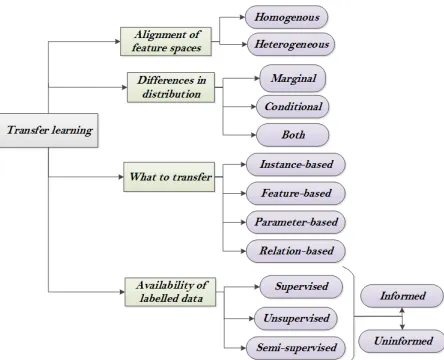
Transfer learning is categorised according to four aspects: alignment of feature spaces, distribution, what has been transferred and availability of labelled data. The first aspect focuses on the relationship between features in both training and deploy-ment spaces. In this direction, transfer learning can be either heterogeneous [Harel and Mannor 2010] or homogenous [Chattopadhyay et al. 2012; Yao and Doretto 2010; Long et al. 2013]. In terms of notations, the case whereXT 6=XDis defined as
hetero-geneous transfer learning. Homogenous transfer learning is where the feature spaces are the same for both training and deployment, i.e.,XT =XD. Transfer learning can
also be categorised according to its aim in distribution correction. It can be either correcting for marginal distribution differences [Pan et al. 2011], conditional distribu-tion differences [Yao and Doretto 2010] or differences in both [Chattopadhyay et al. 2012; Long et al. 2013]. Distribution correction mainly occurs in homogenous condi-tion, where features in training and deployment domains are aligned. Heterogeneous methods, on the other hand, focuses on aligningXT andXD while assuming that
dis-tributions are the same. Work such as [Shi et al. 2010] addressed the distribution correction in addition to feature spaces alignment. Further studies are required to combine distribution correction methods with feature spaces alignment.
Transfer learning can also be categorised with respect to what has been trans-ferred which includes four approaches: instance-based transfer, feature-based transfer, parameter-based transfer, and relational-based transfer.
per-forms well when features in both domains are homogenous. In [Chattopadhyay et al. 2012], for example, the weights of different sources in the training domain are computed based on the marginal distribution differences between the training and deployment domains. These weights are then changed according to the difference in the conditional distribution. The weights in [Yao and Doretto 2010] are adapted according to the performance of the algorithm in each boosting iteration.
— Feature-based transferaims to adapt the feature space of the training domain to attain the best performance in the deployment domain. Feature-based transfer can be either symmetric [Pan et al. 2011] or asymmetric [Long et al. 2013]. In Symmet-ric feature transfer finds a common latent feature space between the two domains that improves the performance while correcting the marginal distribution in both domains. Asymmetric transfer, on the other hand, maps the features directly from the training domain through reweighting to closely match the deployment domain. — Parameter-based transferassumes common parameters across training and tar-get domain. Therefore, prior knowledge of parameters would be transferred between training and deployment domains [Chattopadhyay et al. 2012].
— Relational-based transferdiscovers relationships among the training data and transfers this knowledge to the target. This type is relatively new area with few work published such as [Li et al. 2012].
It is important to highlight the difference between homogeneous feature-based transfer and heterogeneous transfer. Homogenous feature based transfer is the case where the feature space is the same between the source and target, and the adap-tation is performed on individual features in an attempt to align the distributions. Heterogeneous transfer is the case of feature spaces being different. In this case the adaptation between the source and target attempts to find a transformation to make both feature spaces common.
Cook [Cook et al. 2013] classified transfer learning in regards to the presence of labeled data. Transfer learning is defined as supervised, unsupervised and semi-supervised based on the availability of labeled data in the training domain. It can also be either informed or uninformed with respect to the presence or absence of labeled data in the deployment domain. Therefore, uninformed supervised transfer learning, for example, means labeled data is available only in the training domain while data in deployment domain is unlabeled. The majority of the methods are supervised, which assume the availability of data labels in the training domain. Few methods, such in [Zhu et al. 2011], are unsupervised. However, these methods are very specific to their related application, such as image classification in [Zhu et al. 2011], and are difficult to use in other applications. Transfer learning has been applied successfully to many machine learning applications such as text classification [Li et al. 2012], image clas-sification [Zhu et al. 2011], human activity clasclas-sification [Harel and Mannor 2010] and object recognition [Yao and Doretto 2010]. Figure 7 summarises transfer-learning categories.
Transfer learning is founded on an underlying assumption that the training domain and deployment domain are related. Therefore, knowledge transfer would bring benefit to the deployment domain. However, there is a situation when both domains are not related and hence transfer learning will be unsuccessful, and even worse, it might have a negative impact on the performance in some cases. This situation is often referred to as negative transfer learning. This field of research is relatively new [Yang et al. 2016]. Future research in transfer learning focuses more on investigating negative transfer and ways to measure and qualify it.
Fig. 7: Transfer Learning Approaches
domain specific meanings. This has been explained in details in cook [Cook et al. 2013]. Traditional approaches for activity recognition assume that training and deployments domains are typically identical. However, this assumption is not valid due to many differences that may exist between both domains. These differences can be because of changes in one or many aspects. We list some of the common reasons for change as follows:
— Sensor modality [Kurz et al. 2011; Roggen et al. 2010]: Sensors used for ac-tivity recognition can be on-body, mobile or ambient sensors. This includes changes of type, location and layout of sensors. These changes may affect data distribution, parameters and features. Thus, changes in sensor modality require instance-based, feature-based, parameter-based transfer to align both domains.
— Time [Pan et al. 2007; Pan et al. 2011]: Changes in activity times between train-ing and deployment domains are very likely in activity recognition. An example of health information associated with user activities, when medical tests, treatments, immunization times for specific disease might be different between domains. Differ-ences could be due to change in the medical plans, test times, immunization avail-ability. Time changes will require feature and/ or parameter based transfer to map between training and deployment domain.
— People [Hachiya et al. 2012]: Typical activity recognition application uses dif-ferent subsets of people in training and deployment spaces. Thus, difdif-ferent peo-ple perform the same activity or the same activity is performed in different ways. This essentially will require instance-based transfer, feature-based transfer and parameter-based transfer.
— Sampling rate [Zhao et al. 2010]: Change in sampling rate between domains
is very common in activity recognition and requires mostly parameter transfer to align both domains.
activ-ities such as walking, standing or sitting. Labels of activity could also have context bias that makes them different across domains. For example, lying activity in the hospital has different context meaning from lying in smart home context. Difference in activities/labels mostly require instance, feature based transfer and relational-knowledge transfer.
In activity recognition, these differences have a direct impact on various data as-pects: distribution (marginal, conditional or both), alignment of feature spaces (Het-erogeneous) and what to be transferred (Instance, features, parameters, relational-knowledge). An efficient learning algorithm will need to be able to transfer informa-tion between domains by addressing the aforemeninforma-tioned changes. As the number of difference increases, the less related training and deployment domains are and more effort is required to align them. Work in the literature focuses on addressing a single change between the domains, which is not realistic when multiple changes exist. Also, more attention needs to be given to negative transfer to be able to decide when it is better or worse to apply transfer learning on activity recognition data.
In the next section, basic concepts of the deployment domain of stream environ-ment are presented to introduce the developed challenges. These challenges of activity recognition that arise from the streaming environment are described in Section 7.
4. MINING CHANGES IN DATA STREAMS
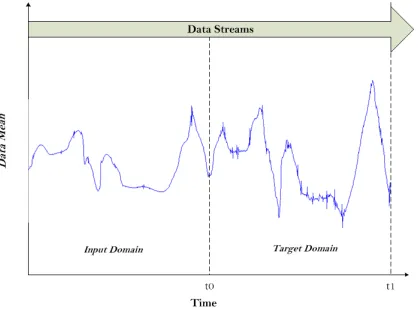
This section discusses various methods proposed to capture changes in data streams. We first differentiate between input and target domains in stream mining. The input data is received before time pointt0; while the target data is received betweent0andt1.
Thus, the change is monitored between the two time pointst0andt1. In a streaming
dynamic environment, changes are expected to occur between the input and target data. These changes might occur once or many times, gradually or suddenly [Gama et al. 2014]. Figure 8 represents an example of the change in data distribution between the input domain and target domain in 1-D data.
Fig. 8: Example of Change in Data Streams
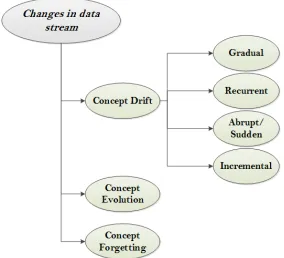
longer relevant in the target domain require a forgetting technique for adapting the model to the recent changes in the stream. Outliers are considered as a rare change of the stream. Unlike concept evolution, outliers are not incorporated into the system or added to the model for enhancement.The goal of detecting outliers is to isolate irrele-vant data and filter them out from real data. Noise can also be considered as a special case of outliers. For various kinds of change, adaptive learning techniques are applied in order to update the learner and cope with the evolution of data. Figure 9 illustrates categories of changes.
Fig. 9: Categories of Changes in Data Streams
Adaptive learning in stream mining can be categorised into two approaches. The first approach aims to update underlying concepts to cope with the most recent changes in data streams. In this approach, changes are not explicitly detected, yet the learner is updated periodically to accommodate for the expected changes in the data streams. While the other approach aims to observe data streams in order to detect the changes and then adapt the model upon the identified changes. In the following, we illustrate different types of change in data streams. Then, we discuss adaptive learning tech-niques that are applied for model update.
4.1. Tracking changes Concept drift.
adapting very fast decision trees - CVFDT. The adaptive Hoeffding tree monitors the quality of the previous model and adapts the model in terms of the splitting features in the tree. While Gaber and Yu [Gaber and Yu 2006] presents a STREAM-DETECT technique that capture change in data streams by monitoring data distribution using an online clustering deviation method.
(a) Concept Drift (b) Concept Evolution
(c) Concept Forgetting (d) Outliers/Anomalies
Fig. 10: Changes in Data Streams
The change is monitored between two time pointst0andt1. Detecting concept drift
selects the size with minimum error. The third approach is based on the combination of two different window sizes; one is fixed and the other is adaptive. The fixed win-dow stores the baseline historical information, while the sliding winwin-dow captures the incoming data streams. Where statistical measures change between the two windows, the change is detected [Dries and R ¨uckert 2009; Ad ¨a and Berthold 2013]. Bifet and Gavalda [Bifet and Gavald `a 2006; 2007] proposed an adaptive sliding window tech-nique - ADWIN and ADWIN2 - that maintains the size of windows according to the rate of change. The main drawback of applying the combination of both windows is the resource constrains. Figure 11 presents the taxonomy of concept drift approaches.
Fig. 11: Summary of Concept Drift Approaches
Concept evolution. The other type of change isconcept evolution, which refers to the appearance of novel concept in the stream. Figure 10(b) represents an illustration of concept evolution. Detecting a novel concept is a challenging task in data streams, especially when dealing with data streams with concept drift. An efficient approach has to be able to distinguish between the drifting of an existing concept and the ap-pearance of an entirely new concept. The apap-pearance of a new concept is followed later in the stream by detection of the recurring data instances that belong to the novel concept. Concept evolution techniques aim to capture the arrival of novel concepts and incorporate the detected novel concept into the existing underlying concept. This inte-gration allows further detection of recurring instances that belong to the novel concept. Different approaches have been developed to distinguish between existing and novel concepts.
capabilities of a concept evolution algorithm to differentiate only between existing and novel concepts without considering the presence of multiple existing concepts. Thus, other approaches have been developed to address the multi-class structure of an un-derlying concept, illustrated in Figure 12(b). The techniques developed in [Masud et al. 2011; Faria et al. 2013; Hayat and Hashemi. 2010] are examples of stream learning ap-proaches for novelty detection with multi-class underlying concept. ECSMiner [Masud et al. 2011] applies an ensemble of classifiers to an incoming stream of equally sized data chunks for prediction. The global decision boundary is defined as the union of local decision boundaries for existing classes in the underlying model. The classifier model in the ensemble classifier is dynamically updated to detect instances that are outside the global boundary. If no classifier is able to predict the incoming data, then data is stored in short memory for further processing. The novel concepts are detected when data in a buffer maintains cohesion with other buffer data and separation from exist-ing underlyexist-ing concepts. This approach addresses the novelty detection in multi-class underlying concepts, yet it requires all data chunks to be labelled to define the new concept. Faria, Gama, and Carvalho [Faria et al. 2013] proposed the MINAS system for concept evolution which applies unsupervised learning approaches. MINAS classi-fies new incoming instances as known or unknown. Unknown instances are the ones located outside the decision boundaries. The declared unknown instances are stored in short time memory. Then, data in short memory is clustered in order to discover new concepts. Hayat and Hashemi [Hayat and Hashemi. 2010] proposed an approach that is based on the discrete cosine transform to build normal concepts of multi-classes with sub-clusters. The distance measure is also applied to distinguish between existing and novel concepts. The aforementioned approaches rely mainly on the distance measures that predict novel concept based on its location from the decision boundaries. The new concept is declared as novel if it is outside the global decision boundary which is the union of local boundaries of clusters. Although the underlying concept contains multi classes, creating a global decision boundary results in a similarity between multi-class models and single class models. It combines all existing concepts in one concept and defines the global boundary for the combined concepts. Thus, these approaches also did not address the appearance of novel concepts that might exist outside the local boundaries, yet inside the global boundary. Moreover, most of these approaches did not consider the labelling cost of data streams when identifying novel concepts.
(a) Single Class Model (b) Multi-class Model
Fig. 12: Underlying Concept Approaches for Concept Evolution
is sufficiently close or far from the underlying concepts based on some appropriate metric. Novelty detection in these techniques detect “filtered out” instances without tracking data for the detection of normal concepts. While approaches in [Faria et al. 2013; Hayat and Hashemi. 2010; Masud et al. 2011; Spinosa et al. 2007] extend the detection of “filtered out” instances by detecting the level of cohesion among these in-stances to form a novel concept. Studies in [Masud et al. 2011; Al-Khateeb et al. 2012] further integrated the novel concept with underlying ones in order to detect recurring instances that belong to novel concept. Figure 13 summarises various approaches in concept evolution.
The idea of concept evolution is also attached to concept forgetting. Dynamic envi-ronments with non-stationary distributions require the forgetfulness of the observa-tions not consistent with the actual behaviour of the nature [Gama et al. 2010]. Both concept drift and concept evolution adapt the model to newer information, while con-cept forgetting abandons old information. Forgetting mechanisms are necessarily with data streams in order to preserve resources (i.e., memory) while dealing with the most recent observations for better accuracy. The system performance relies on its capabil-ities to learn changes and new concepts appear in the stream as well as forgetting outdated concepts that became a burden on the system [Kifer et al. 2004]. Concept for-getting, in this direction, is concerned about outdated concepts instead of observations. It might use the same forgetting mechanisms, applied for observations, yet at concept level. Whereas incremental learning manages the continuous learning of new concepts, decremental learning focuses on forgetting abandoned concepts[Cauwenberghs and Poggio 2001]. Figure 10(c) explains the concept forgetting in data streams.
Fig. 13: Summary of Concept Evolution Approaches
applied pervasively for outlier detection. There are many techniques that studied out-lier detections in data streams such as [Angiulli and Fassetti 2007; Assent et al. 2012; Niennattrakul et al. 2010; Pokrajac et al. 2007]. Few studies have combined the detec-tion of outliers with concept evoludetec-tion such as in [Masud et al. 2011; Masud et al. 2013; Al-Khateeb et al. 2012]. A detailed survey of outlier detection approaches is presented in [Aggarwal 2013]
In a nutshell, evolving data streams may have encountered many kinds of change. That includes concept drift, concept evolution, and concept forgetting. Concept drift could be gradual, sudden, incremental, recurrent. In this section, we discussed vari-ous kinds of changes and different approaches to detect each. The main target of these approaches is to spot and identify the change. In the following section, we review tech-niques to learn from rapidly changing data streams. Thus, we study the problem of learning in an evolving streaming environment when changes occur.
4.2. Learning from changes
Adaptive learning. The evolving nature of data streams necessities the need of a learning approach that is capable of accommodating the anticipated changes. Con-tinuous learning in evolving data streams refers to the well-known term of incre-mental learning oradaptive learning. There are two categories of adaptive learning; blind/implicit learning or informed/explicit learning [Gama et al. 2010]. Techniques for blind learning update the learner periodically without prior knowledge of the en-countered changes. The adaptation occurs at fixed time intervals independent of the kind of change. Unlike the blind approach, explicit/informed learning techniques are triggered when change is detected. Therefore, informative learning based on the kind of change is performed whenever change occurs.
An adaptation process in the blind approach is incremental without prior explicit knowledge of the change itself. VFDT [Domingos and Hulten 2000] is a typical example of blind learning where the decision tree leaves are updated periodically according to a loss function. In contrast, informed learning requires explicit knowledge about change to trigger the adaptation of the learner. Masud et al. [Masud et al. 2011], for instance, applied an ensemble classifier for detecting concept evolution in data streams with concept drift. The proposed system incorporates a new learnt model into a learner for future prediction of recurring instances.
the new concept and its recurring instances will be either misclassified or classified as
unknown.
Adaptive learning is also categorised based on the adaptation response. The adapta-tion reacadapta-tion is either revoluadapta-tionary or progressive. In the revoluadapta-tionary approach, the learner is retrained and reconstructed with the most recent important data. The ex-isting model is discarded and totally replaced with a new model from new data [Gama et al. 2014; Street and Kim 2001; Gama et al. 2004]. Alternatively, new data adapts existing models incrementally in the progressive approach in order to react to the changes in the stream. An example is the OLINDDA system [Spinosa et al. 2007] that applies online and incremental learning for extensions of existing concepts or discov-ering novel concepts.
Figure 14 summarises different approaches for adaptive learning.
Fig. 14: Summary of Adaptive Learning Approaches
A special category of incremental learning is active learning. Active learning focuses on labelling only few data instances in order to enhance the learner accuracy. In data stream settings, it is impractical to assume the availability of labels while a stream evolves. Many approaches have been proposed for efficient active learning techniques in data streams, such as in [Widyantoro and Yen 2005; Masud et al. 2012; Huang and Dong 2007]. Studies in [Huang and Dong 2007; Fan et al. 2004; Lindstrom et al. 2013] developed an active learning approach based on the change detection method. When the system detects change in a data streams, that triggers active learning to inquire for true labels. Other approaches built on an assumption that part of the data streams is labelled while the other part is unlabelled [Li et al. 2012]. Recent work in [Zliobaite et al. 2014] presents a framework for active learning in data streams with concept drift. The developed system learns in batches while saving the labelling cost. The main target of active learning is to keep the trade-off between minimising the cost of labelling while maximising the gain in performance.
All in all, we reviewed state-of-the-art-techniques in data stream mining. Ap-proaches for data stream mining focuses mainly on the non-identical distribution feature of data. Techniques for data stream mining include handling data streams, learning from data streams and capturing change in evolving data streams. Incoming data in activity recognition typically streams from sensors. In the following section, we discuss the intersection between stream mining and activity recognition areas of research. That also includes the mapping of terminologies between the two fields of study.
5. ACTIVITY RECOGNITION TECHNIQUES USING DATA STREAM MINING
de-pendency nature of activity data, while approaches in stream mining focus on the non-identically distributed streaming data. Traditional activity recognition approaches are based on the assumption that the processed data is stationary. This assumption is vio-lated when dealing with real time sensory data that is typically evolving over time. Data streams approaches deal with non-identically distributed data and also con-straints imposed in the streaming nature, e.g. infinite number, high speed, concept drift etc. However, most of the stream mining approaches have not been used to ad-dress activity recognition. Activity recognition in data streams approach is an over-lapping between stream mining and activity recognition when both i.i.d.conditions of independent and identically distributed are violated. The developed techniques for activity recognition in data streams have to be adaptable and flexible, to accommodate for the evolving nature of activities.
Some approaches in data stream mining might be seen as applicable for activity recognition [Fong et al. 2016; ˇZliobait˙e et al. 2016]. Particularly, mining sequential data streams could be considered for activity recognition. This approach deals with sequential data streams as ordered chunks with or without a notion of time. Although techniques in this approach consider the dependency in data, two major core differ-ences make these techniques incompatible with activity recognition. According to the previously explained approaches in Section 4, most techniques in sequential data pro-cessing aim to find interesting/frequent patterns instead of mining the sequential pat-terns in order to predict classes of incoming data. This is different from the main target of activity recognition which is the prediction of incoming activities with sub-targets that might also be included in some cases for finding the interesting patterns. In data stream mining, few studies have addressed the actual mining of sequential patterns in data streams. Yet, these techniques assume that the sequential data is in a transac-tional form which assumes that the stream is segmented and each segment is assigned to one well-defined class. This assumption is not valid for activity recognition when a stream of data representing a sequence of performed activities arrives with no bound-aries in-between. Activities also can be interleaving, such se pauses while walking or recurrent, such as running while bouncing the ball in a basketball court. Although se-quential stream mining is conceptually related to activity recognition, its techniques are not applicable for activity recognition because of the aforementioned core differ-ences in terms of the learning target and domain definition. It is also important to emphasis the relationship between time series as a special type of data streams that has a time notation and activity recognition.
5.1. Time Series and Activity Recognition
fea-ture extraction and domain knowledge. However, the model is overfitted and handles only atomic activities. [Chen et al. 2013] proposed a new DTW measure, DTW-D, that targets Semi supervised learning for many applications, including activity recognition. Subwindow Ensemble Model [Zheng et al. 2013] used an ensemble of classifiers trained on features made up of coarse summary statistics computed from different temporal scales. Kogeh [Hu et al. 2013] built an alignment-free time series classification frame-work that requires only weakly-labeled data. The frameframe-work applies a threshold-based approach to distinguish between patterns inside a single time series. It also reduces the computation of 1-NN by constructing data dictionary. The framework showed fast and accurate performance compared to traditional time series techniques for seven different applications including activity recognition.
Applying time series classification for activity recognition might encounter a number of challenges which are:
— Segmentation:Most literature on time series classification assumes that the be-ginning and ending points of the pattern of interest can be correctly identified [Hu et al. 2013]. This assumption is unrealistic for activity recognition in data streams when data arrives as a continuous sequence of multi-layered of concurrent and over-lapped activities. Segmentation of a time series into a sequence of physical activity types rather than classifying an entire time series as a single activity type is essen-tial. The quality of segmentation directly influences the recognition results.
— Complex activities: Activity patterns are complex, repetitive and represented with different lengths. Time series techniques work well when the task is to match the overall shape of a time series. However they perform poorly on activities with repetitive patterns [Zheng et al. 2013]. The basic machine-learning task involves classifying a time series as a single physical activity type [Zheng et al. 2013]. Using time series to classify complex activities could be challenging. Moreover, data used for time series are arranged to be of same length. For example, in the world’s largest collection of time series datasets, the UCR classification archive, all datasets con-tain only equal-length data [Chen et al. 2015]. This assumption is not applicable for activity recognition.
— Personalisation:Time series representing activities can change from one person to another. Therefore, a classified time series activity can belong to more than one well-defined class. Some people tend to have pauses of standing while walking; oth-ers may walk as fast as jogging. The current solution to preprocess such data re-quires human intervention in order to keep only data that represent the activity of interest [Hu et al. 2013].
— New activities: In real-life streaming data, new activities that have not been trained with the classification model might evolve over time. Detecting new activi-ties and assimilate them into the classification model will enhance the classification accuracy. We found no reference in the literature of using time series techniques for detecting new activities.
CenceMe classifiers run on the phone and the backend server according to the split-level classification design. The backend server classification presents a higher split-level of contextual recognition of activities. The activity-recognition algorithm presented in [P ¨arkk ¨a et al. 2010] is based on a binary decision tree classifier to automatically recog-nise physical activities on a portable device. The labelled data is provided to evaluate the system performance and update the decision tree threshold values with the user’s own data.
Although the response time of these techniques seems to resemble one for stream mining techniques, none of the other performance characteristics of data streams have been addressed in these techniques. Particularly, they have no notion for handling infinite, high speed, and mostly unlabelled data streams. Moreover, these approaches lack the consideration of concept drift, outliers, or concept evolution that are known phenomena in data streams. These approaches are not flexible for personalisation and adaptation with the evolving activities.
Some terms in activity recognition have their corresponding meanings in stream mining, yet in different settings and with different contexts. A typical example of this isoutlier detection. Hawkins [Hawkins 1980] defined an outlier in general as: “An out-lier is an observation which deviates so much from the other observations as to arouse suspicions that it was generated by a different mechanism”. Outliers in data stream mining correspond to abrupt changes in data streams from the underlying concepts. Outliers can be referred to as noise, anomalies, and abnormalities. The term of out-lier detection in activity recognition refers to sudden activity such as fall detection. Detection of sudden activities resemble outlier detection as they both aim to find the unusual events in data. The term of “sudden activity” or “fall detection” is pervasively discussed in activity recognition, especially for elderly people aids [Luˇstrek and Kaluˇza 2009; Mubashir et al. 2013; Bakar et al. 2016].
Novelties are considered as a special category of outliers, yet with aggregated data points [Aggarwal 2013]. However, in this survey we suggest a separation between the two concepts, outliers and novelties. By definition, outlier is an unusual event that is completely different from the underlying/known concepts. It is mostly expressed as a set of individual data points that correspond to noise, sensor failure, etc. Outliers can-not be aggregated under a single concept as they have different natures and different causes. On the other hand, novelty data represent novel concept which still have some commonality with existing underlying concepts. Though the novel concept is different from the underlying concept, they still preserve some common similarities. Examples of outliers are noise, credit card fraud, or sudden falls in activity recognition which are entirely different from the underlying concepts. While novelties are about discovering new “normal” concepts such as discovering a new category of credit card transaction or a new activity that the user started performing recently. There are two main dif-ferences between outliers and novelties. First, novelties represent novel concepts that have not been seen by the system before. Yet, novel concepts are neither completely different nor abnormal from the underlying concepts. Thus, new concepts might ap-pear in the middle of existing ones. Moreover, novel concepts are represented by a set of aggregated instances, while outliers instances are mostly irregular that appear separately and most of the time with no relation to other detected outliers.
The term “novelties” is also referred to as concept evolution and novelty detection. In stream mining approaches, concept evolution, as introduced earlier in Section 4.1, is the process of monitoring the data streams in order to discover the appearance of novel concepts. The term of concept evolution is analogous todetecting novel activity
presented for data streams in [Gama et al. 2010]. Concept forgetting is also relevant to activity recognition whereas activities are no longer performed by users.Forgetting abandoned activitiesaims to update the model continuously to reflect the most recent changes in data and remove outdated/abandoned activities.
Another term that is well-known in stream mining is concept drift. It primarily refers to the change in data distribution while a stream evolves. This change could be gradual or sudden that happens once or recurring. A typical data stream evolves over time. Thus it requires an effective approach to handle the drift and accommodate for the most recent changes in the stream. In activity recognition, the definition of concept drift is relevant, yet in a different context. The deviation between input and target domains in an activity stream occurs as activities are performed in a different way from one user to another. When the recognition model (target) is different from the incoming data (input), this deviation resembles concept drift for activity recognition. More precisely, approaches addressing concept drift in activity recognition are termed as model personalisation. The personalisation process targets the adaptation of the recognition model to fit data for a particular user.
The process of learning from aforementioned changes is done with adaptive learn-ing in data streams which include incremental and active learning. The anatomy of adaptive learning in data streams is model adaptation in activity recognition. The goal of adaptive learning in data streams is the same of model adaptation in activity recognition, which is continuous learning to adapt to the most recent changes in the evolving data. The concept of model adaptation in activity recognition applies also to incremental and active learning.
Some of the issues that have been addressed in both stream mining and activity recognition, yet under different settings and with resembling meanings, are sum-marised in Table II. The table shows a subset of stream mining terminologies and its corresponding related terms in activity recognition.
Table II: Terminology Mapping between Stream Mining and Activity Recognition
Stream mining Meaning Activity recognition Meaning
Learning from concept drift
The detection and re-sponse of change in a data stream
Model personalisation The tuning of the model to suit a personal way of performing activities
Concept evolution The discovery of new concepts in the stream
Detecting novel activ-ity
The discovery of new activities
Outlier detection Detection of abnor-mal instances in data stream
Sudden activity detec-tion
The detection of sud-den changes in activity data
Concept forgetting The decremental learn-ing of outdated con-cepts
Forgetting abandoned activity
The decremental learn-ing of abandoned activ-ities