Volume 2007, Article ID 60245,12pages doi:10.1155/2007/60245
Research Article
Video Summarization Based on Camera Motion and
a Subjective Evaluation Method
M. Guironnet, D. Pellerin, N. Guyader, and P. Ladret
Laboratoire Grenoble Image Parole Signal Automatique (GIPSA-Lab) (ex. LIS), 46 avenue Felix Viallet, 38031 Grenoble, France
Received 15 November 2006; Revised 14 March 2007; Accepted 23 April 2007
Recommended by Marcel Worring
We propose an original method of video summarization based on camera motion. It consists in selecting frames according to the succession and the magnitude of camera motions. The method is based on rules to avoid temporal redundancy between the selected frames. We also develop a new subjective method to evaluate the proposed summary and to compare different summaries more generally. Subjects were asked to watch a video and to create a summary manually. From the summaries of the different subjects, an “optimal” one is built automatically and is compared to the summaries obtained by different methods. Experimental results show the efficiency of our camera motion-based summary.
Copyright © 2007 M. Guironnet et al. This is an open access article distributed under the Creative Commons Attribution License, which permits unrestricted use, distribution, and reproduction in any medium, provided the original work is properly cited.
1. INTRODUCTION
During this decade, the number of videos has increased with the growth of broadcasting processes and storage devices. To facilitate access to information, various indexing techniques using “low-level” features such as color, texture, or motion have been developed to represent video content. It has led to the emergence of new applications such as video summary, classification, or browsing in a video database. In this paper, we will introduce two methods required to study video sum-mary: the first one explains how to create a video summary
and the second one how to evaluate it and to compare diff
er-ent summaries.
A video summary is a short version of the video and is composed of representative frames, called keyframes. The se-lection of keyframes has to be done with the aim of both rep-resenting the whole video content and suppressing the re-dundancy between frames. As we said, videos are usually
de-scribed by “low-level” features to which it is difficult to give
a meaning. On the contrary, a semantic meaning can be de-duced from camera motions. For example, an action movie contains many scenes with strong camera motions: a zoom-in will focus the spectator’s gaze on a particular location zoom-in a scene. In this paper, we exploit the information provided by camera motion to describe the video content and to choose the keyframes.
In the literature, some video summary methods were proposed from camera motion. The first family uses camera
motion to segment the video but not to select the keyframes.
The keyframe selection is based on other features. In [1], the
camera motion is used to detect moving objects and this
in-formation is used to build the summary. In [2], camera
mo-tion is used to partimo-tion the shots in segments and keyframe selection is carried out with other indexes (4 basic measures, i.e., visually pleasurable, representative, informative, and dis-tinctive). A shot is, by definition, a portion of video filmed
continuously without special effects or cuts, and a segment is
a set of successive frames having the same type of motion. In
[3], shots are segmented according to camera motions. Then,
MPEG motion vectors, that contain the camera and object motions, are used to define the motion intensity per frame and select the keyframes. Nevertheless, these approaches do not select keyframes directly according to camera motion. In fact, the camera motion is used more to segment the video than to create the summary itself.
The second family is based mainly on the presence or
the absence of motion. Cherfaoui and Bertin [4] detect the
shots, then determine the presence or the absence of camera motion. The shots with a camera motion are represented by three keyframes, whereas the shots with fixed camera have
only one. Peker and Divakaran [5] work out a summary
method by selecting the segments with large motions in or-der to capture the dynamic aspects of video. In this case they
used camera motion and also object motion. In [6], the
based on simple considerations which exploit little informa-tion contributed by camera moinforma-tion.
The third family uses camera motion to define a simi-larity measure between frames; this simisimi-larity is then used
to select the keyframes. In [7], a similarity measure between
two frames is defined by calculating the overlap between them. The greater the overlap is, the closer the content is and the fewer keyframes are selected. In the same way, Fauvet et
al. [8] determine from the estimation of the dominant
mo-tion, the areas between two successive frames which are lost or appear. Then, a cumulative function of surfaces which ap-pear between the first frame of the shot and the current frame is used to determine the keyframes. Nevertheless, these ap-proaches are based on a low-level description which mea-sures the overlap between frames. They are based on geomet-rical and local properties (number of pixels which appear or which are lost between two frames) and do not select frames according to the type of motion detected.
In this paper, we propose a new method of video sum-mary based on camera motions (translation and zoom) or on static camera. We think that camera motion carries im-portant information on video content. For example, a zoom in makes it possible to focus spectator attention on a particu-lar event. In the same way, a translation indicates a change of place. Therefore, keyframes were selected according to cam-era motion characteristics. More precisely, the method con-sists in studying the succession and the magnitude of camera motions. From these two criteria, various rules are worked out to build the summary. For example, the keyframe
selec-tion will be different according to the magnitude and the
succession of the motions detected. The advantage of this method is to avoid a direct comparison between frames (sim-ilarity measure or overlap between frames on pixel level) and it is based only on camera motion classification.
Video summarization methods must be evaluated to ver-ify the relevance of the selected keyframes. As already men-tioned, video summarization methods are widely studied in the literature. Nevertheless, there is no standard method to
evaluate the various video summaries. Some authors [9,10]
propose objective (mathematical) measures that do not take human judgment into account. To overcome this problem, other authors propose subjective evaluation methods. Three families of subjective evaluation can be distinguished to judge video summarization methods.
The first family of methods compares two summaries.
For example, in [11], people view the entire video and choose
between two summaries the one which best represents the video viewed. One summary results from a video summa-rization method to be tested and the other comes from an-other method developped by an-other researchers (a regular sampling of the video or a simplified version of the summa-rization method to be tested). The aim is to show that the summary suggested by one method is better than another method.
The second family creates a summary manually, a kind of “ground truth” of video, that is used for the comparison with the summary obtained by its automatic method. The comparison is made with some indices (recall and precision).
The comparison is carried out either manually or by
comput-ing distances. For example, Ferman and Tekalp [12] evaluate
their summary by requiring a neutral observer to announce the forgotten keyframes and the redundant ones. The criteria of evaluation are thus the number of forgotten and redun-dant keyframes.
In the third family, subjects are asked to measure the level of meaning of the proposed summary. A subject views a video, then he is asked to judge the summary according to a given scale. The subjects can be asked questions also to mea-sure the degree of performance of the proposed summary. In
[13], the quality of the summary is evaluated by asking
sub-jects to give a mark between one and five for four criteria:
clarity, conciseness, coherence, and overall quality. In [14],
the subject must initially give an appreciation for each shot on the single selected keyframe (good, bad, or neutral) then he must give appreciations on the number of keyframes per
shot (good, too many, too few). In [15], three questions are
asked about the summary: who, what, and coherence. Ngo
et al. [16] propose two criteria of evaluation to judge the
summary: informativeness and enjoyability. The first crite-rion reveals the ability of the summary to represent all the information in the video by avoiding redundancy, and the second evaluates the performance of the algorithm in giving enjoyable segments.
The evaluation method that we propose belongs to the second family. It consists in building an “optimal” summary, called the reference summary, from the summaries obtained by various subjects. Next, an automatic comparison is carried out between the reference summary and the summaries vided by various methods. This evaluation technique
pro-vides a method to test different summaries quickly.
The camera motion-based method to create a video
sum-mary is explained inSection 2. Then, inSection 3, the
subjec-tive method to evaluate the proposed summary is presented.
Finally,Section 4concludes the paper.
2. VIDEO SUMMARIZATION METHOD FROM CAMERA MOTION
The principle of the summarization method consists in cut-ting up each video shot in segments of homogeneous camera motion, then in selecting the keyframes according to the suc-cession and the magnitude of camera motions. The method requires the parameters extracted from the camera motion
recognition and described in [17] to be known. A short recall
of the camera motion recognition method is presented fol-lowed by an explanation of the keyframe selection method.
2.1. Recognition of camera motion
This recognition consists in detecting translation (pan and/or tilt), zoom and static camera in a video. The system
architecture, depicted inFigure 1, is made up of three phases:
motion parameter extraction, camera motion classification (e.g., zoom), and motion description (e.g., zoom with an
en-largement coefficient of five). The extraction phase consists
Video stream
Phase 1: motion parameter extraction
Phase 2: camera motion classification
Stage 1: combination based on heuristic rules Stage 2: static/dynamic separation
Stage 3: temporal integration of zoom/translation
Phase 3: camera motion description
Camera motion classification and description
Figure1: System architecture for camera motion classification and
description.
frames by an affine parametric model. The core of the work
is the classification phase which is based on transferable be-lief model (TBM) and is divided into three stages.
The first stage is designed to convert the motion model parameters into symbolic values. This representation aims at facilitating the definition of rules to combine data and
to provide frame-level “mass functions” for different camera
motions. The second stage carries out a separation between static and dynamic (zoom, translation) frames. In the third stage, the temporal integration of motions is carried out. The advantage of this analysis is to preserve the motions with sig-nificant magnitude and duration. Finally, a motion is associ-ated with each frame and a video is split into segments (i.e., set of successive frames having the same type of motion).
The description phase is then carried out by extracting
different features on each video segment containing an
iden-tified camera motion type. For example, a zoom segment (see Figure 2(a)) is represented by the enlargement coeffi
-cientecand the direction of the zoom (in or out). A
trans-lation segment (seeFigure 2(b)) is described by the distance
traveled noteddtand the total displacement notedtd. The
total displacementtdcorresponds to the displacement along
the straight line between the initial and the final positions,
whereas the distance traveled dt is the original path and
corresponds to the integration of all displacements between sampling times.
Consequently, this method is used to identify and de-scribe camera motion segments inside each video shot. The parameters extracted to describe translation and zoom seg-ments will be used to create the summary.
2.2. Keyframe selection according to camera motions
Keyframe selection depends on camera motions in each video shot. As mentioned before, each shot is first cut into segments of homogenous camera motion. The keyframe se-lection is divided into two steps. First, some frames are cho-sen to be potential keyframes to describe each segment: one at the beginning and one at the end, and in some cases one in the middle. In practice, even for long segments, we noted that three keyframes are enough to describe each segment.
Then, some of the keyframes are kept and others removed according to certain rules. We will present the keyframe se-lection first according to the succession of motions, second the magnitude of motions and finally by the combination of both.
2.2.1. Keyframe selection according to succession of camera motions
To select the keyframes, we define heuristic rules. Because of the compactness of the summary, only two frames are se-lected to describe the succession of two camera motions. If one of the two successive segments is static, the two frames are selected at the beginning and at the end of the segment with motion. One of these frames is also used to represent the static segment. If the two successive segments have cam-era motions, a frame is selected at the beginning of each
seg-ment.Figure 3recapitulates how the keyframes are selected.
The process is repeated iteratively for all the motion segments of the shot.
This technique processes two consecutive motions at a time. Let us suppose that three consecutive motions are de-tected in a shot: static, translation, and static. By applying
the rules defined in Figure 3, we obtain the results shown
inFigure 4. Each iteration corresponds to the process of two consecutive segments. By superposition of the iterations, the result obtained is two selected frames: one at the end of the static segment (or at the beginning of the translation seg-ment) and one at the end of the translation segment (or at the beginning of the last segment).
2.2.2. Keyframe selection according to magnitude of camera motions
Keyframe selection also has to take into account the magni-tude of camera motions. For example, a translation motion with a strong magnitude requires more keyframes to be de-scribed than a static segment, since the visual content is more dissimilar from one frame to the following one. In the same way, a zoom segment is described by a number of keyframes
linked to its enlargement coefficient.
For a translation segment, the coefficientcr=(dt−td)/dt
is calculated in order to determine if the trajectory is
recti-linear. This coefficientcr lies between 0 and 1 and describes
the motion trajectory. The smallercr is, the more
rectilin-ear the motion is. Consequently, if coefficientcris lower than
a threshold δr, the motion is considered rectilinear. In this
case, if the total displacementtdis large, that is, higher than
thresholdδtd, the first and the last frames of the segment are
selected. Only the last frame is selected if the total
displace-ment td is weak (lower than threshold δtd). On the other
hand, if coefficientcr is higher thanδr, the motion changes
direction. If the total displacementtdis higher than
thresh-oldδtd, the frames of the beginning, the middle, and the end
of the segment are selected. If not, the last frame of the seg-ment is selected.
For a zoom segment, the keyframes are selected
Initial frame Final frame
ec32 (a) Definition of the enlarge-ment coefficientec
Initial frame
Final frame
td d(t)
dt
(b) Definition of the distance traveled dt and the total dis-placement td from displace-mentd(t) between 2 successive frames
Figure2: Example of parameters extracted to describe each segment of a video for (a) a zoom and (b) a translation.
Frames Translation Static
Frames Zoom Static
(a)
Frames Translation Static
Frames Translation
Zoom
(b)
Frames Zoom Static
Frames Translation Zoom
(c)
Figure3: Rules for keyframe selection according to two
consecu-tive camera motions. Cases: (a) translation and static, (b) zoom and static, (c) translation and zoom. For example, if a static segment is followed by a translation segment (Figure (a) left), the first frame of the translation segment (or the last frame of the static segment) is selected as well as the last frame of the translation segment.
great (i.e., higher than thresholdδec), the first and the last
frames of the segment are selected. In the opposite case, only the last frame is selected.
After an experimental study, we chose the following
thresholds:δr =0.5,δtd=300, andδec =5. Keyframe
selec-tion according to camera moselec-tion magnitude is summarized inFigure 5.
2.2.3. Keyframe selection according to succession and magnitude of camera motions
Keyframe selection takes into account both the succession and the magnitude of camera motions. We will combine the
Keyframes
Translation
Static Final
(succession of motions)
Frames Translation Static 2nd iteration
Frames Translation Static 1st iteration
Shot
Translation
Static
Figure4: Illustration of keyframe selection. The first iteration
cor-responds to the process of segments 1 and 2. In the same way, the second iteration corresponds to the succession of segments 2 and 3. Keyframe selection is one frame at the end of the static segment (or beginning of the translation segment) and one frame at the end of the translation segment (or at the beginning of the last segment).
different rules explained above. First, the identified motions
which have a weak magnitude or a weak duration are pro-cessed as static segments. If a translation motion of duration
T with a total displacementtdis detected, the standardized
total displacementtds=td/T is calculated. This is regarded
as a static segment if the durationTis shorter than threshold
δT and if the standardized total displacementtdsis shorter
than threshold δt. In the same way, a zoom of durationT
with an enlargementecis regarded as a static segment if the
duration Tis shorter than thresholdδT and if the
Translation If high magnitude
and no rectilinear translation
Translation If high magnitude
and rectilinear translation
Translation If low magnitude
If low magnitude Zoom
If high magnitude Zoom
Figure5: Keyframe selection according to the type and magnitude of camera motions.
Keyframes
Translation
Static Succession
and magnitude
Translation High mangnitude
and no rectilinear
Statique Translation Succession of segments
Translation Static Succession of
segments
Shot
Translation
Static
Figure6: Illustration of keyframe selection according to succession
and magnitude of motions.
were fixed in an empirical way atδt = 1.5,δe = 1.8, and
δT =50.
Then, keyframes are selected by applying the rules ac-cording to the succession of motions. From the magnitude of motions, frames can be added for the summary. Let us have a look at the previous example with three consecutive detected motions in a shot: static, translation with a strong magnitude
and static.Figure 6illustrates the keyframe selection.
Moreover, in the case of a motion included in another one, if the motion included is of strong magnitude, then the segment containing this motion is described by the frame in the middle of this segment. Lastly, if a shot contains only one camera motion, then the keyframe selection is obtained by applying the rules according to the magnitude of the mo-tions.
Figure 7illustrates the different steps of the summariza-tion method proposed. It concerns a video sequence named “Baseball,” an extract from a baseball match, which has 9
shots (seeFigure 7(a)). InFigure 7(b), from the bottom
up-wards on the y-axis, we have, respectively, the position of
0 25 50 75 100 125 150 175 200 225
250 275 300 325 350 375 400 425 450 475
500 525 550
(a) Sampling of the “baseball” video (1 frame out of 25)
0 100 200 300 400 500
t
Shot Static Translation
Zoom Selection
1 2 3 4 5 6 7 8 9
0 59
220 275 276 331
378 448 60 125
126 196
332 377
504 540 541 563 126 180
197 219
449 503 29 60 125126 208 247 303 354 413 503 522 552
(b) Keyframe selection according to succession and magnitude of mo-tions
29 60 125 126 208 247 303 354 413 503
522 552
(c) Summary of the video “baseball” according to succession and magnitude of motions
Figure 7: Example of video summary made by camera
motion-based method.
the shots, the identification of static segment (absence of motion), translation segment and zoom segment, and
fi-nally the selection of the keyframes. For example,n◦1 shot
(from frame 0 to frame 59) is identified as static and the
keyframe corresponds to frame 29. In the same way, n◦7
shot (from frame 378 to frame 503) contains two segments: a static segment (from frame 378 to frame 448) followed by a zoom segment (from frame 449 to frame 503). The keyframe
shows the keyframes used for the summary of the “Baseball” video.
For each shot of the “Baseball” video, the summary cre-ated from the succession and the magnitude of camera mo-tions seems visually acceptable and presents little redun-dancy.
We developed a summary method which exploits the in-formation provided by camera motion. In order to validate this method, we have designed an evaluation method.
3. EVALUATION METHOD OF VIDEO SUMMARIES
Video summarization methods must be evaluated to verify the relevance of the selected keyframes. However, the qual-ity of a video summary is based on subjective considerations. Only the “user” can judge the quality of a summary. In this part, we propose a method to create an “optimal” summary
based on summaries created by different people. This
“op-timal” summary, also called the reference summary, is used as a reference for the evaluation of the summaries provided by various approaches. The construction of a reference
sum-mary is a difficult stage which requires the intervention of
subjects, but once this summary has been obtained, the com-parison with another summary is rapid.
Our evaluation method is similar to that of Huang et
al. [18]. Nevertheless, although their evaluation occurs on
the video level, their method of building the reference sum-mary is carried out on the shot level. The evaluation method that we propose was developed within a more general frame-work and provides (i) a reference summary with keyframes selected per shot and (ii) a hierarchical reference summary that takes into account the “importance” of each shot to add weight to the keyframes of the corresponding shot. As the summary from camera motions is proposed on the shot level, we only present the evaluation method on the level of each shot. We will present successively the manual creation of a summary, then the creation of the reference summary and finally the comparison between the reference summary and the automatic summary provided by our camera motion-based method.
3.1. Creation of a video summary by a subject
The goal of the experiment is to design a summary for dif-ferent videos. We asked subjects to watch a video then to create a summary manually. From the various summaries, a method is proposed to generate the reference summary in order to compare it with the summaries provided by various algorithms.
3.1.1. Video selection
Video selection is an important stage which can influence the results. Two criteria were taken into account: the content and the duration of the video. We chose three videos with
varied content and different durations: a sports
documen-tary (called “documendocumen-tary”) with 20 shots and 3271 frames, “the avengers” series with 27 shots and 2412 frames and TV news (called “TV news”) with 42 shots and 6870 frames. Each
video is made up of color frames (288×352 pixels) displayed
at a frequency of 25 frames per second.
It should be noted that these videos are of short dura-tion. The longest lasts approximately 5 minutes. In
compari-son, the longest video used in [18] has 3114 frames and has a
maximum number of 20 shots. The fact of not choosing long videos is linked to the duration of annotation by a subject. It is thus a question of finding a good compromise between
a sufficient duration and a reasonable duration for the
ex-periment. In our experiment, the manual creation of a video summary requires between 20 and 35 minutes.
3.1.2. Subjects
12 subjects participated in the experiment. They did the ex-periment three times (for the three videos). The order of video presentation is random from one subject to another. All the subjects had a normal or corrected to normal vision and they knew the aim of the experiment—the creation of a video summary—but they were not aware of our video sum-marization method based on camera motion.
3.1.3. Experimental design
The subjects did the experiment individually in front of a computer screen. The experiment is designed using a pro-gram written in C/C++ language. Each subject received the following instructions. On the one hand, the summary must be as short as possible and preserve the whole content. On the other hand, the summary must be as neutral as possible. It is thus the subject who distinguishes by himself the degree of acceptance of the summary. The creation of a video sum-mary proceeds in three stages.
1st stage: viewing of the video
In the first stage, the subject viewed the whole video (frames and sound) then he had to give an oral summary in order to make sure that the video content was understood. He viewed the video a second time.
2nd stage: annotation of the video extracts
In the second stage, the video was viewed in the form of ex-tracts presented in chronological order in the top left-hand
corner of the screen (seeFigure 8). Subject was asked to
Frames selected Next
Vi Vi Vi i
Ni
10
5 6 7 8 9
0 1 2 3 4
To select frames (from 1 to 3 frames)
This extract appears to you to be important for the summary of the video Very important Important No important
c d
b a
Figure8: Second stage of the reference summary creation for the “documentary” video. The subject had to indicate the degree of importance
of the extract in zone b. Then in zone d, he had to select the frames which seemed relevant to him for the summary of the extract presented in zone a. As the frames were displayed with a spatial undersampling by four, the subject could see them with a normal resolution by placing the mouse on a frame of zone d in order for it to appear in zone a. In zone c, the frames already selected from the preceding extracts were displayed to keep a record of the selection.
of the shot (from at least one to three) bearing in mind that the selection had to be as concise as possible and represent the entirety of the content. The maximum number three was selected by preliminary tests. During this stage, when sub-jects were allowed to choose five keyframes, the majority of them chose fewer than three keyframes per shot, except for some of them who systematically chose five frames to de-scribe even very short shots. Once the subject had finished his annotation for a given extract, he validated it and the re-sults were displayed in the bottom left-hand corner of the screen to keep a record of the annotations already given.
The second stage is illustrated inFigure 8
(“Documen-tary” video). The subject indicated here if the extract was important for the summary of the video. He also selected one
frame (framen◦2) to summarize this extract. The annotation
of the previous extracts is displayed in the bottom left-hand corner where 5 frames were selected.
Two remarks can be made about this stage. The first con-cerns the limited number of levels of importance. Only three levels of importance are proposed: “very important,” “im-portant”, or “no important.” A scale with more levels would have made the task more complex and perhaps
disconcert-ing for the subject because of the difficulty of making the
difference between levels. The second is about the sampling
of the frames of the extract. We chose the sampling of one frame out of ten to avoid displaying the complete shot on the screen, which would render the task of keyframe selection
difficult and fastidious. Because of temporal redundancy of
the frames, it seemed advisable to carry out this sampling
and thus 5 frames displayed on the screen correspond to 2 seconds of the video.
3rd stage: confirmation of the annotations and construction of a short summary
In the third stage, once all the extracts had been annotated, the complete summary was displayed on the screen. The aim is to provide a global view of the summary and to allow the user to modify it and to validate it. Each extract was repre-sented by the chosen frames and the degree of importance was indicated in the lower part of each frame. The subject was asked to modify, if he wished, the degree of importance of the extracts, then to remove the frames which appeared redun-dant and finally to select only a limited number of frames. The purpose of this stage is to provide a hierarchical sum-mary with a fine level on a shot scale and a coarser level on the scale of the video.
In order to understand the experiment, a training phase is carried out with a test video with 5 shots and 477 frames.
3.2. Construction of a reference summary
The difficulty consists in creating a reference summary from
a distance between the frame descriptors since the gap be-tween low-level descriptors and semantic content has not yet been bridged. The process is based on elementary considera-tions to create the optimal summary. We develop two meth-ods to create a reference summary, one designed for each shot called “fine summary” and the other created from com-parison between shots called “short summary.” As the sum-mary method from camera motions provides the keyframes for each shot, we only present the fine summary in this paper. The construction of summary on the shot level is car-ried out only from the annotations of stage 2 . As already mentioned above, each extract viewed corresponds to a shot, and only the frames chosen by the subjects will be examined and not the degrees of importance of the shots. As the pos-sible number of frames selected varies from one subject to another, the optimal number of keyframes must be given to represent an extract. The arithmetic mean could be used to determine the optimal number. Nevertheless, as the mean is influenced by a typical data, the median is privileged because of its robustness.
Once the number of keyframes has been found, it is nec-essary to determine how the frames chosen by the various subjects are distributed on a given level. Nevertheless, the temporal distribution of the frames is not enough, since it is not possible to take into account the temporal neighbour-hood of frames. As frames were sampled one out of ten, two neighbouring frames can be selected by various subjects and can have the same content. Moreover, it is also
neces-sary to differentiate the subjects who selected a few frames
from those who selected many. According to the number of frames chosen by a subject for a given shot, a weight is given to each frame. If only one frame is selected for a given shot, the weight associated with the frame is worth three, whereas if three frames are chosen, the weight of each frame is equal to one. This strategy ensures an average weight by shot which is equal for each subject. This remains coherent with the fact that if a subject chose many frames, they would have a weak weight and inversely.
In order to take into account the neighborhood of the se-lected frame, a Gaussian, centered on the frame and with a
standard deviationσ, is positioned according to a temporal
axis. The magnitude of Gaussian is according to the weight given above. If the subject chose, for example, only one frame to represent the shot, then only one Gaussian was placed on the temporal axis with a magnitude of three. The standard deviation is an important parameter for the creation of the reference summary. The greater this parameter is, the more
frames selected by the different subjects will be combined.
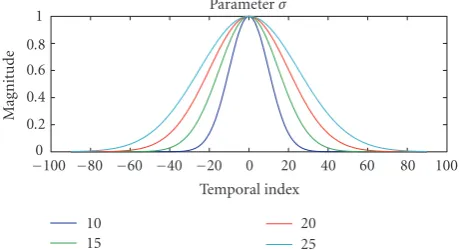
Figure 9shows how the weight of the close frames varies
ac-cording to the parameterσ. As the frames to be chosen were
displayed according to a regular sampling, the weight of the close frame depends directly on this parameter and is located
at index 10. For example, ifσ = 20 then the weight of the
close frame is worth 0.88.
After accumulation of the answers, we obtain the
tem-poral distribution of selected frames.Figure 10shows the
re-sults for the “documentary” sequence. We can note for exam-ple that the first shot is very long and has many local maxima
−100 −80 −60 −40 −20 0 20 40 60 80 100 Temporal index
Parameterσ
0 0.2 0.4 0.6 0.8 1
M
ag
nitude
10 15
20 25
Figure9: Parameterσaccording to the frame chosen by the subject.
The Gaussian is positioned on the selected frame. For example, if the parameterσ =10, then the close frame (on the left or on the right) has a weight of 0.6 and the following frame has a weight of 0.13, since the frames are displayed according to a regular sampling (all ten).
whereas the second shot has one maximum. The maxima symbolize the locations where the frames must be selected to summarize the video, since these locations are chosen by the subjects. We obtain the maxima by calculating the first derivative and by finding the changes of sign. They are sorted by decreasing order. The close local maxima are combined to avoid the presence of local maxima on a window lower than 2 seconds (or 50 frames). Moreover, all local maxima whose magnitude is lower than 20% of the global maximum are re-moved.
Finally, for each shot, we retained only thenfirst local
maxima sorted by descending order according to the op-timal number of frames required. They correspond to the keyframes selected to summarize the shot and thus the video.
The chosen parameterσis explained with the description of
our results.
3.3. Comparison between the automatic summary and the reference summary
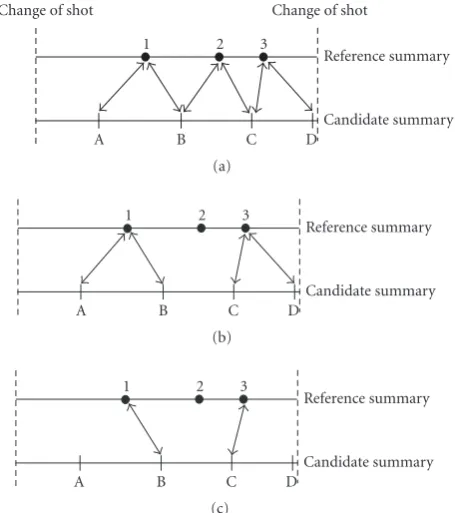
The comparison between the reference summary and the au-tomatic summary obtained by an algorithm, called candidate summary, is a delicate task since it requires the comparison of frames. The process of comparison between the reference summary and the candidate summary for the shots is carried
out in 4 stages.Figure 11illustrates the comparison of the
summaries for each shot. We can note in this example that the reference summary has 3 keyframes whereas the candi-date summary has 4.
The first stage consists in determining the frames of the reference summary with which each frame of the candidate summary could be associated. Each candidate frame is thus associated if possible with two frames of the reference sum-mary, which are temporally the closest frames in the same shot. For example, frame B of the candidate summary is as-sociated with frames 1 and 2 of the reference summary (see
500 1000 1500 2000 2500 3000 Temporal index
−1 0 1 2 3
A
ccumulat
ion
of
the
answ
er
es
Figure10: Distribution of keyframe selection on the
“documen-tary” video standardized by the number of subjects (horizontal axis corresponds to the frame number). The maxima on this curve gives the selection of keyframes. The crosses on the curve are the frames chosen to summarize the video. The curve at the bottom corre-sponds to the staircase function between−0.5 and−1 that locates the changes of shot. In this example, the parameterσis fixed at 20.
1 2 3
A B C D
Change of shot Change of shot
Reference summary
Candidate summary
(a)
1 2 3
A B C D
Reference summary
Candidate summary
(b)
1 2 3
A B C D
Reference summary
Candidate summary
(c)
Figure11: Illustration of the comparison for each shot between the
reference summary and the candidate summary. The reference sum-mary has 3 frames (from 1 to 3) whereas the candidate sumsum-mary presents 4 frames (of A with D). (a), (b), and (c) represent the first three stages of the comparison.
The second stage consists in determining the most sim-ilar frame to the frame of the candidate summary among the two potential frames of the reference summary. For ex-ample, frame B which can be associated with either frame
1 or 2 is finally associated with frame 1 (seeFigure 11(b))
because it is assumed to be closer in terms of content. This requires the representation of frames by a descriptor and the definition of a distance between two frames. Nevertheless, it
is difficult to compare the content of two frames. However,
as the frames belong to the same shot, there is a temporal
continuity between the frames and the comparison between the frames can be carried out by comparing their color his-tograms. Indeed, two similar histograms will have the same content since the frames are temporally continuous. Inside the same shot, the probability that two similar histograms
correspond to different frame contents is very low. The
de-scriptor used here is a global color histogram obtained in color space YCbCr and the distance between histograms is obtained by the L1 norm. We chose not to present a color histogram, as it is not essential to understand the method.
However, a detailed description can be found in [19].
The third stage deals with the case where several frames of the candidate summary are associated with the same frame of the reference summary. For example, frames A and B are
as-sociated with the same frame 1 (seeFigure 11(b)), and finally,
only frame B is associated with frame 1 (see Figure 11(c))
since the distance between frames 1 and B is assumed to be weaker.
Lastly, the fourth stage consists in preserving only the
clustering where the distances are lower than a thresholdδs.
The frames which were gathered can have great distances. Thresholding makes it possible to preserve only the frames
gathered with similar content. The parameter δs is
funda-mental and will be largely studied in the presentation of the results.
The comparison between the reference summary and the candidate summary leads to the number of frames gathered.
The standard measures Precision (P), Recall (R), andF1(F1
is a harmonic mean between Recall and Precision) can then be used to evaluate the candidate summary.
3.4. Evaluation of automatic summary
As the summary method from camera motion provides a shot-level summary, we only study the evaluation method on the shot level. Five methods of creating summaries are tested: four are elementary summarization methods and one is our summarization method. For the first method, a number of keyframes is chosen randomly (between 1 and 3) for each shot, then the keyframes are chosen randomly (random sum-mary). For the second method, keyframes are chosen ran-domly in each shot, but the number of keyframes is defined by the reference summary (semirandom summary). For the third method, only one keyframe is selected in the mid-dle of each shot (center summary). For the fourth method, keyframes are selected with a regular sampling rate as a func-tion of the shot length (one keyframe per 200 frames) (regu-lar sampling summary). Finally, the last one is the one that we proposed using camera motion (camera motion-based sum-mary).
It is important to note that the third method is classically used in the literature. The second one is, in practice, unfeasi-ble. In fact the reference summary is not known, so the num-ber of keyframes to be selected in each shot is unknown. This
method might offer good candidate summaries, because they
have the same number of keyframes as the reference one.
Table1: Results of the four summarization methods for the three videos. The thresholdδsof clustering between two frames is fixed at 0.3 and the parameterσis 20 (R: Recall,P: Precision,F1).n◦1: random summary,n◦2: semirandom summary,n◦3: summary by selecting the frame in the center of each shot,n◦4 summary based on a regular sampling, andn◦5 summary based on camera motion.
Summary Documentary TV news Series
R P F1 R P F1 R P F1
n◦1 62 (15/24) 40 (15/37) 49.1 83 (46/55) 50 (46/91) 63.0 80 (24/30) 40 (24/59) 53.9
n◦2 54 (13/24) 54 (13/24) 54.1 72 (40/55) 72 (40/55) 72.7 76 (23/30) 76 (23/30) 76.6
n◦3 50 (12/24) 60 (12/20) 54.5 63 (35/55) 83 (35/42) 72.1 73 (22/30) 78 (22/28) 75.8
n◦4 62 (15/24) 54 (15/28) 57.7 69 (38/55) 70 (38/54) 69.7 73 (22/30) 73 (22/30) 73.3 n◦5 79 (19/24) 55 (19/34) 65.5 80 (44/55) 77 (44/57) 78.5 86 (26/30) 72 (26/36) 78.7
propose according to the succession and the magnitude of
motions provides the best results (in term ofF1) for the three
videos. For the “series” video, methods n◦2,n◦3, and n◦4
present close results compared to the method according to the magnitude and the succession of motions. This confirms that the methods which select only one frame by shot (ei-ther a frame in the middle of the shot or at a random
loca-tion in the shot) are relatively effective when the shots are
of short duration. The “series” video contains 16 shots out of 28 of less than 3 seconds whereas the “documentary” and “TV news” video have, respectively, 8 shots out of 20 and 9 shots out of 42 of less than 3 seconds. It is indeed natural to select only one frame for these shots. However, the results for the three videos confirm the interest of using camera mo-tion to select frames. The longer the shots are, the more likely
the contents are to change and thus the more effective the
method is.
However, the comparison method of summaries requires various parameters to be fixed which can influence the re-sults. In the method of reference summary construction, the
parameter studied is the standard deviation of Gaussian σ
around the frame chosen by a subject. Indeed, if the
param-eterσ selected is low, then the close frames selected by the
subjects cannot be combined. In the same way, if the
param-eterσselected is large, then the frames will be gathered easily.
Thus, the number of local maxima inside a shot depends on
this parameterσ.Figure 12illustrates the results of the
sum-marization method with the keyframe selection in the cen-ter of the shot, and the method using succession and
mag-nitude of motions according to parameterσ. Moreover, the
results of the two methods presented remain relatively stable
according to parameterσ. We can also note that the number
of keyframes of the reference summary for the three videos
does not decrease greatly with the increase of parameterσ.
Thus, we can conclude that this parameterσ does not call
into question the performance of the methods. Thereafter,
this parameterσwill be fixed at 20.
Lastly, with regard to the comparison between the ref-erence summary and the candidate summary, although the description of the frames is carried out by color histogram, clustering between frames is preserved only if the distances
are lower than the thresholdδs. However, this threshold plays
an important role in the results. Indeed, if the threshold
se-lected is rather low, then the frames will be gathered with
difficulty, whereas if the threshold is too large, the
dissimi-lar frames can be matched together.Figure 13illustrates the
results of various methods according to thresholdδs. As
ex-pected, the more the threshold increases, the more the per-formances increase (up to a certain value). Nevertheless, whatever the threshold selected, the method according to the succession and the magnitude of motions presents the best results for the “documentary” and “TV news” videos. With regard to the “series” video, the most competitive method is that based on the magnitude and the succession of motions for thresholds 0.1, 0.2, 0.3, and 0.4. On the other hand, for thresholds 0.5 and 0.6, the summarization method with the frame in the center of the shot is more competitive. Gener-ally, the performances obtained for thresholds 0.5 and 0.6 are fairly similar for the same video. That means that parameter
δsis too high and that dissimilar frames can be gathered.
Pa-rameterδsshould be selected inferior to 0.5 because the slope
is nonnull.
4. CONCLUSION
In this paper, we have presented an original video summa-rization method from camera motion. It consists in select-ing keyframes accordselect-ing to rules defined on the succession and the magnitude of camera motions. The rules we used are “natural” and aim to avoid temporal redundancy between frames and at the same time to keep the whole content of the video. The camera motion brings “high-level” information; in fact the camera motion is desired by the film maker and contains some cues about the action or an important loca-tion in a scene. The keyframe selecloca-tion is directly based on
the camera motion (succession and magnitude) and offers
the advantage of not calculating differences between frames
as it was done in other research.
A new evaluation method was also proposed to
com-pare the different summaries created. A psychophysical
ex-periment was set up to make it possible for a subject to cre-ate manually a summary for a given video. Twelve subjects
summarized three different videos (duration from 1.5 to 5
10 15 20 25
σ
20 30 40 50 60 70 80
F1
or
numb
er
Center-based summary Camera motion-based summary Number of frames of reference summary
Documentary
(a)
10 15 20 25
σ
40 45 50 55 60 65 70 75 80 85
F1
or
numb
er
Center-based summary Camera motion-based summary Number of frames of reference summary
TV news
(b)
10 15 20 25
σ
20 30 40 50 60 70 80 90
F1
or
numb
er
Center-based summary Camera motion-based summary Number of frames of reference summary
Series
(c)
Figure12:F1as a function of the parameterσfor two
summariza-tion methods (summaries by selecting the center of each shot and based on camera motion) for three videos. The thresholdσsis fixed at 0.3. The third curve, at the bottom of each figure, corresponds to the number of keyframes for the reference summary as a function of the parameterσ.
0.1 0.2 0.3 0.4 0.5 0.6
δs
20 30 40 50 60 70 80 90
F1
Semi-random
Camera motion-based summary
Center Random Documentary
(a)
0.1 0.2 0.3 0.4 0.5 0.6
δs
30 40 50 60 70 80 90
F1
Semi-random
Camera motion-based summary
Center Random TV news
(b)
0.1 0.2 0.3 0.4 0.5 0.6
δs
30 40 50 60 70 80 90 100
F1
Semi-random
Camera motion-based summary
Center Random Series
(c)
Figure13:F1as a function of the parameterσsfor four
summariza-tion methods and for the three videos. The parameterσis fixed at 20.
Finally, we proposed an automatic comparison between this reference summary and the summary built by our method.
This method can also be used to compare different kind of
summaries, with different lengths.
hierarchical summary would be based on our camera motion-based summary (per shot) and would include some criteria to measure the relative importance of each shot. This new criteria would be for example the magnitude of motion in a segment or for static segment, the relative “interest” of the segment. The relative interest can be described by a bio-logical model of saliency. A “degree of importance” could be linked to each shot and the keyframes of the shot (selected by the camera motion) would be weighted with this index of “importance.” A hierarchical summary can be easily evalu-ated with our subjective evaluation method. In fact, with this method, we already have access to the “important” informa-tion for each shot.
ACKNOWLEDGMENTS
The authors would like to thank C. Marendaz and D. Alleyson (Laboratoire de Psychologie et NeuroCognition, Grenoble, France) for having welcomed and helped them with the experiments. They also would like to thank S. Marat for her help in testing some summarization methods.
REFERENCES
[1] S. Kopf, T. Haenselmann, D. Farin, and W. Effelsberg, “Au-tomatic generation of video summaries for historical films,” inProceedings of IEEE International Conference on Multimedia and Expo (ICME ’04), vol. 3, pp. 2067–2070, Taipei, Taiwan, June 2004.
[2] Y.-F. Ma and H.-J. Zhang, “Video snapshot: a bird view of video sequence,” inProceedings of the 11th International Mul-timedia Modelling Conference (MMM ’05), pp. 94–101, Mel-bourne, Australia, January 2005.
[3] X. Zhu, A. K. Elmagarmid, X. Xue, L. Wu, and A. C. Catlin, “InsightVideo: toward hierarchical video content organiza-tion for efficient browsing, summarizaorganiza-tion and retrieval,”IEEE Transactions on Multimedia, vol. 7, no. 4, pp. 648–666, 2005. [4] M. Cherfaoui and C. Bertin, “Two-stage strategy for indexing
and presenting video,” inStorage and Retrieval for Image and Video Databases II, vol. 2185 ofProceedings of SPIE, pp. 174– 184, San Jose, Calif, USA, February 1994.
[5] K. A. Peker and A. Divakaran, “An extended framework for adaptive playback-based video summarization,” in Internet Multimedia Management Systems IV, vol. 5242 ofProceedings of SPIE, pp. 26–33, Orlando, Fla, USA, September 2003. [6] A. Kaup, S. Treetasanatavorn, U. Rauschenbach, and J. Heuer,
“Video analysis for universal multimedia messaging,” in Pro-ceedings of the 5th IEEE Southwest Symposium on Image Analy-sis and Interpretation (SSIAI ’02), pp. 211–215, Sante Fe, NM, USA, April 2002.
[7] S. V. Porter, M. Mirmehdi, and B. T. Thomas, “A shortest path representation for video summarisation,” inProceedings of the 12th International Conference on Image Analysis and Processing (ICIAP ’03), pp. 460–465, Mantova, Italy, September 2003. [8] B. Fauvet, P. Bouthemy, P. Gros, and F. Spindler, “A
geometri-cal key-frame selection method exploiting dominant motion estimation in video,” inProceedings of the 3rd International Conference on Image and Video Retrieval (CIVR ’04), pp. 419– 427, Dublin, Ireland, July 2004.
[9] I. Yahiaoui, B. M´erialdo, and B. Huet, “Automatic video summarization,” inMultimedia Content-Based Indexing and
Retrieval (MMCBIR ’01), Rocquencourt, France, September 2001.
[10] G. Ciocca and R. Schettini, “Dynamic key-frame extraction for video summarization,” inInternet Imaging VI, vol. 5670 of Proceedings of SPIE, pp. 137–142, San Jose, Calif, USA, January 2005.
[11] S. Corchs, G. Ciocca, and R. Schettini, “Video summarization using a neurodynamical model of visual attention,” in Proceed-ings of the 6th IEEE Workshop on Multimedia Signal Processing (MMSP ’04), pp. 71–74, Siena, Italy, September-October 2004. [12] A. M. Ferman and A. M. Tekalp, “Two-stage hierarchical video summary extraction to match low-level user browsing prefer-ences,”IEEE Transactions on Multimedia, vol. 5, no. 2, pp. 244– 256, 2003.
[13] X. Shao, C. Xa, and M. S. Kankanhalli, “A new approch to au-tomatic music video summarization,” inProceedings of IEEE International Conference on Image Processing (ICIP ’04), vol. 1, pp. 625–628, Singapore, October 2004.
[14] Y.-F. Ma, L. Lu, H.-J. Zhang, and M. Li, “A user attention model for video summarization,” inProceedings of the 10th ACM International Conference on Multimedia, pp. 533–542, Juan-les-Pins, France, December 2002.
[15] S. Lu, M. R. Lyu, and I. King, “Video summarization by spatial-temporal graph optimization,” in Proceedings of In-ternational Symposium on Circuits and Systems (ISCAS ’04), vol. 2, pp. 197–200, Vancouver, Canada, May 2004.
[16] C.-W. Ngo, Y.-F. Ma, and H.-J. Zhang, “Automatic video summarization by graph modeling,” inProceedings of the 9th IEEE International Conference on Computer Vision (ICCV ’03), vol. 1, pp. 104–109, Nice, France, October 2003.
[17] M. Guironnet, D. Pellerin, and M. Rombaut, “Camera mo-tion classificamo-tion based on transferable belief model,” in Pro-ceedings of the 14th European Signal Processing Conference (EU-SIPCO ’06), Florence, Italy, September 2006.
[18] M. Huang, A. B. Mahajan, and D. DeMenthon, “Automatic performance evaluation for video summarization,” Tech. Rep. LAMP-TR-114, CAR-TR-998,CS-TR-4605,UMIACS-TR-2004-47, University of Maryland, College Park, Md, USA, June 2004.