R E S E A R C H
Open Access
Design of mobile augmented reality game
based on image recognition
Boping Zhang
Abstract
The work studied a complete set of development system for mobile augmented reality game based on combination of AR technology and RTS game. An effective image recognition strategy was proposed through SIFT feature matching algorithm. Integrated with cloud image recognition module, the response speed of image recognition module was improved by eliminating error matching point. Through optimization of the scheme and existing technologies, the improved image recognition algorithm was applied to the game system, realizing RTS game system on mobile intelligent terminal. The experimental results showed that the proposed method meets the requirement of augmented reality system in terms of efficiency and accuracy. In addition, the demand of users for information expansion can be satisfied by the method to some extent, which is more applicable than traditional augmented reality.
Keywords:Mobile augmented reality, Image recognition, SIFT feature recognition, RTS game
1 Introduction
Augmented reality (AR) is a three-dimensional scene where virtual objects are superimposed on real scene. In such a scene, virtual objects can be quickly generated, manipulated, and rotated to enhance users’understanding of the real environment [1, 2]. As an extension of simulated real technology, AR integrates emerging technologies of computer graphics, computer vision, image processing, sensor technology, human-computer interaction, and photoelectric display. The capabilities of intellectualization and information processing for mobile terminals are grad-ually enhanced with the development of wireless mobile network technology and increasing bandwidth. The users frequently access the Internet through mobile intelligent terminal. Multi-sensor equipment on mobile phone has provided hardware foundation for application of AR. In terms of software support, companies such as Microsoft and Qualcomm continually introduce various kinds of SDK with intellectual properties through innovative research and development. Such hardware and soft-ware development lays a guarantee for hierarchical and personalized service of mobile information https://tieba. baidu.com/p/4143666840.
Mobile augmented reality is becoming a hotspot in the field of game development. In 1997, Feiner et al. [3]
developed MARS, the world’s first mobile augmented
reality system, which is mainly used in navigation tech-nology. In 2000, Tomas et al. [4] released AR-Quake game, an extension of the Quake game on the PC. It is very popular at that time, allowing games to be played indoors and outdoors. Cheok et al. [5] released Human-Pacman in 2003, which is a mobile interactive entertain-ment system equipped with GPS and inertial sensors for positioning and visual sensing, as well as a touch-controlled human-computer interface. Schrier of the Massachusetts Institute of Technology designed a mobile augmented reality educational game called“relive
the war of independence” [6]. Wherein, the playing
scene is settled in Lexington, the starting place of American revolutionary war. Navigated by PAD with GPS, the participants explore Lexington battle-related public green area and other buildings. Besides, PDA overlays to display the virtual history characters and arti-facts, as well as visual audio materials when they arrive at the target location.
Ingress is a mobile augmented reality game released by Google in 2012 [7]. In this game, a group of European
Correspondence:[email protected]
School of Information Engineer, Xuchang University, Xuchang, Henan 461000, China
scientists finds some mysterious energy with unknown sources and usage, and some researchers think that the energy should be controlled or it will enslave the human beings after being affected mentally. The camp is
di-vided into two groups named “Enlightened” and
“Resistance”—the former trying to accept the energy as a gift to humanity; the latter striving to resist and pro-tect the rest of our resources and wealth. The game players, called“Agent”in the game, fight each other to control the strongholds such as landmarks or sculp-tures in the real world.
Pokemon Go, an augmented reality (AR) RPG mobile game in pet nurturance https://www.nintendo.com/, jointly developed by Nintendo, Pokemon Company, and
Niantic Labs Company of Google, is welcomed globally. It has won five certificates by Guinness World Record in August 2016. However, Pokemon Go has not been re-leased in mainland China. It indicates that AR game has not grown into a mature industry at present, where both opportunities and challenges exist.
In the work, AR technology and RTS game (Real-Time Strategy Game) were combined to study a complete development system of mobile augmented reality game. A mobile AR game named LastStandStan was developed to improve the speed of instant image rec-ognition for clients. Proposing an improved SIFT fea-ture matching algorithm integrated with cloud image recognition module, the response speed of image Fig. 1The system framework of AR game
recognition module was improved by eliminating error matching point. Through optimization of the scheme and existing technologies, we applied the improved image rec-ognition algorithm to the game system, realizing RTS game system on mobile intelligent terminal. The experi-mental results prove that the proposed method meets the requirement of augmented reality system in terms of effi-ciency and accuracy. In addition, the demand of users for information expansion can be satisfied by the method to some extent, which is more applicable than traditional augmented reality.
The work included the following three aspects:
1. To implement RTS game system on mobile intelligent terminal, the system architecture based
on C/S was designed, divided into the cloud subsystem and the mobile terminal subsystem. 2. In order to improve the matching speed of image,
the optimal value of SIFT algorithm was found by searching on the traditional SIFT (scale-invariant feature transform) algorithm through lots of experiments, allowing user to set the optimal parameters manually. Under the environment of Easy AR, the improved SIFT algorithm is exported as a package running on the cloud server in case of designing games, with its main function of image recognition by SIFT algorithm to improve the matching speed of the random images.
3. In the work, a game namedLastStandStanhas been developed as an application of the improved SIFT algorithm, which can run on Android phones currently.
Fig. 3Gaussian pyramid
Fig. 4Comparison of gauss-laplacian and DoG
Fig. 5Gaussian pyramid of each group
2 Overall structure of game system
At present, the commonly used image recognition methods in the augmented reality games are mainly based on special objects and image natural feature points [8]. Method based on special objects has great limitation in applications for it requires additional spe-cial markers on target image, affecting user experience to some extent. Moreover, it is difficult to identify the target image in the presence of partial shade on special markers. The method based on image natural feature points does not need additional markers; thus, it is more often to be used in the field of augmented reality with its concise and flexible way of usage. There are mainly two ways, the method based on partial image characteristics/machine learning [9]. Traditional SIFT algorithm based on partial image characteristics has high matching precision and a better robustness for image reverse, illumination, and perspective change. Meanwhile, it produces large amount of calculation data stored in the mobile terminal, causing a larger bur-den due to the limitation of hardware equipment, such as mobile processor and memory. It fails to meet the requirement of real-time application in augmented reality system [10].
In the work, a C/S architecture-adopted RTS system is built based on cloud image recognition. The STIF classi-fier data can be stored in the server by C/S architecture technology, thus effectively reducing the memory load in mobile terminal and improving the response speed in Fig. 7The histogram of the main direction
Table 1Artificial intelligence
Name Category Props description
Robot Robot Providing hints of the next level of action when switching scenes
Steed knight Robot Searching for extraterrestrial life (starting wars), with service life limit
Defenses device Device Attacking surrounding enemies at regular interval
Energy collector Device Acquiring a certain amount of energy every fixed time
Alien life Monster Continually moving toward the base; blowing themselves when touching defense equipment. The attack of each enemy on the base will reduce a certain degree of durability.
Table 2Game numerical table
Name Basic values Dynamic change
Energy 150 Energy collectors collect 100 points per minute
Steed knight 1 With 6 times of service life, it requires 1000 points of energy and 90 points of metal for regeneration after the service life is used up.
Artificial intelligence 10% Increase per 1% consumes 100 points of energy and 20 points of metal.
Mineral 0 Each victory obtains 1–3 points. Metal 50 Each victory obtains 30–50 points. Durability 80% Increase per 1% will consume 100 points of energy and 20 points of metal.
Life research 0% Being less than or equal to 99% is equivalent to artificial intelligence, while above 99% will trigger the final story.
Defense device A 1 Maximum blood volume is 40, launching a detection of a range of 13 every 2 s
Defense device B 1 Maximum blood volume is 50, launching a detection of a range of 14 every 1.8 s
Defense device C 1 Maximum blood volume is 80, launching a detection of a range of 14 every 1.6 s
Defense device D 1 Maximum blood volume is 80, launching a detection of a range of 16 every 1.6 s
Large monster 0 It is automatically and randomly generated by the system every 3 s. Its self-explosion causes 15 damage points to the base.
system. Figure 1 shows the framework of augmented reality game system [11].
The RTS game system on the user’s intelligent ter-minal establishes socket communication with the cloud server through wireless network such as 3G, 4G, and WIFI, realizing the data exchange between appli-cation and cloud server. After RTS game system up-loads the currently identified image to the cloud, the recognition system retrieves and identifies the image from database. If the current image exists in the data-base, the RTS game system will download the en-hanced information associated with the image to local storage via the cache mechanism. Finally, the interface
of the smart phone is designed to show the related en-hancement information of the recognition scene, and the rendering engine of Unity3D is used to draw the 3D model in real time, which is divided into subsys-tems of cloud management and intelligent terminal management. In terms of cloud management subsys-tem, the first step is to acquire image through the in-put device. After pretreatment, the scene is checked whether a target that needs display augmentation ex-ists. If the target exists, 3D registration is conducted. If not, the automatic tracking program is started. After tracking, 3D registration is performed and then stored in information database. Meanwhile, an augmentation Fig. 8Main design model of the game
information database is established to store 3D model as well as text, video, and audio information. The in-formation index is built to improve retrieval speed. As the basis of image recognition, such information can provide sample training and quick identification. The intelligent terminal management subsystem obtains augmented 3D model information of the cloud through image recognition. Virtual information is dis-played on corresponding coordinate positions through image fusion.
3 Methods of SIFT image recognition
3.1 Basic principles of SIFT image recognition algorithm
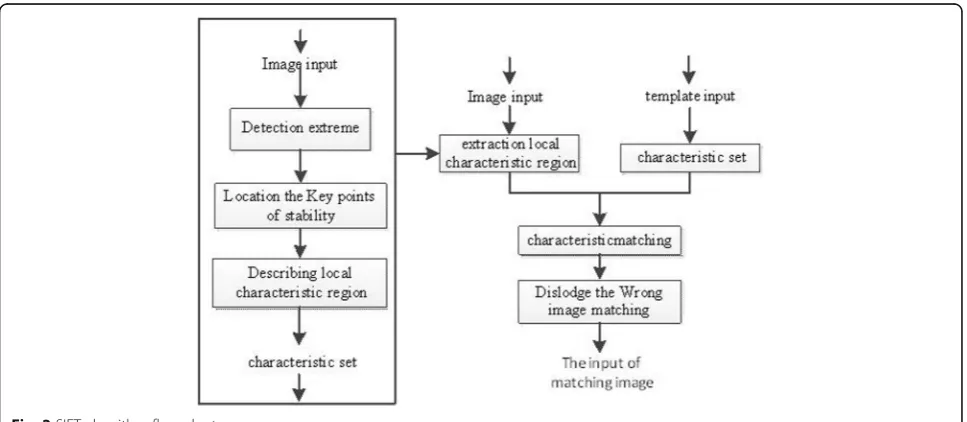
SIFT algorithm has characteristics of similarity and unchanged rotation. When structuring features, mul-tiple details need to be focused and processed to en-sure faster operation and more intensive positioning [12]. Figure 2 shows the flow block diagram of SIFT algorithm.
Generation processes of local descriptive features in-clude [13]:
1. Detecting extreme points: Gaussian differential function is used to search the image and identify potential fixed points at all scales.
2. Positioning key points: The scale of candidate position is determined through the model. The degree of stability determines the choice of key points.
3. Determining orientation of key points: Using gradient-orientation histogram, each key point is assigned with an orientation at the highest gradient, thus determining main orientations of key points.
4. Describing key points: Calculating local gradients of the image, a symbol is used to represent each gradient.
3.2 Key point detection
1. Scale-space theory
Scale space, proposed in the middle of the twentieth century, is defined after development as follows: Introducing a scale parameter into processing model, the continuously changing scale parameters are used to obtain and propose expression sequence of scale space. Then, principal contour of scale space is for-mulated as feature vector, extracting features such as edge [14].
Scale-space method means that the scale image be-comes increasingly blurred when the scale bebe-comes larger, thus simulating formation process of the target in the human eye retina.
2. Expression of scale space
Scale space of the image is expressed as Formula (1).
L xð ;y;σÞ ¼G xð ;y;σÞ I xð ;yÞ ð1Þ
where G (x, y, σ) is Gaussian function, I (x, y) the ori-ginal image I (x, y), and * the convolution operation.
Gx;y;σ¼ 1
2πσ2e
−ððx−d=2Þ2þðy−b=2Þ2Þ=2σ2
ð2Þ
Fig. 10The tendency chart of Sigman matching time and quantity Table 3The matching time and quantity of Sigman
Parameter Sigman The initial value
Values 0.01 0.16 0.32 0.5 1 2 4
Matching quantity 45 45 45 46 45 45 45
wheredandb are the dimensions of Gaussian template; (x,y) is the pixel position;σis the scale space factor.
3. Constructing Gaussian pyramid
Operations of this process include Gaussian blur and down sampling (See Fig. 3).
The pyramid is characterized by different sizes and tower-like model with increasingly smaller sizes from bottom to the top.
The tower is realized as follows: Original image is used in the first layer, while new image obtained from
down sampling in the next layer. There are n layers
in each tower. The number of layers is calculated as follows.
n¼ log2f minðp;qÞg−d d½0; log2fminðp;qÞg
ð3Þ
where p and q are the sizes of original image; d is the logarithmic value of minimum dimension of the image on top of the tower.
4. Gaussian difference pyramid
According to previous studies, after the scales of maximum and minimum values of Gaussian Laplacian
function σ2∇2G are normalized, their results and
other feature extraction functions such as gradient can generate the most stable image feature. Then,
Gaussian difference function is developed, which is approximated by the scale-normalized Gaussian Laplacian functionσ2∇2G. The relationship is described as follows.
∂G
∂σ ¼σ2∇2G ð4Þ
Difference approximately replaces differential:
σ2∇2
G¼∂G∂σ ≈ G xð ;y;kσkσÞ−−G xσð ;y;σÞ ð5Þ
then
G xð ;y;kσÞ−G xð ;y;σÞ≈ðk−1Þσ2∇2G ð6Þ
wherek-1 is a constant.
As shown in Fig. 4, the red is DoG operator curve, while the blue is Gauss-Laplacian curve. Extreme value is detected by replacing Laplacian with DoG operator [15].
D xð ;y;σÞ ¼ðG xð ;y;kσÞ−G xð ;y;σÞÞ I xð ;yÞ
¼L xð ;y;kσÞ−Lðx;y;σ ð7Þ
In the calculation, Gaussian difference image is ob-tained by subtracting the upper and lower layers of Gaussian pyramid of each group (see Fig. 5).
5. Space extreme point detection Table 4The matching time and quantity of thresh
Parameter thresh Initial value
Values 0.01 0.02 0.03 0.04 0.1 0.3 0.5
Matching quantity 47 47 47 46 28 5 0
Matching time 0.02 0.014 0.012 0.011 0.005 0 0.001
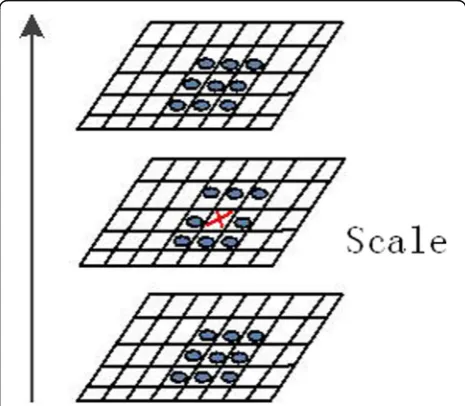
Local extreme points constitute key points in the space of Gaussian difference. In search for key points, the images between two adjacent layers in the same group are compared. Then, each pixel point is com-pared with all the neighboring points around it to judge its size. Figure 6 shows that the red intermedi-ate detection point is compared with corresponding 26 points in surrounding as well as up and down scale space, thus ensuring that the extreme points can be detected.
In the right image of Fig. 5, N+ 2 layers of DoG
pyramid and N+ 3 layers of Gaussian pyramid are
re-quired if there are N extreme points in each group.
Due to influence of factors such as edge response, ex-treme points generated in such a case are not all stable.
Key points include location, scale, and orientation. To maintain invariance of view angle and illumin-ation, the key points need to be described by a set of vectors. The descriptors need to include key points and pixels that contribute to the key points. Mean-while, independent characteristics of the descriptors should be ensured to improve the probability of cor-rect matching of feature points.
Key point matching is divided as follows.
1. Gradient calculation
The modulus and orientation are determined by Formula (8).
m xð ;yÞ ¼
ffiffiffiffiffiffiffiffiffiffiffiffiffiffiffiffiffiffiffiffiffiffiffiffiffiffiffiffiffiffiffiffiffiffiffiffiffiffiffiffiffiffiffiffiffiffiffiffiffiffiffiffiffiffiffiffiffiffiffiffiffiffiffiffiffiffiffiffiffiffiffiffiffiffiffiffiffiffiffiffi
N xð þ1;yÞ−N xð −1;yÞ
ð Þ2
þðN xð ;yþ1Þ−N xð ;y−1ÞÞ2
θð Þ¼x;y αtan2 N xð;yþ1Þ−N xð;y−1Þ N xðþ1;yÞ−N xð−1;yÞ
v u u u u u t
ð8Þ
whereNrepresents scale space value of key points.
2. Gradient histogram statistics
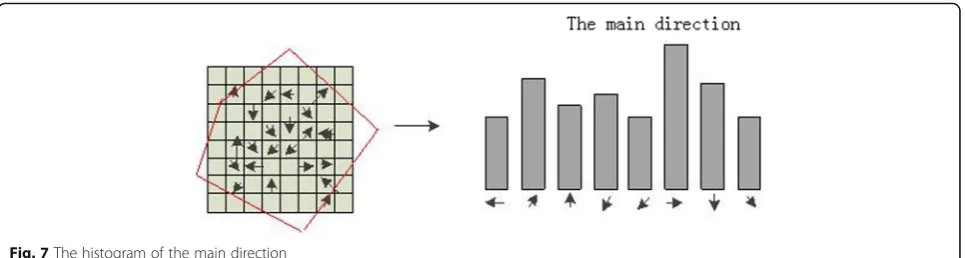
The gradient and orientation of pixels in neighbor-hood are counted, shown in the form of a histogram. Figure 7 shows that the orientation ranges from 0 to 360°, with a bin per 10° and 36 bins in all. The peak in the field of feature points represents gradient orienta-tion. The histogram of maximum values is the main orientation of key points [16]. Meanwhile, the histogram, with the peak 80% greater than main orientation, is se-lected as auxiliary orientation, thus improving match robustness.
The entire algorithm has not ended after key points are matched successfully, as large number of mismatch points occur in matching process. Gener-ally, Ransac method is used to eliminate mismatch points in SIFT matching algorithm [17]. The core of the algorithm is continual iteration through repeated testing.
3.3 SIFT image recognition
SIFT feature looks for stable pole through scale space to generate local feature descriptors, where the stable ones have high representative and distinguishing fea-tures. However, they are generated in small number in one picture. Therefore, RTS game system in the work adopts classical SIFT matching algorithm as the original SIFT matching method, manually determining the accuracy and mismatch rate of each match, that is, describing the matching performance by accuracy
Table 5The matching time and quantity ofr Parameter r Initial value
Values 0.01 0.5 5 10 20 50 100
Matching quantity 59 7 28 46 56 62 62
Matching time 0.017 0.01 0.05 0.011 0.016 0.018 0.018
and misrecognition rate. The accuracy is defined by the ratio of number of valid matches retained to total objective. The misrecognition rate is determined by the ratio of the result (the total number of key points minus the match points) to the total number of key points. The identification process includes image pre-processing, module on feature extraction, module on image description, training module, and identification module. A package to identify atlas is exported with the algorithm in Easy AR.
1. Pre-processing module
The pre-processing module outputs the area con-taining object in the image by operations, such as fil-tering the object containing image, searching for the contour, and establishing the minimum surrounding rectangle.
①Gray degree transforms the image by the formula ofL= 0.299∗+ 0.587∗G+ 0.114∗B.
②The median filter and Gaussian filter are used to filter the original image separately.
③The image is reversed with grayscale and processes with binarization.
④Searching contour is conducted to the binary image.
⑤Establish a minimum surround rectangle for the obtained contour, and output the image inside the smallest rectangle.
2. Module on feature extraction
Module on feature extraction is divided into two steps. First, the key points are detected by reading the image in the grayscale pattern, then testing the key points with the output of key points assemblage. Second, features are described. The key code is as follows:
Sift feature detector extractor; Mat descriptor;
extractor.compute(img, keypoints, descriptor);
Code in the first line declares a SIFT feature de-scriptor generator. The second line declares a Mat type of data used to store description. The third line directly uses the calculation method of descriptor generator to calculate the descriptor.
3. Module on image description
This module is to describe the image by spatial pyra-mid model. The specific process is as follows:
Step 1: Extract the SIFT key points of the image by using the initial layer scale of 1, with the initial layer grid width of 6.
Step 2: Extract the key points of SIFT feature of the original image.
Step 3: Combine the key points assemblage generated in Steps 1 and 2 to form a new set of key points.
Step 4: Describe the SIFT feature of the key points assemblage generated in Step 3, and output the image description vector.
4. Key point matching Table 6The matching time and quantity of NBP
Parameter NBP Invalid Invalid Initial value
Values 2 X X 4 8 16 32
Matching quantity 47 X X 46 28 6 0
Matching time 0.004 X X 0.011 0.019 0.02 0.002
For DoG function in scale space, curve fitting is conducted and the ratio of main curvature to feature value is calculated, eliminating edge feature points and feature points with low contrast. After calculating the gradient of extreme point, the adjacent region is divided based on gradient direction of feature points specified by gradient histogram. Then, the feature point descriptor is generated through integration, ex-cluding feature points smaller than threshold value and counting the number of matching points. Setting a threshold, if the number of matching point is bigger than the threshold value, end the program and output match result; if the threshold value is bigger, the ap-proximate component of the first layer image is used again to repeat Steps 2–6, then end the program after getting matching result.
4 System application
In order to verify the effectiveness of the improved SIFT algorithm, we developed a mobile AR game based on LastStandStan [18]. Integrating SIFT image recognition algorithm, AR technology and RTS game, the game focuses on using the proposed SIFT recog-nition technology to recognize pictures randomly taken by users.
The game is about a science fiction story that takes place in the future. As humans waste too much earth resources, the earth finally becomes deserted after 50,000 years due to depletion of resources. Human beings have to leave their homes and take spacecraft
drifting in space, while the space environment is not suitable for breeding the earthling. Therefore, the earth lives are completely caught in sleepy and energy-depleting spacecraft, leaving only the robots still running the instructions given by their devel-opers. Due to the coming depletion of energy, the machine system of spacecraft starts the final program to create an unprecedented super robot. When the robot is about to wake up, its radio waves will be connected to the brain waves of players from the dis-tant past. Players need to help the robot complete various tasks of production and combat readiness. The robot is a virtual image for player’s control of the spacecraft. Players are required to promote devel-opment of the game through ways of collection,
cre-ation, and war, ultimately completing the final
purpose of life research.
4.1 Game design features
The game LastStandStan completes 3D modeling in the 3ds max 2014 environment as well as virtual interaction in Unity3D 5.0 engine. For achievement of AR function, a plug-in based on Easy AR has been developed to implement image recognition through the improved SIFT algorithm. The game output is based on screen of intelligent mobile terminal [19]. These are the following characteristics in the game design:
1. The game integrates task sequence and construction features of RTS game, blending characteristics of tower-defense game in battle scene. All operations are converted to the changes of various values.
2. A robot is selected by the player as the protagonist to provide operating instructions when the player switches game levels. Players click UI or corresponding objects Table 7The matching time and quantity of NBO
Parameter NBO Initial value
Values 1 2 4 8 16 40 80
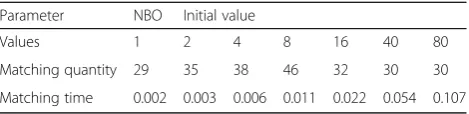
Matching quantity 29 35 38 46 32 30 30
Matching time 0.002 0.003 0.006 0.011 0.022 0.054 0.107
through touch. Different values feedback will be returned to players if they click on different objectives. The first time players enter the game, they will receive a hint about whether they choose a robot or not [20–24]. When loading levels, the robot will prompt the player to operate the next step and complete daily collection of energy. Through the energy, all kinds of equipment are produced for wars, life research, and repair of spaceship.
3. Interaction is implemented on AR virtual objects. The interaction is achieved when the touching point coincides with the fixed point on virtual object. For example, in the spacecraft scene, when the player clicks the cabin in the middle of model, next-step command is actually triggered—cabin color changes the command. Then, the player can switch the level after clicking the confirmation button again.
4. Two outcomes are designed in the game. One is when the intelligence reaches 99%; the player needs to sacrifice the robot to complete life research, thus awakening the sleeping life of the earth. The other is to retain the robot when the intelligence reaches 99%. New mechanical civilization emerges after a few years. 5. Different operations are required in various
cabins to promote game process. In collection cabin, energy collectors should be built to speed up energy collection. Repair cabin
can enhance durability of the spacecraft
(the game failure failed at durability less than 0). The content of library cabin remains to be expanded, which allows players to view game background information. Combat cabin can be used to construct defensive equipment and create steed knight for warfare. Steed knight has six service lives, which need to be
re-manufactured after the lives have been used up. The player can enter battle scene by clicking steed knight.
6. Combat scene is designed as a hexagonal terrain, generating enemies at random locations. With large and small sizes, the enemies will blow themselves when touching the defense
equipment or base. Large monster has relatively higher moving speed and damage to the base. The defensive device detects surrounding enemies at regular intervals to destroy them. The durability at 0 results in game failure. The player will be rewarded with mineral, energy, and metal after all enemies have been destroyed to win battle victory.
7. Biological engineering cabin is the main task of the game, where players need to enhance the artificial intelligence through energy as well as minerals and metal obtained from wars. When artificial intelligence reaches 99%, final story of the game will be triggered to retain mechanical civilization or complete life.
4.2 Artificial intelligence
In order to enhance pleasure of the game, behavior logic is added in game design. Such logic is con-trolled by the system rather than the player, with feedback of numerical values [25]. When a single player fights against AI, AI is in random combina-tions and fight after AR recognition to players’ image.
Table 8The matching time and quantity of magnif
Parameter Magnif Initial value
Values 0.01 0.5 2 3 4 12 18
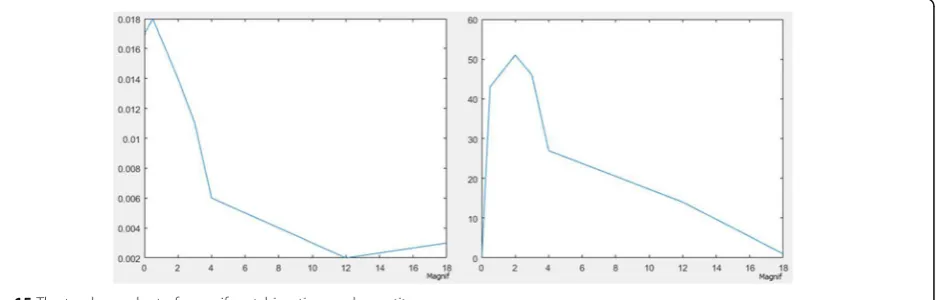
Matching quantity 0 43 51 46 27 14 1
Matching time 0.017 0.018 0.014 0.011 0.006 0.002 0.003
The characteristics of AI is that if AI takes advantage in the battle, it automatically chases players and launches attack after reaching a certain distance; if AI is in the weak side, it escapes in random directions. If they are the same branch of armed forces, two states are randomly generated—one is to actively pur-sue the player and attack in a certain distance, and the other is to escape in random directions. Table 1 shows specific artificial intelligence.
4.3 Numerical balance
Internal mechanism is the interaction among various values, while the values determine the time length of the game. In LastStandStan, the system needs to con-trol basic values of energy, the damage to the base caused by monsters, as well as detection range and frequency of defense device. Basic values of the game will be balanced with revenue and spending values. Table 2 shows the detailed game balance values.
4.4 Main model design
Figure 8 shows main design model of the game.
5 Experimental test
5.1 Experiment of SIFT image matching algorithm
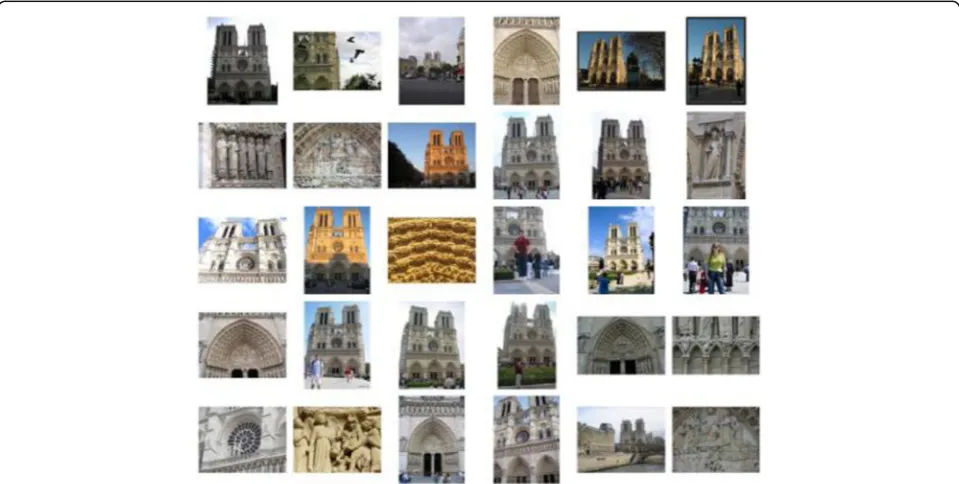
In order to evaluate the proposed algorithm, the ex-periment selected image sets containing view trans-formation in the data set. Figure 9 shows the selected images, with the change of viewing angles of each
group becoming larger. The proposed SIFT matching algorithm is used as the initial SIFT matching me-thod. Matching accuracy and mismatch rate are manually determined for each match, namely describ-ing matchdescrib-ing performance with accuracy and error. The accuracy is defined by the ratio of the number of retained correct matches to the total number. Sub-tracting the number of matching points from the total number of key points, the error is calculated by the ratio of subtracting results to total number of key points. Figure 9 shows the matching result of SIFT al-gorithm with an image.
In order to study the influence of the values of rele-vant parameters in SIFT algorithm on matching re-sults, four main steps were included as follows:
Step 1. Experiment sample was selected. Considering workload of experimental study, only two representative samples were selected from the four samples in this part, namely
illumination and head rotation samples, respectively. The influence of relevant parameters changes on light changing and angle changing images was explored. Step 2. Relevant parameters were selected
from SIFT algorithm. Six main parameters were selected from SIFT algorithm, including Sigman, r, thresh, NBP, NBO, and magnif.
Step 3. The range of parameters was studied. Regarding initial values of the six parameters in SIFT algorithm as midpoints, three valid values were taken to the left and the right, respectively (Due to the scope limit of parameters, it is not really for all that the left/right had three valid values.) Step 4. Performance indicator parameters were determined according to the matching results generated from the change of parameter values, with parameter analysis.
Table 9The matching quantity and time of Sigman
Parameter Sigman Initial value
Values 0.01 0.16 0.32 0.5 1 2 4
Matching quantity 11 11 11 11 11 11 11
Matching time 0.002 0.002 0.005 0.002 0.002 0.002 0.002
Main work was included in Steps 3 and 4, with de-tailed process as follows:
Initial values of the six parameters in SIFT algo-rithm were as follows: Sigman = 0.5; r= 10; thresh = 0.04; NBP = 4; NBO = 8; and magnif = 3. Then, control variables were adopted: Only one parameter was changed per time for each of the two samples, while other parameters remained unchanged. In order to ensure visual display of experimental results, time data of 1000 magnifications was used in the experiment.
5.1.1 Experiment on parameter adjustment for illumination change image
1. Parameter Sigman
According to Table 3 and Fig. 10, experiment re-sults are within the whole taking value interval after changing the parameter of Sigman. In terms of matching time index, the matching time of SIFT algo-rithm keeps unchanged. For matching quantity index, the matching number of initial values is 46, while that of other Sigman values remains unchanged.
Considering factors of experimental error, the change of Sigman values is almost irrelevant to matching time and quantity indexes of SIFT algo-rithm. Thus, Sigman is not considered as the key parameter of SIFT algorithm in improving matching rate of SIFT algorithm.
2. Parameter thresh
Based on Table 4 and Fig. 11, experiment results are within the whole taking value interval after changing the parameter of thresh. Both indexes of matching time and quantity of SIFT algorithm show a declining trend in the whole range.
Considering factors of experimental error, the
change of thresh values is negatively correlated with indexes of matching time and quantity of SIFT algo-rithm. In other words, the matching time and quan-tity of SIFT algorithm gradually reduce with the increase of thresh values taken from left to right. Therefore, thresh can be regarded as a negative cor-relation parameter of matching performance in the test improving matching rate of SIFT algorithm.
3. Parameterr
According to Table 5 and Fig. 12, experiment re-sults are within the whole taking value interval after
changing the parameter of r. Both indexes of
match-ing time and quantity of SIFT algorithm show a rismatch-ing trend.
Considering influence of experimental error, the change ofrvalues is positively correlated with matching time and quantity of SIFT algorithm. That is, the match-ing time and number of SIFT algorithm gradually de-cline with the increase of r values from left to right. Therefore, r can be regarded as a positive correlation parameter in the test improving matching rate of SIFT algorithm.
4. Parameter NBP
From Table 6 and Fig. 13, NBP value needs to be a positive; thus, only the value of 2 satisfies the require-ment before the initial value of 4.
Table 10The matching quantity and time of thresh
Parameter Thresh Initial value
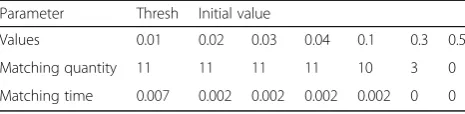
Values 0.01 0.02 0.03 0.04 0.1 0.3 0.5
Matching quantity 11 11 11 11 10 3 0
Matching time 0.007 0.002 0.002 0.002 0.002 0 0
Experiment results are within the whole taking value interval after changing the parameter of NBP. The matching time of SIFT algorithm firstly increases and then decreases, while the matched quantity shows an overall decreasing trend.
Considering effects of experimental error, the influ-ence of NBP value change on matching time of SIFT al-gorithm firstly enhances and then decreases, with the increasing parameters of NBP values taken from left to right. There is an overall negative correlation between matching number and NBP value change. Thus, NBP is regarded as a negative-correlation parameter of match-ing performance in improvmatch-ing matchmatch-ing rate of SIFT algorithm.
5. Parameter NBO
Based on Table 7 and Fig. 14, experiment results are within the whole taking value interval after chan-ging the parameter of NBO. The matching time of SIFT algorithm presents an increasing trend, while the matching quantity firstly increases and then declines.
Considering effect of experimental error, the change of NBO parameter value has a positive correlation with matching time of SIFT algorithm, with the in-creasing parameters of NBP values taken from left to right. For matching quantity, the correlation is firstly positive and then becomes negative on the whole. Therefore, in the test improving matching rate of
SIFT algorithm, a better match rate can be obtained
when taking values within the range of 4–16 for set
of NBO values.
6. Parameters magnif
Table 8 and Fig. 15 shows that experiment results are within the whole taking value interval after changing the parameter of magnif. The matching time of SIFT algorithm shows a decreasing trend, while the matching quantity firstly increases and then decreases.
Taking into account experimental error, the change of magnif values has a negative correlation with matching time of SIFT algorithm, with the increasing
parameters of r values taken from left to right. For
matching number, the correlation is firstly positive and then becomes negative on the whole. Therefore, when setting parameter values of magnif in the test improving matching rate of SIFT algorithm, a better match rate will be obtained within the value range of 0.5–3.
5.1.2 Experiment on parameter adjustment for angle change image
1. Parameter Sigman
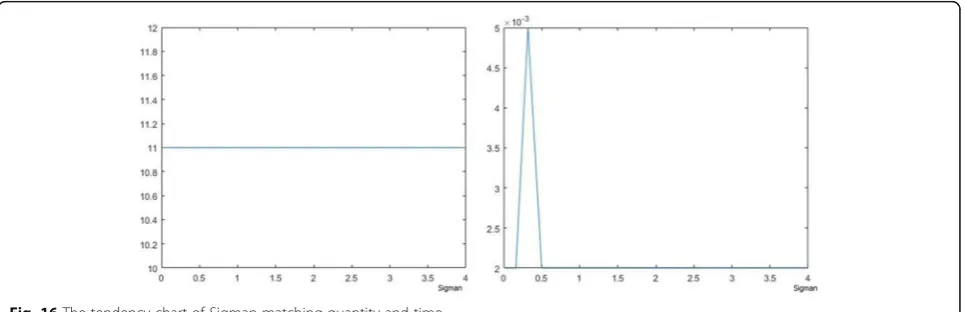
Table 9 and Fig. 16 show that experiment results are within the whole taking value interval after chan-ging the parameter of Sigman. The matching time of SIFT algorithm shows a steady trend at first, and then presents a sudden rise, finally returning to be steady after a decline. The number of matches basically re-mains unchanged.
When considering experimental error, the change of Sigman parameter value is positively at first and then becomes negatively correlated with matching time of
Table 11The matching quantity and time ofr Parameter r Initial value
Values 0.01 0.5 5 10 20 50 100
Matching quantity 16 1 8 11 12 14 14
Matching time 0.003 0 0.001 0.002 0.003 0.003 0.003
SIFT algorithm, as the parameters of Sigman values increase from left to right. There is no correlation with the match number on the whole. Therefore, Sig-man can be regarded as an irrelevant parameter in setting of Sigman parameter values during the test improving matching rate of SIFT algorithm.
2. Parameter thresh
Table 10 and Fig. 17 show that experiment results are within the whole taking value interval after chan-ging the parameter of thresh. Both the matching time and quantity of SIFT algorithm show an overall de-clining trend.
Considering the influence of experimental error, the change of thresh values is negatively correlated with matching time and quantity indexes of SIFT al-gorithm. In other words, matching time and quantity of SIFT algorithm gradually decrease as thresh values increase from left to right. Therefore, thresh can be regarded as a negative correlation parameter of matching performance in the test improving match-ing rate of SIFT algorithm.
3. Parameterr
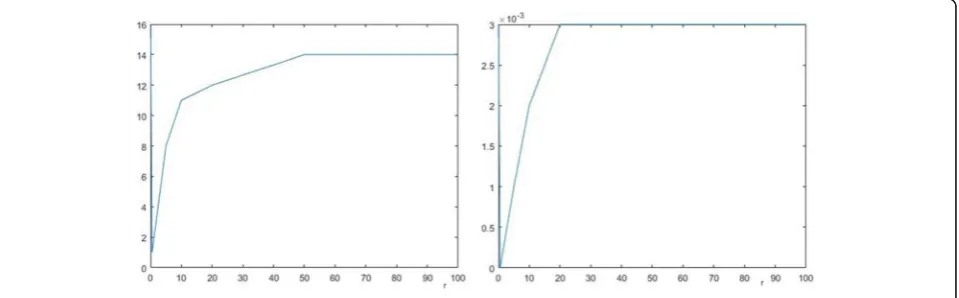
Table 11 and Fig. 18 show that experiment results are within the whole taking value interval after
chan-ging the parameter of r. Matching time SIFT
algorithm presents an overall rising trend, while the matching quantity firstly decreases and then increases, finally becoming steady.
Taking into account experimental error, the change of the r values is negatively at first and then becomes positively correlated with matching time and quantity indexes of SIFT algorithm. That is, matching time and quantity of SIFT algorithm firstly decrease and
then increase, and finally become steady, with r
values increasing from left to right. Therefore, r is
considered as a positive correlation parameter of matching performance in the test improving matching rate of SIFT algorithm.
4. Parameter NBP
According to Table 12 and Fig. 19, NBP value needs to be a positive; thus, only the value of 2 can be taken before the initial value of 4. Experiment results are within the whole taking value interval after chan-ging the parameter of NBP. The matching time of SIFT algorithm firstly increases and then declines, while the matching quantity presents an overall de-clining trend.
Considering effect of experimental error, the influ-ence of NBP value change on matching time of SIFT algorithm firstly enhances and then decreases, with the increasing parameters of NBP values taken from left to right. There is an overall negative correlation
Fig. 19The tendency chart of NBP matching time and quantity
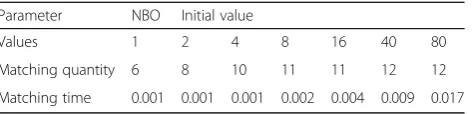
Table 13The matching quantity and time of NBO
Parameter NBO Initial value
Values 1 2 4 8 16 40 80
Matching quantity 6 8 10 11 11 12 12
Matching time 0.001 0.001 0.001 0.002 0.004 0.009 0.017
Table 12The matching time and quantity of NBP
Parameter NBP Invalid Invalid Initial value
Values 2 4 8 16 32
Matching quantity 17 X X 11 4 0 0
between matching number and NBP value change. Thus, NBP is regarded as a negative correlation par-ameter of matching performance in improving match-ing rate of SIFT algorithm.
5. Parameter NBO
Table 13 and Fig. 20 show that experiment results are within the whole taking value interval after chan-ging the parameter of NBO. The matching time of SIFT algorithm presents an increasing trend, while the matching quantity firstly increases and then be-comes steady.
Considering the effect of experimental error, the change of NBO parameter value has a positive correl-ation with matching time and quantity of SIFT algo-rithm, with the increasing parameters of NBP values taken from left to right. Therefore, NBO is regarded as a positive correlation parameter in setting of NBO param-eter values during the test improving matching rate of SIFT algorithm.
6. Parameters magnif
Table 14 and Fig. 21 show that experiment results are within the whole taking value interval after changing the parameter of magnif. The matching time of SIFT algorithm shows a decreasing trend, while the matching quantity firstly increases and then decreases.
Taking into account experimental error, the
change of magnif values has a negative correlation with matching time of SIFT algorithm, with the
in-creasing parameters of r values taken from left to
right. For matching quantity, the correlation is firstly positive and then becomes negative on the whole. Therefore, when setting parameter values of magnif in the test improving matching rate of SIFT algorithm, a better match rate will be obtained at the value of about 0.5.
The overall trend of the results is well
demon-strated, though generation of errors cannot be
avoided due to the limitations of experimental sam-ples. Figure 22 shows the matching results.
5.1.3 Summary of experimental results
In terms of the images of illumination and angle changes, Table 15 shows the influence of each parameter change on matching performance.
5.2 Game test
1. Class testing
The parameters in Easy AR need to be primarily modi-fied to load different scenes when designing codes. A numerical manager (AllARguments function) was de-signed to manage all the codes. The loading of various scene models was changed through ray detection (Ray function) and level switch (Interim function). Using the overall UI management (TheAirshipUI function), we achieved image recognition, identification, dele-tion, and other general functions. The function values of such core code areas would be returned to other functions. The functions were running inde-pendently except for the link with core code block. Such design is consistent with design principles of
“high cohesion and low coupling.” The designed code
Fig. 20The tendency chart of NBO matching quantity and time
Table 14Matching quantity and time of magnif
Parameter Magnif Initial value
Values 0.01 0.5 2 3 6 12 18
Matching quantity 0 16 13 11 3 1 1
framework was divided into core code block and other code blocks, where the former was used to control the code of other blocks. Figure 23 shows specific code framework.
Class testing was mainly performed for the following functions: Login interface (TheLoding function), space-craft UI manager (ARairship function), energy tank UI (ARenergyCupola function), UI management of
bio-logical engineering cabin (ARbioengineeringCupola
function), combat cabin UI (ARcombatCupola function), UI management of defense device (ARcombat function), UI manager of main compartment (ARmainCupola function), collection cabin of UI manager (ARgather-Cupola function), library UI management (ARlibrARy-Cupola function), UI management of repair cabin (ARrepairCupola function), etc. In battle scene, the testing functions involved management generated by random enemies (RandomEnemy function), enemy AI (EnemyAll function), and weapon AI (WeaponAll function). In addition, the codes achieving other func-tions were tested, such as the particle scale effect
(ScalePARticles function), text flicker effect (Flash-Book function), and music manager (MusicManage function).
2. Running test in development environment of Unity3D
Unity 3D has run-time debugging as other develop-ment software. The achievedevelop-ments of the developed
game were better displayed, with detection on
realization of various functions of the game. The game was run by clicking the Run button (see Fig. 24).
3. Testing on mobile terminal
Mix series were used in the game development, where series of Mix 4 and 5 could run the game smoothly. Testing was also performed in other phone models. Ac-cording to the testing results, phone models that can run the game include Mix 4, Mix 5s, LeEco 2x620, Vivo x7, and Noblue note. Figure 25 shows part of the phone Fig. 21The tendency chart of magnif matching quantity and time
properties. Currently, the phone model that fails passing the test is Vivo Y51A, caused by analytical package error resulting from too low Android version.
6 Results and discussion
The work developed a mobile AR game based on tech-nology of SIFT image recognition, with main conclu-sions as follows.
1. Compared with the traditional image recognition, bold and new breakthroughs are implemented in terms of technology. The recognition algorithm is based on random pictures taken by gamers in the game according to their needs rather than fixed images. Experimental results indicate that such method can improve accuracy of image matching with similar structures. According to performance testing of algorithm, the algorithm can meet the requirement for precision and instantaneity of the system. AR management system of the cloud is beneficial to management on AR data of different applications.
2. In terms of game play method, the work changes the previous situation of single play method in RTS game. Features of tower defense and role play features are integrated in the game to provide rich and colorful game experiences.
3. For interactive mode of the game, touch-click way is adopted in interaction as there are not AR game specifications within the industry.
The main limitation of the work is that the matching algorithm is prone to errors in matching process of SIFT image, due to influence of factors such as light,
Table 15Influence of parameters on SIFT matching performance
Parameter Influence on SIFT matching performance
Sigman The change of Sigman value is irrelevant with the matching quantity on the whole. Thus, Sigman can be regarded as an irrelevant correlation parameter in the test improving matching rate of SIFT algorithm.
Thresh The change of thresh values is negatively correlated with matching quantity of SIFT algorithm. Therefore, thresh parameter is regarded as a negative correlation parameter in the test improving matching rate of SIFT algorithm.
r The change of thervalues is negatively at first and then becomes positively correlated with matching time of SIFT algorithm, presenting a positive correlation trend after the initial value of 10.
NBP The change of NBP values is negatively correlated with matching quantity; thus, NBP is regarded as a negative correlation parameter of matching performance in improving matching rate of SIFT algorithm.
NBO The change of NBO values has overall positive correlation with matching quantity. It can be regarded as a positive correlation parameter in setting of NBO parameter values during the test improving matching rate of SIFT algorithm.
Magnif The change of magnif values is positively at first and then becomes negatively correlated with matching quantity. When setting parameter values of magnif in the test improving matching rate of SIFT algorithm, a better match rate will be obtained at the value of about 0.5.
occlusion, and camera movement. Sensor is consid-ered to be used for correction. In addition, the game has not yet been available on iOS.
The main work in the work is conducted based on traditional SIFT algorithm. There are still many prob-lems left to be improved due to personal ability and lim-ited time. The future work can be taken from the following three aspects:
1. According to the conclusion of the study, the SIFT algorithm should be continuously improved to increase the matching rate and robustness.
2. The parallel operation of SIFT algorithm can be optimized to improve the speed of image processing, and the performance of SIFT can be optimized by combining with hardware equipment.
3. In the process of SIFT image matching, the matching algorithm is prone to errors due to many factors such as illumination, occlusion, and fast moving camera.
The sensor is used for correction in the later work. The game has not been released on iOS.
7 Conclusion
The present job designed an augmented reality game based on SIFT image recognition built on C/S structure. This game was divided into subsystems of cloud man-agement and intelligent mobile terminal manman-agement. In this game, players can use both cloud database images and random images grabbed during game playing for image recognition which can be utilized for new game scene designing. To accelerate image recognition, in this paper, SIFT algorithm was improved by setting opti-mizing parameters and eliminating wrong matching points. The improved SIFT algorithm was integrated in Easy AR and working as a plug-in unit in the cloud server. The game is currently testing in laboratories before a hopeful public marketing.
Fig. 24Computational results in Unity 3D
Acknowledgements
The author would like to thank the editors and anonymous reviewers for their valuable comments.
Availability of data and materials
Data will not be shared; reason for not sharing the data and materials is that the work submitted for review is not completed. The research is still ongoing, and those data and materials are still required by the author and co-authors for further investigations.
Author’s contributions
BZ designed the research, analyzed the data, then wrote and edited the manuscript.
Funding
This work was supported by the science and technology key project of Henan Province, China. NO.172102210462.
Author’s information
Boping Zhang is currently an Associate Professor at the School of Information Engineering, Xuchang University, China. She received master’s degree from Zhengzhou University, China, in 2006. Her current research interests include computer vision, image processing, virtual reality, and pattern recognition.
Competing interests
The author declares that she has no competing interests.
Publisher’s Note
Springer Nature remains neutral with regard to jurisdictional claims in published maps and institutional affiliations.
Received: 21 September 2017 Accepted: 29 November 2017
References
1. A Ronald, A survey of augmented reality. Presence Teleop. Virt.6(4), 355–385 (1997)
2. Azuma, R. Recent advances in augmented reality[J]. IEEE Comput. Graph. Appl., 2001,12(11):34-47.
3. Feiner, S., MacIntyre, B., Hollerer, T. et al.,A Touring Machine: Prototyping 3D Mobile Augmented Reality Systems for Exploring the Urban Environment[A] Proc. ISWC‘97 (First Int. Symp. on Wearable Computers)[C], vol. 1 (Cambridge, Personal Technologies, 1997), pp. 208. doi:10.1007/BF01682023
4. B Thomas, EB Close, J Donoghue, et al.,AR Quake:An Outdoor/Indoor Augmented Reality First Person Application[a]. Proceedings of 4th International Symposium on Wearable Computers[C](Cieee Computer Society, Australia, 2000), pp. 139–146
5. Cheok, A. D. ( 2003) Human Pacman: A Mobile Entertainment System with Ubiquitous Computing and Tangible Interaction over a Wide Outdoor Area. In: Chittaro L. (eds)Human-Computer Interaction with Mobile Devices and Services. Mobile HCI 2003. Lecture Notes in Computer Science, vol 2795. Springer, Berlin, doi:10.1007/978-3-540-45233-1_16
6. KL Schrier,Revolutionizing History Education: Using Augmented Reality Games to Teach Histories[D](Massachusetts Institute of Technology, Cambridge, 2005) 7. Google releases online reality augmented mobile games“Ingress”[OL].
http://www.csdn.net/article/2012-11-16/2811943-google-launches-ingress. Accessed 28 Jul 2017
8. M Villamizar, J Andradecetto, A Sanfeliu, et al., Bootstrapping boosted random ferns for discriminative and efficient object classification[J]. Iberian Conf. Pattern Recognit. Image Anal.45(9), 3141–3153 (2012)
9. L LIN, K YANG, Y-t WANG, et al., Key issues study for mobile augmented reality system[J]. J. Image Graph.14(3), 560–564 (2009)
10. D Lowe, Distinctive image features from scale invariant keypoints[J]. Int. J. Comput. Vis.2(60), 91–110 (2004)
11. Yan Lei,Yang Xiaogang et al. Mobile augmented reality system design and application based on image recognition [J], J. Image Graph., 2016, 21(2):184-191. 12. DG Lowe,Object Recognition from Local Scale-Invariant Features//
Proceedings of the International Conference on Computer Vision(Corfu, 1999), pp. 1150–1157
13. MINGA-LMA Hua-Dong, Region-SIFT descriptor based correspondence between multiple cameras[J]. Chin. J. Comput.12(4), 650–662 (2008)
14. K He, X Wang, G Yunfeng, Adaptive support-weight stereo matching algorithm based on SIFT descriptors[J]. J. Tiajin Univ.49(9), 978–984 (2016) 15. DG Lowe, Distinctive image features from scale-invariant key points. Int. J.
Comput. Vis.60(2), 91–110 (2004)
16. C Guangxi, G Zhenting, et al., Fast image recognition method based on locality-constrained linear coding[J]. Comput. Sci.43(5), 308–314 (2016) 17. B Tingzhu, H Xibao, An improved image matching algorithm based on SIFT
[J]. Trans. Beijing Inst. Technol.33(6), 622–627 (2013)
18. Z Wei, L Wei, P Jiexin, A image stitching method based on SIFT and region selection[J]. Microelectron. Comp.27(6), 205–207 (2010)
19. M Hincapie, A Caponio, Rios,An Introduction to Augmented Reality with Applications in Aeronautical Maintenance. Consumer Electronics (ISCE)(2013), pp. 197–198
20. Q Zhou, J Luo, Artificial neural network based grid computing of E-government scheduling for emergency management. Comput. Syst. Sci. Eng.30(5), 327–335 (2015)
21. Q Zhou, R Liu, Strategy optimization of resource scheduling based on cluster rendering. Clust. Comput.19(4), 2109–2117 (2016). https://doi.org/10. 1007/s10586-016-0655-9
22. Q Zhou, Research on heterogeneous data integration model of group enterprise based on cluster computing. Clust. Comput.19(3), 1275–1282 (2016). https://doi.org/10.1007/s10586-016-0580-y
23. Zhou, Q. Electron Commer Res (2017). doi:10.1007/s10660-017-9265-8. Accessed 28 Jul 2017
24. Q Zhou, J Luo, The study on evaluation method of urban network security in the big data era. Intell. Automation Soft Comput. (2017). doi:10.1080/ 10798587.2016.1267444