DOI10.1186/2190-8567-1-10
R E S E A R C H Open Access
Diffusion laws in dendritic spines
David Holcman·Zeev Schuss
Received: 1 August 2011 / Accepted: 27 October 2011 / Published online: 27 October 2011
© 2011 Holcman, Schuss; licensee Springer. This is an Open Access article distributed under the terms of the Creative Commons Attribution License
Abstract Dendritic spines are small protrusions on a neuronal dendrite that are the main locus of excitatory synaptic connections. Although their geometry is variable over time and along the dendrite, they typically consist of a relatively large head connected to the dendritic shaft by a narrow cylindrical neck. The surface of the head is connected smoothly by a funnel or non-smoothly to the narrow neck, whose end absorbs the particles at the dendrite. We demonstrate here how the geometry of the neuronal spine can control diffusion and ultimately synaptic processes. We show that the mean residence time of a Brownian particle, such as an ion or molecule inside the spine, and of a receptor on its membrane, prior to absorption at the dendritic shaft depends strongly on the curvature of the connection of the spine head to the neck and on the neck’s length. The analytical results solve the narrow escape problem for domains with long narrow necks.
1 Introduction
Recognized more than 100 hundreds years ago by Ramón y Cajal, dendritic spines are small terminal protrusions on neuronal dendrites, and are considered to be the
D Holcman (
)Institute for Biology (IBENS), Group of Computational Biology and Applied Mathematics, Ecole Normale Supérieure, 46 rue d’Ulm, 75005 Paris, France
e-mail:[email protected]
D Holcman
Department of Applied Mathematics, UMR 7598 Université Pierre et Marie Curie, Boite Courrier 187, 75252 Paris, France
Z Schuss
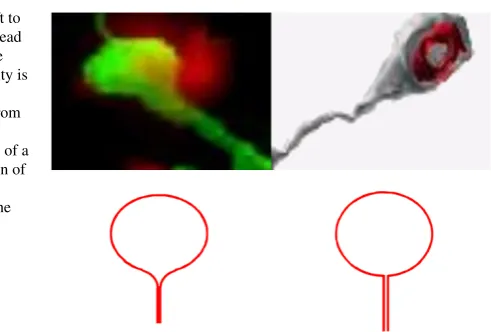
Fig. 1 Upper row (from left to right): The dendritic spine head is connected smoothly to the neck (the postsynaptic density is marked red) and (right) the connection is not smooth (from [6]). Lower row:
A mathematical idealization of a cross section: A cross section of a sharp and non-sharp connection approximating the spine morphology.
main locus of excitatory synaptic connections. The general spine geometry consists of a relatively narrow cylindrical neck connected to a bulky head (the round part in Figure1). Their geometrical shape correlates with their physiological function [1–6]. More than three decades ago, the spine-dendrite communication associated with the particle transfer was already anticipated [7] to be mediated not only by pure diffu-sion but it was hypothesized to involve other mechanisms such as twitching. This idea was reinforced by the findings [8] that inside the spine, the cytoplasmic actin is organized in filaments, involved in various forms of experimentally induced synap-tic plassynap-ticity by changing the shape or volume of the pre- and postsynapsynap-tic side and by retracting and sprouting synapses. The fast dendritic spine contraction was finally confirmed in cultured hippocampal neurons [9] and consequences were studied theo-retically in [10–12]. Interestingly, a serial electron microscopy and three-dimensional reconstructions of dendritic spines from Purkinje spiny branchlets of normal adult rats allowed to relate spine geometry to synaptic efficacy [1]. This image reconstruc-tion approach leads to the conclusion that the cerebellar spine necks are unlikely to reduce transfer of synaptic charge by more than 5-20%, even if their smooth endo-plasmic reticulum were to completely block passage of current through the portion of the neck that it occupies. The constricted spine neck diameter was proposed to isolate metabolic events in the vicinity of activated synapses by reducing diffusion to neigh-boring synapses, without significantly influencing the transfer of synaptic charge to the postsynaptic dendrite [1].
and theory [18], and the main conclusion was that geometrical changes in the spine neck such as the length or the radius are key modulator of the spine-dendrite commu-nication [12,19,20], affecting calcium dynamics. However, in all these studies, the nature of the connection between the neck and head was not considered. The theoreti-cal studies [19,21] considered non-smooth connection only of the head to the narrow cylindrical neck (Figure1) and did not account for any effect of curvature. This is precisely the goal of this article to investigate the consequences of this connection.
The connection between the head and the neck is not only relevant for the three-dimensional diffusion, but also essential to the analysis of other synaptic proper-ties. Indeed, synaptic transmission and plasticity involve the trafficking of receptors [22–27] such as AMPA or NMDA receptors (AMPARs or NMDARs) that mediate the glutamatergic-induced synaptic current. Single particle approaches have further [28,29] revealed the heterogeneity of two-dimensional trajectories occurring on the neuron surface, suggesting that there are several biophysical processes involved in regulating the receptor motion. In addition, the number and type of receptors that shape the synaptic current [23] could be regulated by the spine geometry. This ques-tion was further explored theoretically [30,31], using asymptotic expressions for the residence time and experimentally [32] by monitoring the movements of AMPARs on the surface of mature neurons using FRAP. Employing a combination of confo-cal microscopy and photobleaching techniques in living hippocampal CA1 pyramidal neurons, a correlation between spine shape parameters and the diffusion and compart-mentalization of membrane-associated proteins was recently confirmed [33]. Lateral diffusion seems to be a constitutive process of AMPAR trafficking; it depends on spine morphology and is restricted by the spine geometry [34].
In this article, we develop a method for computing the NET from composite spine-like structures that consist of a relatively large compartment (head)1and a narrow cylindrical neck of cross section|∂aand length L(see Figure2). Our connection
formula is given as
¯
τx→∂a= ¯τx→∂i+
L2
2D +
|1|L
|∂a|D
. (1)
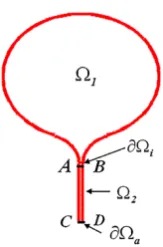
Fig. 2 The composite domain consists of a head1connected by an interface∂ito narrow
neck2. The entire boundary is
reflecting, except for a small absorbing part∂a.
2 The NET from a domain with a bottleneck
We consider two- and three-dimensional composite domainsthat consist of a head
1 connected through a small interface∂i to a narrow cylindrical neck2. The
boundary ofis assumed reflecting to Brownian particles, except the far end of2,
denoted∂a, which is absorbing. For example, in Figure2, the interface∂i is the
black segment AB and the absorbing boundary∂a is the segment CD at the
bot-tom of the strip. The NET from such a composite domain cannot be calculated by the methods of [39–42], because the contribution of the singular part of Neumann’s function to the MFPT in a composite domain with a funnel or another bottleneck is not necessarily dominant. The method of matched asymptotic expansions requires different boundary or internal layers at a cusp-like absorbing window than at an ab-sorbing window which is cut from a smooth reflecting boundary (see [43–46]). The methods used in [21,35] for constructing the MFPT in a composite domain of the type shown in Figure1d are made precise here and the new method extends to the domains of the type shown in Figure1c.
First, we recount some basic facts about the NET [35,39–41,43–45,47,48]. The NET is the MFPT of a Brownian trajectory to a small absorbing part of the bound-ary of a domain, whose remaining boundbound-ary reflects Brownian trajectories. Refined asymptotic formulas for the NET were derived in [42,46,49,50], and were used to estimated chemical reaction rates.
Consider Brownian motion x(t ) in a sufficiently regular bounded domain , whose boundary∂consists of a reflecting part ∂r and an absorbing part∂a.
The expected lifetime ofx(t )in, givenx(0)=x∈, is the MFPTv(x)ofx(t )
fromxto∂ais the solution of the mixed boundary value problem [38]
v(x)= −1
D forx∈ (2)
v(x)=0 forx∈∂a (3)
∂v(x)
∂n =0 forx∈∂r, (4)
MFPTτ¯=v(x)is to leading order independent ofx∈aand can be represented by
the Neumann functionN (x,y)as
¯
τ=v(y)= −1 D
N (x,y) dx−
∂a
N (x,y)∂v(x)
∂n dSx. (5)
The sum of the integrals is independent ofy∈aoutside a boundary layer near∂a.
The Neumann function is a solution of the boundary value problem
xN (x,y)= −δ(x−y)+
1
|| forx,y∈ (6)
∂N (x,y) ∂nx =
0 forx∈∂,y∈ (7)
and is defined up to an additive constant [39,47].
2.1 The MFPT from the head to the interface
In the two-dimensional case considered in [40] the interface ∂i is an absorbing
window cut from the smooth reflecting boundary of1, as in Figure1d. The MFPT ¯
τx→∂i is the NET from the reflecting domain1 to the small interface ∂i (of lengtha), such thatε=π|∂i|/|∂1| =π a/|∂1| 1 (this corrects the definition
in [40]). It is given by
¯
τx→∂i= |1| π D ln
|∂1| π|∂i|+
O(1)
forx∈1outside a boundary layer near∂i.
(8)
In particular, if1is a disk of radiusR, then forx=the center of the disk,
¯
τx→∂i=
R2 D
logR
a +2 log 2+
1
4+O(ε)
, (9)
averaging with respect to a uniform distribution ofxthe disk
¯
τx→∂i=
R2 D
logR
a +2 log 2+
1
8+O(ε)
. (10)
When the interface∂i (of lengtha) is located at an algebraic cusp with radius of
curvatureRc(see Figures1c and2), the MFPT is given in [36,37] as
¯
τ = |1|
4D√2a/Rc
(1+O(1)) forε |∂|. (11)
In the case of Brownian motion on a spherical head of the surface of revolution ob-tained by rotating the curve in Figure1d about its axis,1is a sphere of radiusR
centered at the origin, connected to2by a circle∂i centered on the north-south
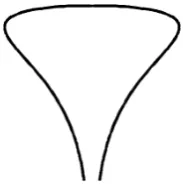
Fig. 3 A surface of revolution with a funnel. Thez-axis points down.
cylinder of radiusa connected to1at∂i, and the absorbing boundary∂ais the
circle of radiusaat the bottom of the cylinder. The MFPT from1to∂i is given
in [37,41,51–53] as
¯
τx→∂i= 2R2
D log
sinθ2
sinδ2, (12)
whereθis the angle betweenxand the south-north axis of the sphere.
A surface of revolution generated by rotating a curve about an axis, as in Figure3, with a funnel of diameterεcan be represented parametrically as
x=r(z)cosθ, y=r(z)sin(θ ), 0≤θ <2π,0≤z < , (13)
where the axis of symmetry is the z-axis with z=0 at the top of the surface and
z=at the end of the funnel,ris distance to thez-axis, andr=r(z)is the equation of the generating curve. We have
r(z)=O(√z) nearz=0
r(z)=a+−α(−z)1+α(1+o(1)) forα >0 nearz=, (14) wherehas dimension of length. Forα=1 the parameteris related to the radius of curvatureRcatz=by=2Rc. Forα >0 [37]
¯
τx→∂i∼ |1|
2D
a
α/1+α
(1+α)sin1+πα, (15) where|1|is the entire area of the surface. In particular, forα=1 we get the MFPT
¯
τx→∂i∼
|1|
4D√2a/Rc
. (16)
The caseα=0 corresponds to a circular cap of a small radiusa cut from a closed surface.
The MFPT of Brownian motion from a solid ball1to a disk∂iof small radius
anear the south pole is given by [42]
¯
τx→∂i= |1|
4aD
1+ a
π Rlog R
a +o
a Rlog
R a
(note that the MFPT is independent ofx up to second order, see [46]). For a general three-dimensional domain,1 the MFPT to a circular cap∂i cut from a smooth
boundary is given by [42]
¯
τx→∂i= |1|
4aD 1+
Lx+Rx
2π ∂i
π 1/2log
|∂1|
|∂i|
+o
|∂i|
|∂1|
log
|∂i|
|∂1|
+O(1)
D ,
(18)
whereLx,Rx are the principal curvatures at a pointx, and|∂i| =π a2is the area
of the circular cap.
When the interface∂i is a circular disk of radiusaat the end of an axisymmetric
solid funnel, the MFPT is drastically affected and changes to
¯
τx→∂i= 1 √ 2
Rc
a 3/2 |
1| RcD
(1+o(1)) foraRc, (19)
whereRcis the radius of curvature at the end of the funnel [37].
3 Connecting a head to a narrow neck
We consider Brownian motion in a domainthat consists of a head, which is a reg-ular bounded domain1, and a narrow neck2, which is a right circular or planar
cylinder of lengthL, perpendicular to the boundary∂1, and of radiusa (see
Fig-ure2). Thus, the interface∂i between the head and the neck is a line segment, a
circle, or a circular disk, depending on the dimension. We assume that∂1−∂i
is reflecting and that the other basis of the neck,∂a⊂∂2, is absorbing for the
Brownian motion. The length (or area)|∂i|is given by
|∂i| =
⎧ ⎨ ⎩
a for a line segment 2π a for a circle
π a2 for a disk.
(20)
The MFPTτ¯x→∂a can be represented as [54], [38, Lemma 10.3.1, p. 388]
¯
τx→∂a= ¯τx→∂i+ ¯τ∂i→∂a, (21)
where the MFPTτ¯∂i→∂a isτ¯x→∂a, averaged over∂i with respect to the flux density of Brownian trajectories in1into an absorbing boundary at∂i (see [38]
for further details).
First, we calculateτ¯∂i→∂a and the absorption flux at the interface. In the nar-row neck2the boundary value problem (2)–(4) can be approximated by the
one-dimensional boundary value problem
u(0)=0, u(L)=uH,
where the value at the interfaceu(L)=uH is yet unknown. The solution is given by
u(z)= − z 2
2D+Bz, (22)
so that
u(L)=uH= −
L2
2D+BL, (23)
which relates the unknown constantsB anduH. The constantB is found by
multi-plying Equation2by the Neumann functionN (x,y), integrating over1, applying Green’s formula, and using the boundary conditions (3) and (4). Specifically, we ob-tain for ally∈∂i
v(y)= −1 D
1
N (x,y) dx−
∂i
N (x,y)∂v(x) ∂n dSx+
1 |1|
1
v(x) dx. (24)
Approximating, as we may,v(y)≈u(L)and using (23), we obtain
−L2
2D+BL= −
1
D
1
N (x,y) dx−
∂i
N (x,y)∂v(x) ∂n dSx
+|1
1|
1
v(x) dx.
(25)
Becausev(x)is the solution of the boundary value problem (2)–(4) in the entire domain=1∪2, the meaning of (25) is the connecting rule (21), where
¯
τx→∂a= 1 |1|
1
v(x) dx (26)
¯
τ∂i→∂a=u(L) (27)
¯
τx→∂i= − 1
D
N (x,y) dx−
∂i
N (x,y)∂v(x)
∂n dSx. (28)
Equation26gives the MFPT, averaged over1. The averaging is a valid approxi-mation, because the MFPT to∂i is constant to begin with (except in a negligible
boundary layer). Equation27is the MFPT from the interface to the absorbing end
∂aof the strip, and (28) follows from (5).
Matching the solutions in1and2continuously across∂i, we obtain the total
flux on∂i as
J=D
∂i
∂v(x)
Noting that∂v(x)/∂n= −u(0)= −B, we get from (20) and (29) that
B= − ⎧ ⎪ ⎪ ⎪ ⎪ ⎪ ⎪ ⎨ ⎪ ⎪ ⎪ ⎪ ⎪ ⎪ ⎩
|1| aD +
L
D for a line segment
|1|
2π aD+ L
D for a circle
|1| π a2D+
L
D for a circular disk.
(30)
Finally, we put (21)–(30) together to obtain
¯
τx→∂a= ¯τx→∂i+
L2
2D +
|1|L
|∂a|D
. (31)
The MFPTτ¯x→∂i is given by (8)–(19) above.
3.1 The NET from two- and three-dimensional domains with bottlenecks
The expression (31) for the NET from a domain with a bottleneck in the form of a one-dimensional neck, such as a dendritic spine, can be summarized as follows. Consider a domainwith head1 and a narrow cylindrical neck2 of lengthL
and radiusa. The radius of curvature at the bottleneck in smooth connecting funnel isRc. In the two-dimensional case
¯
τx→∂a =
⎧ ⎪ ⎪ ⎪ ⎪ ⎪ ⎪ ⎪ ⎪ ⎪ ⎪ ⎪ ⎪ ⎪ ⎪ ⎪ ⎪ ⎪ ⎪ ⎪ ⎪ ⎪ ⎪ ⎪ ⎪ ⎨ ⎪ ⎪ ⎪ ⎪ ⎪ ⎪ ⎪ ⎪ ⎪ ⎪ ⎪ ⎪ ⎪ ⎪ ⎪ ⎪ ⎪ ⎪ ⎪ ⎪ ⎪ ⎪ ⎪ ⎪ ⎩
|1| π D ln
|∂1| a +
O(1) D +
L2
2D +
|1|L aD
planar spine connected to the neck at a right angle
π|1| D
Rc
a (1+o(1))+ L2
2D+
|1|L
2π aD
planar spine with a smooth connecting funnel |1|
2π Dlog
sinθ2 sinδ2 +
L2
2D+
|1|L
2π aD
spherical spine connected to the neck at a right angle |1|
2D ε
−α/1+α
2α/1+α
(1+α)sin π 1+α
+ L2 2D+
|1|L
2π aD
spherical spine with a smooth connecting funnel,
(32)
whereRis the radius of the sphere,a=Rsinδ/2, andθis the initial elevation angle on the sphere. If|1| aLandLa, the last term in (32) is dominant, which is the manifestation of the many returns of Brownian motion from the neck to the head prior to absorption at∂a(see an estimate in [19]). The last line of (32) agrees with
the explicit calculation in [37].
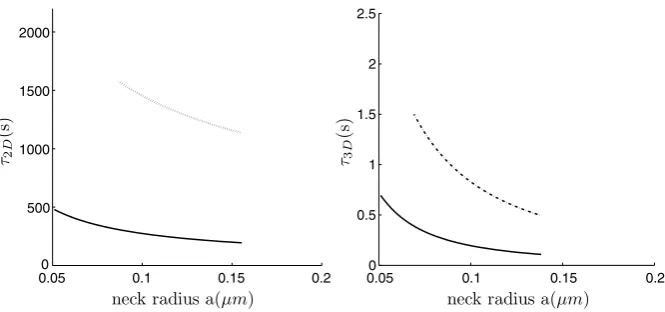
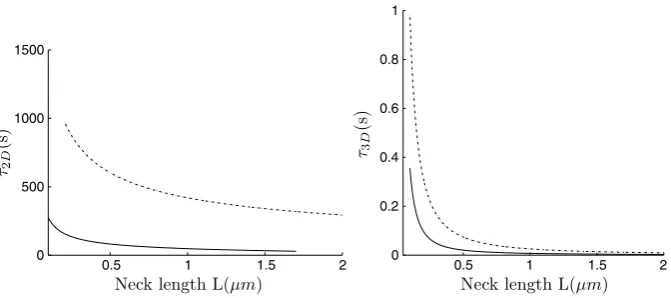
Fig. 4 Left: The NET of Brownian motion on a sphere with a bottleneck connected by a smooth funnel to the neck (dashed line), and with a non-smooth connection (continuous line). Right: The NET of Brownian motion in a ball with a bottleneck connected by a smooth funnel to the neck (dashed line), and with a non-smooth connection (continuous line).
by
¯
τx→∂a=
⎧ ⎪ ⎪ ⎪ ⎪ ⎪ ⎪ ⎪ ⎪ ⎪ ⎪ ⎪ ⎪ ⎪ ⎪ ⎪ ⎪ ⎪ ⎪ ⎪ ⎪ ⎪ ⎪ ⎪ ⎪ ⎪ ⎪ ⎪ ⎪ ⎪ ⎪ ⎨ ⎪ ⎪ ⎪ ⎪ ⎪ ⎪ ⎪ ⎪ ⎪ ⎪ ⎪ ⎪ ⎪ ⎪ ⎪ ⎪ ⎪ ⎪ ⎪ ⎪ ⎪ ⎪ ⎪ ⎪ ⎪ ⎪ ⎪ ⎪ ⎪ ⎪ ⎩
|1|
4aD
1+ a
π Rlog R a
+O(1)
D + L2
2D+
|1|L π a2D
solid spherical head of radiusRconnected to the neck at a right angle
|1|
4aD 1+
(Lx+Rx)
2π ∂a
π 1/2
×log
|∂1|
|∂a|
+o
|∂a|
|∂1|log
|∂a|
|∂1|
+O(1)
D + L2
2D+
|1|L π a2D
a general head connected to the neck at a right angle
1 √ 2 Rc a 3/2|
1| RcD
(1+o(1))+ L 2
2D+
|1|L π a2D
a general head connected smoothly to the neck by a funnel,
(33)
whereRc is the curvature at the cusp. The order 1 term can be computed for the sphere using the explicit expression of the Neumann-Green function [46]. Figures4 and5show the NET for various parameters, such as the neck length and radius.
Fig. 5 Effect of modulating the neck length. The geometry is the same as in Figure4.
4 Discussion and conclusion
We have shown that the mean residence time (or flux) of Brownian particles inside a spine-like structure or on its surface depends strongly on the geometrical properties of both head and neck. Surprisingly, it also depends strongly on the smoothness of the connection between the two.
The application to a freely diffusing AMPA receptor, which is responsible for the excitatory synaptic current, shows that its motion on the spine membrane is strongly restricted by dendritic spine geometry. Our results can be used to estimate the res-idence time of the receptor on the membrane if interactions with any scaffolding molecules are neglected (the latter are mostly concentrated in a local microdomain called the PSD). Using Equation32 for non-smooth geometry (Figure1b) and for a spherical head of radius R =1 μm, a neck length L=1 μm, a neck radius
a=0.1 μm, and a diffusion coefficientD=0.1μm2/s, we obtain from the third line of Equation32that the residence time isτ2D≈260 s, while for a smooth
con-necting geometry (Figure1a) with a curvature radius ofRc=1μm at the connecting
neck-headτ2D≈1150 s (line 2 in Equation32). Evidently, the residence time is more
than doubled, leading to the conclusion that there is a significant difference between the function of spines with smoothly and non-smoothly connected necks. We con-clude from this analysis that an AMPA receptors that do not interact with the PSD stay on a typical dendritic spine between one and a half to 5 min on average and this residence time is controlled mostly by the geometrical properties of the spine.
We now consider the residence time for freely diffusing particles such as molecules, mRNA, and ions (e.g., calcium) inside a dendritic spine. For a calcium ion, the diffusion constant is aboutDca=400μm2/s [12]. Calcium ions that exit the spine only to the dendrite shaft at the end of the neck, but not through exchangers, give the following residence time estimates. Using formula33for a non-smooth con-nection between the spine head and the neck, we obtain thatτ3D≈195 ms (line 1),
while for a smooth connection with radius of curvature 1μm, the residence time is
τ3D≈820 ms (line 3 in Equation33). Interestingly, the mean residence time is tripled
A remaining open question is to extend the present analysis to the case where many binding molecules can trap receptors. This effect should be expected to significantly increase the residence time inside a dendritic spine, as has already been observed in [55] for the case of a receptor inside the PSD. The present mathematical analysis of the residence time provides a solution to the narrow escape problem for domains with bottlenecks [21,35]. Other generalizations of this study is to include the dynamics of many receptors [30,56] or/and to study dendritic trafficking [57].
There are many other factors that affect the spine-dendrite communication with re-spect to calcium. This includes calcium pumps, endogenous buffers, calcium stores, the number and rates of exchangers. These mechanisms affect the residence of cal-cium in spines [58–60] and it would be interesting to add them in the present analysis.
Competing interests
The authors declare that they have no competing interests.
Authors’ contributions
DH and ZS contributed equally to the manuscript. All authors read and approved the final manuscript. Acknowledgements This research was supported by an ERC starting Grant.
References
1. Harris, K.M., Stevens, J.K.: Dendritic spines of rat cerebellar Purkinje cells: serial electron mi-croscopy with reference to their biophysical characteristics. J. Neurosci.12, 4455–4469 (1988) 2. Bourne, J.N., Harris, K.M.: Balancing structure and function at hippocampal dendritic spines. Annu.
Rev. Neurosci.31, 47–67 (2008)
3. Korkotian, E., Holcman, D., Segal, M.: Dynamic regulation of spine-dendrite coupling in cultured hippocampal neurons. Eur. J. Neurosci.20(10), 2649–2663 (2004)
4. Hotulainen, P., Hoogenraad, C.C.: Actin in dendritic spines: connecting dynamics to function. J. Cell Biol.189(4), 619–629 (2010)
5. Newpher, T.M., Ehlers, M.D.: Spine microdomains for postsynaptic signaling and plasticity. Trends Cell Biol.5, 218–227 (2009)
6. Sheng, M., Hoogenraad, C.C.: The postsynaptic architecture of excitatory synapses: a more quantita-tive view. Annu. Rev. Biochem.76, 823–847 (2007)
7. Crick, F.: Do dendritic spines twitch? Trends Neurosci.5, 44–46 (1982)
8. Filkova, E., Delay, R.J.: Cytoplasmic actin in dendritic spines as a possible mediator of synaptic plasticity. J. Cell Biol.95, 350–365 (1982)
9. Korkotian, E., Segal, M.: Spike-associated fast contraction of dendritic spines in cultured hippocampal neurons. Neuron30(3), 751–758 (2001)
10. Holcman, D., Schuss, Z., Korkotian, E.: Calcium dynamic in dendritic spines and spine motility. Biophys. J.87, 81–91 (2004)
11. Holcman, D., Schuss, Z.: Modeling calcium dynamics in dendritic spines. SIAM J. Appl. Math.65(3), 1006–1026 (2005)
12. Holcman, D., Korkotian, E., Segal, M.: Calcium dynamics in dendritic spines, modeling and experi-ments. Cell Calcium37(5), 467–475 (2005)
14. Collin, C., Miyaguchi, K., Segal, M.: Dendritic spine density and LTP induction in cultured hippocam-pal slices. J. Neurophysiol.77(3), 1614–1623 (1997)
15. Korkotian, E., Segal, M.: Release of calcium from stores alters the morphology of dendritic spines in cultured hippocampal neurons. Proc. Natl. Acad. Sci. USA96(21), 12068–12072 (1999)
16. Svoboda, K., Tank, D.W., Denk, W.: Direct measurement of coupling between dendritic spines and shafts. Science272(5262), 716–719 (1996)
17. Bloodgood, B.L., Sabatini, B.L.: Neuronal activity regulates diffusion across the neck of dendritic spines. Science310(5749), 866–869 (2005)
18. Holcman, D., Marchewka, A., Schuss, Z.: Survival probability of diffusion with trapping in cellular neurobiology. Phys. Rev. E, Stat. Nonlinear Soft Matter Phys.72(3), 031910 (2005)
19. Biess, A., Korkotian, E., Holcman, D.: Diffusion in a dendritic spine: the role of geometry. Phys. Rev. E, Stat. Nonlinear Soft Matter Phys.76, 021922 (2007)
20. Holcman, D., Kupka, I.: Some questions in computational cellular biology. Fixed Point Theory Appl. 7(1), 67–83 (2010). doi:10.1007/s11784-010-0012-1
21. Berezhkovskii, A.M., Barzykin, A.V., Zitserman, V.Y.: Escape from cavity through narrow tunnel. J. Chem. Phys.130(24), 245104 (2009)
22. Chen, L., Chetkovich, D.M., Petralia, R.S., Sweeney, N.T., Kawasaki, Y., Wenthold, R.J., Bredt, D.S., Nicoll, R.A.: Stargazin regulates synaptic targeting of AMPA receptors by two distinct mechanisms. Nature408, 936 (2000)
23. Bredt, D.S., Nicoll, R.A.: AMPA receptor trafficking at excitatory synapses. Neuron40, 361 (2003) 24. Adesnik, H., Nicoll, R.A., England, P.M.: Photoinactivation of native AMPA receptors reveals their
real-time trafficking. Neuron48(6), 977–985 (2005)
25. Shi, S.H., Hayashi, Y., Petralia, R.S., Zaman, S.H., Wenthold, R.J., Svoboda, K., Malinow, R.: Rapid spine delivery and redistribution of AMPA receptors after synaptic NMDA receptor activation. Sci-ence284(5421), 1811–1816 (1999)
26. Malinow, R., Malenka, R.C.: AMPA receptor trafficking and synaptic plasticity. Annu. Rev. Neurosci. 25, 103–126 (2002)
27. Malinow, R.: AMPA receptor trafficking and long-term potentiation. Philos. Trans. R. Soc. Lond. B, Biol. Sci.358(1432), 707–714 (2003) (Review)
28. Borgdorff, A.J., Choquet, D.: Regulation of AMPA receptor lateral movements Nature417(6889), 649–653 (2002)
29. Choquet, D., Triller, A.: The role of receptor diffusion in the organization of the postsynaptic mem-brane. Nat. Rev., Neurosci.4, 251–265 (2003)
30. Holcman, D., Triller, A.: Modeling synaptic dynamics and receptor trafficking. Biophys. J.91(7), 2405–2415 (2006)
31. Earnshaw, B.A., Bressloff, P.C.: A biophysical model of AMPA receptor trafficking and its regulation during LTP/LTD. J. Neurosci.26, 12362–12373 (2006)
32. Ashby, M.C., Maier, S.R., Nishimune, A., Henley, J.M.: Lateral diffusion drives constitutive exchange of AMPA receptors at dendritic spines and is regulated by spine morphology. J. Neurosci.26, 7046 (2006)
33. Hugel, S., Abegg, M., de Paola, N., Caroni, P., Gähwiler, B.H., McKinney, R.A.: Dendritic spine morphology determines membrane-associated protein exchange between dendritic shafts and spine heads. Cereb. Cortex19(3), 697–702 (2009)
34. Makino, H., Malinow, R.: AMPA receptor incorporation into synapses during LTP: the role of lateral movement and exocytosis. Neuron64(3), 381–390 (2009)
35. Schuss, Z., Singer, A., Holcman, D.: The narrow escape problem for diffusion in cellular mi-crodomains. Proc. Natl. Acad. Sci. USA104(41), 16098–16103 (2007)
36. Holcman, D., Hoze, N., Schuss, Z.: Narrow escape through a funnel and effective diffusion on a crowded membrane. Phys. Rev. E, Stat. Nonlinear Soft Matter Phys.84, 021906 (2011)
37. Holcman, D., Schuss, Z.: Brownian motion in dire straits: Part I. Preprint (2011)
38. Schuss, Z.: Diffusion and Stochastic Processes: An Analytical Approach. Springer, New York (2010) 39. Singer, A., Schuss, Z., Holcman, D., Eisenberg, B.: Narrow escape I. J. Stat. Phys.122(3), 437–463
(2006)
40. Singer, A., Schuss, Z., Holcman, D.: Narrow escape II. J. Stat. Phys.122(3), 465–489 (2006) 41. Singer, A., Schuss, Z., Holcman, D.: Narrow escape III. J. Stat. Phys.122(3), 491–509 (2006) 42. Singer, A., Schuss, Z., Holcman, D.: Narrow escape and leakage of Brownian particles. Phys. Rev. E,
Stat. Nonlinear Soft Matter Phys.78, 051111 (2008)
44. Ward, M.J., Henshaw, W.D., Keller, J.B.: Summing logarithmic expansions for singularly perturbed eigenvalue problems. SIAM J. Appl. Math.53, 799–828 (1993)
45. Ward, M.J., Van De Velde, E.: The onset of thermal runaway in partially insulated or cooled reactors. IMA J. Appl. Math.48, 53–85 (1992)
46. Cheviakov, A., Ward, M.J., Straube, R.: An Asymptotic analysis of the mean first passage time for narrow escape problems: Part II: the sphere. Multiscale Model. Simul.8(3), 836–870 (2010) 47. Holcman, D., Schuss, Z.: Escape through a small opening: receptor trafficking in a synaptic
mem-brane. J. Stat. Phys.117(5–6), 191–230 (2004)
48. Kolokolnikov, T., Titcombe, M., Ward, M.J.: Optimizing the fundamental Neumann eigenvalue for the Laplacian in a domain with small traps. Eur. J. Appl. Math.16, 161–200 (2005)
49. Holcman, D., Schuss, Z.: Diffusion through a cluster of small windows and flux regulation in mi-crodomains. Phys. Lett. A372, 3768–3772 (2008)
50. Holcman, D., Schuss, Z.: Diffusion escape through a cluster of small absorbing windows. J. Phys. A, Math. Theor.41, 155001 (2008)
51. Gandolfi, A., Gerardi, A., Marchetti, F.: Diffusion-controlled reactions in two dimensions. Acta Appl. Math.4, 139–159 (1985)
52. Linderman, J., Laufengerger, D.: Analysis of intracellular receptor/Ligand sorting: calculation of mean surface and bulk diffusion times within a sphere. Biophys. J.50, 295–305 (1986)
53. Coombs, D., Straube, R., Ward, M.: Diffusion on a sphere with localized traps: mean first passage time, eigenvalue asymptotics, and Fekete points. SIAM J. Appl. Math.70(1), 302–332 (2009) 54. Matkowsky, B.J., Schuss, Z., Tier, C.: Uniform expansions of the transition rate in Kramers’ problem.
J. Stat. Phys.35(3–4), 443–456 (1984)
55. Taflia, A., Holcman, D.: Dwell time of a Brownian molecule in a microdomain with traps and a small hole on the boundary. J. Chem. Phys.126(23), 234107 (2007)
56. Bressloff, P.C., Earnshaw, B.A.: A dynamical corral model of protein trafficking in spines. Biophys. J.96, 1786–1802 (2009)
57. Bressloff, P.C.: Cable theory of protein receptor trafficking in dendritic trees. Phys. Rev. E, Stat. Nonlinear Soft Matter Phys.79, 041904 (2009)
58. Majewska, A., Brown, E., Ross, J., Yuste, R.: Mechanisms of calcium decay kinetics in hippocampal spines: role of spine calcium pumps and calcium diffusion through the spine neck in biochemical compartmentalization. J. Neurosci.20(5), 1722–1734 (2000)
59. Majewska, A., Tashiro, A., Yuste, R.: Regulation of spine calcium dynamics by rapid spine motility. J. Neurosci.20(22), 8262–8268 (2000)