R E S E A R C H
Open Access
Shadow removal with background difference
method based on shadow position and edges
attributes
Shiping Zhu
*, Zhichao Guo and Li Ma
Abstract
This article presents a shadow removal algorithm with background difference method based on shadow position and edges attributes. First, a novel background subtraction method is proposed to obtain moving objects. This method mainly includes three parts, namely detecting the moving regions approximately by calculating the inter-frames differences of symmetrical frames and counting the static index of each probable moving point; modeling for background by the statistics of brightness information and updating this model combining motion templates; then extracting moving objects and its edges. Second, based on the above processing, we suppress shadows in the HSV color space first, then the direction of shadow is determined by shadow edges and positions combining with the horizontal and vertical projections of the edge image, respectively, the position of the shadow is located accurately through proportion method, the shadow can be removed finally. Experimental results indicate that the proposed method is easy to be realized and can determine the direction of the shadow adaptively, then eliminate the shadow and extract the whole moving object accurately, especially when the chrominance invariant principle is ineffective.
Keywords:Background subtraction, HSV, Shadow removal, Shadow position, Edge attributes
1. Introduction
Video object segmentation is of fundamental importance in many advanced video applications such as tracking and interpreting human behavior, surveillance, motor traffic analysis or environmental monitoring, and so on [1-4]. Many segmentation approaches for background subtraction have been proposed over the past decades [5-9]. Some methods include parametric and non-parametric background density estimates and spatial cor-relation approaches [10]. However, most video objects extracted results are usually unsatisfactory in case that shadows exist in every frame of video sequence. So, moving shadow detection is critical for accurate object detection in video streams since shadow points are often misclassified as object points, causing errors in segmen-tation and tracking [11].
Shadows have two important visual properties. One is that they are so different from background that may wrongly be extracted as foreground. The other is that both shadows and moving objects have the same motion features. Because of these two visual properties, shadows usually make the geometrical shape of moving objects distorted, sometimes even cause the losing or merging of moving objects. Therefore, detecting and removing shadows from object regions have great practical signifi-cance and tremendous challenge in the field, which have attracted a great deal of attention recently.
A rather novel method [12] detects shadows and mov-ing objects based on the sound physical models with good efficiency. In [13], all four assumptions (such as light source causing a cast shadow has a certain extent) are used at the same time to detect image regions changes by moving cast shadows. Because the chromati-city information is not affected by the change of illumin-ation for some cases, a shadow region can be detected by selecting the region which is darker than its neigh-boring regions but has similar chromaticity information. * Correspondence:[email protected]
Department of Measurement Control and Information Technology, School of Instrumentation Science and Optoelectronics Engineering, Beihang University, XueYuan Road No. 37, HaiDian District, Beijing 100191, China
According to this illumination invariant property of chromaticity, several efficient methods [14,15] have been developed to detect shadows for color images efficiently. Tian et al. [16] use image information theory to deduce the tricolor attenuation model and employ blackbody ir-radiance to estimate its parameters, then detect shadows based on the new model. Tsai [17] presents an automatic property-based approach for the detection and compen-sation of shadow regions with shape information pre-served in complex urban color aerial images for solving problems caused by cast shadows in digital image map-ping. Lu et al. [18] first sampled shadow pixels based on the estimated shadow direction, afterwards, three shadow attributes were calculated based on sampled shadow pixels, but it costs significant processing time. In [19], moving shadows were detected by using its motion characteristics and the underlying physics based on the color segmentation, this method had poor accuracy since it could not distinguish shadows from black objects. Cucchiara et al. [20] proposed an approach which exploits color information for both background subtrac-tion and shadow detecsubtrac-tion to improve object segmenta-tion and background update.
Overall, the existing shadow removal methods can be divided into two categories: model-based method and feature-based method. The former one generally uses some prior knowledge such as scene, object, illumination condition, and so on, through which can match the arrises, lines, angles of the moving objects in order to detect shadows. Unfortunately, the prior knowledge is usually very difficult to obtain. This kind of method also has long processing time and it is minimally used in practice. Feature-based method as proposed in refer-ences prefers using shadow’s brightness, color informa-tion, saturainforma-tion, texture, and geometric features directly to detect shadows. This kind of method is commonly used, while also has drawbacks. For example, if the color feature method is adopted, when the object and shadow have the similar color, then the invariant color features are not applicable, and the shadows cannot be differentiated.
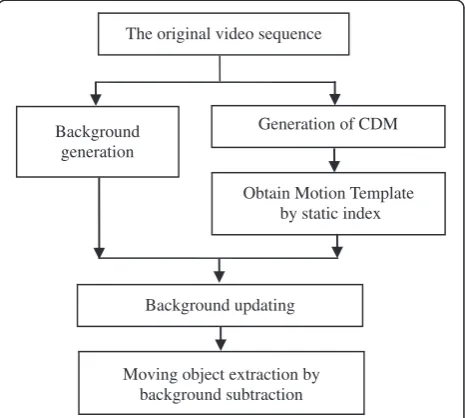
To avoid drawbacks in featured-based method, we propose an approach of shadow detection and elimin-ation based on shadow position and edge attributes after HSV shadow removal. This approach is shown in Figure 1, which is simple and easier to be carried out. It includes two important parts, namely moving object extraction and shadow detection and removal, shown in Sections 2 and 3. Section 2 lays foundation for future process. Section 3 is the emphasis of the whole ap-proach, which is novel to some extent. The proposed method can still locate the shadow direction adaptively and suppress it exactly even under the circumstance that most color-based removal methods cannot work well when the invariant color features are not applicable.
2. Moving object extraction by background subtraction method
2.1. Generation of change detection mask and motion template
The process for the generation of CDM (change de-tection mask and motion template) is clearly shown in
Foreground edge extraction
Shadow suppression in HSV
Projection to horizontal direction
Estimate shadow position and search direction
Projection to vertical direction
Make an exact search and remove shadow points
Fill the residual boundaries. Morphological filter makes an exact
search and remove shadow points
Obtain VOP by alpha template
Figure 1Flowchart of the proposed shadow removal method.
The original video sequence
Background generation
Obtain Motion Template by static index
Background updating
Moving object extraction by background subtraction
Generation of CDM
Figure 2. Letfk(x,y) be thekframe of the video sequence which is gray-valued. The symmetrical frame distance is δ (one to two frames generally). So, the inter-frame dif-ference for currentkframe is defined as follows
dkðx;yÞ ¼
255 if abs fkð ð þδðx;yÞ fkðx;yÞÞ
>T1jjabs fkð δðx;yÞ fkðx;yÞÞ>T2Þ
0 else
8 < :
ð1Þ
T1 and T2 denote frame difference threshold which should be chosen according to moving speed, range, noise distribution of the video object motion, and they are determined by experiments in the proposed algo-rithm. Parameters T1and T2 are usually selected about 10 in most experimental video sequences. abs() denotes
absolute operation. Although the accumulative frames difference can reflect the boundary and region of moving objects well, while it also increases noises. So, it is neces-sary to filter the noises.
After the noises filtering (using morphologic process), a method to obtain the motion template by using static index is proposed in this article. The main idea of this method is shown as follows: first, select the denoised video sequence for some frames (may be the whole video sequence) according to the requirement of real-time, supposing the total frames number isn_NumFrame, and the size of each frame is width × height. Since the back-ground point remains still, that is to say dk(x,y) = 0 within most video sequences, those points can be seen as static. According to this, treat all the frames, count the number of times when the pixel point (X,Y) is static Figure 3The extraction results of video sequence contain no shadows after the method of background subtraction.
in n_NumFrame frames, which is called static index n_Static(X,Y) for pixel point (X,Y). Finally, if the static index n_Static(X,Y) of the selected pixel point is bigger than 0.93 ×n_NumFrame(0.93 is determined by experi-ments in the proposed algorithm), then the pixel point (X,Y) is background point, otherwise it is foreground point. And the motion templatePMask(X,Y) of the video sequence is generated as follows:
if dð kðx;yÞ ¼¼0Þ
n Static Xð ;YÞ ¼n Static Xð ;YÞ þ1 x;X∈½0;Width1 y;Y∈½0;Height1 k∈½1;n NumFrame ð
ð2Þ
PMask Xð ;YÞ ¼ 255 if n Static Xð ð ;YÞ≥0:93xn NumFrameÞ
0 else
(
ð3Þ
2.2. Background modeling and updating
The simplest way of background modeling happens when there is no moving object in the scene. However, it is hard to satisfy this requirement in actual application. Thus, it is very necessary to create and update back-ground model adaptively when there is a moving object in the scene. We use statistical modeling approach to build the background model. Specific strategies are as follows: first, let G(x,y) be the set of all possible pixel
values of pixel point (X,Y) inn_NumFrameframe, count the frequency that every pixel value appears at the pixel position (X,Y) in then_NumFrameframe; second, define the pixel value which appears with most high frequency at the pixel position (X,Y) as the background pixel value Bkground(X,Y).
G X;ð YÞ ¼fG1;G2. . .Gkj0<k≤ n NumFrameÞ
ð4Þ
Bkground Xð ;YÞ ¼ GiCount Gð Þi≥Count Gj ;
0<i≤k;j¼1;2. . .i1;iþ1;. . .kg
ð5Þ
Count() in (5) denotes the operation of counting the number of pixels.
Combining the motion template PMask(X,Y) obtained in section 2.1, substitute the background pixels values of non-motion region with the corresponding pixels values of the current frame and substitute the background pixels values of motion region with 0. Then, the back-ground model at (x,y) of n-th frame can be updated as follows
Bkgroundnðx;yÞ
¼ fnðx;yÞ if PMask Xð ð ;YÞ ¼¼0Þ
Bkground Xð ;YÞ if PMask Xð ð ;YÞ ¼¼255Þ (
ð6Þ
2.3. Motion object detection and edge extraction
Based on the above steps, it is able to extract the moving objects by using background subtraction.
pVOPalphanðx;yÞ ¼abs fðnðx;yÞ Bkgroundnðx;yÞÞ
ð7Þ
Then, we can get the alpha template pVOPalphan (x,y) by threshold. IfpVOPalphan(x,y) is 255, it indicates that pixel point (X,Y) is considered as a foreground point, otherwise it is considered as a background point.
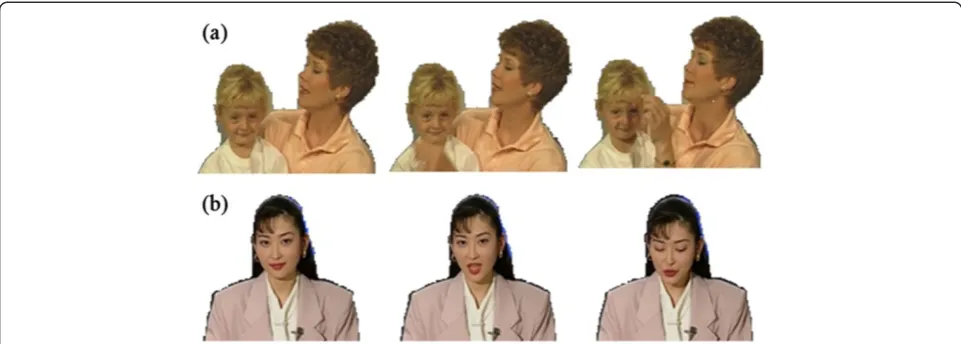
Both Figures 3 and 4c,f show the extraction results by the background subtraction method we presented above. The first three images in Figure 3a display the segmented results of frames 57, 59, and 64 in “mother– daughter” video sequence. The last three images in Figure 3b are the segmented results of frames 3, 14, and 47 in “Akiyo” video sequence, respectively. We can see clearly from Figure 3 that this new method is very applicable to the video sequence which does not have shadows on it.
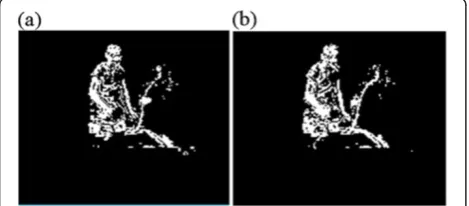
Figure 4 shows the extraction results of the 1st and 3rd frames of video sequence “Table”. As shown in Figure 5Sobel edge detection results of“Table”. (a)Sobel edge
detection result of the 1st frame of“Table”.(b)Sobel edge detection result of the 3rd frame of“Table”.
Figure 4, the existing of shadows seriously affects the ac-curacy of extraction, though the moving object keeps itself integrated. Therefore, the shadows must be elimi-nated to ensure the accuracy of extraction results.
Before the shadow removal, edge detection could be done on the foreground region which has been obtained. Figure 5 shows the binary images of Sobel edge detec-tion results of (c) and (f ) in Figure 4.
Through a large number of experiments and obser-vations, we can find that comparing with video objects edges, the shadow edges seem much simpler, they are adjacent to object points and most of them distribute mainly on the outer contour. Based on the attributes of shadow edges, first, we attempt to detect and eli-minate shadow edges based on the edge extraction including moving objects edges and shadows edges; second, the moving object can be reconstructed by the remaining edges. This method not only can
reduce the computational load greatly, but also be easier to detect shadows.
3. Shadow detection and removal
3.1. Shadow suppression in HSV
The existing approaches of shadow suppression based on the color characteristic are mainly concentrated in RGB and HSV color space. In RGB color space, human perception differences have less consistency with computational differences. Moreover, the correl-ation of the three components in RGB color space often leads to less effective detection. But these short-comings could be overcome in HSV color space. It indicates that HSV color space can reflect the inten-sity and color information better than RGB color space, and it has better color perception consistency in HSV color space. In shadow detection, relative to the pixels of background region, V component becomes
(a)
(b)
(c)
(d)
y_height of the first frame
pixels number
0 10 20 30 40 50
pixe ls positio n 0 20 40 60 80 100 120 140
x_width of the first frame
pixels position
0 20 40 60 80 100 120 140 160 180
pixels n umebe r 0 10 20 30 40 50 60
y_height of the third frame
pixels number
0 10 20 30 40 50
pixels p osition 0 20 40 60 80 100 120 140
x_width of the third frame
pixels position
0 20 40 60 80 100 120 140 160 180
pixels numbe r 0 10 20 30 40 50 60
smaller with big change, which is an important parameter for distinguishing shadows from foreground regions. S component has little value and its difference with the background will be negative. H component varies hardly. We first eliminate shadows in HSV color space according to the rules described in (8).
S xð;yÞ ¼
0 ifðα≤ðIVðx;yÞ=BVðx;yÞÞ≤β; ISðx;yÞ
BSðx;yÞ≤TS;and abs IðHðx;yÞ BHðx;yÞÞ≤THÞ
255 else
8 < :
ð8Þ
In (8),α,β,Ts,THare, respectively, the threshold of in-tensity, hue, and saturation (0 < α < β <1). Figure 6 shows the edge images of foreground of 1st and 3rd frames of“Table” after HSV shadow suppression, where α= 0.1,β= 0.9,Ts=TH= 0.2.
3.2 Shadow removal based on shadow position
In most instances, shadow suppression in HSV color space seems effective. However, this method is not reli-able when the background brightness is low or the back-ground has the similar chrominance with foreback-ground. Once the brightness of background is low, it is very difficult to distinguish all the shadows from background because its brightness will change a little when shadows cover on the background as shown in Figure 6. Meanwhile, some pixel points inside the moving object may be eliminated as shadow points.
To overcome the shortcomings of HSV suppression, we propose an approach based on the combination of shadow position and edge attributes after HSV suppres-sion which can be divided into five parts as shown in Figure 1.
As mentioned in Section 2, most shadow regions have less inner edges and the shadow edges mainly concentrate on the outer contour when the background has simple texture. After the shadow suppression in HSV color space, the outer contour edges of undetected shadow become much sparser. In addition, we find that the outer contour edges of shadows are usually adjacent to the moving ob-ject through many experiments and observations. The two points mentioned above are the shadow edge attribute and shadow position feature, respectively.
We can acquire the initial shadow position by propor-tion method based on the shadow posipropor-tion feature. Then the precise shadow pixels positions can be determined by the shadow edge attribute and then the remaining shadow can be eliminated further. The specific steps are as follows.
Step 1: Distribution statistics after HSV suppression
In order to locate shadow position, we should project each frame of edge video sequence PVOPalphan(j,i) to
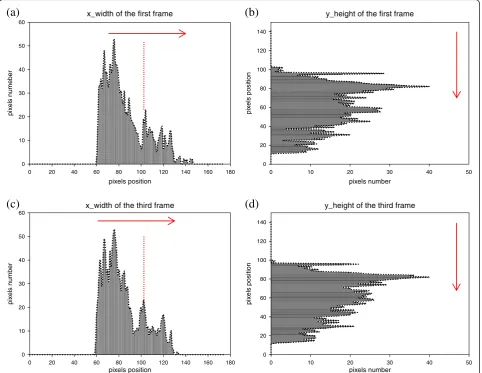
horizontal and vertical directions, respectively, as shown in Equation (9) after shadows have been eliminated ini-tially in HSV. Figure 7 reflects the distribution statistics results, from which the foreground pixels number of each row or each column can be seen clearly.
ifðpVOPalphanð Þ ¼¼j;i 255Þ Horizonataln½ ¼i Horizontaln½ þi 1;
Verticaln½ ¼j Verticaln½ þj 1;
ð9Þ
i∈½0;Height1; j∈½0;Width1; n∈½1;n NumFrame
ð Þ
Step 2: Estimate the approximate shadow position and determine the search direction
After projection in Step 1, some key positions should be found to get ready for determining shadow position and search direction. These key positions includein,minin,max corresponding to i when Horizontaln[i] is not zero and jn,min jn,max corresponding to j when Verticaln[j] is not
Figure 8Marks of key positions for horizontal search.
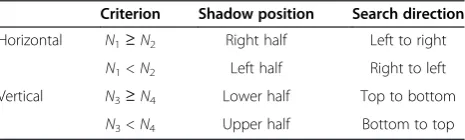
Table 1 Shadow position and search direction
Criterion Shadow position Search direction
Horizontal N1≥N2 Right half Left to right
N1<N2 Left half Right to left
Vertical N3≥N4 Lower half Top to bottom
zero as shown in Figure 8 which have marked in red. And then, count pixels number as follows:
N3¼ Σ
jn;minþjn;max
ð Þ=2
j¼jn;min
Verticaln½ j
N4¼ Σ
j¼ðjn;minþjn;maxÞ=2
jn;max
Verticaln½ j
ð10Þ
In accordance with shadow edges attribute, the ap-proximate shadow position can be judged preliminarily in the sparser part. Therefore, the corresponding rela-tionship between the shadow approximate position and search direction is shown in Table 1.
Step 3: Search for possible adjacent positions between shadows and moving objects
Shadow position feature denotes that shadow outer contour edges are usually adjacent to the moving objects. From Step 2 we have obtained search directions of each frame which have been marked by red arrows in Figure 7. So, the adja-cent position could be searched by the strategy as follows:
ifðHorizontaln½ i≠0 & &Horizontaln½iþm<10 ðm¼1;2;. . .;4;5ÞÞ
iHAdjacent¼i ð0≤¼i<heightÞ
if Verticalð n½ j≠0& & Verticaln½jþm<10 ðm¼1;2;. . .;4;5ÞÞ
jVAdjacent¼j ð0≤¼j<widthÞ
ð11Þ
When the probable adjacentiorjappears, stop search-ing and go to Step 4, otherwise continue searchsearch-ing.
Step 4: Remove the false adjacent position
The adjacent positions i or j got in Step 3 by Equation (11) are very possible to be the cuspidal points of moving
objects which are the false adjacent positions. These bad position points are supposed to be filtered out. The judg-ment rule based on proportion method is as follows.
true WidthΣ1
k¼j Verticaln½ k <T3
false WidthΣ1
k¼j Verticaln½ k ≥ T3
8 > > < > >
: ð
12Þ
Ifjin Equation (12) is a true adjacent position, we will reserve it, otherwise eliminate it. This circumstance is just an example of horizontal direction which supposes Figure 9The shadow removal results of Figure 9a without step 4 and with step 4. (a)The 98th frame of“Table”after HSV suppression.(b) The shadow removal result of(a)without Step 4.(c)The shadow removal result of(a)with Step 4.
Table 2 Selected video sequences
Video sequence type Name Frame size Frame numbers
Standard Table 176 × 144 150
Silent 352 × 288 300
Self shoot Men 352 × 288 150
Wait 352 × 288 150
that the shadow is in the right. Other seven cases should be judged according to the similar rules.
Step 5: Eliminate shadow edge points accurately
When the shadow position has been located accurately, count the pixel values of each line and column in hori-zontal and vertical directions of shadow region. In the shadow region, comparing the pixel values of each row or each column, once the number is smaller than the threshold obtained by experiments, then we remove the whole row or column by setting their values as zero in the edge image which got in Section 2 that the shadows will be eliminated from. That is the key to keep moving objects extracted completely. Figure 9 shows the shadow removal results without and with Step 3.
Finally, fill up the remaining moving object edges and process them with mathematical morphology, and then map the alpha plane to the moving object.
4. Experiment results and discussion
To verify the effectiveness of the proposed algorithm, we select two types of video sequences with shadow as dis-played in Table 2 to conduct experiments.
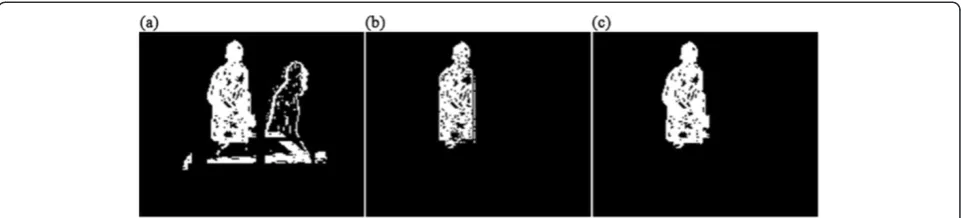
Figure 10 gives the shadow elimination result compari-son between the algorithm in [5] (only considering HSV color space) and the proposed algorithm for the 1st and 3rd frames of video sequence “Table”. Figure 11 gives the shadow elimination result comparison between the algorithm in [5] and the proposed algorithm for the 10th and 13th frames of video sequence“Silent”.
In Figure 10, the pixel values of the background and foreground have a high contrast. But, it varies little when shadow projects on the background. If we still suppress shadow just in HSV color space, some shadow edges will be considered as moving object edges.
In Figure 11, the background brightness varies little when shadow projects on the background, meanwhile the background is complex and close to the foreground color. This will cause the color invariability ineffective and result in some shadow edges miss-detected and wrong-detected, and then make some moving object edges to be eliminated as shadow edges wrongly. From the comparison results in Figures 10 and 11, it is obvi-ous that the proposed algorithm can overcome these problems successfully and extracts the complete moving object accurately and robustly.
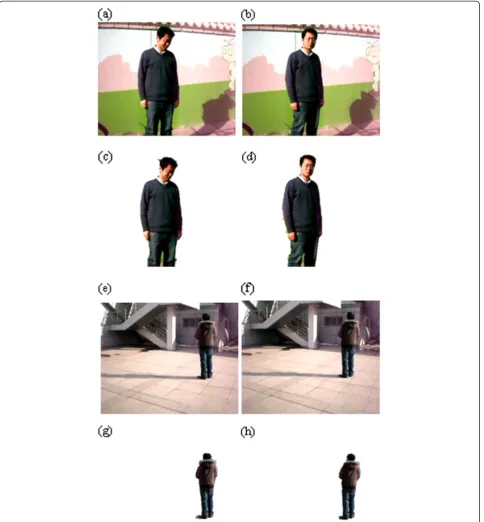
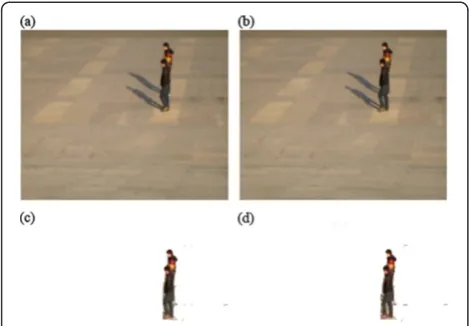
To validate the adaptability to shadow direction of the proposed algorithm further, we also shoot two video sequences which have shadows in different directions. The experimental results are shown in Figure 12.
The proposed algorithm can also be applied in more complex situation, such as in the case of multiple objects. The experimental results of video sequence “Men walk-ing”are shown in Figure 13.
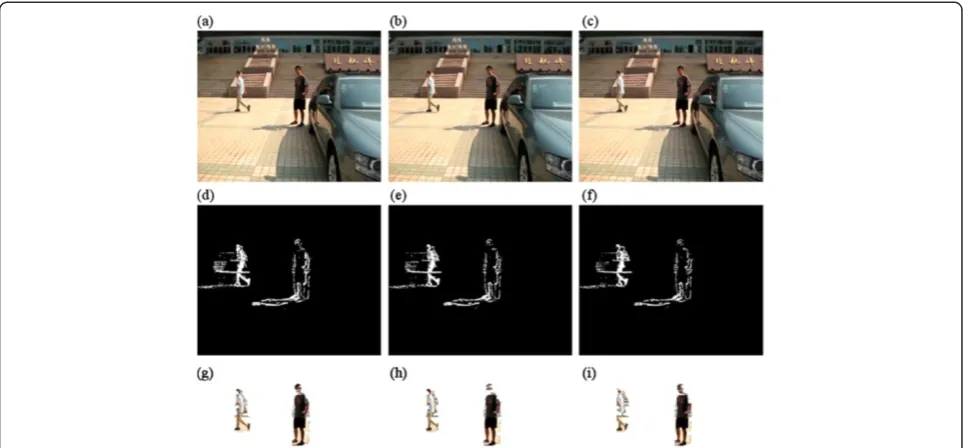
To further prove our algorithm in the case where shadows connect with other foreground objects and their shadows, we shoot another two video sequences: “Lamp man” and “Car men”. Both of these two sequences contain multiple objects and crossed sha-dows. The results are shown in Figures 14 and 15. It Figure 11Results of the 10th and 13th frames of“Silent”by using the algorithm in [5] and the proposed algorithm. (a)The 10th frame of“Silent”.(b)Result of the 10th frame of“Silent”by using the algorithm in [5].(c)Result of the 10th frame of“Silent”by using the proposed algorithm.(d)The 13th frame of“Silent”.(e)Result of the 13th frame of“Silent”by using the algorithm in [5].(f)Result of the 13th frame of
is obvious that our proposed method can effectively cope with such situations.
In order to test the proposed algorithm for its abil-ity in dealing with shadows of different directions, results of another three video sequences (“Ball man
noon when it is overcast, its shadows are very weak and much smaller comparing with the others. Appar-ently, the proposed method can also be applied in such circumstances. Results are shown in Figures 16, 17, and 18.
In order to evaluate the validity and effectiveness of the proposed algorithm objectively, we use the criterion
proposed by Wollborn and Mech [21] to judge the extracted results of the proposed algorithm. The video object mask spatial accuracy (SA) of each frame defined in this criterion is as follows:
SA¼1Σð Þx;y A est
t ðx;yÞ⊕A ref t ðx;yÞ
Σð Þx;yAreft ðx;yÞ
ð13Þ
Atref(x,y) andAtest(x,y) denote the video object mask of the reference frame and the VOP alpha mask we obtained respectively.⊕is “XOR”operation. SA reflects the level of similarity between the video object mask of the reference frame and the VOP alpha mask we obtained of each frame. Higher SA indicates more accur-ate segmentation, while lower SA indicaccur-ates poor result.
In this article, we get the reference video object masks by hand. Both Figures 19 and 20 display the SA of the first 15 frames of video sequence “Table” and “Silent” by using two different shadow elimin-ation methods.
It can clearly be seen from Figure 19 that, if we just suppress shadow in HSV, the SA which shifts from 0.11 to 0.38 is much smaller than that of the proposed algorithm which shifts from 0.62 to 0.80. In Figure 20, the SA even keeps above 0.90 of the proposed algorithm. All these indicate the validity and accuracy of the pro-posed algorithm.
Figure 13Results of“Men walking”by using the proposed algorithm. (a)The 37th frame of“Men walking”.(b)The 38th frame of“Men walking”.(c)Result of the 37th frame of“Men walking”by using the proposed algorithm.(d)Result of the 38th frame of“Men walking”by using the proposed algorithm.
Figure 14Results of“Lamp man”by using the proposed algorithm. (a)The 17th frame of“Lamp man”.(b)The 18th frame of“Lamp man”. (c)The 19th frame of“Lamp man”.(d)Result of 17th frame of“Lamp man”before the process of shadow elimination.(e)Result of 18th frame of
Figure 15Results of“Car men”by using the proposed algorithm. (a)The 2nd frame of“Car men”.(b)The 3rd frame of“Car men”.(c)The 4th frame of“Car men”.(d)Result of 2nd frame of“Car men”before the process of shadow elimination.(e)Result of 3rd frame of“Car men” before the process of shadow elimination.(f)Result of 4th frame of“Car men”before the process of shadow elimination.(g)Result of the 2nd frame of“Car men”by using the proposed algorithm.(h)Result of the 3rd frame of“Car men”by using the proposed algorithm.(i)Result of the 4th frame of“Car men”by using the proposed algorithm.
Figure 17Results of“Ball man B”by using the proposed algorithm. (a)The 5th frame of“Ball man B”.(b)The 6th frame of“Ball man B”. (c)The 7th frame of“Ball man B”.(d)Result of 5th frame of“Ball man B”before the process of shadow elimination.(e)Result of 6th frame of“Ball man B”before the process of shadow elimination.(f)Result of 7th frame of“Ball man B”before the process of shadow elimination.(g)Result of the 5th frame of“Ball man B”by using the proposed algorithm.(h)Result of the 6th frame of“Ball man B”by using the proposed algorithm. (i)Result of the 7th frame of“Ball man B”by using the proposed algorithm.
Figure 18Results of“Ball man C”by using the proposed algorithm. (a)The 21st frame of“Ball man C”.(b)The 22nd frame of“Ball man C”. (c)The 23rd frame of“Ball man C”.(d)Result of 21st frame of“Ball man C”before the process of shadow elimination.(e)Result of 22nd frame of
Tables 3, 4, 5, 6, 7, 8, 9, and 10 list the SA of extracted results by using the proposed method for the first 14 frames of video sequences “Men”, “Wait”, “Men walking”, “Lamp man”, “Car men”, “Ball man A”, “Ball man B”, and “Ball man C”, respectively.
Taking into consideration that parameters are set heuristically based on the test sequences, machine learn-ing techniques could be useful for strengthenlearn-ing the adaptability of parameter determination. Franek and Jiang [22] address the parameter selection problem in image segmentation and presents a novel unsupervised framework for automatically choosing parameters. A supervised learning algorithm for quantum neural net-works based on a novel quantum neuronnode
frame number
0 2 4 6 8 10 12 14 16
SA
0.0 0.2 0.4 0.6 0.8 1.0
shadow elimination result of Table in this paper HSV shadow suppresson result of Table
Figure 19The contrast SA of extracted VOP after using two different shadow elimination methods for“Table”from frame 1 to 15.
frame number
0 2 4 6 8 10 12 14 16
SA
0.6 0.7 0.8 0.9 1.0
shadow elimination result of Silent in this paper HSV shadow suppresson result of Silent
Figure 20The contrast SA of extracted VOP after using two different shadow elimination methods for“Silent”from frame 1 to 15.
Table 3 SA of“Men”from frame 1 to 14
Frame number SA Frame number SA
1 0.95861 8 0.94231
2 0.95509 9 0.94068
3 0.94365 10 0.93756
4 0.95671 11 0.93090
5 0.95828 12 0.92437
6 0.95099 13 0.90610
7 0.91660 14 0.88357
Table 4 SA of“Wait”from frame 1 to 14
Frame number SA Frame number SA
1 0.71666 8 0.76305
2 0.70474 9 0.66742
3 0.77763 10 0.68103
4 0.76703 11 0.68488
5 0.66944 12 0.65208
6 0.65043 13 0.65634
7 0.68501 14 0.69310
Table 5 SA of“Men walking”from frame 1 to 14
Frame number SA Frame number SA
1 0.61964 8 0.70842
2 0.70218 9 0.72362
3 0.72017 10 0.75352
4 0.62057 11 0.65328
5 0.69633 12 0.75350
6 0.61004 13 0.74318
7 0.68432 14 0.67887
Table 6 SA of“Lamp man”from frame 1 to 14
Frame number SA Frame number SA
1 0.68430 8 0.82165
2 0.69719 9 0.79509
3 0.70289 10 0.78900
4 0.72078 11 0.77558
5 0.74172 12 0.77272
6 0.76683 13 0.78399
implemented as a very simple quantum circuit is pro-posed and investigated in [23]. Methods like PSO, ML, and SVM are also well work in overcoming the inadapt-ability of parameters selection [24-26]. After researching these references relevant to machine learning, we will take the method of revised SVM into use in our future work in order to realize automatic and adaptive param-eter dparam-etermination.
5. Conclusion
In this article, we propose an effective background difference approach of shadow detection and suppres-sion based on shadow position and edge attributes after HSV shadow removal. Comparing with other methods, this method can locate various shadow posi-tions and remove them accurately even in the cases that the chrominance invariant principle is ineffective, or the color of background texture is similar to the color of moving objects. Meanwhile the proposed method can keep the completeness of the extracted moving object while the most color-based shadow re-moval methods cannot work well. The results of the experiments also demonstrate that the proposed me-thod is simple and robust.
Competing interests
The authors declare that they have no competing interests.
Acknowledgments
The authors would like to express their appreciation to the anonymous reviewers for their insightful comments, which help improving this article. The study was supported by the National Natural Science Foundation of China (NSFC) under Grants nos. 61075011 and 60675018, also the Scientific Research Foundation for the Returned Overseas Chinese Scholars from the State Education Ministry of China.
Received: 20 July 2011 Accepted: 19 November 2012 Published: 10 December 2012
References
1. H Jiang, H Ardö, V Öwall, A hardware architecture for real-time video segmentation utilizing memory reduction techniques. IEEE Trans. Circuits Syst. Video Technol.19(2), 226–235 (2009)
2. SS Huang, LC Fu, PY Hsiao, Region-level motion-based foreground segmentation under a Bayesian network. IEEE Trans. Circuits Syst. Video Technol.19(4), 522–531 (2009)
3. Y Wang, Real-time moving vehicle detection with cast shadow removal in video based on conditional random field. IEEE Trans. Circuits Syst. Video Technol.19(3), 437–441 (2009)
4. W Christopher, Richard, A Ali, D Trevor, P Alex. Pfinder: real-time tracking of the human body. IEEE Trans. Pattern Anal. Mach. Intell.
19(7), 780–785 (1997)
5. H Yong, JW Tian, Y Chu, QL Tang, J Liu, Spatiotemporal smooth models for moving object detection. IEEE Signal Process. Lett.15, 497–500 (2008) 6. JM McHuch, J Konrad, V Saligrama, J Pieree-Marc, Foreground-adaptive
background subtraction. IEEE Signal Process. Lett.16(5), 390–393 (2009) 7. SY Chien, SY Ma, LG Chen, Efficient moving object segmentation
algorithm using background restoration technique. IEEE Trans. Circuits Syst. Video Technol.12(7), 577–586 (2002)
8. I Haritaoglu, D Harwood, LS Davis, W4: real-time surveillance of people and their activities. IEEE Trans. Pattern Anal. Mach. Intell.22(8), 809–830 (2000) 9. DM Tsai, SC Lai, Independent component analysis-based background
subtraction for indoor surveillance. IEEE Trans. Image Process.18(1), 158–167 (2009)
Table 8 SA of“Ball man A”from frame 1 to 14
Frame number SA Frame number SA
1 0.61439 8 0.52659
2 0.69350 9 0.54150
3 0.68585 10 0.53528
4 0.64878 11 0.58532
5 0.67616 12 0.57267
6 0.65152 13 0.64483
7 0.52030 14 0.72007
Table 9 SA of“Ball man B”from frame 1 to 14
Frame number SA Frame number SA
1 0.63101 8 0.69870
2 0.66835 9 0.69798
3 0.64873 10 0.67867
4 0.68583 11 0.67290
5 0.68347 12 0.65459
6 0.67429 13 0.64195
7 0.67652 14 0.62116
Table 10 SA of“Ball man C”from frame 1 to 14
Frame number SA Frame number SA
1 0.67083 8 0.82519
2 0.61804 9 0.84115
3 0.68857 10 0.87843
4 0.66784 11 0.84514
5 0.67092 12 0.83298
6 0.74328 13 0.90959
7 0.84979 14 0.88732
Table 7 SA of“Car men”from frame 1 to 14
Frame number SA Frame number SA
1 0.66703 8 0.59044
2 0.56089 9 0.51441
3 0.56109 10 0.46840
4 0.61166 11 0.49626
5 0.62941 12 0.50759
6 0.67986 13 0.47656
10. M Piccardi, Background subtraction techniques:a review, in IEEE International Conference on Systems, Man and Cybernetics, vol. 4 (10-13 Oct., 2004),pp. 3099–3104
11. A Prati, I Mikic, MM Trivedi, R Cucchiara, Detecting moving shadows: algorithms and evaluation. IEEE Trans. Pattern Anal. Mach. Intell.
25(7), 918–923 (2003)
12. S Nadimi, B Bhanu, Physical models for moving shadow and object detection in video. IEEE Trans. Pattern Anal. Mach. Intell.
26(8), 1079–1087 (2004)
13. J Stauder, R Mech, J Ostermann, Detection of moving cast shadows for object segmentation. IEEE Trans. Multimed.1(1), 65–76 (1999) 14. P-M Jodoin, M Mignotte, J Konrad, Statistical background subtraction
using spatial cues. IEEE Trans. Circuits Syst. Video Technol.
17(12), 1758–1763 (2007)
15. R Cucchiara, C Grana, M Piccardi, A Prati, S Sirotti, Improving shadow suppression in moving object detection with HSV color information, in Proceedings of the IEEE Intelligent Transportation Systems Conference (Oakland, CA), 25-29 Aug 2001, pp. 334–339.
16. JD Tian, J Sun, YD Tang, Tricolor attenuation model for shadow detection. IEEE Trans. Image Process.18(10), 2355–2363 (2009)
17. VJD Tsai, A comparative study on shadow compensation of color aerial images in invariant color models. IEEE Trans. Geosci. Remote Sens.
44(6), 1661–1671 (2006)
18. YH Lu, HJ Xin, J Kong, BB Li, Y Wang, Shadow removal based on shadow direction and shadow attributes,in Proceedings of the IEEE International Conference on Computational Intelligence for Modeling Control and
Automation(Sydney, NSW), Nov. 28 2006-Dec. 1, 2006, pp. 37–41.
19. X Pan, Moving shadow detection based on color information and edge features. J. Zhejiang Univ. (Engineering Science).38(4), 389–391 (2004) 20. R Cucchiara, C Grana, M Piccardi, A Prati, Detecting moving objects,
ghosts and shadows in video streams. IEEE Trans. Pattern Anal. Mach. Intell.25(10), 1337–1342 (2003)
21. M Wollborn, R Mech, Refined procedure for objective evaluation of video object segmentation algorithms. Doc. ISO/IEC JTC1/SC29/WG11/ M3448, March (1998).
22. L Franek, X Jiang, Adaptive parameter selection for image segmentation based on similarity estimation of multiple segmenters. Lecture Notes Comput. Sci.6493, 697–708 (2011)
23. AJ da Silva, WR de Oliveira, TB Ludermir, Classical and superposed learning for quantum weightless neural networks. Neurocomputing.
75(1), 52–60 (2012)
24. AB de Carvalho, A Pozo, Measuring the convergence and diversity of CDAS multi-objective particle swarm optimization algorithms: a study of many-objective problems. Neurocomputing.75(1), 43–51 (2012) 25. AC Lorena, IG Costa, N Spolaor, MCP de Souto, Analysis of complexity
indices for classification problems: cancer gene expression data. Neurocomputing.75(1), 33–42 (2012)
26. TAF Gomes, RBC Prudencio, C Soares, ALD Rossi, A Carvalho, Combining meta-learning and search techniques to select parameters for support vector machines. Neurocomputing.75(1), 3–13 (2012)
doi:10.1186/1687-5281-2012-22
Cite this article as:Zhuet al.:Shadow removal with background
difference method based on shadow position and edges attributes.
EURASIP Journal on Image and Video Processing20122012:22.
Submit your manuscript to a
journal and benefi t from:
7Convenient online submission
7Rigorous peer review
7Immediate publication on acceptance
7Open access: articles freely available online
7High visibility within the fi eld
7Retaining the copyright to your article
![Figure 11 Results of the 10th and 13th frames of “Silent” by using the algorithm in [5] and the proposed algorithm](https://thumb-us.123doks.com/thumbv2/123dok_us/915369.1589402/8.595.59.539.89.296/figure-results-frames-silent-using-algorithm-proposed-algorithm.webp)