A Randomized, Controlled Trial Comparing Two Different Continuous
Positive Airway Pressure Systems for the Successful Extubation of
Extremely Low Birth Weight Infants
Beatrice M. Stefanescu, MD*; W. Paul Murphy, MD‡; Brenda J. Hansell, RT, CCRC*; Mamta Fuloria, MD*; Timothy M. Morgan, PhD§; and Judy L. Aschner, MD*
ABSTRACT. Objective. To determine whether the use of the Infant Flow continuous positive airway pressure (IF CPAP) system reduces the rate of extubation failure among extremely low birth weight (ELBW) infants (in-fants with birth weight <1000 g) when compared with conventional CPAP delivered with a conventional venti-lator and nasal prongs.
Methods. A prospective, unmasked, randomized, controlled clinical trial was conducted in 162 eligible intubated ELBW infants who were hospitalized in 2 in-tensive care nurseries in Winston-Salem, North Carolina, between July 1997 and November 2000. Successful extu-bation was defined as no need for reintuextu-bation for any reason for at least 7 days after the first extubation at-tempt.
Results. The individual extubation success rates were 61.9% (52 of 84) in the conventional CPAP group and 61.5% (48 of 78) in the IF CPAP group. There were no significant differences in the extubation success rate in any birth weight subset between the 2 cohorts. The most common cause of extubation failure was apnea/bradycar-dia. Infants who were randomized to IF CPAP had fewer days on supplemental O2and shorter hospital stays.
Conclusions. Extubation failure is a common prob-lem, occurring in nearly 40% of ELBW infants who re-quire mechanical ventilation. IF CPAP was as effective but no more effective than conventional CPAP in pre-venting extubation failure among ELBW infants. New strategies are needed to identify predictors of extubation success and to treat apnea/bradycardia, the most common cause of extubation failure, thereby reducing the likeli-hood of prolonged intubation in this high-risk cohort of premature infants.Pediatrics2003;112:1031–1038; contin-uous positive airway pressure, extremely low birth weight, extubation, Infant Flow CPAP.
ABBREVIATIONS. ELBW, extremely low birth weight; BPD, bronchopulmonary dysplasia; NCPAP, nasal continuous positive airway pressure; IF, Infant Flow; BW, birth weight; Fio2, fraction
of inspired oxygen; NIPPV, nasal intermittent positive pressure ventilation.
P
rolonged intubation and mechanical ventila-tion of extremely low birth weight (ELBW) infants is associated with upper airway trauma and development of bronchopulmonary dysplasia (BPD).1Extubation of ELBW infants to nasal contin-uous positive airway pressure (NCPAP) has been shown to decrease the need for reintubation, thereby reducing these ventilator-associated risks.2– 4 CPAP has also been shown to reduce atelectasis, improve ventilation-perfusion matching, and reduce apnea of prematurity.5,6Various systems for delivering CPAP are avail-able, but there is little evidence for the superiority of one system over another.7–10 The Infant Flow (IF) CPAP system (Electro Medical Equipment Ltd, Sus-sex, England), invented in Sweden in the 1980s by Moa and Nielson and approved for use in the United States in 1995, uses a dedicated driver and generator with unique fluid mechanics to adjust the gas flow throughout the respiratory cycle. The fluid flip action of the IF generator has been reported to assist spon-taneous breathing and reduce the work of breathing by reducing expiratory resistance and maintaining a stable airway pressure throughout respiration.11–14 However, published reports on the efficacy or supe-riority of IF CPAP have been confined to laboratory studies using a test lung or clinical studies of brief duration with measurements of pulmonary function as the only endpoints.11–17Nevertheless, this techno-logically novel device is gaining widespread accep-tance in European and North American nurseries18 without supporting evidence from randomized, con-trolled clinical trials of the efficacy or superiority of IF CPAP versus other CPAP delivery systems for facilitating extubation or preventing the need for mechanical ventilation.
The present study was designed to test the hypoth-esis that the use of the IF CPAP system will reduce the extubation failure rate, defined as no need for reintubation within 7 days of extubation, among ELBW infants by 50% (from 40% to 20%) when com-pared with conventional CPAP delivered by a me-chanical ventilator and INCA prongs (Ackrad Labo-ratories, Inc, Cranford, NJ). Secondary outcome measures included death, survival without BPD, and the length of hospital stay.
From the Departments of *Pediatrics, ‡Anesthesia, and §Public Health Services, Wake Forest University School of Medicine, Winston-Salem, North Carolina.
Received for publication Jan 13, 2003; accepted Apr 24, 2003.
Reprint requests to (J.L.A.) Department of Pediatrics, Wake Forest Univer-sity School of Medicine, Medical Center Blvd, Winston-Salem, NC 27157-1081. E-mail: [email protected]
METHODS
A retrospective chart review of 30 infants who had birth weight (BW)ⱕ1000 g and were treated in 2 intensive care nurseries under the management of neonatologists from Wake Forest University School of Medicine demonstrated a 40% extubation failure rate, consistent with the published literature.3,5,19,20Power analysis
in-dicated that a cohort of 162 infants would be needed to demon-strate a 50% reduction in extubation failure from 40% to 20%, with a power of 0.8 and an␣-error of 0.05.
Patients, Randomization, and Study Criteria
A prospective, unmasked, randomized, controlled trial of IF CPAP versus conventional CPAP for successful extubation was initiated in 1997 in consecutive eligible ELBW infants in the inten-sive care nurseries at Brenner Children’s Hospital and Forsyth Medical Center in Winston-Salem, North Carolina. Between July 1997 and November 2000, 162 ELBW infants were assigned using a table of random numbers and sealed opaque envelopes to either IF CPAP or conventional CPAP and stratified into 3 BW blocks as follows:ⱕ600 g, 601 to 800 g, and 801 to 1000 g. Randomization occurred after informed consent had been obtained from the in-fant’s parent or legal guardian and close to the time of the inin-fant’s first extubation attempt. In the rare circumstance when an infant was randomized but not immediately extubated, the randomiza-tion card was marked with indelible ink and kept in the study notebook at the respiratory therapy desk in the nursery until extubation occurred. CPAP was delivered per randomization as-signment with either IF CPAP or “conventional CPAP” using INCA prongs and a time-cycled, pressure-limited ventilator. Our study design precluded crossover between the CPAP delivery systems.
The primary endpoint was a reduction in the percentage of infants who failed extubation, defined as no need for reintubation for 168 hours (7 days). Secondary endpoints were death, survival without BPD, number of days on CPAP, days on supplemental oxygen, and length of hospitalization. Potential confounders of extubation success, such as necrotizing enterocolitis, patent ductus arteriosus, sepsis, and intracranial hemorrhage, were also com-pared between the 2 groups.
Study entry criteria included BWⱕ1000 g, need for mechanical ventilation, first extubation attempt, and signed parental consent. Exclusion criteria included major chromosomal anomalies, known airway anomalies, neuromuscular disorders, other major congen-ital malformations, and participation in a concurrent randomized clinical trial. Regardless of gestational age or BW, the suggested criteria for a mandatory trial of extubation included respiratory stability for 12 to 24 hours on minimal ventilatory settings, defined as mean airway pressure ⱕ5 cm on conventional mechanical ventilation or ⱕ7 cm on high-frequency ventilation, with pH ⱖ7.25, Pco2ⱕ65 torr, and fraction of inspired oxygen (Fio2)ⱕ0.3.
Infants could be extubated from higher levels of support at at-tending discretion. The study protocol included administration of methylxanthine therapy before extubation. Infants were extubated to CPAP of 4 to 6 cm H2O and were to remain on their assigned
CPAP device for a minimum of 24 hours. CPAP was discontinued when the infants were stable on CPAP of 4 cm H2O and Fio2ⱕ0.3
and the patient was having⬍5 apneic episodes per day. Extubation failure was defined as the need for reintubation and mechanical ventilation for any reason within 168 hours of initial extubation. Patients were reintubated when they exhibited arterial hemoglobin saturations⬍88% while receiving Fio2ⱖ0.50, arterial
CO2ⱖ65 torr with arterial pH⬍7.25, the need for CPAP⬎8 cm of
H2O, or recurrent significant apnea or bradycardia requiring
bag-mask ventilation or vigorous stimulation. Infants who deterio-rated after CPAP was discontinued were placed back on their initially assigned CPAP system unless immediate reintubation and mechanical ventilation was deemed necessary. Infants who failed their initial extubation attempt and required reintubation were extubated on subsequent attempts to the CPAP system to which they were initially randomized.
Cranial ultrasounds were performed on all infants on days 7 and 42 of life or more frequently as clinically indicated. Cranial ultrasounds were read by radiologists who were masked to the infants’ randomization assignment. Radiographs, blood cultures, and echocardiography were done when clinically indicated. Ma-ternal and infant demographic data, birth history, chest
radio-graphs, cranial ultrasound reports, pharmacy records, and respi-ratory data were collected.
Study Definitions
Air leaks were documented by evidence of pneumothorax, pneumomediastinum, or pulmonary interstitial emphysema on chest radiograph. Patent ductus arteriosus was documented by echocardiography. Intraventricular hemorrhage was determined according to Papile’s classification of cranial ultrasound findings of echodensity in the germinal matrix or ventricular extension. Periventricular leukomalacia was defined by development of periventricular cysts identified by cranial ultrasound. Sepsis was diagnosed by a positive blood culture or suggestive clinical and laboratory presentation resulting in a clinical decision to treat with antibiotics for at least 7 days despite the absence of a positive blood culture. Necrotizing enterocolitis was defined as stage 2 or higher as per modified Bell’s criteria.21Retinopathy of
prematu-rity was defined as per the international classification.22BPD was
defined as an oxygen dependence at 36 weeks’ postmenstrual age in association with characteristic radiograph changes.
Statistical Methods and Data Analysis
Patient characteristics were summarized using observed pro-portions and means, standard deviations, and ranges. Compari-sons between categorical outcomes and patient characteristics be-tween the 2 CPAP groups were tested using Fisher exact test. Comparisons between continuous measures between the 2 CPAP groups were tested using thettest. Time to reintubation among the infants with extubation failure in each CPAP group was de-picted using Kaplan-Meier plots, and comparison of time on CPAP was tested using the log-rank statistics.
Ethics
The research protocol for this study was approved by the Institutional Review Boards of the Wake Forest University School of Medicine and Forsyth Medical Center. The procedures followed were in accordance with the Helsinki Declaration of 1975 as re-vised in 1983.
RESULTS
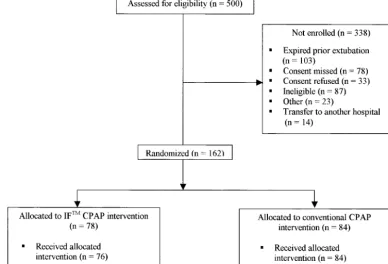
Between July 1997 and November 2000, 500 infants who were ⱕ1000 g at birth were admitted to the intensive care nurseries at Brenner Children’s Hos-pital and Forsyth Medical Center (Fig 1). Of these, 162 infants fulfilled the study entry criteria and were enrolled in our study. Among the 338 nonenrolled infants, 33% (n⫽103) died before their first extuba-tion attempt, 23% (n ⫽ 78) were extubated before consent was obtained, 10% (n ⫽ 33) of parents re-fused participation, 25% (n ⫽ 87) were ineligible either because they were enrolled in a competing study (15%,n⫽52) or they met the other ineligibility criteria (10%; n ⫽ 35). In 7% (n ⫽ 23), there were other reasons for nonenrollment (study enrollment ended before extubation, nares were too small, phy-sician chose IF CPAP, error of enrollment, or consent deferred because of maternal illness or unavailabil-ity), and 4% (n ⫽ 14) of infants were transferred to another hospital (Fig 1).
Per study protocol, methylxanthine administration should have been given before the initial extubation attempt. However, 10 infants were extubated before methylxanthine administration. Of these 10 infants, all 3 in the IF CPAP group and 4 of the 7 infants in the conventional CPAP group were extubated suc-cessfully; the remaining 3 infants in the conventional CPAP group failed extubation because of a need for
⬎8 cm H2O CPAP to maintain arterial hemoglobin saturations above 88%.
To address other potential confounders of extuba-tion failure, we compared the rates of other compli-cations of prematurity. As shown in Table 3, the 2 groups were comparable with respect to their clinical
outcomes. Fewer infants received bronchodilators in the IF CPAP group (8%) compared with conven-tional CPAP group (19%), which did reach statistical significance (P⫽ .04).
The overall extubation success rate in the com-bined cohort was 61.7%. There were no significant differences between the infants who were random-ized to the IF system and the conventionally deliv-ered CPAP system with respect to the primary out-come variable of successful extubation. Among the infants in the IF CPAP group, 61.5% (48 of 78 pa-tients) remained extubated, whereas in the conven-tional CPAP group, 61.9% (52 of 84 patients) were extubated successfully. Both of these results
approx-Fig 1. Flow diagram of ELBW infants who were screened and randomly assigned to the IF CPAP and conventional CPAP groups, adapted from the Consort Statement.23The number of infants excluded and the reasons for nonenrollment are provided. Two infants in
the IF CPAP group did not receive the allocated treatment (1 infant died after randomization but before extubation, and 1 was extubated directly to nasal cannula). Statistical analysis was by “intention to treat.”
TABLE 1. Maternal Baseline Characteristics
Maternal Characteristics Conventional CPAP
(n⫽84)
IF CPAP (n⫽78) Age (y)
Mean⫾SD 26.7⫾6.2 25.5⫾6
Range 14–40 14–39
Ethnicity (n[%])
White 39 (46%) 46 (59%)
Black 38 (45%) 28 (36%)
Asian 1 (0.1%) 1 (0.1%)
Hispanic 4 (0.5%) 2 (0.2%)
Other 2 (0.2%) 1 (0.1%)
Antenatal steroids (n[%])
Complete 38 (45.2%) 36 (46.1%)
Incomplete 21 (25.0%) 16 (20.5%)
None 22 (26.2%) 21 (26.9%)
Unknown 3 (3.6%) 5 (6.4%)
Chorioamnionitis (%) 12 (15%) 11 (13%)
Preeclampsia/eclampsia (n[%]) 22 (26%) 16 (20%)
Cesarean section (n[%]) 46 (54.7%) 49 (62.8%)
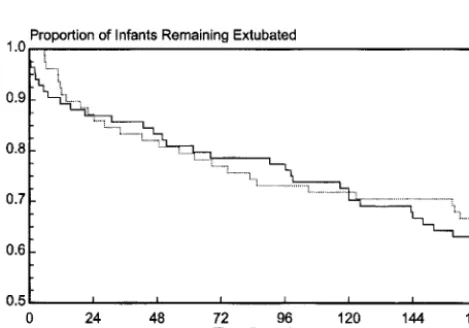
imated our historical control finding of a 40% extu-bation failure rate among infants with BWⱕ1000 g. Figure 2 is a Kaplan-Meier curve depicting the time
to reintubation among the infants who failed extu-bation in each CPAP group. There were no signifi-cant differences in the time to reintubation among the 2 groups.
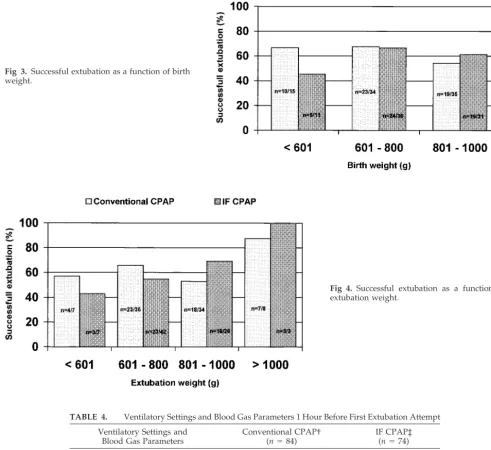
Figure 3 shows the percentage of infants who were extubated successfully as a function of BW. We did not find any statistical differences between the 2 CPAP groups among the 3 BW categories: ⱕ600 g, 601 to 800 g, and 801 to 1000 g. The mean weight at extubation was higher among infants in the conven-tional CPAP group (828⫾195 g vs 781⫾135 g in the IF CPAP group), and infants in the conventional CPAP group were slightly older (mean age at extu-bation: 16.6 ⫾ 19.1 days in the conventional CPAP group and 13 ⫾ 13.3 days in the IF CPAP group), although these differences were not statistically sig-nificant.
We found no significant differences between the 2 CPAP groups as a function of extubation weight (Fig 4). Infants who weighedⱕ600 g were as likely to be extubated successfully as infants who weighed 601 to 1000 g. Infants who weighed⬎1000 g at the time of extubation had a 92% likelihood of being extubated successfully.
As shown in Table 4, there were no significant
Fig 2. Kaplan-Meier curve depicting the time course of extuba-tion failure among infants in each CPAP group who required reintubation within the first 7 days (168 hours). Approximately 40% of infants in both groups were reintubated by 168 hours. Almost 15% of all infants, or approximately 35% of infants who failed the first extubation attempt, required reintubation within 24 hours.
TABLE 2. Infant Baseline Characteristics
Infant Characteristics Conventional CPAP
(n⫽84)
IF CPAP (n⫽78) BW (g)
Mean⫾SD 755⫾155 744⫾123
Range 406–1000 440–985
Gestational age (wk)
Mean⫾SD 25.7⫾2.0 25.9⫾1.5
Range 22–31 23–29
Male sex (n[%]) 35 (42%) 33 (42%)
Singleton (n[%]) 63 (75%) 64 (82%)
CRIB score
Mean⫾SD 7.4⫾4.4 7.9⫾3.8
Range 1–17 1–16
Surfactant therapy (n[%]) 82 (98%) 78 (100%)
1-minute Apgar score (mean⫾SD) 4.2⫾2.4 4.5⫾2.5
5-minute Apgar score (mean⫾SD) 6.5⫾2.1 6.3⫾2.2
CRIB indicates Clinical Risk Index for Babies.
TABLE 3. Clinical Outcomes in the Conventional CPAP and IF CPAP Groups
Outcome Conventional CPAP
(n⫽84)
IF CPAP (n⫽78)
PDA treated with indomethacin (n[%]) 48 (59%) 43 (55%)
PDA ligation (n[%]) 13 (15%) 6 (8%)
Sepsis (n[%]) 70 (83%) 66 (85%)
Postnatal steroids for BPD (n[%]) 53 (63%) 44 (56%)
Diuretics (n[%]) 57 (68%) 46 (59%)
Bronchodilators (n[%]) 16 (19%) 6 (8%)
NEC (n[%]) 15 (18%) 18 (23%)
PIE (any grade;n[%]) 17 (20%) 20 (26%)
Gross air leak (n[%]) 10 (12%) 4 (5%)
ROP (n[%]) 72 (86%) 60 (77%)
Surgery (n[%]) 9 (11%) 6 (8%)
IVH (grades 1 and 2;n[%]) 17 (20%) 13 (17%)
IVH (grades 3 and 4;n[%]) 14 (17%) 11 (14%)
PVL (n[%]) 5 (6%) 3 (4%)
Ventriculomegaly (n[%]) 25 (30%) 24 (31%)
differences between the 2 CPAP groups with respect to blood gas parameters or ventilator settings in the hour before first extubation attempt. Eleven (13%) infants in the conventional CPAP group and 13 (17%) infants in the IF CPAP group were extubated directly from high-frequency ventilation. One infant in each group was extubated from the Bunnell Life Pulse high-frequency jet ventilator; the other infants were extubated directly from the SensorMedics 3100A high-frequency oscillatory ventilator.
There were no statistical differences between the groups with respect to the outcomes of death, sur-vival without BPD, or total number of days on CPAP
(including initial and subsequent extubation at-tempts) as shown in Table 5. However, infants who were randomized to IF CPAP had fewer days on supplemental O2(P⫽ .03), and their length of hos-pitalization was shorter (P⫽ .017).
The reasons for extubation failure are depicted in Fig 5. As shown, the most common reason for extu-bation failure was apnea and bradycardia, occurring in almost 60% of the infants who required reintuba-tion. Nearly equal numbers of infants required retubation because of inadequate oxygenation and in-adequate ventilation on NCPAP (approximately 15% in each category).
Fig 3. Successful extubation as a function of birth weight.
Fig 4. Successful extubation as a function of extubation weight.
TABLE 4. Ventilatory Settings and Blood Gas Parameters 1 Hour Before First Extubation Attempt
Ventilatory Settings and Blood Gas Parameters
Conventional CPAP† (n⫽84)
IF CPAP‡ (n⫽74)
Fio2(mean⫾SD) 0.33⫾0.11 0.33⫾0.10
MAP
CMV (mean⫾SD) 4.5⫾1.2 4.6⫾1.5
HFOV* (mean⫾SD) 7.5⫾2 7⫾1.5
Blood pH (mean⫾SD) 7.36⫾0.06 7.34⫾0.06
Blood Pco2(mean⫾SD) 46.6⫾11.9 47.2⫾11.8
MAP indicates mean airway pressure; CMV, conventional mechanical ventilation; HFOV, high-frequency oscillatory ventilation.
DISCUSSION
This prospective, randomized, controlled trial is the largest published study to examine extubation outcomes in infants with BW ⱕ1000 g. This is also the first published randomized, controlled trial to compare IF CPAP with conventional CPAP to facil-itate successful extubation of ELBW infants. In this study, we showed that infants who were extubated to IF CPAP were as likely but no more likely to be extubated successfully than infants who were placed on conventional CPAP using nasal prongs and a pressure/time-limited ventilator (61.5% vs 61.9%, re-spectively). Similar to our retrospective analysis and similar to the data available in the literature,3,5,20the failure rate at the time of first extubation attempt for infants with a BWⱕ1000 g was approximately 40%. The study patients were well matched in terms of BW, gestational age, and sex, as well as severity of illness (using Clinical Risk Index for Babies score as a surrogate marker) as shown in Table 2. Although the infants in the conventional CPAP group had a higher mean weight at extubation (828 ⫾ 195 g vs 781⫾135 g in the IF CPAP group) and were older at the time of initial extubation attempt (16.4 ⫾ 18.8 days vs 12.9⫾13.2 days in the IF CPAP group), these differences did not reach statistical significance. We did not find any statistical difference in the rate of successful extubation between the 2 CPAP groups among 3 BW subcategories:ⱕ600 g, 601 to 800 g, and 801 to 1000 g (Fig 3). Among the infants who weighed ⱕ600 g at the time of first extubation at-tempt, 50% (7 of 14 infants) were extubated success-fully, a percentage that was similar to the 60%
suc-cess rate (82 of 137 infants) among those who weighed 601 to 1000 g (P⫽ .77). Infants with extu-bation weight⬎1000 g had⬎90% likelihood of suc-cessful extubation (Fig 4). The ventilator settings and blood gas parameters 1 hour before the first extuba-tion attempt were nearly identical in both groups (Table 4).
The number of surviving ELBW infants who re-quire prolonged mechanical ventilation has in-creased in the past decade.24 Efforts to limit the duration of intermittent positive pressure ventilation led to attempts at early weaning of ventilatory sup-port to decrease morbidity and mortality. Early ex-tubation of ELBW infants is fraught with difficulties because of upper airway instability, relatively poor respiratory drive, compliant chest wall, alveolar at-electasis and residual lung damage. CPAP, applied by various means and devices,3,7,25is frequently used to wean infants from mechanical ventilation. Many studies have shown that NCPAP is more beneficial than oxyhood2,4,9,25–28 by preventing atelectasis, de-creasing the frequency of apnea/bradycardia epi-sodes, and improving lung function. However, the use of endotracheal CPAP before extubation proved to be more deleterious than extubation directly to NCPAP,27,29,30 particularly among the smallest in-fants.
Several published studies have investigated the efficacy of weaning infants from mechanical tion to nasal intermittent positive pressure ventila-tion (NIPPV) compared with NCPAP. Most studies that evaluated NIPPV had a small sample size.6,20 Ryan et al,31 when studying the advantages of
Fig 5. Reasons for extubation failure.
TABLE 5. Secondary Outcomes of Death Survival Without BPD, Days on CPAP, and Days on Supplemental Oxygen
Secondary Outcome Conventional CPAP
(n⫽84)
IF CPAP (n⫽78)
PValue
Death (n[%]) 3 (4%) 8 (10%) .12
Survival without BPD (n[%]) 31 (37%) 30 (38%) .87
Days on CPAP
Mean⫾SD 10.17⫾8.53 8.74⫾8.04 .27
Range 0.06–37.79 0–36.32
Supplemental O2(d)
Mean⫾SD 77.2⫾35.1 65.7⫾31.4 .03
Range 0.5–224 3–147
Length of stay (d)
Mean⫾SD 86.3⫾37.34 73.7⫾28.7 .017
NIPPV over NCPAP, showed no benefit of NIPPV in the treatment of apnea of prematurity. However, the study endpoint encompassed only a short time pe-riod of 6 hours after extubation. Lin et al6 found decreased apnea in infants who were on NIPPV dur-ing a 4-hour observation period.
Recently, in a prospective randomized study, Khalaf et al5found synchronized NIPPV to be more effective than NCPAP in weaning infants with respi-ratory distress syndrome from mechanical ventila-tion. The extubation success rate in the synchronized NIPPV group was 94% at 72 hours postextubation. Despite a higher mean gestational age and mean weight at extubation in the Khalaf et al study, the rate of successful extubation at 72 hours in the NCPAP group was identical (60%) to our findings at 7 days. Although the results are encouraging, larger prospective studies are needed to evaluate the safety and efficacy of this technique in ELBW infants.32 Future studies should include additional endpoints such as survival without BPD, length of hospital stay, incidence of complications such as gastrointes-tinal perforation and nosocomial infections, and long-term survival and developmental outcomes.
Despite no difference in our primary outcome of successful initial extubation attempt or in the total number of days on NCPAP, infants in the IF CPAP group had fewer total days on supplemental O2and shorter lengths of hospitalization. If future studies confirm this association, then there may be a cost advantage to the use of IF CPAP.
Extubation failure remains a common clinical problem among ELBW infants. In our study, apnea/ bradycardia was the most common reason for extu-bation failure in both CPAP groups. In our combined cohort, 58% of ELBW infants who failed extubation did so because of apnea and bradycardia episodes. This finding is consistent with that of another re-ported study.33 Methods for preventing apnea and bradycardia have been the subject of a number of studies. The use of prophylactic methylxanthines for extubation in ELBW infants has been shown to re-duce the frequency and/or severity of apnea/brady-cardia in larger preterm infants34,35 but does not eliminate the problem entirely, and questions about safety remain unresolved.36 Several studies have shown that NIPPV can be an effective therapeutic tool for decreasing apnea of prematurity.
CONCLUSIONS
We found no difference in the rate of extubation failure between the IF CPAP and conventional CPAP groups. Innovative approaches to the postextubation treatment of these infants are needed. Novel inter-ventions that reduce the frequency of apnea and bradycardia are likely to reduce extubation failure among this population of vulnerable infants.
ACKNOWLEDGMENTS
This study was supported by the Wake Forest University School of Medicine General Clinical Research Center (grant M01-RR07122) and an unrestricted grant from SensorMedics Corp (Yorba Linda, CA) and Electro Medical Equipment, Ltd (Brighton, Sussex, England).
We acknowledge the expert data formatting assistance of
Rob-ert M. Amoroso of the General Clinical Research Center of Wake Forest University School of Medicine.
REFERENCES
1. Avery ME, Tooley WH, Keller JB, et al. Is chronic lung disease in low birth weight infants preventable? A survey of eight centers.Pediatrics. 1987;79:26 –30
2. Higgins RD, Richter SE, Davis JM. Nasal continuous positive airway pressure facilitates extubation of very low birth weight neonates. Pedi-atrics. 1991;88:999 –1003
3. Annibale DJ, Hulsey TC, Engstrom PC, Wallin LA, Ohning BL. Ran-domized, controlled trial of nasopharyngeal continuous positive airway pressure in the extubation of very low birthweight infants.J Pediatr. 1994;124:455– 460
4. Davis P, Jankov R, Henschke P. Randomized, controlled trial of nasal continuous positive airway pressure in the extubation of infants weigh-ing 600 to 1250 g.Arch Dis Child Fetal Neonatal Ed. 1998;79:F54 –F57 5. Khalaf MN, Brodsky N, Hurley J, Bhandary V. A prospective
random-ized, controlled trial comparing synchronized nasal intermittent posi-tive pressure ventilation versus nasal continuous posiposi-tive airway pres-sure as modes of extubation.Pediatrics. 2001;108:13–17
6. Lin CH, Tsai WH, Lin YJ, Wang ST, Yeh TF. Efficacy of nasal intermit-tent positive pressure ventilation in treating apnea of prematurity.
Pediatr Pulmonol. 1998;26:349 –353
7. Lee KS, Dunn MS, Fenwick M, Shennan AT. A comparison of under-water bubble continuous positive pressure with ventilator-derived con-tinuous positive pressure in premature neonates ready for extubation.
Biol Neonate. 1998;73:69 –75
8. Childs PRN. A comparison of flow phenomena and functionality be-tween two nCPAP systems.Neonatal Intensive Care. 2000;13:13–20 9. Engelke SC, Roloff DW, Kuhns LR. Postextubation nasal continuous
positive airway pressure. A prospective controlled study. Am J Dis Child. 1982;136:359 –361
10. Derleth D. Clinical experience with mechanical ventilation via nasal prongs for intractable apnea of prematurity.Pediatr Res.1992;31:200A 11. Klausner JF, Lee AY, Hutchinson AA. Decreased imposed work with a
new nasal continuous positive airway pressure device.Pediatr Pulmonol. 1996;22:188 –194
12. Mazzella B, Bellini C, Calevo MG, et al. A randomized controlled study comparing the infant flow driver with nasal continuous positive airway pressure in preterm infants.Arch Dis Child Fetal Neonatal Ed. 2001;85: F86 –F90
13. Moa G, Nilsson K. Nasal continuous positive airway pressure: experi-ences with a new technical approach.Acta Paediatr. 1993;82:210 –211 14. Moa G, Nilsson K, Zetterstrom H, Jonsson LO. A new device for
administration of nasal continuous positive airway pressure in the newborn: An experimental study.Crit Care Med. 1988;16:1238 –1242 15. Courtney SE, Pyon KH, Saslow JG, Arnold GK, Pandit PB, Habib RH.
Lung recruitment and breathing pattern during variable versus contin-uous flow nasal contincontin-uous positive airway pressure in premature infants: an evaluation of three devices.Pediatrics. 2001;107:304 –308 16. Pandit PB, Courtney SE, Pyon KH, Saslow JG, Habin RH. Work of
breathing during constant- and variable-flow nasal continuous positive airway pressure in preterm neonates.Pediatrics. 2001;108:682– 685 17. Ahluwalia JS, White DK, Morley CJ. Infant Flow driver or single prong
nasal continuous positive airway pressure: short-term physiological effects.Acta Paediatr. 1998;87:325–327
18. Makhoul IR, Smolkin T, Sujov P. Pneumothorax and nasal continuous positive airway pressure ventilation in premature neonates: a note of caution.ASAIO J2002;48:476 – 479
19. So BH, Tamura M, Mishina J, Watanabe T, Kamoshita S. Application of nasal continuous positive airway pressure to early extubation in very low birth weight infants.Arch Dis Child. 1995;72:F191–F193
20. Barrington KJ, Bull D, Finner NN. Randomized trial of nasal synchro-nized intermittent mandatory ventilation compared with continuous positive airway pressure after extubation of very low birth weight infants.Pediatrics. 2001;107:638 – 641
21. Bell MJ, Ternberg JL, Feigin RD, et al. Neonatal necrotizing enterocolitis. Therapeutic decisions based upon clinical staging.Ann Surg. 1978;187: 1–7
22. An international classification of retinopathy of prematurity.Pediatrics.
1984;74:127–133
23. Moher D, Schulz KF, Altman DG. The CONSORT Statement: revised recommendations for improving the quality of reports of parallel-group randomized trials.Lancet. 2001;357:1191–1194
morbidity for very low birth weight infants, 1991–1999.Pediatrics. 2002; 110:143–151
25. Davis P, Henderson-Smart D. Post-extubation prophylactic nasal con-tinuous positive airway pressure in preterm infants: systematic review and meta-analysis.J Paediatr Child Health. 1999;35:367–371
26. Gittermann MK, Fusch C, Gittermann AR, Regazzoni BM, Moessinger AC. Early nasal continuous positive airway pressure treatment reduces the need for intubation in very low birth weight infants.Eur J Pediatr. 1997;156:384 –388
27. Tapia JL, Bancalari A, Gonzales A, Mercado ME. Does continuous positive airway pressure (CPAP) during weaning from intermittent mandatory ventilation in very low birth weight infants have risks or benefits? A controlled trial.Pediatr Pulmonol. 1995;19:269 –274 28. Andreasson B, Lindroth M, Svenningsen NW, Jonson B. Effects on
respiration of CPAP immediately after extubation in very preterm infant.Pediatr Pulmonol. 1988;4:213–218
29. Davis PG, Henderson-Smart DJ. Extubation from low-rate intermittent positive airways pressure versus extubation after a trial of endotracheal continuous positive airways pressure in intubated preterm infants.
Cochrane Database Syst Rev.2000;(2):CD001078
30. Kim EH, Boutwell WC. Successful direct extubation of VLBW infants
from intermittent mandatory ventilation rate. Pediatrics. 1987;80: 409 – 414
31. Ryan CA, Finer NN, Peters KL. Nasal intermittent positive-pressure ventilation offers no advantages over nasal continuous positive airway pressure in apnea of prematurity.Am J Dis Child. 1989;143:1196 –1198 32. Davis PG, Lemyre B, De Paoli AG. Nasal intermittent positive pressure
ventilation (NIPPV) versus nasal continuous positive airway pressure (NCPAP) for preterm neonates after extubation.Cochrane Database Syst Rev. 2001;(3):CD003212
33. Ho JJ, Subramaniam P, Henderson-Smart DJ, Davis PG. Continuous distending pressure for respiratory distress syndrome in preterm in-fants.Cochrane Database Syst Rev. 2002;(2):CD002271
34. Steer PA, Henderson-Smart DJ. Caffeine versus theophylline treatment for apnea in preterm infants. Cochrane Database Syst Rev. 2000;(2): CD000273
35. Henderson-Smart DJ, Subramaniam P, Davis PG. Continuous positive airway pressure versus theophylline for apnea in preterm infants. Co-chrane Database Syst Rev. 2001;(4):CD001072
36. Schmidt B. Methylxanthine therapy in premature infants: sound prac-tice, disaster, or fruitless byway?J Pediatr. 1999;135:526 –529
THE ANTISEPSIS SCAMS
“Listerine had first been marketed in the late 19th century as a proprietary promoted to physicians and was named after Sir Joseph Lister, antiseptic surgery’s pioneer. Touted as ‘the best antiseptic for both internal and external use,’ it was recommended for treating gonorrhea and for ‘filling the cavity, during ovariot-omy.’ In 1921, the ebullient Gerald Lambert, son of the founder, decided to vend his product direct to the public in a massive way. Within a few years, the company’s sales had spurted phenomenally, and net earnings had multiplied 40-fold. Much of Listerine’s success must be credited to ‘halitosis.’ This coined word frightened the continent, not because bad breath was a fatal malady but because it was a social disaster. Listerine advertising raised worrisome doubts in each reader’s mind with telling slogans like ‘even your best friends won’t tell you,’ and ‘often a bridesmaid but never a bride.’”
Young JH.The Medical Messiahs. Princeton, NJ: Princeton University Press; 1967
DOI: 10.1542/peds.112.5.1031
2003;112;1031
Pediatrics
M. Morgan and Judy L. Aschner
Beatrice M. Stefanescu, W. Paul Murphy, Brenda J. Hansell, Mamta Fuloria, Timothy
Weight Infants
Airway Pressure Systems for the Successful Extubation of Extremely Low Birth
A Randomized, Controlled Trial Comparing Two Different Continuous Positive
Services
Updated Information &
http://pediatrics.aappublications.org/content/112/5/1031
including high resolution figures, can be found at:
References
http://pediatrics.aappublications.org/content/112/5/1031#BIBL
This article cites 36 articles, 11 of which you can access for free at:
Subspecialty Collections
sub
http://www.aappublications.org/cgi/collection/fetus:newborn_infant_ Fetus/Newborn Infant
following collection(s):
This article, along with others on similar topics, appears in the
Permissions & Licensing
http://www.aappublications.org/site/misc/Permissions.xhtml
in its entirety can be found online at:
Information about reproducing this article in parts (figures, tables) or
Reprints
http://www.aappublications.org/site/misc/reprints.xhtml
DOI: 10.1542/peds.112.5.1031
2003;112;1031
Pediatrics
M. Morgan and Judy L. Aschner
Beatrice M. Stefanescu, W. Paul Murphy, Brenda J. Hansell, Mamta Fuloria, Timothy
Weight Infants
Airway Pressure Systems for the Successful Extubation of Extremely Low Birth
A Randomized, Controlled Trial Comparing Two Different Continuous Positive
http://pediatrics.aappublications.org/content/112/5/1031
located on the World Wide Web at:
The online version of this article, along with updated information and services, is
by the American Academy of Pediatrics. All rights reserved. Print ISSN: 1073-0397.