University of Pennsylvania
ScholarlyCommons
Publicly Accessible Penn Dissertations
1-1-2013
Motion Primitives and Planning for Robots with
Closed Chain Systems and Changing Topologies
Steven Robert Gray
University of Pennsylvania, [email protected]
Follow this and additional works at:http://repository.upenn.edu/edissertations Part of theRobotics Commons
Recommended Citation
Gray, Steven Robert, "Motion Primitives and Planning for Robots with Closed Chain Systems and Changing Topologies" (2013).
Publicly Accessible Penn Dissertations. 757.
Motion Primitives and Planning for Robots with Closed Chain Systems
and Changing Topologies
Abstract
When operating in human environments, a robot should use predictable motions that allow humans to trust and anticipate its behavior. Heuristic search-based planning offers predictable motions and guarantees on completeness and sub-optimality of solutions. While search-based planning on motion primitive-based (lattice-based) graphs has been used extensively in navigation, application to high-dimensional state-spaces has, until recently, been thought impractical. This dissertation presents methods we have developed for applying these graphs to mobile manipulation, specifically for systems which contain closed chains. The formation of closed chains in tasks that involve contacts with the environment may reduce the number of available degrees-of-freedom but adds complexity in terms of constraints in the high-dimensional state-space. We exploit the dimensionality reduction inherent in closed kinematic chains to get efficient search-based planning.
Our planner handles changing topologies (switching between open and closed-chains) in a single plan, including what transitions to include and when to include them. Thus, we can leverage existing results for search-based planning for open chains, combining open and closed chain manipulation planning into one framework. Proofs regarding the framework are introduced for the application to graph-search and its theoretical guarantees of optimality. The dimensionality-reduction is done in a manner that enables finding optimal solutions to low-dimensional problems which map to correspondingly optimal full-dimensional solutions. We apply this framework to planning for opening and navigating through non-spring and spring-loaded doors using a Willow Garage PR2. The framework motivates our approaches to the Atlas humanoid robot from Boston Dynamics for both stationary manipulation and quasi-static walking, as a closed chain is formed when both feet are on the ground.
Degree Type Dissertation
Degree Name
Doctor of Philosophy (PhD)
Graduate Group
Mechanical Engineering & Applied Mechanics
First Advisor Vijay Kumar
Second Advisor Maxim Likhachev
Keywords
MOTION PRIMITIVES AND PLANNING FOR ROBOTS WITH
CLOSED CHAIN SYSTEMS AND CHANGING TOPOLOGIES
Steven R. Gray
A DISSERTATION
in
Mechanical Engineering and Applied Mechanics
Presented to the Faculties of the University of Pennsylvania in Partial
Fulfillment of the Requirements for the Degree of Doctor of Philosophy
2013
Vijay Kumar, PhD, Supervisor of Dissertation
Professor, Department of Mechanical Engineering and Applied Mechanics
Maxim Likhachev, PhD, Co-Supervisor of Dissertation
Research Assistant Professor, Robotics Institute
Jennifer Lukes, PhD, Graduate Group Chairperson
Associate Professor, Department of Mechanical Engineering and Applied Mechanics
Dissertation Committee:
Acknowledgements
While at the University of Pennsylvania, I worked on many different projects which
let me explore different aspects of robotics. To all those I worked with at Penn,
Carnegie Mellon, Willow Garage, Lockheed Martin, and other partner institutions
and organizations, thank you for helping me learn and experience so much.
I would like to thank my advisors, Vijay Kumar and Maxim Likhachev, for all of
their support and advice. Vijay is a dedicated advisor who has let me choose and
shape my involvement in the projects we worked on together. Max has always been
there to help me with questions and think through solutions to those issues that
inevitably crop up during implementation. I consider myself very fortunate to have
had Vijay and Max as mentors. Additionally, I would like to thank Mark Yim, George
Pappas, and Sachin Chitta for taking the time to serve on my dissertation committee.
I would also like to thank all my friends and colleagues in GRASP for making the lab
a great place to work and for making Philadelphia a great place to have spent these
past six years.
I am immensely grateful to my family for their love and support. My parents
accomplish whatever I set out to do. My wife, Danielle, has been there for me every
step of the way. She cheers me when I am down, lights a fire under my butt when I
ABSTRACT
MOTION PRIMITIVES AND PLANNING FOR ROBOTS WITH
CLOSED CHAIN SYSTEMS AND CHANGING TOPOLOGIES
Steven R. Gray
Vijay Kumar
Maxim Likhachev
When operating in human environments, a robot should use predictable motions
that allow humans to trust and anticipate its behavior. Heuristic search-based planning
offers predictable motions and guarantees on completeness and sub-optimality of
solutions. While search-based planning on motion primitive-based (lattice-based)
graphs has been used extensively in navigation, application to high-dimensional
state-spaces has, until recently, been thought impractical. This dissertation presents methods
we have developed for applying these graphs to mobile manipulation, specifically for
systems which contain closed chains. The formation of closed chains in tasks that
involve contacts with the environment may reduce the number of available
degrees-of-freedom but adds complexity in terms of constraints in the high-dimensional state-space.
We exploit the dimensionality reduction inherent in closed kinematic chains to get
efficient search-based planning.
Our planner handles changing topologies (switching between open and
closed-chains) in a single plan, including what transitions to include and when to include
chains, combining open and closed chain manipulation planning into one framework.
Proofs regarding the framework are introduced for the application to graph-search
and its theoretical guarantees of optimality. The dimensionality-reduction is done
in a manner that enables finding optimal solutions to low-dimensional problems
which map to correspondingly optimal full-dimensional solutions. We apply this
framework to planning for opening and navigating through non-spring and
spring-loaded doors using a Willow Garage PR2. The framework motivates our approaches
to the Atlas humanoid robot from Boston Dynamics for both stationary manipulation
Contents
1 Introduction 1
1.1 Background . . . 2
1.2 Motivation and Contributions . . . 4
2 Literature Review 7 2.1 Background on Motion Planning . . . 7
2.2 Planning for Generic Closed-Chain Systems . . . 9
2.3 Application to Mobile Manipulators . . . 10
2.4 Motion-Primitive Based Graph Planning . . . 16
3 Preliminaries 19 3.1 Graph Search . . . 19
3.1.1 Dijkstra Search . . . 21
3.1.2 A∗ Algorithm . . . 22
3.1.3 Weighted and Anytime Variants . . . 23
3.3 Closed Chains . . . 26
4 Planning Framework for Closed Chains and Systems with Changing Topologies 30 4.1 Abstractions for Closed Chain Systems . . . 31
4.1.1 Planning Problem Formulation . . . 33
4.1.2 Reduced-Dimensional Graph . . . 36
4.1.3 Algorithm . . . 37
4.1.4 Theoretical Properties . . . 38
4.2 Proof of Concept . . . 41
4.2.1 Implementation . . . 42
4.2.2 Results . . . 44
4.2.3 Discussion . . . 49
5 Case Study: Door Opening 50 5.1 Related Works . . . 53
5.2 Motion Planning . . . 56
5.2.1 Graph Representation . . . 57
5.2.2 Precomputation . . . 61
5.2.3 Cost Function and Heuristic . . . 64
5.2.4 Search . . . 66
5.4 Simulation Results . . . 70
5.5 Experimental Results . . . 73
5.5.1 Experiments at Penn . . . 73
5.5.2 Experiments at Carnegie Mellon University . . . 77
5.6 Discussion . . . 80
6 Application to Walking 83 6.1 Atlas Humanoid . . . 84
6.2 Background . . . 85
6.3 Balancing Controller . . . 86
6.3.1 Center of Mass Position and Posture Controller . . . 87
6.3.2 Contact Force Distribution . . . 88
6.3.3 Balancing for Manipulation . . . 90
6.3.4 Implementation Details . . . 92
6.4 Extension to Walking . . . 93
6.4.1 Walking State Machine . . . 93
6.4.2 Implementation Details . . . 94
6.5 Results . . . 95
6.6 Motion Planning . . . 98
6.6.1 Graph Representation . . . 99
6.6.2 Implementation . . . 101
7 Concluding Remarks 108
7.1 Summary of Contributions . . . 108
7.2 Future Work . . . 109
Chapter 1
Introduction
Interacting with objects in the environment is becoming increasingly important in
robotics. Robots are making inroads into human environments, from cleaning to
patient care [37, 45, 93]. They are moving beyond the rigidity of assembly lines and
fixed, repetitious motions [53, 94]. However, to effectively interact with the world
around them, including human environments, robots must be able to plan for situations
in which multiple contacts are made with the world. Additionally, when operating in
human environments, a robot should use predictable motions that allow humans to
trust and anticipate its behavior. Heuristic search-based planning offers predictable
motions and guarantees on completeness and sub-optimality of planned trajectories.
While search-based planning on motion primitive-based (lattice-based) graphs has been
used extensively in navigation, application to high-dimensional state-spaces has, until
graphs to mobile manipulation, specifically for systems which contain closed chains.
The formation of closed chains in tasks that involve contacts with the environment
may reduce the number of available degrees-of-freedom but adds complexity in terms
of constraints in the high-dimensional state-space. We exploit the dimensionality
reduction inherent in closed kinematic chains to get efficient search-based planning.
1.1
Background
As the complexity of our robotic platforms increases, so does the need to plan
in high-dimensional state-spaces. As little as a decade ago, low degree-of-freedom
wheeled ground vehicles were dominant; now humanoid robots and mobile manipulation
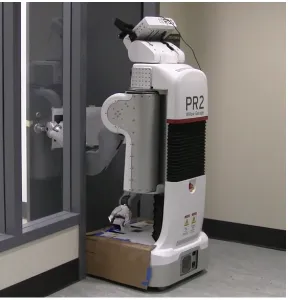
platforms abound. Two popular platforms, the Willow Garage PR2, with its holonomic
wheeled base and dual arms (for a total of 20-degrees-of-freedom), and the humanoid
HUBO, with 38-degrees-of-freedom, are shown in Figure 1.1.
Probabilistic sampling-based planning methods have come to the fore as a tractable
means of searching high-dimensional spaces. However, they have a cost: these methods
trade guarantees on solution completeness (with respect to geometric algorithms) and
optimality (with respect to search-based algorithms) for speed, and must settle for
probabilistic completeness guarantees. While RRT∗ and related works seek to recover
path optimality, they may only do so in an asymptotic fashion; as the number of
samples approaches infinity, they approach the optimal solution [56, 83]. Lately, there
(a) (b)
Figure 1.1: The Willow Garage PR2 (a) with 20-degrees-of-freedom and the Korea
Advanced Institute of Science and Technology (KAIST) HUBO (b) with
38-degrees-of-freedom are widely-used robotics platforms which require planners capable of handling many
Search-based planning is being applied to higher degree-of-freedom systems than ever
before, as will be discussed in Chapter 2.
Planning for navigation, whether for field robots or robotic manipulators, typically
involves planning through free space without additional constraints. Even in mobile
manipulation literature, the common paradigm is to plan to get an end-effector near
an object to manipulate, form the appropriate pre-grasp pose, approach the object
to grasp, then move with the object attached, again planning without constraints
[20, 22, 99, 111]. Other works have introduced constraints on manipulated object
poses [7, 9]. However, there are instances when planning for mobile manipulation
cannot be reduced to a series of open-chain planning problems. For instance, when
interacting with an object constrained by or attached to the world in some way.
Examples include opening doors and drawers, using levers and valves, and pushing
objects along a track.
1.2
Motivation and Contributions
This thesis will demonstrate that search-based algorithms are applicable to systems
with many degrees-of-freedom involving closed chains. The closed chains often arise in
the form of contacts with the world, such as in mobile manipulation. Towards that end,
we present a planning framework for search-based planning for mobile manipulators
with changing system topologies; the systems contain closed chains, open chains, and
doors and is used to motivate our approach to bipedal locomotion. Door opening is
an example of planning to manipulate an object along a constrained trajectory. Both
tasks involve making and breaking closed chains.
First, Chapter 2 will provide an overview of the current state of the art in
motion planning, planning for closed chains, and planning for mobile manipulation.
Hierarchical planners and motion primitive-based planners will be covered. The
algorithms involved span the gamut from deterministic, geometry-based planners to
random sampling-based planners with probabilistic completeness guarantees to
graph-based planners with their bounds on suboptimality of solutions. Additional literature
pertaining to applications in later chapters will be discussed in those chapters.
In this thesis, we use search-based-planning algorithms. Chapter 3 begins with an
overview of search-based planning, from Dijkstra’s algorithm up to modern motion
primitive-based approaches. This includes an overview of the A∗, Weighted A∗, and
Anytime Repairing A∗ algorithms. We discuss lattice-based graphs, connected by
motion primitives. Further, Chapter 3 provides descriptions of closed chains, systems
in which they are likely to appear, and what constraints they impose.
Chapter 4 introduces our planning framework for handling open chains, closed
chains, and transitions between them, all in a single planning instance, maintaining the
completeness and optimality guarantees which would have been lost or weakened in a
hierarchical planner. Theoretical guarantees are mentioned along with the necessary
provided.
Chapter 5 covers application of our framework to the task of opening spring-loaded
and non-spring-loaded doors using a mobile manipulator with a holonomic base. The
door is constrained by its attachment to the world via revolute joint and may only
move along a 1-D manifold, though it may move in either direction along that manifold.
The robot must move its base to open the door and pass through the doorway. It may
also switch between contacts with the door during planning and is allowed to contact
the door with either arm, the base, or nothing at all.
Finally, Chapter 6 describes our approach to walking for a humanoid. We detail
our control framework for the DARPA Robotics Challenge, specifically a balancing
controller which has been extended to support quasi-static walking. In the double
stance phase, the lower body forms a closed chain, while the single stance phase is an
open chain. Planning for the humanoid involves abstractions for the complexity of
kinematic chains from the pelvis to each foot. On that note, our planning framework
inspires our work on walking, but the system is complex and the required assumptions
and thus the guarantees of the framework do not apply directly. Our planning and
control are able to successfully negotiate difficult terrain with hills and scattered
Chapter 2
Literature Review
2.1
Background on Motion Planning
Motion planning difficulty depends on the dimensionality of the system and the
constraints on the motion. Exact algorithms, which guarantee a solution when one
exists and return failure when one does not, are limited to low-dimensional
config-uration spaces due to computational complexity. For instance, the most efficient
exact algorithm has exponentially increasing complexity in dimensionality [17]. When
considering the history of motion planning, we see that with exact methods
infea-sible, it was necessary to sacrifice exact completeness in order make the planning
problem tractable. Discretization of dimension and configuration parameters was
introduced. In general, algorithms based on an approximated cell decomposition of
discretization size. In fact, narrow passageways smaller than the discretization size
are guaranteed to be missed. Efficient heuristic algorithms have been developed based
on the potential field approach [58]; these perform gradient descent on the potential
field and may become trapped at local minima. Thus, the design of the potential
function is crucial, but difficult for non-convex and high-dimensional spaces. All of the
above approaches are applicable in practice to systems involving only a few variables,
typically four or less.
Sampling-based planners, satisfying a weaker form of completeness but capable of
handling high-dimensional configuration spaces, were introduced in the 1990s [57, 64].
These planners, probabilistic roadmaps (PRMs) and rapidly-exploring random trees
(RRTs) guarantee probabilistic completeness; the planners sample randomly (or
in a biased random fashion) from the configuration space. Such planners are not
guaranteed to find a solution if it exists, often the case in the narrow passage problem,
though variants have been introduced to handle such cases. There is also a drive to
derandomize the sampling to improve coverage properties [63].
Lattice-based planners, used in this thesis, allow for planning as graph search.
Such planners allow us to leverage results in graph search literature (A∗, D∗ and their
variants), previously applied to cell-decomposition methods. These methods have
recently been shown to be applicable to high-dimensional state-spaces, as discussed in
2.2
Planning for Generic Closed-Chain Systems
A number of planning methods exist specifically for closed kinematic chains. The
works discussed below address planning for closed chain systems consisting of rigid
links in 2-D (revolute and prismatic joints only) or 3-D (also includes ball joints).
Complete planners suffer from high computational complexity and difficult
im-plementations. Some works, such as [103], are complete, but the path returned is
not optimal by any metric. The cited work is valid for closed kinematic chains with
spherical joints and will use at most n−2 accordion moves to reach the desired configuration. The accordion moves are not optimal with respect to distance traveled
nor any other metric. These works do not handle self-collisions or obstacles. An
extension allowing point obstacles is limited to planar chains [67].
Early sampling-based methods for closed-chains were slow because the vast majority
of generated samples did not satisfy the loop-closure constraints and so were rejected.
A later sampling method, [112], applied to closed chains of a single cycle. It broke the
closed chains into sub-chains, one of which used standard random sampling techniques,
and the other which was populated using inverse kinematics to enforce the closure
constraints. This method was applied to mobile manipulators and employed a
two-stage PRM strategy. The first two-stage was generating a PRM for the manipulator at a
single base location, and the second stage was replicating the PRM at different base
locations and connecting them.
broken apart and gradient descent applied to minimize the sum of squares Euclidean
distances between joints that should be collocated to satisfy the kinematic closure
constraint. While samples could thusly be modified to satisfy the closure constraint,
this was a time-consuming endeavor. In [101], the authors propose planning with
reachable distances, precomputing and sampling directly from the subspace that
satisfies the closure constraints. Closed chain systems are represented as a hierarchy
of sub-chains; the corresponding reachable range of each can be computed using the
triangle inequality. The method can be applied to most sampling-based planners, such
as PRMs and RRTs. It has so far been applied to abstract chains in simulation.
The sampling-based works above have been applied to mobile manipulators, but
do not allow for constraints on the motion of a manipulated object. The geometric
methods have not been applied to mobile manipulation and cannot, for example,
account for nonholonomic constraints of a robot base.
2.3
Application to Mobile Manipulators
As a central idea of this thesis is planning for closed-chain systems with specific
application to mobile manipulation, we include an overview of other methods used in
that field.
The idea of decomposing the motion of mobile manipulators into mobility and
manipulation dates back to the first discussions of such systems in the 1980s. In [18],
and end-effector configurations were considered separately, and the optimization
problem was solved for a sequence of manipulator and base configurations which
minimized the cost function. Controls-based approaches have been used to drive a
robot base in a manner that enables following specified end-effector trajectories [35].
Given a path for the end-effector, a feasible path is planned for the base such that
the end-effector trajectory is always in the dexterous workspace. In this work, the
dexterous workspace is always projected onto the ground plane, ignoring the height.
Stability for the base and end-effector trajectory-following controllers is proven.
Finding the appropriate base position for manipulation tasks is not a trivial
problem. Some work has applied probabilistic methods like rapidly-exploring random
trees and probabilistic roadmaps to plan motions for mobile manipulators taking
inverse kinematics and base position into account. For instance, [77] addresses the
problem of motion planning along a specified end-effector path for a mobile manipulator
with a nonholonomic wheeled base and kinematically redundant manipulator. For a
given initial configuration, a path is assigned and a feasible solution generated using
probabilistic methods. Redundant variables are chosen in advance; when sampling,
values for these redundant variables are randomly generated, then the remaining
variables are solved analytically. The redundant variables may also be generated by
forward-integrating the equation of motion for the system using a random
pseudo-velocity. Unlike our work, there are no optimality guarantees and only probabilistic
Probabilistic roadmaps (PRMs) have been used to solve multiple-query problems
for mobile manipulators. Similar to RRTs, randomly sampled states are checked for
feasibility, then connections between states are evaluated for feasibility. Unlike RRTs,
a tree structure is not required; cycles are allowed and in fact add robustness. Work
has gone to speeding this process up by only evaluating necessary connections between
states (those required as the graph search is in progress), called Lazy PRM [11]. Lastly,
it has been recognized that the probabilistic sampling is often unnecessary, leading to
regularly-sampled versions, called LRMs [63].
In [104], solutions for dual-arm manipulation tasks are addressed for a fixed-base
robot. First, the robot’s reachability workspace is precomputed; it is represented
by voxels in 6-D pose space and each voxel contains a probability of successfully
answering an inverse kinematics (IK) query, i.e, solving for joint angles that produce
the desired end-effector pose. Gradient descent is used to find a local maximum
in the reachability space and combined with random sampling of free parameters.
Then RRT-based motion planning algorithms are applied, interleaving finding IK
solutions with searching for a collision-free trajectory. The work of [114] analyzes the
manipulator reachability by discretizing the workspace with a regularly spaced spheres.
On each sphere n-points are uniformly distributed, then frames are generated for each point on the sphere and serve as the tool center point for the inverse kinematics of
the robot. Cross-correlation is used to decide the best base location for carrying out a
the spheres. In this work, the trajectory is required to be completely contained in the
reachable workspace from a specific base location.
Berensonet. al introduce constrained bi-directional RRT for planning in
configura-tion spaces with multiple constraints [10]. Pose constraints are handled by projecting
sampled states onto configuration-space manifolds. The most common projection
tech-nique is the the Jacobian pseudo-inverse, in which the required workspace displacement
to place the configuration back onto the manifold boundary is first calculated, then
mapped into the joint space of the manipulator using the Jacobian inverse for square
Jacobians or the Moore-Penrose pseudo-inverse for non-square Jacobians. The planner
is able to handle moving heavy objects using sliding surfaces which support part of an
object’s weight. Dragging an object along a surface becomes an additional constraint
manifold; if the object is not near a sliding surface but is too heavy to be lifted by
the manipulator, the configuration is rejected. The advantage of our search-based
method over this is that we may use the constraints to reduce the dimensionality of
the state-space we are searching; the constraints enable a faster search.
CHOMP [92] is a trajectory optimization method that creates a naive initial
trajectory from start to goal (unconstrained, it does not need to be a feasible trajectory),
then runs a modified gradient descent on the cost function. The cost function typically
has two components, one which is a cost for points along the arm which increases
as they approach obstacles (this requires precomputation of a signed distance field)
to check the output of CHOMP for feasibility, i.e., being collision-free. The result of
CHOMP is dependent on the initial trajectory given, as it may get caught in local
minima. STOMP [54] is a similar approach which adds random noise to attempt to
avoid local minima.
In contrast, [98] presents a trajectory optimization method which combines
sequen-tial convex optimization with a novel formulation of the collision avoidance constraint
considering swept volumes. Rather than requiring precomputation of a signed distance
field for the environment, this work requires either an approximate convex
decomposi-tion or a simplified mesh. Results compare favorably to CHOMP and STOMP. The
work of Vernazaet al. focuses on identifying the low-dimensional Lagrangian structure
of physical systems and applying this knowledge to aid in high-dimensional motion
planning [105–107]. The algorithm learns and exploits the structure of holonomic
motion planning problems using spectral analysis and iterative dynamic programming
and is able to solve problems in higher dimensions than known methods for optimal
motion planning. The quality of solutions found compares favorably to those obtained
via sampling-based planning and smoothing.
RRT∗ is a recent development building upon RRT which converges to an optimal
path as the number of samples tends to infinity. It adds a cost function which is used
to calculate cost between vertices. When adding vertices to the tree, the edges are
rearranged such that each vertex is reached using a minimum cost path from the
degrees-of-freedom by combining RRT∗ with the Ball Tree Algorithm. Other attempts
to use probabilistic planners on costmaps include [6]. In this work, transitions to
an increased cost state were allowed with a probability that depended on a thermal
energy analog. When many subsequent expansions were rejected, the energy increased.
This work does not provide guarantees on path optimality, but has a tendency to
explore connected low-cost regions first and as such is appropriate for what the authors
deem cost space chasms, narrow regions of low cost surrounded by higher cost, often
of lower-dimensionality than the state-space and so unlikely to be found by naive
sampling.
Hierarchical planning schemes have been proposed to reduce complexity by
sepa-rating planning into smaller, simpler problems. Typically, a high-dimensional local
planner is combined with a low-dimensional global planner. The typical benefit of a
multi-level scheme is a significant reduction in planning time. Local planners have
been implemented using various techniques, including reactive obstacle avoidance [102]
and dynamic windows [15, 85]. While these types of planners can result in difficulties
with suboptimality and mismatches between the local and global levels, our approach
avoids these problems altogether by generating optimal plans in a low-dimensional
space that maps to much higher-dimensional optimal solutions. Our representation
has an additional advantage of incorporating a parameter to describe the contact
state of the mobile manipulator and object being manipulated, allowing one plan to
optimality.
2.4
Motion-Primitive Based Graph Planning
A key motivation of this thesis is to utilize lattice-based search for mobile manipulation.
The advantage of search-based plans is bounded solution suboptimality, as well as
determinism of solutions and completeness with respect to the discretization.
Searching motion primitive-based graphs has been applied to a variety of planning
problems in robotics, including navigation problems [65]. Specifically, this work
included planning dynamically-feasible maneuvers for vehicles at high speeds over
large distances. Motion primitives searches have also been used for planning trajectories
for UAVs [61, 68].
Formulation of motion primitives is key in [88]. In order to allow backward searches
such as D∗, it is necessary to make sure the motion primitives can be connected forwards
and backwards. Towards this end, they are constrained to begin and end on regularly
discretized grid-cell centers. Motion primitives are pruned to generate near-minimal
spanning action spaces by representing longer primitives as combinations of other
primitives when possible. The work has also been extended to handle dynamics [89]
by solving the corresponding two-point boundary value problem. The method has
been shown to be valid for low-dimensional systems like wheeled vehicles, and has
recently been extended to quadrotors [90].
high-dimensional problems, specifically manipulation problems [23]. Planning times are
lessened by combining informative but quickly computable heuristics (a Dijkstra
search over the voxelized 3-D workspace), a small number of motion primitives, and an
anytime, incremental graph search, Anytime Repairing A∗ (ARA∗). An extension [25]
incorporates motion primitives with variable dimensionality; these lower-dimensional
primitives move a subset of the joints and are only used when near the goal end-effector
position. Motion primitives which use inverse-kinematics to directly move from the
current position to the goal are also used when near the goal. Additional constraints
present in two-arm manipulation have been used to plan in a lower-dimensional
graph [24]. A similar approach is used by [21], but their system lacks the ability to
push and pull spring-loaded doors or make and break contact points with the doors.
More recently, experience graphs have used results from previous searches have been
incorporated to bootstrap solutions for new queries [86, 87].
Recent work has also been conducted on search-based planning with adaptive
dimensionality [38, 39]. This uses the intuition that while planning in full-dimensional
state-space is sometimes necessary, for large portions of the robot’s workspace it is not.
An adaptive-dimensional state-space and corresponding transition set is iteratively
constructed that that consists mainly of low-dimensional states and transitions, using
high-dimensional states only where necessary to ensure a feasible path. We incorporate
this approach in our work on mobile manipulation with closed chains.
algorithm [110]. Instead of planning for all robots in a configuration space containing
the union of all robot configuration spaces, each robot is planned for separately. The
configuration spaces are appended only if the robots are found to interact. In a process
termed subdimensional expansion, the algorithm searches a lower-dimensional graph
embedded in the full graph representing all the robots. Only when robots are found
to interact are higher-dimensional state transitions back-propagated.
In this thesis, we consider a variety of closed-chain mobile manipulation tasks,
including opening doors. This thesis represents the first work, to the author’s
knowl-edge, to incorporate transitions in system topology into search-based planning with
motion primitives. The additional constraints from closed-chains are used to reduce
system dimensionality in regions where the topology includes closed-chains, enabling
efficient search. In contrast with the works above, the planning framework herein
handles the transitions between open and closed chains in a single plan, including
what transitions to include and when to include them. It does so while maintaining
completeness and optimality guarantees over the entire plan, and the results share the
Chapter 3
Preliminaries
3.1
Graph Search
In this thesis, motion planning problems are represented by graph searches. Given a
finite graph, we need an efficient way to search it for a solution path. We will now
provide a brief review of graph search methods. We note that our planning framework
with its dimensionality reduction is independent of the graph search chosen, though
the specific guarantees of solution optimality do depend on the properties of the chosen
search method.
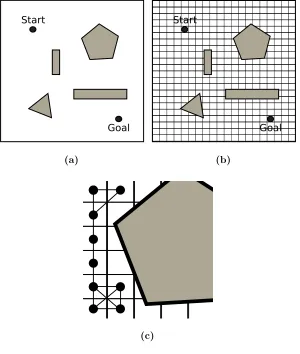
Depending on the search space, the easiest method for constructing a graph is to
discretize the state-space. For example, considering the 2-D search space in Figure 3.1,
we can easily uniformly discretize the space, yielding a grid. Each discretized state
Start
Goal
(a)
Start
Goal
(b)
(c)
Figure 3.1: A 2-D state-space example. A configuration-space map (a) is uniformly
to another. Each edge has a weight which corresponds to the distance between cells.
It is easy to envision using a 4- or 8-connected grid representation for the discretized
space, as shown in the close-up in Figure 3.1(c).
Regardless of underlying representation, we discuss the planning problem as a
graph, G= [S, T], where S is the vertex set and T is the edge set. We define a set of transitions T ={ai,j|si, sj ∈S}, whereai,j is a transition from state si to state sj.
Each transition is associated with a non-negative costc(ai,j), also written as c(si, sj).
The objective of the planner is to find the least-cost path in G from start state sstart
to goal state sgoal. Let π(si, sj) denote a path fromsi to sj, and let π∗(si, sj) denote
the least cost path. The path cost is the sum of the transitions along the path,
P
i,j∈πc(ai,j), denoted asc(π(si, sj)).
3.1.1
Dijkstra Search
Dijkstra’s algorithm [33] solves the single-source shortest path problem for a graph
with non-negative edge weights. The g-value of a given state, g(s), represents the current lowest cost path to reach that state. The search is initialized withg(sstart) = 0,
theOP EN set. The process repeats until g(sgoal) is updated. The least cost path can
be reconstructed by working backwards from the goal, always choosing the predicate
state with the lowest g-value plus transition cost. Visualized on a 4 or 8-connected grid, Dijkstra’s algorithm can be likened to a wavefront propagating outward from
the start location.
Dijkstra’s Algorithm
g(sstart) = 0, all other states set to g(s) =∞
OPEN = {sstart}
while g(sgoal) ==∞ do
remove s with smallest g(s) from OPEN
for each successor s0 of s do if g(s0)> g(s) +c(s, s0) then
g(s0) =g(s) +c(s, s0)
Insert s0 in OPEN if not already present
3.1.2
A
∗Algorithm
A∗ search is a popular graph search algorithm [46], improving upon Dijkstra’s algorithm
by utilizing a heuristic to focus the search toward the goal. The search introduces the
h- and f-values for a given state, where the h-value is the heuristic estimate of the cost to reach the goal and f(s) =g(s) +h(s). The search is very similar to Dijkstra, except (1) the state removed from the OP EN set each iteration is now the one with the lowestf-value and (2) thef-value is updated when theg-value is updated. The
h-values must be an underestimate of the least cost path from the current state to the goal (admissibility) in order to ensure that the algorithm returns the optimal path.
That is, for any two states where s0 is a successor of s, h(s)≤c(s, s0) +h(s0).
A∗ Algorithm
g(sstart) = 0, all other states set to g(s) =∞
OPEN = {sstart}
while g(sgoal) ==∞ do
remove s with smallest f(s) from OPEN
for each successor s0 of s do if g(s0)> g(s) +c(s, s0) then
g(s0) =g(s) +c(s, s0)
f(s0) = g(s0) +h(s0)
Insert s0 in OPEN if not already present
3.1.3
Weighted and Anytime Variants
The weighted version of A∗ works by biasing the sampling of new states toward the
goal. For a given admissible heuristic function, multiplying the heuristic by a constant
>1 and then performing the search as usual produces a solution with cost at most
times the least cost solution [82]. In many domains, using the inflated heuristic greatly reduces the number of states expanded by the search before finding a solution.
While A∗ is able to find optimal plans, it can fail to find solutions when deliberation
time is limited. Anytime planners, on the other hand, aim to find the best plan they
can in the time allowed [28]. A (possibly) highly suboptimal plan is found and then
improved and until either times runs out or the optimal solution is recovered.
In this thesis work, we have chosen to use an anytime heuristic search algorithm
called Anytime Repairing A∗ (ARA∗) [66]. The algorithm has control over the
property: it uses a loose bound to quickly find an initial solution, then tightens the
bound progressively as time allows. Given enough time, it arrives at the optimal
solution. ARA∗ reuses previous search efforts as it reducesand, thus, is more efficient than other anytime search methods. In comparison, a similar method called Anytime
A∗ does not control directly (aside from setting the maximum during the first search) [115]. Instead, it continues to expand and re-expand states after the first
solution is found by pruning states with f-values larger than the best cost solution so far.
3.2
Lattice State-Space
A state lattice, as described in [88], is a discretization of the configuration-space into a
set of states and the connections between those states. Unlike the simple 8-connected
grid representation of Figure 3.1, connections in the state lattice are required to be
feasible motions of the system. Thus, any solution found while searching a lattice
graph will also be feasible; the planner does not need to consider differential constraints
directly.
The searches of this thesis are applied to regular lattices of states. Regularly
sampled lattices provide translational invariance, in that a control or motion primitive
connecting two states arranged in a certain way will also connect all other pairs of
states arranged in the same way. Starting at a given location and applying the set of
a roadmap or graph containing all trajectories possible given the discretization and
choice of controls. The controls do not need to connect all adjacent states in the
discretized space, but it is required that the states they connect are separated by
multiples of the discretization value. These controls can be precomputed offline and
stored as a canonical set of allowed motions. Barring obstacles, these motions encode
the connectivity of the search space.
Motion primitives are defined as the smallest feasible motions that connect the
discretized states in the graph. When planning a kinematic path, they are defined
as small, kinematic displacements able to be tracked by the controller. Such is the
case in [23–25]. When planning a kinodynamic path, the primitives correspond to
known control inputs. Motion primitives can be designed by sampling the control
space. Most such works attempt to do so in such a way as to result in good sampling
in state-space in terms of discrepancy, dispersion or path diversity [13, 36, 44, 81].
In general, designing primitives this way is difficult due to the complexity of the
relationship between the robot’s control-space and state-space given the constraints
upon the system. Finding control inputs that drive the system from one state to
another can also be approached as solving a two-point boundary value problem for
systems where that is possible [88, 89].
Similarly to how the state-space is discretized, we can think of discretizing the
continuum of motions available to the system at a given state. This discrete set of
a wider variety of motion primitives and increased planning times. Smaller primitives
may help the planner find paths in narrow passageways, while longer primitives
may have faster planning times because fewer expansions are required. Ideally, the
action space for each state in the lattice would contain a sufficient variety of motion
primitives that every possible feasible path through the lattice could be constructed
by combining sequences of these actions. Realistically, including a large number
of primitives increases the branching factor of the graph to be searched and thus
negatively affects the time required for each expansion, which is proportional to the
total number of primitives. The best choice is often domain-dependent.
3.3
Closed Chains
A closed chain refers to a linkage whose kinematic structure contains one or more
cycles. Compared to an open chain of the same number of links, closed chains have
fewer degrees-of-freedom due to loop closure constraints. Namely, the product of all
frame transformations around the chain must yield the identity tranformation.
T1· · ·Tn =I
An open chain is considered kinematically redundant if it has more than the
minimally required degrees-of-freedom to span the space. For planar manipulators,
this value is 2; for spatial manipulators, it is 6. Consider a closed chain with one link
be able move; the valid motions of the closed chain comprise the self-motion manifold.
Internal motions are those motions along the self-motion manifold and must satisfy
J(θ) ˙θ =0
where J is the Jacobian and θ the vector of joint angles.
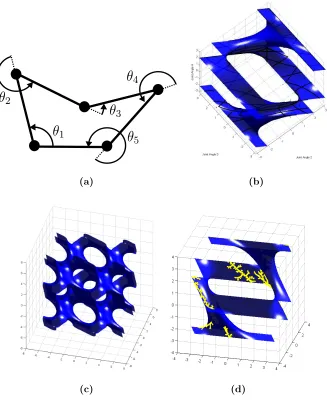
Consider, for example, a linkage consisting of 5-revolute joints with parallel axes
of revolution as shown in Figure 3.2(a). This planar 5-R linkage is kinematically
redundant and has 2 degrees-of-freedom taking the loop closure constraint into account.
If the linkage is equilateral, the configuration-space will look like Figure 3.2(b). For
visualization, the configuration-space has been plotted as a function of three of the
linkage joint angles, though it is actually a 2-D manifold. This manifold is the
self-motion manifold; any trajectory along it will satisfy the loop closure constraint.
Ignoring joint limits and self-collisions, the configuration-space can be endlessly
replicated, forming a complicated structure without discontinuity but with numerous
holes and thus many possible paths in different homotopy classes.
Because the space of valid configurations is a 2-D manifold, there is effectively no
chance of randomly sampling a valid configuration if sampling for all 5 joint angles.
There are methods that address this by breaking the closed chain into sub-chains and
only sampling for one of them. Because there are 2 degrees-of-freedom in this chain,
the active sub-chain will have 2 degrees-of-freedom and can use standard random
sampling techniques, while the passive sub-chain with 3 joints and will be solved using
(a) (b)
(c) (d)
Figure 3.2: Example showing the configuration-space of a planar, equilateral 5-R linkage
(a). The configuration-space is plotted as a function of the first three linkage joint angles.
The robot has two degrees-of-freedom and so the configuration-space is a 2-D manifold, with
black lines indicating stationary configurations (b). Ignoring joint limits and collisions, the
configuration-space can be replicated endlessly (c). Standard planning methods, such as
to sample directly in the space that satisfies the closure constraints [101] or to drive
the full-dimensional samples to the constraint manifold [6, 113].
In screw theory, a stationary configuration occurs when any k joint screws belong to a screw system of order less than k where k must be less than the number of joints in the chain and greater than 1 [60]. In case of the 5-R example, stationary
configurations occur when 3 or 4 of the joints are coplanar (though only 3 can be
coplanar if the linkage is equilateral). Stationary configurations are shown with black
lines in Figure 3.2(b). When 3 joints are coplanar, they have an instantaneous mobility
of 1, and the other two joints are constrained so they only have one independent
degree-of-freedom. Thus, if only those 2 joints were actuated, it would be impossible
to navigate the control singularity. When 4 joints are coplanar, the remaining joint is
transitorially inactive and cannot be used to control the robot through the singularity.
Thus, when actuating closed chains, choosing which joints to actively control and
which to make passive is very important.
Closed chains often arise in the form of contacts with the world, such as in mobile
manipulation. When such systems makes and break contacts, they transition between
open and closed chains. Bipedal walking is one example, in which the ground becomes
the link which closes the chain formed by the pelvis and legs. When a bipedal robot
is pushing against a wall with both hands, multiple closed chains arise; from each
hand to each foot, hand to hand, and foot to foot. All these chains are closed by the
Chapter 4
Planning Framework for Closed
Chains and Systems with
Changing Topologies
Motion primitive-based graph planning in high-dimensional systems is time consuming
as planning times increase exponentially with increasing dimensionality. This is
particularly a problem for mobile manipulation where the number of
degrees-of-freedom is quite large. In addition, contacts between the robot and the environment
result in the formation ofclosed chain linkages. A closed chain linkage is one whose
kinematic structure forms a cycle. Such cycles introduce complex kinematic constraints,
but can also be used to reduce the dimensionality of the planning problem. Examples
We propose a planning framework that handles systems with changing topologies,
working with open chains, closed chains, and transitions between them. We propose
abstracting away the complexity of closed chain systems to reduce the dimensionality
of the planning problem in state-space regions where the closed chains exist, and give
the conditions for completeness and optimality of solutions. For example, in the case
of motion constrained to a plane, we may replace the manipulator with a
two-degree-of-freedom linkage with two prismatic links but with a finite workspace and ignore the
specifics of the manipulator in the abstraction. More generally, complex constraints
associated with closed chains are replaced by abstractions that model the key aspects
of the contact with the environment, removing unnecessary degrees-of-freedom and
enabling switching between open and closed chain topologies within a single planner
for mobile manipulation.
Several theoretical results provide the justification for the method and guarantees
on optimality. The benefits of this planning methodology are verified through results
and statistics from simulations involving a mobile platform with a planar arm moving
an object along a plane. Applications to opening doors and walking are shown in
Chapters 5 and 6, respectively.
4.1
Abstractions for Closed Chain Systems
n-dof
(a) (b)
Figure 4.1: Example of an abstraction. Planning for an end-effector motion along a
constrained manifold (a) may be simplified by planning only for the base and end-effector
(b), then reconstructing the higher-dimensional path afterwards.
represent the set of configurations of the mobile base, Y ⊂ S1 ×S1 ×. . .×S1 the set of manipulator arm configurations, and Z⊂SE(3) the set of manipulated object configurations. W={0,1}may be used to indicate whether or not the manipulator is in contact with and constrained by the object or the environment. The standard
planning paradigm is to plan inSE(2)×Rn (where we have replacedS1 with
R), with
appropriate constraints on end-effector motion. However, in many settings, mobile
manipulation tasks may be encoded solely (but not uniquely) by the motion of the
object being manipulated and the motion of the base.
Indeed, for a redundant manipulator, there may be infinite motions for the arm
satisfying the end-effector motion. But it is clear that a sufficing plan can be found by
restricting the search toX×Zprovided that, for every sufficing plan, feasible motions
that this is feasible in general as long as the reachable arm configurations for a given
pair (X,Z) define a path-connected set, ensuring the existence of transitions between consecutive inverse kinematics solutions (see Assumption 1 later in this chapter). For
manipulators that do not satisfy this condition, and thus whose feasible configurations
are in disconnected sets, we must limit ourselves to one such set. In the case of an
n≤6 degree-of-freedom manipulator interacting with objects in SE(3), replacing the manipulator inRnwith the object motion inSE(3) does not reduce the dimensionality of the state-space. However, the proposed abstractions help in systems with n >6 or when n = 6 but the object motion is only in SE(2).
4.1.1
Planning Problem Formulation
We represent the full-dimensional planning problem as a graph, Gf = [Sf, Tf], where
Sf is the vertex set and Tf is the edge set. Let us define the full-dimensional (of
dimensionality h) discretized finite state-space Sf as the 3-tuple (X,Y,Z), where X∈X,Y∈Y,Z∈Z. As in Figure 4.1, X⊂SE(2) is the set of configurations of the
mobile base, Y⊂Rn the set of manipulator arm configurations, and Z⊂SE(3) the
set of manipulated object configurations. We emphasize that Y is finite, containing
all valid manipulator configurations associated with positions chosen from Xand Z.
We define a set of transitions Tf = {af i,j|s
f i, s
f
j ∈ Sf}, where a f
i,j is a transition
set Sf and edge set Tf. The objective of the planner is to find the least-cost path in
Gf from start state sfS to goal state sfG. Let π(sfi, sfj) denote a path from statei to state j, and letπ∗(sfi, sfj) denote the least cost path. The path cost is the sum of the transitions along the path, P
i,j∈πc(a f
i,j), denoted as c(π(s f i, s
f j)).
We note that the 3-tuple Sf is over-defined when an object is attached to the manipulator; {(X,Y)|X ∈ X,Y ∈ Y} maps to a unique Z ∈ Z using the forward kinematics mapping f:
f(X,Y) =Z.
In this thesis, we use a lattice-based graph representation to define the transitions
between states, allowing motion planning problems to be formulated as graph searches,
as discussed in Chapter 3. Lattices are well-suited to planning for constrained robotic
systems because, unlike other graph-based representations such as n-connected grids, the feasibility requirement ensures that any solutions found using a lattice will also be
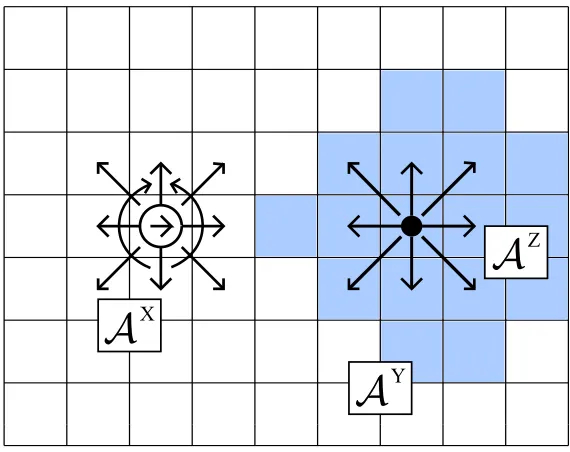
feasible. We define a set of motion primitives as a set of precomputed kinodynamically
feasible atomic actions. See Figure 4.2 for an example. We define a transition from
the set Tf to be the result of a motion primitive applied to a state sf. Let AX be
the set of motion primitives for X⊂SE(2) and AZ the set of motion primitives for Z⊂SE(3). LetAYbe the set of corresponding motion primitives ofY⊂Rnthat make
the transition in X,Z feasible when the manipulator is grasping an object. AY are defined as relative displacements and are dependent on the starting arm configuration
X
Y
Z
A
A
A
Figure 4.2: Example motion primitives for a mobile manipulator attached to an object. AX
is the set primitives belonging to a mobile base withX= (x, y, θ) constrained to move along
an 8-connected grid or turn in place. AZ is the set belonging to an object with Z= (x, y),
constrained to move on an 8-connected grid. In this case,AY is the set of arm motions which
keep the end-effector on the object during all transitions chosen from the feasible portion of
freely. In the full-dimensional state-space, we define a motion primitiveaf as a 3-tuple
member of the set Af(Y) = {(aX, aY, aZ)|aX ∈ AX, aZ ∈ AZ, aY applied to Y enables (aX, aZ)}.
4.1.2
Reduced-Dimensional Graph
Let us also define a reduced-dimensional (of dimensionality l) discretized finite state-space Sl as the 2-tuple (X,Z). The crux of this work is that we may also represent
the same mobile manipulation motion planning problem as a graph on the
reduced-dimensional state-space Gl = [Sl, Tl], where Sl is the vertex set and Tl is the edge set.
Sl is a projection ofSf onto the lower-dimensional manifold. We define a many-to-one
mapping γ : Sf → Sl, in which γ((X,Y,Z)) = (X,Z), dropping the manipulator configuration Y. We also define the inverse mapping γ−1 :Sl → Sf, a one-to-many
mapping. When an object is grasped by the manipulator,
γ−1((X,Z)) ={(X,Y,Z)|Y∈Y, f(X,Y) = Z}.
Otherwise, when no object is grasped (i.e., the manipulator forms an open chain),
γ−1((X,Z)) = {(X,Y,Z)|Y∈Y}.
There is also a many-to-one mapping ϕ:af →al, whereal is a 2-tuple of the set
Al
(Y) = (aX, aZ)|aX ∈AX, aZ∈AZ,
We require that edge costs be such that for every pair of states
c(π∗(sfi, sfj))≥c(π∗(γ(sfi), γ(sfj))) (4.1.2)
The least cost path between any two states in the high-dimensional state-space is
at least the cost of the least-cost path between their images in the low-dimensional
state-space. The transition cost in the high-dimensional graph is
c(π(sfi, sfj)) =c1(π(sfi, s f
j)) +c2(π(sfi, s f
j)) (4.1.3)
the sum of two terms that are not interrelated. The first term in Equation 4.1.3 is
also the transition cost function of the lower-dimensional state-space; it is a function
of only X, Z, aX, andaZ. The additive second term is a positive cost as a function of Y and aY.
4.1.3
Algorithm
The overall algorithm is to construct and search the reduced-dimensional graph for
a least-cost path from start to goal, then use that path to reconstruct one of the
corresponding least-cost full-dimensional paths. This decouples the planning for the
manipulator from the planning for the mobile platform. Reconstruction is done by
traversing the path in the lower-dimensional space. Beginning with the first state, aY
any aY that producessf2 and satisfies Equation 4.1.1 is selected (either by planning or interpolation of inverse kinematics solutions).
When constructing the reduced-dimensional graph, we must verify the existence
of some aY such that (aX, aY, aZ)∈ Af(Y) . This check can either be done using an
inverse kinematics query at plan time, or done in advance as a precomputation (which
is our chosen option). The precomputation is also used eliminate transitions with
self-collisions. When constructing the graph during planning, we also must check
transitions for collisions with the world. It is worth noting that both the high- and
low-dimensional graphs include explicit transitions between grasping and not grasping
an object.
ConstructFullDimPath(π∗(sl
start, slgoal))
setsfstart to initial robot configuration
while sl
n6=slgoal do
compute Yn using IK seeded with Yn−1 setaY=Yn−Yn−1
n=n+ 1
if transition (aX, aY, aZ)∈Af(Y), thencontinue else compute aY using arm planner
4.1.4
Theoretical Properties
We proceed to show that a graph search on Gl is sound, complete, and optimal. First, for convenience, let us define σ:π(sl
i, slj)→π(s f i, s
f
j), which maps a path in the
lower-dimensional state-space to a set of corresponding paths in the higher-dimensional
Assumption 4.1.1. We assume that when the manipulator is connected to the object,
the setYof feasible manipulator arm configurations for a given lower-dimensional state
sl
i occupies a path-connected set. For manipulators that do not satisfy this condition,
and thus the feasible configurations are in disconnected sets, we limit ourselves to one
such set.
That is, for any given sli = (Xi,Zi), any corresponding feasible Yi can be reached
from any other feasible Yj. Y forms a fully-connected set, though the connections are
not required to be enumerated as part of aY ∈AY. When no object is grasped in the manipulator,Y contains all possible manipulator configurations.
Theorem 4.1.2. Soundness. Any path π(sli, slj) in Gl can be executed in the full-dimensional space. That is, every π(sli, slj) corresponds to at least one path π(sfi, sfj)
given by σ(π(sl i, slj)).
Proof. As our base case, we know the starting configuration may be mapped to the
full-dimensional space. Assume the mapping σ exists and has produced π(sfi, sf n),
with j > n > i, terminating in (Xn,Yn,Zn). From the lower-dimensional path, we
have al
n,n+1 = (aXn, aZn) and snl+1 = (Xn+1,Zn+1). By Equation 4.1.1, there exists anaY such that for some starting configuration (Xn,Yj,Zn), there is (aXn, aY, aZn)∈Af(Yj).
However, Yj may not be equal to Yn. Assumption 1 maintains that Yj and Yn are
path connected, so we may transition from Yn to Yj. Then, by definition, applying
Theorem 4.1.3. Completeness. If there exists a path π(sfi, sfj) in the Gf, then there
exists a corresponding path π(sli, slj) in Gl.
Proof. As our base case, we know the starting configuration may be mapped to the
lower-dimensional space by dropping the Y component. Assume the mapping σ−1
exists and has produced π(sl
i, sln), withj > n > i, terminating in (Xn,Zn). From the
full-dimensional path, we have afn,n+1 = (aXn, aYn, aZn) and sfn+1 = (Xn+1,Yn+1,Zn+1). The existence of aln,n+1 = (anX, aZn) is indicated by Equation 4.1.1, because aYn exists. Applying al
n,n+1 to sln results in the retrieval of the next state sln+1 = (Xn+1,Zn+1). Thus, by induction, the entire corresponding path is given by σ−1(π(sf
i, s f j)).
Theorem 4.1.4. The cost of a least-cost path from start to goal in Gl is a lower
bound on the cost of a least-cost path in Gf.
c(π∗(slS, slG))≤c(π∗(sfS, sfG))
Proof. Theorem 2 established that the pathπf∗(sfS, sfG) can be mapped onto the lower-dimensional state-space Sl. Given the restrictions on edge costs in Equation 4.1.2, the
costs of any transition in Gl are bounded from above by the cost of any transition it maps to in Gf. Thus, with all transitions comprising the path bounded from above,
the cost of a least-cost path from start to goal in Gl is a lower bound on the cost of a
least-cost path in Gf.
into the higher-dimensional state-space σ(π∗(sl
S, slS)), is also (one of ) the optimal cost
path(s) c(π∗(sif, sfj)) in Gf.
Proof. Theorem 4.1.2 established the mapping π(sfi, sfj) = σ(π(sl
i, slj)). Because
transition costs are independent of Yand aY, and because the full-dimensional states and transitions are mapped to the reduced-dimensional system by dropping only the
Y andaY terms, the costs remain unchanged. Thus, the lowest cost path in Gl is one
of multiple lowest cost paths in Gf due to the multiplicity of the mapping.
By similar arguments, the paths inGl that are-suboptimal (are of at most-times
the cost of the least-cost path) are guaranteed to map to-suboptimal paths in Gf. This result is important when using -suboptimal searches like Anytime Repairing A∗, used in the experiments in this chapter.
4.2
Proof of Concept
To demonstrate the benefits of our method, we test extensively in simulation on a
system like that shown in Figures 4.1 and 4.2. We use a mobile base (X⊂SE(2)) with an n-degree-of-freedom planar arm (Y⊂Rn) to move an object around the ground
plane (the object has no notion of directionality, so Z ⊂ R2). The configuration
space has been inflated so the robot and object can be represented as points. The
manipulator may attach and detach from the object, switching between open and
omnidirectional wheels; the planar arms make contact with the cylinder at a height
greater than the height of any world obstacles. Thus, obstacles can collide with the
mobile base and the object being moved, but not with the arms. When the arm makes
contact with the cylinder, we assume it is rigidly attached.
Any state in the full-dimensional state-space is given by
sf = (xr, yr, θr
| {z }
X
, θ1, . . . , θn
| {z }
Y
, xo, yo | {z }
Z
, m
|{z}
W
)
where (xr, yr, θr) ∈X is the mobile base pose, (θ1, . . . , θn) is the joint angles of the
arm, (xo, yo) ∈Z is the cylinder location, and m is a binary value indicating if the
object is attached to the manipulator. A state in the reduced-dimensional state-space
is given by
sl= (xr, yr, θr
| {z }
X
, xo, yo | {z }
Z , m |{z} W )
4.2.1
Implementation
The goal of the planner is to get the object to a desired location on the 2-D grid.
The robot must navigate to the object, attach it to the manipulator, then move it
along the plane to the goal while avoiding obstacles. There is no fixed goal for the
location of the robot base. The heuristic function used to guide the search is the
distance between the robot and object plus the distance between the object location
and the goal. When the robot is connected to the object, only the latter is used. Both
distances are calculated for the entire map during precomputation using 2-D Dijkstra
The cost function is:
c(ali,j) = (ccostmap(aX,X) + 1)(cmovement(aX) +cobj(aZ,Z))
where ccostmap(aX,X) represents the maximum cost cell traversed during the transition,
cmovement(aX) the cost associated with moving the robot, and cobj(aZ,Z) the cost
associated with moving the object. The cost is independent of manipulator motion,
satisfying Theorem 4.1.5. The units for the cost functions are seconds; the movement
cost for forward or backwards motion is the distance divided by nominal velocity of
the robot and the cost for turning in place is the angular distance divided by the
nominal angular velocity. The cost for moving the object is similarly a distance divided
by nominal velocity for the object (one could think of it as the speed at which the
object may be moved without tipping). The costmap is unitless with a value of 0 for
unoccupied space and 254 for the obstacles themselves.
A valid configuration of the arm, Y, when not connected to the object is any
configuration not in self-collision. A validYwhen connected to the object must satisfy
the (X,Z) pair. Such pairs are constrained such that the object is at least one arm link length distant from the base, but no more than the total length of the arm. The arm
is assumed to be above the height of the obstacles and so cannot collide with them.
This, coupled with the distance constraint, satisfies the path connectivity requirement
of Y.
The reduced-dimensional lattice is constructed using 12 motion primitives, of which
for forward and backwards movement. The robot arm is allowed to connect to the
object, but not to disconnect from it. ARA∗ is first run on the reduced-dimensional
state-space representation, initially with suboptimality bound = 5.0 and continued until= 1.0. Full-dimensional paths are generated by populating the arm joint angles using inverse kinematics (using an iterative method, seeded with the previous state’s
joint angles). If the interpolation fails to connect two solutions without self-collision, a
random arm configuration is generated, checked for collision, then used as the seed for
the inverse kinematics call. This method succeeded in generating a full-dimensional
path in all trials.
4.2.2
Results
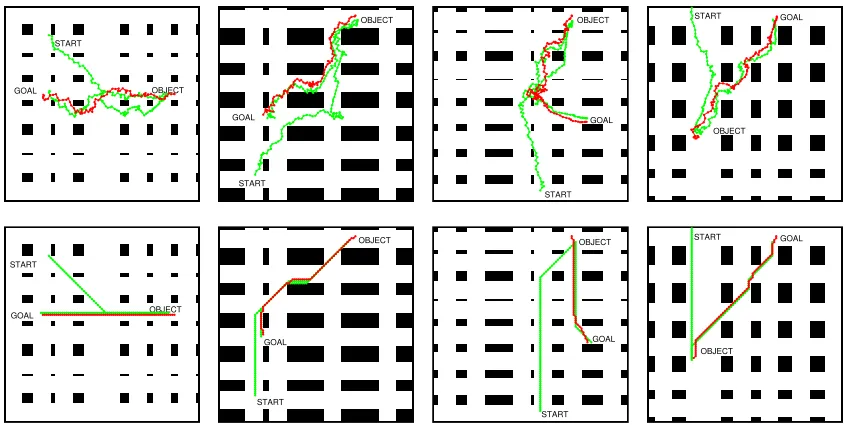
We tested the graph planner with closed chain abstractions on 100 randomly-generated
maps of size 100 by 100 cells, 10 cm on a side. 50 of these were pseudo-outdoor
environments (random circular obstacles) and 50 were pseudo-indoor environments
(grid obstacles). Robots with planar arms of 3 or 10-links were used; the 3-link arms
had link lengths of 10 cm, while the 10-link arms had link lengths of 4 cm. The graph
planner results were compared against those found by a sampling-based planner,
RRT [57, 64]. The RRT was implemented as two successive searches; the first (S1) was
to bring the robot end effector into contact with the object and the second (S2) to
move the robot end effector, now with object attached, to the goal location. The RRT